




Abstract
Over the past two decades, there has been a wide-ranging debate about the impact of citizenship education on young people’s political engagement and participation across Britain. Using data from a survey of 1025 young people aged 18 years at the time of the 2010 General Election, we examined the impact that studying for a formal qualification in General Certificate of Secondary Education in Citizenship Studies has on young people’s political and civic engagement. Drawing from the hypothesis that those young people who took the course would be more engaged than those who did not, results demonstrated that there are many differences between the two groups in terms of their political perspectives as well as their past and future patterns of political participation.
Introduction
Since the turn of the new Millennium, scholars and politicians have been concerned about the apparent withdrawal of citizens from democratic participation across a range of established democracies (e.g. Norris, 2001; Furlong and Cartmel, 2011; Torney-Purta and Amadeo, 2013; Albacete, 2014; Henn and Foard, 2014; Kisby and Sloam, 2014; Sloam, 2014; Bechtel et al., 2015; Fesnic, 2015; O’Toole, 2015; Henn and Oldfield, 2016; Keating and Janmaat, 2016). In particular, attention has often centred on young people, whose levels of electoral and party engagement tend to be lower than that of the population in general, and indeed of previous youth generations (Henn and Foard, 2012b). However, studies have also revealed that despite their seeming lack of interest in formal political activities, young people are attracted to, and often engage in, informal and alternative modes and styles of participation in political life (O’Toole, 2015).
The underlying factors associated with, and shaping, young people’s political values, attitudes and patterns of political behaviour are complex. Political socialisation, defined as the transmission of political culture to new generations of citizens in a given society (Almond and Verba, 1963), encompasses five key agents, including the mass media, the family, peers, voluntary associations and schools (Amnå, 2012; Quintelier, 2013). Of these, school experience has been found to exercise particular influence on the development of young people’s democratic knowledge and political literacy skills, of building an informed young citizenry, and of preparing them for participation in democratic life (Print, 2007; Dassonneville et al., 2012; Kisby and Sloam, 2014). Furthermore, research demonstrates that the best available predictor of adult voting and democratic engagement is participation in formal courses in civics or citizenship education (Niemi and Junn, 1998). Of particular significance, studies indicate that the effects of civic education are long-term, and also that the civic skills and political values acquired in schools are retained into adulthood (Torney-Purta, 2004; Hooghe and Wilkenfeld, 2007).
Despite the considerable body of research into the subject of citizenship education in different national settings (e.g. Alexander et al., 2012; Garratt and Piper, 2012; Henn and Foard, 2012a; Jerome, 2012; Patterson et al., 2012; Burton et al., 2015; Geboers et al., 2015; Knoester and Parkison, 2015; Lin, 2015), there remain unanswered questions concerning its impact in Britain, and specifically the influence that studying for a formal qualification in the General Certificate of Secondary Education (GCSE) in Citizenship Studies (CS) exerts on young people’s political engagement. 1 For example, are young people who study the GCSE CS at school more inclined to vote than others who do not? Do GCSE CS students hold different views about, and levels of faith in, politicians and political parties when compared with young people who did not take this course?
This article comprises two main sections to address this gap in knowledge. First, there is a critical examination of the literature that centres on the concept of citizenship education. This will consider how the concept is defined, the implementation of citizenship education in schools, what the current debates are concerning the issue of citizenship education, and what the challenges are in turning citizenship education into an effective tool for promoting young people’s civic and political participation. In the second section, we analyse the results from a representative online national survey of 1025 British 18-year-olds conducted in 2011, to examine whether or not there are differences between those young people living in England who completed the GCSE CS and those living elsewhere in Britain who did not, in terms of their political engagement and general political orientations. According to the existing literature on youth political engagement and CS (e.g. Keating and Janmaat, 2016), it is expected that young people who studied for the GCSE CS course at school will be more politically engaged than those who did not.
Citizenship education
The term ‘citizenship education’ has emerged as one of the main themes in recent British political discourse in response to contemporary concerns about civic disengagement, diminishing interest in formal politics, and pessimistic projections of active citizenship among the future generations (Henn and Weinstein, 2006; Kisby, 2007). Additionally, previous studies (e.g. Print and Coleman, 2003; Fahmy, 2004; Henn et al., 2007; Kisby, 2009) link concerns about perceived declining rates of social capital (Putnam, 2000) with the need for citizenship learning in schools. Evidence also suggests that higher levels of social capital are associated with greater citizen engagement in democratic politics (Gibson and McAllister, 2012). This is often expressed in terms of voter turnout at elections, volunteering in social groups and the contacting of other citizens on issues of common concern. However, these formal methods of participating in civic and political life are in decline, and this is particularly evident with respect to young people’s ongoing electoral abstention (Henn and Foard, 2014; O’Toole, 2015). Therefore, there may be a role for citizenship education in boosting social capital for the purposes of stimulating civic and political engagement. This rationale underpinned the UK Government’s decision to introduce statutory citizenship lessons in schools in 2002 to address what was perceived as an ongoing decline in levels of social capital (Kisby, 2012; Kisby and Sloam, 2012).
Additionally, recent studies indicate a range of social and educational variables shaping young people’s political outlook and behaviour. Henn and Foard (2014) have suggested that gender, social class, ethnicity and particularly educational career each appear to have a bearing on youth political engagement. Glanville’s findings strongly suggest that instrumental extracurricular activities (such as debating and drama, government and political clubs, student councils as well as youth organisations in the community) increase political participation in early adulthood (Glanville, 1999). School community service has also been identified as a strong predictor of adult voting and volunteering (Hart et al., 2007). Finally, the length of time in full-time education is also likely to have an important bearing on political outlook. In particular, experience in higher education is likely to lead to exposure to forms of political socialisation not available to other young people (Flanagan et al., 2012; Henn and Foard, 2014).
According to Davies (2014), citizenship education is crucial to processes of civic regeneration. As stated by Kisby and Sloam (2014), ‘it offers a means for connecting young people to the political system, helping them to make sense of a complex political world, and thereby strengthening democracy’ (pp. 52–53). As such, any citizenship curriculum should seek to develop young people’s understanding of democracy, government, and the rights and responsibilities of citizens. It should
[Provide] students with knowledge and understanding of political ideas and concepts, and local, regional, national and international political processes and institutions; develop students’ skills, to enable them to engage in decision-making, critical thinking, debate, and to participate in civic and political activities; and, instil in students values which make it likely they will want to engage in British democracy. (Kisby and Sloam, 2014: 53)
Citizenship education and the National Curriculum in England
Citizenship education was introduced as a statutory subject into the National Curriculum of English secondary schools in September 2002 (Kisby, 2012; Tonge et al., 2012), providing all pupils aged 11–16 years in maintained schools an entitlement to citizenship education. The inclusion of citizenship classes in schools was triggered by the report of the Advisory Group on Citizenship (AGC), Education for Citizenship and the Teaching of Democracy in Schools, published in September 1998; its vision was to initiate a transformation in the political culture, both nationality and locally, ‘for people to think of themselves as active citizens who were willing, able, and equipped to have an influence in public life’ (Crick, 1998: 7). Additionally, a similar vision was identified in the latest framework document (December 2014), from the National Curriculum in England, where the purpose of citizenship education was stated as providing pupils with knowledge and skills to explore social and political issues critically, to be able to debate, and to make reasoned arguments (Department for Education, 2014).
The establishment of the AGC was prompted by growing concern about declining youth participation in civic and political life and, in particular, ongoing electoral abstention by younger age groups (Keating et al., 2010). Citizenship education was identified as a critical measure to help tackle the issue, and the report advocated a ‘three-pronged approach to citizenship education, covering: knowledge and understanding; skills of enquiry and communication; and participation and responsible action’ (House of Commons, 2007). Consequently, the final recommendations of the AGC and the National Curriculum framework sought to address these concerns in the aims, outcomes and design of the new Citizenship curriculum. Moreover, since the political literacy strand was first identified, citizenship education has evolved considerably. In particular, more emphasis has been placed on dealing with identity, diversity and community cohesion, and on encouraging children and young people to participate more in their schools and in their local communities (Qualifications and Curriculum Authority (QCA), 2007). Increased interest in the former was reflected in the revised guidelines for Citizenship in the new National Curriculum in 2008 and in the introduction of a duty for schools to promote community cohesion (DFES, 2007). However, there are various critiques of the AGC report. For example, Kisby (2009) examined the impact that the concept of social capital has on the citizenship education initiative in England through its influence on the content of the policy as embodied in the report of the AGC. He argued that the model of citizenship put forward by the AGC is situated within the context of an uncritical acceptance of the boundaries prescribed by neo-liberal economic orthodoxy, which inevitably weakens the community attachments that the citizenship education policy seeks to promote.
Effective education for citizenship is defined in the report of the AGC in terms of ‘social and moral responsibility, community involvement and political literacy’ (Crick, 1998: 13). The social and moral responsibility aptitude was designed to help achieve learning self-confidence and socially and morally responsible behaviour both in and beyond the classroom – towards those in authority and to each other. The community involvement dimension intended to support the accomplishment of learning about, and becoming involved in, the life and concerns of students’ communities. Finally, it was anticipated that through political literacy, young people would learn about the institutions, problems and practices of democracy, and how – through the skills, values and knowledge that they acquired – they might more effectively contribute to the life of the nation, their region and their locality. The report also argued for flexibility in delivery of citizenship, taught either as a distinct subject or as a cross-curricular subject through other subjects, including personal, social and health education, history, geography and religious studies (Crick, 1998).
There is also significant attention needed with respect to the question of what is meant by effective citizenship education (Kerr, 2000; House of Commons, 2007). One of the difficulties facing practitioners in this field is how to maintain pace with, and respond positively to, changes unfolding in contemporary societies. In many countries, there is growing concern about an apparent deepening disconnect between young people and democratic politics and institutions and, in particular, with the signs of their ongoing lack of interest and non-participation in political life. Effective citizenship education in schools is considered as crucial to addressing this concern (Kerr, 2000; Hoskins and Kerr, 2012). However, there remains considerable debate as to what is meant by the term ‘effective’ and how it can best be assessed and achieved.
In his review of citizenship education across Europe, Kerr (2000) highlights eight common and critical challenges faced by such programmes. These comprise (1) achieving a clear definition, (2) securing curriculum status, (3) teacher preparedness and training, (4) adopting suitable learning approaches, (5) resources and sustainability, (6) assessment arrangements, (7) developing and sharing good practice and (8) influencing young people’s attitudes. It should also be noted that many of these issues are interrelated. Furthermore, some authors have stated that there is evidence that young people who have taken citizenship education in the United Kingdom also demonstrate higher levels of civic knowledge and skills than those who have not studied such courses (Henn et al., 2007; Print, 2007; Keating et al., 2010; Kerr, 2014). Similar results have been found in other countries, including Australia (Lindström, 2010), the United States (Patterson et al., 2012), Israel (Court and Abbas, 2010) and Scotland (Brown, 2012).
Rethinking citizenship education
Notwithstanding the benefits claimed by some to follow from such teaching and learning, Biesta and Lawy (2006) identified three problems with the notion of citizenship education. The first is that citizenship education is largely aimed at individual young people – the hypothesis being that they, as individuals, lack appropriate levels of knowledge and skills, the right values and the correct dispositions to be the citizens that they should be. In other words, citizenship is depicted as a capacity or capability, based upon a particular set of knowledge, skills and dispositions, and understood in terms of individual responsibility and choice, and not taking into account someone’s community context. The second problem concerns the assumption that citizenship can be understood as the outcome of an educational trajectory. Here, the idea of citizenship as outcome reveals a strong instrumental orientation in the idea of citizenship education, and the authors challenge this assumption. Third, Biesta and Lawy argue that there is no guarantee that at the end of the course, students’ understandings of the citizenship ideas and concepts will match the intended learning outcomes. Finally, several authors claim that the problem of citizenship is not about young people as individuals but about young people in context; where they are apparently unwilling to become active in social and political life, this is less about lack of understanding of citizenship issues, and more to do with young people feeling both let down by politicians, and that there are no meaningful opportunities for them to influence the political world around them (Kerr, 2000; Biesta and Lawy, 2006; Henn and Foard, 2014).
It has also been argued (Kerr, 2000; Jones, 2007; Biesta et al., 2009) that there should be a strong focus on the participatory element of citizenship education – on experiential learning, and on extending citizenship education beyond the classroom and into the community. Central to this position is the collaborative role that schools and non-governmental organisations can play in building school-community partnerships that extend beyond traditional sectarian boundaries supporting citizenship education and active citizenship (Ilcan and Basok, 2004). Therefore, civic education curricula can implicitly act as the agency of political structures and their reproduction, not only in what is taught but also how it is taught (Biesta et al., 2009; Haste, 2010).
A recent report undertaken by the Youth Select Committee (2014) during 2013 and 2014 recommended that the UK Government invest ‘in new initial teacher training places for dedicated citizenship teachers, with a view to ensuring that all citizenship lessons are taught by citizenship specialists by 2020’ (p. 34). This reflects suggestions proposed in other studies (e.g. Jones, 2007; Biesta et al., 2009; Kerr, 2014; Whiteley, 2014). The report also suggested that political education should be a compulsory element structured within the school curriculum for all young people. It should offer information on key formal political activities – such as how to vote, how to register to vote, how to contact elected politicians, information on different types of elections and the different positions of political parties (Youth Select Committee, 2014). Furthermore, the Committee recommended a review of politics and citizenship education in schools which would evaluate the potential benefits of introducing compulsory politics as a stand-alone subject in the GCSE. The Department for Education (DFE) published a revised National Curriculum on 11 September 2013 for first teaching from September 2014, suggesting that Citizenship programmes of study must be taught to pupils at Key Stage 3 (age 11–14 years) and Key Stage 4 (age 14–16 years), with schools deciding how to organise their curriculum to address these statutory teaching requirements (Department for Education, 2014).
Alongside the debate concerning citizenship education, there are still issues to be examined concerning the impact of such study on young people’s participation in civic and political life. However, after the Government’s revision of the National Curriculum in 2013, the Secretary of State for Education declared that although citizenship education would be maintained as a statutory subject at secondary school level, in practice it was revised and reduced (Kisby and Sloam, 2014). However, according to Kisby (2014), there has been some concern expressed by citizenship education campaigners regarding the fact that the new reduced citizenship curriculum is ‘very problematic, underpinned by a highly individualised, consumerist agenda – focusing on teaching about personal finance and financial services and products but not providing students with knowledge about public finance and economic decision making more broadly’ (p. 7). Additionally, although citizenship was retained as a GCSE qualification for optional study, the Assessment and Qualifications Alliance (AQA) are not planning to offer an Advanced Level qualification for the subject in 2017 (AQA, 2016).
Aims and objectives of this study
To date, despite the various studies into the topic of citizenship education (e.g. Tonge et al., 2012; Kisby and Sloam, 2014; Abe et al., 2015; Knoester and Parkison, 2015), there is still a need to better understand the impact that studying for a formal qualification in GCSE CS – which is currently only available for study in England – has on young people’s political and civic engagement. The main aim of this study is therefore to examine young people’s patterns of political engagement and general political orientation, and whether these reflect study in CS. Our approach reflects the existing literature on youth political engagement and citizenship education (e.g. Print, 2007; Keating et al., 2010; Whiteley, 2014), and hypothesises that those young people who took the GCSE in CS were more politically engaged than those who did not take the course.
Methods
To examine this hypothesis, quantitative data from a study conducted by one of the authors in 2011 was created. 2 This was derived from a national, representative online survey of 1025 young people aged 18 years living in England, Scotland and Wales in May 2010. Using this sample enabled the authors to compare the views of young people living in England who completed the GCSE CE with those of other young people across Britain who did not take the course – whether living in England (who had opted not to take the course), or in Scotland and Wales who were not eligible to take the GCSE CS. The survey was conducted during April and May 2011, one year after the 2010 UK General Election; this was important because we wanted to assess the views and reactions of this particular age group after they had been granted their first opportunity as newly enfranchised citizens to gain experience of life under a new government – regardless of whether or not they had opted to vote in the election.
Participants
The sample (n = 1025) comprised slightly more males (51.5%) than females, and the overwhelming majority of the participants were 19 years old (18 years at the time of the preceding 2010 General Election). Over four-fifths of the sample (83.8%) reported being White British. Slightly more than half (57.3%) remained in full-time education at the time of the survey, and 22.3% of the participants left full-time continuous education when they were 17 or 18 years of age. A summary of key socio-demographic variables can be found in Table 1.
Sociodemographic characteristics of the sample.
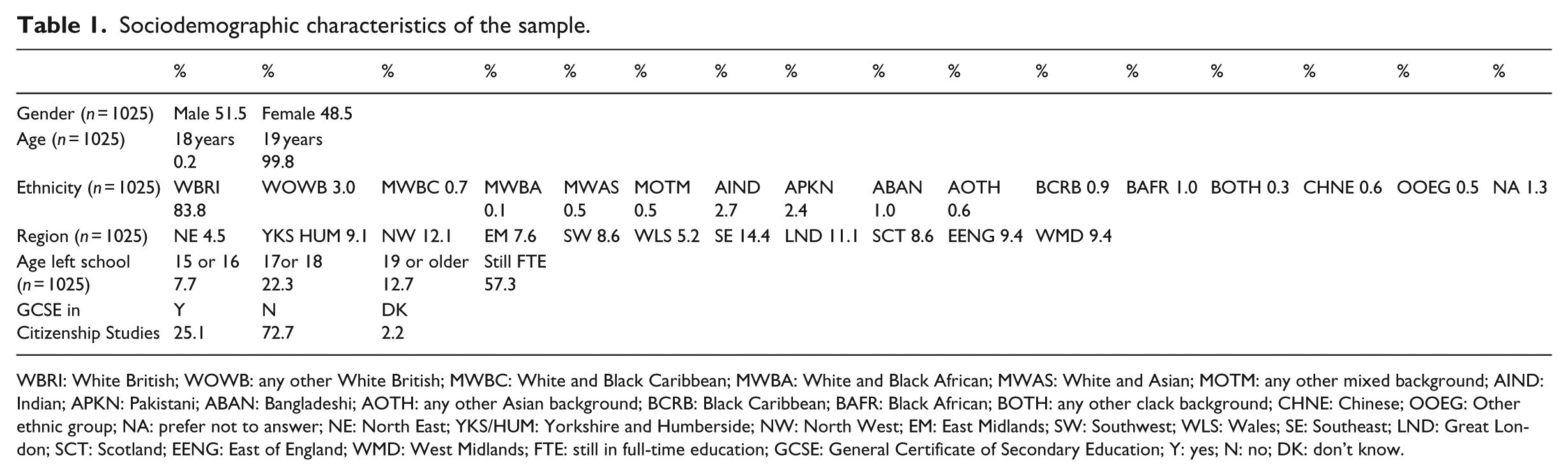
WBRI: White British; WOWB: any other White British; MWBC: White and Black Caribbean; MWBA: White and Black African; MWAS: White and Asian; MOTM: any other mixed background; AIND: Indian; APKN: Pakistani; ABAN: Bangladeshi; AOTH: any other Asian background; BCRB: Black Caribbean; BAFR: Black African; BOTH: any other clack background; CHNE: Chinese; OOEG: Other ethnic group; NA: prefer not to answer; NE: North East; YKS/HUM: Yorkshire and Humberside; NW: North West; EM: East Midlands; SW: Southwest; WLS: Wales; SE: Southeast; LND: Great London; SCT: Scotland; EENG: East of England; WMD: West Midlands; FTE: still in full-time education; GCSE: General Certificate of Secondary Education; Y: yes; N: no; DK: don’t know.
Materials
The questionnaire 3 used in the original survey comprised items assessing socio-demographic factors such as gender, ethnicity, age the participants left school, region of residence and social class. There were also questions addressing young people’s interest in politics and elections, and a section of questions related to their satisfaction with the way that democracy works in the country, how they felt about electoral processes and outcomes in Britain, along with their likelihood to vote according to different and alternative forms of voting. Moreover, there was a group of questions and statements related to political parties, as well as items assessing how active the young respondents were in politics and community affairs. A full list of those items examined in this particular article is set out in the Supplemental Appendix.
Statistical analyses
The statistical analyses comprised (1) independent sample tests for mean comparisons (Table 2) and (2) categorical data analyses (i.e. chi-square tests; Tables 3 to 5). All statistical tests adopted a significance level of p < 0.05.
T-test differences in political engagement and political participation according to young people’s enrolment or not on the GCSE Citizenship Studies course.
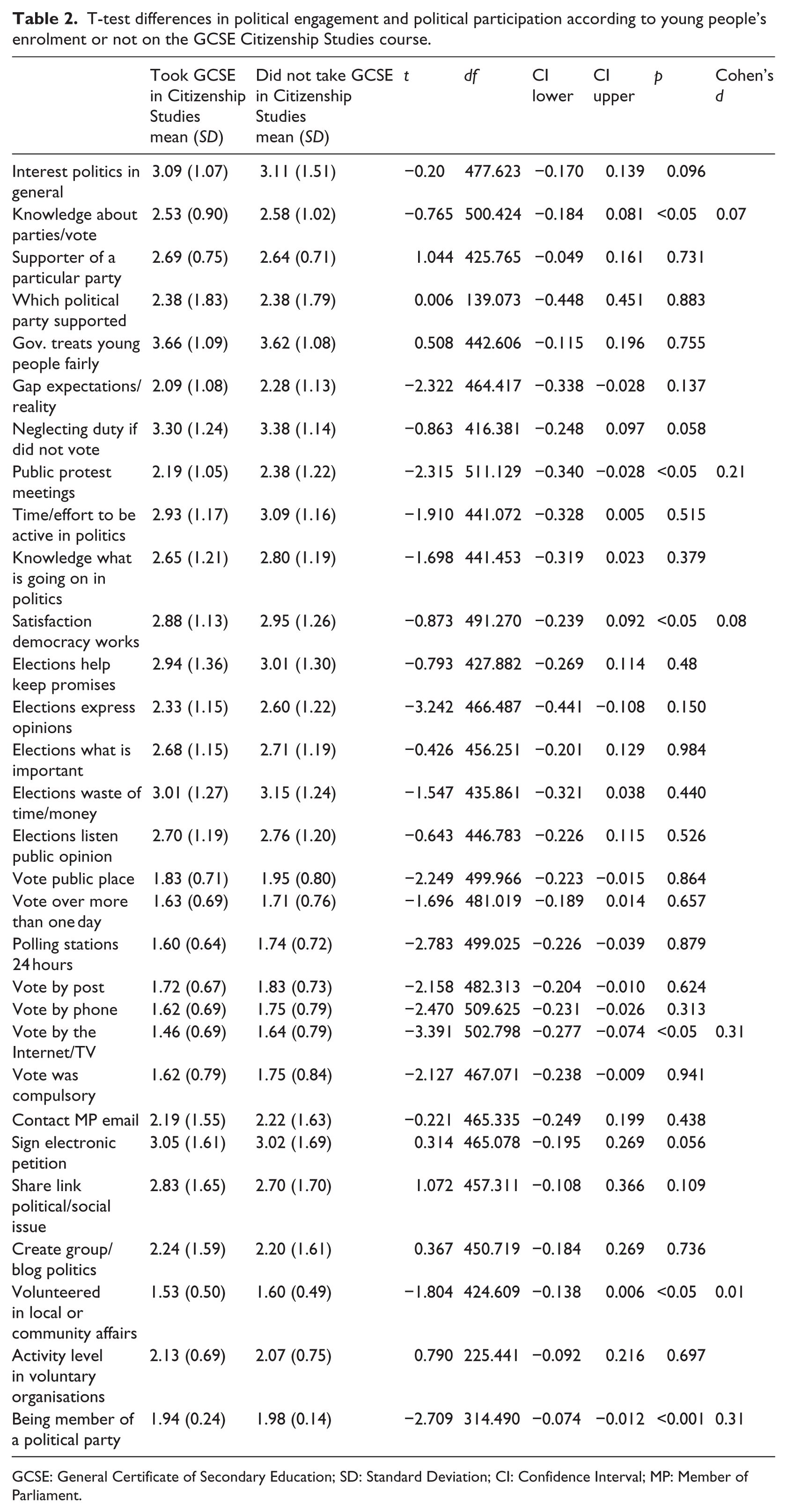
GCSE: General Certificate of Secondary Education; SD: Standard Deviation; CI: Confidence Interval; MP: Member of Parliament.
Chi-square differences in voting choices according to young people’s enrolment or not on the GCSE Citizenship Studies course.
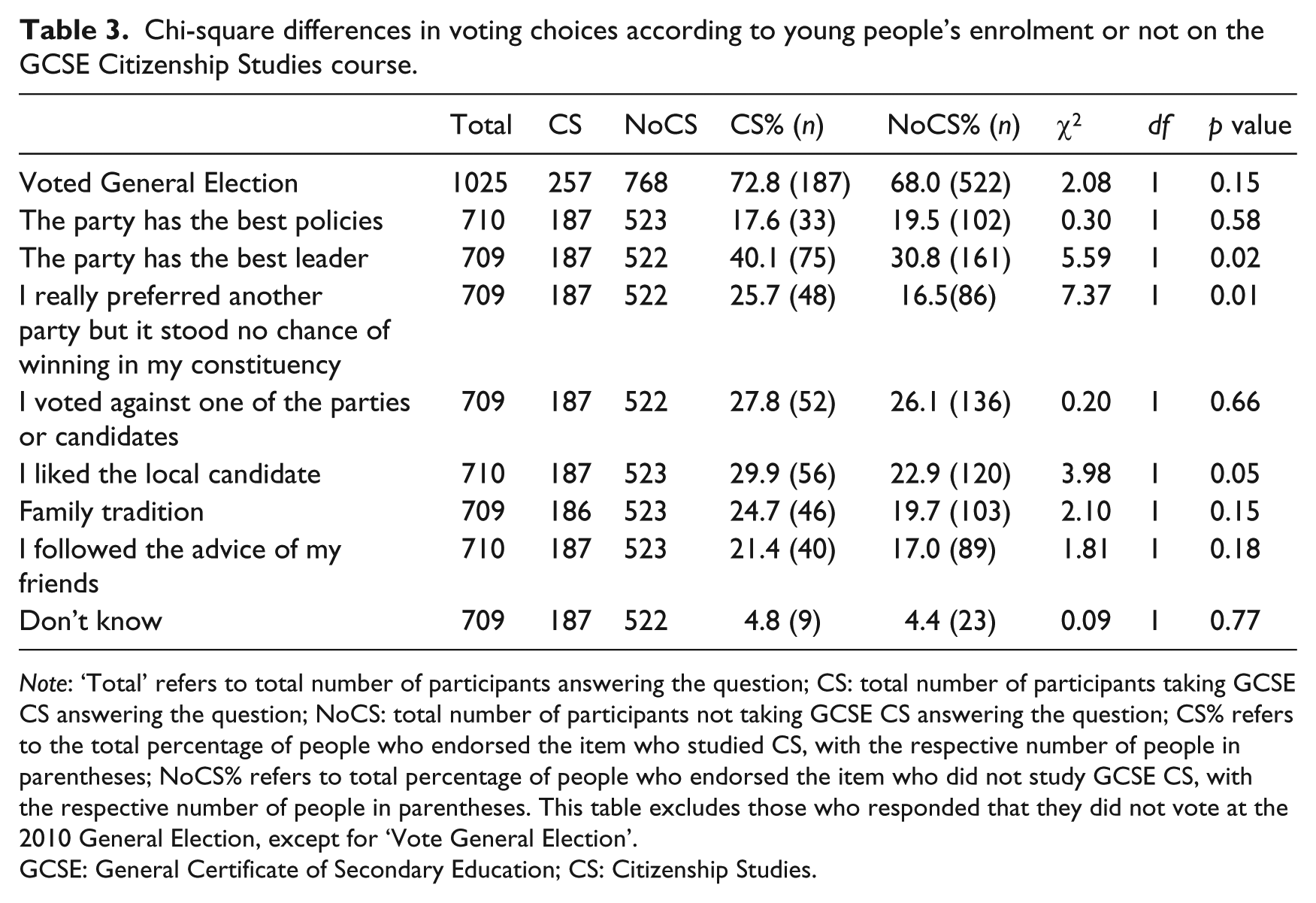
Note: ‘Total’ refers to total number of participants answering the question; CS: total number of participants taking GCSE CS answering the question; NoCS: total number of participants not taking GCSE CS answering the question; CS% refers to the total percentage of people who endorsed the item who studied CS, with the respective number of people in parentheses; NoCS% refers to total percentage of people who endorsed the item who did not study GCSE CS, with the respective number of people in parentheses. This table excludes those who responded that they did not vote at the 2010 General Election, except for ‘Vote General Election’.
GCSE: General Certificate of Secondary Education; CS: Citizenship Studies.
Chi-square differences in voting motivations according to young people’s enrolment or not on the GCSE Citizenship Studies course.
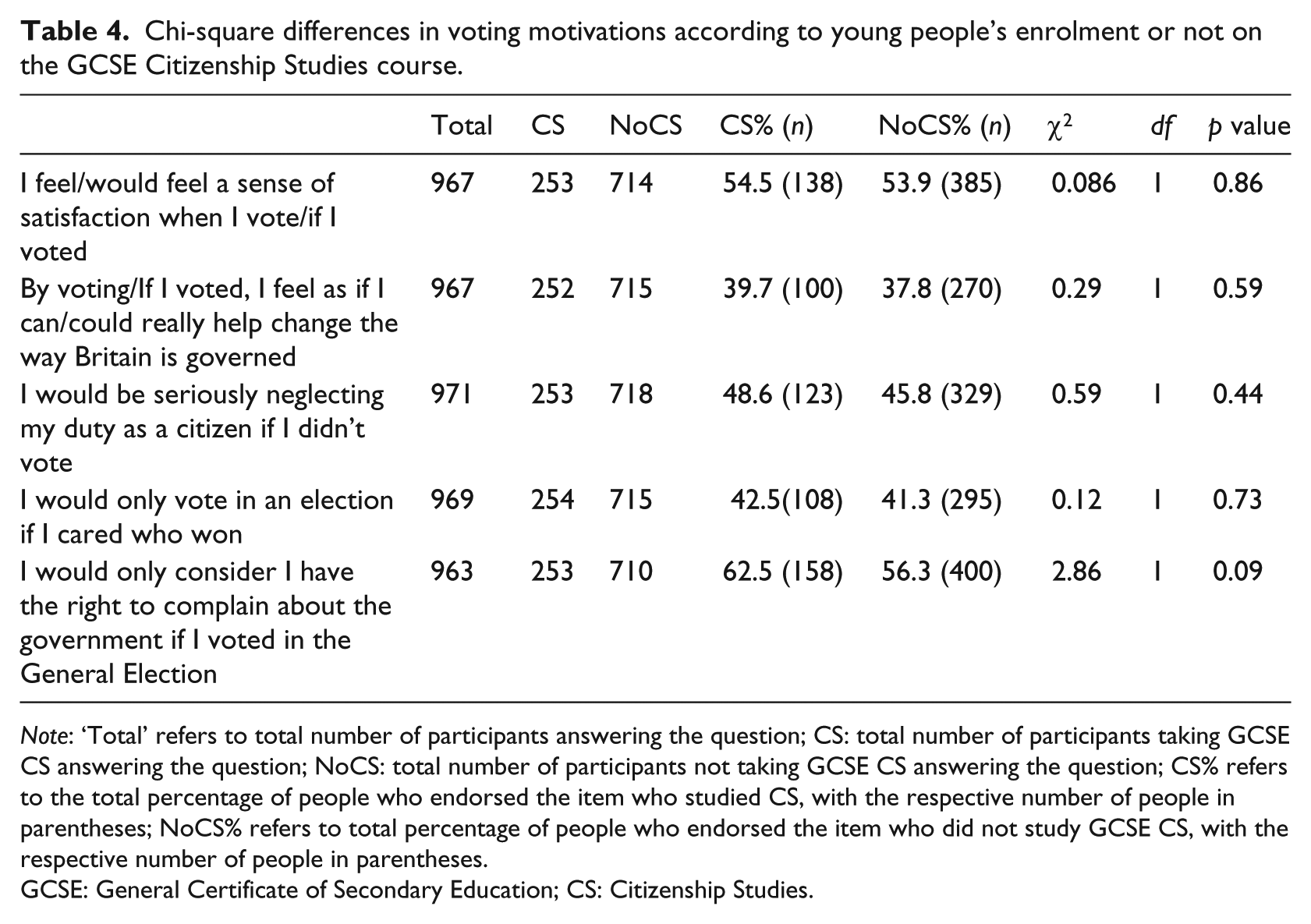
Note: ‘Total’ refers to total number of participants answering the question; CS: total number of participants taking GCSE CS answering the question; NoCS: total number of participants not taking GCSE CS answering the question; CS% refers to the total percentage of people who endorsed the item who studied CS, with the respective number of people in parentheses; NoCS% refers to total percentage of people who endorsed the item who did not study GCSE CS, with the respective number of people in parentheses.
GCSE: General Certificate of Secondary Education; CS: Citizenship Studies.
Chi-square differences in perceptions of political parties according to young people’s enrolment or not on the GCSE Citizenship Studies course.
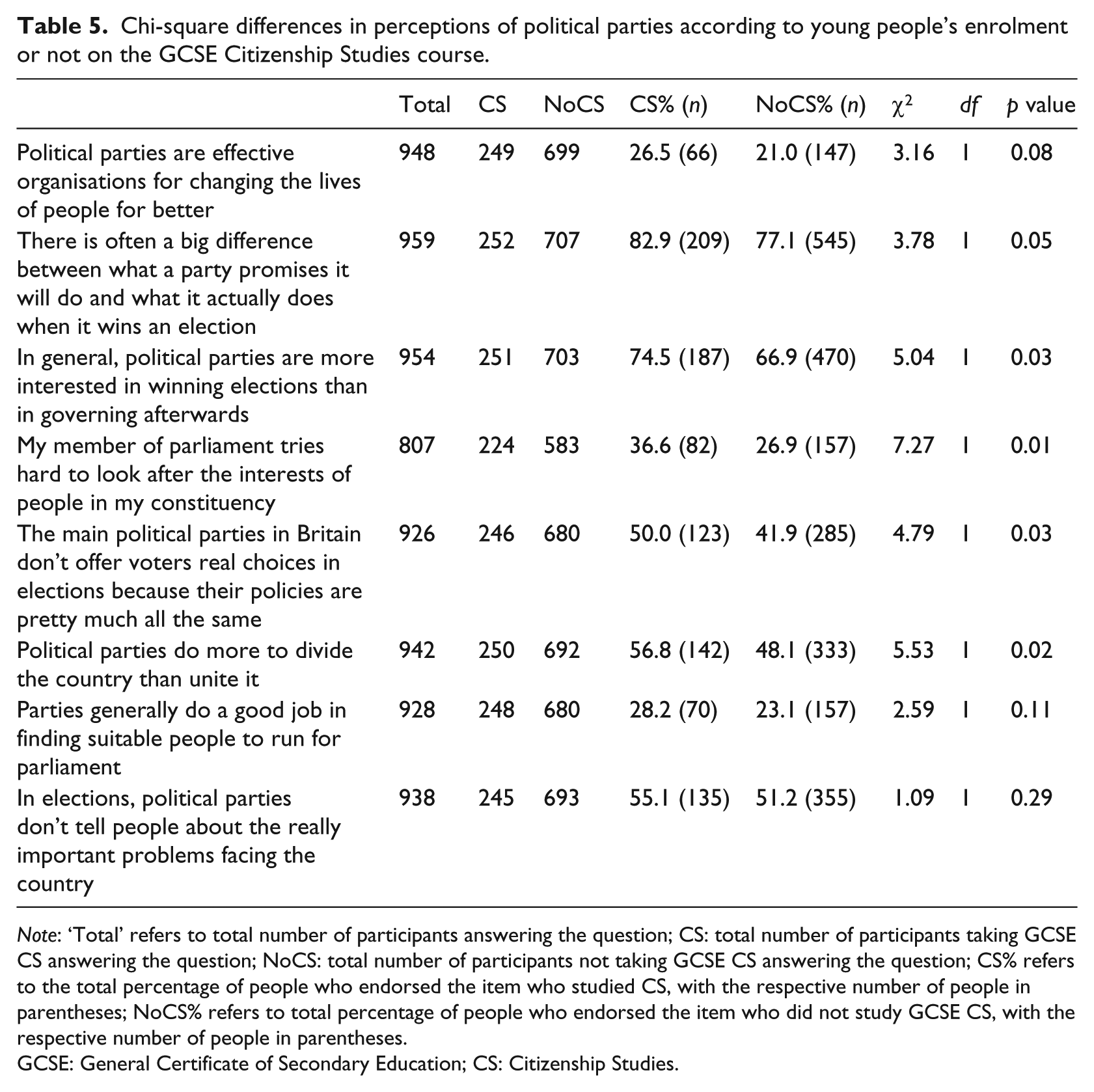
Note: ‘Total’ refers to total number of participants answering the question; CS: total number of participants taking GCSE CS answering the question; NoCS: total number of participants not taking GCSE CS answering the question; CS% refers to the total percentage of people who endorsed the item who studied CS, with the respective number of people in parentheses; NoCS% refers to total percentage of people who endorsed the item who did not study GCSE CS, with the respective number of people in parentheses.
GCSE: General Certificate of Secondary Education; CS: Citizenship Studies.
Results
Only 25% of the survey respondents studied for the GCSE course in CS which was only available to students educated in England, while three-quarters of the sample did not. The results from the independent t-tests summarised in Table 2 indicate that in terms of formal/electorally based participation, young people who had taken the GCSE CS were significantly more likely than those that had not taken the course to (1) support the idea of voting via the Internet or digital TV in the future if there was such an option available (t(503) = −3.39, p < 0.05) and (2) be a member of a political party (t(315) = −2.71, p < 0.001; see Table 2).
Regarding informal methods of political participation, young people who took the GCSE CS course were more likely than those that had not taken the course to (1) agree with the idea that people should be allowed to organise public meetings to protest against the government (t(511) = −2.32, p < 0.05) and (2) have previously been involved in local community affairs (t(425) = −1.80, p < 0.05; see Table 2).
Furthermore, in relation to the attitudes towards democratic practices, processes, parties and professional politicians, young people who had completed the GCSE CS were also more likely than those that had not taken the course to be satisfied with the way that democracy works in Britain (t(491) = −0.87, p < 0.05; see Table 2). However, results also revealed that young people who had studied the GCSE CS were significantly less likely than those who had not to have confidence in their knowledge about political parties when it comes to deciding how to vote at an election (t(500) = −0.77, p < 0.05; see Table 2). Furthermore, statistically significant differences emerged in terms of their motivations for voting for one party rather than another. Table 3 indicates that those who had not studied the GCSE CS differed from those who took the course and were less likely to cite the following statements when justifying their voting decisions: (1) ‘the party has the best leader’ (χ2 (1, 161) = 5.59, p = 0.02), (2) ‘I really preferred another party but it stood no chance of winning in my constituency’ (χ2 (1, 86) = 7.37, p = 0.001) and (3) ‘I liked the local candidate’ (χ2 (1, 120) = 3.98, p = 0.05; see Table 3).
Interestingly, the GCSE CS group were significantly more likely to express negative views about the outcomes from democratic practice, and particularly in terms of the motives and actions of the political parties and elected politicians. The findings reveal statistically significant differences between the two groups, with those who had completed the GCSE CS considerably more likely than their counterparts to agree that (1) there is often a big difference between what a party promises it will do and what it actually does when it wins an election (χ2 (1, 209) = 3.78, p = 0.05), (2) in general, political parties are more interested in winning elections than in governing afterwards (χ2 (1, 187) = 5.04, p = 0.03), (3) the main political parties in Britain don’t offer voters real choices in elections because their policies are pretty much all the same (χ2 (1, 123) = 4.79, p = 0.03) and (4) political parties do more to divide the country than to unite it (χ2 (1, 142) = 5.53, p = 0.02; see Table 5). Of particular note, although very critical of the political class in general, this group of GCSE CS completers were more positive of their particular member of parliament than were their counterparts, claiming that they try hard to look after the interests of all people in their constituency (χ2 (1, 82) = 7.27, p = 0.01; see Table 5).
Discussion
The main aim of this study was to examine if there were differences between young people who studied for the GCSE qualification in CS and those who did not in terms of their levels of political engagement and participation. Results demonstrated that the GCSE CS group were more likely to have voted in the previous General Election than their contemporaries. Given that the literature suggests that turning out to vote is a strong indicator of young people’s political engagement (e.g. Tonge et al., 2012; Whiteley, 2014), this fits with our hypothesis that formally studying citizenship matters is positively related to political engagement (Keating et al., 2010; Tonge et al., 2012). However, results also suggested that those who did not take the GCSE CS were more confident in their knowledge about political parties when it comes to deciding how to vote at election times. This runs counter to the expectation from the hypothesis and is in contrast with previous studies that found evidence that young people who have taken formal citizenship education demonstrate higher levels of confidence in their civic knowledge (Henn et al., 2007; Print, 2007). Nonetheless, Niemi and Junn (1998) found that studies conducted in America since the 1960s concerning the impact that high school classes in American civics have on political knowledge of young people found that there is little or no effect. In their own research based on the 1988 US National Assessment of Educational Progress survey data, they also examined the relationship between civic education and political knowledge, and their analysis demonstrated significant (though modest) effects of civic education on knowledge among American students (Niemi and Junn, 1998).
Results revealed that young people in the CS group were more inclined than other young people to agree with the idea that people should be allowed to organise public meetings to protest against the government. According to Albacete (2014), emerging forms of political participation are characterised by the use of non-political behaviour to express political opinions, and such activities are as diverse as buying or boycotting products, using new technologies for political reasons, and protesting and carrying out artistic demonstrations in the streets conveying political messages (Delli Carpini, 2000; Albacete, 2014). Research also suggests that those young people are also likely to engage in protest activities, have higher expectations of democratic politics and are consequently more likely to express their discontent with governance and the quality of participatory opportunities offered by the political system (Sloam, 2014). However, despite their view that people should be allowed to organise public meetings to protest against the government, young people who completed the GCSE CS appeared to be more satisfied with the way democracy works in the Britain than those who did not take the CS course.
Those young people in the CS group reported that they would be more likely than their counterparts to vote in the future if they were able to do so via the Internet or digital television. Likewise, in a recent study of youth engagement, researchers found that 66% of young people would be more likely to vote if they could do so online (Birdwell et al., 2014), and the Sky News Stand Up Be Counted Survey also found that four out of five young people would be more likely to do so (Sky News, 2014). Research evidence indicates that new technologies enable the individual to be an active agent in accessing, modifying and disseminating information on a potentially global scale, almost instantaneously (Haste, 2010). Moreover, Gallagher and Hafner (2008) stated that using modern technology, it should be possible to make citizens aware of governmental activities, bring them into the decision-making process and facilitate a closer relationship between the government and the people. It could also help increase young people’s political literacy by helping them learn about how to make themselves more effective in public life (Crick, 1998). For example, in 2009, the Ackerman Colloquium on Technology and Citizenship Education was conceived as a forum exploring new ground and topics on how to integrate technology within citizenship education in schools (Van Fossen, 2009).
It is interesting to highlight that the rationale underpinning the decision to introduce citizenship education in schools was in part driven by the 1997−2001 UK Government’s desire to reverse what were perceived to be declining levels of social capital evident at that time (Kisby, 2006). Previous studies have found evidence that community service is a strong predictor of adult voting and volunteering (Hart et al., 2007) and also a factor that may influence young people’s feelings and actions about civic and political participation (Finlay et al., 2010). Given that our analyses revealed that the GCSE CS group within the study exhibited higher levels of involvement in community affairs when compared with other youth, this suggests that formal study in this citizenship qualification may have a positive impact in terms of their social capital.
Results also indicated that when asked about the reasons to vote for one political party rather than another, young people who studied for the GCSE CS were statistically significantly more likely than their counterparts to justify their choices by responding that either the party they voted for had the best leader or that they preferred another party, but it stood no chance of winning in their constituency, or that they liked the local candidate.
Finally, notwithstanding the positive reception that they give to individual local Members of Parliament, young people who took the GCSE CS were otherwise significantly more sceptical than other youth of the motivations and practices of the British political class in general. In particular, they were considerably more likely to agree that there is often a big difference between what a party promises it will do and what it actually does when it wins an election, and they are more interested in winning elections than in governing afterwards. They also feel that the main political parties in Britain do not offer voters real choices in elections because their policies are pretty much all the same; furthermore, these same parties do more to divide the country than unite it. These results reinforce findings reported elsewhere within the literature that young people lack trust in political parties and are disillusioned with the way that formal politics works in practice (e.g. Henn and Weinstein, 2006; Albacete, 2014; O’Toole, 2015).
It is important to note that although young people who took the CS GCSE were more likely to have voted in the previous General Election than their contemporaries (by a margin of 73% to 68% but not statistically different), it does not signal that they are not disillusioned. Some people vote even if they are disillusioned with the way that politics works, but they may consider that voting is the only means open to them to influence what is going on in politics (e.g. Lee and Young, 2013). It is also important to emphasise that these differences found between the two groups – those who took the GCSE CS and those who did not – in terms of their political and civic behaviours, may pre-date their taking of the course. It might be the case that those who are more politically and/or civically engaged are also more likely to take the GCSE CS course in the first place, so these particular classes might have little or no impact on students’ behaviours and engagement. For example, in their study on the role of diversity, deprivation and democratic climate at school, Keating and Benton (2013) observed that when prior outcomes were taken into account (e.g. regarding young people’s participation in civic activities), they were clearly the strongest and most consistent predictors of students’ current civic attitudes and behaviours. Although this was not addressed in this study, this would be something to examine more systematically in future studies.
Limitations and future research
This article has generated potentially important findings about the impact of studying for the GCSE CS on political engagement and participation among a large representative sample of teenage participants. However, this study has some limitations that need to be considered.
The first of these is that the data are self-report and subject to well-known biases (such as recall biases and social desirability biases). Another limitation relates to the questions used to assess young people’s political engagement because they mainly focused on formal (rather than informal) forms of political participation. Another limitation was that there are no previous studies investigating the differences between young people’s political engagement between those who have taken the GCSE in CS and those who have not; therefore, there are no direct comparisons with previous findings. However, the absence of such prior studies provides a justification for this particular research study. Additionally, due to the cross-sectional nature of this study, it was possible to establish correlations between taking or not the GCSE course and young people’s political and civic engagement. However, it was not possible to establish causality. There could be, for example, other factors intervening in the way civic education works, such as the lack of training of teachers who deliver citizenship education classes at school or even individual differences across young people that could require an analysis from a psychological point of view.
In light of these limitations, future research should be conducted to explore at more depth the differences between those young people who take formal qualifications in CS at school and those who do not, in terms of their political engagement. Such research should examine indicators related to both formal and alternative methods of political participation. Moreover, the motives as to why some young people opt not to study CS courses should be investigated, so that necessary actions designed to encourage greater youth involvement in politics can be articulated and implemented. Other studies should be carried out to ascertain the potential benefits of introducing compulsory politics in GCSE classes in schools.
Conclusion
Politicians, academics, practitioners and commentators often point to the need for schools to provide more education about citizenship matters. The results from this study demonstrate that there are some considerable gains to be made in this respect, with some significant differences between those young people who have completed study for the GCSE in CS and those who have not in terms of their respective levels of political engagement, participation and inclinations.
Schools play an important role in political socialisation. However, to address citizenship-related issues more efficiently, the impact of the delivery of teaching and learning issues must be acknowledged. For example, some authors argue that for citizenship education to be effective, policy announcements must be supported with practical assistance from schools and trained teachers (Keating and Kerr, 2013). Accordingly, Burton et al. (2015) found that the most salient issue concerning the inclusion of citizenship education in schools was who teaches it, when, and how it is delivered and assessed. Therefore, it appears that the training of teachers in citizenship education is fundamental for their own confidence in the subject matter, and if delivered in an appropriate manner, this may translate into greater understanding and appreciation of the subject by students. This is in line with one of the Youth Select Committee (2014) proposals, which encourage the Government to invest in new initial teacher training places for dedicated citizenship teachers with a view to ensuring that all citizenship lessons are taught by citizenship specialists by 2020.
There are still issues to be discussed concerning the impact of citizenship education on young people’s participation in civic and political life. To achieve its ambition to contribute to enhanced youth political engagement, the teaching of citizenship needs to be supplemented with a more in-depth understanding of the ways in which young people actually learn in the communities and practices that make up their everyday lives.
Footnotes
Declaration of Conflicting Interests
The author(s) declared no potential conflicts of interest with respect to the research, authorship, and/or publication of this article.
Funding
The author(s) received no financial support for the research, authorship, and/or publication of this article.
Supplemental Material
Supplemental material is available for this article online.
Notes
References
Supplementary Material
Please find the following supplemental material available below.
For Open Access articles published under a Creative Commons License, all supplemental material carries the same license as the article it is associated with.
For non-Open Access articles published, all supplemental material carries a non-exclusive license, and permission requests for re-use of supplemental material or any part of supplemental material shall be sent directly to the copyright owner as specified in the copyright notice associated with the article.
