



Abstract
Early purposes of education in the United States concentrated on preparing young citizens to understand democratic principles in order to participate in their democratic communities. Today elementary instruction has contracted in response to years of high stakes accountability measures. Social studies has not been a focus of federal accountability measures and therefore has become increasingly absent in elementary classrooms. The purpose of this study was to examine how elementary students understood and applied their knowledge of civic virtue and engagement within an integrated social studies and literacy unit of instruction based on the framework of Critical Democratic Literacy. A modified version of Design-Based Research was used with a classroom teacher in a multiage first, second, and third grade classroom with the goal of ‘improving practice’ and engaging in ‘an iterative, collaborative design’ in an authentic instructional environment. Findings demonstrated that the elementary students understood the concepts of civic virtue and civic engagement in both historical and present contexts, as well as its relevance to their lives and the lives of others as helping and standing up in the face of injustice.
The current United States’ political climate has increased the visibility of how citizens engage and advocate (i.e. stand up) for themselves and others by posting on social media, attending political events, protesting, as well as talking with political leaders. These activities rest on citizens’ understanding of how to express their civic rights and responsibilities in a democratic state. Historically, U.S. schools concentrated on preparing young citizens to understand democratic principles in order to participate in the country’s democratic communities (Engle and Ochoa, 1988; Giroux, 1980, 1983, 2009; Gutmann, 1987; Parker, 2001). Classrooms were positioned as ‘embryonic societies’ (Dewey, 1944), where concepts such as civic virtue and engagement guided young students as they learned how societies were structured and what roles they could play in society’s maintenance and improvement. In addition to knowing how to read, write, and solve mathematical problems, students were taught social studies and its associated disciplines (e.g. civics, history, geography, and economics). Today social studies is increasingly absent in elementary classrooms due to federal student testing accountability measures focused on reading and mathematics (Fitchett et al., 2014; Fitchett and Heafner, 2010; Heafner and Fitchett, 2012; VanFossen, 2005) and an additional emphasis in science, technology, engineering, and math (STEM) fields (Heafner and Fitchett, 2012). Focusing on teaching STEM and reading without social studies eliminates the core democratic principles that should guide those disciplines toward the common good in an increasingly complex global community. Keeping democracy in the care of its citizens relies on education where the purpose of social studies ‘is to help young people make informed and reasoned decisions for the public good as citizens of a culturally diverse, democratic society in an interdependent world’ (National Council for the Social Studies, 1994: 3). Therefore, the purpose of this study was to examine how elementary students understood and applied their knowledge of civic virtue and engagement within an integrated social studies and literacy unit of instruction based on the framework of Critical Democratic Literacy (CDL) (Obenchain & Pennington, 2015). A modified version of Design-Based Research (DBR; Penuel et al., 2011; The Design-Based Research Collective, 2003) was used with a classroom teacher in a multiage first, second, and third grade classroom of 6- to 9-year olds with the goal of ‘improving practice’ by engaging in ‘an iterative, collaborative design’ (Penuel et al., 2011: 333). The following sections detail the rationale and conceptual grounding for CDL, describe the instructional and research methodology, and conclude with the results and discussion.
CDL
We approached democratic education within an elementary school context utilizing what we term CDL (Obenchain & Pennington, 2015). CDL is a specific type of literacy comparable to notions of scientific and mathematical literacy (Alexander et al., 2008) and is dependent on the disciplinary knowledge that democratic/citizenship (i.e. civic) education provides, a connection which can be traced back to ‘schooling in literacy as preparation for citizenship, and the equation of literacy and democracy . . . [in Athens, Greece]’ (Graff, 1987: 23). Our conceptualization of CDL relies on integrating social studies and literacy education from a critical perspective (Giroux, 1980; Kincheloe, 2004; Macedo, 1993). Overlapping with critical conceptions of civic education (Cho, 2018; Westheimer and Kahne, 2004) as well as critical literacy (Endres, 2001; Freire, 1983; Freire and Macedo, 1987; Janks, 2000), we posit that social studies and literacy should be taught in integrative ways (Hinde, 2005) that promote elementary students’ awareness of injustices, past and present, as well as seeing their civic roles in contesting injustice for themselves and others. Teaching for CDL shares Freedman et al.’s (2016) definitional goal for ethical civic actors who demonstrate thoughtful, reasoned judgments about social and civic matters, are concerned about the rights and welfare of others, have the capacity to deliberate with others about issues affecting the common good, and believe that they can make a positive difference in relation to these matters. (p. 109)
Moving beyond notions of justice as fairness where everyone is equal before the law (Rawls, 1971), our work is founded on Young’s (1990) critical perspective of democracy that emphasizes structural injustices related to individuals’ history, economic status, race, and gender identity. CDL requires that educational experiences incorporate subject matter and conceptual knowledge to provide opportunities for students to understand and evaluate their world from a knowledgeable democratic perspective. While notions within CDL are broad and encompass many traditions, theories, and approaches, we employed two tenets in our instructional design and pedagogical approach: (1) social studies conceptual instruction and (2) critical multiple literacies.
Elementary social studies
Social studies provides the curricular space to explicitly attend to understanding how historical events and civic knowledge inform our current decision-making processes (Thornton and Barton, 2010) to prepare our K-12 students for ‘informed and reasoned’ participation through ‘enlightened political engagement’ (Parker, 2003: 32). Research on critical civic learning at the elementary level is limited but growing. Recent studies suggest that with appropriate teacher scaffolding, elementary students can understand injustice at both the individual and systemic levels (Cho, 2018) and develop their civic voice (Mitra and Serriere, 2012). Furthermore, when positioned as citizens who can make a difference in their communities, elementary students are capable of creating relevant ways to engage in civic life (Mayes et al., 2016). A challenge to this critical work is the prevalence of Hanna’s (Stallones, 2002) expanding communities model in which young children first study themselves and their local communities. Designed to attend to students’ cognitive development, this might include students’ learning about classroom and school rules in order to provide a concrete introduction to the rule of law. Given this, social studies typically includes limited or fragmented subject matter content and skills in the early grades (Stallones, 2002). Social studies curriculum designed in this manner is aligned with the idea young children are not developmentally ready to understand the complex ideas and methodologies found in the disciplines that are a part of social studies (e.g. civics, economics, geography, history) so they are provided with facts that may relate to their knowledge about things such as the pledge of allegiance, famous historical figures, or past presidents. In addition to the elementary civic research noted above, research in history learning indicates that young children can comprehend more complex historical content with support (Seixas, 1996; VanSledright, 2002).
Concept learning in social studies
Using social studies concepts (e.g. justice, civic virtue, leaders, poverty, chronology) and related essential questions (Wiggins and McTighe, 2013) as the organizing core for an integrated curriculum provides one way to reposition social studies in the elementary classroom (Levstik, 2008; Obenchain & Pennington, 2015). The importance of concepts essential to understanding the subject matter disciplines in social studies is frequently connected to the work of Hilda Taba (Frankel, 1992; Taba, 1967) and more generally linked to Jerome Bruner (1966). In contrast to skills, concepts are ‘words that represent highly abstract generalizations’ that have the ‘capacity to organize and synthesize large amounts of information (i.e. specific facts)’ (Frankel, 1992: 172). Organizing instruction around social studies concepts, using social studies facts and skills, allows students to apply civic concepts from the foundations of our democracy to past, current, future circumstances and events.
Critical and multiliteracies
Whereas social studies has been marginalized at the elementary level, literacy instruction has consistently received attention due to its positioning as the cornerstone of several accountability movements (Pennington, 2004). In response, many schools elect to rely on scripted programs (Beatty, 2011; Crosland and Gutiérrez, 2003; Pease-Alvarez and Thompson, 2014; Valli and Buese, 2007) which can result in a simplistic, functional view of literacy (Scribner, 1984). On the other hand, critical literacy recognizes the need for educating students in ways that support civic engagement in their democratic communities (Giroux, 2009; Janks, 2012) and highlights critical thinking in relation to social justice (Morrell, 2007) and how literacy is inherently connected to civic engagement (Luke, 2008). These ideas complement The New London Group’s (1996) A Pedagogy of Multiliteracies, where they describe three realms of existence: working lives, public lives (citizenship), and personal lives (lifeworlds) and propose focusing on cultural and linguistic diversity in a globalized world by extending literacy learning beyond traditional text-based with multimodal representational forms (The New London Group, 1996; Vasudevan, 2011; see Figure 1).
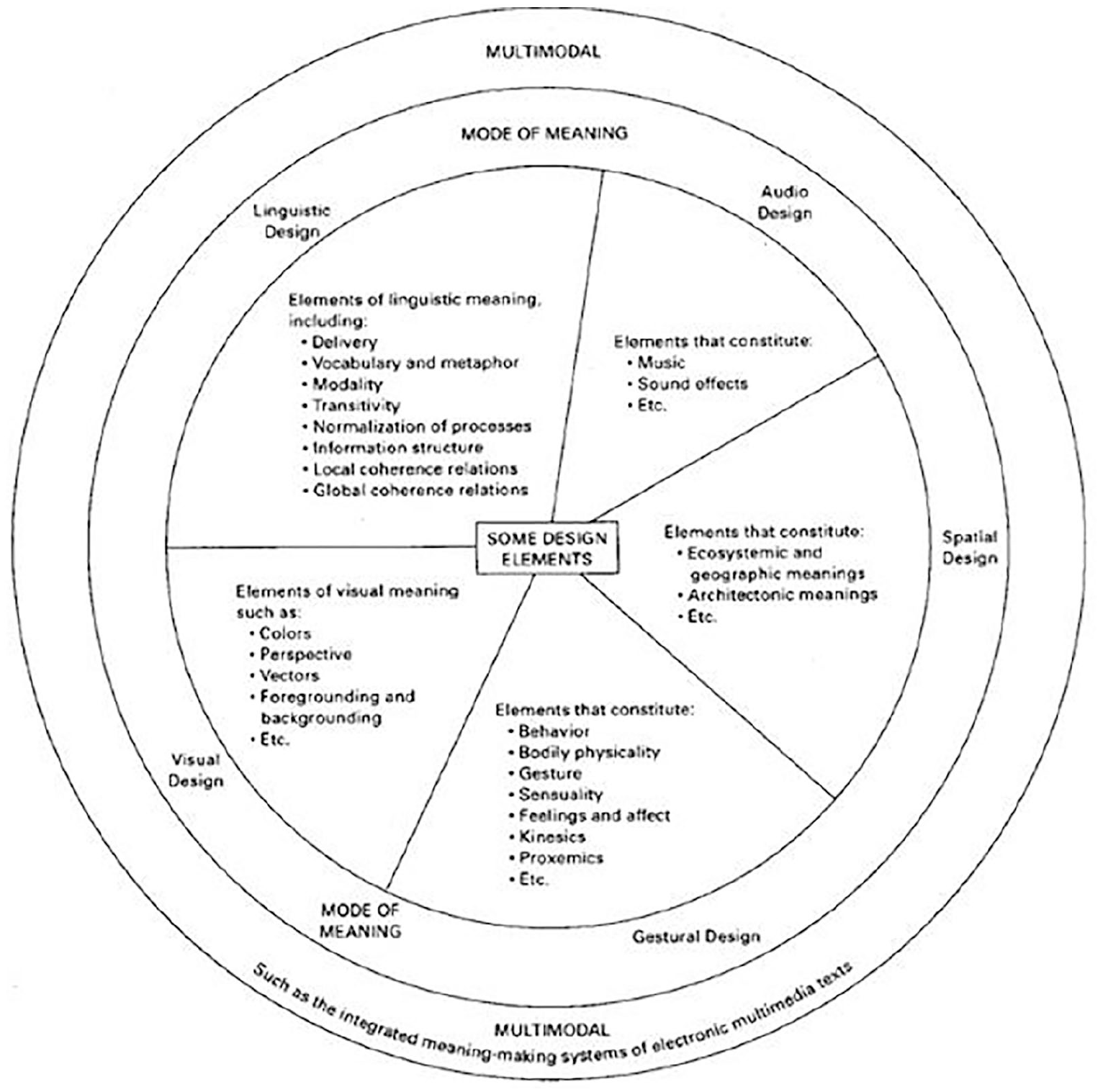
Multimodal designs (The New London Group, 1996).
Multiliteracies as a pedagogical construct recognizes that literacy goes beyond the acts of reading and writing to encompass multimodal understanding and expression (e.g. linguistic, visual, audio, gestural, spatial) allowing students to critically think about the systems they interact with while recognizing that civic spaces are not monocultural. Multiliteracies also call for the institutions of schooling to ‘shift’ their role and responsibilities to ‘reclaiming the public space of school citizenship for diverse communities and discourses’ (The New London Group, 1996: 72). Multimodal instruction is recommended often in scholarship and research in literacy instruction (see Garcia et al., 2018; Mills, 2010), focusing on various types of texts (Serafini, 2015) and writing tools and genres (Dalton, 2015), as well as in the content areas such as science (Meneses et al., 2018; Schwartz et al., 2011), mathematics (Freeman et al., 2016), and social studies (Dalton, 2015). While crucial to literacy learning, from a social studies’ perspective, these measures may overlook key conceptual aspects of civic education as expressed through multimodal modes. Sakr et al. (2016) analyzed elementary students’ emotional engagement using a multimodal analysis as they studied World War II by using mobile devices, while Brugar et al. (2018) found that middle school students understood the American Revolution by reading graphic novels. Currently, there is little research on how multimodal instruction and assessment can be used in elementary social studies to examine concept understanding. Therefore, the purpose of this study was to examine how elementary students understood civic virtue and engagement through their participation in an integrated social studies and multimodal literacy unit based on the conceptual foundations of CDL.
Research methods
Due to the persistent problem of practice of bringing social studies conceptual instruction to elementary classrooms, the study utilized DBR methods. Wang and Hannafin (2005) describe DBR as ‘. . . a systematic but flexible methodology aimed to improve educational practices through iterative analysis, design, development, and implementation, based on collaboration among researchers and practitioners in real-world settings, and leading to contextually-sensitive design principles and theories’ (p. 6). While DBR is typically used in a post-positivistic intervention model (Penuel et al., 2011; The Design-Based Research Collaborative, 2003; Wang and Hannafin, 2005), three key elements of DBR as defined by Penuel et al. (2011) applied to our ongoing iterative design and adaptations in working with the classroom teacher: (1) ‘persistent problems of practice’, (2) a ‘commitment to iterative, collaborative design’, and (3) ‘developing theory related to classroom learning’. Notions of DBR and design-based research implementation (DBRI) were modified to emphasize the study’s focus on classroom collaboration with the teacher and continual iterative design and redesign of a particular instructional method (Penuel et al., 2011; The Design-Based Research Collaborative, 2003; Wang and Hannafin, 2005). Our adaptations of DBR were situated within one classroom and relied on qualitative analysis of student learning and research methods detailed in the following sections. The iterative, collaborative design of the study was dependent on the need to study classroom instruction in flexible and responsive ways. Limitations of the study related to the small sample, the brief time frame of the unit, and the reliance on the textbook materials demonstrate the reality of implementing social studies instruction in a classroom setting. While DBR allows for methodological flexibility, we recognize the need for larger scale ongoing empirical research on both elementary students’ conceptual learning and expanding instruction to incorporate additional in-depth concept work such as racism.
Setting and participants
In order to examine how elementary students understood the social studies concepts of civic virtue and civic engagement, the researchers collaborated with an elementary teacher in one first to third grade multiage classroom of 6- to 9-year-old children. Establishing a close working relationship with the classroom teacher was a key aspect of the DBR design and aligned with conceptions of critical pedagogical research that call for teachers to be involved in research in critical and reciprocal ways, and specifically, ‘attempt to confront the injustice of a particular society or public sphere within the society’ (Kincheloe et al., 2011: 164). The elementary classroom teacher’s class consisted of 22 linguistically and culturally diverse students, 8 first graders, 7 second graders, and 7 third graders. Data analysis focused on the diverse group of first graders (one African-American, three Latinos, one Asian-American, one Pakistani, one Eastern European, and one White student). Prior to the study, the teacher taught social studies using the required social studies textbook (Scott Foresman, 2011) during the 90-minute literacy instructional time period. Small groups rotated through centers consisting of guided reading instruction (Fountas and Pinnell, 1996), and independent reading, with one group reading and answering questions from the social studies textbook (Scott Foresman, 2011). Students worked daily and independently in grade level groups to read and listen to CDs of the assigned social studies textbook chapters, respond to questions from the text, and engage in discussion. The first-grade textbook design reflected Hanna’s expanding communities’ model beginning with home and school, neighborhoods, to aspects of life around the world as well as information about national symbols, holidays, weather, map skills, and one-page descriptions of notable figures. After 1 week of videotaping and observing the teacher’s existing social studies and literacy instruction, the researchers and the teacher began to construct a unit for study. The next section details the unit plan, instructional approaches used in the study, and the data collection and analysis description.
Instructional design
The two researchers, author one (literacy researcher), author two (social studies researcher), and the classroom teacher planned a 2-week standards-based (Common Core State Standards, 2010; National Council for the Social Studies, 2013) CDL unit focused on the social studies concepts of civic virtue and engagement. Content centered on Black History month using individuals from the textbook (Tubman, Carver, Bridge, Jemison) as requested by the teacher. Therefore, as Table 1 illustrates, the instruction was organized around the concepts of civic virtue and engagement, utilized the teacher’s focus on Black History Month and the individuals from the textbook as content, and embedded multiliteracies pedagogy within the daily literacy instructional block. Researcher one taught the first-grade students for the first week and then co-taught the entire class of first, second, and third graders with the teacher for 1 week.
Instructional units.
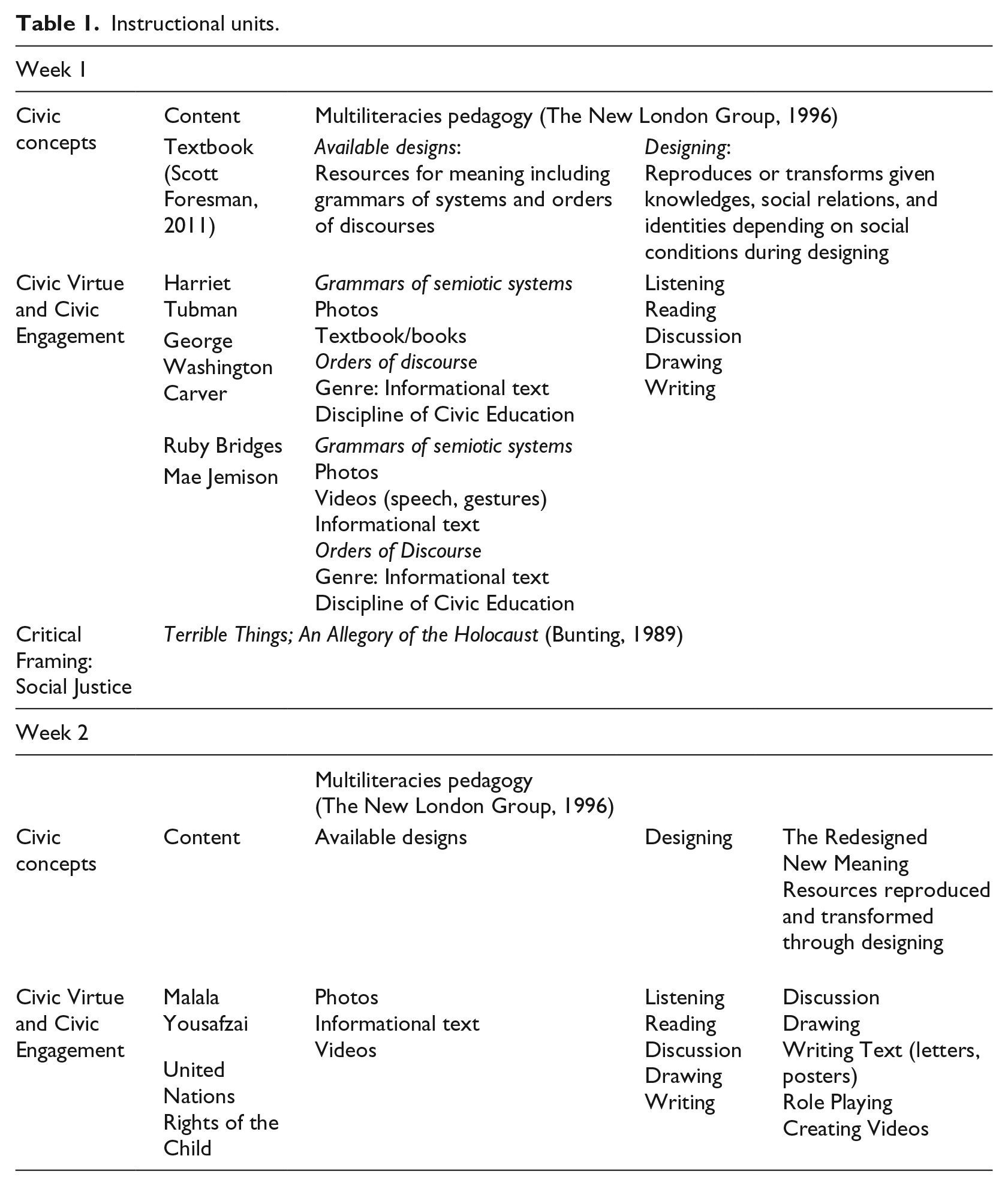
Civic virtue and civic engagement concepts were defined for the elementary students using the work of political theorists (Dagger, 1997; Galston, 2007), and civic virtue was defined as standing up for yourself and standing up for others when others were treated unfairly. Similarly, civic engagement was defined as taking part in individual or community activities to make their communities better (Wicks et al., 2014). In order to conceptualize the lessons around civic virtue and engagement, the researchers worked with the materials provided to highlight how the individuals in the textbook were civically engaged. Due to the lessons’ conceptual focus on civic concepts and limited time, racism and oppression were taught as individual events related to the content from the required textbook rather than historical content or concepts. For additional discussion related to teaching race in elementary grades, see Bolgatz (2005), Garrett and Segall (2013), Hess (2005), Husband (2010), and Tyson (2003). During the second week, the concepts were used to examine relatable peers, beginning with Malala. Students were familiar with her activism and her call for children’s rights. The rights of children (United Nations (UN), 1990) were utilized as a tool for students to evaluate actions and contexts related to their understandings of civic virtue and engagement by showing them they had rights as children These rights gave them permission and criteria to stand up for or against what they saw as just or unjust actions and situations. Utilizing the list of children’s rights, the students evaluated photos of children in various circumstances (e.g. segregated schools, playing, in need of health care) and discussed their evaluations in group presentations. Finally, all activities varied in their use of modes (oral, visual, gestural, sound). Multimodal design, as an aspect of multiliteracies, describes three elements of design and how they relate to pedagogy: (1) Available Designs, (2) Designing, and (3) The Redesigned (Kress, 2005; The New London Group, 1996). Available designs refers to the designs for meaning provided by the lessons, designing is the semiotic process involved as the students and instructors used the available designs to make meaning, and redesigning refers to the transformed resources in the redesigned products. These three elements provided a foundation for literacy instruction by bringing in materials beyond books such as photos, primary sources, drawings, and videos and allowing students to demonstrate their understanding in multimodal ways.
Data collection and analysis
Data collection consisted of videotapes of all class lessons, including readings, student writing, students’ analysis of primary sources, and students’ viewing and discussion of images, photos, and videos. All student artifacts were collected including student drawings, writings, and notes. Teaching artifacts were also collected and included instructional charts, lesson plans, books, videos, Internet sites, and reflective notes. In order to address how students understood civic virtue and engagement, analysis focused on examining the ongoing lessons as well as the culminating experiences of student-created public service announcements (PSAs), posters, and letters to public officials. In alignment with the collaborative and iterative nature of DBRI, data analysis and instructional adjustments were made in collaboration with both researchers and the classroom teacher throughout the study. Daily discussions and meetings were held to analyze the students’ learning, lessons, and assessment designs to modify instruction. Upon completion of the unit, final data analysis was conducted in two phases.
Initially, all components of the students’ work were analyzed to determine how students understood civic virtue and engagement from its introduction as a concept to its evaluation and application in various contexts. Students’ discussions on video, transcripts, writings, and lesson participation were evaluated and compared over time. Each researcher, authors one and two, university faculty, author three, the classroom teacher, and author four, a graduate assistant, analyzed the classroom data individually and noted all activities related to the concepts of civic virtue and engagement. Initial coding of students’ expressions of understanding civic virtue and engagement indicated that the students did understand the concepts of civic virtue and engagement as demonstrated by their participation in discussions and lesson activities. These understandings ranged from participatory views of engagement to justice-oriented views (Westheimer and Kahne, 2004). The posters and the PSA activities were noted as exceptional examples of how students redesigned and represented their understanding of civic virtue using multimodal modes and were singled out for additional analysis. In this second phase of data analysis, multimodal elements of design were used to closely examine how students not only understood civic virtue and engagement but how they expressed their understandings relevant to their own lives and social contexts using various modes of expression (The New London Group, 1996). The second phase of data analysis revealed the complex nature of the students’ use of various modes such as oral language, visuals, spatial relationships, and gestures to express their conceptual knowledge.
Findings
Findings demonstrated how the elementary students understood the concepts of civic engagement and virtue in historical and present contexts, as well as its relevance to their lives and the lives of others in two ways. The students understood civic engagement as the action of helping themselves and others while recognizing civic virtue’s commitment to fairness and justice guiding all actions. The following sections detail the students’ understandings of civic engagement and virtue through their various modes of representation.
Civic engagement as helping
Civic engagement as helping was specifically described by the students over the course of the unit. The students viewed helping as a way to be engaged and categorized helping in relation to acting to help themselves and acting to help others. For example, students described George Washington Carver as someone who helped himself because ‘he made his self happy [sic]’ and he helped other people and his community by being a teacher. From the perspective of personal responsibility, the students understood that being individually responsible for their own actions was connected to particular social norms consistent with being a functioning member of society, while also noting that these actions were good for them. Drawing on their own experiences, they talked about picking up their toys so they would not fall (i.e. personal safety) to learning in order to ‘get a job’. Elias stated, ‘I help myself; I do my homework’. These understandings were connected to how students viewed personal responsibility as acting to help themselves.
Beyond being responsible for one’s actions, students viewed the historical actors under study as examples of engaging in the community. Students easily recognized how Harriet Tubman and Ruby Bridges helped others. Elias thought Harriet Tubman helped herself and others by running away to be free. Tomas added that she helped her community by being a nurse and ‘she brought her family to the underground railroad’. In these early understandings of civic virtue and engagement, students emphasized specific actions where each historical figure helped people. Yet, when asked how they might help others, students initially struggled. When asked ‘Have you helped people in your classroom’? Most students responded with a choral, ‘No’. Tomas stated, ‘I’ve never helped people’. Rebecca mentioned how she might help her classmates if they fell by finding the teacher, while Peter wrote about the importance of making people happy, ‘I help my community . . . I am funny, I make [people] laugh and make them smile’. As the lessons progressed, the students made more connections about helping others. After initially stating that he did not help anyone, Tomas stated, ‘My dad gives money to homeless people’. Kevin added, ‘My older brother helps feed the poor. I serve the food for breakfast. I help’. Tomas and Kevin’s comments indicated their idea that helping consisted of providing for those less fortunate. Other students discussed picking up trash and stating that they had seen their parents donate money. The idea of giving money and donating was consistent with earlier readings and videos about Mae Jemison and Ruby Bridges creating organizations to donate money to education. These acts of helping were articulated by the students throughout the unit as exemplified by Erica as she described her drawing and writing, ‘This says pick up trash in the community. Give people money. Help my mom at work and my dad. Help other people at work . . . This picture is me working for people that’s [sic]sick’. Other students echoed these acts of helping others related to their personal contexts. Amira stated, I help poor people. I give them money because they do not have money and they are hungry. One time, I saw two people, they did not have money and I gived [sic] them money. They got happy. I pick up the toys so no one fall [sic] down.
Students recognized their personal responsibilities and being aware of the needs of others, all acts of engagement as exemplified by helping.
Civic virtue as justice
Civic engagement without virtue can be blind to structures and acts that deny justice to individuals and groups. Therefore, teaching civic virtue was crucial to develop a social justice frame of reference for students. Fairness was a conceptual bridge to injustice since students understood what being fair meant in relation to their personal experiences. Throughout lessons, students initially began to frame virtue and justice by recognizing racism as unfair and soon moved to discussing the importance of standing up to injustice. In a writing assessment, students were asked how Bridges helped people. Kevin wrote, ‘Ruby Bridges was important because she teaches children about helping each other’ (Figure 2).
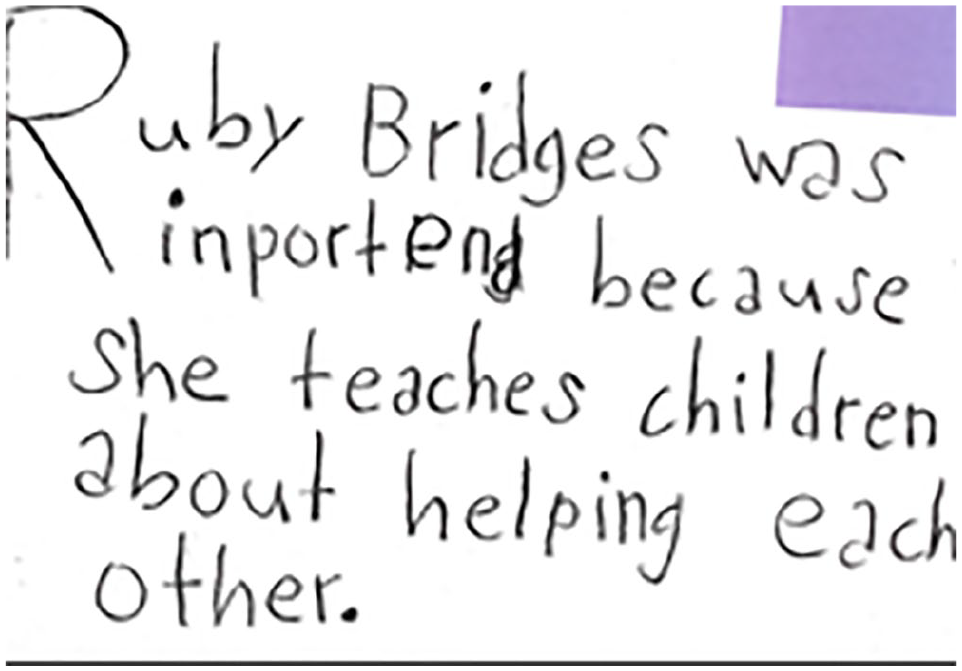
Kevin’s writing.
At this point in the unit, the students did not explicitly name the racial discrimination faced by Ruby Bridges as a part of how she helped children today. Soon, students moved to naming the unfairness of racial discrimination as Lina stated, ‘Ruby Bridges taught people to be nice to each other and their community. When Ruby Bridges [as a child] went to school, everybody was mean to her because she was Black’. These notions depict the engagement actions of helping and begin to explicitly recognize the injustices that placed the individuals in need of help. Once students recognized instances of injustice, particularly in the form of racial discrimination, they incorporated their understanding of civic engagement. They saw that standing up for others was an appropriate action aligned with civic virtue and a form of civic engagement. As they learned more about how African-Americans were treated and how they responded, Kevin and Lina discussed a photograph of Ruby Bridges going into school surrounded by U.S. Marshals:
They had separate schools because they didn’t want to get mixed up, but what’s wrong with having different colors? We’re all the same . . . she’s the first Black girl to go to a White people’s school. She was the first one to try it out.
After a long time, other Black children came to school.
She is the one, the White people aren’t helping. She is helping the Black people.
How is she helping the Black people?
She’s trying a new school.
Standing up to injustice
The students understood the significance of Ruby Bridges being the first Black student to attend an all-White school. In addition, they noted how Washington Carver had to go to a ‘Black school’ and how Tubman and the enslaved people she saved were treated. The students began to see helping (i.e. civic engagement) as related to the injustice of racism. Erica wrote, ‘They were being mean to Ruby Bridges and a person stuck up for her’. Standing up for others became prevalent in class discussions as the students noticed the relationship between helping and fairness:
You can stand up for people
Have you ever had anyone stand up for you?
No.
I heard about it but I haven’t had to do it. Well- I have had to do it but I don’t get used to doing it.
Peter’s recognition of the need to advocate for others and how it can be difficult was shared by the other students. Standing up for yourself and its relationship to injustice were clear to the students. These connections were directly related to their own lives rather than just the figures studied in the unit. Fairness was familiar to the students as they shared their experiences and their observations of acts at their own school. Throughout the unit students provided examples in their own lives related to bullying and other students being mean to them or others they knew. In the following discussion, Kevin expanded on the challenges related to standing up for yourself:
When people are being mean to you, you’re shy to do it, but you gotta [sic] help yourself.
What does that mean? Can you give me an example?
If someone is being mean to you and you’re too scared to tell, or fight back, but you’re too shy to do it, then you realize that you can do it.
Several students included the idea of standing up through writing or pictures. The multimodal activities allowed for students to express their ideas in ways they were comfortable with; many students who were quiet during class discussions drew pictures or orally explained their ideas one on one. Rebecca wrote, ‘I give people money. I stand up for people’ and drew a picture of two girls, one of whom was crying while the other girl is saying ‘stop being mean’. While Lina described how she could stand up for people and how someone could stand up for her. ‘I stand up for people . . . This is a picture of someone being mean to me and this is Erica saying stop. Telling them to stop’. The students’ understanding of engaging moved to acting to protect themselves and others (Figure 3).
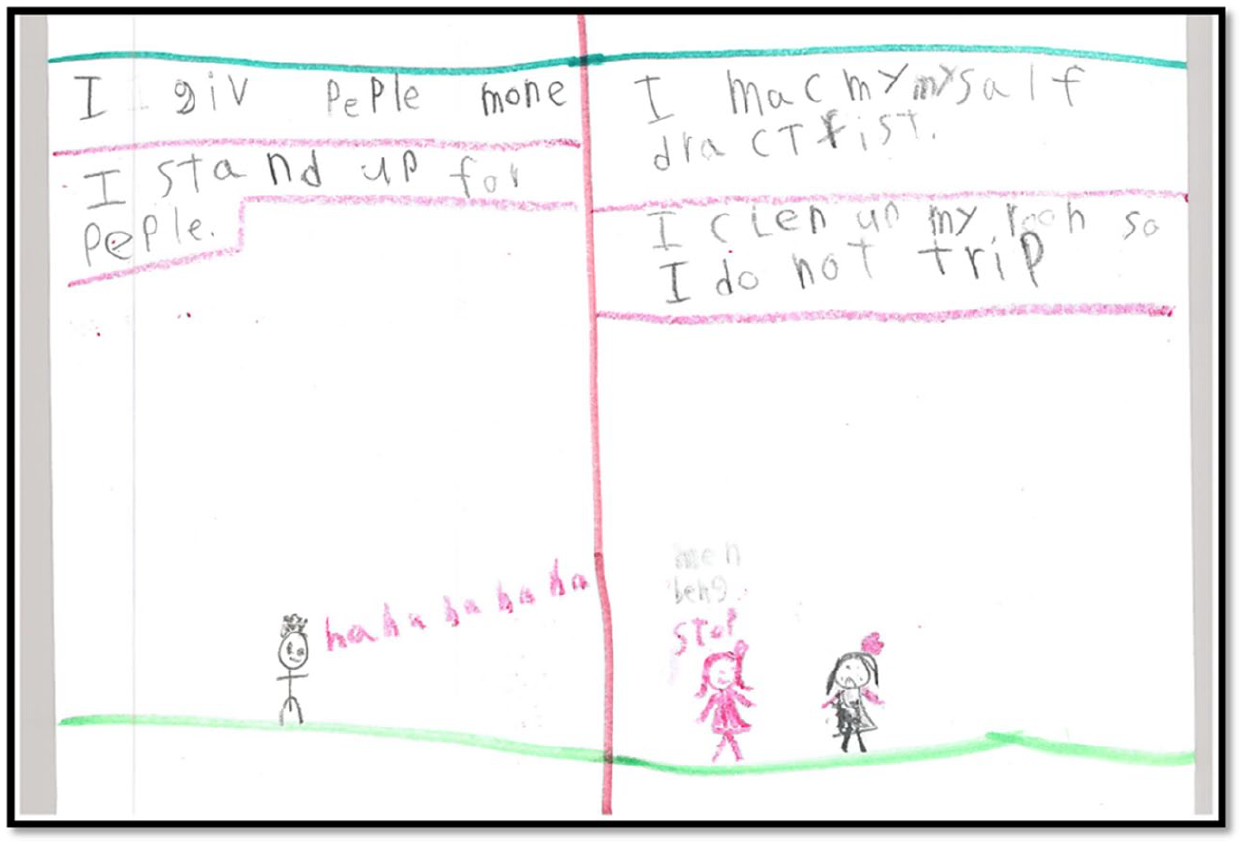
Lina’s writing.
Acting on behalf of others in relation to unjust acts or circumstances was clearly articulated by the students in their discussions, drawings, writings, role playing, and PSA videos, one example depicted a student being bullied in a school. The construction of the PSA demonstrates the students’ use of modes such as gestural, spatial, visual, and linguistic design (The New London Group, 1996). Two students greeted each other with a handshake and smiles. Another student approaches them and asks, ‘Can you help me find room 8?’ One of the students says, ‘No’, the second student joins in, ‘You should know where your classroom is’. The lost student sinks to the floor and covers her face and pretends to cry. Two other students talk off to the side; they approach the two standing students walking up to them quickly, ‘You have to stop bullying them’. The ‘bullies’ ask, ‘Why? It’s none of your business’, using stern tones and crossing their arms. The other two students move closer to them stating, ‘We’ll tell your parents. We’ll tell the principal’. The bully states, ‘We don’t care’. One points her finger in the bully’s face stating, ‘We’ll make a law’ (Figure 4).
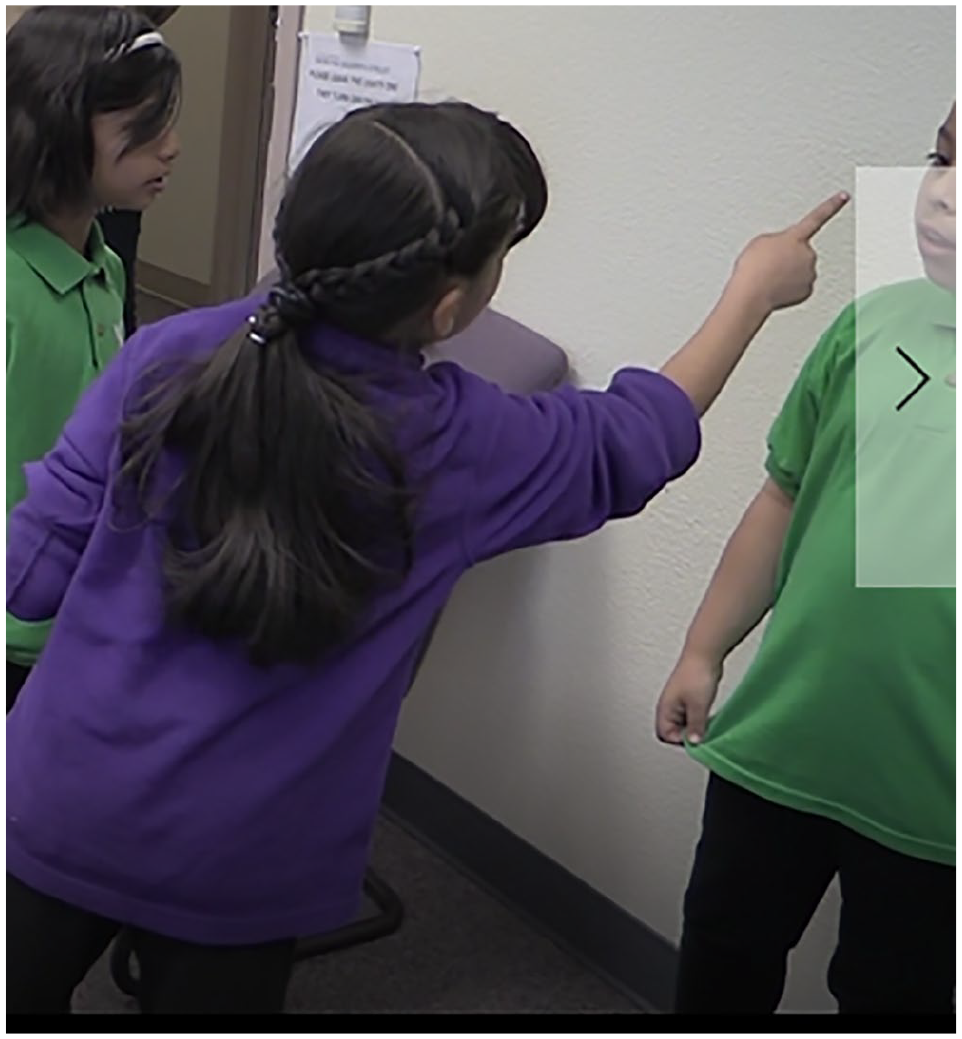
Bullying PSA.
The bullies, back up against the wall, look at each other and state, ‘I feel bad’ and apologize. The students in the group explained how they set up their work to show how ‘The bullies didn’t think about other people . . . and thanks to these two, they stood up and helped’. Although the PSAs were only a simulation of what students could do in the face of bullying, students did demonstrate their understanding of civic virtue engagement as standing up for justice by physically stepping into a space where unfairness was occurring.
The students also noted what happens when no one stands up to injustice. Upon revisiting the previously read text, The Terrible Things: An Allegory of the Holocaust (Bunting, 1989), the students evaluated the rabbits, who did not help the other animals as they were abducted. The students noted that the rabbits did not stand up for the rights of the animals in the community to be safe:
How might [the story] have been different?
If they stuck together.
Did they stick together? Did they help their community?
No.
What did they all do?
They all complained.
They all just let them down. They just left them.
What is the story trying to show you? What’s it trying to teach you?
You should do the community thing.
It means that you always have to be safe.
You have to help other people.
You have to help the community and your friends no matter what other people say.
The students understood the role of civic virtue and engagement in relation to standing up to others and the potential cost to those experiencing injustice if others do not step in. Based on the students’ understandings, we modified the next lessons to provide examples of other individual rights, a cornerstone of American democracy.
Standing up for individual rights
In democratic states, such as the United States, civic virtue is grounded in core ideals such as individual rights, liberty, equality, and the rule of law (Moore, 2012). The students understood the importance of standing up for specific rights such as standing up for peace through viewing Malala Yousafzai’s speech to the United Nations (UN) and reading the United Nations Convention on the Rights of the Child (https://www.unicef.org/rightsite/files/uncrcchilldfriendlylanguage.pdf), which lists 42 specific rights for children under the age of 18 and includes rights such as ‘the right to be alive, to a name, to be cared for, to be with your family, to give your opinion’. After viewing Malala’s speech, the students stated,
She has the right to play.
She has the right to talk.
She has the right to sing.
She has the right to have peace.
What does peace mean?
The right to stand up.
Malala was the one who is standing up.
She was speaking out loud and not giving up.
The addition of Malala Yousafzai’s standing up for girls’ rights to an education and the UN rights provided a broader view of what is just and unjust beyond bullying and racism. Additional activities included having students analyze photographs of situations depicting children without access to clean water, not being able to play with others, or not having access to health care, with the goal of evaluating what rights were violated. These examples were analyzed and discussed by the students as they brought the UN children’s rights into use as an evaluative tool of fairness/unfairness. When deemed unfair, students discussed appropriate civic engagement actions, such as letter writing, posters, and PSAs (Figures 5 and 6). They used the language of specific UN rights and connected them to new contexts and ideas along with means of taking civic action, as evidenced in the posters stating, ‘We have the right to speak up. Speak up! Stop making guns. Don’t be shy, Go and speak up!’ and ‘We have the right to stay alive!!!!! No! Knives- no guns- no bullets!!!!! No poison!’
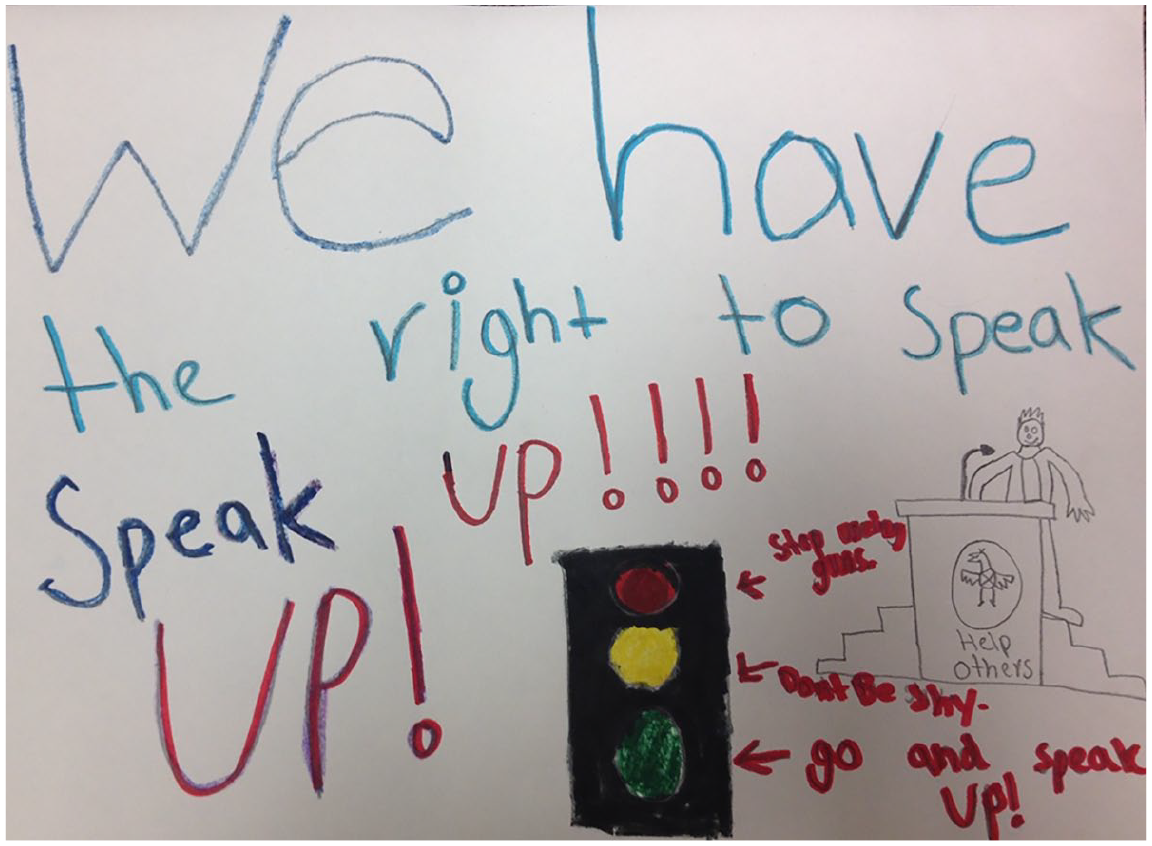
Right to speak up poster.
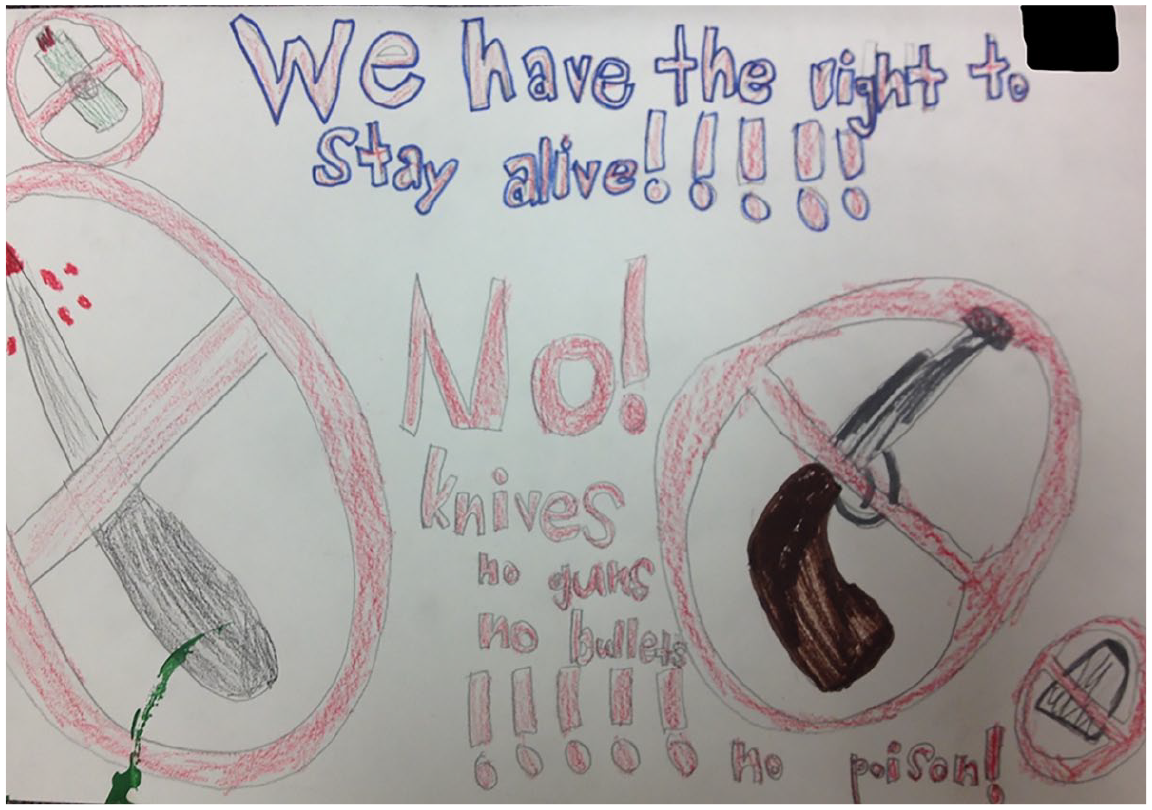
Right to stay alive poster.
Students also expressed their knowledge of their rights related to civic virtue (i.e. what was fair/unfair within the UN articulated Rights of the Child) and their responsibility to engage in civic life as they wrote letters to their principal about how they were bullied on the school playground, as well as to the current governor asking him to veto a proposed state law allowing guns on school property: Did you know that kids have to stand for thereselfs [sic] when they get bullyed [sic] at school? I am never stood up for. But I will always stand against bullying. ‘I have the right to stand up’
The right to be safe was also a repeated topic in students’ writing. Students wrote about the right to be safe from guns and violence, from bullies at their school, as well as the right to be cared for at home. These ideas were driven by the UN Rights of the Child statements shared but they were closely connected to students’ experiences as depicted in student letters to the governor: I was hearing the news . . . that they were allowing guns in [schools]. I go to class in the [school] and I am afraid there [sic] gonna shot [sic] me and my classmates so is there anything that you can do to change that? There is news about having weapons in [schools]. I think it’s dangerous for me and everyone else. Can you do something about it?
While the students did not hear from the governor, their actions resulted in meeting with the principal to problem solve the bullying. Student letters demonstrated Freedman et al.’s (2016) characteristics of ethical civic actors (p. 109) by determining that allowing guns or bullying in schools was a civic matter and they expressed concern about themselves and others. Their chosen form of deliberation was to contact leaders, and their letters were a way to engage and make a difference. Students recognized their rights and worked to stand up for themselves and others.
Overall, findings indicated that the students understood the concepts of civic virtue and civic engagement and were able to demonstrate that understanding in complex ways, through a variety of mediums as they designed and developed products (Kress and Van Leeuwen, 2001) focused on civic virtue and engagement. Student groups planned and constructed videos, letters, and protest posters in response to the lessons related to the unit goals of civic virtue and children’s rights (UN, 1990). Multiliteracies pedagogy (The New London Group, 1996) was effective for bringing CDL into the elementary classroom. The students’ redesigning and production of new representations of their understandings of civic virtue and engagement were clear and reflected their abilities to bring transformed meanings of civics to their classmates beyond simple reproduction of existing designs.
Discussion
Results indicate that when explicitly designed and taught, students can understand and apply concepts such as civic virtue and engagement to individuals from history, to their own lives, and to a global context using their understandings of civic virtue to design educative examples of engagement and calls for action. Students’ definition of civic virtue as standing up to injustice and their ability to evaluate engagement in relation to a given framework (i.e. the UN Rights of the Child) was clear. Their moral sense of what was unfair in a critical and justice-oriented (Westheimer and Kahne, 2004) understanding of civic life relates to existing theoretical frames by Kohlberg (1981) who identified how children’s moral development is honed in on justice with a focus not only on the self but on notions of the social order. Students responded by positioning themselves as ‘ethical civic actors’ (Freedman et al., 2016: 109) with clear examples of what it looked like to stand up for others, even though it might be difficult. With support and strong social studies instruction, education can prepare elementary students to be civic actors and Hanna’s expanding communities’ model (i.e. self, family, neighborhood) (Stallones, 2002) can be pressed further to include current and relatable issues that students are aware of and often experience. It is important to note that while the students did recognize when and where they could engage in civic life, their understandings in this unit did not reflect the collective action need to work against systemic injustice.
Elementary children are capable of conceptual understanding and application of social studies concepts beyond what is expected of them, particularly in history (Seixas, 1996; VanSledright, 2002). The students understood the historical figures’ experiences of racism and actions within their historical contexts, that when Harriet Tubman lived, human slavery was legal in the United States and it was wrong, that when Ruby Bridges was denied the right to go to a White school because she was Black it was wrong. These examples facilitated the ability of the students to transfer conceptual understanding of civic virtue and engagement from history into their current lives. However, the social studies textbook was not a history textbook and it was not organized chronologically, nor did it address the master narrative of racial injustices. Therefore, our use of history as a means to teach civic concepts had limitations in that we did not focus solely on teaching about the history of racism. Several adjustments (e.g. bringing in timelines for chronology, teaching specific events in history) were made throughout the unit to clarify historical and structural information for the students not present in the teaching materials required of the teacher.
Our work with students demonstrated that they can learn social studies concepts via multiliteracies. While information can be gained by reading and discussion, the use of multimodal instruction allowed the students, who were not all reading and writing at the same level, to expand their learning in embodied modes that transferred across contexts. These notions are particularly salient with elementary student populations (e.g. young students, second language learners) who struggle with more limited uses of literacy relegated to just reading and writing. The students were able to be actively engaged in creating their understandings using elements from the available designs and engaging in the process of designing and redesigning their understandings (see Table 1). Using available designs, students drew pictures, engaged in dialogue, and role playing to convey their learning and reflect the instruction modes of teaching using photos, videos, stories, and primary sources. Bringing the elements of design (audio, spatial, gestural, visual, linguistic) into civic conceptual instruction provided students with opportunities to see what makes a concept such as civic virtue applicable not only to historical figures such as Harriet Tubman but how it can be constructed and become a part of their own lives and civic identities. Students were engaged in both reproducing the available designs of the concepts but also transformed their understanding by redesigning as ‘founded on historically and culturally received patterns of meaning . . . a transformed meaning [where] meaning makers remake themselves. They reconstruct and renegotiate their identities’ (The New London Group, 1996: 23). When coupled with social studies conceptual foci and content knowledge, aspects of design allow for close examination of how to construct learning experiences that reflect both disciplines. Defined as standing up for yourself and for others to make things fair, the elementary students in our study understood the concepts of civic virtue and engagement in various historical and current contexts at their developmental level.
Implications
Are we preparing our children to fulfill their role as informed and engaged citizens in our democracy or are we simply teaching them to read, write, and complete mathematical problems devoid of understanding the civic contexts integral to participating in our democracy? At a time in the United States when political movements are increasingly prevalent, elementary schools are not providing the necessary social studies knowledge and skills to navigate civic issues. We argue for a justice-oriented civic curriculum focused on civic virtue, engagement, and the common good as a driving force of education beginning in the early grades which would require a focus on curriculum design and teacher knowledge development at the elementary level. At the end of a lesson about Ruby Bridges’ work with children, the students discussed the way she taught children today through her foundation, Peter summarized their thoughts, ‘Teaching children . . . There could be a new generation to stop them from being mean to other people’. We recommend additional research focused on educating young children from a justice-oriented civic perspective. Child development scholars have theorized and studied how young children understand notions of fairness and rules for decades (see Kohlberg, 1981), yet research on children’s developmental conceptions and applications of justice related to specific democratic principles has not been clearly documented. Democracy is in need of civic engagement encased in civic virtue at all levels. Elementary students must know the foundational concepts of democratic engagement to understand how and why to stand up for themselves or others.
