




Abstract
Research on Black girls’ and women’s literacies reveals how they utilize literacy practices to resist oppression and define their identities. Yet, these practices are frequently absent from or marginalized in formalized schooling spaces. In addition, Black girlhood is rarely placed at the center of equity interventions in schools. As the history of activism in the United States is tied to Black women’s struggles for freedom, research and practice involving racial equity must be attentive to the literacies and activism of Black girls. Grounded in Black feminist theory, this article describes a longitudinal study of the critical consciousness development of two young Black women as they engaged in distinct literacy practices to navigate and resist racial oppression in high school. The author analyzes interviews as well as literacy artifacts to explore how these girls enacted critical, digital, and subversive literacies to challenge intersecting oppressions of race and gender in a predominantly White, suburban school.
Keywords
For to survive in the mouth of the dragon we call America, we have had to learn this first and most vital lesson—that we were never meant to survive.
In the summer of 2020, the United States witnessed a wave of protests sparked by the extrajudicial murders of George Floyd, Breonna Taylor, and Ahmaud Arbery. Primarily organized by youth activists, these demonstrations led to widespread calls for racial justice within schools and institutions and increased support of the Black Lives Matter (BLM) movement across many mainstream platforms. Just as the BLM movement was organized by Black women activists (Alicia Garza, Patrisse Cullors, and Opal Tometi), the 2020 BLM protests were also predominantly led by young Black women who, as subjects of intersecting forces of structural inequity, were not unfamiliar with the impacts of racial injustice or with the necessity of resisting oppression as a means of survival. Attention to Black women’s activism is critical to understanding social change movements in the United States because “as long as social justice remains elusive for African-American women, it is likely to evade U.S. society overall” (Collins, 2009, p. 238). Thus, the existence of true justice in society is predicated upon the empowerment of Black women (Muhammad & Haddix, 2016).
Years before the 2020 BLM protests, a group of young Black women attending a predominantly White suburban school similarly attempted to resist racial oppression and marginalization in their community but were met with punishment, rather than support or acceptance. These girls’ experiences are indicative of the challenges Black girls and women face in resisting their marginalization and the resilience required to continue to fight for their liberation. As Black female students in the same school, Layla and Aaliyah (the chosen pseudonyms of the two focal participants in this article) experienced the invisibilizing of their identities and the policing of their literacy practices by peers and school administrators, leading to their development of subversive literacies as practices of freedom, celebration, and critical consciousness.
In response to Sealey-Ruiz’s (2016) call for researchers to understand the impact of educational inequality on Black girls and to “create strategies and actions to interrupt them” (p. 294), this longitudinal research study of a group of young Black women from a suburban school community examines Black girls’ critical literacy and critical consciousness development through a Black feminist theoretical lens. In the absence of a school curriculum or environment that was safe for or supportive of their intersectional identities, these girls’ literacy practices became essential to their survival and particular forms of Black girl activism.
Black Feminist Literacies as Critical Thought and Action
The history of civil rights movements in the United States reveals that Black women’s intersectional identities play a critical role in the fight for equity for all oppressed communities (Patton & Njoku, 2019). Yet, little research exists that traces the development of Black women’s sociopolitical awareness and activism from adolescence and through experiences in school. As Black women and girls are especially subject to the overlapping forces of racism and patriarchy, understanding their development of sociopolitical awareness and action is essential to understanding the role of critical consciousness in individual and social transformation.
Critical Literacies and Multimodal Literacies
As an approach to developing sociopolitical understandings of the world, critical literacy development is an essential component of social transformation. It rests on the notion that one must first be able to name and analyze the world to remake it (Freire, 1983). This naming involves critical analysis of structures of oppression and how they intersect to create individuals’ realities. A critical reading of print and digital texts can encourage students to “question power structures that lead to restricted opportunities for marginalized groups” (Price-Dennis, 2016, p. 338). Because Black girls face multiple forms of oppression and experience the world differently than White girls and Black boys do, their development of critical literacies is distinct, complex, and crucial to their daily survival (Young et al., 2018).
Collins (2009) explained that the subjugation of Black women’s knowledge has led to Black women’s engagement with “music, literature, daily conversations, and everyday behavior as important locations for constructing a Black feminist consciousness” (p. 270). Exploring the multimodal literacy development of Black girls is thus necessary for understanding how they analyze and act upon their social worlds, including how they develop subversive forms of resistance through mediums such as art and poetry. Albers et al. (2012) described art as “a subversive language, a way to communicate social issues through metaphor” (p. 189). In particular, the format of collage serves to elicit “multiple narratives” of the artists’ inner and outer worlds and can lead to new ideas and understandings (Plakoyiannaki & Stavraki, 2018, p. 313). In their research of a secondary ethnic studies class, de los Ríos and Molina (2020) discussed how students’ critical and visual literacies represent “innovative, cultural displays of everyday knowledge” as well as “civic dialogue with institutions” (p. 47). These critical and visual literacies provide a mechanism for youth to develop sociopolitical perspectives and respond to injustices in their communities.
Black Girl Literacies
Black women’s literacy practices in the United States have historically been tied to their quest for freedom and social transformation (Price-Dennis et al., 2017). Elizabeth McHenry’s (2002) work has documented the rich legacy of Black women’s literary societies and how “the practices of free black women in literary societies . . . embodied the contradictory demands that they faced to be simultaneously meek and vocal, submissive and assertive” (p. 63). The development of what I herein refer to as “subversive literacies” stems from this history of Black women utilizing their literacy practices to resist oppression and assert their freedom while circumventing surveillance structures that would otherwise attempt to erase and punish their resistance.
Price-Dennis et al. (2017) define Black girl literacies as “specific acts in which Black girls read, write, speak, move, and create in order to affirm themselves, the(ir) world, and the multidimensionality of young Black womanhood and/or Black girlhood” (p. 5). Much of the extant literature exploring Black girls’ literacies focuses on after-school or out-of-school programs designed to engage Black girls in reading and writing practices (Muhammad & Haddix, 2016). Winn’s (2010) study of formerly incarcerated Black girls in a playwriting and performance program examined how the girls used their writing, speaking, and performing practices to “navigate their way out of labels and stereotypes” (p. 444). Based on a literacy collaborative rooted in “Qur’anic principles and writing for social change,” Muhammad (2015) discussed how Black, adolescent, Muslim girls who participated in this community-based summer program created protest poems to analyze and resist disempowering structures in society (p. 288). Similarly, McArthur and Muhammad’s (2020) study of the Black Girls WRITE program emphasized the tradition of Black women’s resistance literacies in analyzing how the young Black women in the program utilized their writing practices as tools for resistance.
An emerging body of research has begun to explore how Black girls develop literacies, identities, and agency through digital and social media platforms. Richardson’s (2006) study of hip-hop literacies explored how Black adolescent girls understood the meanings portrayed in hip-hop music and videos and how these understandings impacted their perceptions of themselves and their social worlds. McLean’s (2013) research revealed that online communities can serve as a space in which Black (immigrant) girls can exercise agency in (re)defining their social identities and resisting those that have been constructed for them. Price-Dennis’s (2016) study of a codesigned, multimodal, social justice curriculum in a fifth-grade English language arts (ELA) classroom found that curriculum focused on current sociopolitical issues provides space for Black girls to develop critical and digital literacies for analyzing the intersections of social justice, power, and activism. In contrast to this empowering curriculum, most existing research on the in-school literacy practices of Black girls reveals that these practices are directly tied to their experiences of isolation and marginalization within schools and in society as well as to the intersections of their raced, classed, gendered, and sexualized identities (Kelly, 2016; Muhammad & Haddix, 2016). Sutherland (2005), for example, found that a group of Black girls reading Toni Morrison’s The Bluest Eye in a racially heterogenous class viewed the classroom as a risky space for sharing their perspectives on the text due to their Black female identities.
As Muhammad and Haddix (2016) explained, In light of the current and ongoing assaults on Black girls and the damaging instructional practices in and outside of schools across the nation, literacy educators must understand a more complete vision of the identities girls create for themselves, and the literacies and practices needed to best teach them. (p. 301)
While the study of Black girls’ literacies is notably “complex” (p. 304), it is these very complexities that must be intricately examined to develop justice-oriented teaching practices for Black girls and for young people more broadly (Muhammad & Haddix, 2016).
Black Girlhood and Critical Consciousnesses
The idea of critical consciousness, or conscientização, was first introduced by Paulo Freire (1970) to describe the process by which individuals who are marginalized within society become aware of and take action against the intersecting forces of oppression that impact their lives. Developmental perspectives on critical consciousness, such as those of Watts and Hipolito-Delgado (2015), describe the components of critical consciousness as involving critical social analysis, collective social identity, political self-efficacy, and sociopolitical action. Scholars such as Duncan-Andrade and Morrell (2008) and Seider et al. (2017) posit that in addition to the ability to analyze and challenge structural oppression, critical consciousness also involves developing capacities for navigating such structures.
Research on youth critical consciousness development primarily focuses on structured approaches to the sociopolitical development of youth of color and urban youth through particular pedagogical and activist frameworks. While some of this research focuses specifically on the critical consciousness of particular subgroups, such as Black boys and men (e.g., Smith & Hope, 2020; Watts et al., 2002), existing literature has yet to address the nuanced experiences of Black girls and women in their development of critical consciousness, especially across distinct geographic contexts. A Black feminist approach conceptualizes critical consciousness as “a politicized understanding of the world and one’s positionality that fuels action and activism” (Patterson et al., 2016, p. 58) and centers these understandings as essential to Black women’s survival and resistance (Collins, 2009).
Rooted in Black feminist epistemologies as well as theories of youth critical consciousness development, this article builds on the recent work of “Black critical liberatory literacies” (Richardson, 2019, p. 22) scholarship to explore how Aaliyah and Layla navigated and challenged the racial oppression within school structures and practices in a predominantly White school environment. While much extant research on critical literacy development in schools examines how teachers engage their students in critical literacy practices as a form of resistance to societal oppression (Skerrett & Warrington, 2018), scant research examines students’ development of critical literacies as resistance to oppression within school. Through individual and focus group interviews, as well as artifact analysis, this study examines how Black female students develop and enact critical literacy practices as a component of critical consciousness and as a form of healing in response to the racial injustices they experience and witness both within and outside of school.
Method
Context of Study
This research study came about as a direct response to the racial injustices I witnessed as a Black woman teaching English in a public high school herein referred to as Apple Valley High, located in a suburban school district that was racially and economically diverse relative to neighboring communities, yet predominantly White and middle-class. As one of three Black teachers among a faculty of just over 100, I experienced racial slights and microaggressions committed by students and colleagues. The Black students that I taught and knew at the school experienced these injustices even more profoundly as youth who were further disempowered by their age and, for many, their socioeconomic status. For Black girls at the school, their gender identities added an additional layer of marginalization and vulnerability. I was made aware of the particular experiences of Black students at the school through the stories that these students would relate to me after class, after school, and sometimes after they had graduated.
While many of the students expressed that their strategy for surviving a racially oppressive school environment was to “smile and nod” until graduation, there were others who refused to participate in that type of performance. Unsurprisingly, those who openly expressed resistance against racial marginalization in school were primarily Black girls. As an English teacher at Apple Valley High School during the months preceding the 2016 U.S. presidential election, I became aware of the resistance of these girls through their class writing, including speeches and poems, much of which explicitly challenged the ideologies of Donald Trump and his supporters. These examples of Black girl resistance against racial and gender oppression seemed to be occurring among a particular class of students, indicating that there was something about their collective experiences as well as the sociopolitical climate of the time that impacted their political self-efficacy (Watts & Hipolito-Delgado, 2015). I became interested in learning more about these girls’ experiences of critical literacy development and the impact of this development on their activism. Consequently, the study discussed herein was designed to explore the following questions:
How do Black girls in a racially oppressive school environment analyze, navigate, and resist racial oppression through their literacy practices?
What role can schools play in fostering (or limiting) the critical literacy and critical consciousness development of Black girls?
Research Design
The design of this research study draws from Black feminist methodology, which responds directly to the needs of Black women and centers their “voices, experiences, and lives” (Patterson et al., 2016, p. 56). Research engaged through a Black feminist lens focuses on the intersections of race and gender as they pertain to Black women’s experiences, centers Black women’s embodied knowledge and self-definition, and invites Black women to learn from and with each other. As a critical response to traditional research, a Black feminist methodology actively resists the distortion and devaluing of Black women’s knowledge and challenges “white male interpretations of the world” (Collins, 2009, p. 269). These methods include debunking an “assumed separation” between the researcher and participants, engaging in a “robust exchange of ideas” through data-collection processes, and presenting research results and interpretations that best serve the community of the participants, rather than the interests of the researcher (Patterson et al., 2016, p. 59). A Black feminist methodology recognizes that the research context and processes of this study are inextricable from my own experiences as a Black woman and former student and teacher in the same community that fostered the development of the participants. It reveals my subjective role in the research process and the responsiveness of the study to the individual and collective needs of the girls involved and their shared communities.
As Black feminist theory is grounded in the collective struggle of Black womanhood, I approached this study through the lens of collectivity, centering the participants’ experiences of sisterhood in the research design and process. As an approach to learning about the critical literacy practices of Black girls who resist marginalization in predominantly White schools, I set out to recruit a group of five girls who attended Apple Valley High and had, at some point, expressed resistance against racial oppression in school. I designed the study to take place over the course of one academic semester and to include an initial 90-min semistructured focus group interview with the participants, followed by individual 1-hr structured interviews with each of them and a second 90-min semistructured focus group interview to follow up on responses from the previous interviews. (See the appendix in the online repository for the initial focus group and individual interview protocols.) Through this design, I intended to provide a safe, generative space for participants’ storytelling and healing at the same time that I could learn from their stories about their critical literacy development and the role that schools can play in fostering this development.
Willis et al. (2008) called for critically conscious research in language and linguistics to examine how participants’ cultures, knowledges, and realities are part of the research process, influencing research design, analysis, and presentation. Similarly, Luttrell (2005) discussed how participants may “actively shape the research process” (p. 247) through their contributions to the research as well as their interpretations of what the research is and could be. This research project was initially designed as a semester-long narrative inquiry of the K–12 schooling experiences and literacy practices of the participants; however, after the first two focus group interviews, it was clear to the group that there was much more to discuss. Thus, the study was extended to include a third, unstructured, 2-hr focus group interview that took place in May of that academic year, shortly before the girls graduated. This interview followed up on the girls’ experiences in school since the previous group interview and included their plans for college. In addition, the girls’ descriptions of the collective space developed through focus group interviews as “a place where people can like just talk about being Black in a safe [space]” (Marissa, focus group interview transcript, May 17, 2018), as well as their request that their teachers and administrators learn from this research, led to a restructuring of the study. This research has thus evolved to become a longitudinal exploration of the participants’ critical literacy development and activism, including how these young women reflect on their current and past schooling experiences through the lens of their developing understandings of themselves and of the world.
These additional group meetings/interviews, which occur once a semester, are loosely structured. They begin with general updates, followed by specific questions about the girls’ college experiences and the current sociopolitical climate, opening into free-flowing dialogue. In this way, these sessions serve as more than a site of research, but also as a space for “meaningful conversations” (Patterson et al., 2016, p. 60) about Black girlhood and womanhood. Notably, while most of the sessions thus far were scheduled to last between 60 and 90 min, almost all of them exceeded the scheduled time, sometimes by hours. This is largely due to the organic dialogue that occurs when this group gets together, sharing recent stories, insights, and life changes while also reflecting on their individual and collective past experiences in school.
Setting and Participants
The participants in this study were recruited based on their position as Black female students in Apple Valley High School. According to the 2020 U.S. World News Report, the racial demographics of the Apple Valley student body, which consists of approximately 1,300 students, includes 60% White students and 40% students of color, including Black (14%), Asian (14%), “Hispanic” (9%), two or more races (2%), and American Indian (1%). With more than 50% of the student body identified as White, I consider this to be a predominantly White high school. However, it is notable that even with 40% of the student body consisting of non-White students, the faculty, curriculum, and culture of the school (i.e., elective and extracurricular offerings, imagery in the classrooms and hallways, invited guest speakers) are largely representative of White, Eurocentric histories and identities.
I began recruitment for this study by inviting Marissa, a former student who at the time was a rising senior at Apple Valley High, to participate in the study and to recommend students at the school who might be interested in participating. Through this process, five Apple Valley High students, in addition to Marissa, volunteered to participate in the study. After the first focus group meeting, an additional student, Kerry, learned about the study and volunteered to participate. A total of seven participants are involved in the study: Aaliyah, Jasmine, Kerry, Layla, Lillian, Marissa, and Monica. All seven of these girls were in their senior year at Apple Valley High at the beginning of this study and had been in the Apple Valley school district since elementary school. All of these girls were also friends and had expressed interest in ending racial oppression through class assignments, poetry, art, in-school organizing, or dialogue with each other.
In the first year, interviews were conducted in a private meeting room at the local community library. Meeting at the library allowed for easy access to the research site by participants (it was within walking distance from their school) and reflected some of the grounding principles of the study, including literacy and community. In the second and third years of the study, the library was undergoing renovations and no longer provided meeting spaces. Instead, our group meetings took place in restaurants located near the students’ home communities. These meetings took place when the girls were home on breaks from college. In addition, the COVID-19 pandemic necessitated that our 2020 gathering took place online via the video-conferencing software Zoom.
Data Collection
The total data collected over the 3 years of this ongoing study consist of six focus group interviews, nine individual interviews with the seven participants, three e-mails from two of the participants, four poems, a poetry anthology, and four pieces of visual art. (See Table 1 in the online repository for an overview of the data sources discussed in this article.) While all of the participants’ narratives provide powerful cases for examining Black girls’ resistance literacies, I found the trajectories of Layla and Aaliyah especially compelling for this study. During their 10th- and 11th-grade years in high school, both girls expressed explicit critiques of racism in their school environments by engaging in digital literacy practices through social media; both of them were subsequently disciplined by the school administration for expressing their views in this manner. After these respective incidents, both Layla and Aaliyah distanced themselves from explicit resistance against racial oppression in school and instead expressed their ideas through literacy practices that were visible, yet covert. This transition from overt to more subversive critical literacies reflects a powerful tension regarding the development and silencing of Black girls’ literacies and identities. To explore this tension, this article focuses on the narratives of Layla and Aaliyah by examining the data reflected in Table 1. Focusing on this particular set of data allows for an examination of the forms of resistance that these girls enacted through their literacy practices as well as how these practices were influenced by their social contexts.
Data Collected and Analyzed in “Exploring Black Girls’ Subversive Literacies” (in Chronological Order).
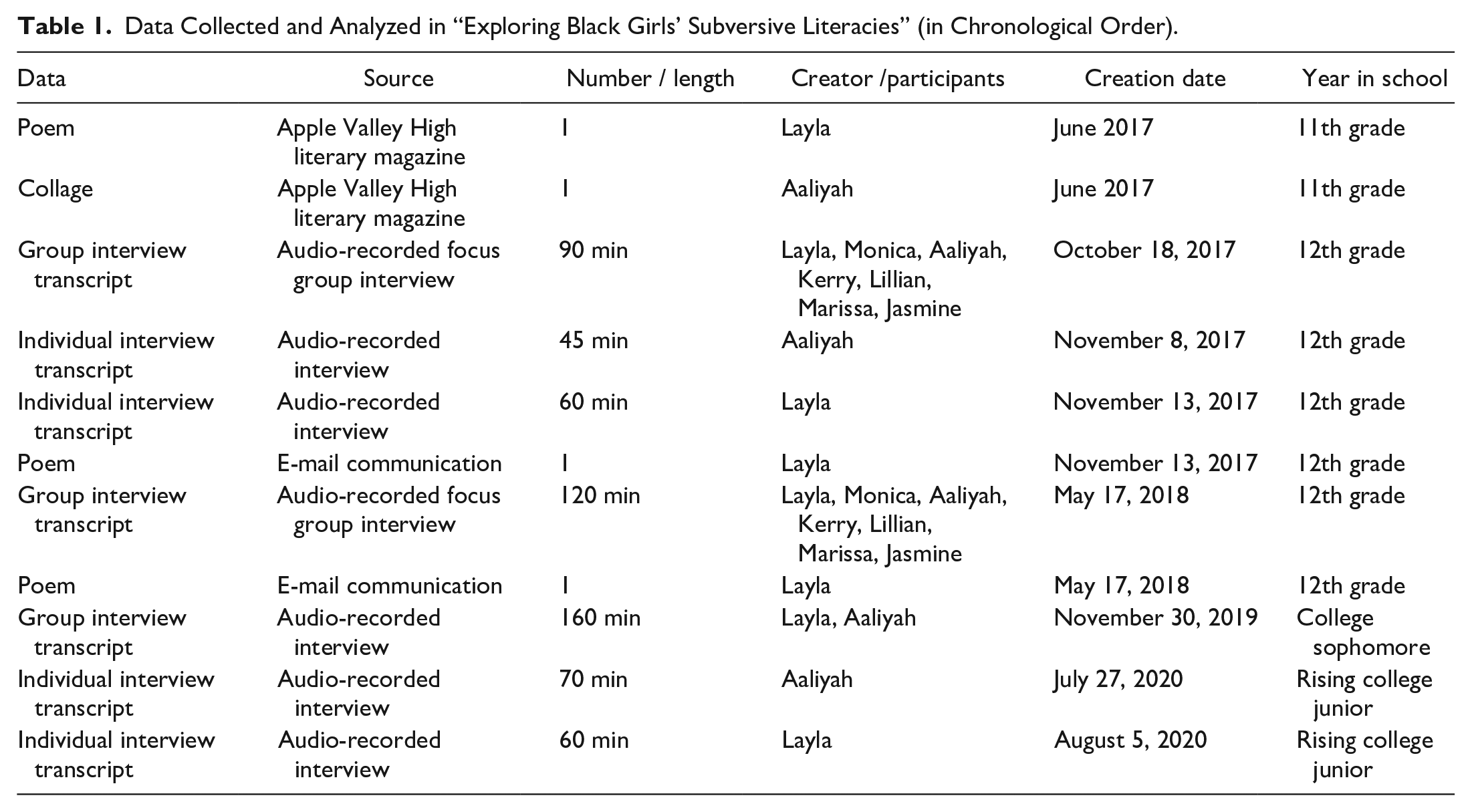
Data Analysis
My approach to data analysis is informed by Black feminist methodology, which “privileges embodied knowledges that emerge” when Black women speak their truths (Patterson et al., 2016), and by Luttrell’s (2005) description of “life stories” as a form of data that explores women’s “identities and self-understandings” (p. 247). In analyzing and presenting the findings of this study, I was committed to creating “opportunities for self-definition and self-determination” by portraying the girls through their own words, sharing their narratives in ways that make visible “multiple truths,” and centering the interests and values of participants as a collective (Patterson et al., 2016, p. 60).
As an approach to making sense of the life stories of the girls involved in the study, I analyzed data through Luttrell’s (2005) three-step coding method, reading and rereading the interview transcripts. This process included “member reflections” (Tracy, 2020), in which I shared emerging findings with participants to receive feedback on my understandings and interpretations of their stories. In the first stage of coding, I took note of recurring ideas, words, themes, and experiences. (See Table 2 in the online repository for examples of first-level codes.) In my second reading of the interview transcripts, I identified moments in which the participants discussed their reading and sense-making of various forms of text, including print and media; reflected on their own critical literacy development; and described the responses of peers, teachers, and administrators to their challenging racial injustice through their literacy practices.
First-Level Coding Sample.
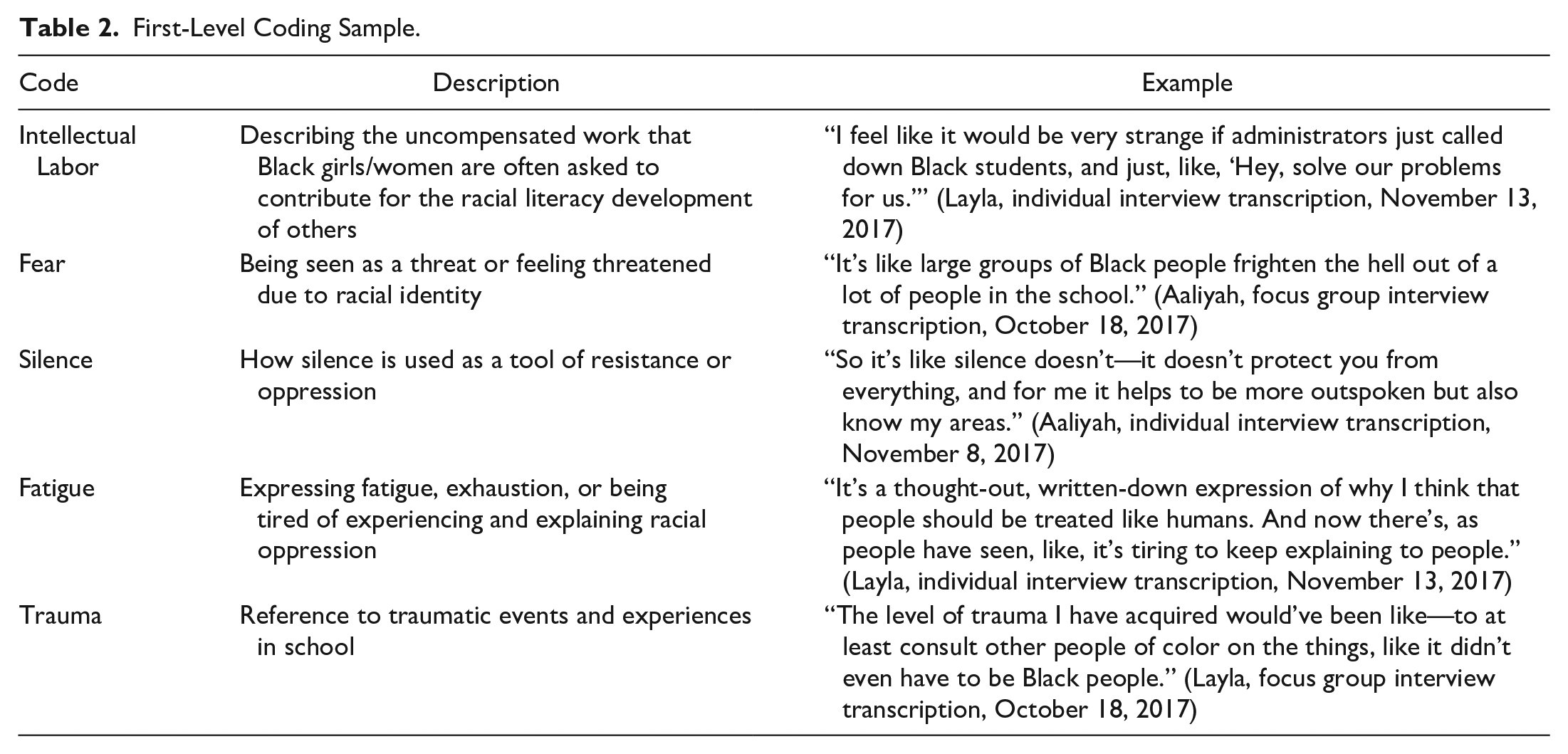
In my third reading of the data, I looked at patterns across Layla’s and Aaliyah’s narratives. During this phase of coding, I engaged in metaphor analysis, a qualitative method for understanding “the cognitive frameworks through which people are viewing their world” (Tracy, 2020, p. 252), as an approach to examining collage-making as both artistic expression and a metaphor for Layla’s and Aaliyah’s critical consciousness development. In the “Findings” and “Discussion” sections, I return to the study’s research questions as well as the conceptual frameworks undergirding this study to examine how Layla’s and Aaliyah’s strategies for analyzing, navigating, and resisting racial oppression in school are rooted in their respective abilities to collage their experiences into subversive forms of resistance.
A Note on Subjectivity
As a Black woman from Apple Valley whose time teaching in Apple Valley High School overlapped with the participants’ experiences as students in the school, I have been deeply invested in this research study not simply as a form of scholarship but more so as a means to amplify the voices of the participants; to create a space for these young women to heal, reflect, and develop a collective consciousness; and to identify strategies for transforming a racially oppressive school community into one that values, celebrates, and supports the critical development of Black girls and women. Admittedly, reading and rereading the data from this study was a heartbreaking process, mitigated only by the brilliance and beauty of these resilient young women and the hope that this research may play a role in transforming oppressive school structures into ones that are humanizing and safe for Black girls and women.
Findings
The narratives and artifacts shared by Layla and Aaliyah in this study reveal how their intersectional identities as young Black women within a school culture that views these identities as threatening led to their engagement with critical literacy practices, including the creation of poetry, art, and social media content, that allowed them to express their ideas and identities while resisting the hegemony that dominates their formal learning environments. In the following sections, I restory (Creswell, 2007) Layla’s and Aaliyah’s individual narratives by chronologically tracing their development of critical consciousness through the framework of analyzing, challenging, and navigating structures of oppression. These examples provide insight into how both girls attempted to resist racial oppression in school through digital literacy practices, the consequences of this resistance, and the transformation of their critical literacy practices into ones that are safe and affirming.
Developing Critical Literacies for Social Analysis and Self-Definition
The examples in this section reveal how the participants developed critical social analysis, an essential component of critical consciousness development (Watts & Hipolito-Delgado, 2015), and how their identities as young Black women impacted this development. As minoritized students in their school community, Layla and Aaliyah developed critical understandings about themselves and the world through their daily encounters with racial microaggressions from peers, teachers, and administrators. Aaliyah referred to these critical understandings as a form of “self-awareness” that is an inevitable component of Black girlhood: For a lot of Black girls, it’s like you’re not able to be slightly ignorant all the time. You’re forced into a state of self-awareness and awareness of the ignorance of the world around you and the hate and the violence that you’re not able to just . . . You can’t just ignore everything. (Aaliyah, focus group interview transcript, November 30, 2019)
As Aaliyah described, this hyperawareness is a form of self-preservation that requires Black girls (and women) to develop critical understandings of the world to arm themselves against it.
Raggedy PDFs
During our one-on-one interview that took place during Aaliyah’s senior year in high school, she shared how her process of critical literacy development began on the internet and provided her with the language and frameworks that she needed to better understand her sociocultural world: I didn’t have a language to talk about it, and I also didn’t know just where to start. And so, that’s where reading really helped me . . . At first it was online PDFs of these books . . . I remember my first book about feminism and stuff like that was some raggedy PDF that I found on Google Drive that I would just take screenshots of and read on the bus . . . and then it sort of expanded into buying books. (Aaliyah, interview transcript, November 8, 2017)
Aaliyah’s reflection highlights the overlap of her digital and critical literacies and the significant role that books played in her critical literacy development. Aaliyah’s independent consumption of digital and print texts stands in stark contrast to her description of in-school reading: The books that we read in school are very . . . you could say, white. And if we do read books about the Black experience it’s like, “segregation, slavery is bad.” And we read stuff like—Huckleberry Finn . . . and it’s like the conversations that we have about racism is . . . ridiculous . . . It’s not like we’re talking about the [school-to-]prison pipeline and stuff like that. . . . It’s like, “So racism is bad. Write an essay about how racism is bad.” (Aaliyah, interview transcript, November 8, 2017)
As a critically literate high school senior, Aaliyah was able to critique the pedagogical strategies and assessment techniques of her teachers and challenge the superficiality of the race-based discourse that, when it did occur, maintained a narrow view of Blackness and racism. While young people’s critical development is an essential component of the global struggle for social justice (Seider et al., 2018), developing critical analysis on one’s own can have the opposite of the intended effect, leaving young people who are critically aware alone to process their anger and frustrations without a space for critical dialogue or support. For Aaliyah, social media and Black feminist literature became that space, making up for the critical learning that was missing in school.
Intellectual labor means something
Layla also described reading as a significant component of her critical literacy development. However, in contrast to Aaliyah’s print text consumption, Layla increasingly gravitated toward digital texts, explaining that much of her critical analysis grew from conducting internet-based research into civil rights, “more than, you know, what we were taught in fourth grade about how Martin Luther King was a hero. . . . I don’t really buy books anymore; everything . . . I read now is articles” (Layla, interview transcript, November 13, 2017). In addition to consuming online texts, Layla also relied on digital spaces to connect to like-minded thinkers and share her perspectives via social media: Instagram, for me, was always more political. . . . So, first, it started, like, me following mainstream pages on Black girls . . . and having the memes from Twitter. . . . And then I started getting into . . . pages of allies; I started looking at a lot of feminism pages, stuff like that. And then, of course, there’s always people trolling, or they genuinely don’t understand, and comments like, “Why is this this way? Why do you think that?” so then I’d be explaining a lot, writing whole paragraphs on Instagram. And so, that’s sort of the literacy aspect of it, ’cause it’s thought-out, written-down expression of why I think that people should be treated like humans. (Layla, interview transcript, November 13, 2017)
While Layla initially enjoyed seeking allies, finding affirming images of Blackness and Black girlhood, and sharing her thoughts on Instagram, she eventually grew tired of explaining her views to people on social media, “because it’s exhausting, and intellectual labor means something” (Layla, interview transcript, November 13, 2017). The “intellectual labor” that Layla describes here, or the mental and emotional effort that Black women consistently find themselves undertaking to explain race and gender oppression to those who do not experience its intersections, has been documented to have a psychological, emotional, and physical toll on Black women (Patton & Njoku, 2019), and an even greater toll on girls who are still in the process of forming their identities. According to Price-Dennis et al. (2017), Black women’s intellectual work is grounded in their ways of thinking about and responding to their particular and collective experiences. Yet, rarely is this intellectual work valued in schools or institutions. In fact, when Black women challenge racial and gender oppression within institutions, they are oftentimes met with opposition, suppression, and other psychological deflections such as gaslighting, ultimately limiting their ability to succeed in these spaces. The following section shares two profound moments in Layla’s and Aaliyah’s narratives as they attempted to call attention to racism in their school.
Resisting Oppression Through Digital Literacies
Critical consciousness scholarship often describes critical social analysis as a “precursor” or a component in the cycle of developing political self-efficacy and activist practices (Watts & Hipolito-Delgado, 2015). In discussing their literacy development, Layla and Aaliyah each attributed much of their political self-efficacy to their participation in online communities such as Twitter, Instagram, and Snapchat. Naturally, their chosen vehicle for challenging racial oppression in school was through social media. However, when these instances of resistance through digital literacy practices intersected with their school community, they were met with opposition and punishment, severely impacting their political self-efficacy and motivation to actively resist oppression in school.
Going in circles
During her junior year of high school, just a few weeks after the 2017 presidential inauguration, Layla was frustrated by a confluence of events, including the election results, the recent "Muslim ban," and her school’s “lack of action” regarding Black History Month. In response to the latter, she decided to post a Snapchat “story” for each day of Black History Month that featured her discussing particular issues related to Black culture and racial oppression, such as “genres of Black music” and the use of “the N-word.” While Layla had volunteered to take on this intellectual labor, she did not expect the subsequent backlash from her peers. Distressed by the outpouring of racist ideologies in response to her posts, Layla brought this incident to the school’s administration, sharing screenshots of her peers’ comments as examples: “I told the administrator that I went to, ‘I don’t care if they get in trouble or not . . . but like something needs to be done . . . use it to try and teach people how to better address racial issues.’” After being called down to the administrator’s office to discuss this incident, the students involved started bullying Layla online. Layla responded by writing, “I’m not afraid of you.” When these students returned to the school administrator to share Layla’s response, she was sentenced to a full day of ISS (in-school suspension) for “being violent and threatening” (Layla, focus group interview transcript, October 18, 2017).
When Layla attempted to explain the racial context of the situation to the school administrator, “she kept arguing with me, and then she brought up—she’s like, ‘Oh, I’m Irish and Italian, and like people use this slur for me.’ And I’m like—I couldn’t even—I was just—I stared at her. I was like, ‘You’re white. It’s not the same.’” As Layla remembers, this “back and forth” continued for all of first period: At one point, [the administrator] was like, “You know, the period’s over. We’re going in circles now. My position still stands,” whatever . . . and I was angry, so I said to her, “I just want you to know that the people who brought this to you, saying that I was aggressive and whatever, they used you as a way to stereotype me, so they said that I was angry, and that made it easy for you to believe. . . .” She was like, “How dare you?” . . . this and that, whatever. She was like, “Get out of my face,” and I left. (Layla, focus group interview transcript, October 18, 2017)
For Layla, this incident with the school administrator only served to exacerbate the deep emotional impact of being betrayed by those she called friends, being the target of online harassment, and receiving disciplinary action in school for defending herself online. The intellectual labor that Layla associated with her social media posts can also be seen in this interaction with the school administrator who equated her Irish and Italian heritage with Layla’s experiences of moving through a White social context in a Black body. In Layla’s description of these events, the racism of peers and administrators were continuously met with Layla’s graciousness in not wanting anyone to “get in trouble” and giving the school administrator the benefit of the doubt that her “stereotyping” of Black students may not be “on purpose.” This patience and sense of responsibility for the critical growth of others is one of the burdens of Black womanhood that Layla, and many of the participants, faced in school.
Less than a year before Layla’s in-school suspension, months before the 2016 presidential election, Aaliyah was battling the daily microaggressions of seeing some of her White peers in school sporting Trump shirts, MAGA (Make America Great Again) hats, and confederate flags. In discussing this time period, Aaliyah recalled, I was going through like—I don’t wanna call it a radical phase, but it was kind of like a radical phase, because it’s like when you first find out about all these social issues, you’re overwhelmed. And then you’re just like, “I just wanna fight the power.” . . . and like you’re just very intense all the time. (Aaliyah, focus group interview transcript, October 18, 2017)
In response to her peers wearing racist attire without facing any consequences, Aaliyah used her Snapchat story to share a photo of two of her White, male classmates, with the caption “white supremacists.” The students and their parents were made aware of this post and contacted the school principal, who put her in ISS for using social media in school.
In recounting the incident during her senior year, Aaliyah admitted that her actions were “messy,” yet that did not, in her opinion, excuse the response of the administration, who did not use this opportunity to listen to her or to address racial inequity in school. Instead, they sat her in a room with two White administrators and lectured her on the dangers of “stereotyping.” Aaliyah remembers, I didn’t speak, because I just was like, “Well, this is gonna get me in more trouble,” so I just sat there, but he was—they were so condescending and rude for no reason. And the fact that like a matter of race was like on the table right here, right, and [they] didn’t even think to call in the one Black administrator in the school or any sort of Black professional. (Aaliyah, focus group interview transcript, October 18, 2017).
In this example, we again see the intellectual labor of Black women, as Aaliyah develops a critical, humanizing approach to school discipline, wondering why these two school leaders did not take the care, time, or thought to include a “Black professional” in this sensitive matter or to consider her positionality as an adolescent Black girl struggling to make sense of the racism she was experiencing in school.
Each of these examples reveals how Layla’s and Aaliyah’s efforts to challenge racial oppression and foster racial literacy in school resulted in resistance from peers and administrators as well as punitive disciplinary action for both girls. Unsurprisingly, one of the lessons that they took away from these instances is that within their school environment, speaking up proved to be more harmful than remaining silent.
Navigating Oppression: Silence as a Tool for Survival
Much literature on youth critical consciousness discusses youth agency and celebrates resistance to oppression through overt forms of activism; however, there is little discussion of what happens when youth agency is unwelcome, not only among school faculty and administrators, but also among peers. Layla and Aaliyah each discovered through their attempts at challenging injustice that their survival paradoxically required their silence and their resistance. This discovery served as a transformative moment for the literacy practices and agentive development of both girls. In describing her interaction with school administration, Aaliyah recalled, I said nothing because if I say something to someone in the heat of the moment, I’m going to regret it and it’s going to land me even further [in trouble] because if I tell you the truth you’re going to be even more mad. And so it’s like you can’t say anything to them. (Aaliyah, interview transcript, November 8, 2017)
This experience taught Aaliyah that since school leaders were unwilling to listen to or stand up for her, much less acknowledge the racism embedded in the school community, she would have to rely on her silence as a form of protection against and navigation of school structures.
In her experiences with school administration, Layla also found that her school leaders were unwilling to listen to her and that she was no longer willing to engage in the intellectual labor required to challenge systems of injustice in school. She explained, Even if you do say something, it’s very hard to—especially because these are adults—challenge their worldview and change it. So I feel like it’s—not that it’s not worth trying, but it takes a lot of energy to do so and [I] don’t really have that. (Layla, interview transcript, November 13, 2017)
Notably, Layla was willing to put in this energy prior to the digital and disciplinary incidents of her junior year, when she genuinely believed that her words might engender change. This shift in her political self-efficacy highlights the role of her school environment in limiting, rather than fostering, her critical consciousness.
“Out of the Scraps”: Subversive Literacies as Acts of Freedom
Extant research on youth critical consciousness does not account for the role of silence as a form of social action, yet as Collins (2009) asserts, silence is both a historical and critical component of Black women’s activism. Although Layla and Aaliyah had chosen silence over explicit action, they did not stop resisting oppression and affirming their Black girl identities through their literacy practices; rather, these practices took on new forms. Layla, for example, began to use her poetry to explore and express her sociopolitical views: I guess, politicized poems have been shared in class and such, like, for assignments. And if I have to write a poem, I will, so then, those get shared. And then, outside [of school], sometimes I use poetry to caption my Instagram posts. . . . I posted something on Saturday, on Instagram, that was actually from one of the poems that I wrote . . . on Black womanhood. (Layla, interview transcript, November 13, 2017)
According to Layla, because her school had not “been made into enough of a safe environment that we feel like we could address problems that we see” (Layla, focus group interview transcript, October 18, 2017), poetry became a “safe” approach to addressing these problems. After leaving the first focus group interview, Layla sent me an e-mail stating, “I actually wrote this in March in ISS on a scrap of paper.” The e-mail contained a link to this poem:
“To the Little Revolutionary”
Be careful, little lightning bug, when you spread your wings
Be mindful of the fire in your belly
There are those who will want to snuff you out
and put out your spark too young.
(Layla, e-mail communication, November 13, 2017)
Layla’s poem serves as both a warning and an inspiration for others like her who refuse to be silenced in the face of oppression. Through her poetry, Layla found that she was able to honestly express her ideas and identities without facing backlash or punishment, even when this poetry was shared in school. In fact, Layla shared that in the school’s student-run literary magazine, which was distributed in the spring of her junior year, she “and another person here and some girls who graduated all had work . . . and it was all about, you know, Blackness. . .because people are writing about similar experiences, especially now” (Layla, interview transcript, November 13, 2017). While Layla’s poetry became a space for her healing and sociopolitical engagement, her sharing these poems in the literary magazine resists the silencing of her ideas that she experienced when she expressed them aloud and through social media.
In a poem she printed in the magazine, entitled “I Am My Hair,” Layla uses the metaphor of hair to assert her own identity as “unwavering, unrelenting, uncooperative . . . unbreakable.” If Layla’s poetry serves as evidence of her critical consciousness development, her poems reveal her agency in resisting oppression and in carving out a space to celebrate her Black girl identities and critical literacies in a school that refused to honor them. By sharing her poetry in a schoolwide magazine, Layla engaged in the practice of subversive literacies, ways of reading, writing, thinking, and creating that subvert structures of oppression and marginalization within school.
As Layla mentioned, she was not the only Black girl whose work appeared in the school’s 2017 literary magazine; this same issue featured three magazine collages created by Aaliyah. Although Aaliyah had not mentioned her artwork during our initial interviews, I came across her collages in the magazine as I was looking for Layla’s poetry. Figure 1 shows one of three collages that Aaliyah published in the literary magazine. Aaliyah’s collage is bright and colorful, featuring powerful imagery of Black beauty and joy, including a smiling photo of rapper Kendrick Lamar and a close-up image of an impeccably braided Black hairstyle. The words gender and change reflect Aaliyah’s ideologies regarding hope and identity and social transformation. In juxtaposition to the small white font of the latter, her choice to place the large, bold text stating “Black Lives Matter” reveals her solidarity with the BLM movement and unapologetic stance against racial injustice. In addition, the statement that is slightly cut off in the top right corner reads, “Freedom is always coming in the hereafter.” If Layla’s poetry reflects her critical consciousness development, the same can be said of Aaliyah’s collage, which affirms her Black, feminist identities as well as her pursuit of freedom and social change.
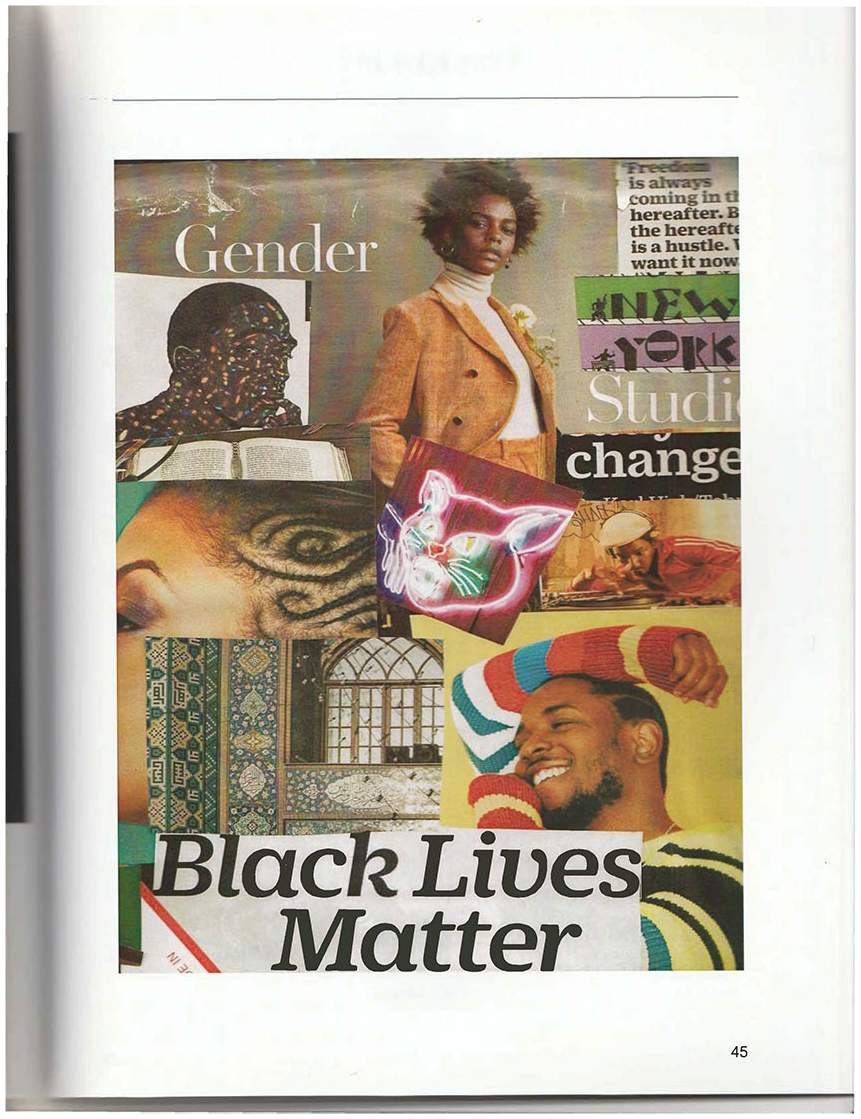
One of Aaliyah’s magazine collages printed in the Apple Valley literary magazine.
More than 2 years after the collage’s appearance in the literary magazine, Aaliyah reflected on the process of its creation: It was out of the scraps that I cut out for the project that I did for [art] class. . . . There were just some mornings that I really didn’t want to do anything. . . so I’d just spend all my time going through the magazines and cutting stuff out and making a pile of stuff. . . . I would just collect any image that I thought was beautiful or could go somewhere or if it showed texture or color or something. . . . If it gave me something, I just cut it out. (Aaliyah, interview transcript, July 27, 2020)
Aaliyah’s collage-making reflects her engagement with subversive literacies in that she subverted the institution of school by avoiding classwork and instead used class materials to create personal collages. In addition, these collages were directly connected to her self-definition and developing critical consciousness. Aaliyah explained how her choice of collage materials was integral to this development: And the selection of magazines gave me a nice picking grounds for stuff that had to do with politics. Imagery that speaks to stuff around the world. Not even just now, but stuff in the past because some of these magazines are dated and stuff, but still seeing imagery from some conflict in Congo from the ‘80s. Some of that imagery is still obviously relevant now, so seeing pictures of that. And obviously being able to read the descriptions of what was going on then before just hacking everything was just interesting. (Aaliyah, interview transcript, July 27, 2020)
As Aaliyah described, her collage-making was a result of her layered literacy practices; she combined her critical reading of texts and images, in particular those related to sociopolitical and global issues, with her artistic perspectives and repurposed class materials to reflect her artistic and ideological expression. In our discussion of the collage, Aaliyah remarked on the visible damage to the top edge of the artwork, which had been sitting in her binder before one of the literary magazine editors encouraged her to submit her work: I remember putting it in the back of my photo binder because I didn’t want people to see it if they were just flipping through my binder. I didn’t really want anyone to make comments about it. I remember just feeling, not protective over it, but I didn’t want to hear any feedback from anyone who wasn’t [my art teacher], because I knew probably the response wouldn’t be positive and they wouldn’t get it. (Aaliyah, interview transcript, July 27, 2020)
Aaliyah’s hesitation to show her work to others is indicative of her learned sensibility to keep her ideas and identities private. Doing so provided a layer of protection from her classmates and teachers. As a high school senior, she referred to this practice as a “balancing act,” a reminder not to “crawl out of bounds” because “you’re going to be reined back in by someone” (Aaliyah, interview transcript, November 8, 2017). Simultaneously, Aaliyah’s creation of these collages, her carrying them around each day in a protective sleeve in her binder, and her pride in seeing her work and name “printed somewhere” (Aaliyah, interview transcript, July 27, 2020), reveals an innate desire, similarly expressed by Layla, to remind her teachers, classmates, and herself that she matters.
Discussion: Collage as Revolutionary Practice
Collage reflects individuals’ experiences of the world as well as the new realities they create from existing ones (Plakoyiannaki & Stavraki, 2018). Layla engaged in collage-making when she sat in the ISS room in March 2017 and penned the poem “To the Little Revolutionary” on a scrap of paper. Aaliyah engaged in collage in art class when she selected words and images to cut out of magazines and gave them “new life and meaning” in juxtaposition with other “disparate” images in her visual creations (Plakoyiannaki & Stavraki, 2018, p. 315). By engaging in collage, Aaliyah and Layla were able to express and transform their reality in ways that they could not do in the overt spaces of school. Their processes of constructing knowledge and beauty out of the raw materials of racial trauma highlight the nature of collage as a “practice founded on paradox” (Plakoyiannaki & Stavraki, 2018, p. 316), through which both girls began to make sense of the paradoxes of their emotional and intellectual depletion at the hands of a school whose mission statement, posted on its website, promised to create “a safe, supportive, collaborative, and nurturing environment.” These practices also became an important part of the girls’ self-definition, which Collins (2009) described as integral to Black women’s survival and activism.
As discussed earlier in this article, Black girls’ literacies take on distinct forms and meanings due to the particular experiences of Black girls in schools and in society. Contrary to traditional measures of critical consciousness development, Layla’s and Aaliyah’s narratives reveal additional mechanisms, including engaging in silence and piecing together new meanings from the “scraps” they are given. Inspired by their critical digital literacy practices, Layla and Aaliyah first attempted to explicitly resist injustice in school before realizing that their survival was predicated on navigating the system and that this navigation was its own form of activism. For Layla and Aaliyah, developing subversive literacies through art was a way to resist silencing while also recognizing their need for protection from the social and structural forces of racial and gender oppression in school. Although no one had explicitly taught these girls how to create subversive art, their development of critical consciousness, which occurred both as a result of and in spite of their experiences in school, led to their engagement with collage-making, piecing together the materials of what they had been provided to create something new and wholly theirs.
Price-Dennis et al. (2017) explained that literacy practices that work toward social justice can be “either silent or more prominent” (p. 13). Yet, most research that discusses youth critical consciousness focuses on overt forms of activism, such as through dialogue, collective action, or direct action against structures of oppression (Watts & Hipolito-Delgado, 2015). This study challenges dominant approaches to critical consciousness research by revealing how Black girls’ activism may occur in ways that are not always visible to others and that may not align with existing frameworks of youth activism, as such frameworks do not account for the particular experiences of Black girls and women or their forms of resistance.
Aaliyah’s and Layla’s use of school materials, including magazines, classroom spaces, and publications, to collage their realities into a unique expression of their identities and critical resistance is a powerful form of Black girl activism and subversive literacy. The development of Black women’s subversive literacies is, of course, not new. In the 19th century, for example, abolitionist Sarah Forten took on pen names in her literary works to provide freedom and safety in sharing political views outside of the “socially imposed constraints of both race and gender” (McHenry, 2002, p. 63). Layla’s and Aaliyah’s engagement in their own forms of subversive literacy is a modern iteration of this long-standing tradition.
Implications for Research and Practice
As much as the participants’ subversive literacy practices offer a significant site of analysis, I caution against celebrating them. Such a celebration might normalize, and perhaps even forgive, the racial violence that led to the necessity of these practices. Celebrating subversive literacies also allows Black girls’ intellectual thought and practice to continue to live on the margins. To center the lives, identities, and literacies of Black girls and women, educators must be intentional in honoring their literacy practices in classroom spaces. If academic classrooms have served as spaces for the development of Black girls’ subversive literacies, surely they have the potential to become sites of overt critical literacy expression and social justice advocacy.
Supporting Black Girls in K–12 Schools
Layla’s and Aaliyah’s narratives make clear the deleterious impact of White-centric school spaces on Black girls’ academic learning, social and emotional health, and critical consciousness development. As Young et al. (2018) explained, “When Black girls’ identities, ways of learning, and leadership capacities are symbolically bonded by chains through a White-only curriculum, culturally biased literary texts, and pedagogical standards, Black female students are in fact experiencing normalized racial violence” (p. 103). To end this violence, schools must actively work to challenge the structures of White supremacy that continue to live in the language, curriculum, culture, pedagogy, disciplinary practices, training practices, and hiring practices of schools, sending implicit messages about who wields power and who has a right to “belong” within the physical and social structures of school.
Previous research has shared powerful strategies for fostering the critical literacy development of Black girls and girls of color, including Butler’s (2017) #SayHerName framework for centering the voices and lives of Black women in ELA curriculum, Young et al.’s (2018) pedagogical model of counter fairy tales, and Lane’s (2017) framework of Black feminist pedagogy. The present study focuses on the literacy development of Black girls in schools to inform strategies for supporting and protecting them in the following ways: honoring their literacy practices; centering their critical thought and activism; addressing school cultures, structures, and practices that harm their critical development; engaging in honest dialogue about racial issues across school spaces; holding school faculty, staff, and administrators accountable for perpetuating racial violence against students; and easing the burden placed on Black girls and women to exert intellectual and emotional labor in teaching others about race, gender, and equity.
Importantly, while the field of K–12 teaching is in dire need of more educators of color, being a Black teacher is not a prerequisite for developing safe, supportive classrooms for non-White students (Bristol & Mentor, 2018). In fact, many of the girls in this study identified White teachers, such as Aaliyah’s art teacher and Layla’s creative writing teacher, whose practices signaled that these classrooms were safe places for their self-expression, and that this person would advocate for them if need be. For youth of color who are vulnerable to multiple forces of oppression in society, knowing there are those with more power than them who see and will fight for them is crucial to their survival and to their critical development.
Building Literacy and Community Through Black Feminist Research
Consistent with the framework of Black feminist methodology, the process of engaging in this research has taken on a life of its own, producing knowledge and theory beyond the data. One example of the generative nature of this research community is the poetry anthology that Layla created in response to the first focus group interview. Layla shared this anthology with me in an e-mail after the third focus group interview in the spring, explaining, It’s called Collection on Black Womanhood, and the first poem, The Things That Free Us, is dedicated to you. I wrote it on my phone in the car on my way home from our first group session back in November. I remember thinking that it felt so good to laugh and to be listened to, for what was really like the first time in 6 months. (Layla, e-mail communication, May 17, 2018).
For Layla and many of the participants, this research study served to not only document the girls’ stories but also to contribute to their development of critical literacies and Black feminist epistemologies. Thus, research focused on Black girls must also be concerned with how the research itself can positively contribute to their lives and communities.
Supplemental Material
966367__Lauren_Kelly – Supplemental material for Exploring Black Girls’ Subversive Literacies as Acts of Freedom
Supplemental material, 966367__Lauren_Kelly for Exploring Black Girls’ Subversive Literacies as Acts of Freedom by Lauren Leigh Kelly in Journal of Literacy Research
Supplemental Material
Appendix-_Interview_Protocols_RSB11 – Supplemental material for Exploring Black Girls’ Subversive Literacies as Acts of Freedom
Supplemental material, Appendix-_Interview_Protocols_RSB11 for Exploring Black Girls’ Subversive Literacies as Acts of Freedom by Lauren Leigh Kelly in Journal of Literacy Research
Footnotes
Declaration of Conflicting Interests
The author declared no potential conflicts of interest with respect to the research, authorship, and/or publication of this article.
Funding
The author received no financial support for the research, authorship, and/or publication of this article.

References
Supplementary Material
Please find the following supplemental material available below.
For Open Access articles published under a Creative Commons License, all supplemental material carries the same license as the article it is associated with.
For non-Open Access articles published, all supplemental material carries a non-exclusive license, and permission requests for re-use of supplemental material or any part of supplemental material shall be sent directly to the copyright owner as specified in the copyright notice associated with the article.
