




Abstract
With renewed emphasis on civic education in K–12 schools, educators and politicians call for young people to engage in civic action. Worth considering are the kinds of ideas taken up, the performances deemed critical enough, and actions recognized in schools as civic engagement. Drawing from a case study of second graders in New York City (NYC), I move away from hypervisible expressions of civic participation to show how children take up critical literacy and civic action through everyday, ordinary moments. Beyond public displays of social action, how do we build up critically literate citizens who question, disrupt, and engage civically in their daily lives? Highlighted throughout this article are children’s questions, inquiries, and tensions around diverse identities and practices (e.g., religion, race, gender, politics). In centering children’s political agendas, I argue that the production of civic engagement is lived out in the curricular, conversational, and playful moments leading up to social movements.
Keywords
Background
I spent the 2016–2017 school year with second graders from a public school in New York City (NYC), situated within a tumultuous political time—immigration bans, Donald Trump’s election, social and political protests, and acts of violence undergirded by White supremacy. In response, politicians and educators alike renewed emphasis on civic education in K–12 schools to leverage democratic participation among children and youth (Banks, 2017). More attention placed on young people as activists via media and curated images (Witt, 2019) evoked emotional responses, mobilized new actions, and brought increased public attention to specific issues (Gash et al., 2020). In contentious political moments, society has always praised children and youth who walk picket lines, hold up signs, and give rousing speeches—all visible signs of civic engagement. However, beyond public displays of social action, how do we build up critically literate citizens who question, disrupt, and engage civically in their daily lives? Aside from the hypervisible movements, how do children take up critical literacy in their interactions, play, and engagement at school?
Worth considering, then, are what kinds of ideas are taken up, what performances are deemed critical enough, and what actions are recognized in schools as civic engagement. Many conversations, like the one featured below, happened in spaces of play or the moments where children freely engaged with others, materials, and the world around them. After Donald Trump’s election, conversations and speculation over Trump’s policies were initiated by children, away from the guidance or direction of adults. During this particular conversation, children were eating snacks and supposedly working on a morning activity. (All names of students and the name of the school are pseudonyms.) 1 Sienna: I hate Donald Trump [fake cries]. If he was on the ground, on the 2 poster, I’d punch them. If he was in the school. 3 Lisa: In this school, all 25 kids picked Hillary Clinton. Twenty-five kids! 4 Haeny: Oh, yeah? In this school? 5 Lisa: I voted. 6 Amal: Donald Trump is the worrrrst. 7 Lisa: Donald Trump won—we might not eat pizza on Fridays. 8 Amal: Yeah!! He might not let this school have pizza! 9 Sienna: Yeah! 10 Lisa: Oh no, my chicken!! 11 Sienna: No-oo. 12 Amal: Oh, I hate chicken. Take the chicken away, Donald Trump.
Most likely, Donald Trump will not come to their school and concern himself with their pizza or chicken. Yet, children were processing bits of what they heard through media, conjecturing about a president’s scope of power, and expressing their ideas on the election outcome. Like many adults, Lisa expressed confusion over Hillary Clinton’s defeat in spite of her popular victory, iterating that “all 25 kids,” meaning everyone, voted for her. Rather than having conversations facilitated by the agendas of teachers or curriculum, children frequently revealed a varied range of interests and opinions about their sociopolitical circumstances through playful exchanges like this one (Buchholz, 2019; Campano et al., 2016).
Donald Trump’s political and social actions came up spontaneously throughout the school year: during playtimes when they further speculated on his title as the “worrrst” (Line 6); during classroom conversations when they still claimed Barack Obama as their president; during independent work times when children processed what they heard: Trump’s dislike of “Black skin,” his desire to “lock her [Hillary Clinton] up,” the threat of “taking us back to the old days.” Embedded in these comments were circulating narratives communicated by the media, their communities, their families, and their peers. The social space of the classroom was where they negotiated and tried out these ideas. Rather than shutting these conversations down or immediately intervening, teachers allowed these ideas to linger but also provided the space to unpack children’s dis/connections (Jones & Clarke, 2007). I take up this delicate balance of teaching and learning—from observing children as a curious listener to taking a more active role in guiding conversations. Through an analysis of classroom literacy events, conversations, and play, I focus on how critical literacy and civic engagement are further cultivated in a second-grade classroom.
Civic engagement is defined by personal responsibility and participatory action (Lin, 2015), from performing civic duties (e.g., voting, picking up litter) to taking collective action on social issues (e.g., racism, sexism). Motivated by the everyday concerns surrounding our social world(s), civic engagement is energized by a sense of civic efficacy (Serriere, 2014) or the belief that one’s actions are capable of invoking change. I argue that the production of civic engagement is lived out in the curricular, conversational, and playful moments leading up to social movements. I highlight critical conversations (Leland et al., 1999), or the opportunities for children to speak honestly about the conditions filling up their everyday lives. They are mobilized by literature, media materials, and the kinds of interactions teachers set up in classroom environments. Critical conversations, at many times, were unplanned and tangential to the lesson at hand, requiring teachers to take up unexpected inquiries forwarded by children.
Theoretical Frame: Critical Literacy and Civic Engagement
Critical literacy, at its foundation, involves “people using language to exercise power, to enhance everyday life in schools and communities, and to question practices of privilege and injustice” (Comber, 2001, p. 1). If we consider the ever-circulating forms, narratives, and contexts taking shape in our multimodal, literacy-rich world, critical literacy and civic engagement are constructed daily with the material, social, and cultural practices of producing and responding to texts, including books, media, and digital content (Johnson & Vasudevan, 2012).
Children inquire about their world through literacy workshops, play, and dialogic interactions as multiple school spaces for social justice work (Rogers, 2017; Vasquez, 2014). Through literacy (e.g., letters, dialogue, texts), language (e.g., discussions, arguments, interactions), and everyday (inter)actions, teachers guide children in reflection and response to both the global and local issues that are important to their experiences. Opportunities to work through complex ideas exist in these curricular structures, but they also present themselves within informal spaces like transitions, snack times, independent work periods, choice time, and play that are simultaneously academic and social. In other words, the “shape of the classroom, the community itself, is the resource” (Bentley & Souto-Manning, 2016, p. 197), and conversations around fairness, equity, and difference happen throughout the day.
Arguably, opportunities for critical literacy are everywhere, embedded in the “mundane and ordinary aspects of daily life” (Comber, 2001, p. 1). This article features interactions around children’s literature explicitly dealing with social issues (i.e., school segregation), alongside children’s play or informal, spontaneous conversations. By insisting that the everyday is already critical, I turn attention to civic engagement as embodied in the “unexpected postures and practices” (Johnson & Vasudevan, 2012, p. 39) of children’s social lives at school.
Civic Engagement, Curriculum, and Schooling
Taking action is one facet of critical literacy that is oriented toward products: protests in public spaces, written texts that incite political change, and outward acts of resistance. However, the process of critical literacy is equally important in developing critically literate stances. Therefore, disrupting the commonplace, considering multiple viewpoints, and focusing on the sociopolitical (Vasquez, 2014) are dispositions that foster social change. Leland et al. (2005) documented how first graders raised critical questions about injustice and created more equitable and respectful relationships with one another. Grounded in children’s engagement with books, they showed how children’s literature “build[s] students’ awareness of how systems of meaning and power affect people and the lives they lead” (Leland et al., 1999, p. 70).
Many studies also highlight how young children engage in critical inquiry of historical texts and topics (Ciardiello, 2004; Damico & Hall, 2015; James & McVay, 2009; King & Swartz, 2015). These studies focus on reexamining “truth” through historical inquiries—to question commonplace thinking and consider perspectives often left out of grand narratives. By re-centering dominant stories around Thanksgiving (James & McVay, 2009), the civil rights movement (Ciardiello, 2004), and slavery (King & Swartz, 2015), teachers and students disrupted false narratives upheld in U.S. history that marginalize the contributions and oppressions of people of color. Together, these studies show that young children are capable of interacting with unsanitized versions of historical pasts that bring to light colonization, racism, and enslavement (Keenan, 2019; Templeton & Cheruvu, 2020). Despite the fact that certain textual encounters are deemed too sad, too serious, too controversial, or too complicated for children to grasp, children are already engaging with the world as cultural beings (Souto-Manning & Yoon, 2018).
Dutro and Haberl (2018) further demonstrate the aesthetic qualities of children’s writing around contemporary border issues and immigration. The Latinx second graders wrote stories, engaged their memories, and employed literary devices (e.g., metaphor) to understand their own fears and longings for home across geographic locations. Like Dutro and Haberl (2018), other scholars note how children are making sense of the world and their place across a range of identities and contexts, including religious affiliations (Noddings, 1993; Skerrett, 2016), racial identities (Butler, 2017; Hunter, 2016), and gender (Gallas, 1997). Of note is how classroom spaces construct opportunities to contest, contradict, and work through differences rather than diminish them.
Interrogating histories and contemporary politics are worthwhile endeavors, yet when we situate activism as heroism in historical pasts or entrenched in risk and acts of grandeur, we discount the realities that young children speak to in seemingly ordinary moments. Through conversations, readings of texts, writing, and play, critical literacy “is always and already occurring, regardless of whether or not it is recognized as such” (Johnson & Vasudevan, 2012, p. 36). Toward this recognition, Butler (2017) advocates for scholarship that takes seriously “literacy practices that are being cultivated within the classroom” (p. 87; emphasis added), re-centering classrooms as potential sites of renewal and resistance in activism and agency.
Everyday Encounters: Play, Literacy, and Rethinking What Is “Critical”
Campano et al. (2016) describe the organic ways that critical literacy forms through children’s play. In their project, elementary-aged children used humor, subversive content, and creative remixing of popular culture to (re)imagine the world around them. They caution us against creating artificial conditions for critical literacy and turn attention toward play as a space for the exploration and interrogation of social world(s).
Buchholz (2019) describes democratic discourses embedded in playgrounds—spaces that are overlooked as complex sites of social negotiation. In studying the historical evolution of a chase game, referred to as “Red vs. Gray,” she documented how K–6 children enacted democratic citizenry and fostered equitable participation, “acting for the public good, fighting against injustice(s) big and small, and standing up for fellow citizens’ civil and political rights” (p. 113). Eventually, one of the fifth graders created a rule book to place Red versus Gray into a larger historical context. The controversy around the rule book evoked actions akin to public protests—children aligned themselves across divisive lines of pro–rule book and anti–rule book stances; they engaged in conversations around policies related to their game; they organized for collective action. Democracy and citizenship were cultivated in children’s play where issues of equity, inclusion, and civility were already circulating with intensity and purpose. Writing and play as political activity builds on Dyson’s (1997) previous ethnographic work highlighting how 7- to 9-year-old girls of color made themselves powerful through textual tools. The children pushed back on the underrepresentation of Black girls and rewrote texts to write their inclusion.
These examples show young children mobilizing play for community participation and social positioning. Buchholz and Dyson both highlight the power and potential of writing in engaging children with abstract thought, appropriating literacy to spark critical dialogue, and creating texts to organize others toward common goals. As Paley (2009) has reminded us for many decades, play is children’s work and is tied to issues of identity and equity alongside development and learning. They explore social issues, apply language and literacy as communicative acts, and try out and test cultural ideologies. Dyson (2020) further demonstrated the benefits of play in coordinating children’s acquisition of basic literacy skills with their desires to play. She argues that children’s participation in the formal skills and development of literacy starts with playful moments—what she calls a “semiotic theater” (p. 3)—where children “situate their composing in relationships, not just in doing ‘their work’” (p. 4). Literacy is not bound to official times of free play or “choice times” (Wood, 2014), but is energized by the social activity of young children as they play with curriculum, teachers, and each other. By highlighting children’s playful interactions alongside the more direct, explicit conversations about race and equity, I seek to expand notions of civic engagement and bounded definitions of play to include everyday explorations of children’s social world.
Method
Drawing from a yearlong qualitative case study of a second-grade classroom, the following questions guide the analysis described in this article.
How do children respond to the sociopolitical conditions of their everyday world(s)?
How do children make sense of social, cultural, and political contexts through critical play and critical conversations?
Utilizing ethnographic tools, I participated in and documented classroom life during visits that occurred approximately 1 or 2 times per week, several hours per day (180–240 min). Extending notions of critical literacy, I focus on children’s interactions through curriculum and formal and informal play within the sociocultural contexts of the classroom, their communities, the city, and the nation, more broadly. The goal of sharing this case study is not to make claims of causality or offer a set of best practices. Instead, I work through lessons learned from a close engagement with this particular classroom at this specific political moment (Dyson & Genishi, 2005).
Site and Participants
Elizabeth Bishop Elementary was a Title I school located in Manhattan, centrally positioned near a busy subway hub and a major street running through most of the city. Most children at the school either walked or took the train, located just one block away from the school. The school was 78% Black and Latinx and 15% White, with the majority of White students enrolled in inclusive classrooms for children diagnosed with autism spectrum disorder (ASD). Situated at the edge of one of NYC’s historic districts, the area has had its fair share of drama in recent years: protests over the increase of high-rise apartments over the low-rise buildings, arguments around development versus historic preservation, and the push-out of long-standing residents. Several streets down from the school was a public housing project where some of the children in the classroom resided.
NYC is an “urban intensive space” (Milner, 2012, p. 559)—that is, it has a high population density within limited space and infrastructure. Metropolitan centers like NYC are marked by segregation and gentrification, inequitable distribution of resources, and visible gaps between the rich and poor (Wells et al., 2004). At the same time, NYC is also a site of past and present activist movements—some of which are highly visible to children along their daily commute (e.g., planned marches, events, rallies). While similar issues and instances persist in urban, suburban, and rural communities across the country, there are local factors and everyday encounters that make each space uniquely situated for civic engagement. These issues confront communities in different ways based on proximity, politics, and social concerns. For example, anti-immigrant rhetoric and its subsequent violence impact children in communities closer to the U.S.–Mexico border (Dutro & Haberl, 2018). Police brutality in metropolitan cities creates heightened racial tensions leading to distrust of and abuse by authorities and other agencies assuming power, particularly for communities of color (Coates, 2015). Mass shootings drastically alter the experiences of people impacted within that community (Rajan & Branas, 2018). Therefore, I draw from the traditions of qualitative research in which the primary goal is not to replicate studies. Instead, I argue for research that brings together the local context, the larger social landscape, and the particulars of classroom life (Dyson & Genishi, 2005).
The classroom consisted of 15 students: five Latinx, four Black, two multiracial, and four White students also diagnosed with ASD (see Table 1). Children with ASD were supported in their inclusion through services, including physical therapies, behavior supports, and social development intervention. Because of these pull-out services, there were many times when the classroom conversations involved only the children of color. At times, the White children were absent from these moments altogether, an important point when discussing notions of race and ethnicity. The general education teacher, Carmen (Puerto Rican and bilingual; her real name), and the special education teacher, Nate (White and monolingual; a pseudonym), were co-teachers.
Demographic Information of the Students.
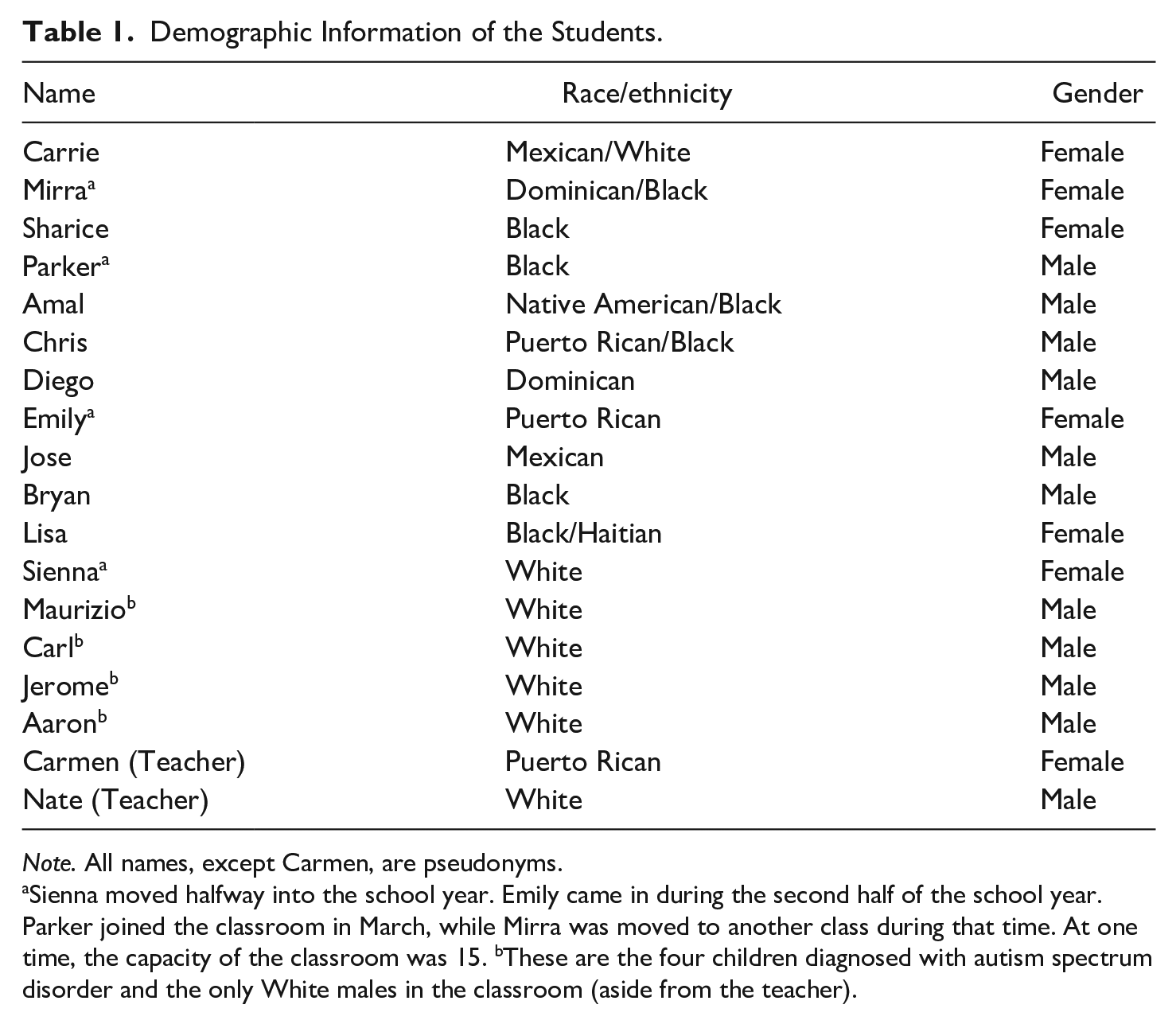
Note. All names, except Carmen, are pseudonyms.
Sienna moved halfway into the school year. Emily came in during the second half of the school year. Parker joined the classroom in March, while Mirra was moved to another class during that time. At one time, the capacity of the classroom was 15. bThese are the four children diagnosed with autism spectrum disorder and the only White males in the classroom (aside from the teacher).
Researcher Role: Reimagining Participation in Democratic Spaces
In this study, I feature Carmen, who has been a research partner, curriculum collaborator, and co-author since 2015. Our work took place in varied K–2 classrooms over the last 5 years across different school contexts. Carmen and I were brought together as dyads of teachers and teacher-educators working toward culturally relevant teaching and practice. Our relationship evolved across the years; it was flexibly constructed depending on the classroom dynamics, our personal inquiries, and our political commitments. Carmen and I began working together by chance, but we continue to forge a strong partnership voluntarily as both colleagues and friends (Yoon & Llerena, 2020). Throughout the classroom project featured, my role shifted from co-player to children, co-teacher alongside the classroom teachers, and coresearcher of classroom space, where I narrated, documented, and debriefed with teachers and students about their experiences.
The conversations highlighted in this article are also relevant to the tensions that I grapple with in my daily life as a Korean American woman figuring out where I sit within my multiple identities. I contemplated changing my name to Susan in third grade to shake off my “weird” name and deflect attention away from my cultural roots. I am always conscious of being around a group of Asian people because of how others might perceive me or the group. I remember feeling ugly when I visited Korea because my dark, tanned skin was measured against whiteness as the marker of beauty. I continue to navigate what it means to be a person of color—acknowledging both the macro and the micro aggressions that I experience as well as the levels of privilege that come from my ethnicity, education, and social class.
As an immigrant myself, I find that these politically uncertain times conjure up feelings of anger toward a president who dehumanizes immigrant communities. Therefore, observing and participating in conversations about politics was often fraught with my own feelings of resentment toward and disappointment with our government. In addition, the children’s religious beliefs and affiliations contended with my prior devotion to and personal struggles with organized religion. To be sure, communal spirituality and the search for truth are an integral and valuable part of being within faith communities, yet I felt inhibited rather than liberated by my previous experiences in the church. Rather than “writ[ing] myself out” (Cushman, 1998, p. 21), I find myself a part of how this story gets written and told.
Throughout, there are times when I turn the analytical lens on myself as another teacher in this space. Other times, I ask questions as a curious observer in children’s conversations where I was positioned in the background of social activity. Still other times, I was guided by how teachers negotiated difficult conversations in which I also played an integral part. My role as a researcher moved from the center to the edges constantly; it was “complicated, contextually stylized, and improvisational” (Green, 2014, p. 149). In other words, identities in social spaces (no matter how distant we claim to be) are filled with power dynamics and unexpected events that require researchers to make decisions about their position and participation. Interrupting notions of the distant observer, Green (2014) argues for “Double Dutch methodology,” or the entanglement of our identities, practices, participation, and experiences in our research sites.
Most important, children’s civic inquiries are worth responding to and are impossible to ignore. Children are critical and agentive citizens of classrooms and their intersecting social world(s). With this in mind, adults have a responsibility to engage in dialogic communication (Blackburn, 2014) and thoughtful listening (Yoon & Templeton, 2019) to the issues and inequities that children grapple with each day. Forwarding children’s concerns about social issues and politics led to collaborative projects and ideas that the teachers and I carried out with varying degrees of immersion and responsibility.
Data Collection
As in many second-grade classrooms across the nation, curriculum and time in this classroom were regulated by standardization and testing. Although teachers implemented a “choice time,” or a period of time for children to play and engage in activities of their choosing (about once per week), they were also constrained by time and found it difficult to offer frequent, dedicated space to play. However, children worked at their tables and engaged each other in conversations often; a social buzz resonated throughout the day. The teachers knew children were off-task, at times, and “distracted” by their own interests. In fact, there were moments when teachers were involved in and equally distracted by the social energy of the classroom. Sanctioned play times were rare in this classroom as well; thus, critical conversations came from playful moments or when children shared and talked openly with and without the purview of adults. This meant that laughter, talk of popular culture, and aspects of kid culture permeated the data set.
Employing ethnographic tools, I collected data using a variety of modes. Because I was often a participant taking up overlapping roles, transcribed audio recordings were important to filling in gaps where notes could not be taken. Photographs of student artifacts and work, student activity and play, and curricular materials from charts and signs to books and teachers’ guides were collected to supplement observation notes with visual data. Data were integrated and reconstructed into formal field notes or written narratives that brought together the various data collected throughout the day, producing 300 pages of field notes across 36 entries. Embedded in the field note narratives were linked images, transcribed conversations, and my own notes recreating each visit.
Attending to the circulating discourses situating the case, I collected official curricular documents (e.g., Core Knowledge) and kept records of the supplemental books, materials, and lesson plans constructed by teachers for analysis. The “Fighting for a Cause” unit directly addressed civic engagement and responsibility, outlined by the Core Knowledge Foundation as English language arts (ELA) and literacy curricula for Grade 2 (Core Knowledge Language Arts, 2013). The unit introduced young children to historical figures who participated in struggles for human rights, highlighting “ordinary people who stood up for what they believed in” (Core Knowledge Language Arts, 2013, p. 5). Divided into ten 60-min lessons, the unit culminated with an oral exam of key vocabulary, a matching quiz linking people with causes, and a short essay assessing learning. While both the curricular and the district guidelines provided roughly 3 weeks (2 weeks of instruction and 1 week of assessment) to complete the unit, the teachers spent 4 months (mid-January through early May) on related activities, supplementing most of the lessons and materials with their own ideas.
Data Analysis
The initial reading of field notes resembled “close readings” (see Dutro & Haberl, 2018) in which I highlighted sections, wrote down key words, underlined phrases, and kept track of conversations that were deemed “critical”—that is, points where children talked about politics, social issues, culture, and personal ideologies. As the focus of this article is on how critical literacy is animated through critical conversations and critical play, I then identified and made note of formal and informal conversations constructed around textual engagements and productions. These texts included children’s literature, signs, drawings, writing, video clips, and photographs.
The collection of key conversations (30 in all) was then organized by sociopolitical issues such as race, religion, gender, politics, morality, and equity. I identified the context in which the conversation occurred (e.g., at breakfast, during read-aloud, in writer’s workshop) in addition to the textual engagements and productions that were relevant to the conversation (e.g., children’s literature, written work, drawings, media). For example, the opening excerpt was initially read and coded inductively as school lunch choices, presidential power, electoral process, voting, and food preferences. The “text” surrounding the discussion was Donald Trump’s election coverage, lunch menu options, and school-wide ballots. The context in which this conversation occurred was during breakfast/snack, where children were free to talk and move about while completing morning activities. Each key conversation was categorized in similar ways: inductive codes, related texts, and contexts. To attend to the research questions, I wrote analytical memos of key conversations (Marshall & Rossman, 2014) during the analysis phase to respond to research questions.
Findings
In what follows, I feature key conversations (written in the form of vignettes) as a way to center children’s responses to texts, broadly construed. The vignettes highlight critical conversations in the everyday life of school that connected to other observed moments. I begin with a conversation on religious identities, connecting several other moments where children made visible their ideological leanings. Moving to issues of race, I focus on racialized hierarchies across and within communities to describe the interplay of Whiteness, racial identities, and levels of privilege. Finally, I describe the children’s own civic engagement in advocating for increased recess time.
Religious Identities and Negotiating World Views: “I Believe in God”
As part of the teachers’ extension of the “Fighting for a Cause” unit, the students learned about Sylvia Mendez, whose family was instrumental in school integration in California, 8 years before Brown v. Board of Education. As several students in the classroom identified as Latinx, the teachers intentionally introduced texts and historical and contemporary figures who reflected the identities and concerns of the classroom demographic. Carmen initiated a discussion on racial segregation with the following question: Who decides if you are White or not? Because, I mean, for example, I know that I’m not White. I wouldn’t describe myself as White. I know that Mr. Mathews is White; he describes himself as White.
Some children responded that individuals decide racial affiliations and color, others thought the president and those in power could make those decisions, and still others pointed toward communities and families as charged with determining racial identity. However, Diego responded, “We’re inside our mom’s body. Um, God decides which color we are because we go out, you don’t know which color you are so God decided.” While Carmen had planned a lesson on school desegregation and racial identities, she followed up on Diego’s assertion and risked asking a “scary question.”
17 Diego: I believe God! 18 Jose: Me too! 19 Carmen: I’m just saying. Believe it or not— 20 Amal: I believe in God. 21 Aaron: [raises his hand and points to himself] I don’t believe in God. 22 Carmen: [nods] Believe it or not, there are people in this world that 23 don’t believe in God. [Aaron turns to the class and points at himself.] 24 Mirra: I think people don’t have to be mean if they don’t believe in 25 God. Like, there’s this restaurant and the owner, he’s Muslim and he 26 doesn’t believe in God, but he still treats me and my family nice 27 when we go. 28 Carmen: You know, Mirra, I love what you just said. 29 Jose: I disagree with what you said. 30 Carmen: You disagree with me? [Jose nods.] You know, thank you for saying 31 it so respectfully. Can you explain to me why you disagree with 32 what I said? 33 Jose: Because I believe in God. Other people don’t. 34 Carmen: And you know what I said? I want to make sure you understand 35 what I said. I said that there are some people that don’t believe 36 in God. [Aaron 37 turns around and points at himself with a smile.] We said that same 38 thing, right? Can I repeat what you said? You said, “I believe in God but 39 there are people that don’t.” And Ms. Carmen said, “There are people 40 that don’t believe in God.” Would you say that you and I agree? 41 [He nods.] 42 Emily: It doesn’t matter if they don’t believe in God or they do. They 43 just, it’s their opinion if they believe God or they don’t believe God. 44 Carmen: I like that you’re respectful of other opinions. You know, I gotta 45 ask one more scary question, is that okay? 46 Amal: Yes, that’s all right. 47 Carmen: Do you think that people that don’t believe in God or the god 48 that you believe in are bad? 49 Jose: No. 50 Diego: I don’t know. 51 Carmen: Do you think there’s something wrong with them? 52 Mirra: I don’t think they don’t believe in God doesn’t mean they’re 53 different, they’re still human beings. [Sharice and Emily give the sign 54 language “agree” sign.] 55 Diego: I think they’re, um, loco. [Carmen laughs.] 56 Carmen: You think they’re crazy? Okay, that’s your opinion. Could you 57 think of a more respectful way to disagree with them than saying 58 that they 59 are crazy? Because they might think you’re crazy for believing. 60 Jose: Other people—they might think you’re crazy. 61 Amal: Yeah, they might think you’re crazy.
Carmen did not strive for a resolution, nor were children forced into an agreed-upon consensus. Instead, they voiced their opinions through support, counterperspectives, personal examples, and questions—all skills mandated by the state standards and district guidelines. However, these ideas materialized in the space of informal conversation—unscripted and spontaneous. Children drew on informal language (Lines 60 and 61), destabilized hierarchies by disagreeing with the teacher (Line 29), confronted each other, and moved between languages (Spanish and English; Line 55). Within this discussion, Mirra, Sharice, and Emily agreed that religious beliefs should not be used as an exclusionary measure. Mirra confirmed that those who did not share her religious viewpoints were still nice and treated others fairly (Line 26). Emily asserted that religious affiliations are a matter of opinion (Lines 42–43), and Jose later agreed that religious beliefs do not make someone bad (Line 49). Diego’s certainty in God’s existence (Line 17) stood alongside Aaron’s own unbelief (Line 20), which he pointed out several times throughout the conversation (Lines 21, 23, 35–36). Both felt safe in exposing their world view, particularly in a world where (historically and contemporarily) religious beliefs are the cause of political feuds, violent wars, and colonization. Even in the United States, religious pluralism and diversity are obscured and attacked by the political right, and productive dialogue between faith groups is often shaded in extremism, dogmatism, and struggles for power. Navigating these ideologically loaded conversations creates division among social groups that intersect with race, ethnicity, sexuality, and other factors that maintain power for the Christian right (Heinrich, 2015; Keenan, 2019). In this conversation, the goal was not to uphold any one religion as the “right” one, but to make space for disagreement and diversity, a key component of productive civic engagement.
Conversations about religious beliefs and world views might feel “risky,” given the turbulent and tenuous separation between church and state (specifically in public schools; see Heinrich, 2015). Yet, curriculum has a long history of promoting Christian European values while ignoring the need for honest discussions on the colonization of indigenous groups and their beliefs (Keenan, 2019; Templeton & Cheruvu, 2020). Decolonizing curriculum is a central project of critical literacy—disrupting commonplace thinking and opening up space for multiple perspectives. Therefore, scholarship on religious literacies advocates for these discussions in school, given our increasingly pluralistic, multicultural, and multiethnic world (Rosenblith & Bailey, 2008). To marginalize these conversations because of our own discomforts neglects the colonial legacies that actively guide curriculum in elementary schools (Keenan, 2019).
Carmen acknowledged children’s existential theories and took seriously the kinds of ideas children were unpacking. There were still contradictory ideas, some “I don’t knows” (Line 50), insistence that nonbelievers are “loco” (Line 55), and misperceptions about who actually believes in “God” (notably Mirra’s misconception that Muslims do not believe in God; Line 25), yet children saw that even in this small classroom, religious identities were hardly monolithic. The strong reactions to beliefs in God point toward the importance of religious identities informing children’s meaning-making and perspectives in approaching the world (Noddings, 1993; Skerrett, 2016). This was not the only nor the last time religion came up in conversation. During choice time, the students argued about whether Jesus was a girl or a boy.
62 Sharice: Jesus is a girl, not a boy. 63 Carmen: Maybe. Who knows? 64 Amal: Jesus is a boy. Jesus is not a girl. 65 Carmen: Jesus could be a girl, I mean, who knows? 66 Amal: I guess some boys have long hair. 67 Diego: He’s a boy, guys. [Lots of overlapping chatter.]
Again, Carmen simply posed a counterperspective to the dominant narrative of Jesus as male. Stereotypical images of Jesus imagine him or her with long hair, which Amal contends with by acknowledging that some “boys have long hair” (Line 66). Consistent with Diego’s dogmatic stance on “crazy” nonbelievers (Line 55), he emphatically insists Jesus is a boy (Line 67). Again, these conversations were informal, and in this case, even further removed from any curricular goals. Carmen refrained from taking a firm stance but questioned commonplace thinking, affirming the possibility of Sharice’s nontraditional view of Jesus’s gender. As in the whole-group conversation, the other children may not have changed their minds, yet disrupting normalized ideas forced Amal to rationalize his point (Line 66) and pushed Diego to confirm and argue for his world view (Line 67). Many months later, when Sharice was making a poster for the Women’s March, she insisted on the slogan “Jesus loves women,” an unsurprising inscription maintaining Sharice’s emphasis on love for women as central to Jesus’s identity.
Thus, religious backgrounds and practices are important aspects of children’s cultural identities and repertoires. Notably, many children of color in this classroom participated in church activities where religious literacies are “deeply intertwined with the social, cultural, and linguistic elements of the different lifeworlds” (Skerrett, 2016, p. 971) children participate in daily. Like many children, youth, and adults, they negotiated and navigated between secular and religious identities that are not “developed and practiced solely within isolated religious contexts” (Skerrett, 2016, p. 981). Religious beliefs play an important role in children’s lives and are often pillars by which communities, especially nondominant communities, find cultural, social, and political voice and strength (Glanville et al., 2008; Jeynes, 2010; Skerrett, 2016). As this section shows, children take up these practices and questions under the facilitation of teachers, but they also pick up these questions with each other in play.
“I’m Not That Black”: Race and Phenotypes in a Textual Background
Skin color came up many times throughout the year, in both formal and informal times. Bryan clarified to the class once that he was not “Black, but Brown.” During a transition time, one White student offhandedly remarked to the other Black students that Trump did not like people with black skin. This circulated among them, coming up at snack time as well when children discussed the election. Other times during informal, unstructured moments, children compared their skin to one another.
68 Sienna: I’m lighter than you [compares arms with Haeny]. 69 Amal: You’re lighter than me [compares arms with Haeny]. 70 Sienna: Do it to Bryan. [Bryan, who is dark-skinned, compares arms with Amal.] 71 Amal: Bryan is mad dark. I’m whiter than him.
Colorism is internalized within communities of color, used as a common physical marker of difference. In the above excerpt, the children (and I) were comparing our skin shades in proximity to Whiteness, using phrases like “lighter” (Line 69) and “whiter” (Line 71) to describe social location. Circulating in the background are limited images of dark-skinned people as beautiful alongside many messages that visibly degrade Black skin or erase Black bodies from the visual landscape (Ramsey, 2015). Consequently, lighter skin tones offer racial capital to people of color as tools for children to racialize each other by forming racial hierarchies within groups (Hunter, 2016). Lingering underneath seemingly innocent comparisons of skin color are implicit biases, revealing the ubiquity of Whiteness as culturally desirable and superior (Hunter, 2016).
After reading Separate Is Never Equal (Tonatiuh, 2014), the students focused on varied skin shades of children in the book. Some confused the lighter-skinned children as White, even though all children featured were Mexican. In response, Sharice shared about her cousin’s hurtful categorization of her dark skin.
72 Sharice: My cousin hurt my feelings because he said I was really, really, 73 really black. 74 Carmen: Now, can I ask you why you felt bad? 75 Sharice: Because I’m not that black. I’m really light-skinned black. And 76 he said it in a mean way. 77 Carmen: He said it in a mean way. So, he said as if black was a bad thing? 78 [Sharice nods.] Really, huh. That’s really interesting. 79 Haeny: I wonder why, though, people think that being dark-skinned is a bad 80 thing? ‘Cause in my mind, I’m not sure if being dark-skinned is a bad 81 thing. But I wonder why people think that? And where that 82 came from? 83 Carmen: I wonder too. And I can’t help but seeing it in my mind, all of 84 these pictures of really dark-skinned people that I know that are 85 brilliant, and that have written the most beautiful books and 86 that have accomplished the most amazing feats in this world. 87 So, I’m a little troubled that your cousin would say that to you. 88 Sharice: He’s 13 years old.
Hunter (2016) asserts that colorism and structural racism are intertwined and reinforced through attitudes, beliefs, and interactions. She cautions, “it cannot be solved only through consciousness-raising or emotional healing” (p. 58). In our failed attempts at mediating the conversation above, we argued that many dark-skinned people have made contributions to the world (Lines 84–86) and remarked on Sharice’s cousin’s condescending tone (Line 87). Does our assurance, though, to Sharice that dark-skinned people have made tremendous contributions really help, given the images represented in popular culture, media, and even curriculum? Admittedly, our reactions and comments during this conversation were insufficient, if not superficial. We dismissed the real tensions that children grapple with when they hurt each other and use skin color as a way to create physical distinctions and implicit hierarchies (Lines 72–76). Through a “Black is beautiful” narrative, we missed an opportunity to go deeper into the social construction of race and concealed the structural limitations that were obvious to us all. Our feigned ignorance of “why people would think that” or “where it came from” (Lines 82 and 83) were troubling responses for both of us—educators who claimed to pursue racial justice and equity for children of color. The histories and experiences of Black people in the United States are marked by hundreds of years of slavery and oppression—a point that we could have honestly explored with the children in this classroom (Hunter, 2016; Omi & Winant, 2014).
Perhaps I was also caught off guard because of my own struggles with identity and skin color. Sharice revealed how children within racial communities tease each other; in this case, her 13-year-old cousin (Lines 72 and 88). The same discourses permeated much of how I thought about my value and self-worth as well. On one hand, racism disenfranchises people of color as a social, political group whereby power is inequitably distributed by the historical and social construction of race in the United States (Omi & Winant, 2014). On the other hand, Whiteness is used within racial groups, signaling varied levels of privilege associated with skin color, alongside the intersecting politics of gender and class (Crenshaw, 1991). These tensions circulated around the classroom as well—children differentiated skin color gradations, determined worth and status by lightness, and used skin color as a tool for power (Lines 68–71). Simltnaeously, children are processing these ideas through familial relationships, peer interactions, curricular moments, textual encounters, and in between the pockets of curriculum. Their play is not always innocent and free-spirited; it is also a complex ideological space where teachers need to bring “greater intellectual honesty and care” (Keenan, 2019, p. 23) in confronting anti-Blackness within and across racial groups.
Reforming Recess: Public Protests in School Spaces
Finally, I turn to children’s visible civic response, embedded within the accumulated experiences and rich conversations presented here. As the Women’s March in NYC approached, Emily told others at her table that we should “be happy for womens and girls.” When Carl and others expressed desires to attend the march at Washington Square Park, Emily quickly inserted that attending was not the only form of active participation: “You can vote for women too.” During writing time, Emily led an impromptu chorus of “Ain’t Nobody Gonna Turn Me Around,” a Black spiritual popularized by the civil rights movement; on other days, Emily led a chorus of Beyonce’s 2011 song “Run the World (Girls).” Reverberating in the classroom and led by Emily were songs representing both historical and contemporary activism. At one point, Emily brought her notebook from home to show the teachers pages of handwritten notes, obviously recopied from another text, defining a feminist as “a person who believes in the equility [sic] of men and women.”
Impromptu singing, stances toward gender equity, and recopying pages from books were individual acts of participation, but children like Carl desired participation in more public, collective means. In this way, I acknowledge that critical conversations alongside concrete demonstrations of activism manifest abstract concepts into tangible actions. The year ended with a visible expression of social action, invigorated by children’s own desires to march. During choice time, a group of children were discussing the various ways to protest, beginning with Maurizio’s new learning about the Vietnam War.
89 Maurizio: Do you know, that, um, actually, in our history, a bunch of 90 protestors were protesting so that the U.S. can stop detonating 91 bombs in North Vietnam? 92 Haeny: What did they do in these protests? 93 Maurizio: They held up signs and posters and they chant and stuff. 94 Parker: We can make a speech. 95 Jose: We can send like letters to newspapers. 96 Carrie: I think we should go in a classroom and we can make posters on 97 the wall and they can read the posters and when they read 98 the posters, they can find out—we can ask other people . . . 99 and we can invite them to our class and we can have more people—
As a result, children wrote proposals for issues related to school: more recess time, cleaner bathrooms, and more physical education (e.g., gym class outside, martial arts club). Teachers provided curricular space for children’s activism, responding to their growing interests. The “Recess Reform” movement—a student-led proposal to lengthen the amount of recess time at their school—resonated the most with others. In a letter to the principal, Jerome cited a neighborhood school that offered students 45 min of recess every day as an example of best practice. Initiated and planned by students, a march was organized, replete with posted flyers around the school, petitions for those in favor to sign, speeches scripted and delivered to other classrooms, and even videos produced for others to view. Due to rain, the march took place indoors as children enthusiastically chanted, “We want recess!” Their voices resounded though the hallways and auditorium, supplemented with handmade signs illustrating their points.
Scholars note children’s participation in civic action is empowered when social action correlates with desired outcomes (Serriere, 2014). However, what happens when children’s best efforts lead to no change? Are these efforts less efficacious? The principal, as some adults are prone to do, deemed their activism as funny and cute, dismissing their preparation and demonstration of civic action. Unlike the fifth-grade girls in Serriere’s (2014) study who were able to secure healthier lunch options for their school, the children in this classroom received little administrative support for their efforts. They were not able to meet formally with the principal to voice their requests, there was no forum or assembly set up to garner support from the school community, they were not interviewed by the local television station or featured in the newspaper, and their protests led to no visible change in the recess structure (see Serriere, 2014, p. 48).
The protest for more recess time was unsuccessful. However, the children’s efficacy, rather than arising from the outcome, came from their ability to plan and enact social action. In spite of invalidation by the administration, others (staff, parents, and students) in attendance supported and lifted up children’s desires and needs. Especially for children in marginalized groups and those with expressed disabilities, these moments empowered their self-efficacy. Children advocated (unironically) for more play, mobilizing writing to argue the benefits of increased recess time. Much like researchers of play are often forced to do, they articulated the real and tangible benefits associated with more recess and play: Children require fresh air, play gives them energy to work, sunshine is good for them, and children will behave better (all ideas articulated by them). Yet, they also pointed to the affective pleasures of play: having fun, playing with friends, and taking time to relax. As scholars (Johnson & Vasudevan, 2012) note, play can be purposeless and without goals and still bring intangible benefits to individuals. As this article highlights, some of the most unpredictable, meaningful moments came from the “recesses” of official school activities.
Discussion: Visible and Invisible Performances and Reframing What is Critical
Throughout this article, I make a case for the capacity of young children to initiate, participate in, and carry out meaningful and difficult conversations. Many times, critical conversations were not always set up or planned, but organically emerged from their play (e.g., Donald Trump and pizza Fridays), stemmed from tangential paths from curricular topics (e.g., Sylvia Mendez), and arose from personal stories mediated by children’s literature (e.g., Separate Is Never Equal).
I also featured Carmen, who willingly welcomed difficult conversations around religion and race as part of curriculum. As evidenced, children’s spiritual lives are deeply connected with faith communities holding shared values and practices, “ensuring social cohesion and stability” (Heinrich, 2015, p. 67). Religious histories and beliefs provide necessary context in analyzing contemporary events. Interrogating connections and disconnections about religious identities and experiences can build tolerance and understanding. Arguably, Americans’ unwillingness to interact with, learn about, and understand religious beliefs different from their own cultivates intolerance and ignorance (Rosenblith & Bailey, 2008). Although religious conversations are often discouraged in public school classrooms, Carmen opened up space for children to voice and embody (Lines 13–23) these ideas even if God and religion were not part of the curricular plan.
Critical literacy also opens up opportunities to deconstruct texts and dismantle the implicit ways that racism and colorism are reinforced (Leland et al., 2005). Race intersects with skin color, ideals about respectability, social class, and gender in ways that grant light-skinned leaders more visibility and power than their dark-skinned counterparts. Rather than explaining away racial politics (Lines 83–87), we need more complex discussions about noticing, naming, and interrogating White privilege and its circulating narratives in historical movements as well as everyday encounters. Racial literacy frameworks unravel the “complex range of discursive, psychological, economic, and political structures” (Rogers & Mosley, 2006, p. 466) that are held in place through systems of oppression, but are also perpetuated through everyday texts, informal conversations, and curricular discussions (Vasquez, 2014).
Furthermore, social action may not always look, feel, or embody typical ideas of activism. Mayes et al. (2016) trouble what it means to be a “good citizen” and how “efficacy is constituted” (p. 632), especially as schools are inequitably structured, and children are differently positioned. In particular, urban schools like the one featured in this article are already spaces where children and teachers are not given sufficient or adequate autonomy, freedom, and flexibility to engage in critical conversations. In constrained and regulated spaces, children’s play is often narrowed and replaced by curriculum that scripts the time and materials for children to engage in their own social agendas (Campano et al., 2016; Yoon, 2013). Scripted curricula should also be read with the understanding that children’s inquiries are worth attention and space despite curricular mandates. In this particular classroom, the “Fighting for a Cause” unit framed civic engagement and activism as practices of a historic past, detached from the local particulars of their own context. The teachers took the time and effort to reframe the unit, introduce new materials and texts, and contextualize civic engagement within everyday contexts. Rather than follow the curricular scripts, they made time for conversations to form, provided materials to guide inquiry, and constructed space for children to pursue political agendas in school. While some of these conversations fell short (e.g., the one about colorism in lines 72–87), children felt comfortable and free in their ideological expression within this classroom space. Although the principal’s response to the recess march was a missed opportunity for increased civic efficacy and student agency, there were classroom moments where teachers took children’s engagement seriously and critically.
Implications: Agency and Visibility in Teaching and Research
Undergirding this study is the belief that children’s playful interactions with one another, the curriculum, and the teacher elicit opportunities for critical conversations. When teachers make space for children to “play and work” (Paley, 2009) or loosen their grip on classroom control, conversations like the ones throughout this article can occur. Or, when teachers take children’s queries seriously, they find themselves engaged with ideas that stray from the standardized curriculum. Or perhaps, when teachers linger on rather than dismiss children’s ideas, they uncover the real issues children are grappling with in their lives outside of school.
An overcrowded and scripted curricular agenda leaves little room to have the kind of in-depth conversations necessary to address the deeper legacies of racism, oppression, and silencing. In fact, many of the conversations featured here were not the result of planned lessons, but were initiated by children in play and classroom activity, occurring at different spaces and times throughout the day (Bentley & Souto-Manning, 2016). The political rhetoric pervading the landscape and issues of fairness and equity were part of how children understood their social world. They communicated these ideas to each other, and while not every conversation was accurate or addressed, children were provided space for playful and serious dialogue. Adults were not always the center of these interactions, and uninterrupted time for children to process ideas with each other was important for future civic engagement.
The conversation around colorism deserves some reflection and holds some implications for classrooms. More images of people of color in addition to broader depictions are needed in the media. In particular, authentic representation is only achievable when Black and Brown people across a range of skin colors are normalized in mainstream culture (Ramsey, 2015). However, cosmetic changes to the images displayed in the classroom and books are only part of transformative shifts in curriculum and pedagogy. Even within materials are hidden messages favoring Whiteness and the lightening of people of color, which elevates the status of light skin (Hunter, 2016). Both children of color and White children take up these ideas in varied ways: White children assume and take up their privileged status, while Black children argue about who is “really, really, really black” (Line 72) and “mad dark” (Line 71). Clearly, unpacking colorism demanded much more from us than a short conversation highlighting Black brilliance. In some ways, questions like this one are difficult to confront when we ourselves are figuring out how to overcome these tensions in our own lives and communities.
Whiteness is a privilege, something that is not earned but given by systems, institutions, and curriculum (Crenshaw, 1991; Souto-Manning & Yoon, 2018). Whether it is the books available, the topics taught, the structures put in place, or the conversations adults have or do not have with children, certain groups are privileged while others are simultaneously marginalized. Teachers are making decisions every day on what interactions are happening and how they are addressed. Taking risks by asking “scary questions” (Line 13) means that we facilitate conversations that offer children windows into new perspectives, world views, and experiences (Bishop, 1990). Other times, even our failed efforts are opportunities for reflexive practice and further reflection. At times, facilitating and engaging children in tough, risky conversations are part of our own development as critical educators. That is, while making space for political talk, teachers can simultaneously interrogate their own assumptions, discomfort, and missteps as part of their practice.
Finally, children are political beings just by being children in the world (Yoon & Templeton, 2019), motivated by the social energy of their peers (Dyson, 2020). As illustrated in this article, civic identities are also constructed as children explore ideas with each other in spaces of informal conversation and play. What is needed, then, is more research that examines the less visible ways young children develop critical understandings. What is happening in between the pockets of curriculum, and how can we take this seriously? Schools are ripe with opportunities for civic engagement during times when teachers structure these conversations as well as when teachers leave children to their own devices. If we consider children as already political, we assume that important interactions are taking place within official curricular spaces as well as adjacent to formal learning and outside of adult-centric activity. Considering all these spaces as research sites for civic engagement brings increased attention to children’s voices in the visible and invisible spaces of the classroom.
Supplemental Material
939557_Translated_Abstract_Adams – Supplemental material for Critically Literate Citizenship: Moments and Movements in Second Grade
Supplemental material, 939557_Translated_Abstract_Adams for Critically Literate Citizenship: Moments and Movements in Second Grade by Haeny S. Yoon in Journal of Literacy Research
Footnotes
Acknowledgements
I acknowledge NCTE (National Council of Teachers of English) for providing intellectual space and funding through the Professional Dyads and Culturally Relevant Teaching (PDCRT) project.
Declaration of Conflicting Interests
The author(s) declared no potential conflicts of interest with respect to the research, authorship, and/or publication of this article.
Funding
The author(s) received no financial support for the research, authorship, and/or publication of this article.

References
Supplementary Material
Please find the following supplemental material available below.
For Open Access articles published under a Creative Commons License, all supplemental material carries the same license as the article it is associated with.
For non-Open Access articles published, all supplemental material carries a non-exclusive license, and permission requests for re-use of supplemental material or any part of supplemental material shall be sent directly to the copyright owner as specified in the copyright notice associated with the article.
