



Abstract
Economic education is an essential prerequisite for coping with economic-characterised problems in various life spheres, especially with socio-economic problems in the societal sphere. Making informed and reasoned decisions on socio-economic problems requires domain-specific content knowledge and domain-specific argumentation skills. Economic education is anchored in many framework curricula at secondary school level in German-speaking countries. Yet, despite its curricular and practical relevance, empirical studies in the economic domain that address both students’ content knowledge and argumentation skills are rare. This article outlines a research design for a proposed intervention study that aims to promote and examine content knowledge and argumentation skills in socio-economic contexts. The research design is built on three core elements: (1) a workshop on teachers’ pedagogical content knowledge, (2) a problem-oriented teaching/learning setting with authentic socio-economic problems and (3) instruments and frameworks to assess students’ competence. The research design serves as a starting point for an internationally comparable research programme, primarily applicable for grammar schools in German-speaking countries.
Keywords
Introduction
Problem statement and relevance
Economic education is an essential prerequisite for coping with problems in socio-economic contexts (e.g. consumer protection, retirement provision) (Ackermann, 2021b; Albers, 1988; Dubs, 2013; Eberle, 2015; Fischer and Zurstrassen, 2014; Kaminski, 1996; Steinmann, 1997; Tafner, 2018). Thus, economic education and the promotion of economic competence is anchored in many framework curricula, mostly at the secondary school level (Ackermann, 2021a; Fridrich, 2018, 2020; Ruoss et al., n.d.; Siegfried and Hangen, 2020). Upon examination of these curricula, the general goal of economic education can be summarised as follows: economic-characterised problems are embedded in various interdependent systems (economic, political and ecological) and involve interaction between different stakeholders (consumers, producers, employees, employers, public authorities, etc.). In addition to this domain-specific goal, in many framework curricula, problem-solving and critical thinking are highlighted as 21st century learning skills (NEA, 2012; P21, 2019). Therefore, economically competent young adults should be able to apply or create solution approaches and options for action regarding economic problems in an informed, reasoned, reflected and responsible manner. The core competence facets needed for these actions are content knowledge and argumentation skills.
Most empirical studies on economic competence either focus on content knowledge or argumentation skills. Findings on content knowledge in the economic domain show that students’ economic knowledge is only moderate and differs dependent on school type (i.e. grammar school, vocational school), academic profile (i.e. science, social science, languages) and professional field (i.e. technical, commercial, social) (Beck, 1993; Marlin, 1991; Müller et al., 2007; Rebeck and Walstad, 2015; Schumann and Eberle, 2014; Schumann et al., 2017). Recent findings on argumentation skills in the economic domain indicate that the quality of students’ written argumentation differs depending on their content knowledge (Ackermann and Kavadarli, 2022). This corresponds with empirical studies in other domains that show a substantial relationship between domain-specific content knowledge and domain-specific argumentation skills (Fleming, 1986a, 1986b; Hogan, 2002; Kortland, 1996; Sadler and Donnelly, 2006; Sadler and Zeidler, 2004; Zeidler and Schafer, 1984; Zohar and Nemet, 2002).
Empirical findings on students’ argumentation skills in other domains can be summarised as follows. First, written arguments are less frequently qualified and rebutted than oral arguments, likely because interaction among students promotes more specific and differentiated arguments (Jimenez-Aleixandre et al., 2006; Kuhn, 1991; Perkins, 1985; Simonneaux, 2007). Second, arguments in favour of one’s own beliefs are more frequent than arguments against them, with students tending to ignore scientific concepts and empirical data that do not support their argument (Chinn and Brewer, 1993; Kuhn, 1991, 1993). Third, arguments with everyday explanations are more frequent than arguments with scientific explanations; students tend to draw on “meaningful” personal experience and common sense instead of recalling and considering scientific concepts and empirical data (Kuhn, 1991; Perkins, 1985; Sadler, 2004; Takao and Kelly, 2003).
Based on the state of research summarised above, it can be concluded that students generally do not sufficiently reach the goal of economic education yet, either in terms of domain-specific content knowledge or in terms of domain-specific argumentation skills. This reveals the importance of promoting students’ competence, especially content knowledge and written and oral argumentation skills in socio-economic contexts. Studies analysing different teaching/learning settings in order to improve economic competence indicate that self-organised, action-oriented and problem-oriented settings have positive effects on performance (Seifried and Sembill, 2010; Sembill et al., 2007) and performance motivation (Eberle et al., 2009). Despite these theoretical and empirical contributions on action-oriented and problem-oriented teaching/learning settings, traditional settings such as direct instruction and teacher-student interaction still remain dominant in the classroom (Reichmuth-Sprenger, 2017; Holtsch et al., 2014; Höpfer and Reichmuth-Sprenger, 2018; Eberle, 2006; Sembill et al., 2007). Thus, it is important that teacher training enables teachers to understand how to design and implement self-organised and problem-oriented settings to ensure long-term effects on students’ competence.
Research goal and methods
Our article outlines a research design for a proposed intervention study that aims to promote and examine students’ competence in socio-economic contexts, conceived of as a combination of domain-specific content knowledge and domain-specific argumentation skills. The research design is applicable in German-speaking countries and is meant to be a starting point for an internationally comparable research programme. In our article, we take a conceptual methodological approach based on a comprehensive literature review.
In Theoretical background and state of research, we describe the theoretical background and state of research relevant to our aim. This encompasses theoretical approaches and empirical findings regarding economic education and civic argumentation, features and effects of teaching/learning settings on students’ learning outcomes, as well as features and effects of teacher training on their professional competence and students’ competence. In Research design, we outline the research design for an intervention study in Grammar schools in German-speaking countries. Firstly, we propose a workshop for a teacher training that focuses on professional competence, especially on pedagogical content knowledge. Secondly, we propose the content and structure of a problem-oriented teaching/learning setting. Third, we propose measurement instruments and analytical frameworks to assess students’ socio-economic competence within the teaching/learning setting. Finally, in Conclusion and outlook we give an outlook for a future research programme in this field.
Theoretical background and state of research
Economic education and civic argumentation
Economic education refers to economic-characterised situations arising in different life spheres Ackermann, 2019: 62–66; 2021b; Albers, 1988; Kaminski, 2017: 36–38; Seeber et al., 2012: 87–88. In the personal-financial life sphere, individuals are faced with situations such as money management, sustainable consumption, long-term savings and private pensions. In the vocational-entrepreneurial life sphere, individuals have either a role as employee or employer/entrepreneur. General vocational situations involve decisions around one’s profession, career changes and further education. General entrepreneurial situations arise from administrative, operational and strategic corporate governance. In the societal life sphere, individuals are confronted with complex socio-economic problems, and with possible problem solutions that are ambiguous and controversial (Ackermann, 2019: 67–70; Dubs, 2013; Eberle, 2015). Current examples for such socio-economic problems include agricultural trade, consumer protection, energy supply, healthcare provision, immigration, retirement provision, public finance, transport infrastructure and unemployment (Ackermann, 2019: 73–76, 320–330; 2021b; Simonneaux, 2007).
Making informed and reasoned decisions on socio-economic problems requires domain-specific knowledge and domain-specific skills (Ackermann, 2021b). Domain-specific knowledge refers to scientific facts and concepts related to the problem (Zohar and Nemet, 2002). In the economic domain, for example, these concepts include debt brake, exchange rate, income distribution, price mechanism, public goods and the solidarity principle. Domain-specific skills encompass cognitive and metacognitive processes on the problem, namely analysing, evaluating, creating, explaining, reasoning, deciding and reflecting. The knowledge and skills associated with a socio-economic problem are domain-specific, and thus, generally, not transferable to problems in other domains, such as STEM. A recent study on civic argumentation in the economic domain indicates that argument quality even varies between socio-economic problems (Ackermann and Kavadarli, 2022). However, domain-specific skills may be supported by domain-general social skills, such as communication, cooperation and collaboration (Euler, 1997; Grob and Maag Merki, 2001).
Civic argumentation refers to societal problems, also called “questions socialement vive” (Legardez and Alpe, 2001). A societal problem may affect many scientific disciplines (Acar et al., 2010; Kolstø, 2006; Sadler and Donnelly, 2006; Simonneaux, 2007; Tiberghien, 2007; Sadler, 2004; Sadler and Zeidler, 2004). Civic argumentation is used in education to develop students’ participation in society and to establish a citizen culture. Argumentation on societal problems involves persuasion and negotiation (Myers, 1990; Sadler and Donnelly, 2006); an argument connects an assertion or conclusion by justifications, whereby the justifications follow facts and narratives. Such an argument is evidence-based and value-based (Kolstø, 2004; Sadler and Donnelly, 2006; Zeidler and Sadler, 2007). Moreover, civic argumentation involves “reasoning about causes and consequences and about advantages and disadvantages, or pros and cons, of particular propositions or decision alternatives” (Zohar and Nemet, 2002: 38).
Problem-oriented teaching/learning settings and students’ learning outcomes
Within cognitive-constructivist and social-constructivist concepts of teaching and learning, learning is understood as an individual, active, constructive, goal-oriented, situated and social process (Reinmann-Rothmeier and Mandl, 2006). Problem-oriented learning supports students’ competence development through self-organised learning and cooperative learning (Petko and Reusser, 2005; Reusser, 2005). Problem-oriented learning promotes transferable knowledge and subject-specific learning and thinking strategies beyond concrete problem solving (Reusser, 2005). Such a teaching/learning setting aims to avoid inert knowledge by teaching students how to cope with authentic problems, combining knowledge acquisition and action for problem-solving as well as near and far transferring acquired knowledge (Renkl, 1996; Reusser, 2005).
In the framework of problem-oriented learning, a problem is an individual’s internal or external state that he or she considers undesirable, but at that moment does not have the means to transform the undesirable state into a desirable one (Dörner, 1987: 10). Solving such a problem involves various sub-processes, such as the search for information, generation and evaluation of solutions, and decision making (Betsch et al., 2011: 4). The general problem-solving process students go through can be summarised by the following steps (Betsch et al., 2011: 146–150): (1) identification of the problem, (2) formulation of hypotheses for solving the problem, (3) analysis of information for confirming or refuting hypotheses, (4) evaluation of alternative solutions, (5) choosing a solution. Cooperative learning is particularly suitable for problem-solving because, among other things, information on the problem can be exchanged and modified, and ideas for action coordinated (Bruch, 2015; Dörner, 1999; Petko and Reusser, 2005).
Problem-oriented learning offers an appropriate didactic framework to fit the general goal of economic education and civic argumentation (Eberle, 2006; Finkelstein et al., 2011; Schumann et al., 2011; Siegfried and Heinrichs, 2020; Wuttke, 2000). Studies addressing constructivist concepts, and especially problem-oriented learning settings, often point to a positive relationship with learning outcomes (Mergendoller et al., 2006, 2020; Sembill et al., 2007; Seifried and Sembill, 2010; Walker and Leary, 2009). Only a few of these studies examine the potential to promote argumentation skills through problem-oriented learning settings (Siegfried and Heinrichs, 2020; Wuttke, 2000). Furthermore, commonly used teaching materials are prepared by the research team rather than by teachers (Finkelstein et al., 2011; Siegfried and Heinrichs, 2020).
However, teachers’ professional competence appears to be crucial for designing and implementing problem-oriented teaching/learning settings and have long-term effects on students’ learning outcomes. In order to promote content knowledge and argumentation skills in socio-economic contexts, teachers have to select problems that refer to economic concepts, allow for multi-perspectives and offer different problem solutions. Furthermore, teachers have to offer tasks that prompt students to identify and evaluate relevant information and then discuss it in groups. Therefore, it seems reasonable to look at teachers’ professional competence and its relationship to student learning.
Promoting students’ competence though teacher training
Shulman (1986, 1987) developed a seminal framework for teachers’ professional knowledge encompasses content knowledge, pedagogical content knowledge and pedagogical knowledge. Baumert and Kunter (2006, 2011) extended this knowledge-based framework to a competence model including cognitive and non-cognitive competence facets. Teacher’s professional competence includes professional knowledge, beliefs and values, motivational orientations and self-regulatory abilities. Here again, teachers’ professional knowledge encompasses content knowledge, pedagogical content knowledge (e.g. learning tasks, cognitive conflicts) and pedagogical knowledge (e.g. classroom management, performance assessment). These professional knowledge facets are intertwined: Profound content knowledge is widely considered as the basis for flexible and varied pedagogical content knowledge (Baumert and Kunter, 2006; Brunner et al., 2006; Holtsch, 2018; Kuhn et al., 2014; Retzmann and Bank, 2013; Wuttke and Seifried, 2017). Moreover, teachers’ content knowledge and pedagogical content knowledge are generally considered prerequisites for teaching quality (i.e. cognitive challenging and constructive supporting learning opportunities in the classroom) and supporting students’ learning progress (Baumert and Kunter, 2006; Lipowsky, 2006; Holtsch and Sticca, 2018). Even though the teacher’s professional competence model does not explicitly comprise situation-specific skills with regards to the professional knowledge facets, pedagogical content knowledge has shown to be relevant to student learning (Krauss et al., 2020). Thus, if teachers are meant to design and implement problem-oriented teaching/learning settings, they need sufficient and adequate pedagogical content knowledge and respective teacher training (Eberle et al., 2009). However, given the actual predominance of direct instruction and teacher-student interaction, it seems necessary to support teachers in developing and reflecting their teaching variety.
Empirical studies on the effect of teacher training in the economic domain mainly focus on content knowledge. Two main findings can be highlighted. Firstly, there is a positive relationship between teachers’ content knowledge and student learning (Holtsch and Sticca, 2018; Marlin, 1991; Schober, 1984; Wuttke and Seifried, 2017). Secondly, (prospective) teachers’ participation in economics courses has a positive effect on their economic knowledge and the knowledge of their students (Allgood and Walstad, 1999; Dills and Placone, 2008; Schober, 1984; Weaver et al., 1987; Becker, 2000; Laney, 1988; Marlin, 1991). Only few studies deal with teachers’ training on pedagogical content knowledge, which is necessary for designing problem-oriented learning in the economic domain (Finkelstein et al., 2011; Mergendoller et al., 2006; Schumann and Eberle, 2008). The findings indicate that appropriately trained teachers have a positive influence on students’ learning. Further findings indicate that the implementation of problem-oriented learning changes students’ behaviour, particularly by increasing students’ oral exchange independent of teacher’s actions in the classroom (MacQuarrie et al., 2012). Therefore, in the following section, a research design for a corresponding intervention study is presented.
Research design
Here, we present a research design for an intervention study that aims to promote and examine students’ argumentation on socio-economic problems. The research design is applicable to grammar school students (“Gymnasium”) in German-speaking countries. The research design is built on three core elements: a workshop to develop teachers’ professional competence (see Teacher training and workshop), a problem-oriented teaching/learning setting (see Problem-oriented teaching/learning setting), and measurement instruments and analytical frameworks to assess students’ socio-economic competence (see Measurement instruments and analytical frameworks for students’ competence).
Teacher training workshop
In order to deepen teachers’ professional competence in designing and implementing problem-oriented teaching/learning settings and to promote content knowledge and argumentation skills in the economic domain, we propose a workshop for the teachers involved in the research programme. The workshop addresses teachers’ professional competence, particularly their pedagogical content knowledge (e.g. students’ domain-specific content knowledge and argumentation skills, particularly analytical and critical thinking). In the workshop, teachers will receive teaching/learning materials that are useable in their classrooms. The teachers participating in the workshop will be recruited and selected according to their specialisation (economics, politics), professional education (state-approved teaching diploma) and teaching experience (service year).
To ensure the quality of the workshop, five factors of successful teacher training will be considered (Desimone, 2009; Kiemer et al., 2015; Wuttke and Seifried, 2017).
Content and coherence. The teacher training workshop focuses on design and implementation of a problem-oriented teaching/learning setting in the classroom for a socio-economic problem. On the basis of resent curricula studies in German-speaking countries in the economic domain (Ackermann, 2021a; Fridrich, 2020, 2021; Ruoss et al., n.d.; Siegfried and Hangen, 2020; Ziegler, 2011), the curricular relevance of socio-economic problems is highlighted. Additionally, the workshop presents problem-oriented learning as an appropriate didactic framework to address relevant socio-economic problems in the classroom. The guiding principles of the workshop include learning conception (e.g. role of students and teacher, learning phases), learning methods and learning tasks (e.g. tasks for reading, writing and discussing).
Active learning and collective exchange. In the teachers’ workshop, active learning and collective exchange is obtained through a three-step approach: (1) teachers design, implement and videotape a problem-oriented teaching/learning setting in their classroom, (2) teachers analyse their videos using observation criteria provided, (3) teachers present and discuss experiences and findings at the workshop. This approach allows teachers to identify obstacles and potentials regarding the designed and implemented problem-oriented teaching/learning settings through individual reflection, peer and expert feedback. It further allows teachers to benefit from different professional expertise and ideas.
Duration. The teachers’ workshop is divided over 3 days with several weeks between attendance days for autonomous learning and working. On the workshop’s first day, teachers are given an introduction into socio-economic problems and problem-oriented learning. On the second day, each teacher designs a problem-oriented teaching/learning setting with the support of the workshop instructors and in exchange with other workshop participants. Between the second and third day, teachers implement the designed teaching/learning setting in their classroom. On the workshop’s last day, the teachers present the implemented teaching/learning setting and discuss their experiences and findings.
Problem-oriented teaching/learning setting
Content for the teaching/learning setting
Socio-economic problems for teaching/learning setting.
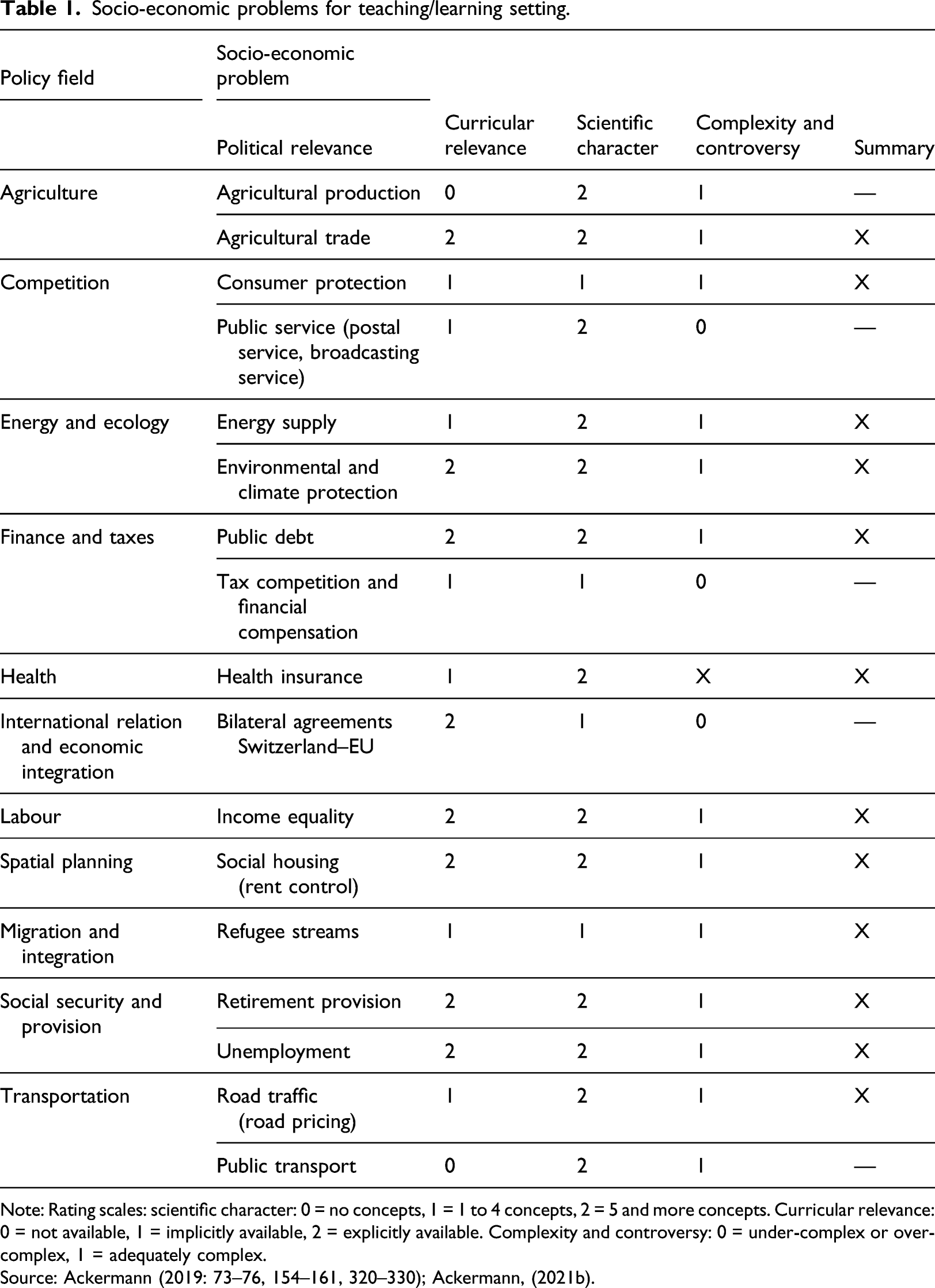
Note: Rating scales: scientific character: 0 = no concepts, 1 = 1 to 4 concepts, 2 = 5 and more concepts. Curricular relevance: 0 = not available, 1 = implicitly available, 2 = explicitly available. Complexity and controversy: 0 = under-complex or over-complex, 1 = adequately complex.
Source: Ackermann (2019: 73–76, 154–161, 320–330); Ackermann, (2021b).
The criteria political relevance (i.e. the problem is current was used to identify representative and relevant problems. About 260 federal referenda in Switzerland from 1990 to 2017 (BFS, 2017) were analysed using a structured qualitative content analysis. The structuring of the referenda yielded 17 socio-economic problems that are assigned to various policy fields. These problems were evaluated based on the following criteria: curricular relevance (i.e. the problem is anchored in the framework curricula of secondary schools), scientific character (i.e. the problem is related to scientific concepts of social sciences) and complexity and controversy (i.e. the problem is complex, its solution ambiguous and controversial). As a result, 12 socio-economic problems remained: agricultural trade, consumer protection, energy supply, environmental and climate protection, public debt, health insurance, income equality, social housing, refugee streams, retirement provision, unemployment and road traffic.
In order to evaluate the authenticity and applicability of the Swiss problems for a teaching/learning setting in other German-speaking countries, the criteria political relevance and curricular relevance have to be applied. The overlapping problems will be used for the intervention study.
Structure of the teaching/learning setting
Classroom schedule for teaching/learning setting.
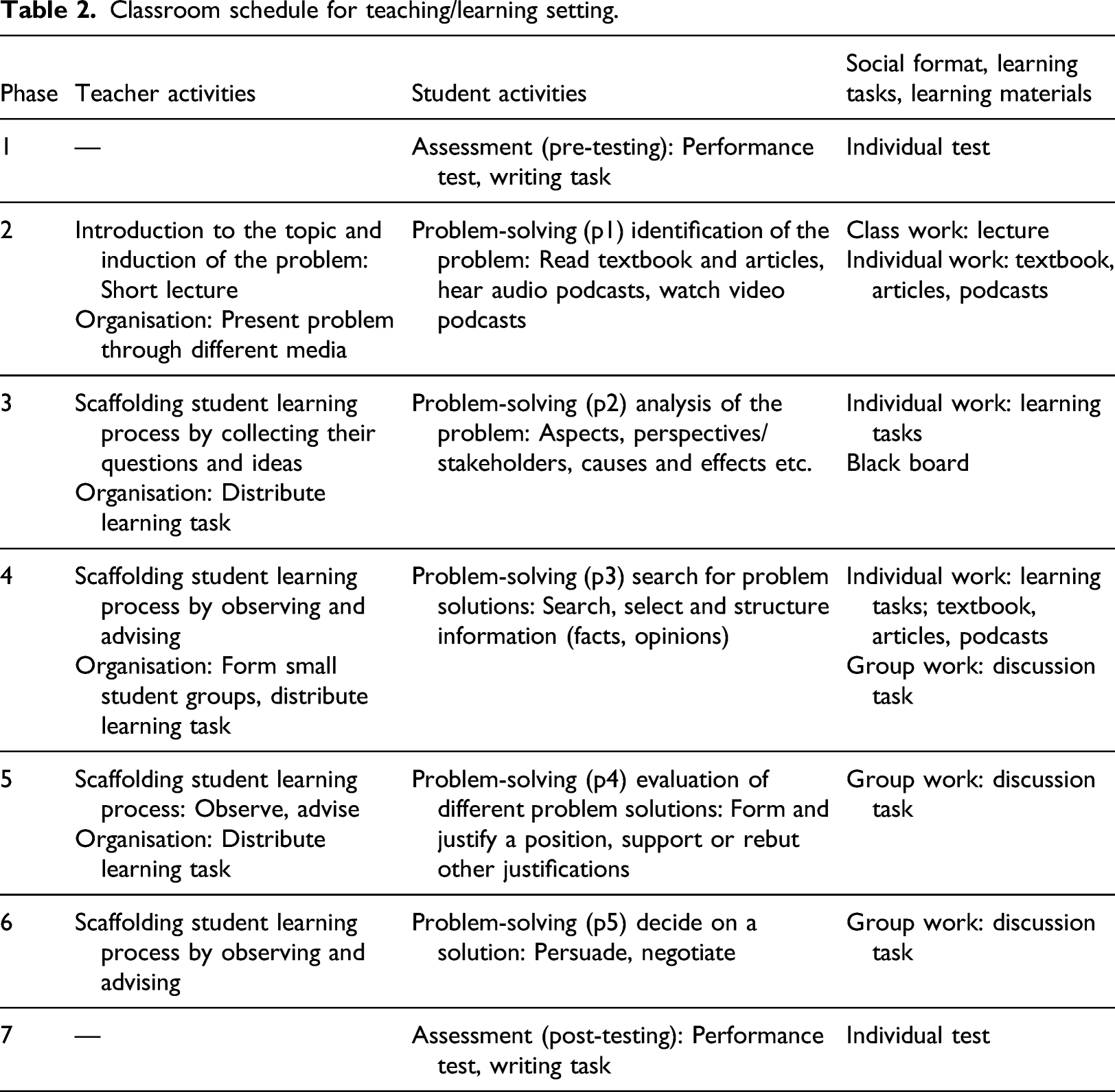
The teaching/learning setting starts in Phase one with an assessment of students’ content knowledge and argumentation skills. The former is tested by a performance test, the latter by a writing task (see Performance test and writing task). In Phase two, the teacher introduces the topic and induces the problem (e.g. by a short lecture, textbook chapters, newspaper articles, audio/video podcasts). The students enter the problem-solving process by identifying the problem (p1). In Phase three, the teacher distributes the learning task for individual work, and collects questions and ideas on the problem. The students continue on the problem-solving process by analysing the problem (p2) regarding different aspects (e.g. economic, social, ecological, cultural), different perspectives (stakeholders), causes and effects etc. In doing so, the students acquire, deepen and consolidate knowledge on the problem-related topics. In Phase four, the teacher forms small groups and distributes learning tasks for group work, and scaffolds the students’ learning process by observing and advising. The students have to search, select and structure information (p3) on problem solutions proposed by different stakeholders. In Phase five, the teacher further distributes learning tasks for group work and continues scaffolding the learning process. The students have to evaluate different problem solutions (p4) through forming and justifying a position, and supporting or rebutting other justifications. In Phase six, students complete the problem-solving process by deciding on a sole problem solution (p5); the decision is reached by persuading each other and negotiation with one another. The setting ends in Phase seven with an assessment of students’ content knowledge and argumentations skills.
The classroom schedule described above is meant to be a basis that applies to an intervention with a control and experimental group of students. For the experimental group, the classroom schedule is extended by a phase of argumentation training after the pre-testing.
Measurement instruments and analytical frameworks for students’ competence
Performance test and writing task
Psychological tests are usually employed to measure students’ competence. Several test instruments have been developed and applied to assess economic competence in recent years, addressing either different competence dimensions (e.g. economic literacy, financial literacy, entrepreneurial literacy) or different school levels (e.g. K-12, K-9, K-6) (Beck, 1993; Beck et al., 1998; Förster et al., 2012, 2017, OECD, 2012, OECD, 2017; Retzmann and Hausmann, 2012; Riklin, 2021; Schumann and Eberle, 2014; Walstad et al., 2013, 2013b, Walstad and Rebeck, 2016, 2017). The WBT (Beck, 1993; Beck et al., 1998) follows a categorical approach in the content domain (i.e. basic concepts, microeconomics, macroeconomics, foreign economics). The test items are related to factual and conceptual knowledge in the subdomains and are only specified in selected-response format. The OEKOMA test (Schumann and Eberle, 2014) integrates a problem-oriented approach in the content domain (i.e. real situations within the above-mentioned subdomains), but the items are still related to factual and conceptual knowledge in the subdomains and about 90% of the items are specified in selected-response format. However, none of these instruments seem to be appropriate for measuring economic competence in socio-economic contexts.
In order to measure students’ content knowledge before and after the intervention, we propose to take the revised test on economic-civic competence (WBK-T2) (Ackermann, 2018, 2019: 166–174). The WBK-T2 is a written psychological performance test that measures the societal/economic dimension of economic-civic competence. It covers four current socio-economic problems (retirement provision, energy supply, public debt, manager salaries). Each problem begins with a short introduction followed by about eight items, in total 32 items. The items systematically vary in cognitive process (k1: recognise and reproduce; k2: understand and apply; k3: compare, evaluate and decide) and answer format (f1: selected-response; f2: short constructed-response; f3: extended constructed-response). The validity of the WBK-T2 test scores has been extensively evaluated using an evidence-based validation procedure (AERA et al., 2014), including validation aspects of test content, internal structure and relations to external criteria (Ackermann, 2019). Consequently, the WBK-T2 seems to be a reliable operationalization of the societal/economic dimension of economic-civic competence, and test scores may be interpreted as reflective of students’ domain-specific content knowledge on the respective socio-economic problems.
In order to measure students’ written argumentation skills before and after the intervention, an adequate writing task has to be specified. In this writing task, students are provided with pre-formulated problem solutions and are asked to take a position by selecting one or several of the given solutions (see Figure 1). Examples for writing tasks in the teaching/learning setting. Source: Own translation according to Ackermann (2019).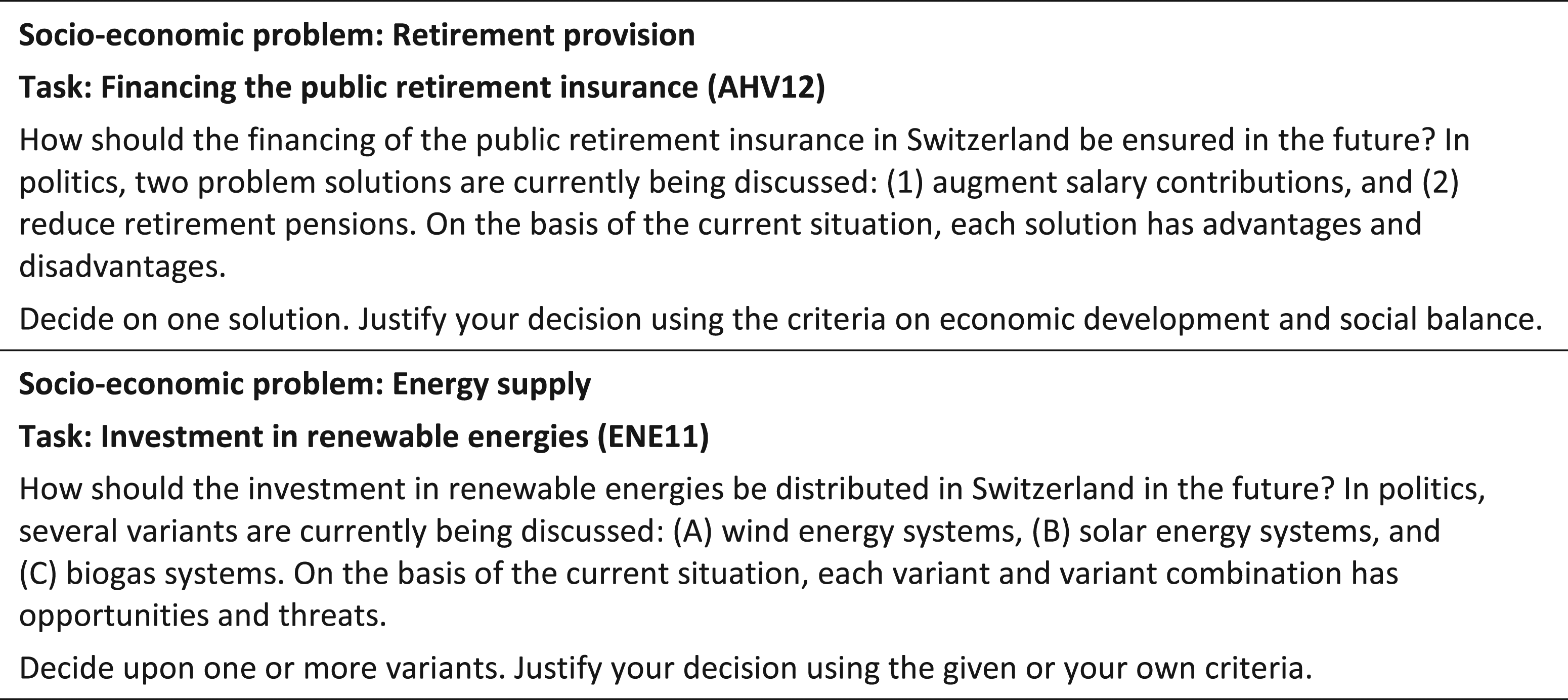
Analytical framework for argumentative writing
Analytical frameworks applied to examine and evaluate students’ argumentation skills (Duschl, 2007) have to provide quality criteria for students’ arguments. With regards to written arguments, two main types of analytical frameworks can be found in the literature (Sampson and Clark, 2008). Domain-general frameworks may be used in various scientific disciplines (Erduran et al., 2004; Kelly et al., 2007; Means and Voss, 1996; Schwarz et al., 2003; Toulmin, 1958) because they focus on the structure of an argument, such as structural components in an argument (i.e. claim, data, justification), structural complexity of an argument (i.e. number of justifications either supporting or qualifying the claim) and type of justification (e.g. abstract/scientific, specific/consequential, truism, authority, personal). In contrast, domain-specific frameworks are used in a specific scientific discipline or subdiscipline (Zohar and Nemet, 2002; Kelly and Takao, 2002; Lawson, 2003; Sandoval, 2003; Sandoval and Millwood, 2005, 2007) and focus on the content of an argument, that is adequacy and accuracy from a scientific perspective.
Analytical framework for argumentative writing on socio-economic problems.
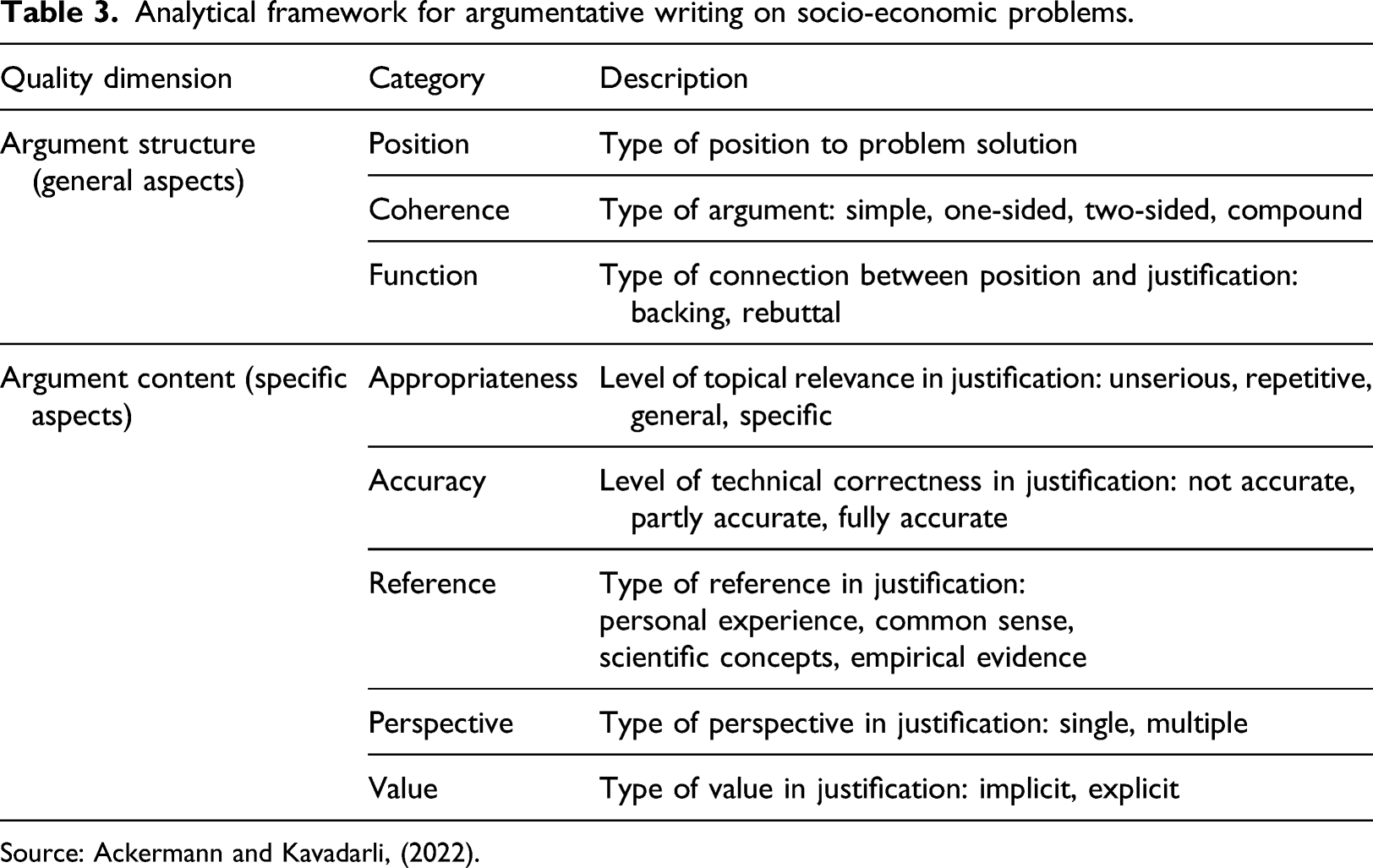
Source: Ackermann and Kavadarli, (2022).
The framework has three categories for argument structure and five categories for argument content. Position captures the problem solution specified in the task and selected by the student. Coherence applies to the type of argument (i.e. simple, one-sided, two-sided, compound) (Schwarz et al., 2003). Function covers the type of connection between the position selected and the justification formulated (i.e. backing, rebuttal) (Toulmin, 1958). Appropriateness refers to the level of topical relevance of the justification (i.e. unserious, repetitive, general, specific). Accuracy refers to level of the technical correctness of the justification (i.e. not accurate, partly accurate, fully accurate) (Zohar and Nemet, 2002). Reference focuses on the type of reference given in the justification (i.e. personal experience, common sense, scientific concepts, empirical evidence) (Schwarz et al., 2003). Perspective accounts for the ‘single’ and ‘multiple’ perspectives included in the justification (e.g. local/global, North/South, presence/future, various interest groups). Value captures ‘implicit’ and ‘explicit’ ethical concepts in the justification (e.g. efficiency, prosperity, equality, sustainability) (Kolstø, 2004; Sadler and Donnelly, 2006; Zeidler and Sadler, 2007).
Analytical framework for argumentative discussing
The ICAP (interactive-constructive-active-passive) framework describes students’ overt learning activities and underlying learning processes in the classroom (Chi, 2009; Chi and Wylie, 2014). The framework classifies four modes of learning activities: (1) passive (e.g. reading, marking, listening, simple agreeing or disagreeing), (2) active (i.e. reproducing information), (3) constructive (i.e. generating new information, articulating own ideas), (4) interactive (i.e. discussing information, responding to each other’s ideas). The four modes are assumed to stimulate different learning processes and produce learning outcomes. Consequently, the framework’s four modes follow an ordered classification: interactive activities are better than constructive ones, constructive activities better than active one, and active activities better than passive ones.
Analytical framework for argumentative discussing on socio-economic problems.
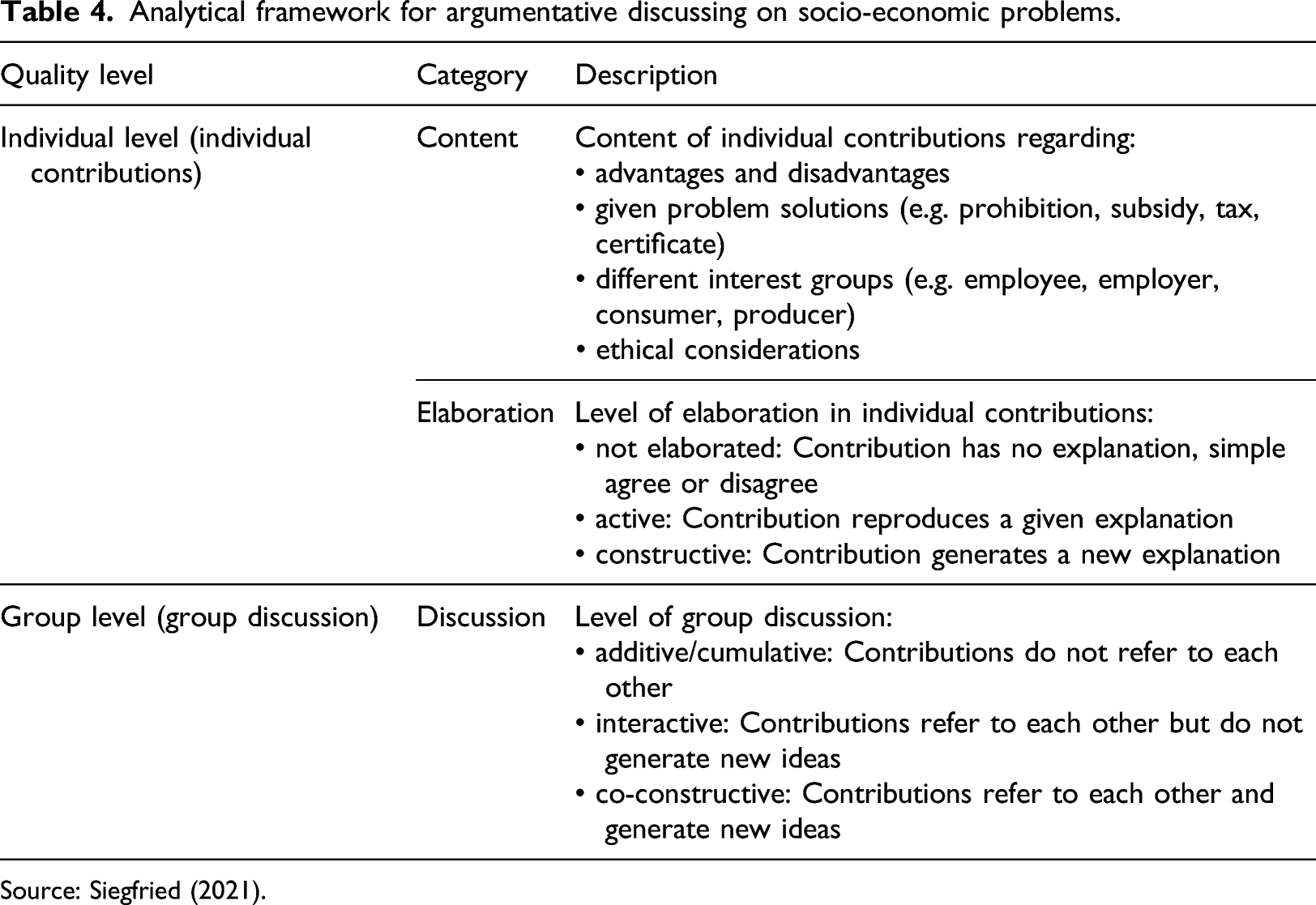
Source: Siegfried (2021).
At the individual level, the category content captures the diversity of individual contributions regarding advantages and disadvantages of given problem solutions (e.g. prohibition, subsidy, tax, certificate) for different interest groups (e.g. employee, employer, consumer, producer). Additionally, this category captures whether individual contributions include ethical considerations on the problem. The category elaboration classifies the level of elaboration in individual contributions: not elaborated (no explanation, simple agree or disagree), active (reproduce given explanation) and constructive (generate new explanation). At the group level, the category discussion classifies the level of group discussion: cumulative (contributions do not refer to each other), interactive (contributions refer to each other but do not generate new ideas), co-constructive (contributions refer to each other and generate new ideas).
Conclusion and outlook
In this article, we presented a research design for an intervention study that aims to promote and examine argumentation in socio-economic contexts. The research design is built on three core elements. The first element is a teacher training workshop that focuses on deepening professional competence, especially on pedagogical content knowledge, in order to promote students’ socio-economic competence. The second element is a problem-oriented teaching/learning setting: (2a) authentic socio-economic problems used as content for the teaching/learning setting, (2b) phases of learning and testing to structure of the teaching/learning setting. The third element is measurement instruments and analytical frameworks to assess students’ competence: (3a) a performance test on civic-economic competence, (3b) writing and discussing tasks on socio-economic problems, (3c) analytical frameworks for argumentative writing and discussing.
The research design is primarily applicable to German-speaking countries (DACH region). This allows us to develop and use materials in the same language for both interventions, the teacher training workshop, and the teaching/learning setting. Furthermore, it allows for the application of linguistically comparable test instruments that yield psychometrically valid test results. The research design primarily addresses the target group of grammar school students (‘Gymnasium’). Grammar schools’ curricula are structured according to the scientific principle (e.g. mathematics, languages, science, social sciences). This facilitates a curriculum analysis of the relevant subjects (e.g. Germany: civics and economics; Austria: geography and economics, Switzerland: economics and law) in order to connect curricular learning contents with identified and evaluated socio-economic problems. In contrast, vocational schools’ curricula are often structured according to the situational principle, and these situations are either profession-general or profession-specific (Reetz, 2003; Tramm and Reetz, 2010).
The presented research design is meant to be a starting point for an internationally comparable research programme on argumentation in socio-economic contexts. The intended outcomes of this research programme are associated with the two interventions. The first intervention is the teachers’ workshop on socio-economic problems and problem-oriented teaching/learning, which aims to deepen teachers’ pedagogical content knowledge. The second intervention is a problem-oriented teaching/learning setting in the classroom, aimed to increase students’ socio-economic competence. The findings of the intended research programme may provide insights into the learning process in a problem-oriented teaching/learning setting. This, in turn, may disclose the potential of promoting content knowledge and argumentation skills in the economic domain.
Footnotes
Acknowledgements
The authors thank Rosa Brown for proofreading.
Declaration of conflicting interests
The author(s) declared no potential conflicts of interest with respect to the research, authorship, and/or publication of this article.
Funding
The author(s) received no financial support for the research, authorship, and/or publication of this article.

Author Biographies
Prof. Dr.
Dr.