




Abstract
In the commercial sector, which is of crucial importance to the Swiss economy among other countries, a large number of apprentices are trained on a vocational education and training programme every year. Besides other subjects, the subject Economics and Society forms an integral part of the vocational education and training curriculum and serves to prepare apprentices for professional, economic and civic participation. Although content knowledge is widely considered necessary to both teaching quality and student achievement, little is known about the subject-specific content knowledge of Swiss Economics and Society teachers. As previous research has shown a gender gap in the content knowledge of (pre-service) teachers in economics, we focus on the question as to whether Swiss Economics and Society teachers’ economics content knowledge differs, including in relation to gender. As additional influencing factors, our study included teaching experience and teaching load. We measured the economics content knowledge of 153 Economics and Society teachers with a shortened German version of the Test of Understanding College Economics in the German-speaking part of Switzerland. Multivariate analyses indicated a gender effect that manifested itself in higher test scores among male Economics and Society teachers. These findings are relevant to the training of vocational education and training teachers.
Keywords
Introduction
In many developed countries, which possess no or low reserves of raw materials, the economy is heavily dependent on companies that operate in the service and commercial sector (Federal Office for Migration, 2010; Federal Statistical Office, 2018). This applies to many European countries, but to Switzerland in particular. The significance of this sector is mirrored in the career choices of the majority of young people who enrol on a vocational education and training (VET) programme (State Secretariat for Education, Research and Innovation (SERI), 2016). According to national statistics, every year, two-thirds of all school-leavers from one cohort enrol on a VET programme, with apprenticeships in the commercial domain being the most popular in Switzerland (SERI, 2016). Not only for Switzerland but also for other countries whose economy is strongly intertwined with VET, it is, not least for economic reasons, important to focus on the learning opportunities that apprentices are provided with by their teachers in commercial VET.
Teachers are responsible for designing teaching and learning processes and initiating learning opportunities for pupils. The quality of teaching and the increase in pupils’ knowledge are, therefore, linked to the professional knowledge of the teachers. Empirical findings indicate that a comparatively high level of teachers’ knowledge has a positive effect on pupils’ knowledge development (Hill et al., 2005; Seidel and Shavelson, 2007). Teachers’ content knowledge is crucial to the initiation of meaningful teaching and learning processes (Baumert et al., 2010; Zlatkin-Troitschanskaia et al., 2019a) and correlates with other facets of professional knowledge, for instance, pedagogical content knowledge (Holtsch et al., 2018; Kuhn et al., 2016) and teachers’ behaviour in the classroom (Blömeke et al., 2015; Jeschke et al., 2019a).
Focusing on the individual teacher, various empirical studies have demonstrated correlations between (pre-service) teachers’ knowledge (e.g. content knowledge) and sociobiographical (e.g. gender) and educational characteristics (e.g. teaching programmes) as well as characteristics of their situation at work (e.g. teaching load) (Bank and Retzmann, 2012; Holtsch et al., 2018; Kuhn, 2014; Kuhn et al., 2014). Recently, various empirical studies have tested the economics knowledge of (pre-service) VET teachers in other German-speaking countries and found evidence of a gender effect (e.g. Brückner et al., 2015a; Fritsch et al., 2015). Remarkably, there are not just gender-specific differences in professional knowledge; knowledge also depends on the extent of teachers’ practical teaching experience and deliberate practice (Zlatkin-Troitschanskaia et al., 2019a). Therefore, it should be examined whether gender-specific differences still exist if the intensity of teaching experience, for instance, years spent in teaching and teaching load, is accounted for in the analysis of their economics content knowledge.
Since a university teaching education degree is a formal requirement for teaching at a Swiss commercial VET school (SERI, 2015), the findings of studies on (pre-service) teachers should provide a starting point for investigating practising VET teachers with respect to their knowledge and the significance of gender and teaching experience.
Based on this brief review of the current state of research, questions arise as to
(a) The level of economics content knowledge that commercial VET teachers possess (RQ1);
(b) Whether the gender effect persists after commercial VET teachers have entered the profession (RQ2).
Should this effect remain, it is worthwhile asking
(c) Whether and, if so, to what extent the effect still remains after the teaching experience and the teaching load of teachers have been taken into account (RQ3).
To clarify these research questions, we use data from Switzerland. Our article first describes a framework for modelling teaching and learning processes and the training of teachers in Switzerland. Afterwards, we review empirical findings on the economics knowledge of university students and pre-service and in-service teachers. Here, we focus on the findings related to gender effects and the effects of teaching experience. On this basis, we derive hypotheses concerning commercial VET teachers’ economics content knowledge and present an empirical study involving 153 teachers at German-speaking Swiss VET schools, among whom we tested these hypotheses.
Conceptual considerations about VET teachers’ education and content knowledge
Modelling teaching characteristics and their interrelations
The conditions and interactions of teaching and learning processes can be described as a model in which learning opportunities are arranged and initiated by teachers and used by pupils with respect to their competence development (Helmke, 2014; Lipowsky et al., 2009; Praetorius et al., 2018). In addition, with a focus on teachers, these models take their personal characteristics (e.g. gender, age), their education (e.g. completed teacher training programmes) and situation at work (e.g. teaching experience) as coefficients for their professional competence into account (e.g. Brühwiler and Blatchford, 2011; Kunter et al., 2013). Apart from this type of model, various detailed teacher competence models are available to describe the professional knowledge and skills of teachers, in which both content knowledge and pedagogical content knowledge, as well as affective–motivational characteristics (e.g. interest), are emphasized (Baumert and Kunter, 2013; Blömeke et al., 2015). In the context of both models of teaching and learning processes and teachers’ competence, knowledge cannot be viewed as isolated, but in terms of teachers’ personal characteristics (e.g. gender) and teachers’ learning opportunities (e.g. through teaching experience).
Teaching economics at commercial VET schools in Switzerland
In the following, we turn to teachers in the context of Swiss commercial VET schools, which apprentices attend for 1 or 2 days per week besides practical training and branch-specific courses. In Switzerland, the major objective of commercial VET schools consists of equipping apprentices with economics skills and knowledge, which encompass economic-civic and commercial facets (Holtsch and Eberle, 2016a). To this end, teachers at Swiss commercial VET schools teach, among other subjects, the core subject Economics and Society (E&S), which forms an essential part of the VET school curriculum and includes subject areas such as economics, business administration, finance and accounting, law, history and political science (Swiss Conference of Commercial Training and Examination Branches (SKKAB), 2018). Although microeconomics topics, such as supply and demand, form part of the E&S curriculum, macroeconomics content predominates and covers, for instance, economic and business cycles, economic growth, structural change, fiscal and monetary policy and market economies (SKKAB, 2017).
Moreover, the analysis of media content in Switzerland conducted by Schumann et al. (2010) showed that most of the coverage concerned macroeconomics (e.g. economic policy and financial markets) and international relationships in the economy (e.g. monetary policy and foreign trade). This suggests that macroeconomics issues are much more frequently dealt with and thus receive more attention than microeconomics issues, such as supply and demand in daily life. It can be concluded that these macroeconomics topics, which are discussed in public sphere and in the media, are also reflected in the E&S curriculum.
To teach curricula and daily topics of relevance in their classrooms, VET teachers need solid knowledge in the form of professional content knowledge (Baumert et al., 2010; Jeschke et al., 2019b; Seidel and Shavelson, 2007). The currently discussed concepts of content knowledge mainly refer to Shulman (1986a, 1986b, 1987), whose concept of content knowledge implies that teachers are experts who are required to understand facts, data and concepts and to be able to structure and link these facts, data and concepts and explain them to their pupils. Content knowledge that is to be taught to a specific target group may not exclusively relate to what has been acquired at a university, and it is not just general teaching experience alone that counts but also, and more importantly, experience in the teaching of specific content (Herbst and Kosko, 2014: 35). Thus, the type of content knowledge that is required in practical teaching is different from purely academic knowledge and shaped through its active use in the classroom (e.g. Jeschke et al., 2019a).
These considerations lead us to questions as to the (empirically identifiable) extent to which VET teachers acquire, develop and possess economics content knowledge and to the extent to which teaching experience contributes to this knowledge.
Swiss VET teacher education and learning opportunities for the acquisition of economics content knowledge
The development of teachers from novices to experts can be described with reference to competence development models that mirror the different phases of this process (Dreyfus and Dreyfus, 1980). According to the qualification hypothesis, the knowledge and skills of teachers develop within individual learning opportunities that teacher education institutions provide (Kunter et al., 2013). Furthermore, in line with Berliner (1992, 1994), the years spent in teaching can be considered as one indicator of teachers’ expertise and of the depth of their content knowledge. In this context, we consider among others (teaching) experience to be an expression of deliberate practice (Ericsson et al., 1993).
With regard to formal prerequisites, E&S teachers are required to hold at least a pertinent bachelor’s degree. Furthermore, pre-service teachers are required to obtain a teaching diploma after completing their subject-specific studies and to possess 6 months of professional experience in the commercial sector (SERI, 2015). A shortage of qualified teaching staff (Swiss Coordination Centre for Research in Education (SCCRE), 2014) has led to further options, which in turn have paved the way for career changers, as described by Holtsch (2017). To perform their responsible function, VET teachers need to possess thorough knowledge to draw on in their E&S lessons. In this content-related context of teacher education and training, an analysis of selected university curricula showed that, with respect to Economics and Business Administration, there is hardly any difference in the content of compulsory curricula between bachelor’s programmes at universities and bachelor’s programmes at universities of applied sciences. The modules at both types of academic institution cover basic microeconomics as well as basic macroeconomics concepts even though the thoroughness and titles of modules may vary. The extent to which this applies to programmes that E&S teachers graduated before – and, in some cases, a long time before – the reform and the redefinition of minimum requirements cannot, however, be ascertained retrospectively. Therefore, it is important to investigate what knowledge practising E&S teachers possess.
In addition to formal teacher education and training, learning opportunities also arise informally and include learning in conversation with other teachers and/or experts, learning on the basis of information material and practising and testing teaching activities or teaching materials (Kyndt et al., 2016: 1122–1124). Informal learning opportunities are created through teaching itself, for instance, or through reflections on everyday school life (Kyndt et al., 2016; Messner and Reusser, 2000; Parise and Spillane, 2010; Reusser and Messner, 2002; Richter, 2013; Richter et al., 2011). Specific ‘on-the-job’ learning opportunities can differ considerably because teaching experience varies, along with the average teaching load. This may be particularly relevant for Switzerland, as the teaching load of E&S teachers at commercial VET schools varies greatly (Holtsch, 2017). This might lead to differences in their content knowledge too.
Regarding the course of teachers’ competence development, the question of inert knowledge needs to be taken into account. Many examples indicate that the active application of content knowledge leads to a deeper understanding of the content (Allgood and Walstad, 1999; Kuhn, 2014; Neuweg, 2011, 2014). If teachers have no opportunity to use their content knowledge in the classroom, which is the case if the curriculum does not require this kind of knowledge, for instance, it is likely that it will turn into inert knowledge and can no longer be actively applied (for an explanation of ‘inert knowledge’, see, for example, Gruber et al., 2000; Lindmeier, 2011; Neuweg, 2011, 2014).
Empirical findings on the effects of gender and teaching experience on teachers’ content knowledge
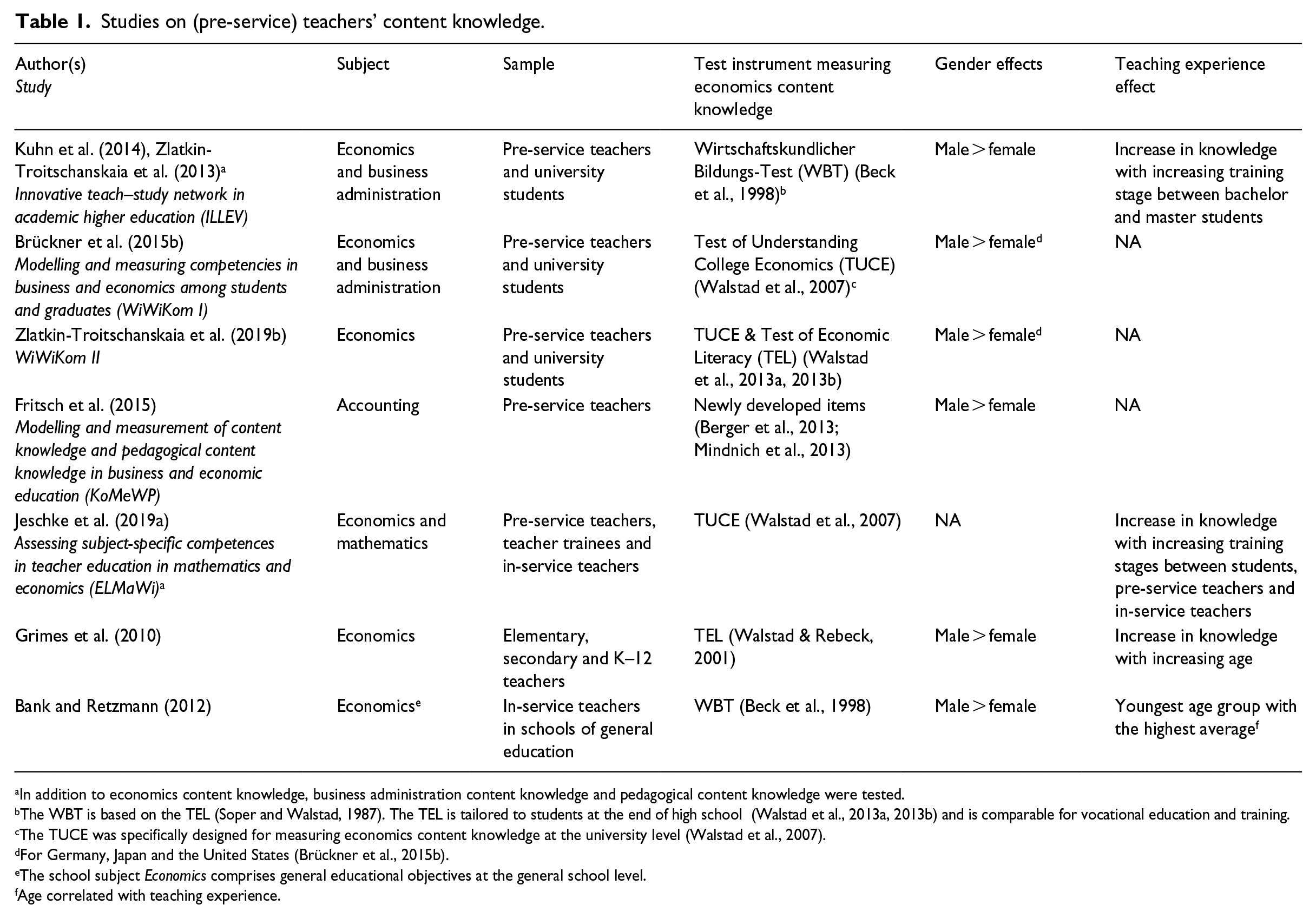
Recent studies on professional knowledge have focused on pre-service and in-service economics teachers’ content knowledge (e.g. Holtsch et al., 2018; Kuhn et al., 2016). Table 1 presents an overview of selected studies from the domains of business and economics. In the following, we include and report selected empirical results from relevant studies that dealt with pre-service and in-service teachers’ content knowledge. To establish a basis for our research, the focus of our review is on potential gender effects and the effects of teaching experience on the content knowledge of in-service teachers in general. Even though the studies vary in terms of samples and test instruments and include variables other than those reported in our review, the study results provide an insight into the effect of gender and teaching experience on teachers’ content knowledge.
Studies on (pre-service) teachers’ content knowledge.
In addition to economics content knowledge, business administration content knowledge and pedagogical content knowledge were tested.
The WBT is based on the TEL (Soper and Walstad, 1987). The TEL is tailored to students at the end of high school (Walstad et al., 2013a, 2013b) and is comparable for vocational education and training.
The TUCE was specifically designed for measuring economics content knowledge at the university level (Walstad et al., 2007).
For Germany, Japan and the United States (Brückner et al., 2015b).
The school subject Economics comprises general educational objectives at the general school level.
Age correlated with teaching experience.
The majority of empirical studies on economics content knowledge is related to university students rather than in-service teachers. As for university students, gender-specific differences in economics knowledge have been reported by a large number of empirical studies (see Table 1). Male gender has been proven to have positive effects on economics and business students’ content knowledge in Germany (e.g. Brückner et al., 2015b; Fritsch et al., 2015), however, with varying effect sizes among countries (Brückner et al., 2015b). Gender-specific differences in content knowledge were also found to be prevalent in studies on teachers in which male teachers outperformed female teachers (Bank and Retzmann, 2012; Grimes et al., 2010).
Moreover, empirical evidence supports the assumption that teachers’ knowledge increases with their years of teaching experience (Table 1). One of these studies was conducted by Grimes et al. (2010) whose analyses pointed to an increase in economic literacy with increasing age. They explained this finding by referring to learning opportunities in a teacher’s everyday practice, which contribute to the development of content knowledge (‘learning by teaching’; Grimes et al., 2010: 14–15). The studies conducted by Kuhn (2014), Kuhn et al. (2016) and Jeschke et al. (2019a) yielded similar results. The results presented by Bank and Retzmann (2012: 79), by contrast, contradicted these results, which the authors explained by a process of knowledge erosion.
Overall, these results provide the first indications of the gender differences and effects of teaching experience that can be expected in a study that focuses on E&S teachers at commercial VET schools in Switzerland. The available findings suggest that there could be (a) a gender effect in terms of higher test scores among males in this particular population and (b) a tendency towards a positive effect of teaching experience. Studies also indicate that gender effects can be country-specific phenomena (Brückner et al, 2015b). Therefore, it is essential to investigate whether these results can be replicated in Switzerland.
Research questions and hypotheses
We are interested in investigating E&S teachers’ content knowledge at VET schools, given that at present there are no results available that pertain to the German-speaking part of Switzerland. If gender differences exist, it seems likely that this might lead to differences in E&S instruction, which, in turn, might affect apprentices’ learning processes and thus their acquisition of knowledge and skills. County-specific information about this crucial type of professional knowledge can provide an evidence-based reference point for further development of teacher training in Switzerland.
Against the background of the relevance of teachers’ content knowledge to pupils’ competence development, and the gender effects found in the field of economics, business administration and accounting in Germany, we address the following questions:
RQ1. How do Swiss E&S teachers perform on an internationally established economics content knowledge test?
We expect E&S teachers to answer items on an economics test that is tailored to the bachelor level at least on a medium level (H1), as Swiss E&S teachers must hold at least a bachelor’s degree. This implies that we focus on the content that E&S teachers should have acquired during their study. As university knowledge may no longer be remembered, we expect a medium number of correct answers and interpret test performance against the background of the results in Germany because of similar study structure and comparable curricula in bachelor study programmes.
RQ2. Does content knowledge test performance differ between female and male teachers?
Taking into account the findings of studies that have analysed samples with economics students, we expect a gender difference and test the hypothesis that male teachers outperform female teachers on the content knowledge test (H2).
RQ3. Do gender differences in economics content knowledge still persist when we include teaching experience and teaching load in our analysis?
We assume that teachers with more teaching experience (quantified in years) and a higher average teaching load will perform better than teachers with less experience and a lower teaching load (H3). We expect that experienced teachers perform better because they have had more (potential) learning opportunities through teaching. Although teaching load has not explicitly been taken into account in the studies reviewed above, we include this aspect in our study as its variation between 15% and fulltime is unique to Switzerland (Holtsch, 2017: 367) and may therefore prove to be relevant. It seems plausible to assume that it makes a difference whether an E&S teacher has taught 5 years on a fulltime basis or 10 years on a 30% basis, for instance.
Methodology
Study design
The teacher study was conducted in the Leading House Learning and Instruction for Commercial Apprentices (LINCA). It was carried out in early summer 2015 and aimed at investigating facets of E&S teachers’ professional competence. More precisely, the study focused on the measurement of E&S teachers’ content knowledge, pedagogical content knowledge and beliefs in the content area of economics. In addition, biographical data were collected. In this paper, we focus on content knowledge as we aimed to present data on teachers’ knowledge that provide a basis for international comparisions.
The surveys took place during school conferences, after lessons, during breaks in classes or in meeting rooms of the schools. Depending on the day of the survey, the school and the timetable, individual teachers or a team of teachers took part in the surveys. The completion of the entire survey took the participating teachers 135 minutes. The test on content knowledge, which provides the data set for this substudy, had to be completed within 50 minutes. Moreover, the test setting included 15 minutes for answering biographical questions. The surveys followed a standardized procedure and were conducted by trained senior test administrators (Holtsch, 2018).
The teachers received no financial compensation for their participation in the survey. Instead, they were offered alternative incentives. First, they received individual feedback on their performance subsequent to the survey. This feedback was available online and included their individual test results in comparison to the overall teacher sample. Second, several school principals accepted the teachers’ participation in the survey and their reflections on individual feedback as part of mandatory in-school continuing education (Holtsch, 2018; Rohr-Mentele et al., 2018).
Sample
In the preparation stage of the survey, the project management team contacted the principals of the commercial VET schools and asked them to encourage their staff to participate in the surveys. Approximately half of the sample was randomly selected, while the other half was made up of teachers who had volunteered to participate. Randomly selected E&S teachers 1 and teachers who had volunteered to participate did not differ significantly in terms of relevant education-related characteristics (Holtsch et al., 2018; Rohr-Mentele et al., 2018).
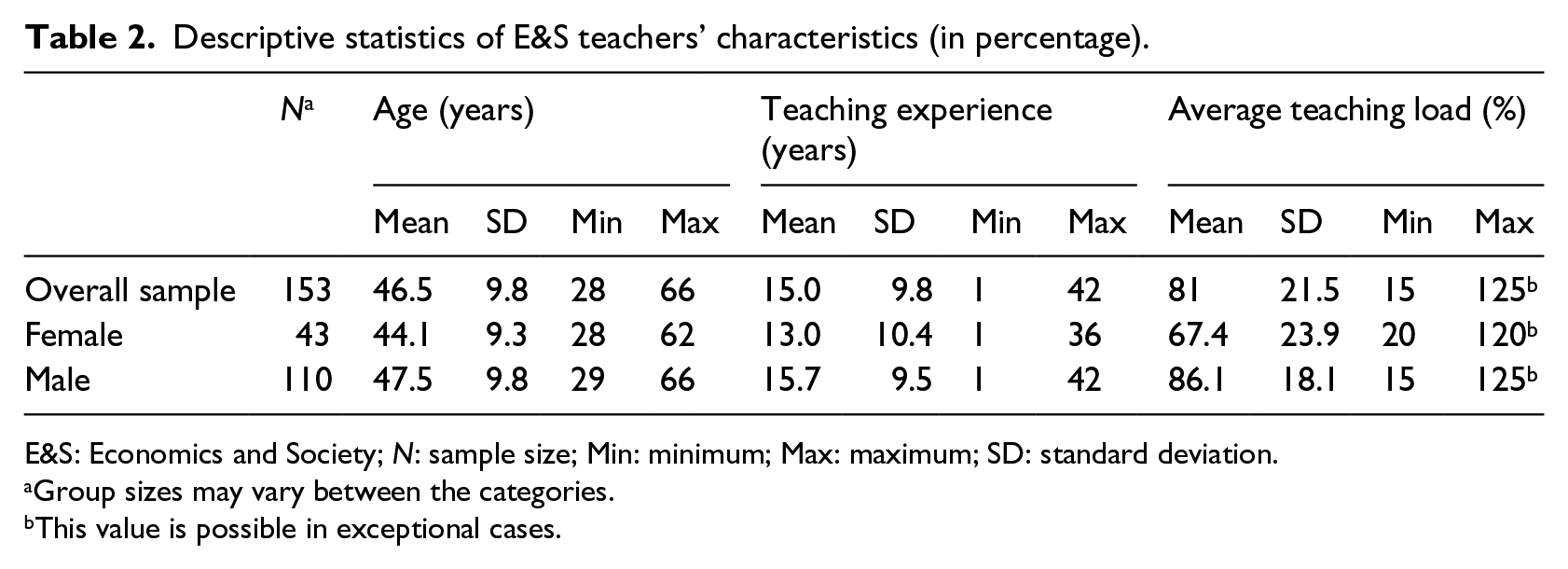
The sample comprised 153 E&S teachers (28% female) who taught at commercial VET schools in the German-speaking part of Switzerland. The number of teachers varied across the 35 VET schools; sometimes, solely one teacher per school was part of the sample. The average age of the participating teachers was 47 years (standard deviation [SD] = 9.8, Min = 28, Max = 66; Table 2). Their average teaching load amounted to 81% (SD = 21.5, Min = 15, Max = 125) of a fulltime equivalent, and their teaching experience was, on average, 15 years (SD = 9.8, Min = 1, Max = 42). Age correlated strongly with teaching experience (Bravais–Pearson r = 0.833, p < 0.000) and was therefore excluded from the following analyses.
Descriptive statistics of E&S teachers’ characteristics (in percentage).
E&S: Economics and Society; N: sample size; Min: minimum; Max: maximum; SD: standard deviation.
Group sizes may vary between the categories.
This value is possible in exceptional cases.
As for gender-specific differences, the analysis indicated that male teachers tended to have chosen a practice-oriented pathway (for more detailed analyses, see Holtsch, 2017). Before entering the teaching profession, the male teachers (40.2%) had completed a commercial VET programme more often than the female teachers (26.8%), for instance. Furthermore, more male than female teachers held a degree from a university of applied sciences (23% male vs 19% female). These differences were not significant, however.
Instruments
After evaluating several instruments for measuring teachers’ content knowledge, we decided to apply the Test of Understanding in College Economics (TUCE-4; Walstad et al., 2007). This internationally established, normed test with closed items covers the content of economics courses at the college and university levels (Walstad et al., 2007). The test provides a basis for comparisons between teacher scores and international student scores. The TUCE has been translated, adapted and validated as part of the project Modelling and measuring competencies in business and economics among students and graduates (WiWiKom I; Zlatkin-Troitschanskaia et al., 2014).
The original test consists of 60 items. Half of the items relate to the microeconomics domain and the other half to the macroeconomics domain. The two domains, in turn, each encompass six content categories (Walstad et al., 2007) which are listed in Table 4. Given the two main educational pathways of E&S teachers (university or university of applied sciences; Holtsch, 2017), and to ensure the content validity of the test, we conducted the aforementioned analyses of the curricula of three universities and one university of applied sciences (Holtsch and Eberle, 2016b; Holtsch et al., 2018).
Owing to the limited survey time of 50 minutes, we shortened the original TUCE, the completion of which would have taken almost 90 minutes. For this reason, we selected three items with medium difficulty from each of the 12 content categories. The resulting short version consisted of a total of 352 items: 17 items related to microeconomics (MiCK) and 18 items to macroeconomics (MaCK). For their application in the Swiss context, the German items needed some slight linguistic modifications and were adapted accordingly. We then implemented this short version of the German TUCE in a standardized survey in the spring/summer of 2015.
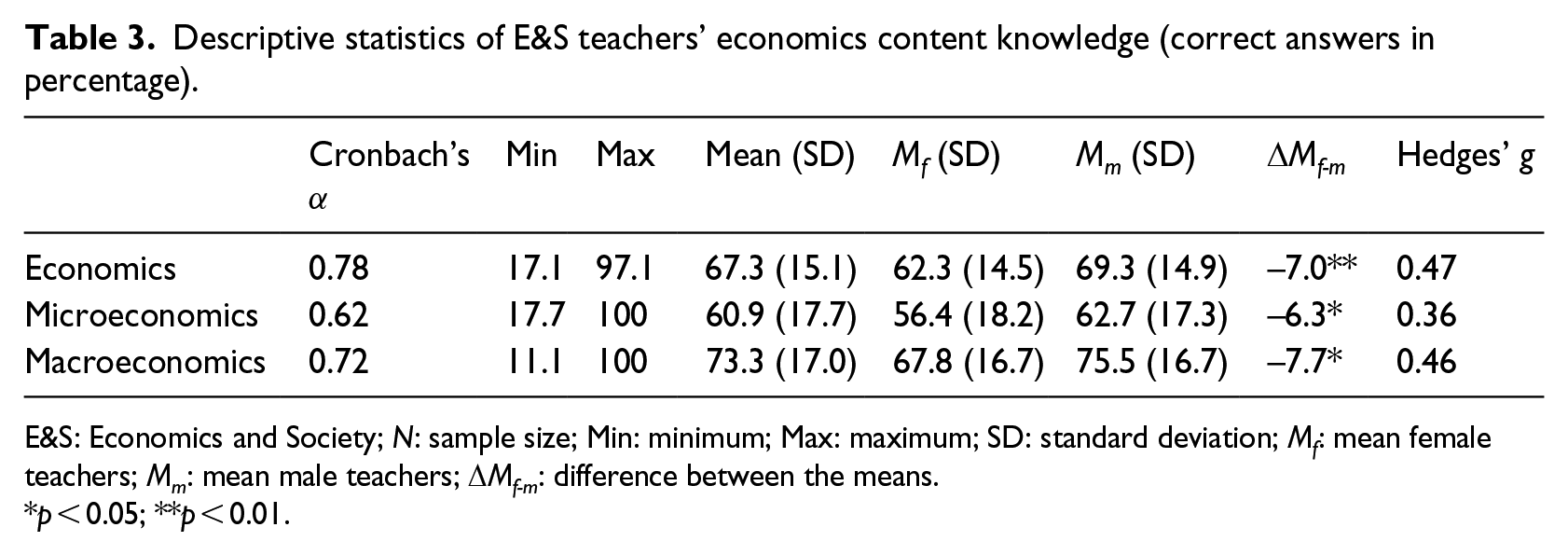
The test on economics content knowledge achieved satisfactory reliability for both the overall test (α = 0.78) and the subtests MiCK (α = 0.62) and MaCK (α = 0.72) (Table 3). Although we used subscales that had been shortened by almost half of the items, the values are somewhat comparable to those of the original test (Walstad et al., 2007: 8, MiCK α = 0.70, MaCK α = 0.77) and the WiWiKom project (Zlatkin-Troitschanskaia et al., 2015: 125, expected a posteriori/plausible value (EAP/PV) reliabilities: MiCK 0.72, MaCK 0.79). In addition, when using the Spearman-Brown (S-B) approximation, it becomes clear that the original reliability values of the test developers can be achieved with an extension to the length of the original test: MiCK (αS-B = 0.74) and MaCK (αS-B = 0.85). The results of the confirmatory factor analysis confirmed the results from Germany. The two-dimensional model (for MiCK and MaCK χ2 = 55.170; df = 53; comparative fit index (CFI) = 0.991; standardized root mean square residual (SRMR) = 0.049; root mean square error of approximation (RMSEA) = 0.016) represented the data better than the one-dimensional model (χ2 = 63.988; df = 54; CFI = 0.959; SRMR = 0.053; RMSEA = 0.035) (Holtsch et al., 2018).
Descriptive statistics of E&S teachers’ economics content knowledge (correct answers in percentage).
E&S: Economics and Society; N: sample size; Min: minimum; Max: maximum; SD: standard deviation; Mf: mean female teachers; Mm: mean male teachers; ΔMf-m: difference between the means.
p < 0.05; **p < 0.01.
The questionnaire for gathering biographical data was newly developed for the purposes of the survey (Holtsch, 2018). It contained both closed and open questions on sociodemographic characteristics as well as general questions on school-leaving certificates, VET, subject-specific studies, teaching diplomas and professional activities. In addition to the biographical data, we asked some questions concerning the teachers’ professional context which related, for example, to the years spent in teaching (experience) and to the average teaching load.
Statistical analysis
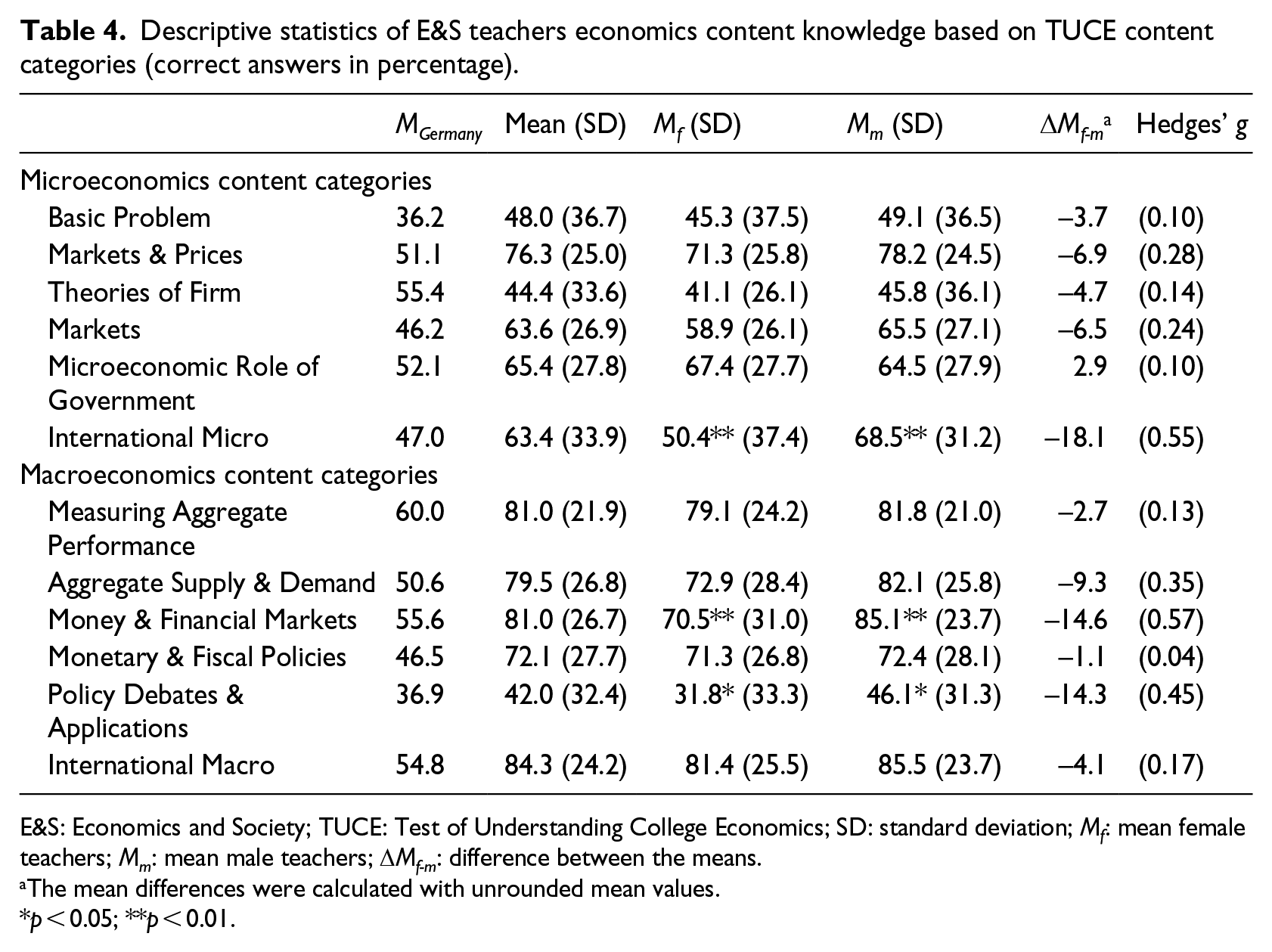
For the investigation of teachers’ characteristics, we applied descriptive analysis (H1). To compare the teachers’ performance with the already available international results, we calculated the corresponding test values. As set forth above, each content category in the short version of the German TUCE was represented by three items of medium difficulty. Therefore, we reconstructed the means of the content categories for the WiWiKom sample (Brückner et al., 2015b). This means that the results of the comparison presented in Table 4, for example, for the content category Money and Financial Markets, do not relate to four items as in the original version of the test, but to the three items applied in LINCA.
Descriptive statistics of E&S teachers economics content knowledge based on TUCE content categories (correct answers in percentage).
E&S: Economics and Society; TUCE: Test of Understanding College Economics; SD: standard deviation; Mf: mean female teachers; Mm: mean male teachers; ΔMf-m: difference between the means.
The mean differences were calculated with unrounded mean values.
p < 0.05; **p < 0.01.
The significance of the differences in the test performance of the female and male teachers was analysed with the aid of t tests (H2). In addition, we calculated the effect size using Hedges’ g instead of Cohen’s d because of unequally sized subsamples of female and male teachers. In accordance with the interpretation of Cohen’s d, values with g ⩽ 0.20 are interpreted as small effects, values around g = 0.50 as medium effects and values with g ⩾ 0.80 as large effects (Bühner, 2011: 238; Ellis, 2010: 41; Künsting et al., 2016: 309).
The correlations between test performance and gender, teaching experience and teaching load were calculated by means of regression analyses. In Model 1, gender was used as an independent variable. In Model 2, the two teaching characteristics teaching experience (quantified in years) and average teaching load served as independent variables, while, in Model 3, all independent variables were included (H3). The dependent variables as well as the continuous variables were z-standardized before the regression analyses.
Results
Swiss E&S teachers’ gender, teaching experience and teaching load
First, we conducted a descriptive analysis of the data on the participating teachers’ teaching experience and teaching load. Table 2 provides a comparison of age, teaching experience and average teaching load for both female and male teachers. Female and male teachers differed in terms of age and teaching experience.
The male teachers tended to be older and to possess more teaching experience than their female counterparts, but these differences were not significant. A significant difference, by contrast, was observed in the case of teaching load: on average, the male teachers had been working almost full time and 20% more than the female teachers since the beginning of their teaching activities (p < 0.001).
Swiss E&S teachers’ economics content knowledge test performance and gender differences
Table 3 shows the comparison of the results of the content knowledge test and the subtests for the whole sample as well as for female and male teachers.
On average, the teachers answered almost two-thirds of the questions correctly. The proportion differed between the subtests, however: the participants answered 61% of the MiCK items and 73% of the MaCK items correctly. While two of them achieved the maximum number of points on the MiCK or the MaCK subtest, there were two others who answered only two MiCK items or three MaCK items correctly.
Our analyses showed that test performance varied between female and male teachers. By means of t tests, we found significant differences between female (Mf = 62.3, SD = 14.5) and male teachers (Mm = 69.3, SD = 14.9) with an effect size of Hedges’ g = 0.47. These differences were greater in MaCK (Mm = 75.5, SD = 16.7; Mf = 67.8, SD = 16.7; p < 0.05) than in MiCK (Mm = 62.7, SD = 17.3; Mf = 56.4, SD = 18.2; p < 0.05). On both subtests, the male teachers significantly outperformed the female teachers.
As the items of the subtests cover different content categories, Table 4 lists the proportion of correct answers for each of the test content categories for the entire sample and by gender. For the purpose of comparison, the corresponding values from the WiWiKom project (Brückner et al., 2015b) are listed in the second column.
A comparison between the content categories within the MiCK and the MaCK subtests indicated that the number of correct answers also varied within the subtests. While items relating to Theories of Firm seemed to challenge the teachers, items relating to Markets & Prices were easier to answer. As regards the MaCK subtest, only the content category Policy Debates & Applications stands out due to its low average number of correct answers. The items for all other content categories were correctly answered by at least two-thirds of the teachers.
In almost all content categories, male teachers, on average, answered more items correctly than female teachers. The only exception was the category Microeconomic Role of Government (MiCK). According to the results of the t tests (see Table 4), however, the apparent differences in the correct answers are significant in only three content categories: International Micro (MiCK), Money & Financial Markets (MaCK) and Policy Debates & Applications (MaCK).
Swiss E&S teachers’ economics content knowledge test performance, gender and teaching characteristics
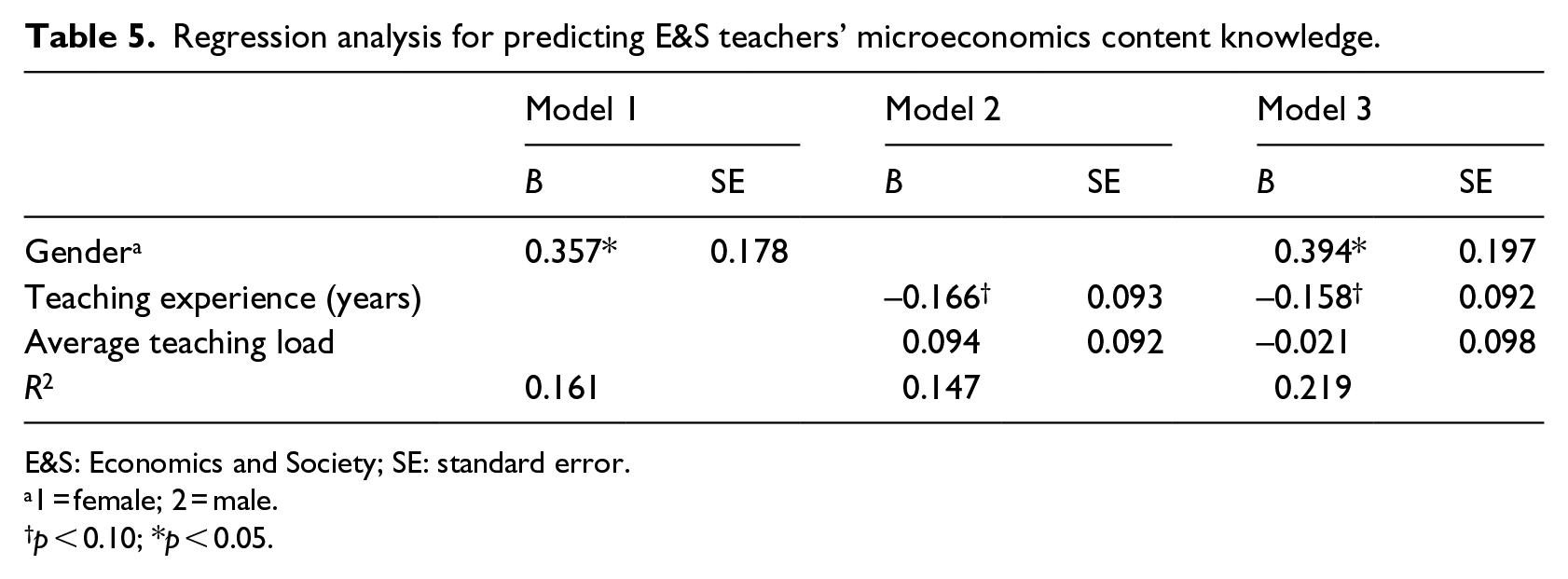
In the first section of the results part, we reported that male and female teachers differed with respect to teaching experience and average teaching load. These differences provided the basis for clarifying the question as to whether the gender effect found in content knowledge test performance correlates with teaching experience and the average teaching load of female and male teachers. Table 5 displays the results of the regression analysis for predicting E&S teachers’ microeconomics content knowledge.
Regression analysis for predicting E&S teachers’ microeconomics content knowledge.
E&S: Economics and Society; SE: standard error.
1 = female; 2 = male.
p < 0.10; *p < 0.05.
In Model 1, the only predictor of microeconomics knowledge is gender, which by itself explained 16.1% of the variance. In Model 2, the predictors are teaching experience and average teaching load. The effect size (beta) of teaching experience on microeconomics knowledge was small and not significant at the 5% level, but it was significant at the 10% level. Teaching experience (quantified in years) explained 14.7% of the variance in the teachers’ microeconomics knowledge. In Model 3, gender, teaching experience and average teaching load were combined. The effect size of teaching experience remained small (p < 0.10) after all variables had been included. The significant effect of gender became slightly stronger when teachers with similar teaching experience were compared. Both gender and teaching experience explained 21.9% of the variance in the teachers’ microeconomics knowledge.
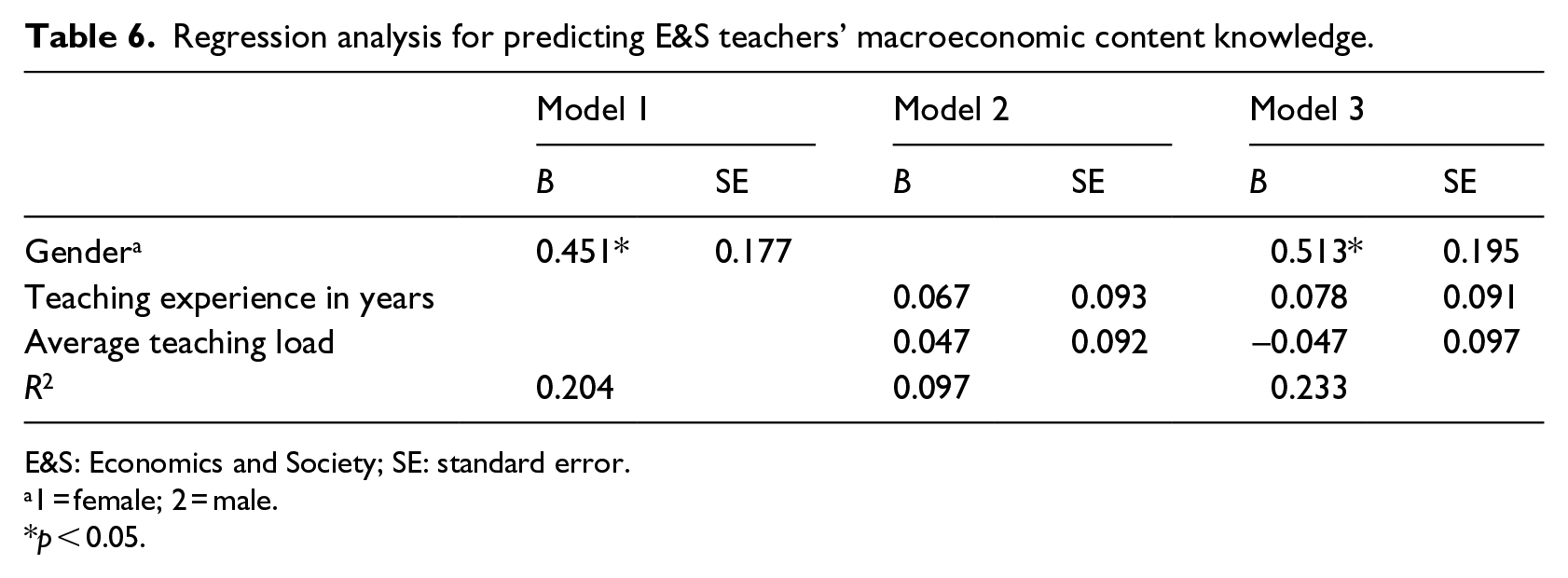
Table 6 summarizes the results of the regression analysis for predicting the E&S teachers’ macroeconomic content knowledge. In Model l, the only predictor is gender, which explains 20.4% of the variance in the teachers’ macroeconomics knowledge. The predictors teaching experience and average teaching load, by contrast, fail to explain variance either in Model 2 or in Model 3.
Regression analysis for predicting E&S teachers’ macroeconomic content knowledge.
E&S: Economics and Society; SE: standard error.
1 = female; 2 = male.
*p < 0.05.
Conclusion and implications
Discussion
In this article, we explored (a) the level of economics content knowledge that E&S teachers possess after entry into the teaching profession and (b) the extent to which the gender effect, as observed among pupils, apprentices, university students and (pre-service) teachers in previous studies, can also be found in E&S teachers. In addition, we investigated (c) whether and, if so, to what extent the potential gender gap persists after teaching experience and average teaching load were taken into account. Our survey has yielded the first findings concerning the extent of economics content knowledge among E&S teachers in the German-speaking part of Switzerland. These results are new in that there were no prior data available on the knowledge of Swiss E&S teachers.
Regarding the first research question about how Swiss E&S teachers perform on an internationally established economics content knowledge test, we assumed that teachers would have answered the items on the TUCE, which had been developed for college and university levels, at least as well as students, and would have achieved a medium number of correct answers (H1). On average, the participants answered almost three quarters of the macroeconomics items and more than 60% of the microeconomics items correctly. Even if the corresponding data for economics and business administration students and pre-service E&S teachers in Switzerland are lacking, the results provide the first indications of E&S teachers’ economics content knowledge. In reference to the results from the WiWiKom project (Zlatkin-Troitschanskaia et al., 2015), the teachers completed the test more successfully than the university students. The results thus mainly confirm our first hypothesis although the teachers seemed to possess more macroeconomics knowledge than microeconomics knowledge and there were differences in performance within the subtests.
This finding indicates that the subtests presented different degrees of difficulty for the teachers. The varying performance of E&S teachers within the subtests might be explained by two other aspects. The first aspect relates to E&S teachers’ opportunities to apply their content knowledge during teaching in VET schools. The comparison between our previously conducted university curriculum analysis and the results of the statistical analyses showed that the knowledge needed for answering the challenging MiCK and MaCK items is included in the curricula of universities but not entirely in the E&S school curriculum. The E&S school curriculum particularly contains macroeconomics content. Since there is no regular need to apply the (microeconomics) knowledge acquired at university in E&S classes, it seems likely that its active use is limited, which, as a consequence, could lead to inert knowledge.
The second aspect relates to facets of teachers’ professional competence (e.g. Blömeke et al., 2015), namely, the interest and the application of economics content knowledge outside VET schools as well as the interplay between knowledge and interest, especially given that macroeconomics topics are more prominent in daily newspapers compared to microeconomics topics (Schumann et al., 2010). This raises the question as to the extent to which an interest in economics topics and news consumption provides informal learning opportunities for teachers and, in turn, whether these factors have an effect on what is taught and how it is taught in individual E&S classrooms, on a teacher’s weighting of the curricular content and on the integration of economics news in learning and teaching activities.
Regarding the second research question relating to whether content knowledge test performance differed between female and male teachers, we expected, in accordance with the existing findings, a gender difference in terms of higher test scores among male teachers. Based on the overall results, we replicated previous results and largely confirmed the second hypothesis (H2), although the gender-related difference did not manifest itself in all microeconomics and macroeconomics content categories. The content categories in which male and female teachers differed significantly were International Micro, Money & Financial Markets and Policy Debates & Applications.
The results can be interpreted with reference to findings related to gender-specific differences in studies on economics students (Brückner et al., 2015a, 2015b; Fritsch et al., 2015). Teachers in our sample may already have started their studies with gender differences regarding their economics content knowledge (cf. argumentation for mathematics student teachers Blömeke et al., 2014), and these differences remain in place throughout their studies and after entering the teaching profession.
A second approach to explaining our findings could be that the male teachers in our sample taught on average almost 20% more than female teachers. Thus, the male teachers can be assumed to have had more and maybe different on-the-job learning opportunities to use their knowledge, which might have contributed to the persistence of a potential gender difference that had possibly already existed since their university studies. To substantiate this explanation, qualitative analyses of the individual use of and reflection on learning opportunities are needed according to Kyndt et al. (2016). Moreover, a longitudinal analysis that included the first years after entry into the teaching profession could clarify the question about how the economics knowledge of teachers develops over time and what learning opportunities might contribute to deepening this knowledge.
Another explanation for the observed gender-specific knowledge differences might be that the content categories, Money & Financial Markets, for instance, relate to topics that are presented in the daily news about business and the economy (Schumann et al., 2010) and could arouse differing levels of interest in men and women. The first results relating to apprentices in VET schools have shown that an interest in economics topics can explain a substantial proportion of the variance in economics knowledge and mediate the effect of gender on this knowledge as male apprentices have been proven to be more interested in economics issues than female apprentices (Förster and Happ, in this issue). This finding indicates that teachers’ knowledge of and interest in specific topics also need to be considered via an integrative approach.
With regard to the third research question that asked whether and, if so, to what extent teaching experience and/or teaching load explain gender differences in teachers’ economics content knowledge, we assumed that teachers with more teaching experience and a higher average teaching load would perform better on the TUCE than teachers with less experience and a lower teaching load (H3). Regression analyses showed that both MiCK and MaCK are predicted by gender. Furthermore, we found a small negative effect size for teaching experience on MiCK, but no remarkable effect size for the average teaching load. The negative correlation with teaching experience remained even after gender had been included. An explanation for this finding might be, according to Bank and Retzmann (2012) and Neuweg (2011, 2014), that content knowledge fades or becomes inert knowledge due to a lack of application in the E&S classroom. The fact that the correlations are not significant at the 5% level can be attributed, in particular, to the small sample with an uneven distribution of gender and to the lack of variance that imposes a restriction on statistical power.
Limitations
Any interpretation of our results is subject to at least two limitations. First, in this study, we applied an international test which is intended to measure the economics content knowledge of college and university students. Our results provide an initial insight into the academic knowledge that VET teachers possess after the completion of their studies. For the purpose of addressing research questions with a wider scope and an analysis of, for instance, correlations between teachers’ content knowledge, pedagogical content knowledge, characteristics of E&S instruction and, ultimately, the competence development of apprentices, the test appears to be only partly suitable. Alternative objective measures of content knowledge would be required which are specifically adapted to the variety of E&S contents to be taught in VET classrooms and tailored to the level of content knowledge that teachers need in order to achieve the objectives of the curriculum. Moreover, an adapted or extended instrument should include further content categories that cover accounting and finance, for example.
The second limitation concerns the sample size. Our sample containing 153 VET teachers is relatively small. In relation to the total number of E&S teachers who teach in the German-speaking part of Switzerland, however, we were able to include a considerable number of participants in our study (Rohr-Mentele et al., 2018). Nevertheless, from a statistical point of view, the differences in the content categories needed to be comparatively large to become significant due to the sample size. In addition, the proportion of women is comparatively small at 28%, which means that the lower potential for generating a sufficiently large variance in the data needs to be regarded as a disadvantage. It is not easy to arrive at a final judgement about the seriousness of this limitation, however, because, specifically for the Swiss context, there are no statistical data on the representativeness of the sample available. Furthermore, the sample size determines the statistical methods that can be applied. As the number of teachers varied across schools and, in some cases, only one teacher per school was included in the sample, a multilevel structure was not considered. Overall, these limitations concerning the sample size call for a larger number of participants in follow-up studies.
Further research
In line with the framework for modelling teaching characteristics and their interrelations, we assume that the content knowledge of E&S teachers correlates positively with their pedagogical content knowledge and influences the design of teaching and learning processes in VET schools. The result that male teachers possess more thorough economics content knowledge than female teachers could thus imply that male and female teachers also differ in the design of teaching–learning situations, in the macroplanning (e.g. proportions/weighting of economic curriculum content) and the microplanning of lessons, and/or in the inclusion of (mass) media (e.g. selection of news to be read and discussed in class). The analysis of potential differences between female- and male-teacher-initiated learning activities and instructional characteristics in the classroom and their impact on pupils’ development should be conducted quantitatively with a larger sample as part of a longitudinal research design as well as qualitatively using video studies.
Assuming that interest correlates with the development of content knowledge (Förster and Happ, in this issue), another approach could focus on promoting the interest of pre-service female teachers in economic topics. The results of our study, which provide the first information on the scope and the depth of VET teachers’ economics content knowledge and the effects of gender, could serve as an empirical basis for the development and improvement of teacher training programmes. If teachers start their studies with gender-specific knowledge and interests, the content and methodology of these studies would have to be geared towards a reduction in these differences. In this context, the relevance of the quantity and the quality of informal learning opportunities and (increasing) teaching experience for teachers’ knowledge development should be investigated in greater depth by means of both quantitative studies with a larger sample from a longitudinal perspective and qualitative studies.
Overall, the study shows that the results of large-scale assessments of gender differences could also be largely replicated for Swiss teachers. Furthermore, teaching experience and teaching load do not contribute substantially to the explanation of the gender gap. It would be important to examine what consequences gender gaps in the content knowledge of teachers might have for learners in the classroom.
Footnotes
Acknowledgements
The authors would like to thank all teachers who participated in the LINCA study and provided us with valuable feedback. Moreover, they are thankful to the reviewers’ helpful suggestions.
Funding
The author(s) disclosed receipt of the following financial support for the research, authorship and/or publication of this article: The research was supported and financed between 2011 and 2017 by the State Secretariat for Education, Research and Innovation (SERI) as part of the Leading House Learning and Instruction for Commercial Apprentices (LINCA), applied for and led by Prof. em. Dr. Franz Eberle.
