



Abstract
Knowledge of economics is becoming essential for citizens to adapt to economic life. Against this backdrop, the economic education of young people in the general education system has, in recent years, assumed greater importance at the level of education policy in many countries. For this reason, an empirical study was conducted in Austria, India and China. The survey tool examines the economic knowledge, self-assessment, personal interest, and attitude towards economic topics among pupils who are about to finish lower secondary school. The findings are presented and compared based on the respective education system and cultural background. The results demonstrate the feasibility of measuring economic knowledge in a standardised way across three different countries. From a comparative perspective, the results indicate the differences in implementing economic education in compulsory education in these countries and that it is critical to exchange good practices and cooperate for innovation to improve the economic education.
Background to the problem and current status of the research
In an economically globalising society, the younger generation is confronted with the complexity of financial markets and services as well as financial risks (cf. OECD Organisation for Economic Co-operation and Development, 2014). Therefore, the need for economic and financial knowledge is growing and will inevitably have an impact on both the future economic life of students and on their career orientation (cf. Sun, 2016).
As early as 2005, the OECD Council recommended that general economic education should be introduced into the school system so that people can be educated about economic matters as early as possible (cf. OECD Organisation for Economic Co-operation and Development, 2005). According to OECD statistics for 2015, at least 59 countries are implementing national strategies for economic education, including China, India and Austria (see OECD, 2015). With the development of young people’s economic education in the general education system in many countries, the amount of research on economic education has increased in recent decades. In addition to the extensive discussion on the conceptualisation of financial literacy or economic education, and the development of an economic competence model (see Gnan et al., 2007; Retzmann and Seeber, 2016), several studies have been conducted in the recent years trying to determine the economic literacy or financial literacy of young people in a standardised approach. In the United States, the Test of Economic Literacy (TEL) developed by the Council for Economic Education in 1979 had been revised in four editions by 2011 (Walstad et al., 2013). With its gradually improvement, the TEL has been widely used in many countries for the assessment of high school students’ economic literacy and in some cases also extended to other student groups (see e.g. Happ et al., 2016; Cameron and Lim, 2019; Reinhardt et al., 2021). In addition, the world-renowned PISA (Programme for International Student Assessment) study has started to conduct their assessment study on the financial literacy of young people in around 20 countries or regions in the world since 2012 (OECD (Organisation for Economic Co-operation and Development), 2014, OECD (Organisation for Economic Co-operation and Development), 2017, OECD (Organisation for Economic Co-operation and Development), 2020). Several empirical studies with representative large-scale samples have also been conducted, for instance in Germany, in recent years. These studies evaluated the economic competence of German youths and investigated its predictors (see Oberrauch and Kaiser, 2019; Kaiser et al., 2020) and latent relationships between financial knowledge and influencing factors (see Happ and Forster, 2019).
In contrast, such large-scale empirical studies on the assessment of economic knowledge and competence of youths are rare in Austria, although it has long been recognised that many young people lack basic knowledge of economic relationships (cf. Greimel-Fuhrmann et al., 2016a). The relevant studies on this topic conducted in the past in Austrian secondary education have primarily focused on the curricular design of the economic education in secondary education, and the development of teaching materials on economic topics in the classroom (see Schwarz, 2012; Szoncsitz et al., 2018), as well as the didactical pedagogies in the teaching practice (see Fridrich, 2012, 2014). Most of them are qualitative research using interview and content analysis. Under these circumstances, the team of Vienna University of Economics and Business embarks on empirical research on the economic education in the Austrian secondary education (see e.g. Greimel-Fuhrmann et al., 2015; Rumpold, 2020; Szoncsitz, 2020). With the development of a survey instrument, they conducted a large-scale empirical study on the assessment of lower secondary students’ economic knowledge in Austria (Greimel-Fuhrmann et al., 2016a; Rumpold, 2020; Rumpold and Greimel-Fuhrmann, 2016). Yet, the Austrian students’ economic knowledge has been scarcely researched in a comparative viewpoint in an international context.
In India, a few publications deal with this topic but only on an abstract or general basis (Tara and Kumar, 2016; Gupta et al., 2016). In addition, these publications refer, above all, to the level of academic education and to the (elective) subject ‘Economics’, which is designed as a subject in this field (cf. Sardana and Bose, 2008). The study by Jambunathan and Jayaraman (2018) is an exception and examines the financial literacy of students. The study was conducted among tenth-to twelfth-grade students in the state of Tamil Nadu. In comparison to developed countries, the level of competence was assessed as low, and improvement of economic education in the school system was called for. At the same time, gender differences were identified. In contrast to developed countries, the performance of women exceeded that of men (ibid.). In India, the curricular anchoring of pre-vocational education and its implementation in some schools was examined (Pilz et al., 2016; Zenner et al., 2017). However, there are no major studies available in the Indian context on the state of general economic competence, particularly among young people at the end of compulsory education.
The literature analysis on China shows that research there on economic education and financial literacy currently converges on secondary education and focuses mainly on the introduction of foreign experience, the discussion of types of development, the analysis of the status quo and suggestions for improvement measures (see Fan and Fu, 2004; Xu, 2005; Yin et al., 2014). Thus, the focus of the existing investigation is primarily limited to the macro level of the education system, or to the conceptualisation of individual education programmes. There are also a few studies at the micro level. For example, curriculum analyses in economic and technical learning areas were conducted in China’s pre-vocational education (Pilz and Li, 2012; Pilz et al., 2016). The results showed that in the Chinese school context economic knowledge is taught as part of the ‘Labour and Technical Course’ or is integrated into the ‘Comprehensive Practice Activity Course’ at lower secondary stage (Li, 2013). In He’s (2018) study of economic education in upper secondary education, it was found that the economic literacy of the students varies depending on the region where the school is situated. The differences in economic development and the quality of education in the various regions have an impact on the economic literacy of the students (cf. He, 2018). In addition to the PISA study, which was carried out in the selected economically well-developed regions of China, more extensive empirical studies have not yet been carried out in other Chinese regions concerning the effect of economic education in lower secondary education.
Accordingly, as the emerging economies with the largest population in the world, both these Asian countries attach importance to the economic education. This is because their large population of young people urgently need economic competence in the rapid economic development, especially after graduating from secondary schools. However, little empirical research and knowledge about the economic competence of young people in such large countries exist, not to mention the studies in a comparative approach. Even in developed European countries like Austria, there is a dearth of more extensive empirical studies in a comparative perspective to explore the economic competence of students under their national context.
To address these research gaps against this background, this study primarily aims at an exploratory comparative analysis of empirical study results regarding pupils’ economic competence in the two largest economies in the world (in terms of population) – China and India – and a smaller highly developed nation Austria. Following the empirical study conducted in Austria, a follow-up study was further implemented in the selected economically strong emerging regions of China and India, to explore the performance of the young people at the end of compulsory education there concerning economic competence. Following these empirical studies, this article presents the results from Austria, India, and China and then compares them based on their respective educational systems and cultural backgrounds.
In the following section, the research questions are specified as a first step and the research design is presented.
Research questions and research design
Economic education is aimed at the development of learners’ economic competence, which, in accordance with Weinert’s (1999) understanding of competence, comprises the knowledge, abilities, skills, attitudes and willingness to behave in a certain way, that make it possible to analyse, assess and successfully and responsibly cope with economically shaped life situations (see Retzmann et al., 2010; Retzmann and Seeber, 2016). In this sense, this understanding of economic competence includes both cognitive facets such as knowledge, skills and abilities as well as affective facets such as interests, attitudes or behavioural willingness (cf. Rumpold, 2020; Greimel-Fuhrmann and Riess, 2020). This comprehensive understanding of economic competence underlies the research work in this study. As the factual knowledge is often the focus when considering competence (ibid.), basic economic knowledge plays a dominant role in the assessment of the targeted students’ economic competence in this study.
This study followed the same research design of the Austrian empirical study on investigation of the economic knowledge of pupils at the eighth grade (Rumpold and Greimel-Fuhrmann, 2016; Rumpold, 2020) and was further conducted in the selected regions in China and India. The collected empirical data were then compared in this study with the data in the Austria study. To ensure the conceptual coherence of the study objectives in three countries, this follow-up study defined the following research questions, which are in line with the research focus of the Austrian study (see Rumpold and Greimel-Fuhrmann, 2016; Rumpold, 2020): • How do the pupils assess their knowledge of the economy on their own? • How do the pupils assess their interest in economic topics? • How do the pupils assess their statements and opinions about the economy? • What knowledge do the pupils have about economic issues and interrelationships?
The pupils’ self-assessment of their acquired economic knowledge is the primary interest of this research. A further interest concerns insights regarding the question of how economic aspects affect pupils and their daily life and how much they enjoy dealing with this topic. These questions therefore focus on the pupils’ interest in economic topics. The third research question deals with the pupils’ attitudes towards the topic of economics by examining their opinions on various statements about different aspects of the economy. The last research question concerns knowledge tasks about different aspects of economic facts and contexts (Rumpold and Greimel-Fuhrmann, 2016; Rumpold, 2020). The reason why the self-assessment, interest and attitude of the target group are given high priority in the study, in addition to the knowledge test, is that it allows many different facets of economic competence to be recorded. As a consequence, the economic competence of the target group can be measured more precisely and comprehensively (ibid.).
In accordance with the aim and interest in knowledge of the study, the research focus in all three countries was on pupils between 14 and 16 years of age, who were studying in the last year of their compulsory schooling. The reason for this sample selection was that the pupils in the phase are those who are already involved in economic life in diverse ways and should already have a certain amount of relevant knowledge. In addition, this group of pupils will shortly complete their compulsory schooling and will be faced with decisions about their educational or professional future, in which their economic competence might exert a subtle influence on their decisions.
The survey instrument, in the Austrian version, consists of a questionnaire in paper form (Rumpold and Greimel-Fuhrmann, 2016; Rumpold, 2020). The processing time is designed for a maximum of 45 min (ibid.). The questionnaire is divided into five parts. The first three parts consist of eight questions each, to record the pupils’ self-efficacy expectations, interests and attitudes towards economic knowledge. A five-level Likert scale from ‘strongly disagree’ to ‘strongly agree’ is available as a response format. The subsequent part contains 24 test questions on economic facts and interrelationships and aims to assess the pupils’ economic knowledge. In addition to general basics of economics and the economic system, the tasks also deal with the different roles of households, companies, the state and abroad in the market economy cycle. The knowledge tasks are closed tasks and are presented in multiple-choice format with four alternative answers each, one or more of which may be correct. The last part of the questionnaire concerns personal information including gender, age, region, language and parental educational background (ibid.).
To apply this questionnaire in Indian and Chinese secondary schools, all test items were translated from German into English and Chinese in accordance with the Guidelines for Intercultural Surveys (Survey Research Center, 2010). Following these guidelines (ibid.), the translation of the survey questionnaire was based on the TRAPD (‘Translation, Review, Adjudication, Pretesting and Documentation’) team translation model. Concretely, the translation of the original questionnaire was initially carried out by a research team with economic and pedagogical knowledge, using the parallel translation technique. First, several team members produced an initial draft translation in both languages independently. Then the draft was compared and refined to revise the adaptation in the translation due to the subjective interpretations and cultural diversity, and to improve the quality (Haas, 2009). The resulting joint translation draft in both languages was then reviewed by an independent bilingual expert and a final version for pre-testing was agreed on. This version of the translated questionnaire was tested with three pupils in India and China. Based on the results of the pre-test, the instruments were again reviewed and revised according to the PISA 2018 Translation and Adaptation Guideline (OECD, 2016) and, once the final version was completed, the translation work and adaptations of the survey instrument (see Chen et al., 2019) were documented.
Brief description of the respective country context
To classify the findings in the respective framework conditions and to improve the understanding of the discussion and interpretation in the chapter five, a brief overview of the relevant part of the school system in each country is given below.
Description of the school system in Austria
Compulsory education lasts 9 years and the entry into the primary level, which extends over four grades of primary school, begins at the age of six. The subsequent lower secondary level also comprises four grades. Pupils can attend either the lower level of the General Secondary School (Allgemeinbildende Höhere Schule, abbr. ‘AHS’) or the New Middle School (Neue Mittelschule, abbr. ‘NMS’) depending on their academic performance. Compulsory education ends at the age of 14 or at completion of the ninth grade, which is the beginning of upper secondary school. This, in turn, extends to five further school levels in addition to the upper level of the AHS and offers further vocational training opportunities. For example, it is possible to attend a vocational secondary school (Berufsbildende Höhere Schule, abbr. ‘BHS’) which, similar to the AHS, concludes with the diploma (Reife-und Diplomprüfung) and confers unrestricted study entitlement. With the commercial academies (Handelsakademie, abbr. ‘HAK’) and the colleges for economic professions (Höheren Lehranstalten für wirtschaftliche Berufe, abbr. ‘HLW’), there is a range of commercially orientated types of schools. The vocational middle schools (Berufsbildende Mittlere Schule, abbr. ‘BMS’) and the dual system of apprenticeship and part-time vocational school are alternatives without the need for a school-leaving certificate or diploma, but provide vocational training in return (see BMBWF (Federal Ministry of Education, Science and Research), 2020, OECD (Organisation for Economic Co-operation and Development), 2010).
The Federal Ministry of Education, Science and Research (BMBWF) is responsible for designing the curricula of the various school types. Economic education is only established to a limited extent in the curricula of general education schools. In the AHS and the NMS, economic content is assigned to the combined subject of geography and economics. The curriculum for secondary level I includes two geographical focuses and the economic focus ‘Market and Economic Cycles’. The focus is on ‘the interplay between production and consumption, or supply and demand, and their interaction for price formation (...)’ (BMBWF, 2019). In 2015, there was also a decree regarding the general teaching principle of economic and consumer education, which should enable students to cope with everyday economic situations and to participate actively and effectively in economic life. As is the case with all teaching principles, this indicative goal is to be achieved across all subjects, with geography and economics being emphasised as a supporting subject in general education (see BMBF, 2015).
Description of the school system in India
Education in India is a shared responsibility between the central government and the individual states. This results in regional differences, both within the school structure and in the quality of the schools. These differences in quality are also due to the existence of different providers, since a large number of non-formal institutions exist alongside state and private institutions (Wessels and Pilz, 2018).
In general, the Indian education system is characterised by the so-called ‘10 + 2 structure’: a 10-year basic education, and a 2-year higher secondary education. Secondary education in India comprises grades nine to 12, with a distinction made between secondary education (ninth and 10th grade) and higher secondary education (11th and 12th grade). The school-leaving certificate after secondary education leads to tertiary education (ibid.).
The nationally applicable framework and guidelines up to the 12th grade of primary and secondary education are determined by the National Council of Educational Research and Training (NCERT). Based on these guidelines, it is up to the individual states to make regional adjustments and set examination standards. Each school is assigned to a committee whose tasks include, for example, curriculum development and final exams. In addition to three national committees, including the Central Board of Secondary Education (CBSE), India has a large number of regional committees, which results in differences in quality within the institutions. The CBSE designs the curricula based on national guidelines issued by the NCERT (Wessels and Pilz, 2018; Krisanthan, 2013).
Description of the school system in China
Lower secondary education (from the sixth or seventh to the ninth grade) in China is part of the 9-year compulsory education system uniformly implemented and is guaranteed by the state. It takes place in the lower secondary school and lasts three or 4 years. Before the 1990s, middle schools selected their pupils based on entrance examinations (Yu et al., 2012). In order to successfully implement compulsory education in the middle school, and to shift the educational focus away from test results towards more comprehensive learning methods, the government replaced the previous entrance exams with a nationwide mandatory enrolment policy based on residency (Yuan, 2013). This means that all primary school graduates must attend the nearest lower secondary school without an entrance exam. The enrolment rate from primary school to lower secondary school reached 99.1% nationwide in 2018 (Ministry of Education, 2019): in that year there were 51,982 lower secondary general schools with 46,526 million pupils (Yuan, 2013).
The curriculum in lower secondary schools is divided into comprehensive courses and subject-specific courses. The subjects mainly include moral education (or politics), Chinese language, mathematics, foreign languages, science (or physics, chemistry, and biology), history and social studies (or geography), sports and health, art (or music and fine arts) as well as comprehensive practical activities and school-based curriculum (Ministry of Education, 2001).
At the end of the final year of lower secondary education, each pupil must take a public examination, which is normally organised and managed by the local education authority in each region in a uniform manner. Pupils complete their compulsory education by passing the exam and receiving their school-leaving certificate. After graduation, pupils can decide whether they want to continue with upper secondary education (10th to 12th grade). Admission to upper secondary education depends on the results of the examination (Ministry of Education, 2015). It determines the future path of the pupils: whether they are allowed to attend either a general upper secondary school or a vocational secondary school (Pilz and Li, 2012).
Samples and results
Before the presentation of results, the samples in each country are described in the following section.
Samples in each country
Within the framework of the quantitative main study, in Austria, 1258 pupils from the eighth grade in different schools and school types from all Austrian provinces, with the exception of Salzburg, were surveyed. Of these surveyed pupils, 44.1% were male and 55.9% female. With a share of 70.3%, most of the pupils were 14years old at the time of the survey, 18.0% were 13years old and 10.1% were 15years old. Pupils attending an AHS made up 62.3%, and the remaining 37.7% an NMS.
In the Indian context, the pupils researched were in the 10th grade of five state schools in the capital Bangalore in the state of Karnataka. The city was selected due to well-developed school infrastructure, in Indian terms, and a heterogeneous student body in terms of socio-economic background. The individual schools were selected by local research partners who had access to the field. A total of 335 pupils were surveyed; 23 questionnaires were excluded from the data evaluation in the course of data processing. The average age of the sample is 15.2years and the ratio of girls to boys is about 50/50.
In China, three normal general secondary schools in Shandong province were selected for testing. Here too, the selection was made against the background of the research requirements (preferably average schools in terms of student numbers) and field access. A total of 335 pupils took part, all of whom were in the ninth grade. 19 questionnaires had to be excluded from the data evaluation due to missing information leaving a total of 316 of valid questionnaires. Of these, 170 were girls and 146 were boys. Of the respondents 94.3% were 15years old, which corresponds to the target group of the survey. The few 14-year-old (or 16-year-old) pupils are likely to have enrolled in school earlier (or later).
In the following section, the central results are presented separately by the main focuses in the survey instrument and are discussed briefly according to countries. All following tables and figure about analysis results here were generated and further processed by the software SPSS 25.0 and Excel.
Results about pupils’ self-assessment of economic knowledge
Descriptive statistics on the self-assessment of surveyed youths.
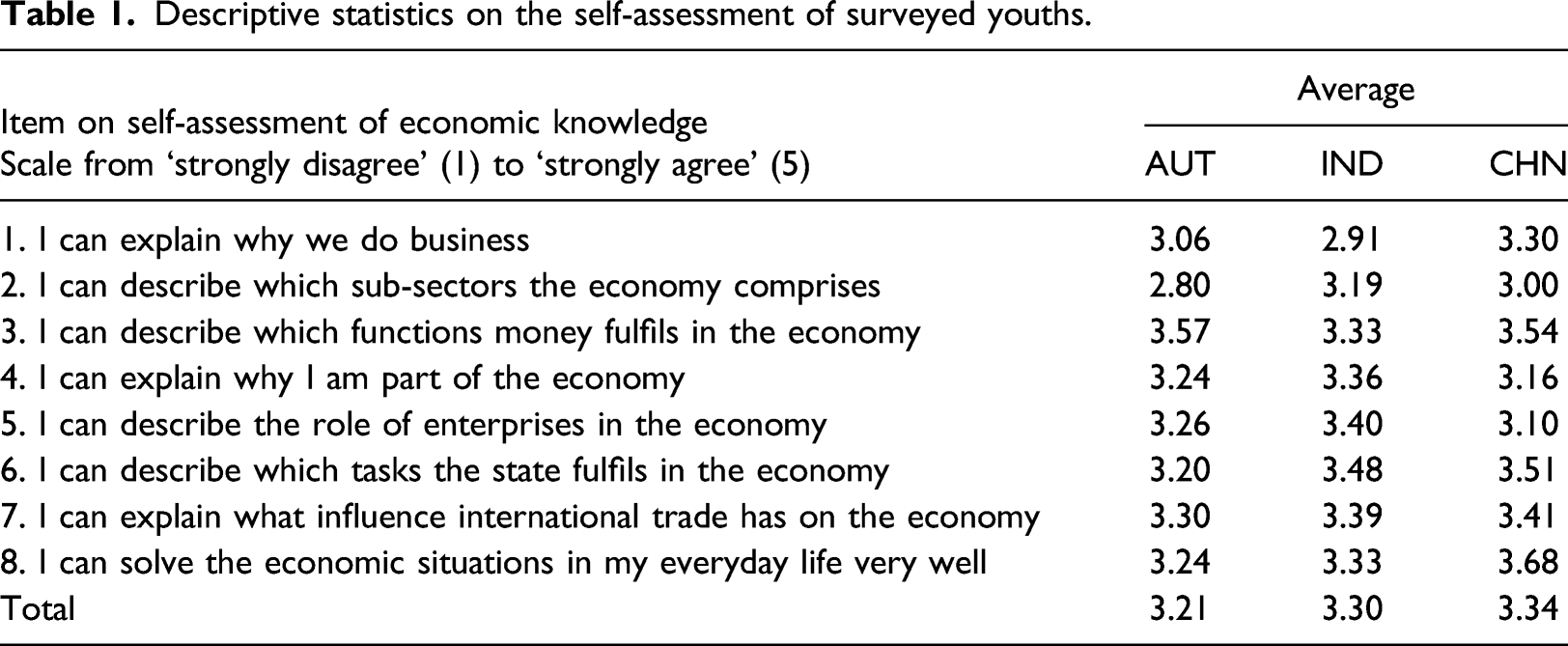
With an average approval rating of 3.21 on the overall scale of all statements, the self-assessment of the economic knowledge of the surveyed Austrian pupils was moderate. A comparatively high approval rating of 3.57 was given to the statement on knowledge of the function of money as a specific instrument in the economic system. It indicates that many surveyed Austrian pupils think that they have already certain cognition on the concept of money. In contrast, noticeably lower approval ratings of 3.06 and 2.80 were given to statements on knowledge of overall economic contexts such as the fundamental function of the economy and its sub-sectors (items 1 and 2).
The surveyed Indian pupils rated their economic knowledge as little above average with an average value of 3.30. Among the eight survey items, the highest agreement lied in the description of the state’s role in the economy (item 6). Similar to the results from Austrian respondents, the statements on knowledge of overall economic contexts (items 1 and 2) were also rated noticeably lower than other statements by Indian respondents.
The surveyed Chinese pupils rated their economic knowledge level at an average value of 3.34. Among the respective evaluation statements, the statement on the topic of economic situations in everyday life (item 8) has the highest mean value at 3.68. In other words, according to their self-assessment, many of these surveyed Chinese pupils believed that they were relatively good at solving economic situations in their everyday life. On the statement of the description of the sub-areas of the economy (item 2), the knowledge level of the Chinese respondents was also estimated to be relatively low at an average of 3.00.
Results about pupils’ interest in economics
Descriptive statistics for the interest of surveyed youths in economics.
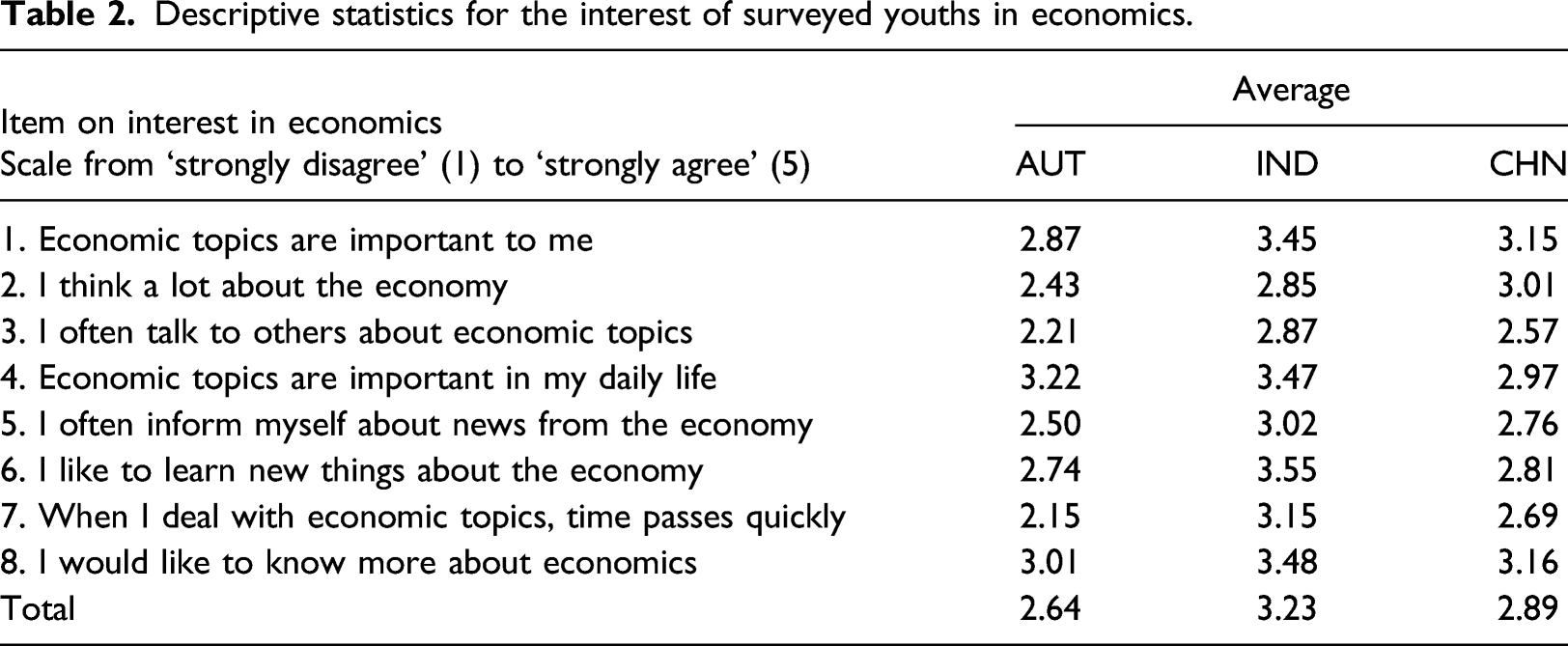
In view of the average approval rating of 2.64 on the overall scale of all statements, the interest in economics of the surveyed Austrian pupils was rather weak. Although the general importance of economic topics and issues for everyday life was still rated comparatively high with a consent score of 3.22 (item 4), the approval rating for interest-related behaviour patterns then dropped significantly. For example, the statement that people often inform themselves about economic news received an approval rating of only 2.50 (item 5). This indicates that these surveyed Austrian pupils have a certain amount of concern and interest in economic topics, but they are still restrictedly involved in economic topics in the daily life.
With mean values between 2.85 and 3.55, the results from surveyed Indian pupils showed just slightly above average interest in economic topics and resulted in a mean value of 3.23 for a composite scale. The statements that express a general interest (cf. Item 1, 4, 6 and 8) showed a greater score than items that ask for specific behaviour (cf. Item 2, 3, 5 and 7). Similar to the Austrian respondents, the surveyed Indian pupils also explicitly express their interest and willingness to learn about economics, especially in regard with new things (cf. Item 6). But there is also inconsistency between their behaviour and desire.
With regard to interest of Chinese youths in economics, the overall mean value of interest for the overall sample was 2.89. The results in the last column of Table 2 shows that the average values of the statements concerning actual behaviour (cf. Items 3, 5, 6 and 7) are below the overall mean value. In contrast, the mean values of statements indicating a general interest (cf. Items 1, 2, 4 and 8) are above the overall average. This results in a roughly analogous situation in the Chinese case as well, in that on the one hand these Chinese respondents consider economic knowledge to be important and their motivation to acquire new knowledge is high. On the other hand, however, their interest in the actual engagement and discussion of economic topics was not so high.
Results about pupils’ opinion on economics
Descriptive statistics for the opinion of surveyed youths on economics.
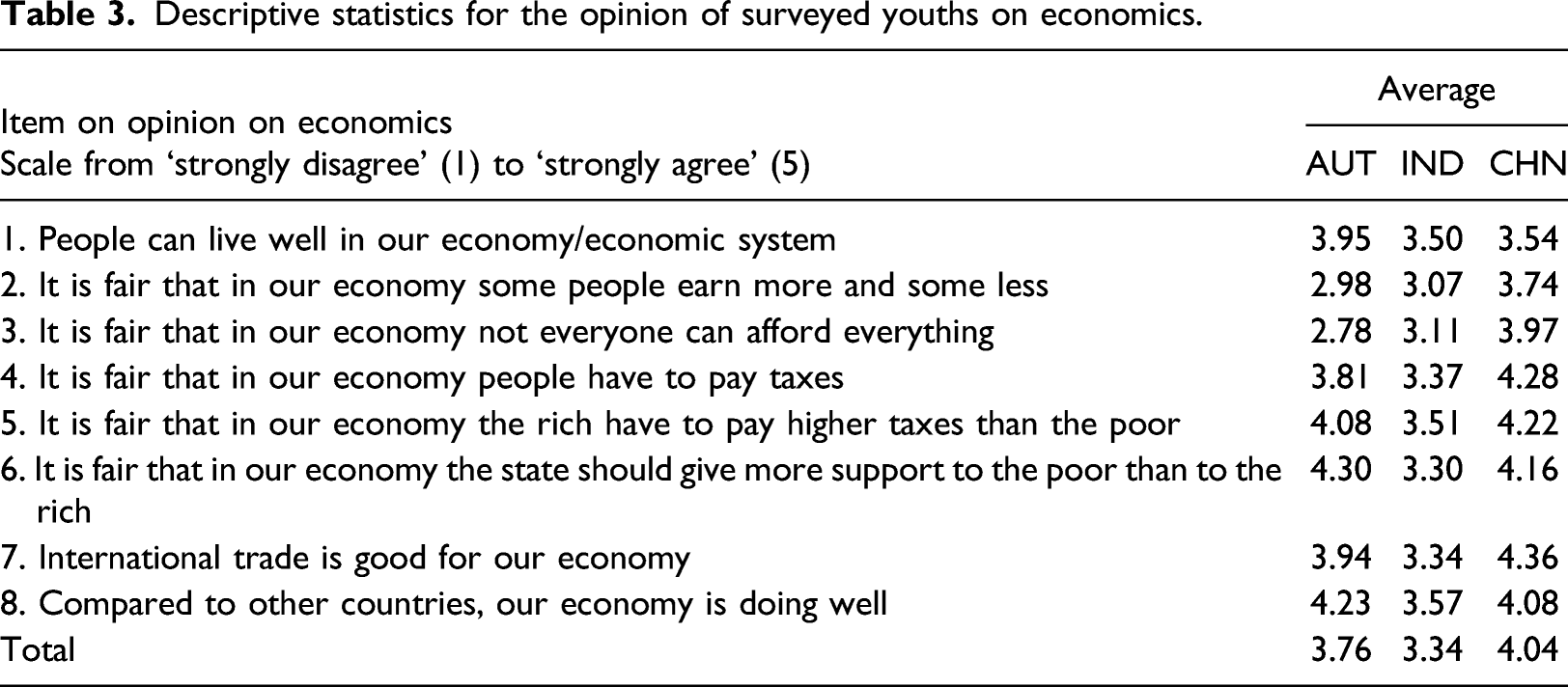
In view of the average approval rating of 3.76 on the overall scale of all statements, the opinion of the surveyed Austrian pupils on economics can be classified as predominantly positive. Comparatively high approval ratings of 4.30 and 4.08 were given to statements on social redistribution in the economic system (items 5 and 6). It indicates that most of the respondents endorse the opinion on the public finance policy of redistribution of income and wealth in Austria. In contrast, the statements on the fairness of income differentials received much lower approval ratings of 2.98 and 2.78 (items 2 and 3).
For all items responded by Indian pupils, the mean value was 3.34 and showed a tendency to above-average approval of the selected items. The highest agreement values showed for statements that refer to the standard of living both in comparison with other countries (item 8), and in the own economy (item 1). This means that many Indian students surveyed share this opinion about the good state of the Indian economy, both domestically and in an international context. Statements that address tax justice (items 4 and 5) also received higher approval ratings. In comparison, statements that address the justice of income or income differentials (items 2 and 3) received less approval.
The overall mean value of the results of the opinions of the surveyed Chinese pupils is 4.04 and is obviously higher than the results in the first two parts of self-assessment and interest. The mean values of the statements on the state of general personal life and personal income and expenditure (items 1, 2 and 3) were below the overall average. The first statement – ‘one can live well in their economic system’ – had the lowest mean value of 3.54, which was the lowest level of agreement among the Chinese respondents. The remaining five statements received a higher agreement, among them, the statement on international trade (item 7) received the highest. Most of the Chinese respondents agreed with this statement that international trade is good and important for China.
Results about pupils’ economic knowledge
Descriptive statistics for economic knowledge of surveyed youths.
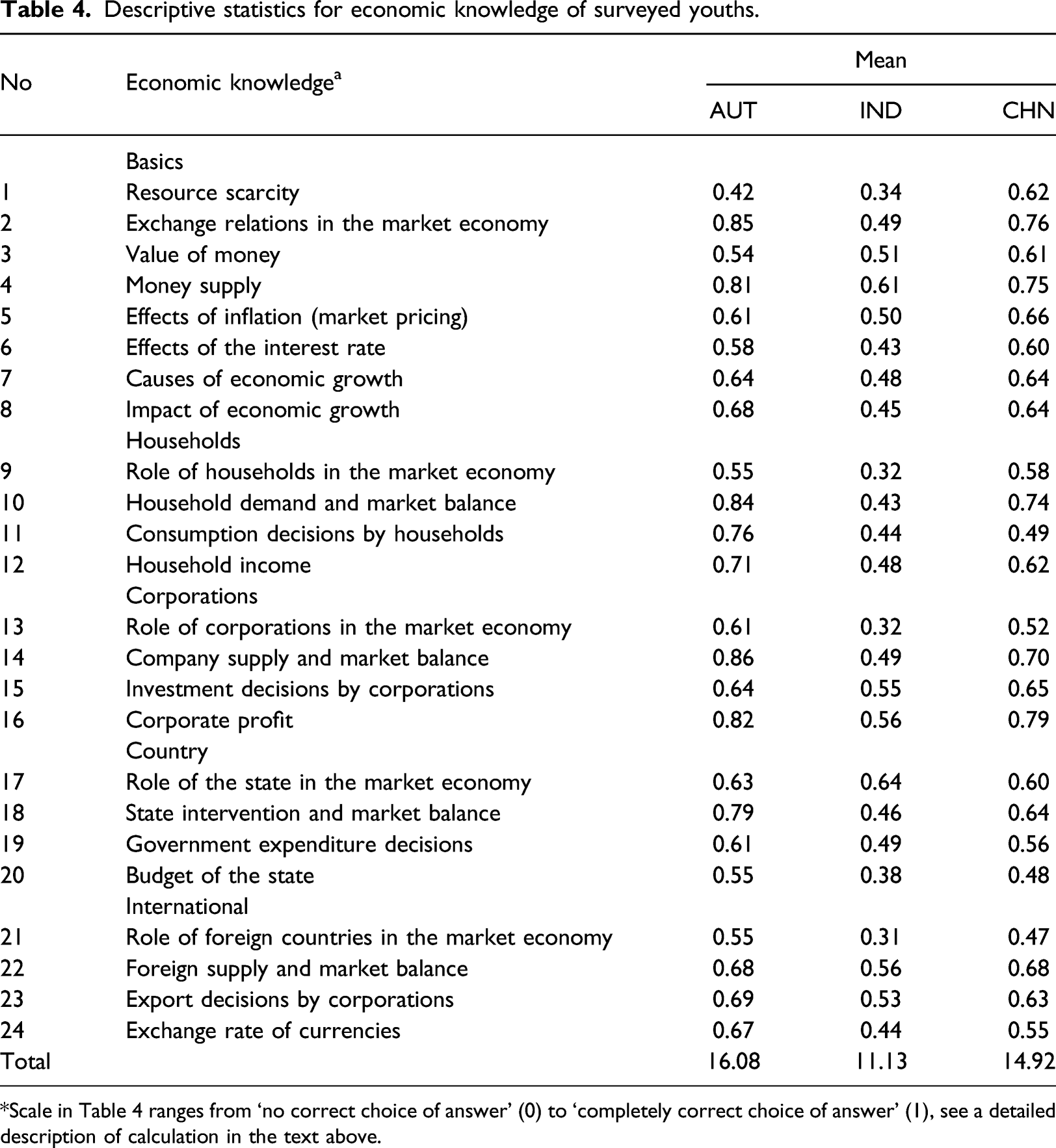
Scale in Table 4 ranges from ‘no correct choice of answer’ (0) to ‘completely correct choice of answer’ (1), see a detailed description of calculation in the text above.
The surveyed Austrian pupils achieved an average solution score of 16.08 points on the overall scale of all 24 tasks. A detailed examination of the tasks shows that the Austrian pupils surveyed had a comparatively good command of the interrelationship between supply and demand as well as market pricing (cf. Items 4, 10 and 14). The corresponding tasks on market mechanism show solution results between 0.68 and 0.86 (cf. Items 10, 14, 18 and 22). In contrast, the understanding of the specific roles of the various economic actors in the market economy cycle was noticeably weaker, as shown by solution results between 0.55 and 0.63 of the corresponding tasks (cf. Items 9, 13, 17 and 21). Even basic economic concepts, such as the scarcity of resources (item 1), the value of money (item 3), or the interest rate (item 6), were relatively poorly mastered with solution results of 0.42, 0.54 and 0.58, respectively.
Out of 24 possible points in the economic knowledge test, an average of 11.13 points were scored by the surveyed Indian pupils. With mean scores between 0.31 and 0.64, less than half of the possible score of the individual questions was achieved on average. Low scores were particularly evident in questions about the general function of the economy or the resources or goods it uses (items 1, 9, 13 and 21), and in questions that deal with actual economic situations (items 10 and 11). In comparison, higher scores were achieved on average for questions dealing with market action (items 2, 3 and 5). A more pronounced understanding of knowledge can also be seen for questions that deal with the consumption or investment expenditure of private households, corporations and the state or foreign trade development (items 11, 12, 15, 19 and 23). On average, the number of points achieved varies from 0.38 to 0.56 and this shows that the surveyed Indian pupils have a lower understanding of government measures to reduce public debt (item 20) than of measures taken by companies to achieve higher profits (item 16).
The average overall score of the full sample in China was 14.92 points out of 24 in the economic knowledge test. The results in the last column of Table 4 show that the mean values of the number of points achieved in the tasks are higher by at least 0.7 for exchange relationships in the market economy (item 2), causes of inflation (item 4), household demand and market equilibrium (item 10), company supply and market equilibrium (item 14) and company profit (item 16). In contrast, the average scores achieved in the tasks relating to the state budget (item 20) and the role of foreign countries in the market economy (item 21) were the lowest. For a few tasks about the different roles in the economic system (cf. Items 9, 13, 17 and 21), the mean values were all below 0.6.
Although the pupils’ economic knowledge was also analysed according to selected sample characteristics like gender of the respondents or the highest educational level of their parents, the precise conclusions cannot be drawn in this study due to the relatively small sample within the countries.
Comparison and discussion of the results between countries
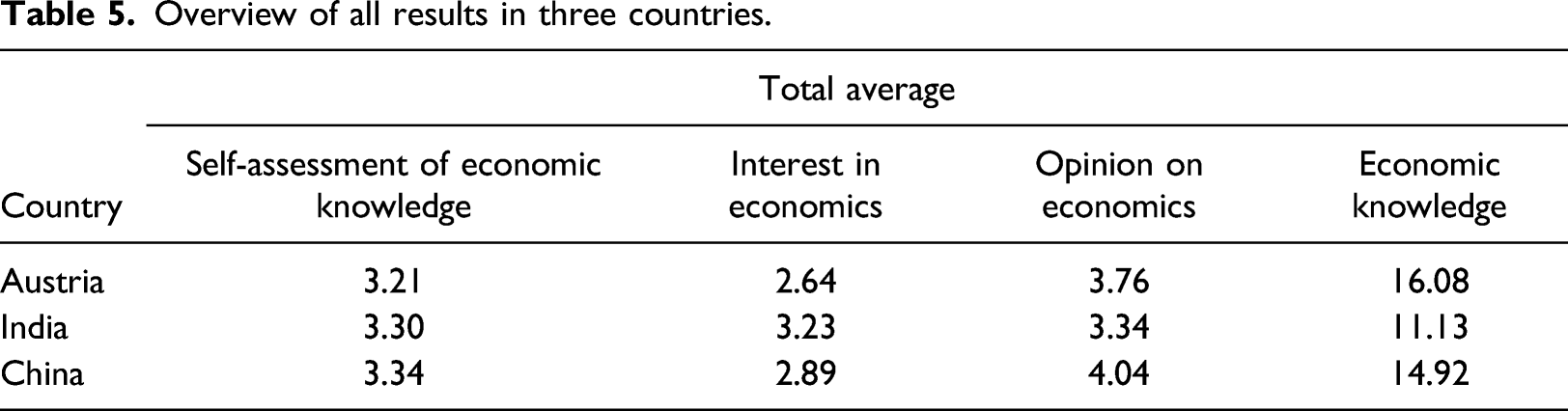
Overview of all results in three countries.
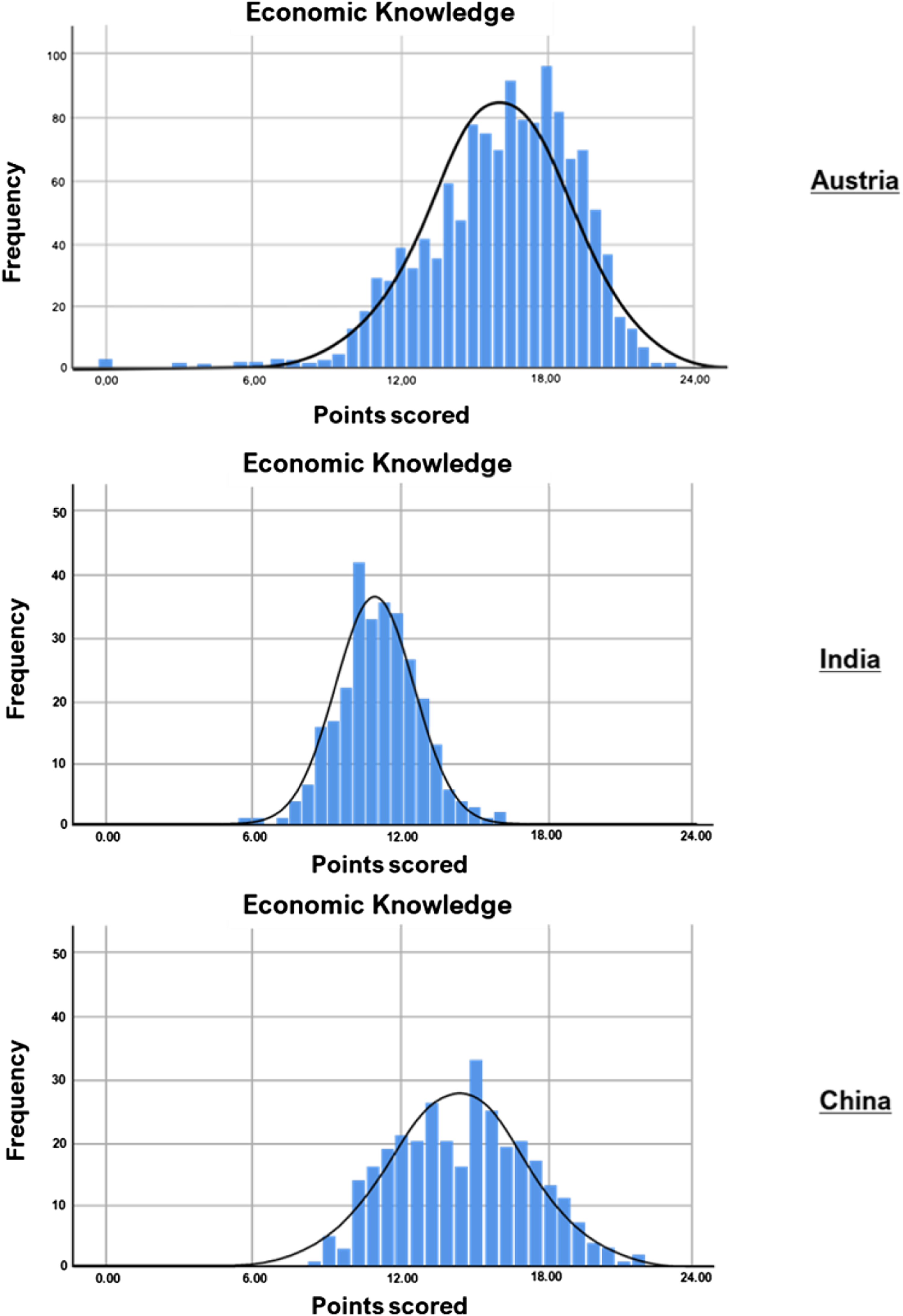
Overview of the economic knowledge test results of Austrian, Indian, Chinese youths.
The results for Austria show that Austrian young people have achieved relatively good results in economic knowledge, with at least 50% giving a single correct answer to almost all questions, especially in the test questions on the everyday economic life of pupils (see Rumpold, 2018, 2020). However, deficits in economic knowledge can be identified, for example, in the area of basic economic understanding and the different roles in the economic system. The results of their self-assessment show that they are aware of their deficits. However, the interest of Austrian young people in the economy as a whole is rather weak. In spite of this they give predominantly positive assessments of the economy. Only the statements on the fairness of income differentials were assessed relatively neutrally (see Rumpold, 2018, 2020). In Austria, economic education, which has long been a part of general education, is predominantly a compulsory subject ‘Geography and Economics’ (GE) and is firmly established in all compulsory school levels (see Fridrich, 2012; Gruber et al., 2019). Economic, geographical and networking topics each make up about one-third of the curriculum (see Gruber et al., 2019). With regard to the economic subject content in this compulsory subject at the lower secondary level, primary production, commodity production and the service sector, as well as insights into the world of work and economic activity in private household and economic contexts are dealt with (cf. BMBWF, 2000; Gruber et al., 2019). Most of the tasks of the economic knowledge test relate to precisely these aspects. Therefore, it should be possible to explain, at least in part, that Austrian youths have achieved better test results in economic science than Indian and Chinese youths. However, the self-assessment and the learning interest of the Austrian pupils with regard to economic topics, is less pronounced in comparison to the other two countries. Research findings on pupils’ interest in economic topics in the GE classroom in Austria showed that the disinterest of GE teachers in economic topics could result in a low level of economic interest among their pupils (see Fridrich, 2012). Consequently, the motivation of the teacher in class has a positive influence on the popularity of these topics among the pupils (ibid.).
The results of this study in India show that in most cases less than half of the possible score was achieved and that the economic knowledge of young people in India shows considerable deficits. It must be considered that the quality of teaching and learning depends to a large degree on the quality of the teaching staff (see Ramachandran et al., 2017). In India, it has been shown that the quality or qualification of the teaching staff and the number of available teaching staff are insufficient. In addition, the guidelines for teacher training have not been revised at the same rate as the school curricula, which leads to coordination problems (cf. Ramachandran et al., 2017; DSERT, 2007). A Teacher Qualification Test (TET) was introduced under the Right to Education Act 2009 and included as a minimum qualification for the right to teach (Ramachandran et al., 2017). According to a World Bank study (Ramachandran et al., 2017), although the shortage of qualified teachers is gradually being compensated for by recruitment and development measures, improving the quality of the teaching staff is still a challenge due to the introduction of compulsory education in the Indian education system and the resulting increase in the number of pupils (Ramachandran et al., 2017). Teachers of social sciences are trained in only one or two of the four subjects (politics, geography, history and economics). According to Srinivasan, a teacher that is only specialised in one social science subject may find it difficult to teach other social science subjects. Moreover, the teachers receive further training in social science only as part of ‘on-the-job training’ and there are no introductory programs or courses offered by higher education institutions that help the teachers to teach all four subjects – politics, geography, history, and economics – effectively. He further adds that even the methods listed in the textbooks may not be understood or seen by the teaching staff (see Srinivasan, 2015). Finally, Srinivasan stresses that the majority of social science subjects are taught by teachers from other subjects (ibid.).
The economic knowledge test scores obtained by the surveyed Chinese pupils are better than those from the Indian respondents but significantly lower than the scores from the surveyed Austrian pupils. Based on the topics in the tasks with better scores, it can be deduced that the surveyed Chinese pupils already had a good knowledge of the performance of the economy, money supply, market action of private households and companies, and profit of companies. This could be because, in the knowledge questions, these topics mainly relate to the everyday life of the pupils. From those low-score tasks, it seems that the tasks on the subject of government debt, foreign management, as well as different roles in the economic system were relatively difficult for the Chinese respondents. Presumably, these topics were, to a certain extent, foreign to the surveyed Chinese pupils, because these topics could hardly play a role in their daily life or in their everyday conversations. This suggests that the questions that are reflected in, or related to, their everyday life are better answered by the Chinese pupils. However, in comparison to the compulsory subject ‘Geography and Economics’ (GE) in Austria, no independent economic curricula have yet been established in China at the secondary school level. Instead, economic education is merely taught in an integrative way in bundled subjects (cf. Li, 2013), for example, in a social studies lesson (cf. Liu et al., 2009). Moreover, the content of Chinese general economic education in the ninth grade is limited to a few areas (see e.g. in the international context Pilz et al., 2016), and no networking between the subject areas can be discerned. In this sense, it can be seen that the subject areas of economic education in Austria are more extensive and comprehensive than those in China, especially at the lower secondary level. Accordingly, the Chinese findings demonstrate that, apart from school curricula, learners tend to acquire economic knowledge related to their daily life through extracurricular activities. The family background of the pupils and home education play an important role in the acquisition of knowledge (see also Zhu et al., 2015; Zhou and Liu, 2017).
Furthermore, the Chinese results show that the general interest of the surveyed pupils in economic knowledge and their self-assessment of economic knowledge is not very high. The reason for this is on the one hand that the current learning content of general economic knowledge does not sufficiently motivate these Chinese pupils in the ninth grade. As explained above, the economic knowledge concerned in the school context is limited and is often combined with moral and political curricula which, from the pupils’ perspective, is not considered as a core subject similar to mathematics and foreign languages (cf. Zhu and Xiao, 2022). On the other hand, these pupils do not have much time and desire to acquire economic knowledge that is not relevant in the entrance examination to upper secondary school (cf. Wan, 2018). As this examination determines the entrance of half groups of pupils into general upper secondary schools and half into vocational secondary schools, the examination is widely regarded, in the viewpoint of Chinese pupils and their families, as a steppingstone in this phase to their future educational achievement (cf. Hau and Ho, 2010; Pilz and Li, 2012). A lot of parents in the researched region expect their children to achieve good grades in the entrance examinations so that they can attend a high-ranking upper secondary school and later, if possible, one of the prestigious universities (see Schulte, 2014; Wan, 2018). Consequently, economic education in this learning phase could be of little importance to these Chinese parents. Under this circumstance, these pupils, especially in the nineth grade, are under great pressure preparing for this entrance examination (cf. Wan, 2018). Many of them attend numerous tutoring courses in core subjects like mathematics or English in their free time, but not with regard to economic topics (cf. Seffert, 2003). Therefore, it is comprehensible why the ninth-grade Chinese pupils have very little time and effort for the acquirement of economic knowledge.
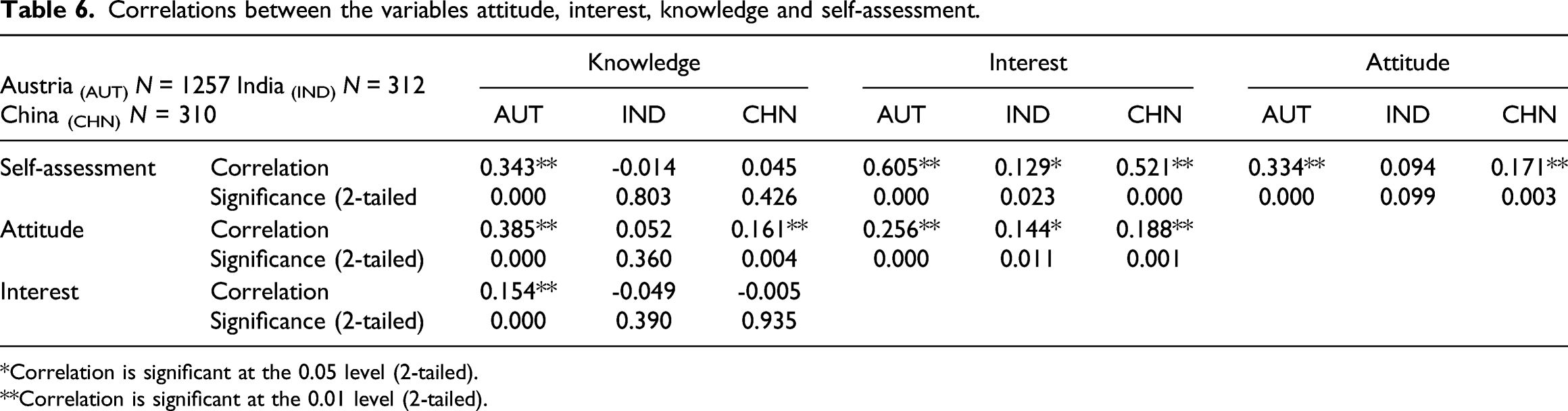
Correlations between the variables attitude, interest, knowledge and self-assessment.
Correlation is significant at the 0.05 level (2-tailed).
Correlation is significant at the 0.01 level (2-tailed).
What is striking in Table 6, is the highly significant positive correlation between all variables in Austria (p < 0.01), so that the Austrian variables self-assessment, attitude, interest, and knowledge are closely related. By comparison, in the Indian case a significant weak positive correlation between interest in economic issues and self-assessment of economic knowledge could be demonstrated (r = 0.129; p < 0.05). It was also shown that there is a significant positive correlation between interest and attitude (r = 0.144; p < 0.05). No correlation could be found between the Indian variables self-assessment and knowledge, self-assessment and attitude, knowledge and interest, knowledge and attitude. In Table 6 for China, there is a significantly strong positive correlation between the variables interest and self-assessment (r = 0.521; p < 0.01). Besides, there is a weak positive correlation between the Chinese variable attitude and the other three variables (self-assessment, interest, and knowledge) (p < 0.01). However, in the Chinese case, no correlation between the variables self-assessment and knowledge as well as between interest and knowledge could be identified.
The Austrian results of the correlation analysis show that the economic knowledge, attitudes, and interest of the surveyed pupils about the economy, are strongly interrelated (also cf. Greimel-Fuhrmann et al., 2016a; Rumpold, 2020). Accordingly, it can be deduced that the respective facets of the development of economic competence cannot be viewed individually, but that the interactions must always be considered. In this context, teaching innovations for learners should be implemented in GE lessons to increase their motivation and interest in gaining economic knowledge and at the same time to strengthen their ability to judge various economic topics and apply what they learned to economic or financial situations (cf. Greimel-Fuhrmann et al., 2016b; Gruber et al., 2019; Rumpold, 2020). For example, the use of case studies or simulation games could be a measure to make economics lessons more interesting and more realistic (Greimel-Fuhrmann et al., 2016b; Pilz and Krüger, 2013).
In contrast, the Indian results of the correlation analysis show that the performance of the surveyed Indian pupils in the economic knowledge test did not interact with the attitude, interest, and self-assessment of these pupils. This confirmed the finding of a previous curriculum analysis of Indian economics-related curricula in the lower secondary schools (Pilz et al., 2016). According to the curriculum analysis results, the economics curricula were predominantly discipline-orientated, which means knowledge played an essential role in the curriculum, whereas the acquisition of personal and general ability in a (simulated) life situation was not really a priority (Pilz et al., 2016). However, economic education is aimed essentially at the development of learners’ economic competence to cope with economically shaped life situations (see Retzmann et al., 2010; Retzmann and Seeber, 2016). Therefore, also following the experience from Austria, not only the cognitive facets such as knowledge, abilities, and skills, but also the affective facets such as interests, attitudes, or willingness, should be emphasised during the implementation process of economic education. In this respect, besides the problem of the provision of qualified teachers mentioned above, strengthening the interactive development of different facets of economic competence in the teaching and learning processes should also be emphasised as a noteworthy issue for the development of economic education in India. It is not only challenging to improve the curriculum design and content but teacher-student interactions also need improvement (cf. Pilz and Regel, 2021).
In contrast, the Chinese results of the correlation analysis demonstrate that the attitude is related to the knowledge performance, interest, and self-assessment of the surveyed pupils. This leads back to the above-mentioned problem of the current anchorage of the learning content of economic knowledge, which was slighted by both surveyed pupils and even their parents because economic knowledge is not a core subject or does not play a role in the final assessment. According to a curriculum analysis by Pilz and Li (2012), apart from some isolated knowledge planned in the ‘Labour and Technical Courses’, there was little systematic knowledge about economics in the curricular documents (p.10). Their results of teacher interviews about the implementation of the curriculum, also confirmed the inferior status of the curriculum relating to economic knowledge in the overall curriculum system of middle school (Pilz & Li, 2012). The lack of attention and practical support from the education administration and schools towards the teaching of economic knowledge, can directly cause the neglectful attitude of teachers (ibid.), and indirectly influence the students’ interest, willingness, and attitude to gaining economic knowledge, which will seriously hamper the development of economic education in China.
Conclusions
The economic test scores achieved by the pupils studied in the researched regions of three countries are considerable but also have implications for the delivery of economic education in all three countries.
On one hand, for efficient economic education, and in view of the importance of economic knowledge for the current and future world, economic issues would have to be anchored more specifically in the curriculum in order to enable young people both to develop the required skills and, in the event of early discontinuation of the educational process at school, to become employable. This includes both a more explicit design of the topics to be taught, and the embedding of missing facts (see Greimel-Fuhrmann et al., 2016a; Pilz et al., 2012). Furthermore, the content should also be conveyed in a suitable, didactically prepared form and the corresponding skills and abilities should be trained and promoted in the course of the training and further training of the teaching staff (ibid.). Although the curriculum for economic education (currently) in GE in Austria is relatively mature in contrast to India and China, there is still much progress to be made on the economic education at the secondary level, such as improvement of teachers’ teaching process and further elaboration of the existing curriculum (cf. Fridrich, 2010, 2014). By contrast, in China and India there is still a lack of fundamental and systematic development of general economic education, both at the curricular level and at the level of teacher training (see Ramachandran et al., 2017).
Although the Indian state of Karnataka, for example, adapted its regional school guidelines in the course of the introduction of the National Curriculum Framework (NCF, 2005) and published a preliminary curriculum (Krisanthan, 2013), the question remains: to what extent the curriculum guidelines are already being implemented by well-trained teachers.
In the context of selected region in China, the question remains whether an independent subject – Economics – should be developed in general education or whether economic knowledge should be integrated into another relevant curriculum. Here, valuable lessons may be learned from the industrialised countries which have developed relatively mature economic education at the primary and secondary level (see e.g. Pilz et al., 2012). As already outlined above, in China, economic curricula in primary and secondary schools are usually combined with Social Studies lessons (see Zhu et al., 2015). Due to the complexity and multi-faceted nature (consumers and employees, society as well as companies) of the topic, such an implementation can be quite fruitful in other countries as well. In secondary education, pupils will not be overburdened to learn comprehensive knowledge of economics as an independent school subject but learn economic knowledge heuristically in an interdisciplinary context. Through a variety of teaching methods such as role-play, pupils can be motivated to apply and reflect on economic knowledge in the lessons of the Social Studies.
This empirical study is an attempt to measure economic knowledge in a standardised way across three very different countries. However, the study is limited to a relatively small sample within the three countries. Also, due to the limited choice of schools, some distortion of the results of the representative survey is inevitable. Although the survey instrument has been validated in Austria, its transfer and adaptation are not yet verified to a large extent. A measurement invariance analysis must be conducted in further comparative studies. Furthermore, the knowledge test only covers certain topics of economic knowledge. For example, the knowledge tasks in the test could be further developed and expanded with regard to economic sustainability and regional characteristics or cooperative economic forms, in order to examine the economic knowledge level of young people even more precisely. Based on the findings and experiences from this study, the investigation of potential factors influencing the results of the knowledge test could be deepened. Unfortunately, neither curriculum analysis nor classroom observation was included in this study, which predictably caused the defects of the present research on the one hand; however, it confirmed on the other hand that there is still much room for further research in the countries themselves as well as in other countries. From an international perspective, it definitely makes sense to take a detailed look at the curricular, material, and personnel deficits in various countries, and to learn from innovations in economic education in other countries.
Footnotes
Declaration of conflicting interests
The author(s) declared no potential conflicts of interest with respect to the research, authorship, and/or publication of this article.
Funding
The author(s) received no financial support for the research, authorship, and/or publication of this article.
