




Abstract
Out-of-field (OOF) teaching is a strategy used to address the shortage of specialist teachers, but extant studies on this phenomenon in Austrian schools are scarce. This article uses data from TALIS 2018 to examine OOF teaching in lower secondary schools in Austria, revealing significant differences in OOF teaching’s prevalence across school types. About half of teachers in lower-level non-academic secondary schools teach OOF compared with less than 10% in lower-level academic secondary schools. In non-academic schools, arts, science, and physical education are most often taught OOF. A logistic multilevel model was used to examine the association between OOF teaching and various characteristics at the teacher and school levels. The model suggests that teaching experience is associated with reduced OOF teaching probability and that the subject taught is a key factor influencing the likelihood of teaching OOF. The study also finds that school size negatively impacts the probability of OOF teaching and that, particularly in main subjects, an increase in the proportion of disadvantaged students within a school population leads to a higher probability of OOF teaching. Consequently, this study’s findings indicate that OOF teaching predominantly manifests in smaller non-academic schools with a higher proportion of disadvantaged students.
Introduction
Teacher shortages in Austria have surged in recent years (Schnider and Braunsteiner, 2024). While in previous decades, teachers were primarily sought for teaching specific subjects, the situation has now worsened, manifesting in a structural shortage of teaching staff. Out-of-field (OOF) teaching is a strategy employed by Austrian schools, particularly by lower secondary ones, to address this shortage of subject-specific teachers (Federal Ministry of Education, Science and Research, 2023). OOF teaching refers to the practice in which teachers teach subjects for which they are not fully trained and hence lack the specific qualifications to teach (Hobbs, 2013; Ingersoll, 1999). 1 This approach has spread in recent years (Court of Audit Austria, 2025; Richter et al., 2024) and has been observed in numerous other countries, albeit with significant variations (e.g., 2% in Korea and 50% in some regions in Australia; Price, 2017; Price et al., 2019).
While this practice can be viewed as an effective tool to overcome the shortage of (subject-specific) teachers, OOF teaching has also elicited criticism (Hobbs and Porsch, 2021; Porsch and Whannell, 2019; Van Overschelde, 2022). It has been hypothesized that teachers who teach subjects other than they had trained to teach negatively impact students’ achievement (Baumert et al., 2010; Goldhaber and Brewer, 2000; Hanfstingl et al., 2023). OOF teaching represents an additional burden to the teachers themselves in most cases, although it has the potential to contribute to their professional development (Du Plessis, 2015; Helm et al., 2024; Porsch, 2023).
However, extant research on OOF teaching’s impact on student performance has not yielded consistent results. The discrepancies in the results can be attributed to heterogeneity in operationalization, differences in subject matter, and the methodological approaches employed in studies on this topic (Porsch and Whannell, 2019). Goldhaber and Brewer (2000) found that students in math classes taught by teachers with a bachelor’s or master’s degree in mathematics outperformed those in classes taught by teachers without subject-specific qualifications. Conversely, no such effects were observed in science classes. However, Sancassani (2023) reported positive outcomes associated with a subject-specific qualification in science.
The literature has also examined the prevalence and (unequal) distribution of OOF teachers across schools and classes (Nixon et al., 2017; Van Overschelde and Piatt, 2020; Ziegler and Richter, 2017), demonstrating that schools with a higher proportion of socioeconomically disadvantaged students are likelier to implement OOF teaching (Glassow et al., 2023; Price et al., 2019).
Although OOF teaching has traditionally been practiced in Austria for some time, research data on various aspects of its prevalence levels remain scarce. To stimulate further research and practical intervention, it is necessary to investigate the prevalence of OOF teaching. Thus, the present article aims to provide initial findings on the prevalence of OOF teaching by school type and subject at the lower secondary level in Austria. Furthermore, the article examines teacher and school characteristics associated with this increasing prevalence. Data from the Organization for Economic Cooperation and Development’s (OECD) 2018 Teaching and Learning International Survey (TALIS) on lower secondary teachers were used (IQS, 2018) in this study.
In addition to raising awareness and establishing a foundation for further research on OOF teaching in Austria, the results help develop appropriate support options for teachers and identify possible changes in training and professional development.
Austrian context
Although OOF teaching is a global phenomenon, national institutional factors (such as the extent of subject specialization in teacher training) play a crucial role in shaping its prevalence in individual countries (Price et al., 2019). This section outlines key aspects of the Austrian school context (as of 2018, corresponding to the TALIS data) that may be associated with the prevalence of OOF teaching in Austria, allowing the study to provide specific context on OOF teaching within both national and international research fields.
In Austria, lower secondary education (Grades 5–8) is characterized by explicit school tracking. Students are sorted into either of two school types depending on their achievement level: non-academic secondary schools (Mittelschule, hereafter non-academic schools) and lower-level academic secondary schools (Allgemeinbildende höhere Schule, hereafter academic schools). Non-academic schools typically serve about two-thirds of a student cohort and are typically smaller than academic schools, which primarily offer continuing education up to Grade 12. Consequently, academic schools can generally draw on a larger pool of teachers to meet the demand for in-field instruction than non-academic schools. 2
The structural divide of students according to their achievement level is also reflected in teacher training: Prior to teacher education reforms in 2016 (Kucher and Rulofs, 2018), teacher-training programs were school-type specific, with universities being responsible for the training of academic school teachers, and University Colleges of Teacher Education (Pädagogische Hochschulen) providing training for teachers of non-academic schools.
Notably, teachers undergoing training for secondary schools must be trained in at least two teaching subjects, while teachers training for non-academic schools had to train in at least one main subject (i.e., Mathematics, German, or English; Mayr and Posch, 2012). Therefore, large pools of teachers were typically available for the main subjects. In contrast, admission requirements for other subjects, such as arts and physical education, pose barriers to entry, potentially leading to shortages in teachers for these subjects.
Until the fall of 2018, the assignment of teachers was centralized: Teachers were allocated to schools by regional (non-academic schools) and federal (academic schools) authorities, whereas particular attention was paid to covering the needs of schools in main subjects. However, applicants could also reject the proposed position, which could result in problems filling vacant positions at less attractive school locations.
Variables associated with OOF teaching
The following section presents international findings on variables associated with the probability of OOF teaching. Overall, OOF teaching can be regarded as the result of a mismatch between teacher supply and teacher demand, which may be affected by variables at different levels. Additionally, mechanisms that may lead to an increased probability of OOF teaching are described, and references to the Austrian context are made.
Differences in school type
OOF teaching is practiced at various educational stages and school types (Nixon et al., 2017; Porsch, 2016). Differences in OOF rates between non-academic schools and academic schools in Germany and Austria, countries characterized by explicit tracking in the lower secondary stage, have been reported. The first official figures for Austria were published recently (Court of Audit Austria, 2025) and show that in the federal state of Upper Austria, 21% of subjects in non-academic schools were taught OOF in 2019. In the federal state of Tyrol, the rate was nearly two times higher (37%). In contrast, the data suggests that OOF teaching hardly exists for academic schools. No data for other states are publicly available. Similarly, Porsch (2016) found a pronounced discrepancy in the proportion of OOF teachers between academic and non-academic schools in Germany.
The differences in OOF teaching between school types may be caused by both universal and Austria-specific factors. Generally, (aspiring) teachers prefer teaching in academic schools over non-academic ones (Altrichter et al., 2023, 2024). This preference may be partly due to the expected more motivated and capable student bodies at academic schools as well as the higher salaries and level of prestige that come with academic teacher positions (Müller et al., 2021). This preference may be reflected in differences in student numbers in school-type-specific teacher training or in variations in the number on applicants for vacancies, which may result in a restricted supply of teachers for non-academic schools, which, in turn, could increase the prevalence of OOF teaching. Moreover, school type differences may be the consequence of structural differences between school-type-specific teacher training programs, such as those that were in place in Austria until 2016 (see Austrian Context). Finally, the adoption of school-type-specific principles in the assignment of teachers to classes may increase the prevalence of OOF teaching. For example, the Klassenlehrerprinzip (class teacher principle) in Germany aims to reduce the number of teachers that teach within a class to foster student–teacher relations (Porsch, 2016). Although for Austria there are no similar legally defined principles, especially non-academic schools—which generally follow a more pedagogical culture than the more subject-oriented academic schools (Eder, 2015)—may informally adopt such strategies in order to increase student-teacher relations.
Subjects
Mathematics and science appear to be frequently taught OOF internationally (Sheppard et al., 2020; Van Overschelde and Piatt, 2020). Consequently, most studies on the influence of OOF teaching have focused on these subjects (Coenen et al., 2018; Hobbs and Porsch, 2022). Nonetheless, striking differences between these subjects can be identified at the international level. For example, Qin and Bowen (2019) found that only 6% of teachers in Chile teach mathematics and science OOF at the lower secondary level, compared to 46% in Belgium. In the case of science lessons, the concept of partly OOF teaching emerges. In certain instances, science instruction is implemented as an integrated discipline; however, teacher education is predicated on a subject-specific approach. This discrepancy can lead to situations in which some parts of the subject are taught OOF (Von Knebel et al., 2023). Furthermore, studies have found OOF teaching to play an increasing role in subjects such as music, art (Porsch, 2016), and geography (Caldis, 2017). Austrian data also indicate that technology and the arts are often taught OOF in non-academic schools (Court of Audit Austria, 2025). Moreover, young teachers in the teacher introduction phase have reported that OOF teaching frequently occurs in German, mathematics, English, and physical education (Prenzel et al., 2021).
As OOF teaching depends on subject-specific teacher supply, OOF teaching rates are influenced by (in-training) teachers’ preference of which subject to study. In this context, the elevated prevalence of OOF teaching in science and mathematics may be attributable to the potential for higher remuneration in these disciplines outside the educational sector (West, 2013). Entrance exams can also limit the number of available teachers by discouraging them from choosing a subject and by selectively restricting access to subjects. Additionally, specifications unique to teacher training, such as the mandatory choice of a main subject (see Austrian Context), ensure adequate teacher supply for these subjects but may limit the supply for other subjects. Finally, a lack of alignment between subjects taught in schools and those formally included in teacher training curricula may increase OOF teaching rates for particular subjects. In Austria, for example, until 2016, technology was not covered by regular teacher training for non-academic schools, although taking a supplementary examination for technology was an option for those looking to teach the subject (Swertz, 2018). While technology was not a required subject in schools until 2018, resulting in limited demand for technology teachers, demand has since increased after 2018.
Teacher characteristics
Connections between OOF teaching and teaching experience at the teacher level have been observed. Teachers with less teaching experience teach OOF more frequently (Schlendorf et al., 2023; Taylor et al., 2020; Van Overschelde and Piatt, 2020). Higher OOF teaching rates among less experienced teachers may be caused by seniority issues. Senior teachers often select their preferred teaching assignments, leaving less experienced colleagues to fill the remaining vacancies (Bryson et al., 2022). Notably, teaching experience can be viewed in different ways. On the one hand, overall teaching experience, which is strongly correlated with age, can be assumed to lower the probability of OOF teaching. Conversely, it is also possible that teaching experience at the individual school, rather than aggregate teaching experience, predicts OOF teaching. Therefore, new teachers at schools would increasingly need to teach OOF independent of their overall level of teaching experience.
Gender differences have also been reported in some studies. Female teachers have been found to be less likely to teach OOF (Glassow et al., 2023; Van Overschelde and Piatt, 2020). Differences in OOF teaching between male and female teachers may be related to gender-specific subject preferences. For example, in Austria, male teachers are likelier to teach geography or physical education, whereas female teachers are overrepresented in subjects such as German, English, and biology (Lessky et al., 2022).
School characteristics
Research indicates that OOF teaching is more common in small schools (Ingersoll, 2002). To cover subject demands, principals often assign available staff to additional subjects (Ingersoll, 2002). The limited number of teachers in small schools also limits the range of subject-specific qualifications, making it less likely that qualified teachers are available for every subject. This structural constraint increases the likelihood of OOF teaching. In this context, the principals’ attitude toward OOF teaching and teaching quality is also decisive (Porsch and Gräsel, 2022; Porsch and Hobbs, 2024).
Moreover, OOF teaching has been associated with school composition. Schools with a relatively higher proportion of students with migrant backgrounds, students with a first language other than the language of instruction, and ethnic minority students indicate higher rates of OOF teaching (Graham and Flamini, 2023; Nixon et al., 2017; Schlendorf et al., 2023; Ziegler and Richter, 2017). A study using TALIS 2008 data indicates that OOF teaching was more prevalent in Austrian non-academic schools with a higher proportion of non-native German-speaking students. No such association was found in academic schools (Weber et al., 2019). Moreover, a recent German study revealed a bivariate connection from the migration background of the students’ body. However, this association was not significant in a multivariate analysis. Notably, the socioeconomic background of the students at the school remained a significant predictor of an increase in OOF teaching (Richter et al., 2024). In general, socioeconomic school composition has also been associated with OOF teaching. For example, OOF teaching has been found to be more prevalent in schools with relatively larger numbers of students of low socioeconomic status (SES; Sheppard et al., 2020). In their cross-national comparison based on TALIS 2018 data, Glassow et al. (2023) provided further evidence of the association of school SES and OOF teaching. Notably, the authors reported a strong association between socioeconomic school composition and OOF teaching in Austria. However, this study did not control for school type differences that potentially affected this association. In short, Austrian non-academic schools, in comparison to Austrian academic schools, have been found to be attended by more children with disadvantaged socioeconomic backgrounds (Weber et al., 2019) and non-academic schools have higher OOF teaching rates than academic schools (Court of Audit Austria, 2025). A German study also found an association of OOF teaching with students’ cognitive abilities, suggesting that students with weaker cognitive abilities are taught OOF more frequently (Ziegler and Richter, 2017). Overall, OOF teaching seems to be more common in schools attended by disadvantaged students. Schools with disadvantaged student bodies are likely to be located in urban areas (Biedermann et al., 2016; Sheppard et al., 2020). Therefore, OOF teaching is more common in urban areas than in sub-urban ones (Sheppard et al., 2020). The more frequent OOF teaching in urban schools and schools with higher shares of disadvantaged students may be due to teacher-sorting mechanisms (Luschei and Jeong, 2018; Kamrath and Bradford, 2020), which are related to turnover rates and teacher preferences for specific schools. Put simply, schools with a higher proportion of disadvantaged students are less attractive to teachers. Due to higher teacher turnover rates, these schools experience frequent vacancies and significant challenges in filling them. This results in an ongoing demand for teachers, which may result in insufficient subject-specific supply.
Conversely, rural schools can be argued to offer better working conditions than urban schools, as rural schools tend have a lower proportion of students from educationally disadvantaged backgrounds. However, these schools are difficult for teachers to reach due to their location, which makes them less attractive to many teachers. This can also result in a higher degree of OOF teaching in rural regions, especially in remote schools (Sharplin, 2014).
Research questions
This article examines the following research questions in the context of the current state of research and the rareness of research specific to Austria:
Research Question 1 (RQ1): What is the extent of OOF teaching in lower secondary schools in Austria, and which subjects are taught OOF most frequently?
The answers to RQ1 should provide insight into the prevalence of OOF teaching in Austria and address differences between school types at the lower secondary level.
In consideration of national and international research findings, we hypothesize that a significant proportion of teachers in Austrian secondary schools teach OOF, with a significantly higher percentage found in non-academic schools compared to academic schools (Court of Audit Austria, 2025; Porsch, 2016; Prenzel et al., 2021). Teacher preferences for teaching in academic schools (Altrichter et al., 2024) may increase the teacher supply for this school type and decrease the supply for non-academic schools, resulting in higher OOF prevalence in non-academic schools.
Furthermore, we expect to find substantial variations in OOF teaching’s prevalence across subjects for Austria, with the assumption that the arts, technology, and science are taught more frequently OOF (Court of Audit Austria, 2025; Porsch, 2016; Van Overschelde and Piatt, 2020). Given that in formal teacher education for non-academic schools in Austria, those studying to be teachers were required to choose at least one main subject (German, mathematics, and English as a foreign language; Mayr and Posch, 2012), the prevalence of OOF teaching for these subjects may be much lower compared to other subjects. These teacher-training restrictions may also contribute to the higher OOF teaching rates identified in non-academic schools, as they limit the supply of qualified teachers for other subjects. Furthermore, admission tests (for the arts and physical education) may result in a lower number of teachers trained in these subjects, hence increasing the probability of OOF teaching. Finally, elevated technology OOF teaching rates in non-academic schools are expected because prior to 2016, technology was not covered by the regular teacher training for non-academic schools.
Research Question 2 (RQ2): Which characteristics at the school and teacher levels are associated with an increased probability of OOF teaching?
RQ2 examines the characteristics of teachers and their schools to provide a more nuanced understanding of the prevalence of OOF teaching. At the teacher level, the study considers sociodemographic characteristics, including gender and teaching experience, as well as the subject taught. RQ2 also examines school-level characteristics (i.e., how school size, school composition, and a school’s degree of urbanization are associated with the prevalence of OOF teaching).
Although OOF teaching is supposedly more prevalent in minor subjects (Court of Audit Austria, 2025), information on OOF teaching rates for major subjects (e.g., German, mathematics, and modern foreign languages) is particularly essential. These subjects prioritize the fostering of fundamental competencies, and potential disparities in instructional quality due to OOF teaching could adversely impact students. Consequently, the second research question examines OOF teaching in general and addresses OOF teaching’s effects in the subjects of German, mathematics, and modern foreign languages.
We hypothesize that younger and unexperienced teachers are increasingly required to teach OOF subjects due to seniority-based assignment practices (see Schlendorf et al., 2023; Taylor et al., 2020; Van Overschelde and Piatt, 2020), which may be attributed to experience within the school as well as to individual teachers’ overall levels of experience. In line with prior research, we expect a higher prevalence of OOF teaching among male teachers (Glassow et al., 2023; Van Overschelde and Piatt, 2020). However, if these gender differences are caused by gender-specific subject preferences, gender differences in OOF teaching should diminish when controlling for subjects.
Given international results, we hypothesize that OOF teaching varies between schools and occurs more frequently in schools with higher proportions of disadvantaged students (e.g., low SES; Glassow et al., 2023; Sheppard et al., 2020; Taylor et al., 2020; Van Overschelde and Piatt, 2020). As teacher allocation in Austria was determined centrally until 2018, the differences in OOF teaching between schools in Austria may not be that pronounced when considering academic and non-academic schools separately. Nevertheless, general teacher-sorting issues, as outlined in the previous chapter, may exist. Additionally, in line with international studies, we hypothesize that a school’s degree of urbanization is associated with OOF teaching’s prevalence, with urban areas exhibiting higher proportions of OOF teaching (Sheppard et al., 2020; Taylor et al., 2020). This may be due to school segregation (Weber et al., 2019). Schools with disadvantaged student bodies are likelier to be found in urban areas, and these schools struggle to find qualified teachers for vacant subjects. In contrast, due to their limited reachability, remote rural schools may face more OOF teaching. Finally, we hypothesize that OOF teaching is more common in smaller schools than in larger ones (see Ingersoll, 2002), as smaller schools, due to their having fewer teachers, face greater challenges in meeting subject-specific teaching demands.
Method
Data
The present study used data from TALIS 2018 (IQS, 2018; OECD, 2019a), an international survey conducted in several OECD countries that concentrates on teachers’ practices and workplace conditions. TALIS adopts a stratified, two-stage sampling design (i.e., schools are selected randomly during the first stage, and teachers within schools are selected during the second stage; for details, see OECD, 2019b). This sampling method is ideal for approximating the results for the entire population, thereby providing representative data (in terms of school type, urbanization, gender, and subject distribution) for characterizing the situation of OOF teaching in Austria. The TALIS 2018 dataset for Austria includes 4255 teachers from 246 compulsory lower secondary schools, comprising 105 lower academic secondary schools, 135 non-academic secondary schools, and 6 schools with public rights (Schmich and Itzlinger-Bruneforth, 2019). However, 6 schools (covering 54 teachers in the sample) with public rights were excluded from the analysis due to data protection issues and incompatibility with the other schools in terms of OOF teaching. 3 The variables in TALIS 2018 were collected using a combination of a teacher questionnaire and a questionnaire at the school management level containing questions regarding school-specific variables.
Variables
Various definitions of OOF teaching can be found in the international context (Hobbs et al., 2022). In this study, OOF teachers are defined as formally qualified teachers (i.e., subject-specific pedagogy or general pedagogy were included in their education or training) who teach (at least) one subject not part of their formal teacher training. Formally qualified teachers teaching only subjects that were part of their formal teacher training are viewed as in-field teachers. 4
Teacher characteristics
The characteristics of gender, teaching experience (in terms of overall professional experience as a teacher and experience at the current school), teaching subjects (summarized in 12 categories), and formal training were analyzed as operationalizations of OOF teaching at the teacher level. Corresponding operationalization questions can be found in the Supplemental Material (Part A).
School characteristics
The evaluated school characteristics included type of school (non-academic and academic schools) and degree of urbanization of the school’s location (rural areas, towns and suburbs, urban/city areas; Kemper et al., 2021). Furthermore, two indicators of school size (number of students and number of teachers) were used. These variables were highly correlated (non-academic schools: r = 0.866; p < 0.001, academic schools: r = 0.829; p < 0.001); thus, an index was calculated as the mean of the z-standardized indicators representing school size.
Additionally, an index of school composition was used to assess the effect of the percentage of disadvantaged students in a school 5 on a five-level scale (none, 1%–10%, 11%–30%, 31%–60%, more than 60%) with the following characteristics: non-German first language, poor school performance, special educational needs, behavioral problems, socioeconomically disadvantaged families, migrants or with migrant backgrounds, and/or refugees. All items had a high intraclass correlation (ICC) ranging from 0.200 to 0.636 for the overall sample, indicating a high level of agreement in the assessment of the reference classes among a school’s teachers. ICC2 is a measure of the school-level reliability of aggregated characteristics (in this case, the teachers’ assessment of class composition; see Lüdtke et al., 2009) that indicates satisfactory reliability for the single composition characteristics (>0.7). Very high correlations of the aggregated teachers’ ratings on class composition were found (between 0.772 and 0.965, median = 0.899) at the school level. Consequently, an index for a disadvantaged school composition was calculated as the mean value of the individual items for each teacher, which was then aggregated at the school level in the next step. ICC2 indicates significantly reliability from this index (non-academic schools = 0.96; academic schools = 0.92). Further details can be found in the Supplemental Material (Part B).
Analysis
Uni- and bivariate analyses of OOF teaching’s prevalence were conducted to respond to RQ1—descriptive statistics (proportions, absolute n, means) are reported in corresponding tables. Subsequently, a binary logistic multilevel regression analysis was conducted to determine the probability of teaching OOF using teacher- and school-level predictors to address the second research question (RQ2). The classification of whether a teacher teaches OOF (0 = no, 1 = yes), regardless of whether they teach another in-field subject, was used as a dependent variable. As we hypothesize that the prevalence of OOF teaching between schools contains substantial variation, we first assessed the ICC for OOF teaching based on a null model with no predictors. In line with the work of Geldhof et al. (2014), we viewed an ICC > 0.05 as non-trivial, suggesting substantial variation between schools. However, it should be noted that there is no consensus on the level of ICC that justifies multilevel modeling. In a set of subsequent analyses, we incorporated predictors at the teacher level (sociodemographic characteristics and subjects taught); when substantial variation was found between schools, school-level predictors (school size, school composition, and urbanization) were included in the model. As outlined above, in the next step, we also conducted analyses to predict OOF teaching in the main subjects (reading, writing, and literature in German; mathematics; and modern foreign languages).
TALIS’s 2018 complex sampling design was taken into account in all analyses (OECD, 2019b). Adequate estimates of the sampling variance were derived using teacher weights (TCHWGT) and balanced repeated replication (BRR) weights, which accounted for the complex survey design in RQ1. Conversely, the multilevel analysis (RQ2) employed the weight TCHWGT at the teacher level and the weight SCHWGT at the school level (Bowers, 2020).
Data preparation and analyses for the first research question were conducted in RStudio (RStudio Team, 2020) using the R packages BIFIEsurvey (BIFIE et al., 2014) and survey (Lumley, 2024). Multilevel logistic regression analyses were conducted using Mplus 8 (Muthén and Muthén, 1998–2017).
The data contain missing values due to item non-response ranging from 0% (e.g., in the variable gender) to 2.9% (school composition). Little’s Missing Completely at Random (MCAR) test suggested that the MCAR assumption was not tenable (χ²(504) = 688.088; p < 0.001). We additionally found that school composition was missing more often in smaller schools, corresponding to a Missing at Random (MAR) missing-data pattern that supports the use of modern missing-data treatment methods, such as multiple imputation (MI). We used the Blimp 3 (Keller and Enders, 2023) software to generate 50 imputed datasets through a fully conditional specification MI approach that also considers the clustering of teachers within schools. Imputation models were run separately for each school type, including all related variables (see above). The convergence of the Markov Chain Monte Carlo algorithm was assessed using the potential scale reduction (PSR) factor, with values less than 1.05 suggesting sufficient convergence (Keller and Enders, 2023).
Results
Prevalence of and subject differences in OOF teaching (RQ1)
Answers to RQ1 are presented in Table 1, indicating a striking difference in the prevalence of OOF teaching between non-academic and academic schools—Pearson χ² with Rao-Scott adjustment (χ²RS (2.658, 651.21) = 143.07; p < 0.001; Cramer’s V = 0.39). Exactly 8.0% of teachers in non-academic schools indicated that exclusively taught OOF subjects, with 40.3% reporting engaging in both in-field and OOF teaching. Around half (50.3%) of the teachers exclusively taught subjects that were also part of their training. Only 9.7% of the teachers surveyed at academic schools reported teaching at least one subject OOF, with 6.4% teaching both in-field and OOF and only 3.3% teaching purely OOF. Lastly, 87% of academic school teachers taught exclusively in-field.
Classification of teachers by school type.
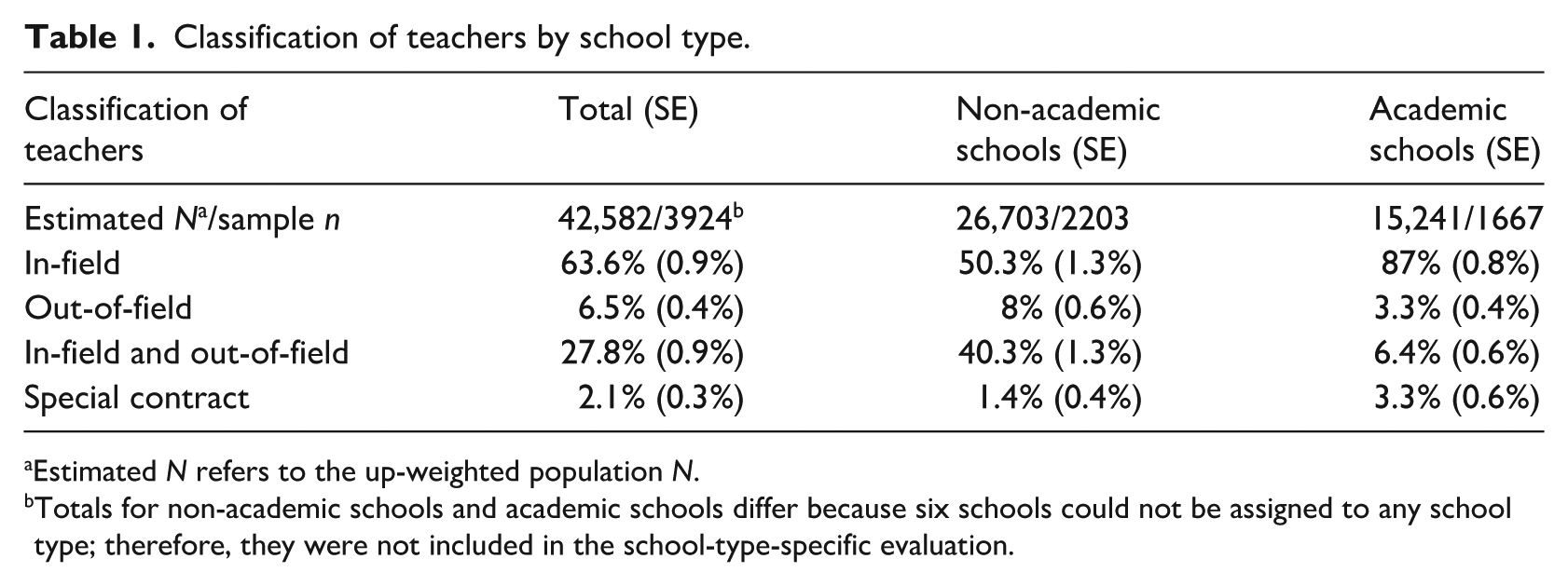
Estimated N refers to the up-weighted population N.
Totals for non-academic schools and academic schools differ because six schools could not be assigned to any school type; therefore, they were not included in the school-type-specific evaluation.
Slightly more than half of the teaching staff in non-academic schools taught more than one subject OOF—on average, around 1.92 subjects (SD = 1.22; Table 10 in the Supplemental Material). The average number of OOF subjects in academic schools was 1.59 (SD = 1.35), with around two-thirds of OOF teachers teaching only one subject OOF in academic schools.
OOF teaching was found to vary not only in relation to type of school but also in terms of frequency across subjects. In non-academic schools, the highest absolute numbers of OOF teachers were observed in the arts, followed by science and physical education (Table 2—ranked by the highest absolute number of OOF teachers). The proportions of OOF teaching in these subjects were 41.8%, 36.3%, and 33.5%, respectively (i.e., out of the approximately 12,000 teachers at non-academic schools that reported teaching the arts, 41.8% lacked relevant specialist training, corresponding roughly to 5000 teachers teaching the arts OOF).
OOF teaching subjects.
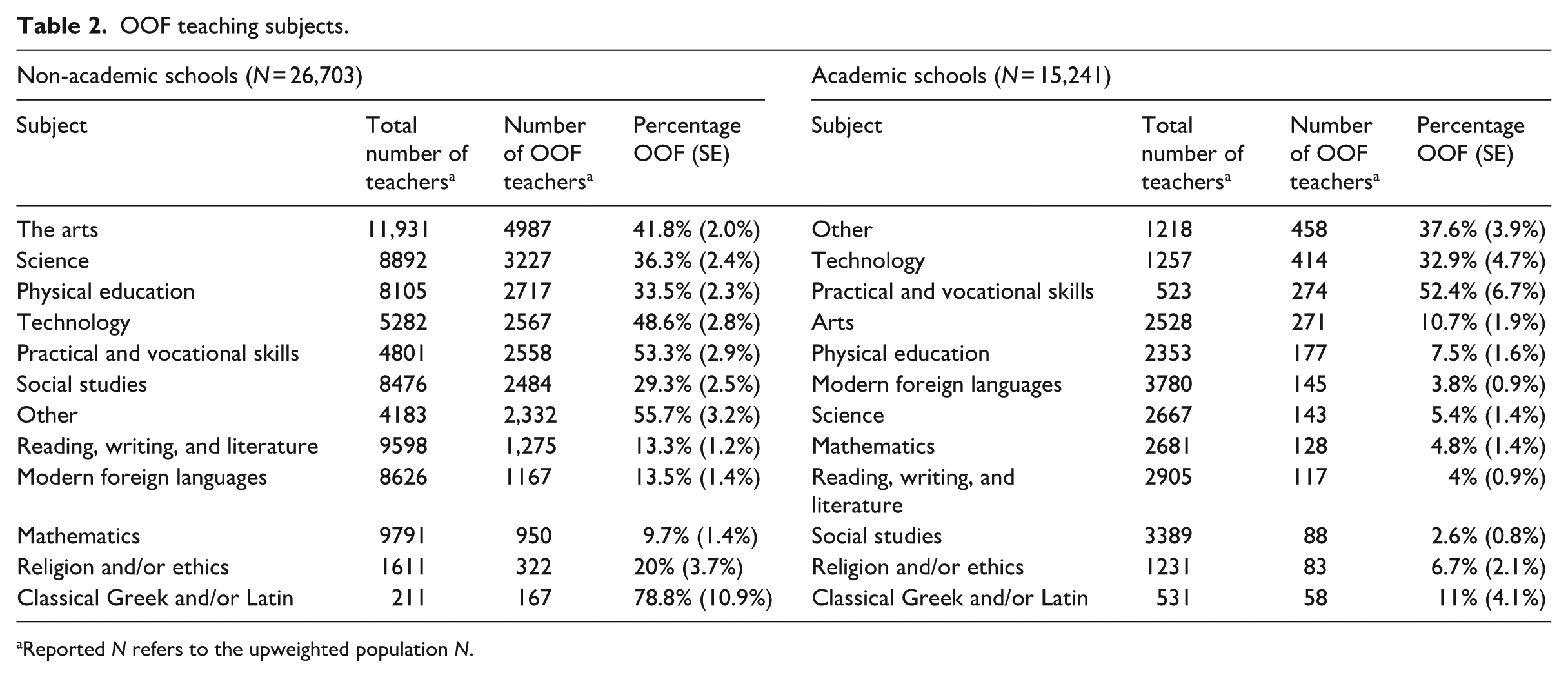
Reported N refers to the upweighted population N.
The percentages for the main subjects—modern foreign languages (13.5%); reading, writing, and literature (13.3%); and mathematics (9.7%)—were significantly lower compared to other subjects. Nevertheless, roughly 1 out of every 10 teachers teaching a main subject lacked formal qualifications in the subject. In academic schools, OOF teaching was most prevalent in other subjects (37.6%), technology (32.9%), and practical vocational skills (52.4%). For example, one-third (32.9%) of the teachers teaching technology lacked relevant formal qualifications, corresponding to 414 teachers in Austrian academic schools. The arts, science, and physical education are taught OOF less often in academic schools than in non-academic schools.
OOF teaching in Austria predominantly occurs in non-academic schools, with nearly half the teaching staff teaching at least one subject OOF. At the subject level, the arts, sciences, and physical education are frequently taught OOF in non-academic schools. In certain instances, OOF teaching also has been observed in academic schools, which have approximately 10% of teachers teaching one subject OOF. Given these striking differences between school types, the following analyses were conducted separately for non-academic and academic schools.
Teacher and school characteristics and OOF teaching (RQ2)
The bivariate correlations for the teacher and school variables and OOF teaching are presented in Tables 20 and 21 in the Supplemental Material. A significant negative but weak correlation was also found between overall experience and OOF teaching for non-academic schools (r = −0.077; p < 0.01). Consequently, non-academic schoolteachers with less professional experience were slightly likelier to teach OOF. For academic schools, an opposing effect was found, although it was only marginally significant (p = 0.085) and exhibited a very weak correlation (r = 0.048). A similar effect was also identified for experience within the current school (r = 0.053; p = 0.074), suggesting that teachers with greater experience in academic schools tended to teach OOF more often than those with less experience. Furthermore, small correlations between OOF teaching and school composition (r = 0.085; p < 0.01) and school size (r = −0.08; p = 0.07) were observed for non-academic schools, indicating that schools with a higher proportion of disadvantaged students and smaller schools are slightly likelier to have higher OOF teaching rates. However, these effects were not evident in academic schools. Moreover, longer experience within the current school was associated with longer overall professional experience (non-academic schools: r = 0.75; p < 0.001; academic schools: r = 0.886; p < 0.001).
The degree of urbanization correlates with the composition of students in both school types (city: non-academic schools: r = 0.652; p < 0.001; academic schools: r = 0.383; p < 0.001/rural: non-academic schools r = −0.633; p < 0.001; academic schools r = −0.317; p < 0.001), and in non-academic schools, with school size (city: non-academic schools: r = 0.329; p < 0.001/rural: non-academic schools: r = −0.387; p < 0.001). As expected, larger schools or schools with a higher proportion of disadvantaged students are likelier to be found in densely populated areas; in contrast, schools in rural, sparsely populated regions are smaller, with a relatively lower proportion of disadvantaged students. Finally, for non-academic schools, a between-school size and school composition (r = 0.255, p < 0.001) was found for non-academic schools, suggesting that disadvantaged students tend to attend larger schools in urban areas, as noted above.
Multilevel analysis results
To determine the presence of substantial variations in OOF teaching between schools, the ICC was calculated based on a logistic multilevel model without predictors (for null model results, see Table 11 in the Supplemental Material). 6 These analyses indicated substantial school-level differences in the prevalence of OOF teaching for non-academic schools (ICC = 0.062). Therefore, multilevel modeling is suitable for explaining school differences. However, for academic schools, no substantial variations were found in OOF teaching between schools (ICC = 0.014), indicating that school-level predictors should be disregarded and that the inclusion of only teacher-level predictors is sufficient for this analysis.
The results from the logistic multilevel models for non-academic schools are presented in Table 3. Model 1.1 reveals a small negative effect (b = −0.018; p < 0.01; β = −0.130) from overall teaching experience when controlling for experience at the school. Consequently, regardless of teaching experience at the current school, more experienced teachers are slightly less likely to teach OOF than teachers who lack experience. This effect was retained even after controlling for all other predictors. No within-school experience and gender effects were observed. The three predictors collectively explain a small proportion of the variation in the probability of OOF teaching (R2 = 0.011). However, when the subjects taught are considered (Model 1.2), the predictive quality for OOF teaching was enhanced significantly (R2 = 0.43). This suggests that the subject taught exerted a substantial effect on the probability of teaching OOF (χ2(9) = 50.117; p < 0.001 7 ). In line with the results reported in Table 2, the strongest effects were found for the arts (b = 1.650, p < 0.001), social studies (b = 1.506, p < 0.001), and physical education (b = 1.436, p < 0.001) indicating higher OOF rates for these subjects.
Results of the logistic multilevel analysis of OOF teaching in non-academic schools.
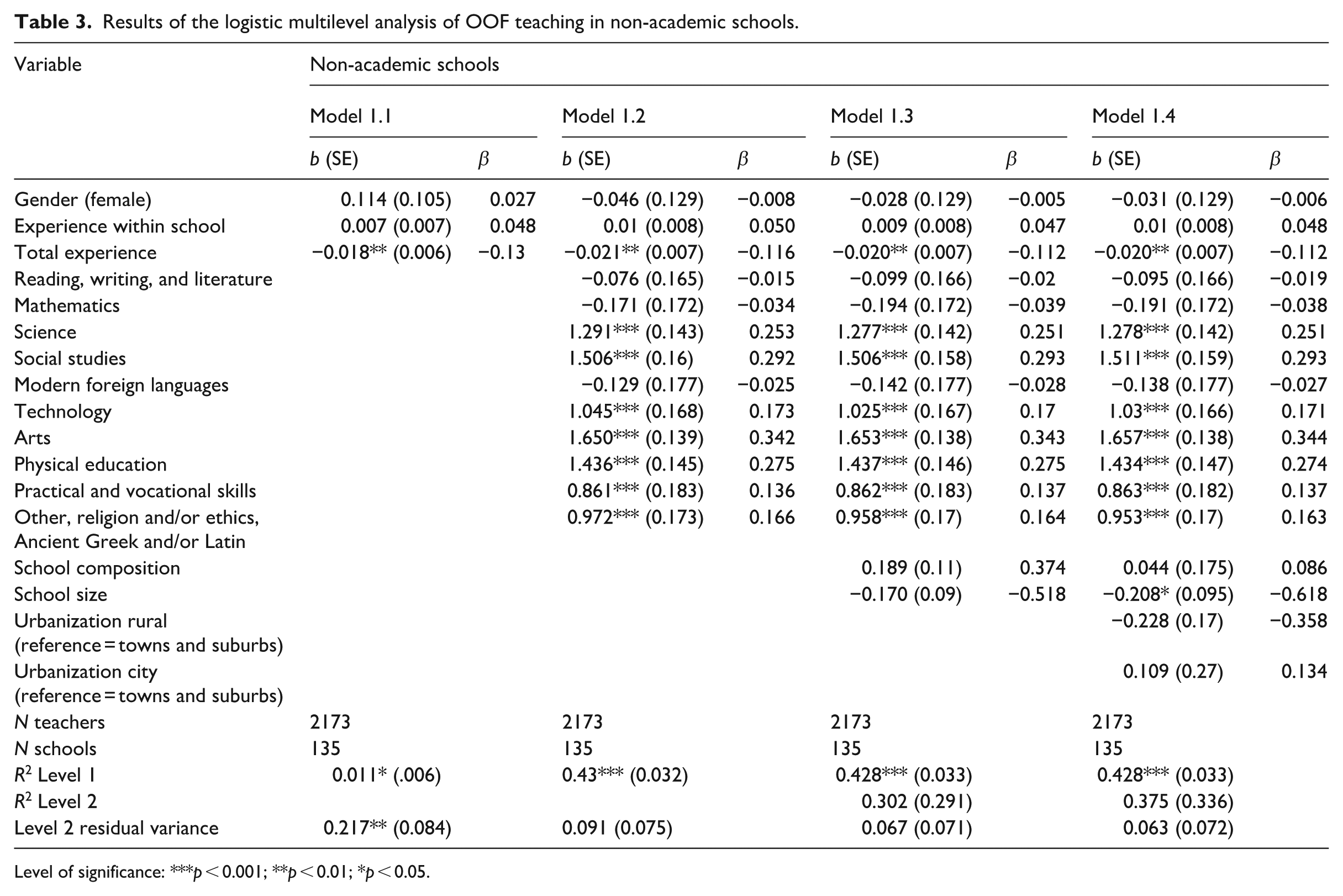
Level of significance: ***p < 0.001; **p < 0.01; *p < 0.05.
These effects notably also contain the effect of the number of subjects taught. Simply put, the more subjects a teacher teaches, the likelier it is for at least one subject to be taught OOF. The coefficients were converted into probabilities to better illustrate the subject effects and differences between subjects, and a series of pair-wise comparisons were calculated. These results are presented in detail in the Supplemental Material (Tables 13 and 14). In line with the results for RQ1, the probability of OOF teaching was found to be highest for the arts at 38.1%. Consequently, 38.1% of all non-academic school teachers taught arts OOF. Furthermore, probabilities of OOF teaching for subject combinations can be calculated from the results. For example, a teacher teaching both the arts and physical education had a 72.1% chance to teach at least one of these subjects OOF.
In Model 1.3, school composition and school size were entered as predictors of OOF teaching probability, exerting a marginally significant effect (school composition: b = 0.189, p < 0.10, β = 0.374; school size: b = −0.170, p < 0.10, β = 0.518). After controlling for the degree of urbanization, the effect of school composition decreased, whereas the effect of school size became significant (b = −0.208, p < 0.05, β = −0.618). Consequently, a trend toward a lower probability of OOF teaching at larger schools was identified. Moreover, urbanization was found not have a significant effect on OOF teaching probability.
Notably, the results reported above were based on fixed slopes (i.e., the effects of teacher-level variables were not allowed to vary between schools). Therefore, we additionally ran a set of analyses testing for random slopes and cross-level interactions (i.e., school-level variables moderating the association of teacher-level variables and OOF teaching). Although some significant random slopes were identified, we did not find evidence of cross-level interactions. For details, see the Supplemental Material (Part D/4).
In academic schools, teachers’ professional experience (either within the school or overall) did not affect the probability of each teacher teaching OOF (Model 2.1 in Table 4). The effect of overall experience, as indicated in the bivariate analyses, suggested an opposite direction, with more-experienced teachers increasingly teaching OOF (Model 2.2: b = 0.018, p > 0.05, β = 0.091). However, this effect was small and not statistically significant.
Results of the logistic multilevel analysis of OOF teaching in academic schools.
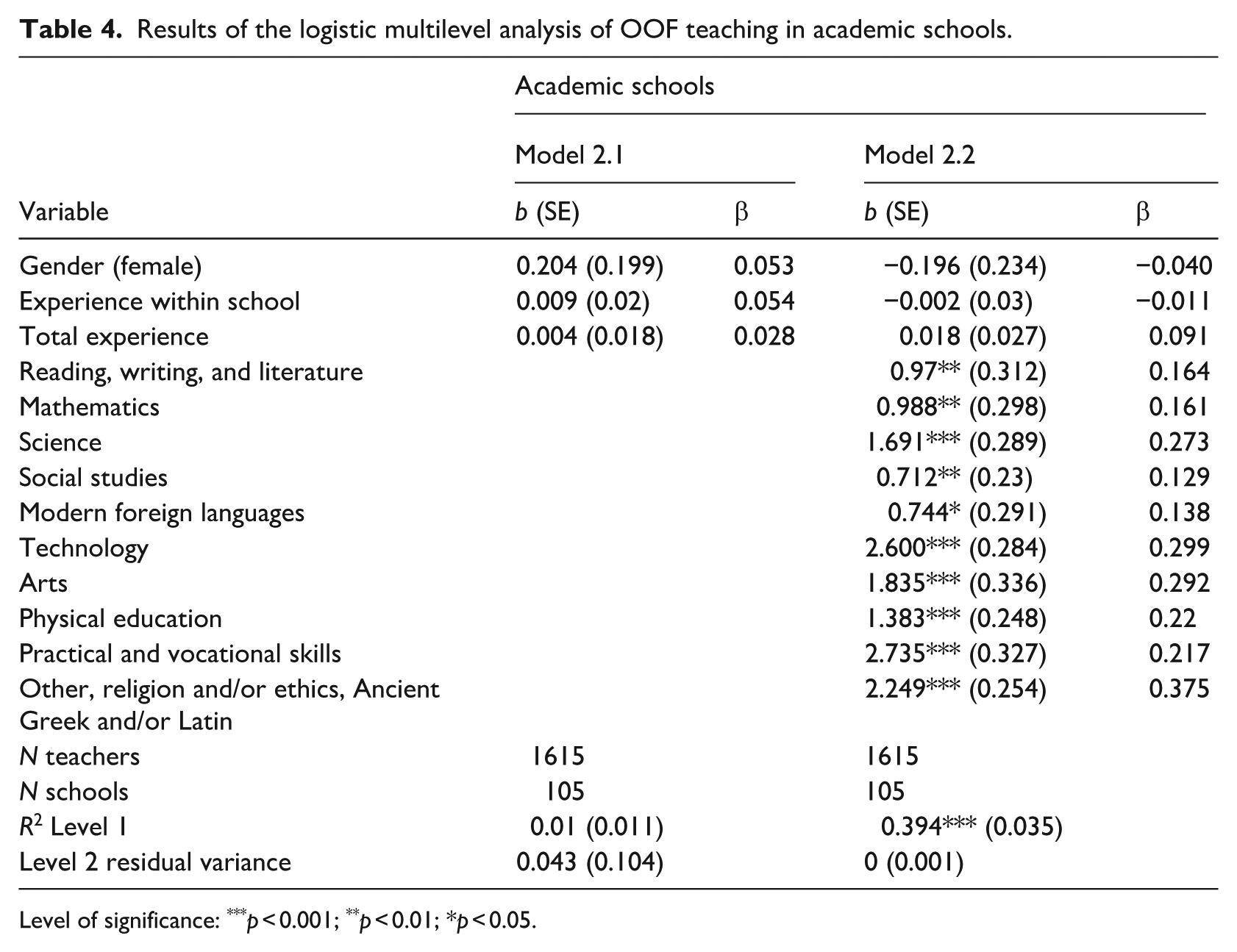
Level of significance: ***p < 0.001; **p < 0.01; *p < 0.05.
In line with the results for non-academic schools, subjects also accounted for a substantial portion of variations in OOF teaching’s prevalence in academic schools (Model 2.2 R2 = 0.394; χ2(9) = 26.784; p < 0.01), with positive effects for all subjects, implying that probability of OOF teaching increases with each additional subject taught. The strongest effects were found for practical and vocational skills, and technology, with OOF probabilities of 8.6% and 7.6%, respectively. The smallest probability for OOF teaching was found for social studies (1.2%) and modern foreign languages (1.3%). For more conditional probabilities, see the Supplemental Material (Table 14).
As the ICC analysis indicated no substantial variation between schools, school-level predictors were not considered further for academic schools (Table 11 in the Supplemental Material).
The subject-specific analyses indicated substantial variations in teaching mathematics (ICC = 0.085) and modern foreign languages (ICC = 0.087) among non-academic schools. The ICC for teaching reading, writing, and literature OOF was below the designated threshold of 0.05 (ICC = 0.033). 8 Therefore, we included only school-level predictors for mathematics and modern foreign languages. Given the relatively small proportion of OOF teaching in the main subjects in academic schools (see Table 1), we did not conduct subject-specific analyses for this school type.
As for non-academic schools, the analyses’ results indicate that the probability of OOF teaching in mathematics and modern foreign languages was not associated with teaching experience. Moreover, differential patterns were found for the effects of the subjects taught. For example, the probability of teaching mathematics OOF was significantly higher when the teachers taught science (b = 0.548, p < 0.05, β = 0.136) and technology (b = 0.568, p < 0.05, β = 0.12). The inclusion of school-level predictors for mathematics and modern foreign languages resulted in standardized coefficients greater than 1. Therefore, we estimated separate models with only one school-level predictor at a time (for detailed results with all school-level predictors, see Table 15 of the Supplemental Material). These analyses revealed significant effects of school composition (mathematics: b = 0.559, p < 0.01; β = 0.868; modern foreign languages: b = 0.543, p < 0.01, β = 0.957), suggesting that OOF teaching for these main subjects was more prevalent in schools with higher proportion of disadvantaged students (Table 5).
Results of the subject-specific logistic multilevel analysis of OOF teaching in non-academic schools.
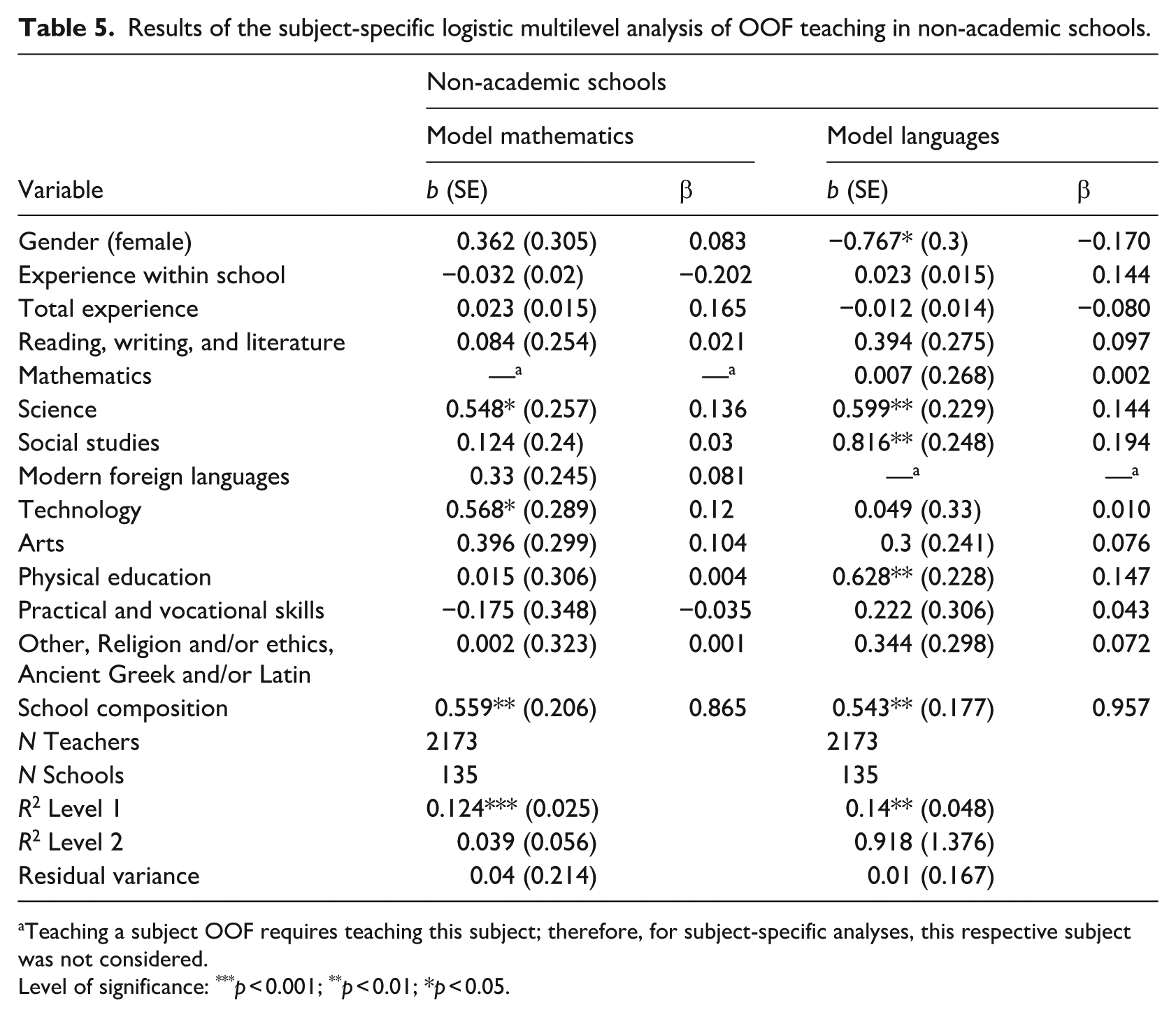
Teaching a subject OOF requires teaching this subject; therefore, for subject-specific analyses, this respective subject was not considered.
Level of significance: ***p < 0.001; **p < 0.01; *p < 0.05.
As for RQ2, it can be concluded that, at the teacher level, teaching experience and the specific subject taught are significant factors for teaching OOF in non-academic schools. However, for academic schools in general and mathematics as well as modern foreign languages in non-academic schools, only the subjects taught influence the probability of teaching OOF at the teacher level. At the school level, school size and school composition in non-academic schools play a role in predicting OOF teaching rates. School composition is particularly predictive of OOF teaching probability in mathematics and modern foreign languages.
Discussion
This study aimed to generate insight into OOF teaching in Austria and consider the impact of differences in subjects, teacher characteristics, and school characteristics on OOF teaching. The generated information can then be used to improve evidence-based policies given ever-increasing teacher shortages.
The findings indicate that in 2018—the year the TALIS data used in this study were collected—OOF teaching was a salient phenomenon occurring at non-academic schools in Austria, although it also occurred occasionally in academic schools. Nearly every second teacher in non-academic schools (48%) taught at least one subject OOF. Conversely, the OOF rate among academic school teachers was 10%. The high number of OOF teachers in non-academic schools can be attributed to various factors. First, the separation of formal teacher training into academic and non-academic tracks, the different contractual arrangements, and the more challenging working conditions (given the higher percentage of socially disadvantaged students in the non-academic tracks) may have led young people interested in becoming teachers to prefer academic schools, as reflected in the higher number of aspiring teachers on the teacher training track for academic schools (Altrichter et al., 2023, 2024). Additionally, the first half of the 2010s saw an increase in the number of teachers approaching retirement, which was especially pronounced in non-academic schools (Bruneforth et al., 2016). The preference for academic schools and the increasing demand for teachers in non-academic schools likely have resulted in a teacher shortage that led to the increase in the prevalence of OOF teaching in non-academic schools. Second, structural constraints in the teacher training program for non-academic schools (i.e., the compulsory choice of one main subject) likely increased the teacher supply for some subjects but may have increased the probability of OOF teaching in other subjects and, therefore, the overall probability of OOF teaching. Third, a lack of or limited training opportunities for subjects newly added to the secondary education curriculum or autonomously offered by schools could have led to a mismatch between the supply of and demand for qualified teachers, thereby increasing the prevalence of OOF teaching both overall and in specific subjects. Finally, teacher-to-class assignment cultures specific to each school type may have contributed to differences between these types.
Moreover, OOF teaching’s prevalence is marked by variations across subjects, as hypothesized and documented in previous literature (Price, 2017). In Austria, OOF teaching is concentrated in minor subjects, such as art and physical education. In non-academic schools, the arts, science, physical education, and technology are often taught OOF. Technology, practical and vocational skills, the arts, and physical education are the subjects most often taught OOF in academic schools. The high OOF teaching rates in science identified in non-academic schools align with international findings (Hobbs and Porsch, 2022; Sheppard et al., 2020); however, the low OOF teaching rates for mathematics contradicts international findings (Van Overschelde and Piatt, 2020). The formerly compulsory requirement that teachers pick a main subject may have ensured an adequate supply of mathematics. The overall favorable working conditions (e.g., higher salaries) in academic schools may have diminished discrepancies in the attractiveness of the teaching profession and jobs outside of the educational sector (West, 2013), leading to very low OOF teaching rates in mathematics.
Elevated OOF teaching rates in the minor subjects reported above may have been caused by admission restrictions (e.g., in the physical education and the arts), a lack or limited training opportunities (e.g., for technology for non-academic schools), and a lack of interested individuals (e.g., individuals interested to teach science in non-academic schools). Moreover, for both non-academic and academic schools, OOF teaching frequently occurs in subjects that schools can freely choose to form part of their autonomous curriculum (e.g., technology and practical and vocational skills; see Altrichter et al., 2011 for information on school autonomy and associated curricular diversification in Austria). Although there is a limited demand for qualified teachers for these subjects, insufficient supply (caused by limited training opportunities or insufficient awareness among those interested in teaching that these less traditional subjects are a possible field of work) may contribute to high OOF teaching rates. Moreover, limited supply and demand complicate the allocation of qualified teachers to vacancies, and principals’ preference for meeting teaching demands with existing teaching staff may have increased OOF teaching rates in these subjects. Principals may have a higher tolerance for OOF teaching in minor subjects such as the arts and physical education, which seemingly require less expertise (Porsch and Hobbs, 2024).
Teaching experience emerged as a significant predictor of OOF teaching, albeit only in non-academic schools. In line with international studies (Ingersoll, 1999), we found that less experienced non-academic school teachers were likelier to teach OOF. We discovered that, under constant teaching experience within the school, the teacher’s overall teaching experience affects the likelihood for OOF teaching negatively. Contrary to the general findings on the influence of experience on the probability of OOF teaching, teaching experience does not appear to be relevant for specific subjects (mathematics and modern foreign languages). These results may indicate that principals try to secure high-quality (in-field) teaching for main subjects that seemingly require more expertise than other subjects (Porsch and Hobbs, 2024). Vacancies in these subjects may be filled based on related expertise (e.g., science or technology teachers teaching mathematics OOF), while vacancies in minor subjects are frequently filled with less experienced teachers, as long-serving teachers tend to enjoy the privilege of being spared from OOF teaching. Accordingly, OOF teaching can be particularly burdensome for young teachers, who are at the onset of their teaching careers and must confront unfamiliar subjects that were not part of their formal training. In contrast to other studies (Glassow et al., 2023), gender was not associated with OOF teaching in either school type. These differences may have been caused by a lack of statistical power. For instance, Glassow et al. (2023) used the entirety of the international TALIS 2018 data (i.e., a sample of 144,316 teachers) and found a significant but small effect.
In line with Ingersoll (2002), the analysis indicates that OOF teaching in Austrian non-academic schools is associated with school size. The limited number of teachers in small schools imposes organizational restrictions that complicate meeting the demand for qualified teachers in all subjects. Academic schools are generally larger than non-academic schools and often cover the upper secondary education stage. Therefore, the pool of teachers in academic schools may not fall below a critical threshold in which organizational constraints caused by the number of available teachers become relevant. In line with this argument, we did not find substantial school-level differences in OOF teaching rates among academic schools.
No associations between OOF teaching and urbanization were found for non-academic schools. The centralized allocation of teachers to schools until 2018 may have attenuated or even compensated mechanisms leading to OOF rates differing by degree of urbanization. However, the urbanization degree variable used in this study might not have sufficiently reflected the regional differences that exist at least between the two federal states for which official data on OOF teaching is available (Court of Audit Austria, 2025).
The overall analyses for non-academic schools, which focused on school composition, showed a non-significant effect for this school-level variable. The centralized allocation of teachers may explain these results. OOF teaching seems to be ubiquitous in Austrian non-academic schools, regardless of their composition. However, in line with international findings (Sheppard et al., 2020; Taylor et al., 2020; Van Overschelde and Piatt, 2020), we found OOF teaching in mathematics and modern foreign languages to be more prevalent in non-academic schools attended by a higher number of disadvantaged students. Teacher sorting may have complicated the filling of vacant positions for these subjects at schools with disadvantaged student bodies. Teachers qualified for these subjects might be in greater demand due to their having the expertise that principals desire for these subjects (see Porsch and Hobbs, 2024). This higher demand and the insufficient supply of teachers for these subjects may have caused schools with disadvantaged compositions to have poorer chances of filling vacancies, causing a dual burden to emerge for such schools: Teachers must address challenges related to school composition and must ensure high-quality instruction in subjects for which they are not qualified. Should OOF teaching be found to be associated with a deficiency in teacher competencies (Baumert et al., 2010; Goldhaber and Brewer, 2000), this can lead to increased educational inequality as already-disadvantaged students are increasingly exposed to low teaching quality, which in turn negatively affects their level of achievement at school (Ziegler and Richter, 2017; Allen and Sims, 2018).
Limitations
While the present study examined the individual and structural factors associated with OOF teaching, it did not address variations in organizational aspects, such as subject allocation procedures within schools, in detail. Clear information on such topics is necessary for better understanding the mechanisms that lead to unequal distributions of OOF teaching. For example, we provide several plausible explanations for school-type differences in OOF teaching and for the association between school composition and OOF teaching. However, we cannot identify the factors behind the distribution of OOF teaching and the extent they contribute to this phenomenon. Understanding these factors would help facilitate the creation of effective measures for addressing differences in OOF teaching rate across schools. For example, to close this knowledge gap, future qualitative studies could explore principals’ rationales for the use of OOF teaching. Quantitative studies could address possible mediators for the association of school characteristics and OOF teaching (e.g., principals’ attitudes).
Furthermore, the study’s use of secondary data raises questions regarding the operationalization of OOF teaching. In defining OOF teaching, this study used subjects of the current school year (2018) as reference, but information regarding the duration and extent of these subjects’ instruction—whether in-field or OOF—is absent in the data. The subjects of the TALIS 2018 study were combined into teaching groups; in some cases, the data did not adequately reflect the actual situation. For example, teachers who possessed a formal education in biology but taught physics were not classified as OOF teachers in the TALIS data. Accordingly, the data used for the analysis considerably underestimated the OOF teaching situation in Austria.
The methods employed in this analysis and the selected sample were instrumental in generating information regarding the OOF teaching phenomenon in Austria. This analysis allowed for a more profound examination of the consequences of OOF teaching for schools, teachers, and students.
Implications and outlook
This paper provides an initial status report on OOF teaching in Austria in 2018. Since 2018, however, various developments in Austria have been made that have potentially impacted OOF teaching. First, given that the teacher shortage has worsened (Schnider and Braunsteiner, 2024), an overall increase in OOF teaching is to be expected, as confirmed by the two federal states with available official data on OOF teaching (Court of Audit Austria, 2025). Second, a teacher education reform that took effect in 2016 merged the school-type specific training programs (Altrichter et al., 2023). Thus, graduates of these programs (the first of whom finished their bachelor’s degree in 2019) can teach in academic as well as non-academic schools. This reform increases the supply of teachers, particularly for non-academic schools, thereby possibly mitigating differences in OOF teaching rates between the two school types. Although most student teachers claimed to prefer working in academic schools when asked at the beginning of their training, which was manifested in the difference in student numbers between school-specific trainings programs prior to the reform, recent research has suggested that these preferences are modifiable during teacher training (Altrichter et al., 2024). Third, a reform that took effect in 2018 granted principals greater autonomy in hiring new teachers. Austria thus moved away from a centralized teacher allocation system, thereby allowing teachers opportunities to self-select into more attractive schools (see Luschei and Jeong, 2018). This may lead to situations in which schools increasingly attended by disadvantaged students struggle to fill vacancies, which makes OOF teaching more likely to occur, particularly in this era of significant teacher shortages. If OOF teaching for these schools—as shown in this paper—increasingly spills over to main subjects, this may increase the educational inequalities that materialize in disparities in basic skills, such as reading or doing math. Fourth, the introduction of new compulsory subjects (e.g., technology) occurred alongside a time-delayed introduction of formal teacher training possibilities, thereby increasing the need for OOF teaching.
Given these developments, future studies (e.g., those using the most recent TALIS data from 2024, which are unavailable at the time of this writing) should address how the distribution of OOF teaching has changed over time. This would provide use starting points for regulatory measures. If school type differences are found to have persisted or even increased over time, measures removing reservations toward non-academic schools during teacher training may improve the supply for these schools and thereby decrease OOF teaching. If the association between school composition and OOF teaching is found to have increased, various countermeasures could be considered. As it is unlikely that policymakers will consider centralizing teacher allocation once more, equity-based funding, which has been extensively discussed for some time in Austria (Bacher, 2015; Bruneforth et al., 2012) and includes changes such as higher salaries for teachers at schools serving disadvantaged students, could make these schools more attractive. In general, the data-based control of supply and demand for specific subjects could help tackle shortages in these subjects. Teacher education institutions have recently presented several subject-specific demand estimates on their websites (based on information from the Federal Ministry of Education). For instance, demand assessments for the 2024–2027 period indicates a higher demand for graduates in the fields of physical education, religion, geometry, and mathematics, while a lower expected demand was found for subjects such as biology, English, geography, and psychology (Lehramt Ost, n.d.). Notably, in response to the oversupply of psychology and philosophy teachers, Austria’s largest university has suspended this subject from their training program in 2020. Other control measures (e.g., advertising for undersupplied subjects and admission restrictions for oversupplied subjects) could further align the demand for and supply of teachers. However, if any of these measures do not result in a sufficient improvement of matching subject supply and demand, thereby causing an increase in OOF teaching, more radical approaches such as questioning traditional subject-specific teacher education could be considered, as previously employed in Norway (see Skagen and Elstad, 2023).
OOF teaching does not automatically result in poor teaching (Porsch and Whannell, 2019), as it offers new learning opportunities for teachers and the chance for them to enhance their teaching (Hobbs, 2013). OOF teaching, especially in non-academic schools, appears to be an established mechanism for making education accessible for all students. Despite this, knowledge about OOF teaching’s prevalence in the Austrian school system should be acquired to develop appropriate support for teachers’ everyday school practice. Moreover, changes in training and further education should be considered, although additional studies should be conducted to more closely examine the challenges and needs of teachers who teach OOF while also considering the potential effects of OOF teaching on students. Despite ongoing efforts to address the shortage of specialist teachers, OOF teaching will continue to play a significant role in the Austrian school system even if the current teaching shortage is successfully resolved.
Conclusion
This study’s findings offer a nuanced view of OOF teaching in Austria in 2018, emphasizing its prevalence and structural determinants in both non-academic and academic schools. Differences in subjects, teacher experience, and school characteristics significantly influence the distribution of OOF teaching, with less experienced teachers being disproportionately affected. The study also draws attention to potential educational inequities arising from OOF teaching, particularly for disadvantaged students. Given the substantial developments in recent years, future studies should analyze the change in the distribution of OOF teaching. Additional qualitative and quantitative studies on mechanisms within schools (e.g., the roles principals play in schools) should provide a database for measures tackling OOF teaching and its effects on students and teachers.
Supplemental Material
sj-docx-1-eer-10.1177_14749041251376730 – Supplemental material for Out-of-field teaching in Austria: A comprehensive analysis of its prevalence at the school, teacher, and subject levels based on TALIS 2018
Supplemental material, sj-docx-1-eer-10.1177_14749041251376730 for Out-of-field teaching in Austria: A comprehensive analysis of its prevalence at the school, teacher, and subject levels based on TALIS 2018 by Eva Sengschmid, Christoph Weber, Christoph Helm and Barbara Sabitzer in European Educational Research Journal
Footnotes
Acknowledgements
We would like to thank the IQS—Institut des Bundes für Qualitätssicherung im österreichischen Schulwesen for providing the data which was used in the present study. Without their support this research would not have been possible.
Data availability statement

Declaration of conflicting interests
The authors declared no potential conflicts of interest with respect to the research, authorship, and/or publication of this article.
Funding
The authors disclosed receipt of the following financial support for the research, authorship, and/or publication of this article: The author’s position is funded by the Austrian Federal Ministry of Education (BMB) and the Austrian Federal Ministry of Women, Science and Research (BMFWF) (former Austrian Federal Ministry of Education, Science and Research (BMBWF)) through the initiative “Educational Innovation Needs Educational Research B3,” which aims to strengthen the field of educational research by creating cooperative doctoral programs between universities and teacher training colleges.
Supplemental material
Supplemental material for this article is available online.
Notes
Author biographies
References
Supplementary Material
Please find the following supplemental material available below.
For Open Access articles published under a Creative Commons License, all supplemental material carries the same license as the article it is associated with.
For non-Open Access articles published, all supplemental material carries a non-exclusive license, and permission requests for re-use of supplemental material or any part of supplemental material shall be sent directly to the copyright owner as specified in the copyright notice associated with the article.
