



Abstract
International cooperation is high on the agenda of policy makers in times of globalisation and shared challenges such as climate change, poverty, equity or digitalisation. The present paper investigates strategies and actors involved in international cooperation policy in the field of vocational education and training within the francophone area. Using a discursive institutionalism approach as an analysis frame, the article traces and identifies the development of ideas and discourses. It also examines the changes and tensions in the French public institutional set-up in that specific policy field. The analysis builds on analysis of policy documents, mission statements of actors involved (ministries, public and private actors, non-for-profit organisations, international and European actors).
Keywords
Introduction
International cooperation is high on the agenda of policy makers in times of globalisation and of shared challenges such as climate change, poverty, equity or digitalisation. International vocational education and training cooperation is embedded within international cooperation, which sets the frame in terms of priorities, financial means and actions. Almost no studies have examined the institutional framework of the international cooperation in vocational education and training within the Francophone area. This area encompasses around 87 countries or territories which use French as official or mother tongue language, most of those countries being located in Africa and Asia. In 2019, USD 4.0 billion of France’s bilateral official development assistance were allocated to Africa and USD 1.6 billion to Asia, accounting for 41.3% and 16.5% of gross bilateral French official development assistance, respectively. Bilateral allocations to Africa are increasing in line with French government policies. Africa was also the main regional recipient of France’s small share of earmarked contributions to multilateral organisations (Organisation De Coopération et Développement Économiques, 2018 1 ). Further to the budgetary significance of the international cooperation for the French State, France can look back on a long and eventful tradition of international cooperation, dating back to the colonial expansion period in the 19th century. This has resulted in specific relationships with the francophone countries and the building of a joint cultural and educational heritage. International cooperation does not merely concern economic or political matters; it also concerns vocational education and training.
The French institutional framework is characterised by an interplay of many institutions, steered by the French government, as well as by continuous shifts in institutional missions and scopes. Analysing the French international VET cooperation by applying a discursive institutionalism approach enables the focus to be placed not only on actors and organisations but also on ideas and concepts of international VET cooperation in a static and dynamic perspective and on interrelated effects. Schmidt (2010: 1) mentions that ‘discursive institutionalism is concerned with both the substantive content of ideas and the interactive processes of discourse in institutional context’. This theoretical approach, as presented in the first part of this article, facilitates reflection upon changes and processes in a more appropriate manner than the other three institutionalisms. ‘It (discursive institutionalism) defines institutions dynamically (…) as structures and constructs of meaning internal to agents whose “background ideational abilities” enable them to create (and maintain) institutions while their “foreground discursive abilities” enable them to communicate critically about them, to change (or maintain) them’ (Schmidt, 2010:1). Approaching this topic with discursive institutionalism ‘provides an explanatory approach to how politics can change through ideas and discourses’ (Schleicher, 2021: 35). The analysis started by adopting an explorative approach to identify which institutions develop and convey ideas and discourses within French international VET cooperation. It also led to the definition of different waves of change as discussed in part two. Understanding the development of discourse relies predominantly on knowing which institutions are involved and how they interact. The review of legal documents, evaluation reports, minutes of hearings, activity reports of single organisations fed into the analysis of policy objectives, the process of agenda setting, strategical change and interdependencies of institutions. The third part of this article takes a deductive approach and is dedicated to how the policy objectives as a whole, the mission statements of single organisations as well as the institutional set-up have emerged and developed (with inconsistencies at some stage). Orientations of actors are bound to actual cognitive maps and narratives of actors. The focus on VET, in part four of this article, is enriched with complementary analysis of core VET related concepts for international cooperation within the francophone microcosm and sets the communicative discourse frame. The article concludes by looking at the interplay between actors and discourses from an institutional theoretical viewpoint and formulates some further research needs.
From the lens of discursive institutionalism
‘Discursive institutionalism is concerned with both the substantive content of ideas and the interactive processes of discourse in institutional context’ (Schmidt, 2010: 1). Schmidt argues that discursive institutionalism enables the obtaining of ‘insights into the dynamics of institutional change by explaining the actual preferences, strategies and normative orientations of actors’ (Schmidt, 2010: 1). Actors formulate ideas and codify them discursively in different documents. In this contribution, the French international VET cooperation will be characterised using law texts, evaluation reports, minutes of meetings, activity reports as specified below. Organisations are of different orders, some having the institutional primacy of defining future actions, others having the role of implementing, others having the role of evaluating the deployment of policies. To my view, ideas through discursive means (declarations, negotiations leading to updated laws, reports) shape changes. What shapes or initiates ideas are experiences from the past (path-dependency), analysis of the current situation and the identification of comparative advantage or competitive environment (rational choice) as well as the identification of windows of opportunities (such as for instance the development of the international discourse on sustainability, poverty and equity). This is the point at which the different strands of institutionalism meet. Schmidt (2010) points to the necessity of including some aspects of the three institutionalisms (historical institutionalism, rational-choice institutionalism and sociological rationalism, see also Hall/Taylor 1996) to understand the choices and turns of ideas in a time perspective. I would argue that changes of institutional set-up are asynchronous as well as non-linear to the delivery of discourses. The aspect of non-linearity has been analysed by Nordin and Sundberg (2018) as regards curriculum change. Ideas as push factors towards new or revised institutions are also determined by discourses taking place outside the sphere of existing organisations and institutions at a given time. In the French case, international cooperation had to change in the wake of a new policy paradigm at the end of the 60s, the development of the European Union in the 80s and the uptake of issues such as worldwide equity and sustainability in the 90s.
The policy objectives and incentives as observed in the case of French international cooperation are pushing changes, but in reality institutional rules and organisational routines, organisational and/or institutional changes need more time to be implemented. Researchers understood changes in different ways. Some, such as Carstensen and Schmidt (2016), associate changes with power structures and processes. They ‘define ideational power as the capacity of actors (whether individual or collective) to influence other actors’ normative and cognitive beliefs through the use of ideational elements. This may occur directly through persuasion or imposition or indirectly by influencing the ideational context that defines the range of possibilities of others’ (Carstensen and Schmidt, 2016: 321). They identify and differentiate between ‘the power through ideas, understood as the capacity of actors to persuade other actors to accept and adopt their views through the use of ideational elements, the power over ideas, meaning the imposition of ideas and the power to resist the inclusion of alternative ideas into the policymaking arena and the power in ideas, which takes place through the establishing of hegemony or institutions imposing constraints on what ideas are considered’ (Carstensen and Schmidt, 2016: 318).
On the one hand, actors are those defining changes. They are also those affected by changes and by new institutions (for instance laws). They have contributed to the setting up of these via their ideational powers. Schmidt sums up this perspective as follows: ‘The institutions of discursive institutionalism (…) rather simultaneously structures and constructs’ (Schmidt, 2008: 1). As stated by Scharpf (2000: 86), the ‘resources for action in the context of policy research are institutional rules that confer or limit competences, participation rights, veto rights or the right to autonomous decision-making for certain issues’. By initiating and delivering new ideas, the French State established an ever-growing single organisation, the French Development Agency (AFD), which started as a single organisation at the beginning of the reform process. AFD ends as an organisation with extended competences and rights – at least at the level of discourse, since existing activity and evaluation reports still identify strategic and operational shortcomings (Assemblée Nationale and Sénat, 2021; Organisation De Coopération et Développement Économiques,2018).
The theoretical discursive institutionalism does not go so far as to evaluate the impacts of discourses on institutions and actors. It seeks to identify changes in institutions based on the role of ideas and discourse in politics. Ideas and discourses exert a greater or lesser impact on institutions in accordance with their levels of generality, content or substance (Schmidt, 2008). Institutions are thus identified on the basis of the following definition: ‘Institutions are understood in discursive institutionalism as rules or structures that guide the actions of individuals and groups. They can be both formal laws and informal rules’ (Schleicher, 2021: 46). She notes that this definition witnesses the overlaps between institutions and the ideas that lie behind. Discursive institutionalism further elaborates on factors sustaining policy adoption based on a conception of a three-level model of policy objectives proposed by policy makers (level one being policy solutions, the second one general policy programmes and the third one policy principles or Weltanschauung (Schmidt, 2008)).
The 60 documents selected for this article are directly connected with the main organisations building the framework for French international VET cooperation; these being Ministries, Parliament and Senate as well as institutions dedicated to this policy field. Three major documents are the acts on international cooperation dating 2014 and 2021 as well as the strategic paper for international cooperation in VET (Ministère des Affaires Etrangères et du Développement International, 2017). Preparatory to those major documents are evaluations and minutes issued by the Senate or the National Assembly. Further documents are activity reports from the organisations themselves. The core assumption in line with discursive institutionalism is that ‘ideas are an important variable shaping public policymaking processes’ as expressed by Swinkels (2020: 282) in reference to Schmidt (2008) and that change can be ‘understood as an endogenous process through background ideational and foreground discursive abilities’ (Schmidt, 2010: 5). Interestingly, Schmidt asserts that ‘ideas and discourse that seek to promote change often have little effect on the crystallised ideas about rationalist incentives, historical paths, and cultural frames’ (Schmidt, 2010: 21) and that at the same time the further three strands of institutionalism can be considered to explain the scope of ideas.
Discursive institutionalism differentiates between a stronger communicative and a stronger coordinative discourse within the process of conveying ideas; the level of coordination or communication depending upon the role of actors in policy decision processes (Carstensen and Schmidt, 2016; Schleicher 2021). Nordin and Sundberg also remind us that ‘coordinative discourse strives towards cognitive justification with, as a result, a discursive coordination around a specific content emerging out of a communicative interaction between different actors and interests’ (Nordin and Sundberg, 2018: 827). A coordinative discourse approach supports the identification of a relatively small number of actors, institutions, individuals or groups that are ‘at the centre of policy construction who are involved in the creation, elaboration and justification of policy and programmatic ideas. These are the policy actors – the civil servants, elected officials, experts, organised interests and activists, among others – who seek to coordinate agreement among themselves on policy ideas, which scholars have shown they may do in a variety of ways in a wide range of venues’ (Schmidt, 2008: 310). Newest policy developments such as the activities of competitors in the field of international VET cooperation or the stronger relevance of European and international organisations as presented below hint at a shift in what Schmidt identifies as the ‘centre of policy construction’. The increased relevance of international agreements, such as for instance the COP 21 or international accountability rules, affects the extent of agenda-setting capabilities of ‘central’ actors and their power within their realm of competences and can be considered as the justifying narratives within the coordinative discourse. The coordinative approach resonates with the strategic dimension of discourse. As elaborated by Jabko (2006): ‘there can be a strong strategic dimension in the sense that leaders will select ideas that seem appropriate with regard to enabling them to build coalitions, create resonance for the public and, eventually, ensure the legitimacy of their action’ (quoted after Crespy and Schmidt (2014: 6)). This strategic dimension cannot per se exclude a bias towards the actors’ own institutional or organisational interest. ‘Ideas reflect policy actors’ normative orientation towards the context in which they operate, and these determine the behaviour they display in that context’ (Hay, 2011); quoted after Swinkels, 2020: 285).
Discursive institutionalism, as briefly introduced above, enables us to focus on the review and analysis of the French international VET cooperation on the basis of two main questions. These can be formulated as follows: how actors, organisations and institutions evolve, change and possibly dissolve as well as how institutions acting as change agents and change subjects are initiating and/or giving sense to the expected changes by means of ideas and discourse.
Waves of changes – setting the scene
Most of the countries with which France is cooperating in Africa and Asia accessed their sovereignties in the 1960s. During the preceding decades, their models of development, of administration, hence their definition and organisation of their education systems (including vocational education and training), have been defined and steered from the central administration in Paris (France). This at least applies to the former French colonies. The education of local African elites in France sustained this process, and local administrations were largely run by French nationals. The policy copying process did not immediately stop once independence had been gained. As mentioned by Delluc (2001), the adoption of the same French models did not stop at independence despite different socio-economic realities ‘especially since locally, this transplantation of the model was naturally defended by its political and administrative guardians’ (Delluc, 2001: 9). The changes to the French VET system in the 1960s, introducing the recruitment of VET learners at the second year of secondary education in technical schools, the creation of technical baccalaureates (for the continuation of studies in technology Institutes or at further training lyceums) were transferred ‘quite naturally’ into French cooperation policies. As Delluc (2001) points out, this had negative effects due to the inadequacy between these training and qualification offers and the needs of weakly industrialised economies. The number of young unemployed graduates thus increased in the countries. The second borrowing from the French model is the devolution of competences in the field of vocational training between a ministry in charge of labour and a ministry in charge of national education. This will lead, as in many Northern countries, to problems of supervision, with competing ministries. In 1980, over 2000 expatriates, so-called cooperating civil servants from the French Ministry for National Education, were operating in those countries. Delluc’s assessment is quite critical; he stresses that those civil servants were not well prepared for their missions abroad, and acted as if they were operating in France while being disconnected from on-going discussions on reforms and new approaches in the French VET system. Their presence in the countries furthermore inhibited the development of local teaching, training and administrative staff. In an institutionalist theoretical approach, the development of institutions and actors, at least in the field of vocational education and training as described above, did not consider the need for embeddedness or adaptation, and the developed new institutions did not pay enough consideration to local resources, beliefs and socio-economic factors. The rationales for the French cooperation in that period, admittedly a difficult time for all countries, were not the improvement and adaption of local solutions. This corresponds with a period of less interest for issues of education and training policies in the frame of French international cooperation.
In terms of heritage or path-dependency, this short historical recall however hints at what is nowadays coined as the ‘common matrix with countries that have adopted our model’ (Delluc, 2001: 9) or the specific added value of the French international cooperation emerging from its historical and linguistic links with most of its priority countries (Organisation De Coopération et Développement Économiques, 2018). This might explain why French cooperation in the field of education and training continues to place a strong emphasis on the French-speaking countries in Africa and Asia (Perret, 2007; Berville, 2018; Ministère des Affaires Etrangères et du Développement International, 2017). French cooperation policy changed considerably during the period from 1980 to 2010. Political strategies diversified both geographically, since France no longer focused on its former colonies, but also technically took place through the means of intervention following involvement in a hundred or so countries (Rigaud, 2012). To understand the ‘mental maps’ of French organisations in the field of vocational education and training it is worth recalling that the French Vocational and Education model is viewed as an etatist model, whereby the State and its Ministries are the major actors. ‘Qualification for employment is regulated on the basis of legal arrangements, preferably by the state or government bureaucracy. In the 20th century, this archetype of qualification for employment became the leading model worldwide’ (Greinert, 2010: 253). As any VET system, the French one underwent many changes and adaptions through the years. It remains strongly school-based. In 2018, merely 5% of young people aged 16 to 25 were following a dual training or apprentissage (France Compétences, 2021).
Considered from an institutionalist perspective, the French colonialist past, France’s history as well as the characteristics of its VET system shape the context in which institutions and actors develop as well as the manner in which institutions interact within that context (Balleix, 2010; Delluc, 2001). As the example shows, the approach to the development of VET in francophone countries as steered by French organisations missed the point of considering the context in which institutions develop and how the context shapes and therefore determined the deployment of VET, at least in its early years. Hall and Taylor (1996) emphasise path-dependency and unintended consequences of agents’ actions. The series of reforms as described below testify to the effort made to defend their interests in uncertain world. This is likely to be driven by a strategic calculus affected by the actor’s expectations about how others are also likely to behave rather than by historical forces (Hall and Taylor, 1996). Considering changes, Mahoney and Thelen (2010) state that institutions change when the actors find circumstances in which they have both an opportunity and an incentive to change or reinterpret the rules in ways that serve their interests. Incremental change occurs as the results of the opportunistic and strategic choices made by a range of actors within institutions. The main impulses for change within the institutional set-up of French international cooperation emerge from the formation of new governments as actors having ‘power over ideas’ as defined by Carstensen and Schmidt (2016).
The discursive institutionalism approach leads to identify two major periods in terms of policy orientation before and after 1980s. Opportunities for changes and reinterpretations of rules emerged at a higher pace in the period 2001–2021, dictated by three main reflection waves, initiated by the respective governments and finalised with two major laws of 2014 and 2021. The reports and law texts increasingly link with the activities of international organisations and, some 30 years later, address the need to build up specialised staff to assist countries in Africa and Asia in developing their vocational and education training systems. The interactive process is highly formalised and the discursive frame, at least for the period from 2001 to 2021, includes information and evaluation reports followed by high-level discussions mostly under the lead of the French Premier Minister and the Ministers for Foreign Affairs. Those actors are the ‘centre of policy construction’ (Schmidt, 2008) and of an updated institutional set-up (including new organisations, legal frame of actions) as discussed in the following part of this article.
French institutional set-up
The discursive institutionalism approach enables actors and institutions to be placed at the core of the analysis. It also leads the analysis towards the identification of preferences and constraints regarding the development of ideas and institutions themselves. The following part reviews the institutional set-up of the French international cooperation, which is continuously undergoing changes mostly initiated through decisions of the respective governments. Due to a complex institutional set-up, French cooperation policies have often lacked clarity and are characterised by inconsistencies; the institutional set-up remains plural despite the reforms (Balleix, 2010; Berville, 2018; Organisation de Coopération et Développement Économiques, 2018). The minutes of the mixed commission (Assemblée Nationale and Sénat, 2021) prior to the 2021 new act testify to concerns about the remit of existing and new actors, their coordination as well as the budgeting within the French financial law and in regard to the financial contribution to European and international programmes. A major reform was initiated in 2011 with a framework strategy paper for international cooperation (Rigaud, 2012). National Ministries shape and steer international cooperation; the activities have been recentralised within the French public administration; the French Ministry for Foreign Affairs with the National Treasury as an auditing actor playing a leading agenda-setting and discourse-giving role. The French Senate acts on its own initiative or by order of the Premier Minister to carry out evaluation and analysis at quite a regular frequency, especially at times of new government building in France. The overarching legal framework is the 2014 act for development and international solidarity (Journal officiel de la, 2014); replaced since 20 July 2021 by the programming act on solidarity development and the fight against global inequalities.
Framework of actors
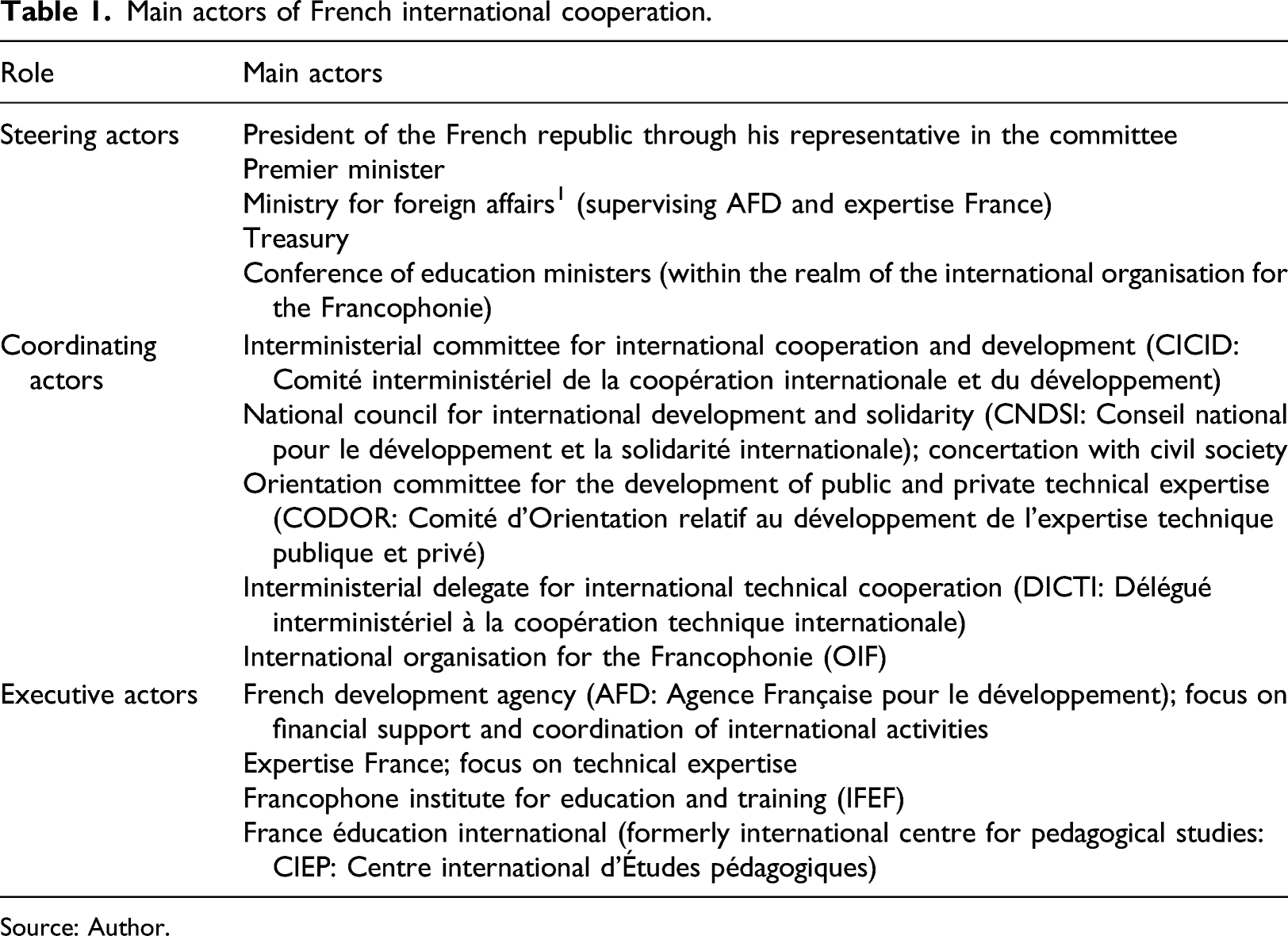
The plurality of actors and institutions within the French international cooperation is a core characteristic of that field. The main actors are presented in the table below. The description of the remits of the single actors highlights the difficulties in implementing the coordinative discourse. The French framework of actors is increasingly embedded within wider frameworks of actors operating at European (European Commission) or international levels (UNESCO for instance). Those actors act as donors to the French actors through calls for projects, for instance. ‘From 1985 onwards, the landscape of educational cooperation changed significantly with the appearance of multilateral donors and the creation of the European Union’ (France Education International, 2020: 3). The main actors consider the European and international framework2 both as an opportunity to expand one’s influence as well as a constraint through European or international regulations and agreements (Assemblée Nationale and Sénat, 2021; Berville, 2018). Balleix concludes that ‘as a former major European colonial power, France shaped the development policy established in 1958 in the framework of the European Community. As its global influence has declined, it has seen a “normalisation” of its development policy since the late 1990s’ (Balleix, 2010: 95). This normalisation went through oppositional discourse against the European framework for international cooperation. Balleix (2010) identifies two veto players: the AFD and the diplomatic corps; the reasons put forward are the sphere of influence for the diplomatic corps and the fear of limited scope of actions and resources for the AFD.
Complementarily to national actors, regional chambers of Commerce and Industries are part of the institutional set-up supporting the development of VET abroad. Their international cooperation tools include international partnerships agreements, development of initial or continuous VET programmes, training of international students, further training to VET leaders in cooperation with own or third-party vocational or business schools, study visits or cooperation programmes for VET development. Specific regions and their administrations, especially in the aftermath of the reforms of regions and the French policy of decentralisation, set up strategies for international cooperation to deal with supporting economic development and VET. In recent years, their strategies have been considered as a contribution to the international sustainable development goals (2015–2030), with specific mechanisms and tools being put at their disposal for international cooperation. In France, the regions constitute local authorities and have exclusive competences in education, training and integration into employment. A national Commission for Decentralised Cooperation is in charge of coordination (Ministère des Affaires Etrangères et du Développement International, 2017).
The 2018 Organisation for Economic Co-operation and Development report on external development activities hints at the difficulties in identifying the budget allocated as well as at the diversities of committees and co-decision bodies. In particular, the report highlights the multiplicity of budget lines, devolution of competences in 13 missions managed by 14 ministries, extra-budgetary funds, no systematic multi-year commitment as well as no systematic coordination between the French actors (i.e. AFD, MEAE, MINEFI, Expertise France and sector ministries) as well as no shared priorities or objectives. In the area of education, the Organisation for Economic Co-operation and Development (2018) underlines the lack of synergies between different lines of activities.
Main actors of French international cooperation.
Source: Author.
The Interministerial Committee on International Cooperation and Development (CICID) is presented below in order to illustrate the role of committees. Created by Decree No. 98–66 of 4 February 1998, the CICID defines the orientations of French policy on international cooperation and development aid. Its status was modified in 2007 (Journal officiel de la République française, 2007). The Prime Minister chairs the CICID and brings together the ministers, most directly concerned by development issues. The ministries making up the CICID are the ministries for Foreign Affairs, Economy, Budget, Interior, National Education, Armed Forces, Ecological and Solidarity Transition, Overseas France and all other interested ministers. Since its creation, the CICID has met 11 times. Under the terms of the 1998 decree and its third article: the committee ‘sets guidelines on the objectives and modalities of international cooperation and development aid policy in all its bilateral and multilateral components’. It determines the countries of concentration and the priority sectors of French cooperation. It ‘ensures the coherence of the geographical and sectoral priorities of the various components of cooperation’. Finally, it ‘ensures a permanent mission of monitoring and evaluation of the conformity of international cooperation and development aid policies and instruments with the objectives set and the means assigned’ (Journal officiel de la République française, 2007). The Ministries of Europe and Foreign Affairs, Economy and the Interior run the CICID secretariat jointly. The French Development Agency (AFD) may be associated with the meetings, upon invitation by the chairs of the co-secretariat. The co-secretariat meets several times a year, allowing regular and operational inter-ministerial monitoring of French development aid policy.
The CICID is the main coordinating actor and sets the guidelines for international cooperation policy and official development assistance, thus framing the scope of actions of all actors. From an institutional perspective, it is both an actor and an institution to the extent that it acts as steering actor. It determines the priority solidarity zone (selection of foreign countries targeted by international cooperation), it elaborates the guidelines on objectives and modalities of international cooperation and development aid policy, it ensures the coherence of the geographical and sectoral priorities of the various components of cooperation. Finally, it fulfils a mission of monitoring and evaluation of the conformity of the policies and instruments of international cooperation and development aid in accordance with the objectives set and the means assigned.
Expertise France – a new actor since 2014
In its analysis of French international cooperation conducted in 2012, the French Senate recommended pooling international French technical expertise under one overarching organisation. Expertise France was created in 2014 (Act of 7 July 2014; Decree, 2014–1656 from 29 December 2014). The aims were for six actors to merge in the first wave and for all actors having technical expertise in international cooperation to be included by 2016. Reform objectives had been partially achieved by 2018. Ministries were still running their own agencies, even though some actors were competing with Expertise France on given projects. Some ministries delegate certain international cooperation projects to Expertise France but keep their steering role. Expertise France is supposed to streamline international cooperation and achieve its financial sustainability through third-party funding whilst continuing to respond effectively to the demands of national administrations, for which international cooperation is a lever of influence and possibly of operational cooperation (Organisation De Coopération et Développement Économiques, 2018; Vial and Perol-Dumont, 2018). The remit of Expertise France is to ensure strategic programming of evaluations and better coordination of evaluations between the Ministry of Europe and Foreign Affairs (MEAE), AFD and the Directorate General of the Treasury (Organisation De Coopération et Développement Économiques, 2018).
From an institutional perspective, it is interesting to review the reasons for merging existing actors and the difficulties emerging from this change. The twofold objective behind the merger was to increase France’s share of the international expertise market whilst prompting economies of scale from an economic-financial perspective (central actors such as the Government and Senate expected less budgetary outlay). The landscape of international cooperation (not only in the field of VET) is assessed as highly competitive, and Germany and Belgium are considered as competitors. Building up the French competitive advantage means developing a joint financial and technical expertise, pooling local networks. ‘The creation of Expertise France was intended to extend French influence, to make the most of the amounts paid by France to international organisations and the European Union in terms of development aid for the benefit of operators and, if possible, French companies, while costing the national budget a minimum’ (Vial and Perol-Dumont, 2018:11).
The merger also means centralising the steering of all activities under one roof. Whereas in the past single Ministries would lead ‘their’ agencies, Expertise France would lead the whole. Yet Expertise France signs agreements with all ministries formerly overlooking the single actors. The request for co-decisional powers led to a multiplicity of committees (See table; many ministries on the board, plurality of committees) and to the establishment of a comitology system. In its internal organisation, Expertise France is required to reconcile the operating modes and administrative cultures inherited from previous independent organisations and that of project research and to master the shift from a service delivery approach to a project search approach, without having all the tools necessary for this change of mission and profession.
The French Development Agency (AFD)
The French Development Agency was created in 1941 during the Second World War as the ‘Caisse centrale de la France Libre’ for an indefinite period (Agence Française pour le Développement, 2019). ‘The transformation of the Caisse into the Agence française de développement (AFD) in 1998, after the integration of the Ministry of Cooperation into the Ministry of Foreign Affairs, can be interpreted in the light of the European trend of New Public Management. Developed in the 1990s, this movement has resulted, in particular, in a multiplication of agencies, often in the new Member States’ (Baillex, 2010: 99). The AFD is meanwhile the main public financing agency in the field of international cooperation and acts in the public interest, operating mainly in Africa with a strong focus on gender equality. The AFD public budget amounts to nearly €3 billion in 2020. It acts in different fields, one of which being education. In the years 2019–2020, the budget allocated to education-related activities diminished (Agence Française pour le Développement Groupe, 2021). Until 2019, the idea was that the AFD should be set up as the umbrella organisation overseeing Expertise France. At the core of the international cooperation network, the AFD is foreseen for the coordination of a series of public operators (Expertise France, Campus France, Agency for French Education Abroad, International Centre for Pedagogical Studies (CIEP), international public employment agency etc.). It also includes local authorities, academies, public and private establishments, academies, non-governmental organisations, social partners (trade unions and employers’ organisations and professional branches), and the world of research (Institute of Research for Development, universities etc.). The major difficulty is that some of the different actors are public administrations whilst others are decentralised services (Ministère des Affaires Etrangères et du Développement International, 2017).
France education international
Created in 1945 under the name of Centre international d'études pédagogiques (CIEP), France Education International is an institution under the supervision of the French Ministry of National Education, Youth and Sports. Its activities run within the framework of the governmental priorities for international cooperation. Alongside its focus on French as a teaching language and support for mobility of language teaching staff, it engages in cooperation projects in the fields of vocational training. Its budget for international cooperation in education and training amounts to €21 million in 2020.43% of its cooperation projects related to education and training concern vocational education and training directly and are mainly financed by AFD and the European Commission. France Education International also liaises with French regional authorities or research institutes in its education and training projects. This organisation is one directly affected by the devolution of competences in the field of vocational education and training to the French regional authorities. Its activities in this field focus on improving the employability of young people and skilled workers (France Education International, 2020).
The International Organisation for Francophonie (OIF) emerged in the 1960s as an association and took its form as an international political actor in the 1970s. As of 2018, 88 French-speaking states were members of the International Francophone Organisation. The French-speaking world’s economy accounts for 8.5% of global gross domestic product. The 31 African member states of the OIF will have nearly one billion inhabitants by 2050. This demographic dynamism means that, potentially, 90% of young French speakers aged between 15 and 29 will be in Africa, provided that progress in education is consolidated. Its specificity is to consider French as a cross-cutting priority, both in education (particularly in countries where French as a language of instruction is a qualitative lever) and in the training and integration of young people (French is the third language of business) (Ministère des Affaires Etrangères et du Développement International, 2017, Organisation Internationale de la Francophonie, 2021).
A further institutional specificity of the OIF is the role of the Conference of Education Ministers (CONFEMEN), which was held for the first time in 1960. The CONFEMEN meets every 2 years and acts as the steering actor for issues related to primary education (access, gender equality, equity and quality of the education and training systems). It acts as an exchange platform between the ministries and governments and decides upon the respective work programmes, which are approbated during the francophone summits (Conférence des Ministres de l’Éducation des États et gouvernements De la Francophonie, 2019; Organisation Internationale De la Francophonie 2021).
The OIF develops its own strategy. It embeds youth employability, development of human resources in priority sectors, the development of public services in the countries and reciprocal youth mobility into the development of civil society. The OIF’s status as a transnational organisation also means that it acts within the framework of or in cooperation with other international organisations such as UNESCO, the African Union or the Development Agency of the African Union. OIF has run its own Francophone Institute for education and training (IFEF) since 2017. The IFEF’s self-evaluation exercise highlights that it remains in 2019 a relatively new unknown actor in the field, operating at a time of decreasing budget allocation to education and training matters, as well as in competition (not always in cooperation) with international donors and actors. Its focus on Africa is also considered as a weakness, although operating from Dakar is, by way of contrast, a positive signal and enables the IFEF to link its activities with those of other Francophone organisations (Institut De la Francophonie pour l’Education et La Formation, 2018a).
The IFEF operates four main programmes. The programme ‘Training and labour market insertion for youth’ is dedicated to VET. It addresses VET managers and teachers in six countries, training them by providing tools for reforming technical and vocational training policies and programmes as well as for learners. More concretely, IFEF is working on the competence-based approach in education and training, guidance, hybrid VET provision, involvement of VET stakeholders (including companies) as well as on validation of prior learning to ease the access of young people to the labour market. It strives to involve companies as training and qualifying actors in the respective VET system. The overall objective is to increase the efficiency of national VET systems to enhance youth employability and to open up VET to women (Institut De la Francophonie pour l’Education et La Formation, 2018).
Agenda setting of international cooperation
The agenda of international cooperation has been constantly redrafted during the last 60 years. It moved from envisaging the countries of Africa and Asia as parts of the French administrative system steered from Paris to envisaging cooperation as instruments of the sphere of influence of the French State within the shared institutional matrix (Delluc, 2001). The French government can be thus considered as the main actor delivering the coordinative discourse. Yet its coordinative ambition goes beyond the field of international cooperation. Nowadays, the agenda setting is a mixed opportunity for the French State to maintain specific relationships with the countries and to gain influence within European and international organisations. This approach is more or less successful (Balleix, 2010). International cooperation, and VET cooperation in particular, is a field of activities for many national and international actors. This field is highly competitive. Some core ideas are acting as push factors for the cooperation strategy adopted by the French governments and actors. These are the fight against poverty, integration of young women and men into the labour market, reducing inequalities for access to education and well-being, gender equality and equity as well as the improvement of norms and quality standards (with an expected positive effect on French companies) in economic and social fields (Berville, 2018; Ministère des Affaires Etrangères et du Développement International, 2017). These arguments were to the fore of the debates that occurred prior to the new act for international cooperation (Assemblée Nationale and Sénat, 2021).
The review of documents by the actors enables identification of the following objectives or narratives. Some of these are directly anchored in the VET field.
VET objectives within international cooperation.
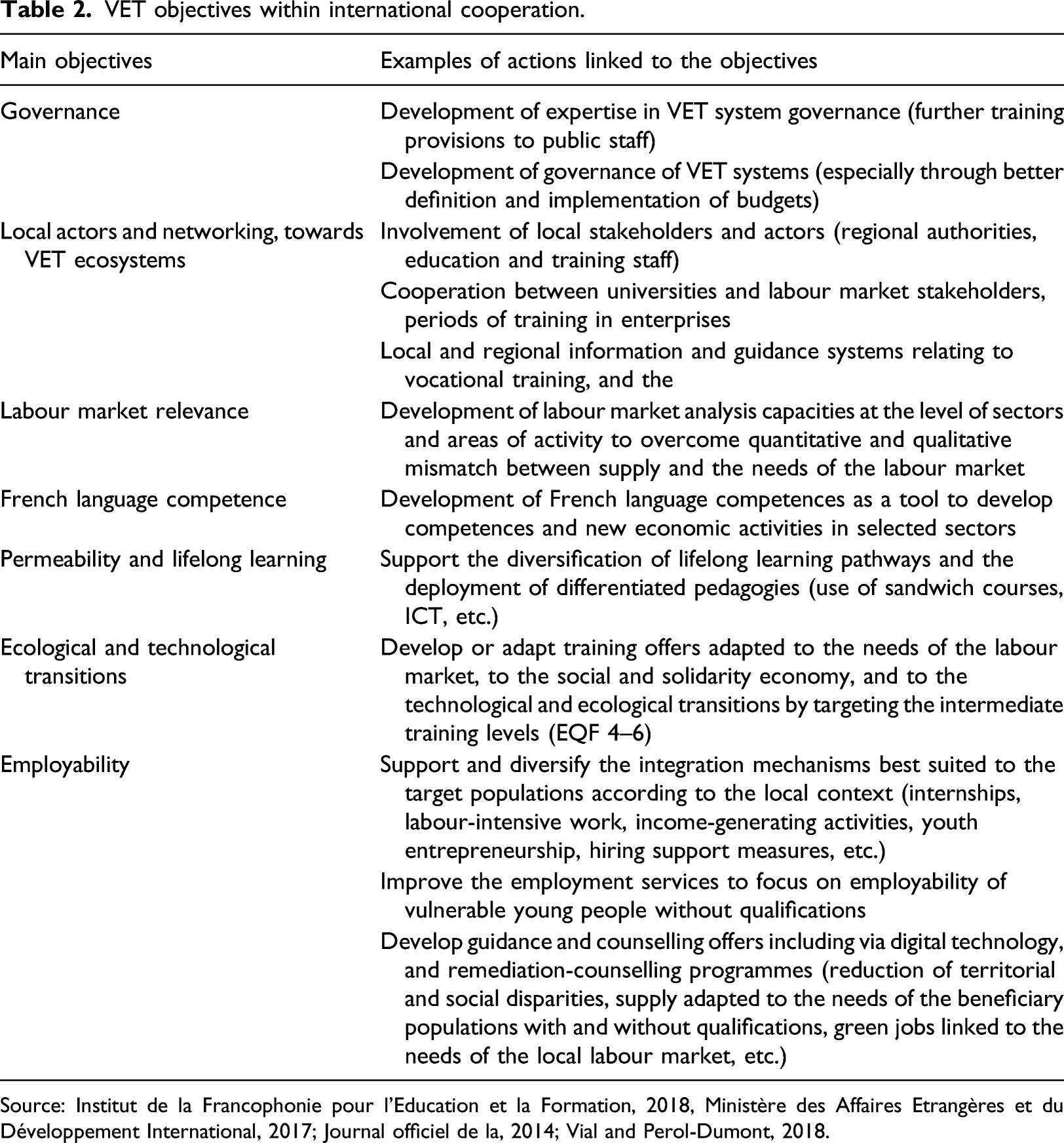
All of these principles are driven by a sense of emergency due to demographic and societal developments especially in African countries. They aim to contribute to the reduction of risks of instability and crisis in this geographical area. Furthermore, they integrate the UN development goals relating to aspects such as environmental issues. French VET cooperation builds upon the proximity of the French education and training system to those of other countries, particularly in the Francophone area. This concerns in particular the development of training regulations, the competence-based approach or the provision of mechanisms for recognition of prior learning. At the same time, the Education-Training-Integration strategy for the period 2017–2021 is aligned with the new international agenda and promotes an integrated vision of the education-training-integration continuum and the recognition of lifelong learning pathways in line with the aspirations of individuals and societies and the needs of the labour market. It is also obvious that the French strategy is following a lifelong approach, VET being part of lifelong learning. Many French actors are working on the development of literacy as a stepping-stone for lifelong learning. Since VET in France is also offered at higher qualification levels (levels 6–8 of the European Qualifications Framework), the agendas of vocational training in the cooperation projects cover the whole of the education and training continuum. To some extent, the publications by the Ministry for Foreign Affairs also testify to a centralised approach as follows: ‘The growing involvement of private actors presents various forms, opportunities and challenges. Whether this involves the development of private education offers (community, low-cost or high-end schools) or public-private partnerships (sectoral training centres including companies and/or professional branches), it implies an increased strengthening of the States’ regulatory capacities’ (Ministère des Affaires Etrangères et du Développement International, 2017).
Concluding remarks
This article reviewed the development of French international cooperation from the perspective of actors and institutions at large and from the viewpoint of cooperation in the field of vocational education and training in particular. It places the main emphasis on ideas and discourses as change agents within the institutional and organisation set-up. Manifold actors are elaborating ideas and discourses as presented in this article. The discursive institutionalism approach enabled the identification of both the explanatory value (rationales for intended changes) and declarative value (intentions) of ideas and discourses. The selection of rationales depends to a great degree on how institutions function (rational choice) and on what they wish to preserve (path-dependency). Discourse can also deploy unintended changes: calling on public-private partnership in the frame of international cooperation for instance can lead to an increase in private organisations being involved and to a lessening of public control or agenda-setting power, an unintended change which is mentioned in the documents on manifold occasions and results in controversies between the actors. These internal contradictory arguments are documented in the reports and articles (Berville, 2018; Rigaud, 2012; Vial and Perol-Dumont, 2018).
This study relies on the publicly accessible document and should be taken forward with interviews with the main actors to provide checks and balances with regard to the extent to which the past and actual preferences of actors have shaped the institutional path development and how the negotiations were carried out. The core of the communicative interaction could be partially rebuilt by analysing the documents. However, oppositional ideas, as possibly expressed within negotiations, were not documented there. Referring to a few available researcher publications enabled some insights to be gained into the difficulties of developing ideas and orientating actors. The dynamics of institutions should be further grounded to identify the endogenous processes underpinning the background ideational abilities and the foreground discursive abilities of institutions (Schmidt 2010: 1, 5). This study tended to focus mainly on the foreground discursive abilities of the main actors.
The analysis enables identification of the development and changes in ideas and concepts underlying international VET cooperation. After being strongly related to the French cooperation sphere as defined in the last decade of colonialism, international VET cooperation emancipated itself from this frame to include more specific rationales linked to development at large, thus modifying the normative orientations of actors. The initially strong rationale linked to the francophone area as explanatory paradigm is fading away, and this has partially led to the initiation of institutional reforms. It would be interesting to analyse to which degree the changes at the level of content of ideas actually affect the institutional set-up. It can be asserted that the changes in the national governance of international cooperation and international VET cooperation in France indicate a higher concentration of decisional power to a few organisations with executive tasks devolved to regional and private organisations, which could be identified as the ‘centre of policy construction’ (Schmidt, 2008). In the present case, ideas fulfil a strong strategic and framework setting functions, leading to the emergence of new actors or, as in the case of AFD, to a change in its organisational remits. The discourse development is strongly linked to what may be termed a cascading system of decision-making or a hierarchical coordination challenged by a changing environment, financial restraints and the multiplicity of actors (not only international or European organisations but also non-for-profit or private organisations). Actors at a lower level of decision and implementation have little to no ideational power; they are required to adapt and have not always internalised the required changes.
The French government, as the main actor in the policy decision-making process, is keeping and strengthening its coordinative discourse. At the same time, it finds itself under pressure from European and international developments. Back in 2008, Balleix mentioned that: ‘The “national prism” of French development cooperation policy continues to resist the pressures of Europeanisation. It is true that the conclusions adopted by the EU Council have a political rather than a legally binding value. Above all, France considers that it has a specific role to play in promoting a more generous vision of globalisation and in defending themes such as cultural diversity, which are less supported by the EU’ (Balleix, 2010: 103). It seems that the French government is expanding its own prism of international cooperation. This prism was specified as follows by Crespy and Schmidt (2014): ‘French “statist liberalism” is rooted in a republican conception of the state making it responsible for society’s welfare and economic modernisation hence geared towards macro-economic intervention' (Crespy and Schmidt, 2014: 11). It would be worth analysing the development to the French strategy and institutional changes in that context from a discursive institutionalist approach in order to elucidate which discourse is more powerful: the search for coherence between national policies or the development co-operation policy. This question is a matter of how far the ‘French leaders justified the reconfiguration of interests by invoking frames that resonate within the respective national cultures’ as analysed by Crespy and Schmidt (2014: 11) in the context of the European economic crisis. Discursive institutionalism focuses on ideas as catalysts for changes, a change that concerns ideas themselves as well as institutions. It does not, however, include the evaluation of the changes or include a feedback loop on how and whether changes have actually taken place. Neither was this the objective of this article. This research question would, however, be worth analysing with a mix of institutionalism theories to find out how far rational choice, historical or sociological institutionalism provide the answers.
The French institutional set-up for international cooperation at large and in the field of VET in particular underwent a series of reforms, some of which were directly initiated by the respective governments in place. The priorities of its cooperation are strongly influenced by its history and specific links to French-speaking countries worldwide. The changes aimed and still aim to improve the financial efficiency of the allocated budgets, to combine national actions with those happening within the European or international sphere and to pool the technical competences of the different actors. The German model of organisation features the KfW bank on one side as a provider of financial means and the German Corporation for International Cooperation (GIZ) on the other as a provider of technical expertise. It acts as a model to copy and adapt to the French context. The striving for a more concerted approach has not ended with the latest reforms. Some observers still mention a parcelled approach and competition between actors. The issue of VET international cooperation is mostly inscribed in the objectives for societal and economic improvements in the targeted countries. In recent years, equity or sustainability have been leading principles for intervention abroad. An assessment of the financial means at disposal for VET international cooperation is difficult to carry out due to the devolution of competences between the different actors. One specificity of the French international cooperation set-up remains the significance of the Francophone area and the different actors relevant to that field.
The development path of the French international cooperation in the field of VET can be best traced if consideration is accorded to the different phases of the French VET policies. However, VET policies do not merely depend upon education and training matters. They are also influenced by labour market policies or by the different reforms in the administrative set-up of institutions. Important institutions changes such as decentralisation (the devolution of competences to regional authorities) also impact on the definition and mission statement of national VET cooperation. This piece of research should be taken forward in two regards: analysis of institutional change from the perspective of path-dependency and historical institutionalism, and secondly by means of a comparative perspective with the focus on competition between Germany and France.
Endnotes
(1) There are no clear indications of the budget allocated to VET in the documents reviewed for this article. However, the OECD figure provides a useful pointer. (2) This framework includes the 2030 Agenda for Sustainable Development and its 17 sustainable development goals adopted by the United Nations in September 2015, the Paris Climate Agreement signed in 2015; a new financial framework with transparency rules and an increased involvement of non-state actors as well as an increased need for financial support in the humanitarian sector (Berville, 2018).
Footnotes
Declaration of conflicting interests
The author(s) declared no potential conflicts of interest with respect to the research, authorship, and/or publication of this article.
Funding
The author(s) received no financial support for the research, authorship, and/or publication of this article.
Note
Author biographies
Since 2012, Isabelle Le Mouillour is head of area “International VET Comparison, Research and Monitoring” at the Federal Institute for Vocational Education and Training (BIBB; Germany). Her comparative R&D interests are European VET policy topics such as lifelong learning, in-company training and apprenticeship, governance of VET systems as well as education policy learning/borrowing. She is involved in European R&D projects for the development of dual apprenticeship approach and VET standards. She has extensive experience as an advisor to different VET stakeholders in Europe and beyond.