



Abstract
Against the backdrop of an increasingly interconnected world as well as the growing role of inter- and supranational organizations, policy transfer has become a widespread phenomenon, not least in the realm of education. While policy transfer research has focused predominantly on isolated education sectors, less is known about the overall institutional conditions that favour or inhibit policy movement in different education sectors. We argue that the conditions for cross-border policy synthesis, as a central form of policy transfer, differ systematically between the two main education sectors preparing for labour market entry, namely higher education (HE) and vocational education and training (VET). Taking the case of the cross-border region of France, Germany and Switzerland as an example, the institutional analysis shows that demand-side, programmatic, contextual and application conditions are more favourable towards cross-border policy synthesis in HE than VET.
Keywords
Introduction: Policy transfer in higher education and vocational training
Against the backdrop of an increasingly interconnected world, the growing role of inter- and supranational organizations and rising competition within the global knowledge economy, policy transfer has become a widespread phenomenon, not least in the realm of education (Steiner–Khamsi, 2014). While education policy research has focused predominantly on isolated transfer cases (Phillips and Ochs, 2003; Steiner–Khamsi, 2016), less is known about the overall institutional conditions that favour or inhibit cross-border transfer in different education sectors. This is striking, as one may reasonably expect that the institutional and organizational characteristics of different education sectors systematically shape such processes of transfer and cooperation. While there is relevant literature on the conditions for policy transfer in specific education sectors (e.g. Waldow et al., 2014), we still lack a comprehensive understanding of these conditions from a cross-sectoral comparative perspective.
In this context, we argue that the conditions for policy transfer and the international cooperation to support that end differ markedly between the two main education sectors preparing for labour market entry, namely higher education (HE) and vocational education and training (VET), due to distinct institutional and organizational characteristics of the respective sectors. We ask: What distinguishes the respective patterns of policy transfer in these two education sectors and how can these differences be explained? To answer these questions empirically, we analyse cross-border transfer, and the cross-border cooperation necessary to that end, in the trinational Upper Rhine region, in which there is a long tradition of learning and cooperation between the neighbouring regions in France (Alsace), Germany (Baden) and Switzerland (several cantons in Northwestern Switzerland) (Walther and Reitel, 2013). This region is characterized by historical, cultural and linguistic proximity (Wassenberg, 2008), as well as a shared focus on the chemical, pharmaceutical and life sciences industries (Streckeisen, 2010). In addition, Europeanization policies, including HE and VET harmonization efforts via the Bologna and Copenhagen processes (Powell et al., 2012), have promoted cross-border integration. Given these favourable context conditions, one would expect considerable policy transfer and cooperation activities across French, German and Swiss borders in both HE and VET sectors. However, despite long-standing bottom-up historical, cultural and economic ties, as well as top-down Europeanization policies, we find very limited policy transfer and cross-border cooperation in VET. In contrast, in the case of HE, we observe manifold transfer and cooperation activities.
The main illustrations of this sectoral discrepancy are EUCOR – The European Campus in the case of HE and the EUREGIO Certificate in the case VET. In the case of EUCOR (HE), we find that the five major universities in the cross-border region collaborate extensively to jointly create new institutional and organizational structures, based, for instance, on the exchange of prior experiences and best practices. The HE sector is thus associated with significant policy transfer activities in the form of policy synthesis. The EUREGIO Certificate (VET), on the other hand, mainly enables international mobility of apprentices based on rather low-key cooperation of the involved stakeholders. It does not significantly influence VET training structures in either of the three involved regions beyond the integration of individual mobility periods, requiring a limited extent of coordination and information exchange. This finding points towards a case of limited cross-border cooperation and policy synthesis. Based on expert interviews, systematic document analysis and a review of the limited available secondary literature, our comparative analysis shows that these differences are grounded in general institutional and organizational features of HE and VET sectors, including specific demand-side, programmatic, contextual and application constraints (Benson, 2009), which shape the respective patterns of policy transfer and cooperation between the three involved regions.
We next outline our analytical framework of factors which constrain or enable transferability and international cooperation. Subsequently, we present our case selection, methods and data. This is followed by a presentation of the two main policy cases – namely, EUCOR and the EUREGIO Certificate – and our in-depth empirical analysis of the factors facilitating and limiting policy transfer in the form of policy synthesis in the two cases and beyond. We then turn to a discussion of our findings and develop avenues for further research. The paper concludes with a reflection on the implications of such sector-specific features for the study of transfer processes and international cooperation in education and training more generally.
Analytical framework: Policy transfer and factors constraining or facilitating transferability
Policy transfer has become an increasingly important and more intensively researched phenomenon in education policy in recent years (Benson and Jordan, 2011; Steiner–Khamsi, 2016). The reasons for its rising prevalence are manifold. They include intensified globalisation, worldwide communication and knowledge production, growing internationalisation of national education sectors and individual organisations, as well as an expanding influence of international and supranational actors such as the Organisation for Economic Cooperation and Development (OECD) or the European Union (EU) (Bieber and Martens, 2011; Lange and Alexiadou, 2010). In the following, we conceptualize policy transfer and present an analytical framework, which will guide our analysis of policy transfer conditions in the sectors of HE and VET.
Many disciplines, such as educational sciences, public policy, comparative political sciences and sociology are concerned with the way policies in one jurisdiction affect those in another. This has led to the existence of a range of terms, including ‘policy borrowing’, ‘institutional isomorphism’, ‘policy diffusion’, ‘lesson drawing’ or ‘policy transfer’, which denote the same core principle, albeit with different theoretical and analytical perspectives as well as metaphorical foci (Marsh and Sharman, 2009). The term ‘policy borrowing’ is frequently used in educational sciences (Steiner–Khamsi and Waldow, 2012) and is connected, for instance, to the analysis of factors that turn a certain policy into a reference case for educational reform (Waldow et al., 2014). ‘Institutional isomorphism’ originated in sociological neo-institutionalism and is concerned with the coercive, mimetic and normative pressures that lead to similar characteristics of and practices among organizations (DiMaggio and Powell, 1983). ‘Policy diffusion’ places an emphasis on structure and pattern-finding, while ‘policy transfer’ is predominantly concerned with agency and process tracing (Marsh and Sharman, 2009). ‘Lesson drawing’ focuses on policy makers’ voluntary deliberations and solution seeking when faced with domestic problems (Rose, 1991). The use of these sometimes vaguely defined terms is not without controversy (Li and Pilz, 2021). In our analysis of conditions that lead HE and VET actors to favour or reject the adoption of policies already implemented elsewhere, we focus on ‘policy transfer’ as it is conceptualized in the interdisciplinary public policy literature (Dolowitz and Marsh, 1996; Rose, 1991). In their seminal definition, Dolowitz and Marsh (2000: 5) describe policy transfer as a ‘process in which knowledge about policies, administrative arrangements, institutions and ideas in one political setting (past or present) is used in the development of policies, administrative arrangements, institutions and ideas in another political setting'.
Marsh and Shaman (2009: 270) point out that researchers tend to implicitly conceive of policy transfer as ‘a process of interdependent policy convergence’ (emphasis added) rather than assuming a more open conceptualization, which could also include the deliberate rejection of a negative policy example and, therefore, non-transfer. Moreover, policy transfer research in different disciplines has predominantly focused on isolated cases of successful policy transfer, which potentially leads to the logical fallacy of only considering idiosyncratic empirically manifest cases, thereby risking ‘a shortfall in our understanding of the agonist, antagonist inputs to the policy cycle that prompt, or do not, policy transfer processes’ (Legrand, 2021: 24). In this paper, we aim to contribute to the literature by systematically examining two policy sectors, namely HE and VET, and shedding light on conditions that both favour or inhibit policy transfer.
Dolowitz and Marsh (2000: 9) further identify the types of actors typically engaged in policy transfer. These include elected officials, bureaucrats, civil servants, pressure groups, political parties, policy entrepreneurs/experts, consultants, think tanks, transnational corporations and transnational organizations. Transfer can be initiated voluntarily or in response to a more or less coercive policy environment (Dolowitz and Marsh, 2000: 9). In the case of the EU, for instance, it can be difficult to discern to what extent member countries voluntarily choose to harmonize policies given influential soft governance mechanisms. This holds particularly true for the domain of education (Lawn, 2006). Dolowitz and Marsh (2000) therefore distinguish between voluntary lesson drawing on the one and coercive transfer on the other end of the policy transfer continuum. Voluntary transfer that is perceived as a necessity, for instance to gain or maintain international acceptance, is located in the middle of the voluntary-coercive continuum (Dolowitz and Marsh, 2000: 13).
Policy transfer can take different forms (Dolowitz and Marsh, 2000: 13). While copying denotes a direct and complete policy transfer from one jurisdiction to another, emulation concerns the transfer of underlying policy ideas. Inspiration means that a policy existing elsewhere serves as inspiration, with the newly implemented policy looking different than the original one. Policy combinations build on a mixture of various different policies. Rose (1991: 22), whose typology of lesson drawing served as a basis for Dolowitz and Marsh’s policy transfer categorization (2000), further divides policy combinations into two subtypes, namely hybridization and synthesis. While hybridization denotes the combination of programme elements from two different places, policy synthesis takes place through a combination of programme elements in effect in three or more different places. Rose (1991: 22) contends that policy synthesis is justifiable especially in cases in which the goal of lesson drawing is to design an effective new programme. We argue that our empirical case of the trinational Upper Rhine region, where new cross-border programmes are being developed on the basis of voluntary lesson-drawing, can best be described with the concept of policy synthesis. Concretely, this refers to cross-border institutional or organizational arrangements – and, more specifically, cross-border programmes – that represent cross-national lesson-drawing in combining elements from either HE or VET programmes in France, Germany and Switzerland to create new joint cross-border programmes.
Policy synthesis requires cross-border cooperation between the respective stakeholders. Of course, the intensity of such cooperation and, hence, the intensity of policy synthesis itself can vary. We operationalize the different degrees of policy synthesis by referring to a cooperation gradation model developed by Emmenegger et al. (2019: 32–33) in the context of regions without a clear political centre, where educational governance builds on voluntary cooperation: The most basic cooperation level is information exchange, implying that the involved stakeholders create and share information that is not publicly available but that is necessary for – in our case – policy synthesis to work across borders. Information exchange is the foundation for deliberations on further action, for instance, in relevant expert commissions. The next level is coordination, meaning that the involved actors adjust their behaviour based on the exchanged information. Coordination is thus associated with the mutual adjustment of behaviour to align complex structures and activities. The highest level of cooperation is collaboration, implying that the involved actors work together to jointly develop a specific policy or programme to create a mutual benefit. Thus, drawing on the cooperation typology by Emmenegger et al. (2019), we distinguish between three increasing levels of cross-border policy synthesis, referring to policy synthesis building on (1) information exchange only, (2) information exchange and coordination or (3) collaboration involving information exchange, coordination and joint action.
Factors affecting policy transferability.
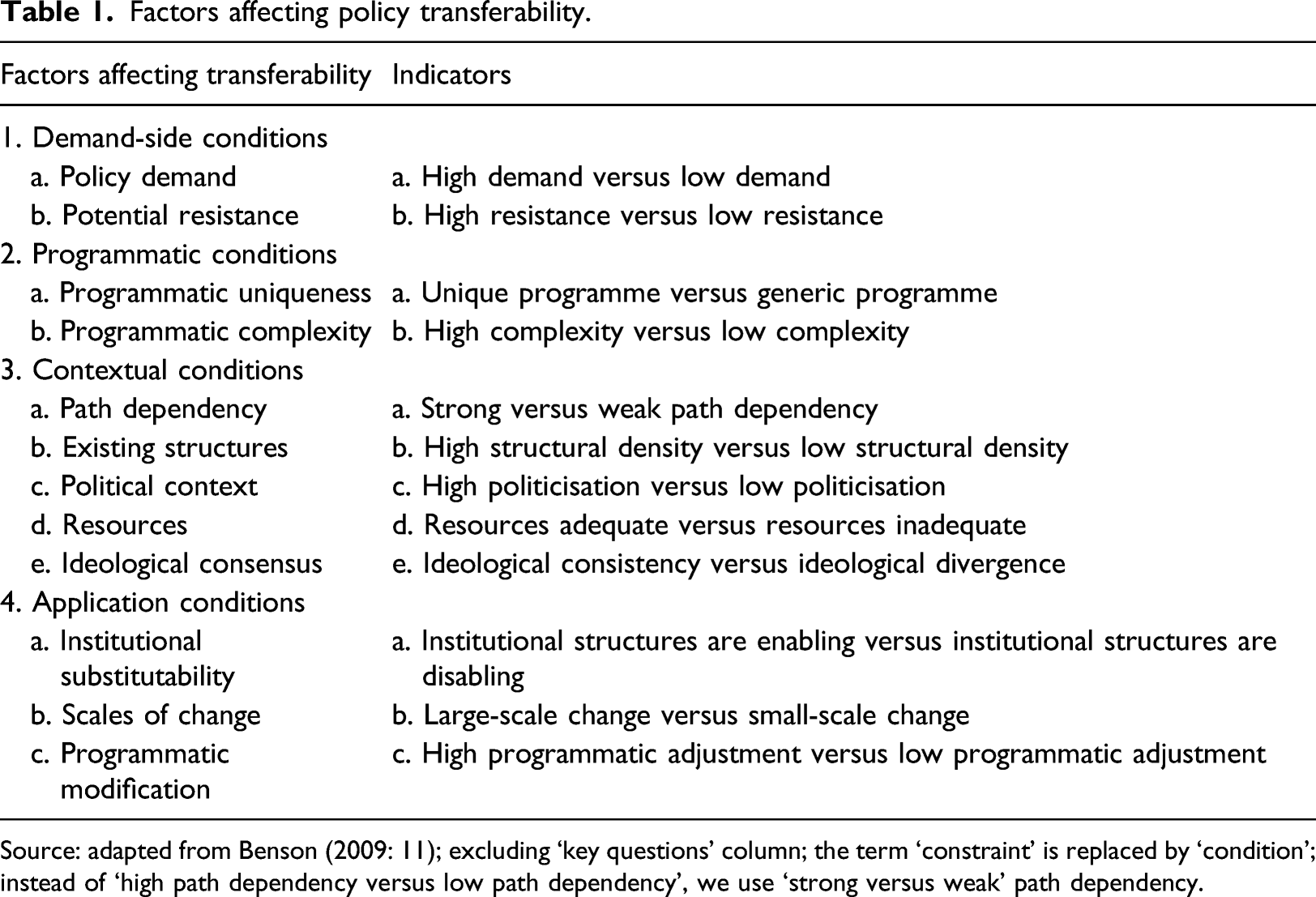
Source: adapted from Benson (2009: 11); excluding ‘key questions’ column; the term ‘constraint’ is replaced by ‘condition’; instead of ‘high path dependency versus low path dependency’, we use ‘strong versus weak’ path dependency.
Demand-side conditions
Policy demand (1a) is shaped by windows of opportunity, which are often created by policy failure or political or economic crises. In Germany, for instance, the ‘PISA shock’ sparked by a poor student performance in the 2000 PISA study was leveraged by policymakers to legitimize the transfer of educational standards and standardized assessments that had been promoted by the OECD (Sill, 2006). Policy demand is also contingent on decision makers’ bounded rationality with regards to policy evaluation and assessment of transferability (Legrand, 2021; Marsh and Sharman, 2009). For example, Mayer (2001) delineates how the failure to adequately assess private firms’ willingness to participate in VET arrangements often hindered the transfer of the German VET system to countries in the Global South. Potential resistance (1b) to policy transfer can arise when key stakeholders’ interests are threatened or when the overall political culture is not open towards the adoption of foreign policies or international cooperation. For instance, in the case of post-communist reconstruction of Kosovan HE, policy transfer from British HE was met with resistance due to local actors fearing a loss of power, and a rejection of external influences still rooted in the political culture of the communist era (Bache and Taylor, 2003).
Programmatic conditions
Programmatic conditions concern, first, the uniqueness of the policy or programme (2a). A programme that is too idiosyncratic in terms of its political, legal and cultural characteristics will likely not translate well into another context. As an example, after Finland’s top performance in the 2000 PISA study, many countries sought to copy its education policies such as comprehensive schooling. Yet, Sahlberg (2012: 185) points out that culture-specific ‘invisible factors’ behind the policies pertaining to, for instance, social values or teacher trust make it hard to replicate Finnish education elsewhere. Second, high programmatic complexity (2b) also constrains transfer possibilities and success. A policy can be characterized as complex if it comprises multiple causes and goals, an unclear empirical focus, substantive externalities, and if it is unfamiliar and unpredictable (Rose, 1993).
Contextual conditions
Path dependency (3a) represents an important contextual condition in the receiving jurisdiction. It refers to ‘historical sequences in which contingent events set into motion institutional patterns or event chains that have deterministic properties’ (Mahoney, 2000). Historical institutionalists have made significant progress in understanding how various forms of institutional change are possible despite path dependencies and in the absence of critical junctures (Thelen, 2004). Path dependencies are crucial in explaining the response of VET systems to ongoing Europeanization and academization processes (Graf, 2015). 1 In the realm of HE, path dependencies resulted in the domestication of Bologna reform policies in countries such as Norway and Germany (Kehm et al., 2010). A high density of existing political and institutional structures (3b) in the receiving context also makes policy transfer unlikely (Dolowitz and Marsh, 1996). Political and institutional structures tie into the larger political context (3c) made up of a variety of actors and interest groups. Benson (2009: 9) observes that ‘politically uncontroversial or inert issues are more amenable to transfer practices’ given a smaller likelihood of actor resistance. A striking example of this is the HE tuition fee debate in Germany. Due to changing party coalitions and political risk aversion, tuition fees – which are common, for instance, in Anglophone countries – were quickly abolished after their introduction, and are now an avoided topic during German election campaigns (Hüther and Krücken, 2014). Moreover, the available funds, laws and public administration capacity, in short, the resources (3d) needed in the policy-receiving context are of crucial importance. The ideological consensus (3e) between the involved jurisdictions matters, too. The latter pertains to political and cultural values, for instance, when it comes to the institutionalized perception of education as a public or a private good (Marginson, 2011).
Application conditions
Lastly, application conditions comprise institutional substitutability (4a). Policy transfer might require alterations of the importer’s institutional structures. This restructuring is often not feasible due to high transaction costs. The same goes for policy transfer requiring a large scale of change (4b) in the receiving context. These two constraints appear, for instance, when it comes to transferring the renowned German VET system with its multi-actor governance elsewhere (e.g. on German VET model transfer to China, see Barabasch et al., 2009; on transfer to Brazil and France, Graf et al., 2014). Policy programmes might also need to be adapted for implementation in another national context. This programmatic modification (4c) could potentially change the initial goals and scope of the intended transfer, rendering the successful transfer of the original model less likely.
Operationalization of central indicators
The different conditions outlined above are sometimes interdependent and cannot always be clearly distinguished from each other. For instance, in the case of (1) demand-side conditions, high policy demand is likely associated with a low resistance on the part of involved stakeholders. When it comes to (2) programmatic conditions, we can reasonably expect that a very unique programme is of higher complexity than a frequently implemented one. In terms of (3) contextual conditions, path dependencies can be closely related to existing policy structures, the overall political context, available resources and the ideological consensus or divergence concerning a certain policy. Lastly, when it comes to (4) application conditions, the required programmatic modifications may relate to both the scale of change and the overall institutional substitutability of policy structures. Due to the sometimes overlapping boundaries of these analytical subdimensions as well as space constraints, we primarily focus our analysis on what we consider the respective central indicator for each category of policy conditions as just described: policy demand (for demand-side conditions), programmatic uniqueness (for programmatic conditions), path dependencies (for contextual conditions) and programmatic modification (for application conditions). Furthermore, in our analysis we combine ‘global’ conditions that generally apply to a specific education sector (HE or VET) with ‘local’ conditions that apply more specifically to the respective education sector within the region under consideration.
Case selection, methods and data
In our case study, we focus on a region that lends itself particularly well to a systematic analysis of policy transfer conditions and related projects of international cooperation: The French-German-Swiss Upper Rhine region (FGS region). Located at the centre of Western Europe, the FGS Upper Rhine is a trinational metropolitan region known especially for its highly productive pharmaceutical, chemical and life science industries (Walther and Reitel, 2013). The region comprises Northwestern Switzerland (cantons Basel-City, Basel-Country, Aargau and Solothurn), Baden in Germany and Alsace in France. Each of the three bordering countries is shaped by specific governance modes, both in terms of their respective national model of capitalism and their skill formation system. Germany is typically seen as an example of a coordinated market economy (Hall and Soskice, 2001). The Swiss model represents a hybrid model, as it combines coordinated elements (e.g. strong role of employers’ associations in labour markets and skill formation) and liberal elements (e.g. relatively weak unions and flexible labour market arrangements) (Mach and Trampusch, 2011). France represents a case of state-led capitalism (Amable, 2003) based on a dirigist regime (Hall and Soskice, 2001: 21, 35).
The FGS region is home to around 6.2 million people and 97,000 cross-border commuters (Oberrheinkonferenz, 2020). This substantive cross-border human capital flow is facilitated by a low language barrier between the neighbouring areas: The Upper Rhine region connects German-speaking Baden, German-speaking Swiss cantons, and Alsace, where a traditional Germanic dialect has prevailed alongside the official French language (Wassenberg, 2008). Long before the European Union (EU) started promoting cross-border integration, various public and private actors in the FGS region, including civil society, started bottom-up initiatives for cross-border collaboration. These were first formalized in 1963 with the Regio Basilensis network (Reitel, 2006). Today, several cross-border governance agencies exist (Muller et al., 2017). They have been successful in fostering exchange of best practices across borders (Interview 8). The most influential of these intermediary organizations are the Franco-German-Swiss Upper Rhine-Conference, Regio Basiliensis, the Interreg Oberrhein, and EURES-Transfrontalier (EURES-T) whose activities are often sponsored by regional and European authorities. They have promoted the cross-national integration of both HE and VET sectors via the Bologna process (since 1999) and Copenhagen process (since 2002) more generally, and through targeted cross-border cooperation funding in the FGS region more specifically (e.g. Interreg, 2021).
We contend that the cross-border region of France, Germany and Switzerland is a very interesting case for the systematic study of cross-border transfer and cooperation in HE and VET sectors. On the one hand, we find significant differences in the way HE and VET are institutionalized in the respective countries (see below). On the other hand, the shared cross-border context and ongoing Europeanization initiatives should enhance cross-border transfer and cooperation in HE and VET especially as both sectors are central to the regional cross-border knowledge economy. Given that several conditions hold equally for HE and VET in this region – for instance, regarding the dominant industrial sector – it is a context in which we should be able to isolate key factors that explain the difference in outcomes for HE and VET in terms of cross-border transfer and cooperation. General mechanisms that we identify in this process should be transferable not only to other comparable cross-border regions in Europe – where there are at least 57 such official cross-border regions (European Commission, 2021a) – but it should also be possible to draw lessons regarding systematic differences in transfer processes in HE and VET in the context of voluntary transfer processes in advanced economies more generally. 2
We base our comparative institutional analysis on a review of the available secondary literature, document analysis as well as expert interviews. Ten semi-structured interviews were conducted between November 2016 and July 2018 with expert practitioners from both public and private sectors working in the FGS region, including key representatives of educational organizations, businesses, unions, cross-border intermediary organizations, and local politicians with first-hand experience of cross-border activities. 3 The interviews followed a guideline informed by key concepts derived from the presented theoretical framework, such as conditions for policy transfer in education and training. The interview data was analysed in view of the approach proposed by Meuser and Nagel (2005). This included coding (ordering of thematic passages), thematic comparison (clustering of similar passages from all interviews), sociological conceptualization (scientific abstraction from original interview) and theoretical conceptualization (presentation of findings from a theoretically-informed point of view). The interviews took place either in the form of personal meetings or via phone and lasted on average 50 minutes.
Policy transfer and international cooperation in the French-German-Swiss Upper Rhine region
In this section, we first present the overall characteristics of HE and VET systems in France, Germany and Switzerland. Then we introduce our core cases of analysis; the EUCOR Campus and the EUREGIO Certificate, which we identify as the most advanced forms of cross-border policy synthesis in HE and VET, respectively. We subsequently apply our theoretical framework to analyse enabling and restraining policy transfer conditions in HE and VET.
Introduction to HE and VET in France, Germany and Switzerland
Despite a growing market orientation and the adoption of New Public Management approaches, Germany’s HE system remains anchored in its tradition of academic self-governance paired with financial state-control, as well as a unity of teaching and research (Hüther and Krücken, 2016). HE organizations can be divided into full research universities, technical universities and universities of applied sciences, with additional research taking place at non-university research institutes (Dusdal et al., 2020). France’s HE system was long marked by relatively high state-control and a strong separation between teaching- and research-focussed HE organizations. Over the last two decades, substantive reforms have led to a reorganisation of the French HE system, which now consists of full research universities, grandes écoles and national research institutes. Still, it remains a HE system where the state plays a dominant role in steering key HE actors (Musselin, 2017). The Swiss HE system is more similar to the German than to the French one. For instance, universities and universities of applied sciences are mainly regulated and financed by the regions (cantons) in which they are located. However, unlike Germany, Switzerland has two federal universities. As Switzerland is not a member of the EU, it tends to be more selective in terms of the European educational policies it adopts (Bieber, 2010). While the French, German and Swiss HE systems are marked by different university types and governance patterns, all three countries follow the same study cycles (BA, MA and Ph.D.) and credit transfer system since the Bologna reform.
In line with the varieties of capitalism mentioned earlier, the governance of VET differs in these three neighbouring countries. In Germany and Switzerland, there is a strong tradition of collectively governed dual apprenticeship training (Busemeyer and Trampusch, 2012). This implies that VET typically takes place in at least two locations, namely the vocational school and the firm. In Switzerland, inter-company training also plays an important role. It is offered at a joint training site, the third place of learning. A significant difference between the two collective VET systems is that Germany represents a social and Switzerland a liberal collective skill formation system (Emmenegger et al., 2020): In Germany, the role of unions is stronger than in Switzerland. While in Switzerland, we find a diversified landscape of hybrid organizations of the world of work that play a key role in the governance of apprenticeship training, the responsible German chambers are less fragmented and build on compulsory membership (Emmenegger et al., 2020). The French VET system, on the other hand, is – despite several recent reforms (Bernhard, 2017) – still primarily based on full-time school-based VET and far more centralized (Bosch and Charest 2008). While the three countries’ VET systems show distinct characteristics, also regarding their governance structures (Bernhard, 2017; Rauner, 2009), the EU’s Copenhagen Process (2002) has promoted European cooperation through a unitary framework of VET qualifications and a common system of VET transfer credits (Powell et al., 2012).
The configuration of HE and VET in the three neighbouring countries, marked by specific country patterns on the one hand, and shared Europeanization frameworks on the other, makes the trinational Upper Rhine region a particularly interesting case for our study of policy transfer and cooperation.
The core cases of policy transfer and cooperation in the Upper Rhine region
In our empirical analysis, we focus on two policies which represent the most advanced and comprehensive forms of cross-border policy synthesis in HE and VET, respectively. This refers to the EUCOR Campus in the case of HE and the EUREGIO Certificate in the case of VET.
EUCOR – The European Campus in higher education
‘EUCOR – The European Campus’ is a trinational university alliance consisting of five universities in the Upper Rhine region: the Universities of Basel, Freiburg im Breisgau, Haute-Alsace, and Strasbourg, and the Karlsruhe Institute of Technology. All universities place a particular focus on science and technology. The alliance unites more than 117,000 students, 15,000 researchers, 13,500 Ph.D. candidates and has a combined budget of 2.3 billion euros (EUCOR, 2021a). EUCOR allows students from all member universities to enrol in courses across the entire European Campus. Moreover, students can benefit from travelling allowances, such as public transportation tickets (EUCOR, 2021b), and the respective student services, including, for instance, athletic facilities, at any other member university at no additional cost. EUCOR also promotes joint research institutes, infrastructure and projects; seed funding for research collaborations, joint professorships, joint administrative personnel and service departments, as well as joint student-, PhD-, postdoc cluster- and degree programs (EUCOR, 2021c).
At the core of EUCOR activities are 14 innovative bi- or trinational study programmes, offered at both undergraduate and graduate levels, whose curricula place a much more pronounced focus on international experiences than comparable study programmes in the respective national contexts. Such jointly offered programmes include the double degree programme BSc Regio Chimica or the trinational MA in Classical and Ancient Studies (EUCOR, 2021d). Typically, as part of such closely co-coordinated double, triple or joint degree programmes, students spend part of their studies or internship phases abroad in one or both other subnational parts of the FGS region. In many cases, students receive degrees from all involved HE institutions (i.e. from two or three countries). In total, there are around 50 study programmes, initiatives and support infrastructure projects in the domain of bi- and trinational study programs in the FGS region (Oberrheinkonferenz, 2013).
The EUCOR network was first established in 1989, one year before the European Union began promoting and funding territorial cross-border cooperation through the INTERREG program. In 2007, the INTERREG Upper Rhine programme, at the time in its fourth funding cycle, made educational integration as well cross-border research and innovation key priorities of action. This led to a further intensification of policy transfer activities, for instance via the creation of the already mentioned double degree programme ‘Regio Chimica’ leading to a BSc in chemistry (Interreg Oberrein, 2014). Since 2015, the campus has a common legal entity in the form of a European Grouping of Territorial Cooperation (EGTC). It is the first EGTC exclusively run by universities (EUCOR, 2021e). The EGTC is a separate legal personality offering a uniform structural framework as well as uniformity of the applicable law. Through its legal standing, EUCOR may possess property, and submit funding proposals as an autonomous entity in France, Germany, Switzerland, as well as at the European level (European Commission, 2021b).
Compared to other strategic university networks, EUCOR can be characterized by a deep legal integration, as well as advanced cross-border governance regarding joint decision making, research and educational provision. We find that EUCOR is a case of substantive cross-border policy synthesis (see below) resulting from initial bottom-up local initiatives and intensifying top-down Europeanization processes. EUCOR features extensive cross-border collaboration based on the exchange of experience and best practices of all involved partners. It has a substantial impact on the HE structures in the three regions.
The EUREGIO Certificate in vocational education and training
At the Upper Rhine, the most advanced form of cross-border policy synthesis in the field of VET is the EUREGIO Certificate specifically created for this region in 1992 by local actors (EUREGIO, 2021a). This certificate supports work experiences abroad, targeting apprentices but also students in full-time vocational schools. For 4 weeks or longer, apprentices go abroad to obtain work experience in a firm within the FGS region – usually during their holidays, as it tends to be difficult to integrate the work abroad phase into the regular curriculum (Interviews 1, 2, 3 and 7). From its inception, the EUREGIO Certificate has received strong support from the Franco-German-Swiss Conference of the Upper Rhine (Lezzi, 2000) and continues to be overseen by it. Further actors involved include regional public governance organizations but also German and French chambers of industry and commerce. The certificate does not build on joint teaching staff or a joint curriculum, but ‘merely’ facilitates student exchange. In 2016, the total number of certificates granted to participants from all three countries was 382 (EUREGIO, 2021a). In 2020, 110 apprentices from the French Alsace region completed work placements in 46 German and 33 Swiss training firms (EUREGIO, 2021b). 4 Overall, the number of participants in the EUREGIO Certificate program is rather limited (Interviews 3 and 10).
The EUREGIO Certificate represents a case of limited policy synthesis. While it brings into dialogue actors from the three subnational regions, the degree to which this programme integrates respective national VET elements is rather insignificant. Moreover, as we outline below, it does not have any substantial impact on the training structures in either of the three parts of the cross-border region. It is not a case of cross-border collaboration that greatly enhances cross-border policy transfer in VET. That is, neither of the core elements of the respective systems is taken up by the VET stakeholders in the other parts of the region. While the cross-border region has seen attempts to further strengthen tools such as the EUREGIO Certificate for cross-national capacity building (Interview 10), the relevant subnational VET structures remain firmly embedded in the respective national VET systems.
Comparing conditions for policy transfer and cooperation in VET and HE in the Upper Rhine region
In the following, we analyse in depth the conditions that enable or constrain policy transfer in the form of policy synthesis in HE and VET at the example of EUCOR and EUREGIO. Following Benson’s (2009) analytical framework, we first examine the demand-side conditions in the policy-receiving contexts of HE and VET in the different regional settings. Here, we proceed from more globally applicable sectoral conditions to Upper Rhine-specific aspects. Subsequently, we consider programmatic, contextual and application conditions in HE and VET sectors.
Demand-side conditions in HE versus VET
The demand-side conditions of policy transfer concern the degree of policy demand and potential resistance in the receiving context. We first examine the respective demand-side conditions in French, German and Swiss HE, and then compare them to demand-side conditions in the sector of VET.
HE systems across the world have been marked by growing isomorphism regarding educational contents and organizational structures due to the rise of a global higher education regime (Schofer and Meyer, 2005). The latter denotes the growing importance of international organisations as HE agenda setters, and an intensified pressure of global HE integration through quality assurance and accreditation mechanisms as well as regional qualification frameworks (Zapp and Ramirez, 2019). Moreover, HE has seen the emergence of a global model of the research university. The latter describes renowned research universities, which can be characterized, inter alia, by a global mission, high research intensity and global collaboration with similar HE organizations (Baker, 2014; Mohrman et al., 2008; Powell et al., 2017). France, Germany and Switzerland have been no exception to such pressures of global isomorphism. Increasing demands for accountability and efficiency as well as uncertainties tied to the changing role of the university in the knowledge society have led HE policymakers in all three countries to remain on the lookout for potentially transferrable best practices (Bao et al., 2018; Hoareau, 2011; Probst and Lepori, 2008). The integration of an international dimension into the daily workings of HE is now a common indicator of quality in national quality assurance programmes, for example the ‘Bienvenue en France’ label introduced in 2019 (Campus France, 2021), or the German university rectors’ internationalization audit (Hochschulrektorenkonferenz, 2021). Moreover, French, German and Swiss universities are encouraged to follow the global research university model and engage in policy transfer and internationalisation activities through funding calls from both the European Union, for instance via the European Universities Initiative (Gunn, 2020), and their own national governments, for instance in the case of the excellence initiative reforms in France and Germany (Highman, 2020) or various funding schemes by the Swiss National Science Foundation (Bundesrat, 2018). The need to attract human capital, produce significant (internationally generated) research outputs, and maintain a positive reputation in a global HE market has led many HE organizations to combine forces with other organizations of equal status or geographical location (Vukasovic and Stensaker, 2018). Through EUCOR, HE stakeholders in the FGS region sought to combine material and human resources in order to create the research and innovation infrastructure associated with both the competitive global research university and a bustling cross-border metropolitan region (see EUCOR, 2017; 2021a). International cooperation and policy synthesis allow the EUCOR universities to visibly position themselves in the competitive HE landscape through a combination of their resources. We can therefore state that there is a relatively high demand for and openness towards policy transfer and international collaboration in French, German and Swiss HE sectors. This relatively high demand for policy transfer is simultaneously connected with a relatively low degree of resistance from HE stakeholders as the inherent value of internationalisation is widely acknowledged (Waldow, 2018).
In contrast, there is no equivalent globally dominant model of VET (Thelen, 2004), neither in terms of educational contents nor organizational structures. Rather, VET systems tend to remain anchored in the national variety of capitalism framework. In this context, the embeddedness of VET in the respective systems of industrial relations (Busemeyer and Trampusch, 2012) is a key explanatory factor. Compared to HE, VET is characterized by more direct involvement of employers and a higher share of private funding. This implies that employers also have a say when it comes to defining the scope for cross-border activities. On the side of training firms, we observe some resistance since harmonization of apprenticeships and integrated mobility periods are perceived as a threat to employer productivity (Interviews 1 and 2). One core challenge is that work-based training programmes are usually very densely packed, leaving little room for cross-border activities and international collaboration. As firms pay apprentices a salary, they are not always keen on sending them abroad and thereby losing productive capacities (Interviews 1 and 6). Furthermore, the different national VET and labour market legislations (Interviews 5 and 7) and corresponding curricular contents make it difficult to create integrated cross-border VET programs (Interview 6), reducing the incentive for VET stakeholders to engage in cross-border policy learning.
While employers in the cross-border region are often aware that they could benefit from the different skill sets available in the other parts of the region, they tend to prefer making use of the possibility to recruit workers with the desired skill set after these have completed their training in the respective region rather than adjusting their own training strategies and, for instance, building a cross-border VET program. For example, Swiss firms often recruit talented graduates from France and Germany for their specific skillset developed in the neighbouring VET systems (Graf, 2021). This leveraging of comparative institutional advantages of other regions (Interviews 1 and 5) is one of the major factors reducing the demand for policy synthesis. 5
Moreover, on the part of VET students, there tends to be a lower return of an international experience compared to HE students (Powell and Finger, 2013). Related to this, within the VET context of the Upper Rhine region, one can observe a ‘lack of knowledge and interest among young people for the neighbouring country and a lack of information among German employers about the material taught in the French schools’ (Knörr and Weber 2018: 75). This indicates that additional efforts would be needed to inform VET students and training firms regarding the potential advantages of cross-border collaboration. Such advantages include that mobile apprentices are likely to become active promoters of cross-border activities as they can help translate different ideas, but also knowledge about institutional and organizational factors that are shaping the different parts of the region. However, this would, in turn, require an increase in the availability of experts that can offer advice on cross-border apprenticeships (Knörr and Weber 2018). The current lack of such consultancy on the end of educational organizations points towards a limited degree to which educational organizations involved in VET themselves benefit from international network reputation relative to the more internationally oriented universities. Overall, in VET the demand for policy transfer by way of cross-border policy synthesis is more limited than in HE.
Programmatic conditions in HE versus VET
In terms of the programmatic conditions of policy transfer, we primarily concern our analysis with the uniqueness of both EUCOR and EUREGIO programmes. We first examine how EUCOR fits into common policies within HE and then analyse EUREGIO’s level of uniqueness in VET.
Universities have a long tradition of partnerships and alliance building in varying organizational forms and at different territorial scales (Gunn, 2020). While both partnerships and alliances aim at a collaborative advantage for each organization involved (Kanter, 1994), an alliance can be distinguished by the existence of a meta-organization representing involved organizations (Ahrne and Brunsson, 2005). Alliances can comprise bilateral or multilateral cooperation between universities within the same country (e.g. the British Russell Group) or across multiple countries (e.g. the Coimbra Group), with their legitimacy being based on either broad representativeness or exclusivity pertaining to prestige or geographical location. Such alliances act as interest groups and advocate their members’ interests towards other education actors, for instance EU institutions (Vukasovic and Stensaker, 2018). In recent years, a new type of university alliance has emerged; one that is closely linked to increasingly more strategic and comprehensive university internationalization efforts. These alliances are no longer merely transactional, marked by specified resource exchange, but rather transformational, changing involved organizations ‘through the generation of common goals, projects, and products’ (Sutton et al., 2012: 152). This development has found its current pinnacle in the creation of the EU-sponsored European Universities Initiative, which promotes long-term university alliances including seamless physical or virtual mobility between member universities (Gunn, 2020). The European University Initiative closely resembles ‘EUCOR – The European Campus’, which was, at the time of its foundation in 1989, a novel policy. The distinct combination of multilateral cross-border best practice exchange, intensive collaboration and co-creation of new educational programmes and governance structures that characterizes such transformational alliances were not common in HE at the time. EUCOR was also the first university alliance to obtain its own legal status via the European Grouping of Territorial Cooperation (EGTC) (EUCOR, 2021e). Today, EUCOR serves as a policy transfer reference case when it comes to establishing deeply integrated university alliances (EUCOR, 2017). The cross-border policy synthesis that characterizes the alliance has become more and more common, especially when considering the 41 European university alliances that have been formed since 2019 (European Commission, 2021c). Since the degree of programme uniqueness is now low, policy transfer is facilitated.
In contrast, in VET, educational programmes in the Upper Rhine region tend to be more complex and, in this sense, also more unique. This holds especially for apprenticeship training that is organized collectively by multiple private and public actors in Germany and Switzerland. This decentralized cooperation is simultaneously linked to specific national regulations for VET and industrial relations on each side of the national border, hampering transfer processes (Interviews 6, 7). Policy transfer must therefore consider a plethora of actors (e.g. firms, employer associations, unions and regional state agencies) and regulations connected to the respective legal and economic systems. As a result, initiatives to transfer policies or design cross-border training programmes are typically limited in terms of their ambition, focus mainly on aspects of information exchange or coordination (rather than genuine cross-border collaboration), and tend to be very individualized (Interviews 2, 3). Knörr and Weber (2018: 77) found that ‘[…] cross-border apprenticeships were set up case by case, since (time-consuming) arrangements between the respective vocational school and company usually needed to be made for each applicant individually […]’. This high overall complexity in the case of VET is also reflected more generally in Europeanization policies in the field of VET, which increasingly anticipate that the uniqueness of VET systems favours the acknowledgement of diversity of different VET landscapes over the creation of a unitary framework (Powell et al., 2012).
Contextual conditions in HE versus VET
In our analysis of contextual policy transfer conditions, we mainly focus on existing path dependencies in the respective receiving contexts. We first examine how historical trajectories shape current HE policies and then draw a comparison with the path dependencies existing in VET.
While universities have always strived to generate and disseminate universally applicable knowledge, they became closely tied to the emerging nation states in the 19th century. For much of the history of European universities, their primary mission was to serve national interests and help build a national elite without significant concerns for deeply integrated international collaboration. The organizational forms and governance modes of universities varied according to nation-specific historical trajectories (Fisch, 2015). Still, around the time of EUCOR’s foundation in the 1980s, and against the backdrop of intensifying globalization, HE systems adopted a more international outlook, not least to prevail in an increasingly competitive HE market (De Wit, 2002). The founding of the ERASMUS programme in 1987 established individual student mobility as a core feature of European HE (Teichler, 2004). The subsequent harmonization of study cycles as well as the introduction of the European Credit Transfer System through the Bologna Reform marked a significant path departure for many European HE systems, including those of Germany, France and Switzerland (Witte et al., 2008). HE systems and universities have experienced considerable isomorphism in recent decades, becoming more alike both in terms of organizational forms and teaching contents (Zapp and Ramirez, 2019). Undoubtedly, these structural changes and the intensified Europeanization of HE have greatly enabled cross-border policy synthesis in the case of the trinational Upper Rhine region, where considerable exchange and cooperation had already taken place before such developments. The EU also provides funds specifically targeted towards the formation of international university alliances, and the creation of joint study programmes such as the ones offered by EUCOR universities. Securing such EU funds is of importance given that universities increasingly rely on the acquisition of external funding (Muscio et al., 2013). To summarize, historical developments, and especially the similar ways in which French, German and Swiss universities have undergone Europeanization, tend to enable policy transfer in HE.
In the case of VET, the historical development of the Upper Rhine region in principle favours cross-border activities as well. In the region, there is a long tradition of cross-border collaboration and one observes relatively strong pro-European sentiments. Furthermore, while we noted earlier that training firms are often hesitant to fund cross-border activities which may harm short-term productivity, there is nonetheless a tradition of regional public agency support of cross-border exchanges. For instance, the EUREGIO Certificate receives funding by Baden–Wuerttemberg’s Ministry for the Economy and the respective chambers; Rhineland–Palatinate’s Ministries for Education and the Economy; the Académie de Strasbourg; the Région Grand Est; and the cantons Basel-Stadt and Basel–Landschaft (EUREGIO, 2021a). However, a substantial challenge remains that key characteristics of VET training differ in the three subnational regions. These characteristics have evolved over a long period of time and are typically path-dependent. They often crystalise vested interests and long-standing compromises between the various public and private stakeholders involved in VET governance. As the VET systems are strongly embedded in the respective national skill system and national model of capitalism, European VET policies are difficult to implement (see Powell and Trampusch, 2012) and transformative forms of change in the direction of cross-border collaboration are rather unlikely. For instance, the historical evolution of different national VET legislations makes it difficult to create new, integrated cross-border VET programs (Interview 6).
The different models of VET governance outlined earlier not only correspond to the trajectories of the respective national models of capitalism, rendering these VET systems developmentally path-dependent, but they are also linked to different ideological understandings of what VET is about. For instance, in Germany and Switzerland, VET is mainly associated with dual apprenticeship training, while in France different forms of firm-based VET are common (Bernhard, 2017). These differences in the perspectives on VET complicate the process of building cross-border institutions around VET.
Beyond this, the pathways of educational expansion differ in the three countries, not least due to the different reputations associated with VET or academic education sectors (Powell et al., 2012). In Germany, but especially in Switzerland, the reputation of VET is higher than in France. In France, unlike in Germany and Switzerland, the VET pathway is sometimes seen as a good option only for those students who are unable to access HE (Bernhard, 2017). Especially in France, but also in Germany, the expansion of academic pathways relative to vocational tracks has outpaced that in Switzerland (Graf, 2021). These differences in participation patterns but also the reputation of VET pathways (Interview 4) render cross-border policy transfer and synthesis more problematic relative to the case of HE.
Application conditions in HE versus VET
Our final analytical dimension concerns transfer application conditions in the receiving contexts. Here, we analyse to what extent programmatic modifications are required in both HE and VET when engaging in policy synthesis.
Today’s universities are relatively autonomous organizational actors (Krücken and Meier, 2006). While universities in France, Germany and Switzerland are largely dependent on state funding, the academic freedom bestowed upon them by law allows them to manage their research, teaching and administrative units relatively independently. 6 This means that it is possible for universities to enter alliances, set common research agendas or develop joint educational programmes without needing to consult with a wide range of other stakeholders as would be the case in VET (Interview 4). Of course, securing funding is crucial for any endeavour that is not part of the regular university budget. But once such funding is obtained, it is relatively uncomplicated to add new organizational units to the university’s administrative body to manage cross-border cooperation. At EUCOR member universities, EUCOR coordinators are a part of the respective International Offices (EUCOR, 2021f). In terms of educational contents, the EUCOR universities also do not need to adhere to a national French, German or Swiss university curriculum that would hinder a cross-border synthesis of programmes. Given similar study cycles and the common European Credit Transfer System, there are also no large-scale structural modifications needed at the respective universities when engaging in cross-border collaboration and policy synthesis. To summarize, the relatively high degree of organizational autonomy requires relatively few large-scale programmatic modifications at universities engaged in policy synthesis.
In the case of VET, the degree of programmatic modification needed to establish cross-border collaboration on joint programs is relatively high. This is because of differences in the concrete VET programmes and structures in the three involved countries (Rothe, 2001). In turn, this is coupled with a lower interest in programmatic adjustments on the side of main stakeholder groups, but to some extent also to a limited capacity to do so on the part of some of these actors. For instance, vocational schools tend to enjoy less organizational autonomy than universities in creating or reforming educational programmes (cf. Krücken and Meier, 2006). This renders it more challenging to implement new programmatic strategies based on the specific conditions related to cross-border collaboration and policy synthesis.
While the goal of creating joint cross-border institutional frameworks to promote regional VET and enhance policy learning is often on the agenda of VET actors, the scale of the required programmatic changes tends to be larger than in HE. For instance, payment scales and holidays ideally need to be – at least partially – adjusted as they differ across the subnational parts of the cluster (Interview 7). Hence, it is not surprising to find that in the context of the EUREGIO Certificate, the scale of programmatic change required to participate in this initiative is very limited. The EUREGIO Certificate is predominantly concerned with elementary information exchange and coordination to enable apprentices to stay in a firm in another subnational part of the region (Interreg, 2021) rather than building a cross-border programme based on collaboration and the synthesis of different best practices within the respective VET systems.
Discussion
In the context of an increasingly interconnected world and growing competition within the global knowledge economy, drawing lessons from other regions and transferring successful policies can be crucial tools for creating strong institutional systems, not least in the realm of education. In this paper, we have contributed to the understanding of such transfer processes by comparing differences in the conditions for policy synthesis – as a major form of policy transfer – in two education sectors, namely HE and VET. These two sectors were selected as they constitute the two main pathways preparing for labour market entry and, indeed, for a smooth transition into an increasingly knowledge-driven economy.
Taking the cross-border region of France, Germany and Switzerland as an empirical touchstone, the institutional analysis showed that demand-side, programmatic, contextual and application conditions are more favourable towards voluntary policy transfer and cross-border policy synthesis in HE than in VET. On the one hand, we found that policy synthesis, which refers to the combination of familiar elements from programmes in effect in three or more different places, takes place in both HE and VET, facilitated by both bottom-up local and top-down Europeanization initiatives. On the other hand, it occurs to different degrees. Based on our operationalization of policy synthesis, which brings together elements of cooperation and transfer, we found that policy synthesis in the HE sector is based on collaboration in addition to information exchange and coordination, while in VET, it ‘merely’ involves information exchange and coordination. We explained these differences by exploring the four main conditions that may hinder or facilitate policy transfer: (a) policy demand, (b) programmatic conditions, (c) contextual conditions and (d) application conditions. For (a), we saw that the demand for policy synthesis is higher in HE than in VET. In the case of (b), we focussed on the aspect of programmatic uniqueness and found that it is higher in VET than in HE, limiting policy synthesis capacity in the VET sector. For (c), our main indicator was path dependency, which is stronger in VET than in HE. This, in turn, constrains policy synthesis in VET more than in HE. For (d), we looked at the need for programmatic modifications, and established that a higher degree of such modifications is typically required in VET. In sum, our findings imply that the conditions for policy transfer are more favourable in HE than in VET.
A general limitation for comparative research on mobility patterns in VET and HE is that detailed data – especially at the regional level – tends to be limited and is usually collected separately for each sector. Furthermore, while our findings show that policy transfer conditions are more favourable in HE than in VET, it was beyond the scope of this analysis to differentiate in detail between different types of HE organizations. To address this limitation, further research could, for instance, explore the case of the trinational dual study programmes that exist in the FGS region, which are offered by more practice-oriented universities like universities of applied science. Dual studies first emerged in Germany and apply the apprenticeship principle to the HE sector, replacing the vocational school with a university as the location for the school-based part of learning (Ertl, 2020; Graf, 2016). Trinational dual studies allow students to study and work in different parts of the cross-border region during their degree (TRINAT, 2021). Our field research indicates that they are seen as innovative and successful cases of policy synthesis in the cross-border region (Interviews 4, 9). This would support our general findings since hybrid dual study programmes – which combine VET and HE elements – benefit from the enabling conditions for policy transfer in HE, such as the higher demand for lesson drawing and the greater autonomy given to HE organizations.
The specific context of the Upper Rhine region has served as a magnifying glass to identify the respective transfer conditions in a context in which many other factors can be held equal. These findings are likely to be transferable to several other cases of policy transfer and synthesis in the sectors of HE and VET. A general example would be initiatives to construct a European model for education and training based on key characteristics of dominant national models (Powell et al., 2012). Future research could apply our analytical framework to such contexts. For policy makers, the implications of our findings are at least twofold: On the one hand, it is advisable to acknowledge the different conditions for policy synthesis in the two sectors and, thus, to accept that policy synthesis in VET is more likely to remain limited to information exchange and coordination, whereas the HE sector is more open towards collaboration across borders. On the other hand, our study highlights the possibility of compensating for some of the more constraining conditions for policy synthesis in VET by offering specific support structures on the part of the state. This can include, for instance, hiring expert counsellors to facilitate lesson drawing and cross-border mobility patterns, mobilizing additional funds to incentivise firms’ active participation in processes of policy synthesis, and potentially granting more autonomy – long enjoyed by universities – to vocational schools when it comes to developing organizational and institutional structures.
Footnotes
Declaration of conflicting interests
The author(s) declared no potential conflicts of interest with respect to the research, authorship and/or publication of this article.
Funding
The author(s) received no financial support for the research, authorship and/or publication of this article.
