



Abstract
The paper theoretically examines the standing of Ukrainian educational qualifications, especially technical and vocational education and training (TVET). It assumes that the existing low social standing of TVET is related to the meritocratic principle. In this sense, this study does not examine the case of Ukraine as an example to illustrate meritocracy but rather examines the case of Ukraine using the concept of meritocracy. It briefly shows how, on the ideal typical level, the merit principle in education-based meritocracies acts as a driver for the dysfunctional devaluation of TVET. After an overview of the Ukrainian education system, the paper examines the shift towards meritocratic logic in Ukraine. It then analyses how this shift influences the Ukrainian education system, educational aspirations, and recruitment strategies in the business world. The paper concludes that the widespread belief in meritocratic principles is an important influencing factor regarding the social devaluation of TVET in Ukraine.
Keywords
Drawing attention to Ukraine
In the English-language research literature, only a few contributions deal with (the current status of) technical and vocational education and training (TVET) in Eastern European or post-Soviet countries, particularly Ukraine. This may be true in part because few non-local researchers engage with this region. Secondly, researchers from these regions seem to publish in English rarely, and in many respects, they follow different research traditions and standards that are more orientated towards a comprehensive presentation and refer to other authors than the ‘Western’ research community. This has led to the perception of seemingly distinct and separate vocational research communities that derive little benefit from each other. Nevertheless, research on these countries could offer valuable and insightful perspectives on the theory, didactics and governance of TVET, particularly due to their unique historical character shaped by their affiliation with or proximity to the Soviet Union.
For the integration of Ukrainian refugees currently staying in various other European countries, whether for a shorter or longer period, it is essential to examine the Ukrainian education system as it existed before the war and to understand the significance attached to various vocational and academic credentials crucial for the social standing of TVET. This is important information for successful integration into the education system and the labour market of the target countries. Since the refugees were educated in the education system before the war, it is precisely this system that is decisive for the present analysis.
In Ukraine, with the attainment of independence and the introduction of a free market economy, there has been a shift towards the meritocratic principle (Braun, 2022: 369f.: 369f; Pohorila, 2011: 82). With the turn towards a free market economy, a pronounced acceptance of social inequality evolved in post-Soviet states (Kelley and Zagorski, 2004: 323). Ukrainian society is still accepting social inequality to an exceptionally high degree compared to other countries (Aksoy and Pozza, 2016). At the same time, TVET lost importance while the importance of academic education skyrocketed. The government is now trying to strengthen TVET, for example, by introducing a dual system, but still facing a deeply rooted disdain for TVET. While there are several reasons, this paper will show how much the existing disregard for TVET in Ukraine is due to the country’s growing meritocratic orientation. Following Georg and Sattel (2006: 125 f.), the paper understands meritocracy as the link between educational success and occupational position.
Method
The paper summarises some of the results of a comprehensive and detailed research project (currently only available in German: monograph of Braun, 2022). The monograph consists of two parts: the first part contains the creation of an ‘ideal type’ (Weber, 1968) of the relationship between meritocracy and TVET (for a short version of this part in English, see Braun, 2023b). In the second part, the ideal type serves as a heuristic frame of reference for the study of the Ukrainian case. The aim of this paper is to compare ideal typical meritocratic characteristics with the Ukrainian real type and to show how an orientation towards the meritocratic principle contributes to the low standing of TVET in Ukraine (see Part 2 in Figure 1). The following section will first give an overview of the state of research on the social standing of TVET. In order to understand Part 2, the main focus of this paper, it is necessary to first briefly summarise the results of Part 1. Methodological conception.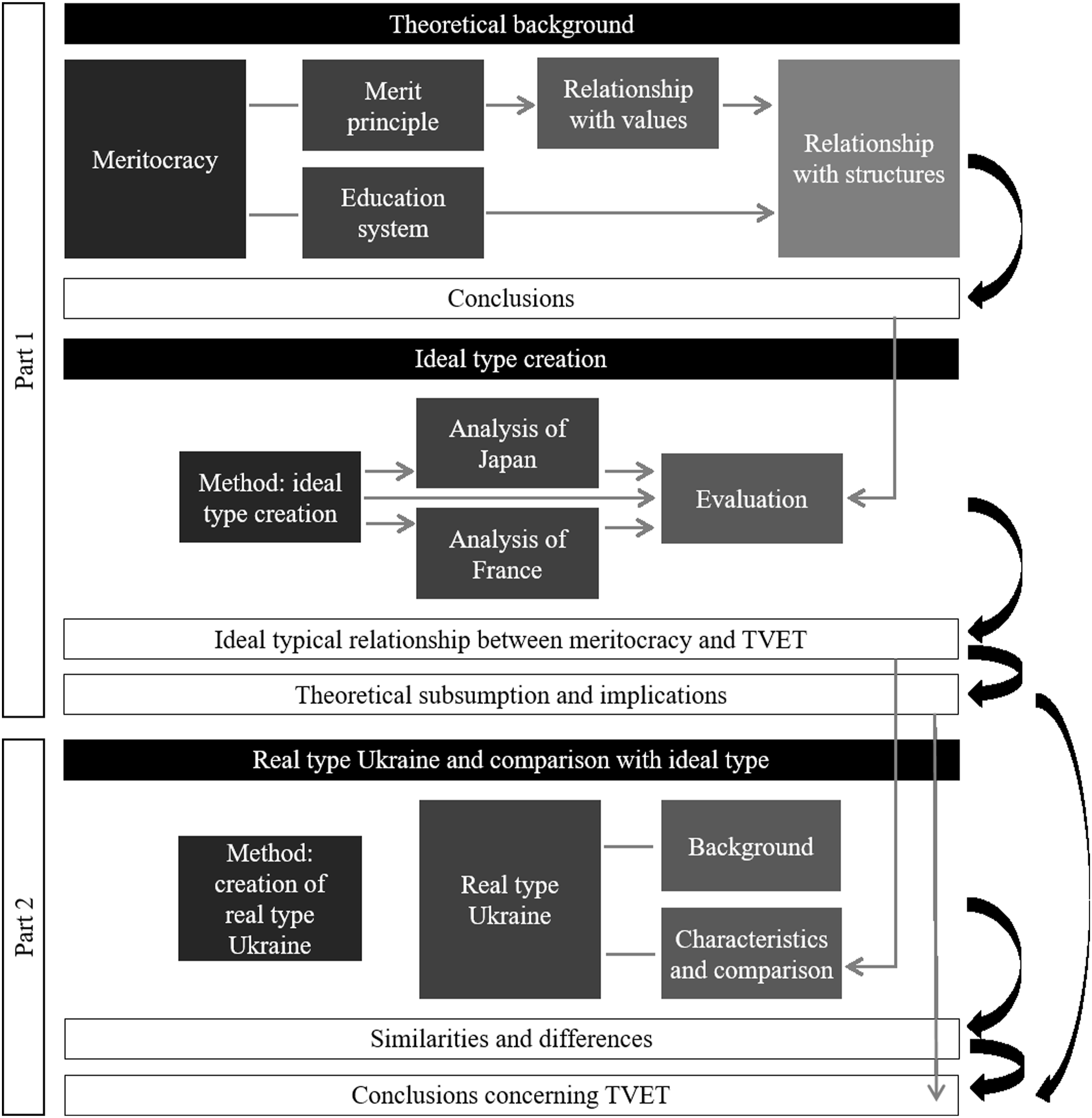
The description of the Ukrainian case was derived from the literature and supplementary group discussions (ngd = 4) of Ukrainian experts who jointly answered questions of a semi-structured questionnaire. The empirical part served to fill literature gaps, and thus the questions were quite concrete. The experts (ne = 18) were mainly Ukrainian project teams from higher education institutions engaged in vocational teacher education and one from an institution representing private employers. All but one of the group discussions took place in person. As the aim was to collect relevant information and not to reconstruct meaning, it was not necessary to produce transcripts (Hildebrandt, 2015: 250). The questionnaires were completed by the groups in joint discussion and recorded as well as translated by the corresponding survey managers as results protocols. The already highly pre-structured data were analysed with the help of a comparative table, which revealed similarities and differences (cf. Hildebrandt, 2015: 253).
Research on the social standing of TVET
Regarding the social standing of TVET, this paper follows the definition of Clement (2014: 11) who understands the ‘image’ or ‘social reputation’ of TVET as ‘the sum of attitudes, associations and feelings about non-academic vocational education and training which people in a cultural group implicitly or explicitly communicate among each other and which influence the willingness of individuals involved to invest in TVET’. Unless explicitly described otherwise, the paper refers to non-tertiary ‘TVET’ as job-related, vocational and technical education and contrasts it to general and/or academic education. The main focus is not on preparation for the world of work in general, but for the private sector.
The relatively low social standing of TVET is a common phenomenon across the globe (Billett, 2014; Billett et al., 2022), even if there are exceptions, as in German-speaking countries. Especially in countries without societal conceptions such as Beruf, TVET ‘continues to suffer from low status and negative societal sentiments’ (Billett, 2014; cf. Hillmert and Jacob, 2003; Hyslop-Margison, 2000). The effects are multi-layered: as governments, employers, and individuals share this view of TVET, this attitude shapes their engagement with TVET, its sponsorship, objectives, structural and content-related design, and governance. Moreover, it steers individuals (and their advisors) facing educational decisions (Clement, 2014: 8–11; Haybi Barak and Shoshana, 2020; Stalder et al., 2022: 4).
As Billett (2014: 3) points out, disdain for TVET has historically been related to ‘privileged others’ who have held positions of responsibility and determined the discourse on TVET without hearing the perspectives of those directly involved. This is closely linked to the distinction of Dewey (1968) between ‘free’ and ‘servant’ activity leading to the superiority of ‘free’ education over ‘mechanical’ or ‘technical’ education.
Talking about reasons for the low standing of TVET, one must mention phenomena like educational expansion and credential inflation driven by an increasing supply of schooling (Collins, 2011: 231), especially post-secondary and tertiary. This has occurred alongside with an ‘academic drift’, which makes the TVET path appear as an unattractive, unviable option to an increasing percentage of young people (Billett, 2020: 162; Deissinger, 2022; Stalder et al., 2022: 5).
Sandel (2020) relates the trend towards ‘academisation’ in the USA to meritocracy. German researchers consider the orientation towards the meritocratic principle a characteristic of modern societies and their education systems, and they make the assumption that a strong meritocratic mindset leads to the marginalisation of TVET (Deissinger and Frommberger, 2010; Frommberger, 2009; Greinert, 1999; Hörner, 1994; Georg, 1998; Ott, 2015). Implicitly, the impact of meritocratic aspirations and educational expansion on TVET was already part of reformist considerations in Germany in the late 1950s (Herrlitz et al., 1981: 150–155; Deissinger, 2022: 90). Lutz (1986) showed the link between meritocracy and the low standing of TVET using France as an example. More recently, some authors have referred to this link in an anthology about the standing of TVET (Billett et al., 2022). However, there has been no systematic and in-depth analysis of the link between meritocracy and TVET. Author offers this kind of analysis by describing an ideal type that the following section summarises.
Ideal typical meritocracy and its education system
There are different levels of discourse in meritocracy research. There is the meritocratic ideal, translated into a meritocratic theory, and there are empirical studies. While in theoretical approaches, social inequality is not reproduced in meritocracies (Goldthorpe, 2003), empirical results show the opposite (e.g. Gruber, 2016; Hoffer, 2002; Kingston, 2006). In consequence, Solga (2013) and Markovits (2019), for instance, describe meritocracy as a socially constructed myth. Thus, a level of discourse is needed where it is clear what we are talking about when we refer to phenomena as ‘meritocratic’. One perspective that is able to capture different dimensions while not conveying a normative ideal is the ideal type (Weber, 1968: 44).
Ideal types describe overarching social or historical phenomena by elaborating their uniqueness in comparison to other phenomena (Hempel, 1984: 90). They describe connecting factors, causes, functional relationships, and interconnections among phenomena (Winckelmann, 1969: 439). They are based on empirical reality, which are real types, but they hide parts of reality by excluding influences other than those of the phenomenon under consideration (Weber, 1968: 42 ff.; Winckelmann, 1969: 439). This is to say, the creator extracts the empirical reality of a phenomenon and takes it to the extreme (Weber, 1968: 47), bringing it to an abstract, idealised level. Thus, ideal types expose mechanisms and logics that do not exist in their pure form in empirical reality. (Weber, 1968: 42 ff.; Winckelmann, 1969: 439). Ideal types as pure types can be used to mirror real types. For example, the degree to which a country is meritocratic can be determined.
This paper explains ideal typical characteristics and mechanisms of the connection between meritocracy and TVET. It then analyses the extent to which Ukraine, as real type, corresponds to the ideal typical picture.
By definition, in meritocracies, professional positions and the associated social status and remuneration are awarded according to the principle of merit. Education-based meritocracies link educational success to professional positions. Only those who have achieved a certain level of education are eligible for certain positions. Certificates from the education system are proof of the level of education and thus defined as merit. The education system selects and distributes pupils to ‘lower’ and ‘higher’ educational paths according to their educational attainment, understood as merit or ability to perform (Goldthorpe, 2003: 234 f.; Hoffer, 2002: 435).
Ideal-typically, this means, among other things, that in socially shared perceptions, different types of education are of different value and standing because there is a need to compare and rank them. Thus, educational hierarchies emerge, institutionalise, and become increasingly differentiated over time. This influences the importance and appreciation of TVET, because societal attitudes and more-or-less official documents, such as qualification frameworks or rankings of educational institutions, classify vocational, activity-oriented, and technical courses as a ‘lesser’ type of education compared to ‘higher’ education, for which it is assumed one requires greater capabilities (Braun, 2022, 2023a).
However, meritocratic logic not only influences the education system and its structure; it also directs educational decisions and recruitment and promotion processes in the economy. Ideal-typically, young people tend to functionalise the education system as a means for a good career. Disciplines and educational courses are selected according to their prestige, not according to the individuals’ talents or interest or the specifics of the professional preparation. This is linked to the behaviour of employers, who ideal-typically recruit and promote based on educational certificates and their ranking in the educational hierarchy (Braun, 2022).
Ideal-typically, meritocratic societies embrace the concept of equality of chances, selection, and elitism, because promoting equal chances strengthens their legitimacy (Braun, 2022: 176–192; 2023a). Thus, for the sake of equal opportunity, pathways towards higher educational are gradually being opened to ever wider spectrums of students (cf. Troger, 2009: 10-11).
German-speaking areas are particular – here we find real types that show a mixture of the meritocratic principle and the Beruf principle as an alternative principle of distribution. Therefore, they are to be classified as special forms that greatly deviate from the pure type (Braun, 2022: 215–217).
As far as meritocracy or the meritocratic principle, the following sections refer to education-based meritocracy as described just above.
Before examining the relationship between meritocracy and the standing of TVET in Ukraine, the following section introduces the Ukrainian education system as background to understand the subsequent sections.
Education system in Ukraine
Since independence in 1991, the Ukrainian education system has undergone numerous reforms. As education laws have been adapted repeatedly since the transformation period, including resulting transition phases, it is difficult to describe the education system in Ukraine comprehensively. For a simplified overview see Figure 2, for current updates and more details see the homepage of ENIC Ukraine (https://enic.in.ua/index.php/en/educationl-system). Ukrainian education system (translated and updated version of Braun, 2022: 259).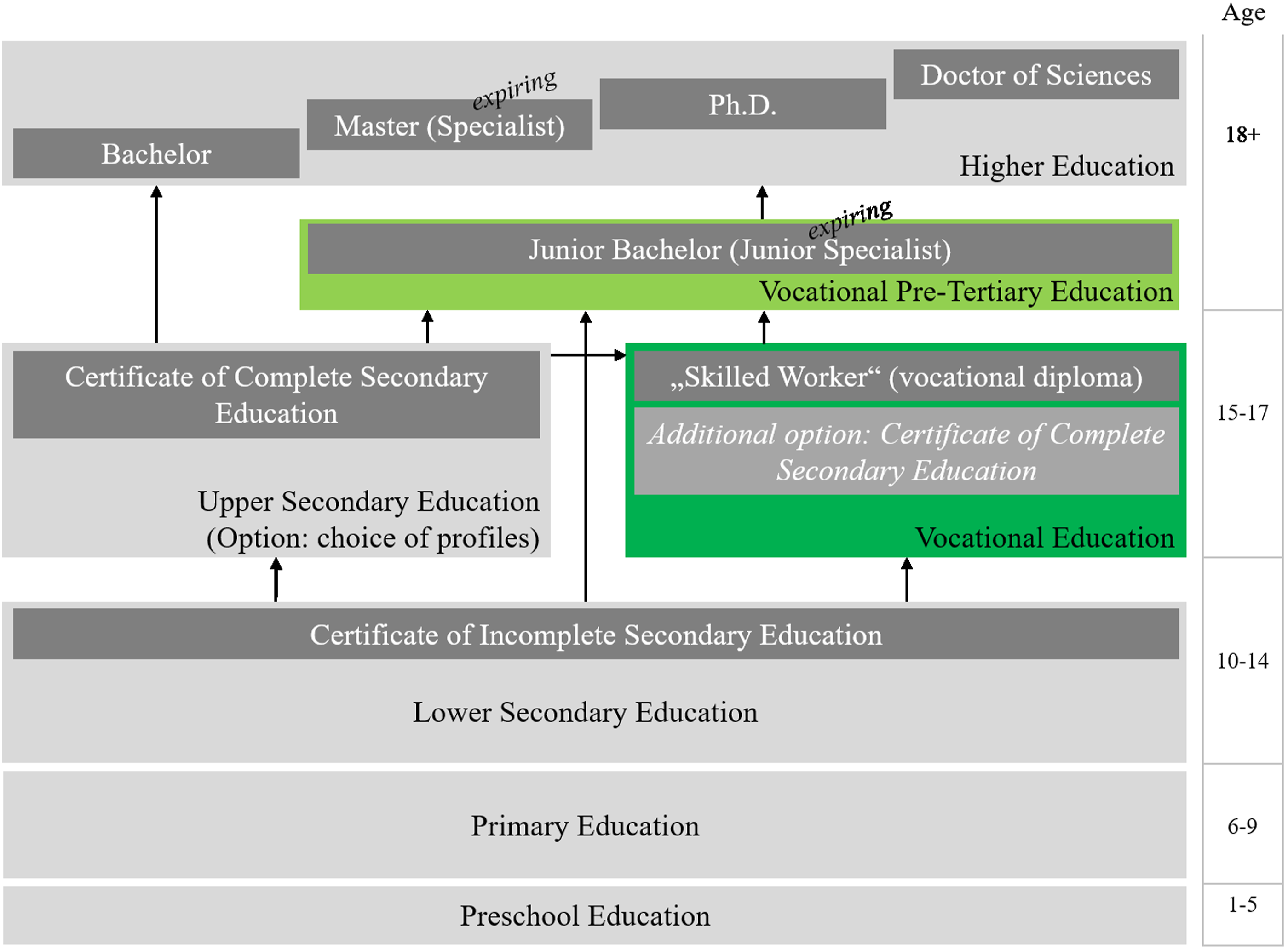
Currently, the Ukrainian education system formally follows the ideas of the ‘New Ukrainian School’, described in the Framework School Act of 2017. It is meant to gradually take effect until 2027 after a transition phase (ETF, 2019b: 3, 7; Friedman and Trines, 2019). The plans for the education system are as follows: after pre-school education at ages 1 to 5, Ukrainian children attend primary school (ages 6 to 9, National Qualifications Framework (NQF) level 1). In Ukraine, primary school is considered part of ‘secondary education’ (there are three levels of secondary education), which continues at the unified grammar school at ages 10 to 14 (secondary level II, NQF level 2). Students can complete secondary education at the age of 15 to 17 in different ways (secondary level III, NQF levels up to 5). The general path on secondary level III leads to a general higher education entrance qualification, referred to in Ukraine as ‘full secondary education’. On the vocational path, students can obtain qualifications in TVET: at the ‘vocational lyceum’, ‘vocational school centre’, or ‘vocational school’. Upon receiving a vocational qualification here, graduates are called ‘skilled workers’.
Additionally, students can obtain the general higher education entrance qualification in parallel through additional lessons. Between the secondary and tertiary education sectors is the so-called pre-university education sector. This follows the various secondary level III qualifications and it includes colleges that grant professional junior bachelor’s degrees. Both the general higher education entrance qualification and the junior bachelor’s degree open access to the various types of higher education institutions (HEI): Universities, academies and institutes with different specialisations offering bachelor’s, master’s, PhD, or doctorate degrees (NQF levels 6–8; Melnyk et al., 2021: 125). The degrees specialists (equivalent to master’s level) and junior specialist (equivalent to pre-university or bachelor’s level), which have served as higher vocational degrees and which were inherited from the Soviet period, are being phased out (Del Carpio et al., 2017: 90; NICAM, 2021).
In Ukraine, there has traditionally been no clear distinction between TVET and academic education. Higher education certificates are generally vocational in a sense that they are at the same time a proof of education and a licence to work professionally in a certain field (Bąk, 2014: 63). Depending on the legal framework at the time, TVET institutions can often award certificates at different levels of education, from the upper secondary level to the pre-university, or even the university level. Under TVET in the narrower sense, the Ministry of Education includes the qualifications ‘skilled worker’ and junior specialist, the latter being phased out. There are more than a dozen such educational institutions, and so they will not be described here (cf. NICAM, 2021).
The area of education that we are interested in under the term ‘TVET’ is that of upper secondary school level (NQF levels up to 5), which is distinct from tertiary education.
Meritocratic influence on the standing of TVET in Ukraine
Social standing of TVET in Ukraine
The Ukrainian education system in the transition period, following the end of the Soviet Union in 1991, can be characterised, among other things, by a striking expansion of education. A quota of more than 80% university students per cohort (Zimmermann and Schwajka, 2021: 21; World Bank Group, 2019: 5) contrasts with a salient decline in the number of students in TVET programmes (SSC, 2018; SSC, 1998-2019b). 1 This development closely links to the extensive opening up of higher education in the 1990s (Braun, 2022: 290 f.; Kremen and Nikolajenko, 2006: 19) and a pronounced societal disregard for TVET (ETF, 2019b: 41; Želudenko and Sabitowa, 2015: 854 f.). As a result of the development, there is a lack of skilled workers while university graduates are pouring into the labour market in abundance (Feiler, 2014: 24 f; World Bank Group, 2020), just as described for other countries with a low standing of TVET (Billett et al., 2022).
TVET’s low standing compared to higher education since independence is also reflected in the priorities of the government in the 1990s: the new laws necessary for the education sector focussed on the regulation of the higher education sector much more quickly than that of TVET (Farla, 2000: 10; Melnyk, 2021: 114).
Even in Soviet times, TVET offered poorer career prospects than academic degree programs. The narrowly specialised work activities associated with TVET, which were socially perceived as less meaningful, brought it into disrepute. It was only through legal regulations obliging students to undergo TVET that it was possible to stabilise its number of participants at a high level (Braun, 2023a). Soon after independence, politicians opened higher education institutions (HEI) to enable as many young people as possible to obtain a university degree as the basis for a good life. Simultaneously with the emerging belief in the meritocratic promise of success being rewarded through the education system, the pressure of young people created in Soviet times due to their excess demand for access to university led to a rush to the universities (Author, 2023a). 2
The extent to which the growing influence of the meritocratic principle has contributed to the dysfunctional devaluation of Ukrainian TVET since independence is analysed based on the following central categories: (1) meritocratic logic in the education system and its structure, (2) meritocratic logic in educational decisions, (3) meritocratic logic in recruitment and promotion in the labour market.
As shown above, the educational expansion in Ukraine has taken place at the expense of TVET. One of several reasons is the influence of the meritocratic principle. The paper now compares Ukraine with the ideal typical relationship between meritocracy and TVET (see ‘Ideal typical meritocracy and its education system’). Because it was not possible here to explain the characteristics of the ideal type in more detail, the following sections also contain references to real types (from which ideal types are obtained, cf. Weber, 1968). Even though differences between the ideal type and the Ukrainian real type exist, this paper focuses on the similarities as it aims to show the contribution of meritocracy to the low standing of Ukrainian VET.
Meritocratic logic in the education system and its structure
Since Ukraine has historically and ideally turned to the merit principle based on the established principle of equality, elements fostering equal opportunities have traditionally been present. Accordingly, education policy has tended to focus on differentiation according to merits and corresponding selection mechanisms (Braun, 2022: 288). In this respect, one could argue Ukraine has gone through meritocratic phases in reverse order compared with countries without a socialist background who initially selected quite sharply according to merits and subsequently established mechanisms to promote equal opportunities, thereby defusing selection. The consequences are very similar (Braun, 2022: 392). Regardless of its path, Ukrainian educational policy has continued to promote equal opportunities.
An example of this is the rapidly strengthening opinion that equal opportunities must be ensured in access to higher education and that the population’s use of educational opportunities must be encouraged (Kremen and Nikolajenko, 2006: 20; Želudenko and Sabitowa, 2015: 866). This was enshrined in constitutional law: every Ukrainian citizen has the right to free and equal chances of access to both (standard) secondary school and vocational or higher education (ETF, 2009: 56).
Similar to the processes in ideal typical meritocratic education systems, which offer upper secondary education to an increasing number of students, HEI opened up in Ukraine to a wide range of students (Braun, 2022: 365; UNESCO Institute of Statistics, 2013–2020: see ‘Social Standing of TVET in Ukraine’). While the number of first-year university students climbed almost threefold between 1992/93 and 2007/08, and almost fourfold by 2010/11 (Klein, 2018: 120), the numbers of TVET institutions and their students have fallen rapidly since independence: there were 1251 TVET schools in 1991, the year of independence, compared to 968 in 2013 and 736 in 2018 (excluding Crimea and occupied territories in eastern Ukraine). In 1991, the Ukrainian State Statistic Service recorded 648 400 trainees, 391 200 in 2013, and only 255 000 in in 2018 (excluding Crimea) (SSC, 1998-2019a). These developments can be interpreted as the consequence of belief in the meritocratic promise described above, although this is likely not the only explanation (Braun, 2023a).
The Ministry of Education introduced competition in university access to select students by academic merit (Klein, 2018: 117; Kremen and Nikolajenko, 2006: 19). For this purpose, it implemented an independent central test (‘External Independent Testing’ – EIT), the results of which are considered alongside the average score on the higher education entrance qualification (NICAM, 2021). Here, the state, in central control, has attempted to make the assessment and certification of merits objective and transparent. Only the most prestigious and popular degree programs hold entrance examinations. Admittedly, one cannot speak of rigorous selection, because only some university places are delegated according to academic achievement; the rest are given to those that pay (full) tuition (Author, 2022: 247, 289, 304, 309). The Ukrainian government is also planning a central, independent test for the transition to upper secondary school. In future, better pupils will enter general upper secondary education, while worse pupils will enter TVET (Braun, 2022: 302; Zimmermann and Schwajka, 2018: 23). Thus, the course is set for a negative selection into TVET, which is also ideal typical for TVET in meritocracies.
Due to the introduction of the EIT and further plans for merit-based selection as described, we can assume an increase in the importance of the selection function in the Ukrainian education system, the key function of ideal typical meritocratic education systems (this stands in contrast with the qualification function, which means providing qualifications tailored specifically to the needs of the labour market).
Similar to other post-Soviet states and meritocratic states with a different historical background (Braun, 2022: 192; cf. Wheelahan, 2016) trying to balance selection and equal educational opportunity, Ukraine has developed a highly diversified higher education sector (Kogan, 2012: 701), including a high number and levels of HEI and educational titles. Whereas previously higher TVET schools were included in the tertiary sector, the adaption of the Bologna education policy changed this. They now belong to the ‘pre-university’ sector (Braun, 2022: 314; Rumyantseva and Logvynenko, 2018: 414). Students predominantly use these educational programs as a bridge to the higher education sector, which corresponds to the ideal typical meritocratic phenomenon that the goal is to achieve the highest possible educational title (Braun, 2022: 315): For ambitious graduates, education does not end in the professional pre-university institutions. A significant part of graduates of professional pre-university institutions enter higher education institutions for further bachelor’s and master’s degrees […]. (363D)
The subsequent ‘relegation’ of higher TVET schools to the pre-university sector resulted in a stronger and clearly hierarchical retroactive separation of TVET and general or academic education. A specific feature of the Ukrainian case is that the pre-university sector competes with other schools that provide higher education entrance qualifications (Braun, 2022: 316): Due to the emergence of professional disciplines, the level of interest in learning among diligent students usually increases. Quite a large number of young students and their parents believe that pre-university education institutions provide better secondary and vocational education than low-ranking general secondary schools. Therefore, in order to obtain a complete secondary education, they prefer institutions of professional pre-university education. (362D)
In ideal typical meritocracies, there is usually a fine-grained hierarchy of HEI and degree programs according to the ranking of educational achievements (cf. Amsler and Bolsmann, 2012; Georg, 2017). This is increasingly the case in Ukraine: for example, the Ministry of Education awards universities with the titles ‘National University’ or ‘Research University’ if they meet certain criteria, setting these universities apart from other HEI. The importance of HEI rankings, published in various media, is growing, indicating continued future differentiation of HEI hierarchy. This could also occur due to a new regulation. It states that the number of study places in the following year must be based on the intake of the previous year (Braun, 2022: 309; Zimmermann and Schwajka, 2021: 15).
According to the ideal typical meritocratic logic, which is also visible in real types (e.g. Pilz and Alexander, 2016: 214 f.; Troger, 2009: 14), in Ukraine educational certificates from general or university courses serve as a proof of merit. The main ‘job’ of Ukrainian TVET is to ‘gather’ low-performing and socially disadvantaged students and lead them to a qualification for the labour market (see below), and thus it does not provide qualifications that represent high merit. Correspondingly, the meritocratic logic applies a rather general definition of merit, which expresses itself in generally oriented curricula and examination subjects. Ukrainian study programs contain compulsory subject blocks dedicated to general education and show an intense focus on theory. A specific Ukrainian feature is the focus on promoting Ukrainian national identity in secondary education and the EIT. Thus, merit is primarily seen through capabilities regarding general educational content, for example, in the ability to recite knowledge (Braun, 2022: 322).
Looking at official documents about the Ukrainian education system like the National Qualification Framework, a meritocratic educational hierarchy that rewards cognitive skills can be seen. The documents group educational qualifications into levels; the ‘higher’ the level, the greater the assumed intellectual demands of the corresponding educational programs. With each level, the relevance of theoretical knowledge and knowledge of scientific methods increases, while the reference to (executive) activities decreases (Braun, 2021: 61; Braun, 2022: 359). Thus, in this respect, the Ukrainian education system is characterised by a definition of meritocracy that refers to relatively general competences and knowledge. However, this means that it is narrow because it leaves out more specific knowledge and competences. The definition of merit that is reflected in the respective contents of higher or lower educational programs. This is also a characteristic of ideal typical meritocracies.
Meritocratic logic in educational decisions
Whereas during the Soviet era one must speak of a functionalisation of education in favour of the economy, this changed in Ukraine with independence (Braun, 2022: 326). We see this in the demand of Ukrainian youth for private supplementary education. They hope that this will give them a better chance of achieving good results in the EIT and thus of gaining a place at a prestigious study program (Długosz, 2016). According to meritocratic logic, young people perceive a university degree as the basis for a well-paid job, a good professional career, and an elevated social status, which is the main reason for many of them to study (see ‘Ideal typical meritocracy and its education system’, for the Ukrainian case: Fedorenko, 2017: 203 f; Libanova et al., 2013: 40). This is not the case for TVET qualifications: adolescents avoid TVET as they perceive it to be a type of education that does not enhance their careers. They (and their parents) aim for higher education, regardless of its quality. In particular, the low social standing of TVET qualifications contrasts sharply with that of higher education certificates (MESU, 2017–2019). With the increasing number of university graduates, the pressure on the upcoming generation to obtain as ‘high’ an educational title as possible has increased (Braun, 2022: 323).
Low-quality institutions or ‘diploma mills’, some of which produce educational titles illegally (Osipian, 2015), make it easier to obtain higher educational certificates than those of TVET. They are evidence of the exaggerated importance of higher education certificates. We also see in other meritocratic countries, for example, the U.S, or China, that illegal attempts are made to circumvent the genuine merit principle (Denisova-Schmidt, 2017; McNamee, 2014). Even though this contradicts the theoretical-normative idea of meritocracy, in reality and ideal-typically it is a part of meritocracy.
Programs at the first two academic levels have much lower enrolment than levels III and IV (SSC, 2018: 127, 129). Students use pre-university programmes as preparation for university studies, not as preparation for the labour market, implied by the name ‘pre-university’, even though such programmes are classified as TVET (see Education system in Ukraine). Furthermore, bachelor’s degrees serve as ‘basic’ higher education, that is, as a preliminary stage on the way to a ‘full’ higher education degree, that is, a master’s degree (Bruun et al., 2009: 21).
In line with meritocratic logic subdividing vertically, clear subject preferences are evident in the choice of studies (Bruun et al., 2009: 21; ETF, 2019a: 10), according to what society values most. Students choose the field of study primarily depending on its prospects for a well-paid job and universities gear their study programs to the demands of applicants (rather than the labour market) (Coupé and Vakhitova, 2013: 27; Kupets, 2015: 31), who often later do not work nor expect to work in professions directly related to their field of study (Morynets, 2006 as quoted in Bastedo et al., 2009: 13; Coupé and Vakhitova, 2013: 27).
TVET’s negative public image, often making such institutions the last refuge for the weakest students (Sichkar and Ermsone, 2019: 51), and the inverse for universities have led to a shortage of skilled manual labourers (without university degree) and a surplus of university graduates. Despite the fact that individuals with higher education certificates face higher unemployment rates than those of ‘lower’ degrees (Feiler, 2014: 24), students have not yet changed their educational aspirations. There is still a lack of understanding of the potential that TVET can offer in the face of current economic circumstances (MESU, 2017–2019). Even within TVET, most students strive for the higher education entrance qualification: in 2017, the number of completed TVET programs with parallel acquisition of the certificate of ‘full’ secondary education (through additional lessons) was 53 600, the number of those without higher education entrance qualification was 6000 (SSC, 2018: 124). Participants see TVET through an entitlement lens, viewing it as offering them wider opportunities in the education system, that is, as a transit station. This is also a characteristic of ideal typical meritocratic education systems, where the dominance of selection displaces the qualificational significance of education.
Given education participants’ and policy’s orientation towards meritocracy, TVET maintains the function of a backstop for socially disadvantaged persons. They are allowed to start TVET even without a secondary school leaving certificate and receive state support (Radkevych et al., 2018: 131; Želudenko and Sabitowa, 2015: 862). TVET is also a stopgap for pupils who underperform in secondary school (Del Carpio et al., 2017: 92). For example, in 2011 and 2014, the percentage of all secondary students that were apprentices was respectively 8.8% and 9.0% (ETF, 2017b: 11). TVET in Ukraine is thus subject to adverse selection, which is strongly reminiscent of the situation in meritocratic countries such as France and India (Bernhard, 2017: 308; Pilz and Regel, 2021: 114), and a feature of the ideal typical meritocracy.
Meritocratic logic in recruitment and promotion in the labour market
Depending on the size, companies in Ukraine typically have different numbers of hierarchical levels. Formally speaking, there is a (meritocratic) understanding in Ukraine that educational level and professional position and remuneration should correspond with each other. For example, official regulations require a university degree for leadership positions (Braun, 2022: 52I; 52K), but it can be earned later via distance learning (Braun, 2022: 532I; 532K). Otherwise, the highest level attainable in companies without a university degree is that of a master craftsperson (Braun, 2022: 52I). The acquisition of the skilled worker or junior specialist certificate formally goes hand in hand with salary grade classification (KI, 2012).
In practice, leadership positions are held mostly by those holding higher education certificates, even in lower management, as stipulated by the NQF and existing professional standards (Author, 2022: 52I; 52K).
The metallurgy sector, as an essential part of Ukrainian industry, is representative of the industrial sector in Ukraine in terms of employees’ educational level and their continued and advanced training (Prytomanov et al., 2018: 242). Recruitment practices are strongly reminiscent of the meritocratic logic. Companies generally prefer to hire university graduates. This also applies to ‘skilled labour’ positions that do not require a university qualification. They reason that TVET graduates are only suitable for jobs in the low-wage sector that do not require high qualifications (Prytomanov et al., 2018: 239). Libanova et al. (2016: 50) confirm that employers of different sectors prefer applicants with higher certificates, even if the job requirements did not require a higher qualification. This is true even for relatively simple jobs (Round et al., 2008: 156) and results in a crowding-out effect: those with university degrees are forcing out TVET graduates, who are often more specifically qualified for such work. Thus, on the one hand there are overqualified employees (graduates), on the other hand people with lower levels of education in precarious employment (ETF, 2017a: 4; ETF, 2017b: 8; Kupets, 2015, 2016: 142). This phenomenon is clearly linked with the adverse selection that takes place in TVET (Braun, 2022: 343).
However, it must be added that Ukraine is far from a state where recruitment is exclusively based on educational attainment as merit (Round et al., 2008: 156). Without personal connections, it is almost impossible for graduates to access jobs (Libanova et al., 2016: 4; Sichkar and Ermsone, 2019: 19).
Young people feel they are good citizens when they work hard for good marks and a university degree. When they transition into the employment market, they suddenly find displaced goalposts because their degree certificate is not enough and employment is only feasible through personal connections or illegal practices (Round et al., 2008: 158). Nevertheless, true to meritocratic logic, the level of education is a necessary – but obviously not sufficient – condition to enter the formal work market, getting a good job and paid well. Currently experts report an increase in competition-based procedures in the allocation of jobs such as aptitude tests (Braun, 2022: 382D, 310K, 531I).
Conclusions
This paper traced how there has been an increased orientation towards the meritocratic principle in Ukraine since independence. It understands meritocracy as the connection between one’s educational success and one’s professional position. Even if educational qualifications are not the sole determinant of jobs, they are a prerequisite for highly paid jobs and heavily influence educational decisions since young Ukrainians tend to belief in this connection. This development is to the disadvantage of TVET and in many respects resembles the meritocratic logic and its influence: in the education system, one finds both elements of the promotion of equal opportunities and an increase in selection according to educational merits. Firstly, this is seen in the opening of universities to a broad spectrum of students; secondly, this appears in the introduction of a centralised test (EIT) for entrance to university. The education system has a clear hierarchy of educational pathways and increasingly of educational institutions. Based on the design of the central university entrance test and of university curricula, theory dominates, going hand in hand with the rewarding of cognitive capabilities as merit. Learners use the education system to obtain the highest possible qualifications, which they see as leading to the highest possible income and social status.
These ‘meritocratic’ developments have had drastic consequences for TVET, where almost exclusively low-performing students are found (Sichkar and Ermsone, 2019: 51) whose chances on the labour market are limited. Due to the poor standing of TVET and the high number of HEI graduates, the labour market is distorted: there is a shortage of skilled manual workers and a surplus of university graduates. Due to the theoretical nature of the degree programs, graduates do not have a high level of employability, while vocationally educated people are not trusted with many jobs due to their perceived low level of education.
This one-sided orientation towards the merit principle endangers TVET. TVET has more of a compensatory function and a low standing in society, and it offers its graduates few prospects, because TVET qualifications signal rather poor achievement in school. They are not equivalent to HEI studies. Increasingly, TVET does not fulfil the function of supplying society as a whole with well-trained skilled workers. The higher education system takes over this role, which, however, is not oriented towards the needs of the economy and rarely imparts job-specific competences. With this in mind, Ukraine may come to regret abolishing the degrees of junior specialist and specialist, which fell victim to reforms based on conforming to the Bologna education policy.
In the current period of war, Ukraine has succeeded remarkably well in maintaining the education of the younger generation in TVET despite all the adversities (Melnyk, 2024:10). Plans are already being made for the post-war period – the already existing reconstruction plan assigns a central role to TVET (MESU, 2022). However, the results of this article indicate that it could become difficult to attract young people to VET programmes.
Footnotes
Declaration of conflicting interests
The author(s) declared no potential conflicts of interest with respect to the research, authorship, and/or publication of this article.
Funding
The author(s) disclosed receipt of the following financial support for the research, authorship, and/or publication of this article: This work was supported by the University of Konstanz.