



Abstract
This paper considers how far Anglo Saxon conceptions of vocational education and training have influenced European Union vocational education and training policy, especially given the disparate approaches to vocational education and training across Europe. Two dominant approaches can be identified: the dual system (exemplified by Germany); and output based models (exemplified by the National Vocational Qualification ‘English style’). Within the European Union itself, the design philosophy of the English output-based model proved in the first instance influential in attempts to develop tools to establish equivalence between vocational qualifications across Europe, attempts that resulted in the learning outcomes approach of the European Qualifications Framework, the credit-based model of European Vocational Education and Training Credit System and the task-based construction of occupation profiles exemplified by European Skills, Competences and Occupations tool. The governance model for the English system is, however, predicated on employer demand for ‘skills’ and this does not fit well with the social partnership model encompassing knowledge, skills and competences that is dominant in northern Europe. These contrasting approaches have led to continual modifications to the tools, as these sought to harmonise and reconcile national vocational education and training requirements with the original design. A tension is evident in particular between national and regional approaches to vocational education and training, on the one hand, and the policy tools adopted to align European vocational education and training better with the demands of the labour market, including at sectoral level, on the other. This paper explores these tensions and considers the prospects for the successful operation of these tools, paying particular attention to the European Qualification Framework, European Vocational Education and Training Credit System and European Skills, Competences and Occupations tool and the relationships between them and drawing on studies of the construction and furniture industries.
Introduction: why has ‘Anglo Saxon vocational education and training’ been influential?
By ‘Anglo Saxon vocational education and training (VET)’ we mean a family of approaches to VET that have developed and gained influence over the last 40 years, although they have roots that go back earlier. ‘Anglo Saxon VET’ is most appropriately associated with the United Kingdom (UK) and Australia, although significant elements are also to be found in the United States (US) context. However, the traditions of VET in the US are too diverse to be summarised in one model, even though elements of the UK approach are also to be found there, as well as its most able proponents and opponents (e.g. Dewey, 1917: Chapter 23; Lewis, 2007; Snedden, 1914/1971).
The basis of the Anglo Saxon approach can be found in the idea of industrial training, or the preparation of individuals for working in specific fields, not necessarily particular occupations. A justification for industrial training can be found in the work of Plato, in both The Republic (1955) and The Laws (2005), focusing solely on the needs of the moment and allowing for further phases of training should the need arise. It does not interest itself either in broad or deep occupational knowledge or in civic and liberal aspects of further education. Further development can be found in Adam Smith (1776/1947), associated particularly with the fragmentation of the labour process, whereby the stages of a product’s construction are analysed and broken down into a sequenced set of necessary behaviours, mediated by a managerial function that ensures planning, co-ordination, control and evaluation. Of bricklaying, for instance, Smith (1776/1947) wrote:
No species of skilled labour, however, seems more easy to learn than that of masons and bricklayers…. The high wages of those workmen, therefore, are not so much the recompense of their skill, as the compensation for the inconstancy of their employment. (p. 92)
David Snedden’s (1914/1971) polemic against John Dewey’s expansive idea of vocational education re-emphasised the narrow focus of industrial training and derided the irrelevance of incorporating broader educational elements into the vocational field. Dewey’s characterisation of the ‘vocational’ and the ‘occupational’ is, however, exceptionally broad, far more so than would be found in the countries of northern Europe. The ‘Anglo Saxon’ model in its current recognisably influential form accords with a particular development of Adam Smith’s idea of analysing and breaking down the work process, which has two features over and above the analytical approach advocated. The first is connected with the idea of ‘training’. If tasks can be broken down into simple steps a la Smith, then operatives can be trained to carry out those tasks, and even paid accordingly. This is of course precisely what Frederick Winslow Taylor advocated in his Principles of Scientific Management (1911). Such ‘training’ can happen most effectively in workplace conditions and assessment can then take place in the workplace, thus guaranteeing that an employer knows that the operative can carry out the tasks required. The second feature involves specifying the tasks to be carried out in ‘learning mode’, what the operative needs to be able to do in order to carry out the required tasks.
In order for the model to work, there must be a co-ordinative, controlling and evaluative faculty in the industrial process that, since this cannot be simply broken down into discrete tasks, requires training in the psychology of managing human beings in commercial and industrial settings. It is assumed that there is sufficient in common in managing humans across a variety of such settings to allow for a largely common curriculum of ‘Human Resource Management’ (HRM) for ‘line managers’ (those who control the production line or its analogue) and the managers of managers. The model thus has the elements of a training programme. The aims are set by the process to be undertaken. A training process for the management function can be developed generically through an HRM curriculum. The content for non-managerial operatives is set by translating arrays of tasks into learning outcomes for each particular bundle of tasks. The result is a high level of managerial input into the process. Indeed, Taylor (2011) suggested an almost equal division of the work and the responsibility between the management and the workmen, with ‘management taking over all work for which they are better fitted than the workmen, while in the past almost all of the work and the greater part of the responsibility were thrown upon the men’ (Principle 4: Chapter 2).
The attractiveness of the Anglo Saxon model in developed and developing countries lies in the following of its features:
The focus on the immediate needs of employers;
The ability to translate these needs into curricula and assessment processes;
The removal of the need to incorporate ‘surplus’ requirements into vocational curricula;
The ease of construction of qualifications suited to the particular needs of employers;
The aptness for the assessment of prior learning in informal and non-formal contexts;
The capacity for rapid response to changes in employer needs;
The use of a learning outcomes approach, allowing for the ‘reverse engineering’ of curricula and pedagogies.
The Anglo Saxon approach to industrial training depends on government bodies taking on a co-ordinating rather than a providing role, setting up a qualification framework that employers can then make use of, with the level of resourcing they see fit (Keep, 2002). In theory, it allows for rapid change in qualifications and thus is forward facing, as configurations of tasks can quickly be made to take into account the future needs of employers. It is not surprising perhaps that this model, which seems to transcend national traditions of VET, has proved attractive to designers of cross-national policy tools. The attractiveness of what is in effect a Human Capital conception of development to the designers of the European Union (EU) VET policy tools, and particularly the European Skills, Competences and Occupations tool (ESCO), is the focus on easily identifiable skills and the possibility to rapidly develop and validate these through practically oriented forms of assessment. The ‘skills’ or ‘human capital’ of the workforce are in this way regarded as a form of property of the individual worker and as associated with the activities of the work process identifiable with particular firms (Becker, 1994; Clarke, 2006). The problem with this Anglo Saxon approach is, however, that the social structures forming and constraining the quantity and quality of labour are neglected (Maurice et al., 1986). A narrow concept of skills – and indeed of labour – is implied, which ignores all the complexities of skill formation at the social as well as the organisational level and therefore results in a distorted form of assessment.
The dominant design philosophy of English VET qualifications over the last 30 years
The post-war demise of Taylorist thinking, which had much to do with the decline in assembly line factory production, devastating critiques by authors such as Braverman (1974), and more sophisticated approaches to management, inspired for instance by Foucault (McKinlay and Starkey, 1997), gave way to what was in effect a similar approach though in a different guise. From the mid-1980s onwards, a distinctive design philosophy for vocational and professional qualifications emerged in England, which was to have influence across the world. This approach was loosely associated with behaviourist psychology, being based on the idea that an agent’s behaviour could be modelled against a set of precise behavioural descriptors. These descriptors could be aggregated into occupational descriptors, which could serve as the basis for a qualification (Raggatt and Williams, 1999). Such was the system of National Vocational Qualifications (NVQs), which have been a significant element of the English VET landscape since 1986, although always in existence alongside older more ‘input-based’ qualifications that rely on the application of theoretical content to workplace practice. The type of qualification that has gained significant international attention is this learning outcomes-based one, such as the NVQs, whose design features influenced the initial design of the European policy tools.
Critical to this design enterprise was the possibility of rendering the behavioural descriptors into the vocabulary of ‘learning outcomes’, or statements of what the learner knew or could do. This ‘outcomes-based’ approach was attractive because it promised a precise account of what the qualification guaranteed, was geared to the current needs of employers (and thus useful for a prospective employee to have), dispensed with any specification that was not relevant to workplace agency, and seemed to be very practical and flexible enough to be easily reconfigured if needs changed. Any theoretical rationale for behaviour (the term preferred to ‘action’ – which is what we usually want from professional workers) or underlying knowledge was accordingly not necessary as, if it did exist, it would not need to be specified in the behavioural requirements for the award of the qualification.
A further crucial element of this design philosophy was that each learning outcome could stand on its own and its attainment could be assessed through the relevant behaviour. In the case of the assessment of knowledge, this could be done through the ‘behaviour’ of giving the correct answers to questions (Coles, 2007; Coles and Oates, 2004). Thus there was no need to assess anything other than the exhibited behaviour for the criterion for that element of the qualification to be attained. However, when this stipulation was conjoined with a design approach that placed learning outcomes in hierarchies of complexity, which was also a critical feature of the NVQ, then an implicit contradiction emerged. For anything other than the lowest level, the qualification was at the same time stand-alone and presupposed the mastery of other lower order behaviours. Unless these lower order behaviours were ‘rolled up’ into or were presupposed by the higher order qualification, it was not possible to guarantee that the worker possessed them, even though they might be important attributes for work that also needed to be guaranteed (Brockmann et al., 2008a; Winch, 2014).
The rationale of the NVQ system was explained by one of its founders, Gilbert Jessup (1991: 192), as having ‘an external reference point for assessment – the statement of competence’. With the support of successive governments, this became the official preferred form of vocational qualification, co-existing alongside more traditional vocational qualifications such as those offered by the Business and Technology Education Council (BTEC) and City and Guilds. Less obvious to immediate scrutiny were the pitfalls. These emerged in due course, but had little deterrent effect on the adoption of this design philosophy in Britain and beyond, such was the allure of outcomes-based qualifications for the implementation of a Human Capital approach to labour supply.
At the heart of an outcomes-based qualification is a behavioural descriptor, which should be unambiguous. The behaviour in question is the manifestation of a ‘skill’ or alternatively a routinised fragment of activity. Typically, an employee can be trained into such behaviours within workplace conditions. NVQs thus rely on the equation of ‘know-how’ with ‘skill’ with ‘describable workplace behaviour’. However, this equation has unforeseen negative consequences. Vocational action becomes the manifestation of a skill or skills that can be completely observed and described. Skills, on this view, are independent manifestations of behaviour that bear no apparent relation to other forms of know-how, including other skills, or any non-directly observable characteristics of an agent, such as the possession of knowledge or character traits.
Very quickly problems with this approach emerged, the first connected with ‘range’. Once one moves away from stereotyped behaviour displayed in a small variety of situations to circumstances where more flexible forms of action are required, the apparent simplicity of the behavioural descriptors proves to be a disadvantage as they cannot capture the range of behaviour required in action in more complex occupations and occupational situations. To circumvent this, descriptors had to be accompanied by ‘range statements’, which were themselves descriptions of the circumstances in which the descriptors would apply.
The second problem to emerge was the cumulation of task descriptors alluded to earlier, the fundamental contradiction between the claim that descriptors of behaviour (learning outcomes) were independent and self-sufficient and the hierarchical ordering of learning outcomes, which implicitly presupposed the mastering of other, lower order ones. A third was the growing realisation that such a system at best captured today’s requirements and that qualifications based on it could not cope with new developments. This was in part owing to a fourth problem, the downplaying of educational and theoretical elements and the reliance on, in effect, the skills of yesterday, as these existed in the workplace (Steedman, 1992). And, a final problem was the difficulty to actually change what was in effect an employer-based system, focussed – as in the human capital approach – on the relation between the worker and the firm, with little involvement of either trade unions or educational authorities, let alone the trainees themselves.
These problems were quickly recognised in the Netherlands, with the result that an NVQ-style reform was abandoned (Westerhuis, 2011). However, it is fair to say that the design philosophy of the NVQ still has global influence despite the fact that it is being quietly discarded in the UK (Richard, 2012; Whitehead, 2013). For this reason alone, it is necessary to continue to pay attention to it.
The governance model for English VET compared with the dual and similar systems
At the heart of the NVQ and of the reform of the English VET system in general in the 1980s was the erosion of collective interest representation, in particular the trade unions, in the development of qualifications (Brockmann et al., 2010a). This was not always the case; indeed trade unions played a prominent role in the tripartite Industrial Training Boards (ITBs) set up under the Industrial Training Act of 1964. However, under the Thatcher government and coinciding with the introduction of NVQs, the remaining ITBs, in particular the Construction Industry Training Board (CITB), became instead employer-led and employee interests were marginalised. Not only were the trade unions accorded no formal role in apprenticeships and written out of apprentice contracts, but their presence within the entire institutional framework for VET became minimal as the system was transformed to become an employer-based one (Ryan et al., 2006). At the same time, employer interests were very difficult to represent collectively owing to their diverse nature and the growing demise of employer associations and above all to increases in self-employment, subcontracting and the use of agency labour, which meant that many large ‘employers’ ceased to be responsible for employing labour. As a result, employer demand-led skill development failed, decade after decade, to materialise (see also Keep in this issue).
Gone were the days of demarcation disputes between trade unions and employers concerning the closely guarded scope of particular occupations, inscribed in the respective qualifications! Instead the Sector Skills Councils (SSCs), the successors of the ITBs, now came to develop qualifications such as NVQs through consultation with only a few, usually larger, ‘employers’, while many others were not represented (Farlie, 2004). The practice of each employer lobbying for having their particular skills needs embodied in nationally-recognised qualifications has also had a detrimental effect on the quality of programmes and led to a further fragmentation of qualifications and the narrowing of skills and knowledge (Brockmann et al., 2008b).
The employer-focussed nature of the system has other severe weaknesses: the narrowness of the qualifications and their reduced educational content (Hayward, 2004). Instead of acting as a construct between the education system and the labour market, qualifications seek instead to mimic and reproduce the ‘skills’ or outputs of the labour market. This strong bias in favour of reflecting fragmented employer interests and demands has the effect that the long term interests of employees for qualifications that will stand them in good stead in their working life are either ignored or played down. Basing the VET system on the immediate needs of employers or current practices in industry also makes for serious difficulties in changing the process, given that it is built around existing skill sets. Not only are skill divisions and even outmoded practices constantly perpetuated and reproduced, but there is no clear means to enhance potential, to introduce innovations or to plan for needs at industry level.
Further peculiarities of the English VET system are that the regulatory role of the state is weak and divided and built on delegating control to private or employer interests. The constitutional divide between Privy Council responsibility for professional education, delegated to the professional institutions, and state responsibility for VET makes for what is in effect a class divide and lack of permeability between professionals and non-professionals and for a structure that is relatively impervious to change (Clarke and Herrmann, 2004; see Parry in this issue). Vocational skills remain individual attributes required to fulfil particular outputs, whose fragmentation is enforced through the autonomous and often unaccountable institutions that govern their formation.
Whilst the British system is based on the principle of governance through quangos, the principle in European countries such as Germany is of tripartite consultation and social partnership (Streeck, 1992; see Kuhlee in this issue). German VET, for instance, is the responsibility of both the private and public sectors and based on the ‘dual’ system, whereby the firm and the vocational schools are jointly recognised as places of learning. The training regulations have been revised by the social partners – the industrial trade unions and employers’ associations – together with the Federal Institute of Vocational Training, Bundesinstitut für Berufsbildung (BIBB), to specify the occupations in the sector, the length and stages of training, the actual content, examination and qualification (Hanf, 2011). The integration of the social partners is at the core of the system, safeguarded by law and with representatives of the social partners involved at all levels and in all aspects, whether in the training itself, in determination of its content or in the examinations. As a result, German qualifications are socially constructed, collectively negotiated and recognised not only through the work process but through different levels of education. The educational content of learning in the vocational schools is broadly defined and VET is itself critical for promoting innovation and change in the process through imparting know-how planned at industry level that is not just transferable but also often in advance of practice.
A zoology of tools – the European Qualification Framework, European Credit system for Vocational Education and Training and ESCO: their relationships and their design philosophies
Perhaps as a result of the weakening of social partnership throughout Europe, a ‘learning outcome’ approach has gained considerable traction. The earlier abandoned attempt of the 1980s to establish equivalence between qualifications at European level through looking at curricula prompted the EU to look for a simpler solution. An outcomes-based approach seemed to promise simplicity, if only through elimination of the need to specify curricula when comparing qualifications. The result was the emergence of the European Qualification Framework (EQF) and the European Credit system for Vocational Education and Training (ECVET). The former was adopted by the EU in 2006 and the latter in 2009. At the time of writing, the ESCO is under construction. EQF and ECVET were initially developed by the Directorate General (DG) for Education, while ESCO is being developed by the DG for Employment independently of the DG for Education. However, in 2014 responsibility for EQF and ECVET was transferred to the DG for Employment.
Both EQF and ECVET were designed according to an outcomes-based approach, intended to reflect learning outcomes, which were to be specified, as with NVQs in England, independently of inputs (curricula and pedagogical processes). In addition, EQF proposed three attributes that a qualification would cover: knowledge, skills and competences. Any qualification would be placed on an eight level scale ranging from level 1 to level 8 (doctoral), whilst specified independently of any other, as in the NVQ case. EQF is described as a ‘translation device’ or ‘meta-framework’, which is not itself a qualification but a way of showing how qualifications in one national system may be ranked in comparison with those in other national systems, a process known as ‘referencing’. EQF is also designed to allow, and indeed to encourage, the comparison of national qualification frameworks (NQFs). Being constructed on a learning outcomes basis, the assumption was that NQFs would be designed, if they had not already been, within the parameters of a learning outcomes philosophy. The final step in such a classification process is ‘referencing’, or the assignment of the level of a national qualification to an EQF level, a process full of possible pitfalls affecting both the labour market and the educational potential of a qualification (see Winch, 2015 for more detail).
Two immediate problems arose in seeking to implement the EQF and ECVET: conceptual and structural. Conceptual problems were associated with the translation of key terms such as ‘competence’, ‘knowledge’ and ‘skill’. Cognates such as ‘Kompetenz’ in German cannot be translated in a straightforward way as the sense very often differs significantly. Furthermore, some languages make distinctions, such as the German distinction between ‘Fähigkeit’ and ‘Fertigkeit’ or the French distinction between ‘savoir faire’ and ‘savoir comment faire’ which are not readily available in English. These translation complexities pose a challenge for a common interpretation of the European VET tools (see Brockmann et al., 2011: Chapter 11 for an extended discussion of these issues).
A second more structural problem related to the organisation of VET in the different countries. The way of designing qualifications congenial to the original ECVET approach involves fragmenting larger qualifications into smaller components or ‘modules’, themselves bundles of smaller tasks expressed as learning outcomes. The concept of modularisation, already popular for higher education qualifications in the US and UK and, since the adoption of the Bologna Agreement in 1999, within parts of the EU as well, allows for qualifications to be built up piece by piece until they accumulate into a full qualification such as a bachelor degree. However, such an approach is anathema to the structure of VET in a country like Germany, which is not modular, but based on integrated programmes of about three years in length beginning on a broad basis and then involving gradual specialisation (see Deissinger in this issue). The idea behind ECVET was nevertheless that credit is given for each sub-qualification (credit accumulation) and that credit is quantified via the allocation of points (credit point accumulation). Thus, prior learning becomes fully recognised and modules studied for part of one full qualification can be transferred to the acquisition of another qualification, possibly in another jurisdiction (credit transfer). The original intention of ECVET was that it should incorporate both credit point accumulation and credit point transfer in order to allow for someone to gradually acquire different elements of a vocational qualification from different VET systems.
The idea of credit point allocation foundered fairly quickly because of the difficulty of getting any agreement on point allocation. A fall-back position was that outcomes-based credit awards could be made without a numerical allocation of points, but it remains unclear that credit awards can in principle be made for components of VET systems across different jurisdictions. The original vision of outcomes-based credit allocation simply cannot be achieved, especially given the different models and structures of VET, because credit has to be awarded for something. Any ability or segment of knowledge relevant to a professional context cannot be acquired without time and effort. In ‘input’ based systems, decisions have to be made by curriculum designers and teachers as to what reasonable amounts of time and effort have to be allocated to acquire the target knowledge and ability. In ‘credit transfer’ systems, these are then translated into credits or credit points. It is hard to see how one can allocate credit for attributes that take time and effort to acquire without some estimation of the time and effort actually required. Accreditation of prior experiential learning (APEL) arrangements, for instance, which seek to award credit for abilities and knowledge acquired through non-formal and informal learning, are based on estimates concerning the time and effort required in more formal contexts of learning. But to do this is to acknowledge the importance ‘inputs’ have in leading to ‘outputs’. The implication is that, whatever future ECVET actually has, it will not have one as a purely outcomes-based tool for credit award.
ESCO is the instrument which most exemplifies the Anglo Saxon approach to skill formation, representing the ‘bottom-up’ approach to vocational qualifications, exemplified by the NVQ, which depends on micro task analysis to yield ‘skills’ (including ‘transversal skills’, itself a problematic concept), which, in turn, yield elements of an occupational qualification. The design philosophy is superficially similar to EQF and ECVET, but task analysis is primary and envisaged as translating, via European Sector Skills Councils, into data for a ‘Skills Observatory’ to predict future skill needs projected from an audit of current ones. Like EQF and ECVET, ESCO is concerned with outputs rather than the content; unlike them, however, it is concerned with activity rather than learning.
This approach follows the logic of classifying occupations sectorally, as with the well-established International Standard Classification of Occupations (ISCO-88), which starts with major sectoral groups and subdivides into ‘three-digit’ occupations. Thus Major group 9 breaks down in the following way:
9. Elementary occupations 91. Sales and services elementary occupations 911. Street vendors and related workers
ESCO classification is similar but not the same. Thus, under ‘elementary occupations’ one finds ‘Street and related sales and service workers’. The intention presumably is, however, to go beyond the equivalent of a three-digit classification to four- and even five-digit classifications, which specify the specific skills or competences that are required in particular occupations, and then to map these across countries for compatibility. The method for doing this will, like the NVQ, involve task analysis, allowing for the generation of skill descriptors that can then be bundled into occupational configurations corresponding to employers’ wishes. As described by the International Labour Organisation (ILO):
ESCO will link detailed ISCO occupational categories to a large number of job titles, and link these to qualifications and to lists of skills and competences. The project aims to develop a standard terminology – a common language – for occupations, skills and competencies, with a view to contributing to the pursuit of a variety of skills and labour market policy objectives. (ILO, 2011: 165)
Whilst the ILO also points to the intention of ESCO to contribute to the development of new occupations in new fields, for example relating to low carbon activities, it is difficult to see how this can be achieved given that the data will be based on information on tasks currently undertaken.
ESCO is confronted with linguistic and conceptual, not to mention labour market, difficulties. Since all descriptions from the most basic (five-digit) upwards must be useable in all EU languages, it depends on translation, which needs to be both possible and accurate. This means extensive testing of ESCO components at all levels before one can be confident that such a translation can be made, as well as extensive review as new tasks are undertaken in particular fields of activity. Like the original NVQ design philosophy, ESCO methodology is task- and outcomes-based. Like EQF, it starts with descriptors at a very high level of generality above the level of a sector and aims to analyse down to the level of task descriptions.
Unlike EQF, ESCO is not, however, at first sight concerned with qualifications but with task and associated skill descriptors. Whatever a qualification requires, it is (apparently) a different matter to locate what is actually required in the workplace. This can be done, it is suggested, by asking employers what tasks, or particular labour market outcomes, they need to have accomplished in their workplaces without reference to qualifications. Major challenges that the ESCO enterprise faces in this respect relate to both technical and transversal skills. ‘Technical skills’ are roughly associated with those abilities needed to carry out discrete tasks in the workplace and what are often termed ‘transversal skills’ with the abilities needed to see through longer term activities required to fulfil a particular occupation, including planning, co-ordination and evaluation. However, ‘transversal skills’ are not ‘skills’ as such, for the following reasons:
They may be instantiated by skills (e.g. ‘planning skills’), but are not to be identified with them. For example, one may be able to draw a flow diagram for a manufacturing process but not be able to plan a manufacturing process.
They are not ‘transversal’ in the sense that, once acquired, they can be used in all contexts. Planning in manufacturing is not necessarily the same as planning in teaching or vehicle driving.
They may be manifested differently in the same context. Both A and B may be able to plan, but A does so differently from B, while still planning.
They are typically to be found as part of the larger articulation of an occupation, best called ‘project management’, and hence not easily separable from much broader aspects of workplace action.
The consequence is that it is difficult to locate transversal abilities within the analytical, decompository and workplace-based methodology employed by ESCO, which focuses on observable behaviours. Nor is it possible to shift the focus of the analysis to ‘transversal skills’ as workplace ‘skills’ associated with transversal abilities are not readily identifiable.
A torrid time for the tools? The evolution of the design features of the tools under the pressures of sectoral and occupational implementation
The original aspiration for European VET Policy Tools was that they should assist in the development of a European Labour Market, facilitating labour mobility, manpower planning and recruitment and selection decisions. Currently there is only limited evidence of their acceptance and use within the labour market. Nor will it be possible to gain traction in this area by reviewing the tools in order to make them more relevant to the needs of employers and employees without assuring governments, employers, unions and VET organisations that they do not represent a covert attempt at downgrading occupational know-how (see, e.g., Deissinger in this issue). At the same time, any review needs to take account of the diversity of national traditions in qualification design; there is no ‘one size fits all’ approach to qualification classification. In this section, we focus on recent research on sectoral implementation of EQF and briefly indicate how EQF can be adjusted to take account of the needs of a European Labour Market that respects this diversity.
One important element missing from the EQF is the ‘fourth dimensional’ feature of scope, or range of abilities a particular qualification covers, which was never addressed in the original design though a few sectoral studies have subsequently attempted to fill it in for selected groups of occupations (e.g. Brockmann et al., 2010b; IG Metall, 2014). These studies have shown that the sectoral and occupational instantiating of EQF involves detailed national and comparative occupational analysis, together with a close study of the VET system in which national occupations and qualifications exist. This is necessary in order to make sense of what the scope of any occupation is – merely observing practice does not capture the multidimensional nature of many occupations. Scope concerns the volume and variety of content that occupational qualification may guarantee and may vary greatly between nominally similar occupational qualifications. As a consequence, sectoral and occupational instantiation inevitably move from a purely outcomes-based analysis to one that involves looking at curriculum content.
A further problem, relating in particular to ESCO, has been revealed in these cross-national occupational comparisons, that not only the scope but also the very nature of an occupation varies (e.g. Brockmann et al., 2013). A bricklayer in Germany, for instance, is involved in a much broader range of activities (tasks) than a bricklayer in Britain, whilst also being responsible for activities that might in the Netherlands be the responsibility of the carpenter. Such differences are reflected in the respective curricula and qualifications, indicating the need to see the nature of an occupation and the tasks or activities it encompasses as relative to particular labour market contexts, rather than fixed and absolute. There is also a need to distinguish between tasks, jobs and occupations – each situated at different levels with a different reference point. A task refers to specific activities that someone may undertake in the work process and a job to the individual employment contract to work in the production process for a particular firm or project, covering a range of tasks, whilst an occupation embraces all the activities negotiated or regulated for a particular labour process (see Clarke et al., 2013).
Occupational differences therefore relate precisely to differences in the nature and strength of regulation and negotiation, and hence also to the degree of employee involvement. Where, for instance, employee interests are strongly represented in the defining of an occupational qualification and the detailing of the respective curricula, then that occupation is more likely to provide a distinct status and long-term livelihood, and hence be broader. Where employee interests are poorly represented, on the other hand, the occupation will more closely resemble a job and be more attuned to a particular labour market outcome or employer demand. Employee involvement is thus critical to the construction of qualifications and hence to qualification frameworks.
This aspect was apparent from a detailed study of bricklaying in eight European countries, intended to identify the problems likely to be confronted at an occupational level in the implementation of the EQF (Brockmann et al., 2010b). The study built on an attempt to show how the EQF might be elaborated at the sectoral level, specifically in relation to the construction sector (Garstka and Syben, 2009). The Bricklaying project revealed how complex and all-embracing bricklaying qualifications can be and just how particular the English qualification is, being confined largely to the skills required to lay bricks, encompassing far fewer knowledge elements and personal and social competences than found in other countries, such as Belgium, Denmark, Germany and France. The qualifications in these countries quite simply have different aims, civic, liberal and vocational, seeking to develop the trainee as a citizen, a person and a professional worker. Indeed, the VET systems for bricklaying are regarded as a continuation of general education, at the same time facilitating access to higher-level qualifications. Not only are their more extended scientific and occupational knowledge requirements especially notable, but the transversal abilities (e.g. planning, communicating, co-ordinating, controlling, evaluating) and project management know-how (building a house/heating system rather than just laying bricks/connecting pipes) embodied in them are geared to developing occupational capacity rather than just task capability.
The Bricklaying project revealed that, whilst a learning outcomes approach has ostensibly been accepted across Europe, including in the different NVQs, the definition of learning outcomes remains attached to definite educational standards and not, as in the English case, removed from the actual learning process. Even though, after long and protracted discussion, a learning outcomes approach has been accepted in Germany, the very breadth and depth of German construction qualifications and in particular the notion of Beruf imply more nuanced definitions of knowledge, skills and competence when attempting to implement the EQF at occupational and sectoral levels (Hanf, 2011). Skill should, for instance, have a proper, but determinate, place in any taxonomy of know-how in professional curricula.
The Bricklaying project suggested that the original EQF framework be elaborated (see Table 1) to provide a tool to help make comparisons of qualifications more transparent and to act as an indicative template for qualification and curriculum designers (Brockmann et al., 2010b). Such an elaborated framework was tested in the Bolster-up project on the European furniture industry, Transparency for Upholstering and Cabinet Making Qualifications and Quality in the European Furniture Industry, intended to establish core competences for upholstery and cabinet-making in different European countries, in line with the EQF (IG Metall, 2014).
Elaboration of EQF framework.
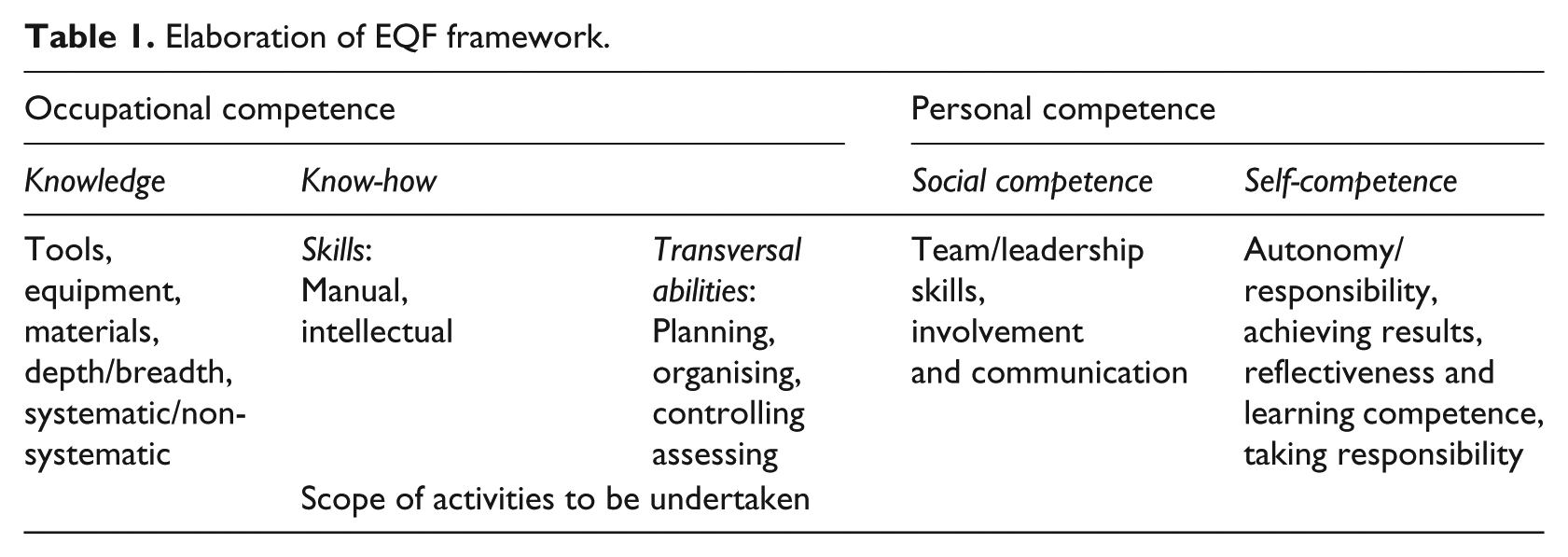
Through the application of this elaborated framework, Bolster-up was able to propose core profiles for these two occupations at different levels as a basis for negotiation and agreement by the respective social partners. At the same time, the project confirmed the main characteristics of what can be regarded as occupational – as qualitatively distinct from ‘skill-based’ – VET systems, as found in particular in Belgium, Denmark, Germany and the Netherlands:
A statutory framework built on social partnership and leading to recognised qualifications obtained through comprehensive, broad and recognised VET programmes in which learning outcomes act as educational standards;
A multi-dimensional understanding of competences embedded in these programmes, seeking to develop ‘occupational capacity’ and knowledge;
The importance of general and civic education geared to developing individuals as active citizens;
Permeability, allowing for life-long learning;
The high labour market currency of qualifications, which act as a defined entry route and contribute to the development of occupational labour markets.
These characteristics contrast strongly with the main characteristics of a VET system associated with a ‘skill-based’ system as exposed in the Bricklaying project (Brockmann et al., 2010b; Clarke et al., 2013):
A weak and employer-based statutory framework whereby employee interests are marginalised and learning outcomes are performance criteria related to defined workplace tasks;
A functionalist-behavourist conception of competence built on task descriptors and built on fragmented narrow skills sets and minimal underpinning knowledge;
The neglect of general/civic education and focus instead on remedial functional skills;
Lack of permeability;
The weak labour market currency of many qualifications and weakness or lack of operation of occupational labour markets (see Marsden, 2007).
Both the Bricklaying and Bolster-up projects illustrate the mixed success of any attempt to implement the European VET tools. Many of the difficulties confronted are associated with the importation of Anglo Saxon VET concepts into policy, leading to outcomes other than those expected by the borrower. Detailed sectoral implementation inevitably entails re-introducing elements associated with ‘inputs’ that were rejected in the initial overall design stage. Attempts at conceptual borrowing, such as substituting the English skill for more fine-grained European conceptualisations of know-how, also run up against the curricula of actual VET systems which make use of home-grown concepts.
Conclusion and speculation: the future of VET policy tools in developing a European Labour Market – how durable is the ‘Anglo Saxon VET Model’?
As evident from the construction and furniture sectors through the Bricklaying and Bolster-up projects, any attempt to implement the EQF at sectoral and occupational levels is confronted with: the qualitatively distinct nature of occupational- and skill-based VET systems; the different understanding of learning outcomes; and the need to elaborate on the original EQF framework, which was focussed on the level rather than the scope of qualifications. Before considering the implementation of ECVET and the other European tools, the incompatibility of an Anglo Saxon employer-, performance- and task-based understanding of learning outcomes with the educational-, social-partner- and occupational-based VET systems of many continental European countries needs to be taken into account. Perhaps this implies two different tool types or perhaps rather an adjustment of the Anglo Saxon model to be more in tune with its continental counterparts. Ironically, in sectors such as construction a major weakness of labour-market based Anglo Saxon qualifications is their weak labour market currency, compared with the strong labour market currency and recognition accorded to their educationally-based continental counterparts. This suggests that the effectiveness of the European tools and their successful implementation at occupational and sectoral levels in the Anglo Saxon world will rest on incorporating employee interests and greater educational content into VET systems.
In the EU more widely their success will depend on their successful adaptation to the conceptual, policy and economic conditions prevailing in the member countries. This can only be done through avoiding a ‘lowest common denominator’ approach, using the most expansive systems as a template for comparison, and expanding the EQF structure along the lines of Table 1. Such an adaptation would allow the EQF to take account of the diversity of possible and actual qualifications, while at the same time detailing the choice points available for curriculum designers (for more detail, see Winch, 2014, 2015). In this way, EQF would remain as a comparative device for allocating qualifications to levels, prompting also a more fine-grained evaluation of credit allocation within ECVET and challenging ESCO to elaborate its somewhat mechanistic approach to workplace tasks. It would also provide a benchmark for important aspects of quality in vocational education. The challenge for the European VET policy tools is to be relevant to the labour market in a way that does not prompt a flight to the lowest common denominator in occupational abilities.
Footnotes
Funding
This research received no specific grant from any funding agency in the public, commercial, or not-for-profit sectors.