




Abstract
Using qualitative content analysis and in-depth interviews, this study examines the hybrid media culture within which the pan-Arab diasporic media in the UK function as they exist physically in a liberal media system while operating virtually in a more restrictive one. The paper further investigates the hybrid patterns of interactions, spaces and politics/media logic to specify new connections between social actors within such a transnational system. It employs two conceptual frameworks: comparing media systems and the hybrid media system as starting points for developing a novel definition of the ‘Transnational Hybrid Media System’ and advancing a comprehensive discussion of its characteristics.
Keywords
Introduction
For decades, pan-Arab media outlets, either broadcasting from inside or outside their home countries, have served as transnational media systems transcending national boundaries by creating new hybrid spaces where national and transnational journalists have mutual relationships aiming to connect audiences across the Arab world and beyond (Kraidy, 2012; Valeriani, 2010). Within these transnational media landscapes, journalists serve as transnational political actors or ‘stakeholders’ by politicizing issues and mobilizing audiences and leadership (Ahmad Kamboh and Yousaf, 2020; Wade, 2011). The term ‘Arab media’ refers broadly to ‘mass media in the Middle East and North Africa (MENA) region—a region that comprises more than 300 million people in over 20 states stretching from the Atlantic Ocean to the borders of Iran’ (Richter and Kozman, 2021: xii.). Though pan-Arab media come in different forms and types, this study focuses entirely on the diasporic pan-Arab media based in the West, taking the UK as a case study. Studying the Gulf-based pan-Arab media such as Al Jazeera, MBC and AlArabiya is beyond the scope of this research.
London was crucial to the emergence of the diasporic pan-Arab daily press and the development of transnational Arabic publications from the late 1970s to the 1990s when technology, expertise and political conditions made the British capital a global hub for Arab media (Jarrah, 2008). Unlike regional pan-Arab media outlets that operate from another Arab country such as Al Arabiya, which is Saudi funded, but based in the UAE, Arab media outlets in the UK work within a unique hybrid media culture as they exist physically in a liberal media system while operating virtually in a more restrictive one, targeting audiences from all over the Arab region and diaspora. However, little scholarly attention has been paid to examining what hybridity means in this unique context.
To bridge this gap, the study employs content analysis and in-depth interviews aiming to advance the Transnational Hybrid Media Systems concept by examining the significant decline of state-funded Gulf media outlets operating inside the UK (Jarrah, 2008), whose long history dates back to the 1970s oil boom that increased the Gulf states’ wealth and ambition in media investment abroad. Since the factors that made London a significant hub for Arab media have now lessened in importance or reversed in effect due to many political, financial and audience preferences changes (Jarrah, 2008), this study investigates the hybrid spaces, interactions, patterns of politics/media relationships, and old/new media logic adopted by these media outlets, aiming to specify how the new connections and changing power dynamics between social actors within such a transnational system have led to their gradual decline in relevance and impact. Since journalists are the key news actors, the study further explores how Arab journalists working for UK-based pan-Arab media build their agenda with regard to the regional Arab politics and how their agenda is highly influenced by the various social, political and economic contexts of both their host and home countries, including the state intervention, ownership, funding schemes as well as the development of their media markets. To achieve this, the paper employs two conceptual frameworks: comparing media systems (Hallin and Mancini, 2004) and hybrid media systems (Chadwick, 2013) as a starting point, connects them together, and reconceptualizes them in the diasporic context aiming to develop a new understanding for the novel concept of the Transnational Hybrid Media System.
Conceptualizing hybridity in media systems
Hybridity is a broad concept that was conceptualized by several scholars to refer to ‘an association of ideas, concepts, and themes that at once reinforce and contradict each other’ (Kraidy, 2005: iv). When connected to international media, Kraidy (2005) proposes hybridity as the cultural logic that emerges from the intermingling of people and media across different cultural boundaries, shaped by communication dynamics, uneven power relations and the broader political economy. To reframe hybridity within a media system, Chadwick defined the ‘hybrid media system’ as a holistic approach that ‘is built upon interactions among older and newer media logics—where logics are defined as bundles of technologies, genres, norms, behaviours, and organizational forms—in the reflexively connected social fields of media and politics’ (Chadwick, 2013: 4). In so doing, media logic points to ‘how the discrete interactions between media elites, political elites, and publics create shared understandings and expectations about what constitutes publicly valued information and communication’ (Chadwick, 2013: 20).
In such a hybrid media system, communication flows become multidirectional, allowing new political discussion models to emerge (Marchetti and Ceccobelli, 2016). The political information cycles involve power relations among various actors that shape the news meaning-making and witness intervention by non-elite citizen activists whose information is integrated by mainstream newspapers and broadcasters (Chadwick, 2017). However, this former understanding of hybridity in terms of power relations among political actors, media actors and publics associated with older and newer media (Chadwick, 2013) is only limited to understanding media operating in one media system, and thus was challenged by other scholars when applied to transnational media contexts. In the diasporic interactive space, hybridity does not only involve online and offline interactions between political and non-political, diasporic and non-diasporic actors (Arafat, 2022; Laguerre, 2005). The mutual transnational collaborations and interactions between the different actors propose conjoining professional roles, hybrid institutional logic as well as interchanging diasporic journalism/activism strategies and practices that offer a hybrid conceptualization of journalism (Porlezza and Arafat, 2022: 1885).
Drawing on Chadwick’s (2013) work, Pyrhonen and Bauvois (2020) have mentioned the Transnational Hybrid Media System with no clear definition in their study, which examines the French and American election-related conspiracy stories as transnationally reported and ‘producer’ generated campaigns channelling news-framed content between mainstream and ‘countermedia’ outlets. They examined conspiracy stories as ‘a specific type and format of news-framed narrative subject matter that producers of reinformation rely on in the transnational context of hybridly mediatized presidential elections’ (2019: 6). However, their paper did not offer any new definitions or explanations of the dimensions the transnational hybridity as a framework entails. This requires further investigation of the concept to be usable by future researchers in different contexts. Based on this, our study aims to examine and expand the current understanding of hybridity within the diasporic state-affiliated pan-Arab media contexts to identify the hybrid spaces, interactions, actors and political/media logic it involves.
Comparing Arab media systems
The paper secondly employs comparing media systems, the theoretical framework proposed by Hallin and Mancini (2004) to analyse different media systems in Western countries which they grouped into three models: the Mediterranean/Polarized Pluralism model, the Liberal or North Atlantic model, and the Democratic Corporatist or North/Central European model. To this end, Hallin and Mancini introduced four dimensions of comparative media system analysis: ‘the structure of media markets, including, particularly, the degree of development of the mass circulation press; the degree and form of political parallelism; the development of journalistic professionalism; and the degree and form of state intervention in the media system’ (2004:296). However, the connections between the variables in the media system and the political system cannot be viewed as a mechanistic, cause-and-effect relationship (2004:296).
The framework received criticism for being inapplicable to non-Western countries, addressing relations between elite media and elite politics, and neglecting the roles of information and communication technology in media systems today (Curran, 2011; Mattoni and Ceccobelli, 2018; Nielsen et al., 2013). Mattoni and Ceccobell revised and expanded the framework suggesting some digital media-related indicators through which each dimension could be measured, as well as adding a fifth dimension, grass-roots participation, which results from the ‘combination of media and the bottom-up participation of citizens’ in a media system (2018:9).
In their latest book, Arab Media Systems, Richter and Kozman revisited Hallin and Mancini’s framework and suggested seven dimensions for comparing and contrasting media systems in 18 Arab countries, including the state’s approach to media, media ownership, fragmentation and polarization, technological advancement and innovation, and transnational mobility and connection (2021:323). Following these dimensions, they explained how the performance of Arab media workers is influenced by various unwritten regulations and self-censorship induced by the state’s approach to media, how media privatization does not necessarily result in media pluralism, how conflict and wars led to the fragmentation of audiences, journalists and content, how media systems differently adopt technological advancement and innovation, and finally how trans-Arab connectedness and outreach of media outside their national borders reflect the interchanging relations between the countries and their media systems. Even though some of these dimensions apply to pan-Arab media in the UK, mainly in relation to fragmentation of audiences, journalists and content, others need to be re-examined, refined and expanded to study and conceptualize the transnational hybrid media system within which pan-Arab diasporic media work – a system that relates to media that exist physically in a liberal media system and operate virtually in a restrictive and polarized media system.
The pan-Arab diasporic context imposes new forms of hybridity, new interactions between local, transnational and international actors, as well as different relations between politics and media. In light of that, this study draws upon the four dimensions of media systems proposed by Hallin and Mancini (2004) as well as Chadwick (2013) and Arafat (2021) to understand hybridity. It aims to conceptualize the transnational hybrid media system by answering the following main research questions.
Mapping pan-Arab media in the UK
Due to the common language, the MENA region has always been a shared hub of mobility for media producers and journalists with a transnational pan-Arab orientation that shapes both national and pan-Arab politics (Kraidy, 2012; Richter and Kozman, 2021). The history of the pan-Arab media dates back to the 19th century. Following the Egyptian revolution in 1952, Egypt launched its Voice of the Arabs, one of the first pan-Arab radio services to be transmitted across many Arab countries creating imagined communities and a sense of brotherhood (Yushi, 2012). Since that time, the pan-Arab media were by and large subject to forms of control by Arab governments and ruling regimes to promote certain political interests. With the aim of encouraging a sectarian agenda to counter the Iranian impact in some parts of the Arabic world, for example, the Saudi royal family expanded its power to the pan-Arab media using various mechanisms of control, including ‘ownership, sponsorship, cooptation and coercion to keep Pan-Arab media in line with its policies’ (Yaghi, 2017: 39). As Rugh (2007) argued, Arab diaspora media targeting audiences in the Arab world follow the basic rules of media systems in the Arab countries although they might not be subject to the same constraints.
London was crucial to the emergence of the pan-Arab daily press and the development of transnational Arabic publications from the late 1970s to the 1990s when technology, expertise and political conditions made the British capital a global hub for the Arab media (Jarrah, 2008). Two of the pan-Arab publications of that time were Asharq al-Awsat (established in 1978) and Al-Hayat (founded in 1988). The first is Saudi owned and the second was Lebanese owned and later bought over by Saudi businessmen close to the Saudi royal family. The early success of the London pan-Arab press led to the city being selected as ‘a launch-pad for the first serious Arab forays into satellite news broadcasting’, including the pioneering Saudi-sponsored MBC channel that first established its initial office in London in 1991 and then moved its headquarters to Dubai in 2001 (Jarrah, 2008).
The UK-based pan-Arab media come in different forms and types due to their diverse political ideologies, advocacy agendas, business models, home- and host-state relationships, as well as target markets which can be mapped out as following: (1) state-funded and/or state-affiliated pan-Arab media outlets such as Saudi Arabia’s Elaph, the Emirati-affiliated Alghad, the pro-Libyan Al-Arab, and the Qatar affiliated Al Arabi Al Jadeed and Al-Quds al-Arabi; (2) pan-Arab media affiliated with political parties and/or Islamist groups (groups claiming Islam as their political ideology) such as the Al-Hiwar TV channel (Muslim Brotherhood); (3) small-sized opposition Arab diasporic media outlets established by exiled political activists to advocate for democratic reforms in their homeland such as the anti-Bahraini regime Voice of Bahrain/Sawt al-Bahrain created by political exiles; and (4) community-focussed diasporic media outlets targeting mainly Arab migrants and expatriates in the host country. While previous studies focussed on small-sized opposition advocacy-oriented diasporic media (Arafat, 2024; Arafat, 2021), this study investigates pan-Arab, UK-based, Gulf-affiliated media outlets.
It should be noted that the importance of Arab diasporic media in the UK has been on the wane in recent years. The closure of these media outlets or their move back to their homeland gives this study special significance to understand the changing power relations in the current pan-Arab media scene. For example, the Saudi privately owned Al Hayat newspaper ceased publication in 2020 due to economic difficulties and lack of funding. The business model based on readership was not sufficient for the paper to survive. The privately owned pan-Arab newspapers stuggled financially with the advance of digital spaces. The state of Qatar acquired the Al Qdus Al Arabi newspaper in 2013 (Galal, 2021). This has helped the newspaper survive economic hardships, but resulted in its famous and controversial editor in chief and publisher Abd Al Bari Atwan leaving the paper.
Research methods
The study employs two qualitative research methods. First, 12 in-depth interviews with editors and journalists (8 males and 4 females) working for UK-based Pan-Arab media outlets were conducted. In-depth interviewing was employed as a method to offer first-hand accounts of diaspora journalists’ perceptions of the different sources of influence, actors, funding business models, and professional logic that shape their news coverage of Arab politics and provide a historical perspective on the changes that pan-Arab media have witnessed over time, which is underresearched in literature. Hence, diaspora journalists’ inside perspectives are crucial in understanding the transnational media system.
The interviewees ranged in age from 30 to 60 years and had at least 10 years of experience in journalism. Many of the participants served as co-founders, heads of editorial departments or managing editors of leading state-owned pan-Arab newspapers and TV stations, including the Al Hayat, Al Arabi Al Jadeed, Al Ra’y Al Youm, Al Shareq Awsat and Al Quds Al Arabi newspapers as well as the Al Arabi and Al Ghad diasporic TV stations and their sister websites. The sampling followed a purposive snowball technique where only journalists currently working for pan-Arab media in London were interviewed and asked to recommend other potential participants relevant to the study. Participants were asked four main sets of questions about: (1) their journalistic background and professional experience of working for pan-Arab media outlets; (2) their perceptions of the changing role of pan-Arab media in the UK over time and the various local and transnational political, economic and organizational actors and sources of influence that shape the hybrid media system they work in, including the influence of state intervention, target markets, audience preferences and hybrid politics/media logic they follow; (3) their perceptions of how their pan-Arab newsroom builds its editorial agenda with regard to regional Arab politics and how this agenda is shaped by the news outlet’s ownership and state-funder’s political leanings; and (4) the constraints of their daily news reporting routine on Arab politics from the diaspora.
A thematic analysis was used. Drawing upon Webb’s thematic analysis guidelines (2017), we first employed open coding to identify the recurring ideas and themes that emerged from the interview data with regard to the participants’ insights on their news outlets’ hybrid media/politics and online/offline logic, structure of the media market, political parallelism, and influence of state intervention as guided by both Chadwick and Hallin and Mancini’s frameworks. To achieve theoretical saturation, we then followed a ‘constant comparison process’ that involved re-reading the transcripts data again until no new themes were found (Webb, 2017: 1344). Subsequently, we grouped codes into categories derived from both data and theoretical frameworks and developed new connections among categories using axial coding to advance theoretical extensions (Corbin and Strauss, 2015) and build connections.
In the second step, the study adopted qualitative content analysis to compare diaspora journalists’ perceptions and claims (reported in interviews) to their actual news reporting practices aiming to answer the third research question. All of the editorials, economic analysis and opinion pieces published by the UK-based, Saudi-affiliated Asharq Al-Awsat, Emirati-affiliated Alghad and Qatari-affiliated Al Arabi Al Jadeed websites between 15 September 2021 and 31 October 2021 on the following topic were chosen for analysis: the Tunisian president Kais Saied’s actions against the Islamist Ennahda movement, including the suspension of parliament, the dismissal of the prime minister, appointment of a new government, and introduction of transitional governing rules which his opponents described as ‘a coup’. This resulted in a total data set of 50 editorials and opinion pieces collected from the news outlets’ digital archives, all of which were analysed. In particular, the selection of editorials, opinion articles and analysis pieces for our content analysis was crucial because the interviewed journalists and editors working for the pan-Arab media claimed diversity of opinion in their produced news content and we wanted to examine whether their perceptions of content diversity matched their actual practice.
We have chosen these three news outlets as they remain the three most prominent pan-Arab news outlets still operating from London despite the decline of other pan-Arab media in the UK. Their political affiliation reflects the geopolitical regional divide between Saudi Arabia (Asharq Al-Awsat), United Arab Emirates (Alghad) and Qatar (Al Arabi Al Jadeed). In addition, we did not restrict the interviews to journalists who worked in these three outlets only because we wanted to capture the wider picture. While we interviewed participants from diverse pan-Arab media outlets to collect diverse insights, only three news outlets were chosen for content analysis because it would have been difficult to analyse news coverage from all the media organizations from which we interviewed participants. Besides, the editorial, opinion pieces and analysis articles we analysed were produced by journalists and editors who do mostly influence and mirror the editorial agenda within their own newsrooms.
Tunisian president Kais Saied’s anti-Ennahda Islamist party decisions was carefully selected as a topic for analysis based on various criteria. Firstly, it was timely and had news salience and significant impact on Arab politics and regional relations. Secondly, it allowed us to examine the differences between the political ideologies, editorial policies and news agenda of the three selected diasporic news outlets to understand how they positioned themselves regarding regional politics and power relations (the Qatari Turkish side supporting the Muslim Brotherhood or the contradicting Saudi, Emirati, Egyptian and Bahraini coalition against them) and whether they promoted the same political agenda as their home countries and its Arab allies. The qualitative content analysis aimed at collecting data around: (1) Who wrote the news items in the research sample and where?; (2) Who are the main actors in the coverage? How are they presented?; (3) What are the prominent issues tackled in the coverage of the selected topic?; and (4) What objectives are used to describe President Qaes Al Saed’s actions, the current democracy status in Tunisia, and Arab intervention in Tunisian politics?
The qualitative content analysis was conducted using Nvivo 12 Pro Software. We first created an initial open-ended coding sheet following Mayring’s inductive category development approach (2000). In this early step of analysis, ‘pre-established codes, built from engagement with past literature, are guiding lights at earlier coding phases of a study and are adjusted as the researcher engages in with the texts being studied’ (Smith, 2017: 1859–1860). In so doing, we first followed a deductive approach where adjectives, advocate frames, presentation of actors and angles of coverage were analysed in each article, searching for pre-established initial themes related to journalistic professionalism logic including diversity of opinion and degree of autonomy or political parallelism, as guided by Hallin and Mancini’s theoretical framework (2004). Next, a close reading of the text was employed leading to inductively identifying new patterns and grouping them into more abstract categories resulting in four news content related characteristics (e.g., mirroring the political stand of state funders, demonizing and delegitimizing the state opponent, pseudo pan-Arab diversity, and promoting conspiracy theories, etc). The relevant categories were then clustered into two bigger groups that best described them (e.g., transnational political parallelism and weak journalistic values). We conducted an inter-coder reliability check to highlight any possible deficiencies in the initial coding scheme or category definitions. While coding was created by the first author, 20% of the selected news sample (ten articles) were coded by the second author who speaks Arabic.
Research findings
Understanding changes in pan-Arab media in a transnational hybrid system
To answer RQ1 and RQ2 and examine the different characteristics of the transnational hybrid media system and the diverse forms of hybridity it entails, this section first discusses the political, economic and technological factors that contributed to shaping the role of pan-Arab media in the UK, offering some historical and current perspectives. It further explains how diaspora journalists build their news agenda towards regional Arab politics and how the different political and organizational sources of influence (e.g., state intervention, interstate relations, digital technologies, etc.) impact their agenda building process in the transnational hybrid context.
The participants explained that the main purpose of establishing pan-Arab media in London was political, aimed at serving regional political agendas. They reported the late 1970s as the practical start of Arab journalism in London and the 1980s and 1990s as its golden time. Some of the diasporic pan-Arab media outlets were created to escape from governments and limitations on freedom of expression in the Arab region while others were directly funded by Arab countries that did not expect a commercially profitable outcome. Journalist 1 argued on how choosing London for establishing pan-Arab media was a strategic decision because of its political hegemony in the Middle East and the significance of London as a European media hub that offered many facilities to host foreign media outlets. Journalist 8 explained how Arab regimes were interested in investing in pan-Arab media in the UK: Historically, the earliest Arab media in London was Al-Arab newspaper that was anti-Al Qazzafi’s regime [in Libya] at the beginning, then it harmonized with the regime because of its need for financial support. Then, Saudi Arabia found it important to have a newspaper in London. This act has both a political and intellectual payload, so Al Sharq Al Awsat and Al Majala magazine were founded.
Additionally, participants reported different sources of influence shaping the transnational hybrid media system. They can be grouped into four categories as follows:
Influence of hybrid media/politics logic
Operating in a changing transnational hybrid media system, participants reported significant influence of hybrid media/politics logic (Chadwick, 2013) on the UK-based pan-Arab media. The evolving connections between media and political systems in the Arab region have impacted and reshaped the role of the pan-Arab media in the UK over the past decades. They elaborated on the importance of digital transformation, interstate politics and new business models, which had been driving many pan-Arab organizations to move back from the diaspora to the Arab region. For example, Journalist 1 explained that many of these organizations that are going back to their home countries are state-owned or state-affiliated media. They are returning to countries that align with their political and editorial agenda, either to the sponsor state itself or to countries allied with the sponsor. For instance, the Qatar affiliated Al Arabi TV (sister media outlet of Al Arabi Al Jadeed) transferred its headquarters back to Qatar in August 2022 after operating in London for almost a decade. A possible reason for this, according to Journalist 1, is the changing hegemony, power structure and political coalitions in the Arab world: Pan-Arab media came to London because there was a hidden conflict between some Arab regimes and they wanted to address their audiences with media published abroad because the formal mainstream Arab media were subject to significant restrictions. They wanted to create media outlets that have an influence on the Arab public opinion and they succeeded in that. Al Sharq Al Awsat and Al Hayat had considerable readership in the Arab world.
Many participants further reported how pan-Arab newspapers, in their golden era, were able to exercise a great degree of editorial freedom and offered specialized, in-depth coverage and analysis using a language distinct from that used by local newspapers which contributed to their prominence and appeal among the elite in the Arab world. To this end, Journalist 5 explained that the physical distance of migrant pan-Arab media is no longer meaningful, so Gulf countries that hold a dominant position in Arab media have now decided to ‘bring back those tools into the national interest’: Since 2015 and onward, the physical presence abroad, which allowed diasporic pan-Arab media to be a breath of fresh air, has unfortunately gone. The political scene has changed and the localized agendas and divides within the political Arabic sphere has narrowed down to two main contradicting blocks.
Influence of technological advancements
Moreover, many participants reported digital transformation and the development of media technologies as other factors contributing to the decline of the UK-based pan-Arab media that used to depend mainly on their distant geographical location as well as the circulation revenues of its print copies in the Arab region as a business model. Journalist 1 further argued that the pan-Arab media lost the necessity that justified its existence beyond geographical borders as online media can be created and accessed anywhere now. To this end, ‘journalists no longer need to relocate to the diaspora for the purpose of printing and distributing their newspapers to the target markets’. Instead, they can establish a social media page or a news website, reach the entire Arab world online, and bypass the printing and production limitations that were once enforced by their home countries. Unless the pan-Arab media are now state-funded or dependent on private funding, they would find it hard to sustain their operations since they can no longer rely on traditional revenue streams including hard copy sales. Journalist 1 also noted the dominance of new media logic over older ones (Chadwick, 2013) as many pan-Arab newspapers discontinued their print editions: The Arab migrant press is on its last legs. The print pan-Arab newspapers in London do not sell ten copies now. The era of print migrant pan-Arab media is over in my assessment since the beginning of [the] 2000s. Social media abolished the ‘migratory’ feature of diasporic media. If newspapers will put their content online, what’s the difference if it is issued in London or inside the Arab world? No difference.
Nonetheless, the difference is surely pressing when it comes to non-state-funded media outlets in the diaspora. Journalist 7 explained that some Arab opposition groups founded digital websites and online TV channels, but they are ‘still weak because they offer one colour and line of oppositional news that challenge media in their homelands’. Although they operate in London, they are not pan-Arab in the true sense of the word (targeting Arab audiences across Arab states, with a pan-Arab editorial agenda), but rather arms for national oppositional movements within border states, with limited transnational reach.
Influence of state intervention and interstate relations
In the hybrid diasporic space where the pan-Arab media faces influence from different countries, the participants detailed how political parallelism and state intervention (Hallin and Mancini, 2004) as well as geopolitics and interstate conflicts between the host and home states and their neighbouring countries serve as key influencing factors in shaping the transnational hybrid system within which they operate. On one level, Journalist 1 reported that there is limited diversity of opinions in some diasporic state-funded pan-Arab media outlets: The problem is when you are funded by a certain country, you are not only following this country’s agenda but also the agenda of its friends and allies. You might also be required to attack the enemies of this country which might lead to losing your independence and impartiality.
On a second level, many participants described how news reporting in the transnational media system entails influence not only from the funding state, but also from its Arab neighbours whose political disputes and geopolitical conditions with the media’s funding country shape news production in two ways: first, Journalist 8 explained how self-censorship has always been a common practice among many pan-Arab journalists even in the old days. Their editorial caution stemmed from the desire to avoid critiquing the policies of specific Arab states to prevent potential censorship of their print copies in those regions because pan-Arab newspapers were printed not only in London, but in publishing houses in Arab capitals as well. Second, interstate relations with neighbour states could also hinder or facilitate access to information and news sources where countries tend to ban the correspondents and offices of pan-Arab media funded by certain regimes. Journalist 7 highlighted banning the Qatar funded Al Arabi TV offices in Egypt as a demonstrative example of how interstate relations can exert additional pressure on the daily news production processes of pan-Arab journalists who depend mainly on their correspondents inside and outside the Arab countries to gather information and visual footage.
On a third level, political interests and interstate relations between both the host and funding countries also impose additional restrictions on the Arab journalists operating in the diaspora (Arafat, 2021; Chaudhary and Moss, 2019). However, none of the participants reported experiencing any kind of political pressure or interference in their journalistic work or news agenda by the UK authorities, or encountering any limitations related to getting licences to establish Arab media outlets or hire Arab journalists to work in London. To this end, Journalist 3 explained that ‘the UK’s communications regulator Ofcom only interferes with our work if there is a complaint. We never heard of its pressure on any media or journalist for the sake of a certain country’. In so doing, participants reported being obliged to follow some legal regulations related to defamation laws, reporting sensitive/violent content, especially graphic images of human casualties, or topics that might violate human rights, which meant abiding by the host country’s regulations and legal jurisdiction. While the UK does not seem to impose its political agenda on the pan-Arab media outlets, the influence of the host state’s intervention cannot be ignored in other political and geographic contexts. For example, Syrian diaspora journalists in Turkey have been encountering censorship imposed by Turkey as an active player in the Syrian conflict, restricting them from publishing stories about Turkish interference in northern Syria (Arafat, 2021).
Influence of hybrid actors and interactions
Furthermore, when it comes to building news agenda around regional Arab politics and transnational conflicts, the participants used different legitimizing narratives to rationalize the influence of various local and diasporic, state and non-state actors, whose interactions in the transnational hybrid media system shaped news coverage to a great extent. Hence, many participants reported operating in hybrid spaces between two countries where hybrid interactions and collaborations were necessary among various local and transnational actors for newsgathering and production purposes. According to Journalist 7, diaspora journalists interact with diverse actors including local citizen journalists, fixers, civil society workers, politicians and whistleblowers in Arab countries, mainly through social media, to report on ongoing events from a distance. They also depend on many diaspora activists and experts for further analysis and investigation. However, many participants argued that currently there was no major difference between state-funded journalism published in the diaspora and their local counterparts published within their respective regions in terms of political autonomy and margins of editorial freedom. Journalist 5 explained how the state-affiliated pan-Arab media’s presence in the West ‘did not present a new agenda as they brought along their agendas, conclusions and opinions about issues and they worked in this politicized context aligning themselves with either left or right, embracing or opposing political Islam movements, or advocating for nationalism or anti-nationalism’.
On the contrary, many journalists justified political parallelism with funding states, arguing that every media organization represented the viewpoint of its funders and achieving full editorial autonomy is impossible even in Western media. For example, Journalist 2 reported: I do not see a contradiction between relying on state funds and producing professional media. Whether you work in an Arab or foreign country, each news organization has a clear political editorial agenda and the journalist chooses whether to work there or not. I do not see any restrictions/pressures on journalists.
Similarly, Journalist 3 believed it was important to differentiate between the news organization and individual journalists. Individuals try to stay professional, but the news organization is not a charity, it is a business that tries to sell a product. He concluded: ‘You cannot be free if you recieve funding from a certain state, party, or opposition group’.
The news content of UK-based pan-Arab media
To answer RQ3, the paper investigates the pan-Arab media’s news coverage of a relevant political topic to examine the professional logic these news organizations follow in their reporting pertaining to Hallin and Mancini’s (2004) third dimension of media systems about journalistic professional values and its coverage-related representational practices. Thus, news coverage of the Tunisian president’s decisions to freeze the work of the parliament, suspend the immunity of all parliamentarians, and dismiss the prime minister was selected as a case study. Qualitative content analysis of editorials, opinion articles and economic analysis pieces in the three news outlets (Asharq Al-Awsat, Alghad and Al Arabi Al Jadeed) identified four content-related characteristics that reflect how the pan-Arab media set their news agenda and how they position themselves with regard to regional Arab politics and power relations (Harb, 2019). The characteristics include: (1) political parallelism (a. mirroring the politics of state funders; and b. demonizing/deligitimizing the state opponent); and (2) weak performed journalistic values (a. pseudo Pan-Arab diversity, and b. promoting conspiracy theories). Such characteristics are translated into a series of editorial selections of adjectives, advocate frames, presentation of actors, and angles of coverage in the news articles as follows.
Transnational political parallelism
a. Mirroring the political stand of state funders: The qualitative content analysis showed how the three news outlets under study promote the same political ideology as their state-funders, providing contradicting understanding of the concepts of democracy, revolution and Arab-state intervention. Adjectives are used to ‘colour’ the way the topic is presented, impacting whom the audience would sympathize with (Boudana, 2016; Fisher, 2016). For example, what is described as ‘robbery of power’, ‘military coup’, ‘counter-revolution’, ‘a leap into the void’ and ‘conspiracy against democracy’ by opinion writers in the Qatar-backed Al Arabi Al Jadeed, is described as a ‘fight against corruption’, ‘rescue before collapse’ and a ‘new Tunisian dawn’ by their counterparts in the Saudi-affiliated Asharq Al-Awsat and Emirati-affiliated Al Ghad outlets. Consistently, the Tunisian President Kais Saied was repetitively associated with contradictory adjectives describing him as a ‘saviour’ in the Saudi and Emirati outlets or as a ‘dictator’ in the Qatari newspaper. The following translated excerpts are demonstrative examples of how the president was either heroized or demonized for his anti-Ennahda policies in the different outlets:
The man [President Saied] does not have a political project, no vision, nor a program. He is a populist politician par excellence, no less bad than former US President Donald Trump. . .. A president haunted by narcissism that has no foundations, who took Tunisia as a hostage, [and] disrupted its progress (Opinions, by Osama Abul Arshed, 30 July 2021, Al Arabi Al Jadeed) They wanted the nominal president, but he [President Saied] became the voice of the Tunisian citizen. Today he is the real president, and he has an opportunity to reform what the government and parliament have failed in. In fact, what he is doing is saving the Tunisian regime, and Tunisia, the country, from the chaos that it witnessed. (Opinion, by Abdel Rahman Rashed, 27 July 2021, Asharq Al-Awsat)
In particular, resonant headlines used by opinion writers served an important role in showing a clear stand on the president’s policies: Tunisia returns to the bosom of Arab tyranny (Story headline, by Ghazi Dahman, 1 August 2021, Al Arabi Al Jadeed) The fall of the last ’Brotherhood’ fortress (Opinion, by Abdel Rahman Rashed, 27 July 2021, Asharq Al Awsat)
These different opinion pieces clearly speak to the political divide in the region.
b. Demonizing and delegitimizing the state ‘opponent’: The Tunisian president, the prime minister, Mohamed Ghannouchi, and his government, the Arab intervention and the Tunisian people are the most recurrent actors identified in the opinion articles. The depiction of regional political conflicts in terms of ‘us’ versus ‘them’ and ‘good’ versus ‘evil’ and siding with one party is a main characteristic of the opinion content in the three news outlets. While opinion writers and economic analysts in Asharq Al-Awsat and Al Ghad celebrated the Tunisian president giving constitutional legitimacy to his actions as a step towards defeating the Muslim Brotherhood and the Islamists’ rule in the region, most of Al Arabi Al Jadeed’s opinion content was dedicated to defending Islamists as democratic actors delegitimizing the president’s policies and accusing the Tunisian people of having a ‘shallow understanding’ of the situation while celebrating the Islamists’ defeat:
It is not surprising that the “Brotherhood” has fallen in Tunisia now, but rather years later than its expected date. Their downfall was due to their being partners in government, and they were associated with chaos, assassinations, and deliberate obstruction operations to thwart government work after it became outside their control (Opinion, by Abdel Rahman Rashed, 27 July 2021, Asharq Al Awsat). President Kais Saied’s coup against the constitution and his monopoly of power represent a major relapse for all movements in the Arab world (Opinons, by Lamis Andony, 1 August 2021, Arabi Al Jadeed) In the era of the Ennahda Party, Tunisia did not witness the opening of any projects or development, but rather setbacks at all economic levels, including agriculture, industry and tourism. The Brotherhood rule is usually suitable for demolition and not for construction, and there are many examples in which it failed to provide developmental achievements (Opinion, by Hafez Al Barghothy, 28 July 2021, Al Ghad)
In particular, fighting Islamists was portrayed by Asharq Al-Awsat’s opinion writers as a mutual goal for all of the Arab countries against corruption, comparing the fall of Islamist rule in Tunisia to what happened in Egypt and Libya: Until this moment, Ghannouchi is not aware that the reason for which the Egyptian masses came out on June 30, 2013, is the same that drove the Tunisian masses last week, and if Egypt has been patient with them for a year in power, the Tunisians have been patient with them for ten years. (Opinion, by Sawsan AlShaer, 1 August 2021, Asharq Al-Awsat).
Weak journalistic values
a. (Pseudo) pan-Arab diversity: Qualitative content analysis further demonstrated how the diversity of the nationalities of reporters and opinion writers in the three news outlets did not necessarily reflect diversity in content, opinion or political stand in the published articles. While Al Arabi Al Jadeed published opinion pieces by Palestinian, Egyptian, Moroccan, Lebanese, Tunisian, Jordanian and Syrian writers, almost all of the opinion articles showed similar support for the Ennahda (Islamist) movement and similar attacks against the Tunisian president and his policies, in line with the newspaper’s editorial policy. Similarly, the space given by Asharq Al Awsat to its Saudi, Lebanese and Egyptian opinion writers did not translate into producing diverse content that criticized or contradicted any of the Saudi politics.
The content analysis also revealed that the lack of diversity in opinions and political views reflected on limited diversity in the angles of coverage used by opinion writers to analyse the political situation in Tunisia. The prioritization of the ‘responsibility’ angle was identified in the opinion articles by the news outlets. All of the opinion articles in Asharq Al-Awsat supported the Tunisian president’s decisions, celebrating the president’s claim of power and leadership, and putting the responsibility of destroying the Tunisian economy on the Islamists and their policies, offering no space for diverse or contradictory opinions. While the majority of the opinion pieces in Al Arabi Al Jadeed criticized the motives and consequences of the Tunisian president’s decisions defending the Islamist rule and giving justifications for why it was not successful, only a couple of opinion articles offered less biased analysis of the problem, putting part of the responsibility on the failing policies of the (Islamist) Ennahda movement while condemning the president’s actions to overthrow it: It has become clear that the goals of Kais Saied and the Ennahda movement on the one hand contradict the goals of the street, and the Tunisian revolution in general on the other hand. . .. These are the goals of the Tunisian revolution, and the goals of all the revolutions and protest movements in the region, and they are the goals from which all forces and all political actors on the Tunisian and regional arenas, including Kais Saied and the Ennahda movement, have escaped. (Opinions, by Hayan, 27 July 2021, Al Arabi Al Jadeed)
As these quotes demonstrate, the one-sided argument became the dominant feature in these opinion pieces. Journalistic values of balance and fairness were missing.
b. Supporting conspiracy theories (not backed by evidence in most cases): Many opinion articles, mainly in the Al Arabi Al Jadeed newspaper, portrayed the Arab intervention in Tunisian politics as part of a conspiracy against democracy in the country led by the United Arab Emirates, which was described by one of the opinion writers as ‘the first supporter of coups in the region’ (Opinions, Mostafa Abdel Salam, 27 July 2021). This editorial agenda is in line with Qatar’s position in regional politics and its troubled relations with UAE, Saudi Arabia and Egypt, which announced the severance of their diplomatic relations with Qatar in 2017 because of its support for Islamist groups and extremist organizations. Accusing the alliance of thwarting the democratic experiment in Tunisia and raising concerns about the Gulf money injection in Tunisian politics was a recurrent theme in Al-Arabi Al-Jadeed’s opinion pieces without presenting fact-based evidence, reports or statistics in most of the cases. In so doing, opinion writers employed various advocate frames using persuasive explanations that involved particular ways of interpreting topics and conflicts and promoting certain viewpoints rather than straightforward information formats (Tewksbury et al., 2000). The following excerpt is an illustrative example:
It is not possible to skip over the role of the regional powers, which are concerned with drying up the sources of the Arab Spring, in the maturation of the Tunisian event, as the UAE-Saudi-Egyptian alliance has spared no effort, over the course of the year to abort the Tunisian democratic experiment, as it is the source of the “democracy contagion” that afflicted the region and pushed its people to take to the streets and demand freedom, democracy, dignity and social justice (Zawaya, by Mohammed Ahmed Banes, 29 July 2021, Al Arabi Al Jadeed).
As indicated in the quote above, the 2011 Arab revolts and their aftermath have been used as a tool in the political rivalry between Qatar and Saudi Arabia.
Conceptualizing transnational hybrid media systems: insights from state-affiliated pan-Arab media in the UK
The study revisits and expands the hybridity and comparing media system concepts by re-examining them in the diasporic media context. Its main contribution lies in advancing our understanding of diasporic pan-Arab media on several connected levels. Our findings propose three main characteristics of the Transnational Hybrid Media System within which the state-affiliated pan-Arab media in the UK function. First, findings from content analysis and interviews with journalists and editors demonstrated how the transnational hybrid media system is not linear as it involves an interplay of various local and transnational actors and sources of influence whose different political and media logic complement and influence each other’s paths. Five main sources of influence were detected in the case of the Gulf-affiliated pan-Arab media in the UK: state intervention/influence, interstate relations, technological advancements, changing target markets and audience preferences, as well as the news organizations’ own professional logic.
As our findings demonstrated, building editorial news agenda and practising forms of self-censorship in these media outlets is not only influenced by the political agendas of the funding countries, but also their diplomatic relations with their allies and enemies, resulting in political parallelism in most of the cases. Journalists working for a Saudi pan-Arab media house might find it hard to criticize Egyptian or Emirati politics because of the current political alliance among these countries, but might find it easier to criticize Qatar, on whom these countries had imposed a 3-year diplomatic, trade and travel boycott (Wintour, 2021). Also, diaspora journalists find it hard to send correspondents, build editorial headquarters, and access resources in countries with a political agenda contradictory to their funding state. This explains how interstate conflicts led to the fragmentation of audiences, journalists and content in the pan-Arab media scene (Richter and Kozman, 2021). The digital infrastructure and licences provided by the host country might present another source of state intervention on diasporic media (Chaudhary and Moss, 2019).
Therefore, it can be argued that the transnational hybrid media system, in which state-affiliated Arab outlets based in the UK operate, aligns closely with Hallin and Mancini’s (2004) polarized pluralist media model. However, that is to be contested. Firstly, hybridity and transnationalism manifest themselves in political parallelism being extended beyond media organizations affiliated to the politics of the country of operation (host country) or party to assuming the politics of the country or parties on the receiving end of the message (home country). Secondly, the hybrid transnational model identifies with two different states’ intervention at one time – the host state jurisdiction and the home state sponsorship. Hence, to fully understand the transnational hybrid media system, a proper understanding of the local media system within the home country is first required. This expands Hallin and Mancini’s (2004) understanding of state intervention in relation to the public money put into public broadcasting, regulations of media concentration, investments in digital infrastructure, and policies on digital media actors operating inside one country.
While digital technological advancements and social media platforms empowered and accelerated the transnational diffusion of journalism beyond borders, they also led diasporic media to lose their unique feature and purpose connected to their geographical distance leading to a huge decline in their print copy sales. This, along with the changing geopolitics and interstate relations/conflicts between dominant countries in the Arab region, have resulted in a decline in the importance of the diasporic pan-Arab media roles. Also, news organizations’ professional logic is another actor in shaping news in the transnational hybrid context. Although pan-Arab news organizations might claim independence and diversity of opinions on their news websites, the content analysis of opinion articles showed how their claims do not match their actual performance as they give extensive space to voices that clearly reflect the publications’ political leanings and the funding states’ ideologies, presenting forms of political parallelism and weak journalistic values in many of their analysed content. Also, diasporic pan-Arab media outlets have transnational media markets located in various geographical locations: audiences from the home country and across the Arab region, diaspora audience groups whether migrants or refugees in exile, and international audiences whom they target with their websites’ English mirrors. As these markets can be reached by newer media formats (e.g., news websites and social media pages), pan-Arab media are choosing newer media logic and giving up on their print versions, which constituted their main profit source for decades.
Second, the state-affiliated pan-Arab media in the UK is one type of many diasporic media that operate within the transnational hybrid media system. The latter is not homogenous as it involves different media organizations with various political ideologies, advocacy agendas, business models, and home- and host-state relationships. Other Arab media types operating in the West are Arab media affiliated with national political parties, small-sized opposition diasporic media established by exiled political activists/journalists, and community-focussed diasporic media outlets targeting migrants and expatriates. Their different ideologies, advocacy agendas and business models are significantly shaped by the components of the transnational hybrid media system within which they operate, which require further scholarly investigation.
Within each group, diasporic news organizations tend to build their editorial news agendas with regard to Arab regional politics differently. Thus, the different funding and ownership models of diasporic Arab media by opposition groups yield different outcomes than those of the state-affiliated pan-Arab media studied here. For example, literature reported how Syrian opposition diaspora media, funded mainly by international donor money, used their news websites to engage in transnational advocacy practices covering oppression and violations in their homeland, empowering the under-represented voices of activists, social movements and human rights defenders (Arafat, 2021). Similar results were reported in studies on Ethiopian, Iranian, Sri Lankan and Myanmarese opposition exiled journalists (Balasundaram, 2019; Skjerdal, 2011; Wojcieszak et al., 2013).
The third characteristic of transnational hybrid media systems is incorporating different forms of hybridity, including hybrid spaces, hybrid interactions among diverse actors and hybrid political/media logic. While diaspora journalists depend on new media logic, they also integrate some old logic and some still keep publishing print versions of their newspapers despite their current low circulation rates (e.g., Asharq al-Awsat and Al-Quds Al-Arabi). Also, diasporic news production involves interactions between various political and non-political actors such as journalists, politicians, activists, local citizen journalists and fixers, amateur writers, civil society actors, whistleblowers, and the public in both the home and the host countries (Arafat, 2022, 2021; Balasundaram, 2019). This facilitates multidirection communication flows (Chadwick, 2013), rejecting simple dichotomies between politicians and journalists, professional writers and amateur bloggers, voluntary sites and corporate big businesses (Chadwick, 2017; Schillemans, 2014: 1110).
Drawing on the previously discussed three components of transnational hybrid media systems, we propose Figure 1, which maps out how the interplay of hybrid actors, hybrid logic and hybrid political loyalties shapes the transnational hybrid media system expanding the hybridity concept as described by Chadwick, (2017) to new hybrid spaces, including the space where elite and new media logic coexist outside the liberal democratic media system sphere. Also, hybrid political loyalties are an additional component to the features of hybridity, Chadwick (2013) argues. While the intersection of different actors and sources of influence in the pan-Arab media matches some of Hallin and Mancini’s four dimensions of media systems, mainly political parallelism, it offers a different understanding related to all these dimensions including the structure of media markets (where audiences spread beyond national borders) and the role of the state (one i.e., located outside the borders of the hosting state) and its impact on professionalization (Hallin and Mancini, 2004: 21–45) in the transnational diasporic context.
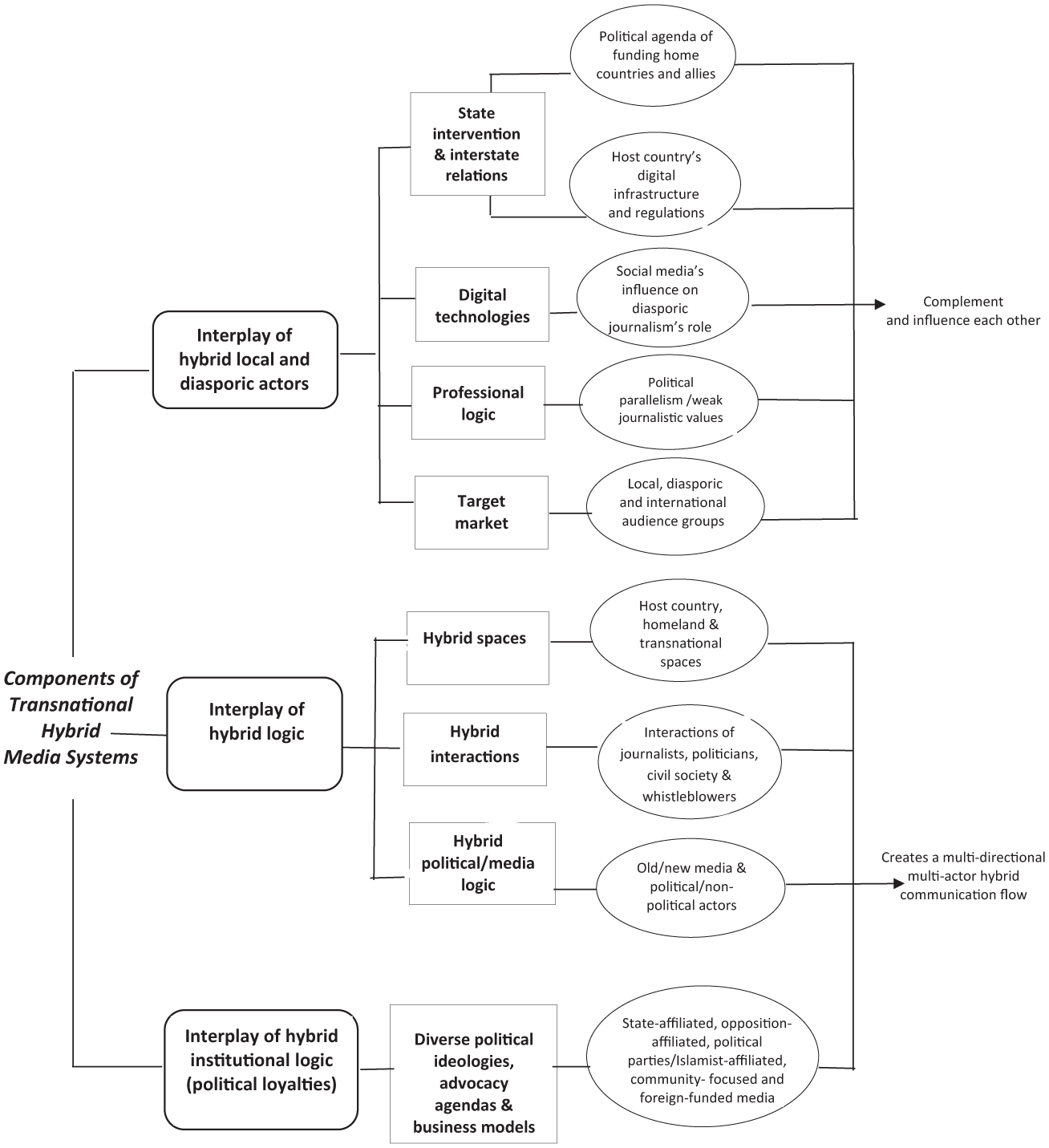
Conceptualizing the components of transnational hybrid media systems.
Based on the case study of the UK-based Gulf-affiliated pan-Arab media our paper presents, we propose the following definition: a Transnational Hybrid Media System is a heterogeneous complex of media institutions with different political ideologies, advocacy agendas and business models, which exists physically in a liberal media system while operating virtually in either a polarized or authoritarian one, proposing forms of hybrid spaces, interactions and political/media logic. It involves non-linear interactions between local and transnational actors where various sources of influence, including state intervention, interstate relations, change in digital technology, professional logic, and target audience preferences, shape the diasporic news industry.
This definition needs to be adapted and revisited in other diasporic media contexts to examine how their unique ideologies and logic might involve a different set of transnational actors and interactions. For example, Al-Arabiya, operating in the UAE, functions within a transnational hybrid media system, yet it significantly differs from the state-funded pan-Arab media based in the UK, reflecting distinct power dynamics, actors and political agendas
Conclusion
In conclusion, the findings of this study indicate that the restrictions and political constraints within which state-affiliated diaspora pan-Arab media outlets work do not differ much from the restrictions and constraints within which pan-Arab media based in Arab countries operate (Harb, 2019). Journalists writing for the pan-Arab media have become instrumentalized, as argued by Hallin and Mancini (2004) while assessing professionalism in the polarized pluralist system. Political loyalties is a common feature in pan-Arab media outlets, whether based in an Arab country or in the diaspora (Harb, 2019). However, the elements of professionalism in the practices of UK-based pan-Arab journalists are maintained within the context of the UK media jurisdiction and rules. These characteristics of transnational hybrid media system can also apply to non-Arab diaspora media operating in liberal democracies’ media systems while addressing audiences in a more restrictive media environment. The uniqueness of the pan-Arab diaspora media studied here is that they are not fully independent from their home governments’ control. The need to claim an independent role while reaching out to pan-Arab audiences is no longer needed in the current virtual and digital flow of information.
This research comes with some limitations. For example, we are aware that the sample analysed in this paper does not include exiled dissent and advocacy media which also operate within a transnational hybrid media system, but with different characteristics. A further investigation into how advocacy journalism fits within the framework of the Transnational Hybrid Media System might produce significant findings. Arab dissent media organizations might become the only Arab media ventures existing in the diaspora.
Footnotes

Funding
The authors disclosed receipt of the following financial support for the research, authorship, and/or publication of this article: This project was funded by the Swiss National Science Foundation (SNSF), fellowship number: P2TIP1_195295.
Declaration of conflicting interests
The authors declared no potential conflicts of interest with respect to the research, authorship, and/or publication of this article.