




Abstract
While leadership is generally understood as an agentic process, there are divergent positions in the literature regarding the extent to which agency is to be understood as centralized in individuals and individual actions or distributed among actors and located in the collaborative process itself. In this study, we align with post-heroic studies of the realization of moments of leadership through interaction, to explore how actors themselves relate to the issue of agency and interpersonal influence. We draw on an ethnomethodological study of calls to action in management meetings to empirically identify two forms of agentic moves, which are distinguishable through the sequential organization of interaction: push moves, which claim agency (e.g., through requests), and pull moves, which grant agency to the recipient. Our analysis shows that, in practice, influence consists of a varied combination of such moves, through which a distribution of agency, acceptable to the actors and appropriate in relation to the organizational circumstances, is achieved. Moreover, we observed how actors engaged in extensive interactional work to mitigate interpersonal friction associated with claims to agency and potential restrictions on recipient autonomy. Our results demonstrate that process-oriented approaches to leadership can indeed involve close attention to individual moves, understood as reflexively designed by individual participants based on the gradually evolving interaction. Our study thus opens possibilities for future post-heroic research on leadership to explore in detail how influence is realized across a variety of settings, as well as the extensive work dedicated to maintaining interpersonal relationships during moments of leadership.
Introduction
There is broad consensus in the field of leadership studies that, when leadership is approached as an interpersonal relationship—rather than as a formal or informal hierarchical position—it involves some form of agentic influence process. Despite this consensus, the field has struggled to theorize the location of that agency and to empirically study the associated influence process. At least two radically different approaches can be identified.
A first approach is illustrated by social-psychological leadership research, which locates agency in particular types of behaviour, called influence tactics (Yukl, 2015; Yukl et al., 2008), performed by individuals identified as ‘leaders’. Research adopting this approach has focused on identifying which tactics are associated with (assessments of) leader effectiveness in different circumstances, showing this to vary depending on the situation and context (Fu and Yukl, 2000). A second approach challenges the decontextualized nature of the first, as well as the leader heroism inherent in its singular focus on one side of the leadership relationship. Post-heroic theorizing instead conceptualizes leadership as a situated, practical, and relational phenomenon. Turning attention away from individual leaders and toward moments of leadership (Lortie et al., 2023; Simpson et al., 2018; Sklaveniti, 2020) and the dynamics of the leadership relationship itself (Einola and Alvesson, 2021; Smith et al., 2018), studies have shown that leadership in real-life settings is fluid (Biehl, 2019; Crevani, 2018) and collaboratively produced (Meschitti, 2019; Nielsen and Larsson, 2025; Simpson et al., 2018), rather than the product of a single actor shaping the actions and understandings of others. A range of theoretical resources have been mobilized, including social identity theory (Smith et al., 2018), Communicative Constitution of Organization (CCO) theorizing (Holm and Fairhurst, 2018), pragmatist philosophy (Meschitti, 2019; Simpson et al., 2018), and ethnomethodology (Larsson et al., 2025; Nielsen and Larsson, 2025), resulting in a nuanced and rich conceptual repertoire for approaching the phenomenon of leadership.
However, this line of research has struggled to come to grips with and study the agentic aspect of leadership. While the emergence of direction and shifts in orientation have been observed, describing how these are produced has proven more challenging. Process-oriented theorizing has attempted to locate agency in the leadership process itself (Simpson, 2016), such that “the question no longer concerns focusing on whether this or that person influences others” (Lortie et al., 2023), but rather how and when conversation and collaboration change and shift. Drawing on practice (Raelin, 2016b), relational, (Uhl-Bien, 2006), or process (Crevani, 2018) perspectives, studies have focused on exploring ongoing coordination and the emergence of direction. As a result, the notion of interpersonal influence has tended to vanish from the stage, prompting criticism that the concept of leadership becomes vague and difficult to distinguish from, for example, teamwork (Denis et al., 2012; Einola and Alvesson, 2021). In essence, theorizing about leadership has become caught in a dichotomy concerning the nature and location of agency. Agency tends either to be situated in individual, agentic actions and influence behaviors, or within collaborative processes in which interpersonal influence tends to vanish from sight. It is to this dilemma that our study aims to offer a way forward.
In this article, we present an ethnomethodologically (Garfinkel, 1967) oriented study of management meetings, showing influence to be realized through a combination of distinct moves by which the actors themselves negotiate the location of agency. We take leadership to be a process through which actions are organized and direction emerges—advanced and realized through a series of influence moves. Drawing on the ethnomethodological understanding of action as embedded in and always building on the current interactional environment, we propose an understanding of leadership influence as accomplished through agentic moves that we term push, in combination with pull moves, which create an interactional context where others can show initiative. This more nuanced understanding contributes to practice- and process-oriented theorizing of leadership by offering a conceptualization of individual contributions without resorting to leader heroism or to treating individuals as containers of influence. Instead, individual contributions are seen as creatively building on the resources available in situ. We suggest that agency cannot be attributed solely to discrete moves but needs to include the interactional environment in which such moves are made intelligible and experienced as appropriate.
The paper is structured as follows. We start out by reviewing how agency is treated in the leadership literature, clarifying that our research addresses the conundrum of a priori locating agency either in individual acts or within a collaborative process. Second, we present our ethnomethodological approach, through which we specify the problem of agency as an empirical question of how interpersonal influence is accomplished through a situated combination of two different types of moves—push and pull. Thirdly, we describe our empirical setting and explain how we have produced and analyzed the video recordings, which constitutes our primary empirical material. Fourth, we use a selection of interactional episodes to demonstrate how interpersonal influence is realized through a combination of different moves, during which the location and distribution of agency is negotiated. Finally, we discuss how our findings contribute to the process-oriented leadership literature and outline avenues for future research.
Leadership influence
At the core of leadership lies the question of how organizational actors are mobilized to take action on emerging issues. It is thus an agentic influence process, where agency is understood as “the capacity to take action” (Tourish, 2014: 80) that “makes a difference” (Cooren, 2010: 3). An important and long-standing discussion, then, concerns how to understand that agency and, in particular, where to locate it (Cooren, 2010; Simpson, 2016).
Traditionally, leadership research has tended to locate agency in one party to the interaction—specifically the ‘leader’—who is seen as capable of single-handedly influencing others and, in doing so, changing the course of events. Building on this perspective, a body of research has focused on identifying the specific actions through which leaders exert influence. Studies of behavioral influence tactics, for instance, have identified categories of behavior such as rational persuasion, inspirational appeal, or ingratiation, which are understood to realize interpersonal influence (Higgins and Judge, 2004; Kipnis et al., 1980; Yukl, 2015; Yukl and Falbe, 1990). More recent conceptual contributions locate interpersonal influence in specific communicative acts or forms of language use, such as noble language (Joullié et al., 2021) or respectful inquiry (Van Quaquebeke and Felps, 2018). These approaches, however, are abstracted from real-life work interactions by being based on non-work contexts, relying on actors’ post-hoc reports of experiences, perceptions, and generalized assessments (e.g., asking respondents what their manager typically does), or by being purely conceptual. Furthermore, by focusing on decontextualized acts by a single leader, they involve significant leader heroization.
As a reaction, post-heroic notions of leadership (Fletcher, 2004; Raelin, 2016a; Simpson, 2016; Tourish, 2014) reject the idea of agency and influence as being located in the “actions of leaders in isolation” (Smith et al., 2018: 1441), and instead embrace interactional, relational, processual, and practice-based perspectives to explore the co-constructed nature of leadership influence. Interactionally oriented studies, in particular, have explored the micro-level strategies and resources that individual actors draw upon in the midst of everyday work to accomplish influence (Clifton, 2009; Fox and Comeau-Vallée, 2020; Holm and Fairhurst, 2018; Larsson and Lundholm, 2010; Meschitti, 2019; Van De Mieroop et al., 2020; Watson and Drew, 2017; for an overview, see Larsson and Meier, 2023). Nielsen and Larsson (2025) showed that the process of mobilizing actors to commit to future actions involves extensive interactional organizing work and struggle with the central questions of what the problem is, who owns the problem, and what should be done. Their analysis says less, however, about the role of influence in settling those questions or how agency is negotiated. More directly engaging with the concept of influence, studies have shown summaries can be effective interactional moves in meetings (Clifton, 2006), as well as the framing of issues in terms of strategic directions (Larsson and Lundholm, 2010). Larsson and Lundholm (2013) demonstrated the persuasive power of a lengthy, stepwise elaboration of a new understanding of an issue, where the active involvement of the influence recipient was crucial. Other studies have shown authority claims to be accomplished through demonstration of expertise or by speaking on behalf of others (Holm and Fairhurst, 2018; Meschitti, 2019). Moreover, humor and the generation of joint laughter have been shown to contribute to building solidarity (Holmes and Marra, 2006), reducing hierarchical asymmetry and tension (Kangasharju and Nikko, 2009), enabling the discussion of problematic topics (Kakalic and Schnurr, 2021), and achieving contested strategic ends (Watson and Drew, 2017). Taken together, such close studies of interaction demonstrate that the “perceived legitimate right to influence and decide in organizational matters” (Holm and Fairhurst, 2018: 696) is not a fixed entity or property, but something negotiated in situ. Accordingly, influence can be seen as a fluid property of talk and action, which “can be exploited by all participants in a meeting if they are skilled enough to do so” (Clifton, 2009: 61). Together, these studies present a less heroic image of leadership influence by demonstrating that any action is fundamentally dependent on the interactional context and consequently involves great variation in form and design. Further, any action is by necessity continuously adapted to the evolving interaction. However, these studies still tend to treat influence largely as consisting of individual agentic moves.
In some contrast, studies that explicitly adopt a process, practice, or relational perspective have clearly shifted analytical attention away from individual actions. At the same time, the concept of influence tends to vanish from view. Often taking a so-called strong process approach (Simpson, 2016), these studies are grounded in the understanding of individuals as “not exist[ing] as separated entities but rather [as] produced and reproduced in relation” (Crevani and Lammi, 2023: 21). As a result, they locate agency in the relational process itself, focusing on questions such as “what does the process of leadership do to organizing practices” rather than “what do individuals do in the process” (Crevani, 2018: 84). For instance, several studies have explored leadership as the in-situ production of direction in the flow of conversation and action (Crevani, 2018; Lortie et al., 2023; Simpson et al., 2018; Sklaveniti, 2020). Drawing on Mead’s (1932) notion of turning points, Simpson et al. (2018: 651) identified moments in management meetings as speech acts where “the remembered past and the anticipated future were immediately adjacent in the same speech act”. These moments were coded for their performative effects, such as “problematizing” (recognizing an unsatisfactory present situation) and “committing” (specifying required action). Sklaveniti (2020) argued that turning points are not individual actions but co-actions and explored the responsive interplay of invitations, exploration, and affirmations at turning points in work meetings. Crevani (2018: 89) explored how direction emerges in meetings where “a number of simultaneously existing stories-so-far meet, co-evolve, leave, clash, return, and so on”, thereby altering the space for co-action. Lortie et al. (2023) examined how turning points manifest as reorientations in the flow of collective action within hierarchical teams.
This research clearly demonstrates that leadership is realized in significant interactional episodes and portrays the process as strongly collaborative. However, building on a notion of agency as residing in the relational process as such, and studying leadership “in the sense of what ‘unfolds’; rather than ‘who’ produces it, or ‘what’ its impact is” (Sklaveniti, 2020: 562), means that “[k]ey elements – such as individuals somehow being there taking or granting roles in an asymmetrical relationship – are absent or downplayed” (Einola and Alvesson, 2021: 849). As a result, this stream of research does less to clarify how significant moments are brought about—that is, it renders less visible the work through which such moments are interactionally realized. Essentially, are individuals passengers on a journey driven by a relational process, progressing through dynamics separate from the actors’ volitional actions, or are they actively contributing to the twists and turns through which direction emerges?
Together, these streams of research present a theoretical divide, where influence is taken to be either located in individuals—through influential moves—or in a relational process that shape the emerging direction. These positions are often characterized by the distinction between an entitative and exchange perspective, on the one hand, and a process-ontological perspective on social interaction, on the other (Crevani and Lammi, 2023; Lortie et al., 2023; Simpson, 2016). Such a sharp divide is problematic, since it limits the capability to account for the full range of distributions and forms of agency found in practice—ranging from clear individual initiatives to moments where direction and collaboration seemingly emerge smoothly from ongoing interaction. To move forward, we suggest that an empirical exploration of such variety is helpful. Rather than starting from an a priori assumption of the location of agency (in individuals
An ethnomethodological perspective
Established in the 1950s and 60s, EMCA is a research tradition focused on how social order is established through situated interaction (Garfinkel, 1967; Llewellyn and Hindmarsh, 2010; Llewellyn and Spence, 2009). As such, it is particularly well suited to explore the subtleties of influence in interaction. In EMCA, the analytical gaze is directed at the evolving sensemaking displayed by participants themselves during interaction, making visible the “seen but unnoticed” machinery of talk in interaction (Sacks, 1984). As Nicolini (2012: 134–135) formulates it, [ethnomethodology (EM)]’s aim is to provide convincing accounts of the methods used by members to produce and reproduce organization and society, and to uncover the work necessary to the concerted production of intelligible forms of activity. The business of EM is thus re-presenting the accomplishment of (work) practices “from within.”
From an EMCA perspective, phenomena such as interpersonal influence can be viewed as situated accomplishments (Lynch, 2007), and influence practices as local, competent “doings” of knowledgeable actors (Clifton, 2009). EMCA has a strong emic focus, meaning that any analytical claim—including those about complex social phenomena such as leadership and influence—must be grounded in the understandings displayed by the interactants themselves in the course of evolving interaction (Clifton and Barfod, 2024; Larsson and Meier, 2023; Llewellyn and Spence, 2009; Schegloff, 2007).
According to EMCA, the performativity of utterances and the formation of social-communicative actions generally cannot be determined solely by their design and construction, as the uptake and interactional environment make them work in particular ways. In other words, a single act or utterance has no inherent effect; rather, its impact is “co-constructed by speaker and recipient in their successive turns at talk, meaning that the action performed by an utterance is partly determined or ascribed by the interlocutor as displayed in the response” (Stevanovic and Svennevig, 2015: 2). It is another participant’s response—such as reluctantly accepting—that gives meaning and function to an action (Sacks, 1992), such as persuasion.
EMCA further offers relevant insights into the interactional and practical challenges involved in influencing others to take action. A substantial body of research has explored the dynamics of one actor attempting to recruit another to carry out an action—for example, through gestures, pointing, or direct requests (Curl and Drew, 2008; Drew and Couper-Kuhlen, 2014). These dynamics concern the negotiation of an acceptable and appropriate distribution of agency in the accomplishment of a particular social act, where agency is understood as “the capacities that being in organized relationships with others make possible” (Rawls, 2008: 717). This negotiation of agency involves balancing between, on the one hand, overly centralizing capacities in the hands of the requester—thus reducing the recipient to a tool—and on the other hand, persistently granting agency to others without producing any claims or outcomes, in which cases no moment of leadership is realized.
Even relatively simple requesting practices—focused on immediate actions such as fetching a glass of water or handing over a dinner plate—have been shown to be interpersonally complex. Questions arise concerning the rights on which a request is made, the obligations that require the recipient to accept it, who deems the action necessary, who stands to benefit, and who assumes responsibility (Clayman and Heritage, 2014). Research has shown that actors manage these issues through subtle and careful turn design, including the use of modal verbs (e.g., “could you”) to avoid overstepping perceived entitlements and to accommodate potential contingencies—that is, to tune the claims on agency to what is taken to be appropriate in the moment. Given such complexities, offers are generally preferred over requests (Drew and Couper-Kuhlen, 2014; Schegloff, 2007). Accordingly, actors often work to elicit offers—for example, by presenting a problem in a way that makes it clear the recipient can help, which might prompt an offer (Jefferson and Lee, 1981; Schegloff, 2007).
This line of research thus offers a nuanced understanding of the negotiation of agency—specifically, how actors can both claim agency for themselves (for example, through a request) and prompt agentic moves from others (such as by eliciting offers). Our aim is to explore how mobilization of actors to perform future actions can be practically accomplished through a range of interactional moves that involve both individual and distributed agency. We take the following as our research question: How are individual agentic moves and moves that grant agency to others combined to realize interpersonal influence in moments of leadership?
Empirical setting and data analysis
We draw on empirical material collected during an eight-month ethnographic study conducted in 2021–22 in two organizations in Denmark, Digitalize and Learn (pseudonyms). Digitalize is a fast-growing private company in the field of digital commerce and Learn is a public vocational school with two campuses in Denmark. The data collected includes initial interviews, close observation, field notes, and video recordings of naturally occurring workplace interactions among top managers, middle managers, and specialists in both organizations.
The analysis presented in this paper focuses on approximately 40 hours of video-recorded interaction, primarily from managerial meetings. Video recordings offer the advantage of allowing for repeated, close examination of various modalities of social interaction—such as speech, gaze, body movements, and gestures—and enable a detailed, moment-by-moment analysis of how actors orient themselves to each other and their surroundings and make sense of one another’s actions (Greatbatch and Clark, 2018; LeBaron and Christianson, 2021).
We analyzed the material following the four-step procedure suggested by Larsson et al. (2025). The first step involves identifying relevant sequences using a sensitizing concept (Blumer, 1954; Larsson et al., 2025). For this study, we employed ‘calls to action' as a sensitizing concept. We take a call to action to refer to a sequence in which actors call for someone or a group of actors to undertake a more or less specified future action in relation to existing tasks, emerging issues, or changes to be made in the organization. In a second step, these sequences were transcribed, and the interactional realization of a call to action was validated. In total, 66 sequences were validated.
The third step involved a close EMCA-oriented analysis of how the call to action was realized through interaction, temporarily bracketing leadership theory to instead focus on the interaction on its own terms. In this step, we drew on the EMCA principle that social interaction is organized sequentially, with each turn building on the preceding turns and projecting what constitutes a conditionally relevant next turn (Schegloff, 2007). EMCA’s strong emic orientation—focusing on how participants themselves make sense of the evolving interaction in situ—is supported by the so called “next turn proof procedure” (Sacks et al., 1974: 728), which involves attending to how an utterance relates to and treats preceding turns. Additionally, the concept of adjacency pairs (Schegloff, 2007) refers to how utterances are designed to fit together—for example, a question and its answer. This means that how an utterance is heard and made sense of depends not only on its syntactical form but also on its sequential position. For instance, whatever follows a question is typically heard and understood as an answer, regardless of the syntactical form. Moreover, and importantly for our analysis, the sequential organization of social interactions often establishes normative expectations, favoring specific types of responses, such as an acceptance in response to an invitation. These are known as preference structures (Pomerantz, 1984; Pomerantz and Heritage, 2013). Such preferences become visible in utterance design, where a dis-preferred response (e.g. a rejection of an invitation) typically includes hesitation markers, delays, and accounts justifying the response.
Early in this third step, we identified two different types of calls to action, which we refer to as push and pull moves. These were distinguished based on differences in the preference structure they set up. A
The fourth step in the procedure outlined by Larsson et al. (2025) involves confronting the results of the close interactional analysis with existing leadership theory—an endeavour we undertake in the remainder of this article. For our discussion, we focus on selected sequences that demonstrate a variety of interactional moves, enabling a rich engagement with the theoretical positions on agency in the leadership literature discussed earlier. For presentation purposes, we have chosen two episodes from the same context: weekly management meetings at Learn.
We acknowledge that applying EMCA to a study of leadership involves going beyond EMCA’s strong emic focus, as leadership is a second-order construct that represents a complex social phenomenon introduced by researchers rather than by the participants themselves. Thus, in applying EMCA, we use conversation analytic tools to examine a phenomenon—leadership—that extends beyond the sequential organization of naturally occurring talk (Clifton and Barfod, 2024).
Findings
In the following, we utilize two episodes of calls to action to demonstrate how leadership influence is accomplished through a combination of push and pull moves. The excerpts are transcribed following standard EMCA conventions (Jefferson, 2004, see Appendix) and translated into English for presentation purposes (all analysis is performed on the original Danish version). In the rich material presented, we focus on aspects and social-communicative actions particularly relevant to the topic of this paper, including a few notable nonverbal details, such as gaze direction and bodily movement. Key lines are highlighted in bold.
The meetings are attended by the school director, Mia, and three department heads: Alice, Norma, and Robin (all pseudonyms). Norma is temporarily acting as head of education until a permanent hire is made, and this role plays a central part in both episodes. While Norma holds this temporary position, she is considered Alice’s supervising manager.
Episode 1
The first interactional episode is relatively brief, with a call to action accepted in under 30 seconds. We utilize this episode to illustrate how pull and push moves can be realized in interaction. Excerpt 1 begins after Mia has finished talking about three candidates for a vacant position of head of economy, and the ensuring silence makes a transition relevant:
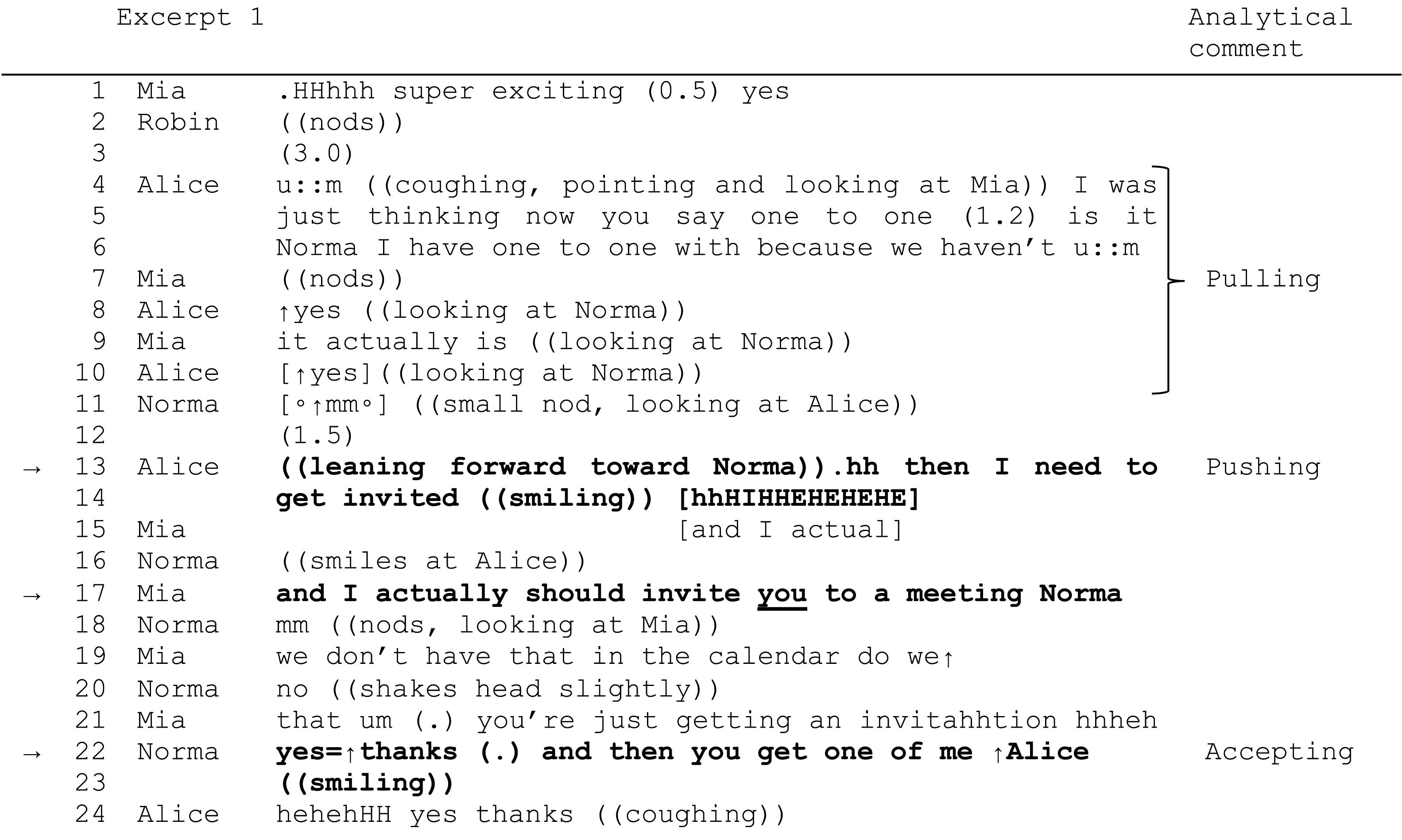
First, a series of turns sets the stage. Alice draws on something Mia said earlier in the interaction in making the topic of the one-to-one conversation relevant (l. 5). Alice then asks whether it is Norma with whom she is supposed to have the one-to-one conversation, accounting for her question with “because we haven’t” (done or planned it yet). Alice directs this question to Mia talking about Norma in third person, which works to set up the one-to-one conversation as an organizational procedure, that is, something done on behalf of the organization rather than because Alice as an individual wishes to have this conversation. As Mia confirms (l. 7), both she and Alice direct their gaze toward Norma (l. 8 and 9), selecting her as the next speaker. However, what is she now expected to contribute? Since the previous lines present a one-to-one conversation between Norma and Alice as a relevant and expected event, the expectation seems now to concern an initiative to set up this conversation. We thus consider lines 4–10 to be a pull for action performed by Alice with the assistance of Mia, granting Norma the possibility of the agentic move of presenting an initiative.
This is, however, not what happens. What follows is a minimal, confirming response from Norma (l. 11), followed by silence (l. 12). Alice then follows up with an utterance that contains a strong element of a push. In lines 13–14, she says “then I need to get invited.” Working as a request for confirmation and setting up an expectation of an acceptance, we consider this as a push for action in the context of a pull move. Both acceptance and initiative are expected, illustrating the complexity of negotiating agency, even in a sequence as seemingly simple as this. The push is relatively direct, accompanied by Alice’s gaze and physical leaning toward Norma, and designed with high entitlement (marked by “need to”; Curl and Drew, 2008). Notably, immediately following this request, Alice smiles and laughs, which works to mitigate the possible threat from the request to Norma’s autonomy (Holmes and Marra, 2006). Alice is thus orienting not only to the task of scheduling one-to-one conversations but also to their relationship. Through her bodily movements here, she visibly treats the ongoing influence process as potentially inducing interpersonal friction.
Immediately following Alice’s request, and in place of Norma’s response, Mia takes the floor and initiates an inserted sequence regarding her own pending one-to-one conversation with Norma. Mia acknowledges that she has not yet invited Norma, asserting that she should (l. 17). Mia’s intervention thus shows that responsibility for uncompleted tasks is shared. Partially overlapping with Alice’s push, this sequence orients to the interpersonal threat of the push. By positioning herself alongside Norma, Mia makes Norma less exposed and offer her some relief from immediately responding to the push and its limited grant of agency, as well as from being positioned as the only one not fulfilling her organizational obligations. The mitigation is effective: Norma now responds with appreciation and agrees to invite Alice (l. 22–23), to which Alice replies with gratitude and laughter (l. 24). The topic is then treated as closed, and the meeting moves on.
In sum, this 30-s excerpt of interaction shows how an influence process aimed at organizing organizationally relevant actions involves both push and pull moves. The local realization of these moves involves lexical choices, utterance design, varying levels of entitlement to request something from others, and multimodal resources such as gaze, smiling, and laughter. These moves are distinct not only in terms of specific utterance designs but, most centrally, in terms of the type of response they make relevant. That is, they set up a preference structure and an interactional environment, opening for some particular types of responses while making others more challenging (though they can never fully constrain the options for the recipient). In combination, these broad types of moves —pushing and pulling—offer resources for navigating the complex terrain of specifying what should be done by whom, while simultaneously maintaining interpersonal relations and preserving sufficient personal autonomy.
Episode 2
While the previous episode was short and relatively uncomplicated, we now turn to look at a more complex interaction, where considerably more leadership work—and a broader range of push and pull moves—is required to accomplish interpersonal influence. The topic on the agenda in this episode is the planning of subjects and classes for the upcoming school year, led by department head Alice. Just prior to Excerpt 2 below, Alice has informed her colleagues about a forthcoming planning meeting she has with the teachers (one of whom, Allan, is mentioned), based on the subjects chosen by students. At the start of the excerpt, Alice makes an open-ended statement that she needs help in connection with the meeting. She does not specify who she expects to provide this help, nor what concrete actions such help might entail. In this way, Alice is effectively pulling for any of her colleagues to step in and offer assistance:
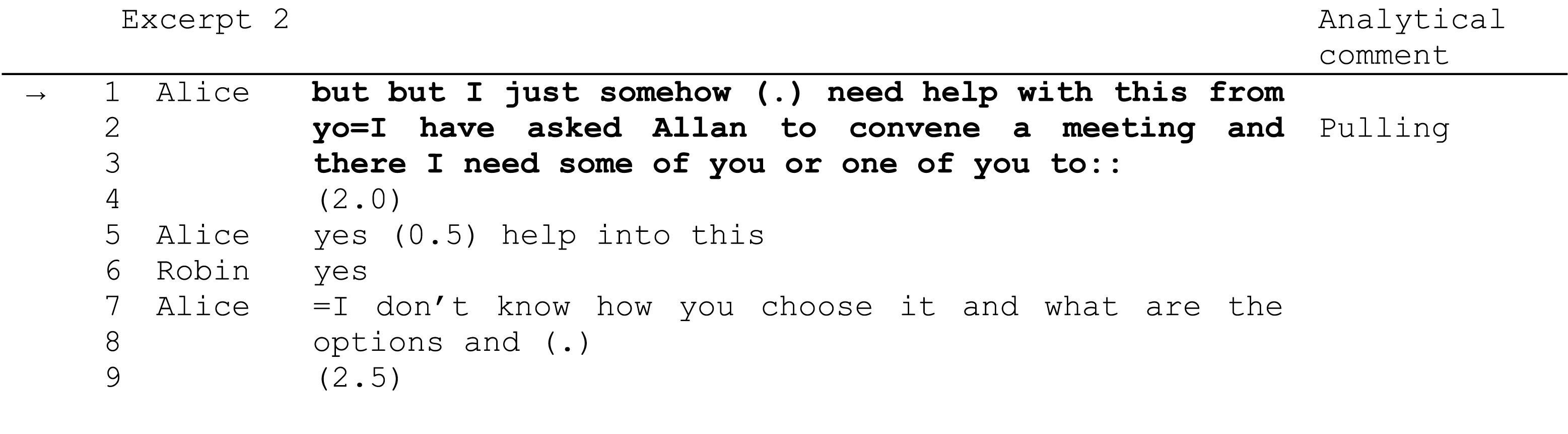
In lines 1–5, Alice produces a pull move in the form of a need for help, designed to prompt an offer (Jefferson and Lee, 1981; Schegloff, 2007). However, no immediate offers follow. Instead, the relatively long silence in line 9 indicates a dis-preferred response is coming up (Pomerantz, 1984), that is, not an offer. We skip a few subsequent lines, during which Alice initiates an insert sequence (Schegloff, 2007) in the form of a brief elaboration on the troubles involved, including the group’s temporary lack of a coordinator to handle such tasks. This elaboration works as an account for why help is needed and specifies some of the contingencies involved. The episode continues in Excerpt 3 below:
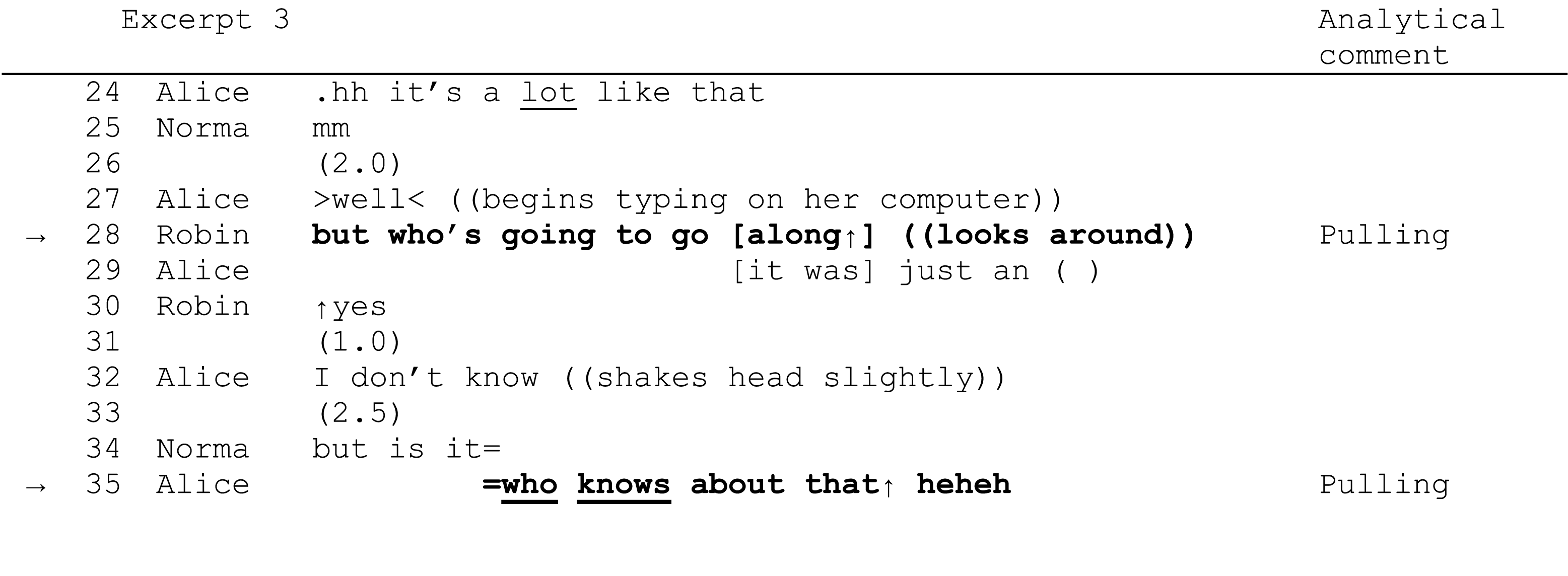
In line 24, Alice finishes her elaboration, which is followed by another significant silence (l. 26). The matter remains unresolved, and Alice displays an orientation toward not getting a response through her quickly delivered “well”—a typical topic-transition marker (Schegloff, 2007)—while she begins typing on her computer (l. 27). However, Robin re-engages with the unresolved issue by repeating the pull for action and establishing a collective actor in need of help (Robin and Alice). This pull is now relatively forceful and can be described as an agentic grant of agency. His question “who’s going to go along” (l. 28) re-establishes initiative or an offer as the conditionally relevant next turn, while also making clear the obligation for someone to actually step in. In line 29, Alice orients to the forceful nature of the pull by downplaying it somewhat (“it was just an”), working to mitigate the interpersonal friction inherent in the imposition of obligation.
Still no offers are forthcoming as the other participants remain silent (l. 31, 33). In line 34, Norma starts to ask a question but is interrupted by Alice. While Alice initially responded to Robins pull and the silence of the others by repeating her inability to determine who should help (l. 32), she now reframes it as a question of “who knows” anything about the issue (l. 35). Alice designs her utterance as a direct question, followed by a brief laughter. Notably, although forceful, Alice’s move still functions as a grant of agency in the sense that it makes initiative or offers relevant, rather than acceptance (the relevant response involves an explicit identification of an action to be performed). At the same time, what is voiced is an organizational obligation, and the agency granted lies in choosing who is to take on the obligation—not whether it will be taken up at all. Our treatment of the interaction as involving pull moves does not depend on how forceful these moves are, but rather on whether they grant agency to the recipient. That is, it depends on the projection of the conditionally relevant next turn.
What happens next is a brief exchange between Norma and Alice about the purpose of the upcoming meeting (ll. 36–37 in Excerpt 4 below). Together, they work to specify the action being called for by sorting out some of the ambiguities surrounding where the obligation to make the offer actually resides. Based on this specification, Norma concludes that a third party not present—the new head of education—should step in (l. 38–39), thereby locating the obligation to take action with this person. However, rather than accepting this allocation, Alice introduces a contingency (ll. 40–41), noting that the subjects must be chosen before the new head of education assumes the role. The conundrum is thus made fully explicit, and what follows is silence and brief laughter, accompanied by slight smiles (ll. 41–46). The issue remains unresolved.
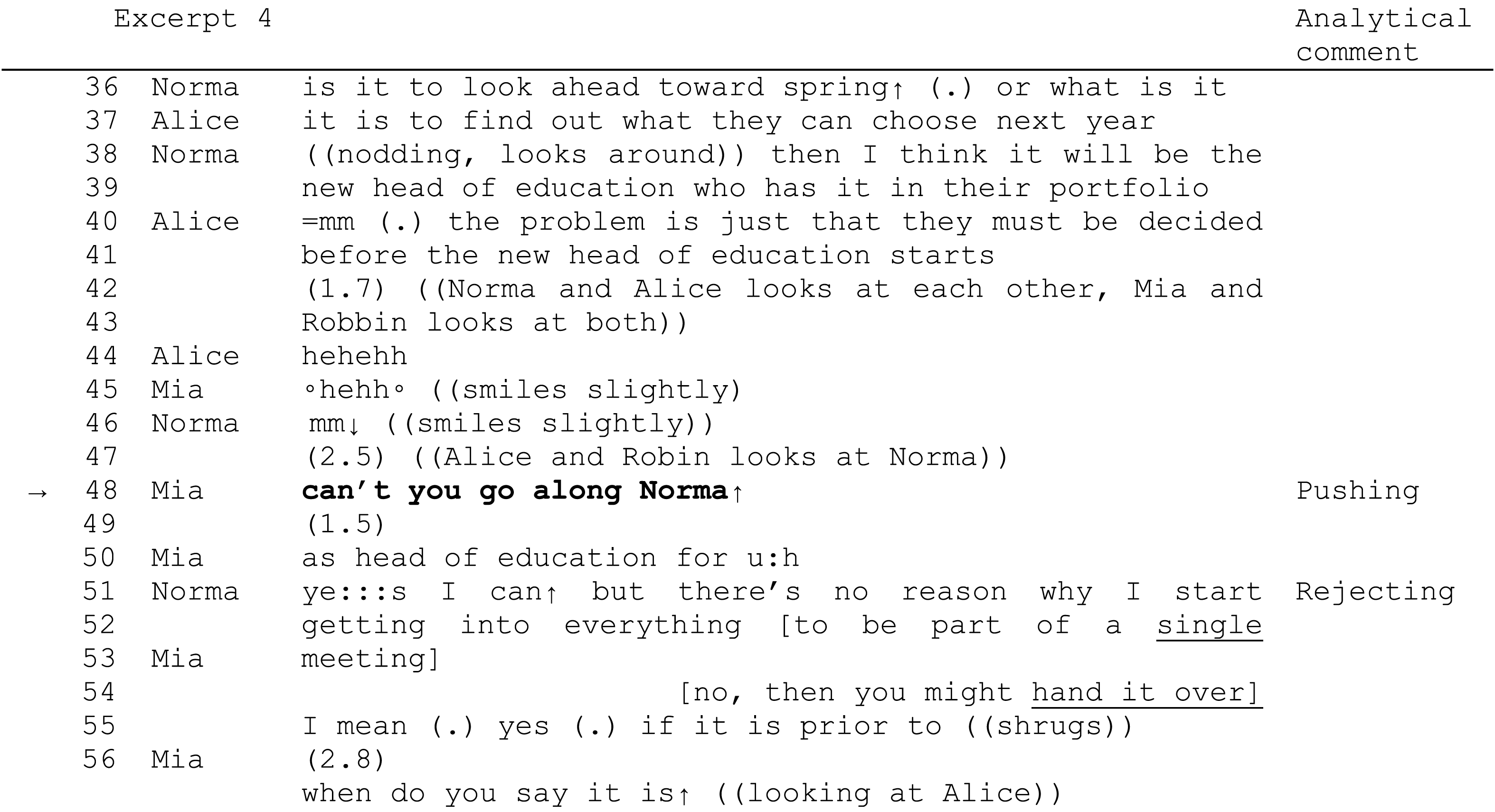
In line 47, Norma is selected as the next possible speaker by Alice and Robin through directing their gaze at her. As no offer is forthcoming, the interaction here shifts to push moves. In line 48, Mia directly addresses Norma with an interrogative request (“can’t you go along, Norma?”), making acceptance—rather than initiative or offer—the preferred next action. The negative interrogative format (“can’t you”) works to mitigate the directness of the request by implying a possible contingency regarding Norma’s capacity to take action. As the question is followed by silence (l. 49), Mia upgrades her pursuit by offering an account of why it should be Norma (l. 50). This clarifies the obligation by drawing on a resource made available earlier by Norma herself—namely, her role as acting head of education—but mitigates potential interpersonal friction by framing the appeal as addressing Norma in a role, rather than as a person.
The negotiation continues. Norma raises issues of efficiency and time limits as contingencies and reasons for rejecting the request, while Mia pursues the push by suggesting ways to handle the contingencies raised by Norma (ll. 51–54). Still, no clear acceptance is voiced. Instead, another long silence follows (l. 55), after which Mia redirects the focus by asking Alice when the meeting will take place. As it has not yet been scheduled, the discussion continues. We skip a section of further discussion without resolution and rejoin the interaction at line 501 in Excerpt 5 below.
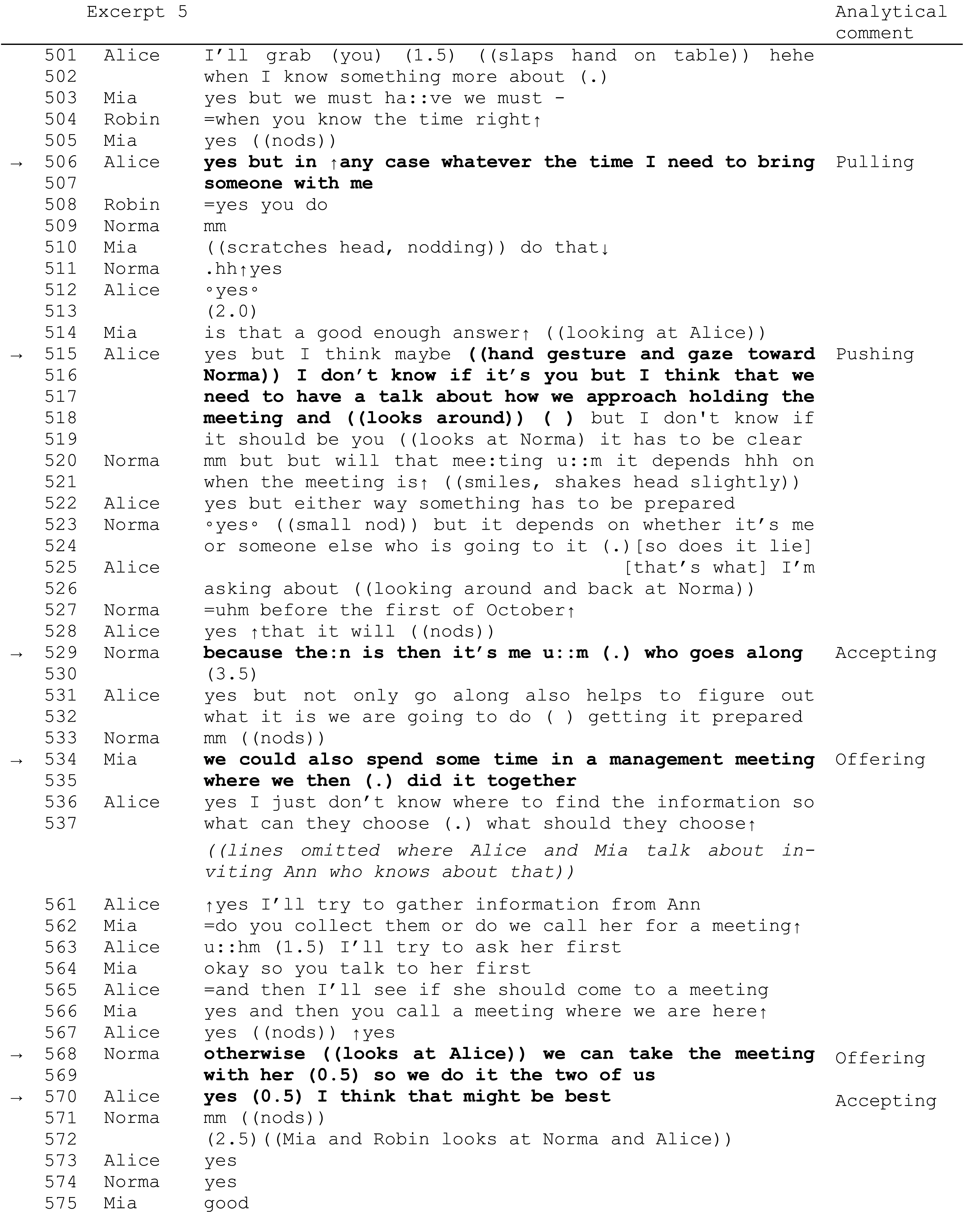
At this point, Alice moves toward closing the topic and reiterates her earlier pull by again expressing a need for someone to accompany her (ll. 506–507). As before, this expressed need creates a context in which an offer would be the conditionally relevant next action; however, no such response is produced. Instead, the other participants display alignment with Alice’s expressed need and her statement that she will grab them when she “know [s] something more” (l. 501)—agreeing without offering to step in (ll. 508–510). Mia further displays an orientation toward closing the topic by asking Alice whether that is “a good enough answer” (l. 514). However, rather than accepting closure, Alice initiates a push move directed both at Norma (“I don’t know if it’s you”) and the whole group (using the inclusive pronoun “we” while looking around). She specifies that she thinks they “need to have a talk about” how they approach and prepare for the meeting (ll. 515–519).
After a further exchange regarding the timing of the meeting between Norma and Alice (ll. 520-528), Norma delivers an accepting response in line 529. Her utterance is designed as a conclusion with the acceptance made contingent on the agreed timing (“then it’s me u::m (.) who goes along”). Alice does not treat this as sufficient resolution. Instead, after a long silence, she specifies what further involvement is required (“help to find out what it is we are going to do”, l. 532), producing another push for action in the sense of making an agreement the preferred next response. Following a minimal response from Norma (l. 533), Mia proposes that they “did it together” at a future management meeting (ll. 534–535). She thus offers to share responsibility for the obligation with Norma. By offering to take on the task collectively, on behalf of the group, she again works to mitigate the pressure on Norma—that is, attends to the interpersonal dimension of the ongoing influence process.
This is followed by an exchange between Mia and Alice (lines omitted), later joined by Norma and Robin, concerning the possibility of inviting a teacher, Ann—identified as knowledgeable about the legislative framework for student subject choices—to the upcoming management meeting. Alice visibly commits to contacting Ann, outlining the steps she will take in collaboration with Mia (ll. 561–567). Interestingly, Norma then produces a self-initiated offer to help, proposing that she and Alice meet with Ann together —“so we do it the two of us” ( l. 569). This move is highly agentic as it contrasts the preceding sequence (marked by “otherwise”, l. 568) where the matter appeared to have been settled as a joint responsibility to be addressed at a later meeting. Norma’s offer marks a shift in footing: she not only volunteers to take part in the concrete follow-up action but also reclaims personal responsibility for its enactment. Alice immediately welcomes this offer (l. 570) and at this point, the participants treat the topic as sufficiently settled to move forward.
In summary, this episode demonstrates not only how the influence process—aimed at mobilizing someone to take future action—can unfold over relatively extended interactions. It also shows a variety of pull and push moves used in combination to mobilize future actions, as well as mitigating devices (both verbal and embodied) to handle the interpersonal dimension of the interaction. The shift from pull to push moves reflects a trajectory of escalating pursuit, where action is oriented to as necessary, but uptake is not immediately forthcoming. Each move incrementally builds on the previous one, increasing the pressure while simultaneously striving to preserve affiliative footing. The episode illustrates how the participants orient toward the influence process as interpersonally delicate and attend to the interpersonal risks inherent in distributing agency unevenly. The participants engage in extensive moves not just to grant agency, but to attend to the interpersonally sensitive matter of simultaneously constraining the recipient’s agency, either by claiming too much agency or by limiting the agentic space for the recipient to only involve organizational obligations.
Discussion
This study has addressed the research question: How are individual agentic moves and moves that grant agency to others combined to realize interpersonal influence in moments of leadership? Our analysis demonstrates that individual agency was claimed through what we term push moves, offering limited agency to the recipient to accept or reject the push. In contrast, pull moves involve granting agency to the recipient by making initiatives and offers relevant, thereby opening up a wider range of possible actions—though at times restricted by organizational obligations and concerns. The analysis demonstrated that influence was typically realized through a combination of such push and pull moves. This finding indicates that in practice, influence is not attributable to a single move or type of move but instead emerges from the in-situ, negotiated distribution of agency between actors in specific interactional contexts. Consequently, our EMCA informed analysis offers a solution to the dichotomy of locating agency either in the hands of individuals or in the collaborative process, suggesting instead that the location and distribution of agency is largely a matter negotiated by the actors themselves, and not necessarily an analytical choice made a priori by the analyst.
Our study thereby extends previous interactionally oriented research on the strategies and resources utilized to accomplish influence (Clifton, 2009; Fox and Comeau-Vallée, 2020; Holm and Fairhurst, 2018; Larsson and Lundholm, 2010; Meschitti, 2019; Van De Mieroop, 2020; Watson and Drew, 2017). It offers a more nuanced view on how a range of such moves are, in practice, combined. While existing studies have focused on influential moves by an individual—for example, in the form of exploiting moments of ambiguity to propose next actions (Van De Mieroop et al., 2020), or by using humour to support claims to authority (Watson and Drew, 2017)—our study uniquely involves moves in which agency is granted to someone else, thereby working toward a distribution of agency among participants. This contribution is enabled by the introduction of push and pull moves as new analytical resources. Moreover, by characterizing these action types in terms of the relevant next turns—rather than solely by design features of utterances—we closely align with the view of leadership influence as realized in the midst of and as part of ongoing practice (Llewellyn and Spence, 2009), rather than as decontextualized actions by a singular, heroic leader.
Further, our analysis extends current process-oriented studies of leadership by bringing nuance to the understanding of the location and distribution of agency. While existing process theorizing prefers to “de-center the individual ‘leader,’ turning the analytical attention instead toward more contextualized, participatory, engaged, and relational understandings of leadership” (Simpson, 2016: 159), and locate agency in the leadership process as such, our study closely examines individual contributions—treating them not as expressions of individual characteristics, but as the very substance of the collaborative process. We take actors and their possible agency to be fundamentally constituted by and constructed within social interaction. Our analysis thus provides empirical evidence to the idea of individuals as being produced in relation (Crevani and Lammi, 2023), while also offering a detailed description of how this relational production is accomplished—that is, how agency is negotiated. It offers an understanding of moments of leadership as not characterized by either specific moves (e.g., speech acts, Simpson et al., 2018) or emergent moments in a process of collaboration (Lortie et al., 2023), but by extensive, ongoing work (Crevani, 2018; Nielsen and Larsson, 2025). In this view, moves and resources are made available and rendered relevant within the interaction itself, highlighting the local and situated nature of interpersonal influence in practice. These findings provide empirical substance to the critique of abstracting single social acts—such as behavioural tactics or speech acts—from the actual processes and messy details through which influence is realized in situ (Larsson and Alvehus, 2023).
Most centrally, our analysis contributes to a nuanced understanding of leadership by paying close attention to the details of how the actors themselves negotiate the location and distribution of agency. While push moves consist of an actor making a relatively strong claim on agency—offering the recipient the option to accept or reject—pull moves instead invite the recipient to make a claim to agency through offers or initiatives. Our analysis thus demonstrates that focusing on individual actions does not necessarily imply treating interaction as an exchange process between pre-existing entities. Instead, the analysis builds on an understanding that “[t]he constituent “parts” of trans-action can never be understood by extracting them from the whole” (Simpson, 2016: 166). Drawing on an EMCA-informed perspective on interaction thus strongly aligns with a foundational understanding of process ontology (Larsson et al., 2025), in which “[t]he act or adjustive response of the second organism [is seen as that which] gives the gesture of the first organism the meaning which it has” (Mead, 1932: 77–78).
Moreover, our analysis demonstrates an important yet less explored dimension of influence work—previously noted by scholars such as Samra-Fredericks (2003) and Larsson and Lundholm (2013): the extensive consideration of not only the task at hand but also of the interpersonal dimension of interaction. As shown throughout the analysis, push moves are frequently designed with features that mitigate possible threats to the recipient’s integrity and autonomy. For instance, in Excerpt 1, Alice smiles while delivering a push move, and Mia intervenes with an insert sequence that reduces interpersonal pressure on Norma by positioning herself as a fellow target of the push. This observation of the considerable interactional effort to mitigate potential threats to autonomy and integrity underscores that the negotiation of agency in leadership work is not merely a thorny theoretical issue—it is a practical challenge faced by the actors themselves. Paying close empirical attention to how this negotiation of agency is performed enhances our understanding of not only agency, but also of what is at stake in practical leadership work.
Conclusion
The location and distribution of agency in leadership processes is largely a matter handled and negotiated by the actors themselves in practice—through a combination of interactional moves that either claim agency (what we call push moves) or grant agency to others (what we call pull moves). These findings offer a way forward from the present conundrum of attempting to a priori locate agency either in individual acts or in a relatively agentless collaborative process. While process-oriented leadership studies (Crevani and Lammi, 2023; Lortie et al., 2023; Simpson, 2016; Simpson et al., 2018) have tended to eschew the notion of influence, our study demonstrates that interpersonal influence can, in fact, be conceptualized and empirically examined from within a strong process ontological position. Our ethnomethodological analysis shows that the location and distribution of agency among actors is accomplished in and through the interaction itself, and that actors and their agency thus emerge from the collaborative process. Moreover, our study extends previous explorations of shifting relational constellations within the leadership process (Crevani, 2018; Meschitti, 2019) by demonstrating in detail how such shifts are accomplished through specific, situated combinations of moves that claim and grant agency.
While we have observed that the interactional realization of influence involves considerable effort to mitigate interpersonal friction, future studies could explore in detail how such relational work is accomplished in different situations. Such research might explore which aspects of the leadership process are more interpersonally sensitive than others, and what is at stake in these moments. Moreover, building on our observation that such sensitivities often manifest through multimodal elements of interaction, future studies could explore how interpersonal relations are handled in leadership situations through body language—thereby extending the emerging literature on embodiment in leadership (e.g., Wåhlin-Jacobsen and Larsson, 2025). Finally, as this study was conducted within a Scandinavian context, future research could explore how interpersonal influence is realized through push and pull moves in different cultural settings.
Footnotes

Funding
The author(s) disclosed receipt of the following financial support for the research, authorship, and/or publication of this article: This research was partly funded by Innovation Fund Denmark.
Declaration of conflicting interests
The author(s) declared no potential conflicts of interest with respect to the research, authorship, and/or publication of this article.