




Abstract
Post-heroic perspectives on leadership, which approach leadership as process, practice and a relational phenomenon, have shifted the theoretical understanding from individual characteristics to significant so-called moments of leadership, where direction emerges, and actions are re-oriented and organized. However, despite considerable theoretical development, research struggles to explore these processes in detail. Utilizing video and audio recordings, in this article we present a systematic approach for analysing the production and realization of moments of leadership as they happen. We propose a four-step procedure which combines an interpretative stance, guided by a sensitizing concept, with an ethnomethodologically inspired inductive analysis of the subtle moves and mechanisms of the construction of social order in interaction. We illustrate the procedure using data from a study of high-risk military leadership, showing how deliberate shifts of analytical stance between the steps – from reliance on researcher sensemaking to a close focus on participants’ own sensemaking, and finally to theoretical interpretation – enable both a unique assessment of the phenomenological nature of sequences selected for close analysis and support the development of theoretical contributions. The approach presented in this article enables a deep exploration of the realization of moments of leadership, complementing the existing emphasis on consequences of such moments of leadership. Such a detailed analysis of the realization of leadership offers new possibilities for empirically well-grounded theoretical developments of relational and processual perspectives.
Introduction
Over the last few decades, post-heroic perspectives on leadership have received significant attention (Fletcher, 2004; Ospina, Foldy, Fairhurst, & Jackson, 2020; Raelin, 2016). Such perspectives reject any notion of leadership as ontologically residing in distinct individuals (as traits, behaviour tactics, or individual identities, and so on; Simpson, 2016). Rather, they treat leadership as a practical, processual and relational phenomenon. For example, a significant number of studies approach leadership through the lens of collective, shared, distributed and plural leadership, focusing on how several actors contribute to realizing leadership (e.g. Empson & Alvehus, 2020; Ospina et al., 2020). Moreover, a growing field of research focuses on leadership as a dynamically evolving relationship (Carroll & Simpson, 2012; Einola & Alvesson, 2021; Endres & Weibler, 2017). Such an orientation towards relational and processual approaches understands leadership as something that is accomplished in the flow of interactions (Biehl, 2019; Crevani, 2018; Endres & Weibler, 2017; Ryömä & Satama, 2019; Simpson, Buchan, & Sillince, 2018), which are ‘situated in time and space and distributed across several actors’ (Lortie, Cabantous, & Sardais, 2022, p. 5). Since leadership is seen as an emergent phenomenon (Raelin, 2016) resulting in the creation of direction (Crevani, 2018; Sklaveniti, 2020), in much of this research the organizing functions of leadership take centre stage (Sklaveniti, 2020). Moreover, such organizing is largely seen to happen in brief episodes, that is, moments of leadership (Buchan & Simpson, 2024; Lortie et al., 2022; Sklaveniti, 2020).
However, despite significant theoretical development regarding leadership processes and relationships, empirically exploring the very nature of the in situ practices and processes of leadership has been challenging. Existing (mainly ethnographically oriented) methodologies are well suited for studying the emergence of leadership in teams (Einola & Alvesson, 2021; Smith, Haslam, & Nielsen, 2018) and the exploration of power dynamics involved in negotiating leader positions (Empson & Alvehus, 2020). Such methodologies have enabled several studies to fruitfully trace the consequences of shifting relational configurations (Crevani, 2018; Meschitti, 2019), changing patterns of coordination (Lortie et al., 2022) and significant moments in team conversations (Simpson et al., 2018; Sklaveniti, 2020). Theoretically, moments of leadership have often been conceptualized as turning points, that is, moments when the trajectory of attention, work and coordination shifts (Buchan & Simpson, 2024). Such turning points are further characterized by specific speech acts (Simpson et al., 2018) or forms of co-action (Sklaveniti, 2020), as well as negotiation of sources of authority (Holm & Fairhurst, 2018; Meschitti, 2019).
However, when turning attention to the micro-level and interactional realization of such significant moments, that is, to the subtle back-and-forth of the relational interplay through which meaning is negotiated in situ (Mead, 1934) and future action constructed (Drath et al., 2008; Larsson & Lundholm, 2013), significant methodological challenges present themselves. More specifically, exploring how such moments of leadership are actually experienced and produced in situ (Llewellyn & Spence, 2009) by the participants themselves has proved challenging, that is, exploring how these moments are interactionally realized. Current methodological practices have only been able to partially make visible and hence analysable the subtle micro-level acts involved in the accomplishment of such moments. In short, we are still lacking an understanding of how, and with what discursive resources, initiatives are put forward, made sense of, responded to, contested, misunderstood, repeated, made legitimate, built upon by others, taken in new directions, and so on. We currently lack a systematic methodological and analytical approach that enables us to explore the minute details of the realization of leadership embedded in ongoing interactions, with a sensitivity to it as emerging in and through practice. In essence, current methodological approaches in the field ‘tend to deal poorly with the fleeting, the chaotic, the non-causal, and the complex’ (Buchan & Simpson, 2024, p. 84).
In this article, we present a methodological approach for engaging precisely with the constitution of moments of leadership, utilizing video and audio recordings of workplace interactions to enable a close empirical exploration of the practice(s) and process(es) involved. Our aim is to contribute to a deep and detailed engagement with rich empirical material, potentially relevant for a broad range of post-heroic leadership theorizing. We draw inspiration from ethnomethodological conversation analysis (Garfinkel, 1967; Sacks, 1992) to develop an approach to the detailed study of situated social processes as they happen. Moreover, we propose a systematic utilization of Blumer’s (1954) sensitizing concept for handling the significant problem of reducing vast amounts of recordings to an analysable corpus, and for creating the space for a creative encounter between leadership theory and the close analysis of interaction. We thereby directly address Buchan and Simpson’s (2024, p. 84) recent call for alternative methods to research leadership, which ‘are needed to engage with people on the move, and to examine the processes by which movement is accomplished’.
Methodological Challenges in Studying Moments of Leadership
Given that the concept of leadership is contested and the empirical phenomenon complex, the choice of what to focus on for detailed study is far from simple (Sklaveniti, 2020). To date, moments, that is, brief episodes, of leadership have mainly been theorized from a pragmatist perspective as turning points. Simpson et al. (2018, p. 649), drawing on Mead (1932), understand turning points as moments where ‘novel actions arise in talk’ by ‘bringing together a particular past and a particular future’. Sklaveniti (2020, p. 649) focused on moments of ‘co-action’, drawing on Gergen (2009) to conceptualize ‘these moments as turning points; “signals of change” where relating is being (re)constructed’. Lortie et al. (2022, p. 5) focus instead on action, arguing that through turning points that ‘occur in the flow of experience’ and ‘result in the reorientation of the flow of action’, leadership ‘creatively shapes action and alternative ways of acting when faced with a problematic situation’. An important common feature of these conceptualizations is an understanding of moments of leadership as located in situated interaction and unpredictably emerging in the flow of ongoing work.
Video and audio recordings are clearly appropriate types of data for studying subtle details of the flow of action as it happens (LeBaron, Jarzabkowski, Pratt, & Fetzer, 2018). They are also the type of data used in several of the previously discussed studies (e.g. Meschitti 2019; Simpson et al. 2018), enabling these studies to capture those moments, or brief episodes, where relational constellations shift and co-orientation occurs. However, working with video and audio recordings of work processes also presents a range of challenges (Gylfe, Franck, LeBaron, & Mantere, 2016). In the particular case of utilizing recordings for studying moments of leadership, two major challenges present themselves: selecting sequences for analysis; and being able to explore the in situ production of moments of leadership.
The first challenge concerns identifying moments of leadership and selecting relevant sequences for closer scrutiny out of a vast amount of recordings. As argued by Sklaveniti (2020, p. 550), ‘the establishment of turning points as the unit of analysis poses a great methodological challenge’, because if moments of leadership ‘stand for cues that change co-action’ the question is, ‘how can these become observable?’ This is less of a problem if the research focuses on easily identifiable features of interaction, such as the use of particular expressions or the use of physical artefacts. However, complex social phenomena, such as leadership, are dependent on participant sensemaking and consequently vary in their actual realization (Blumer, 1954), making simple identification challenging (Larsson & Alvehus, 2023).
Existing studies have employed a range of tactics to handle this challenge. While some studies have relied on identifying predefined speech acts (Simpson et al., 2018) or specific moments in a work process (Lortie et al., 2022), others have relied on the participants themselves (post hoc) identifying significant moments in their workflow (Sklaveniti, 2020). Studies taking a relational perspective have largely relied on ethnographers’ observations and sensemaking to identify processes of situated coordination (Biehl, 2019; Ryömä & Satama, 2019), the negotiation of relational positioning (Meschitti, 2019), and emerging and intertwining storylines (Crevani, 2018).
These approaches have enabled important insights into the consequences of moments of leadership and some of the central dynamics involved in the work of leadership. However, when turning attention to the very production of moments of leadership, deeper attention to the participants’ own in situ sensemaking is called for. Beyond relying on researcher identification of moments of leadership, we need to ‘describe how [such moments] get concretely achieved as intersubjectively real for the participants’ (Emirbayer & Maynard, 2011, p. 241). This demands a detailed investigation of how the participants themselves in situ (as opposed to post hoc) make sense of the situation, and if that sensemaking resonates with the researchers’ interpretation.
Such a description, however, involves a level of detail that is not practically feasible for the large amounts of data that are quickly produced through video and audio recordings (Gylfe et al., 2016). This first challenge thus concerns how to allow researcher-based identification of relevant sequences, independent of close analysis of participant sensemaking, while at the same time enabling a critical assessment of whether the moments are intersubjectively real for the participants in the way it is assumed (that is, to assess the phenomenological nature of the moments), which depends on such close analysis.
Such an approach is based on a realist and empiricist position in the sense of assuming that (what researchers conceptualize as) leadership processes exist independently of the researcher, and that they are produced and realized in situ by the participants in the interaction (without them necessarily labelling them as such; Buchan & Simpson, 2024; Hacking, 1999; Larsson, 2017). It is distinct from realism in the sense of statistically based hypothesis-testing (Cornelissen, 2017; Pratt, Kaplan, & Whittington, 2020), but it resonates with a performative understanding of interaction and communication, such that ‘communication generates, not merely expresses, key organizational realities’ (Ashcraft, Kuhn, & Cooren, 2009, p. 2).
The second challenge concerns going beyond observing that moments of leadership happen, to making visible and exploring how these moments are produced. This involves making visible the subtle moves through which relationships are realized and shifted, and through which significant moments are accomplished and come to be experienced as such. It means analysing how such moments are constituted and brought about in the here-and-now and approaching the ‘evolving process from within while it is being enacted’ (Lortie et al., 2022, p. 4).
Existing studies tend to rely on theoretical assumptions about what constitutes and characterizes moments of leadership and relational movements. For instance, Simpson et al. (2018, p. 251) relied on the theoretically derived characterization of turning points as moments where ‘the remembered past and the anticipated future were immediately adjacent in the same speech act’. Lortie et al. (2022, p. 8) used non-participant observation of work in an haute cuisine kitchen to identify ‘the main turning points that produced or created reorientation of the flow of collective action’. And Buchan and Simpson (2024, p. 86) focused on moments of co-orientation resulting in the ‘emergence of . . . new text[s]’. Significant moments could thus be identified and ‘traced and compared’ (Lortie et al., 2022, p. 8) to explore the consequences of such moments and movements in terms of conversational trajectories and patterns of work coordination. Exploring leadership work in team discussions, Crevani (2018, p. 97) instead focused on how conversations circled around different aspects of the participants’ work and roles, enabling her to discuss the leadership process as involving ‘relational configurations [continuously] under development’.
While these approaches have been helpful for identifying that moments of leadership and relational negotiations happen, they are less well suited to capturing the very production and constitution of moments of leadership as they happen, and empirically exploring the fleeting and subtle processes involved (Buchan & Simpson, 2024). In particular, they are less helpful for an exploration of how the moments are accomplished in situ, including how they are made real by and for the participants themselves (Emirbayer & Maynard, 2011; Garfinkel, 1967), which necessarily involves a strong element of induction. As pointed out by Rawls (2008, p. 724): ‘The observer is not constructing the situation they are analyzing, the participants are’. Existing approaches tend to be less sensitive to how participants make sense of what they are doing on a turn-by-turn basis and thereby construct the evolving interaction, and how they negotiate a shared understanding of the current situation as a moment involving, for instance, the emergence of direction and re-orientation of attention and action, that is, as a moment of leadership. What is left out is precisely the ‘almost imperceptible directions, movement and orientations, having neither beginning nor end’ (Wood, 2005, p. 1115) through which meaning and experiences are continuously shaped and re-shaped, and shifts of co-orientations, conversational trajectories and relational constellations are achieved. In other words, despite the explicit aim of this field of research to explore and focus on the ongoing processes of leadership, the favoured methodological approaches struggle to capture the minute details of in situ interaction. Consequently, we risk losing sight of ‘[t]he act or adjustive response of the second organism [that] gives the gesture of the first organism the meaning which it has’ (Mead, 1934, pp. 77–78), that is, the local and situated process of meaning making.
Attending to in situ meaning making requires that we, rather than aiming for ethnographic insight and interpretation (Heritage & Clayman, 2010), aim to observe the subtle ‘seen but unnoticed’ (Garfinkel, 1967, p. 10) details of interaction through which a particular understanding of a situation is produced. At the same time, such close attention is far removed from the more abstract theoretical interests driving studies of leadership. The gap between a wealth of micro-level details of interaction on the one hand, and the theories of leadership as process, practice and relationships on the other hand, risks becoming too wide to bridge. The challenge that such a gap presents might invite attempts to impose theoretical conceptions on the interaction process or to simplify and thus gloss over the complexity of the leadership process (Larsson & Alvehus, 2023). The challenge we are addressing here thus concerns how to endorse a very strong orientation to the participants’ own evolving sensemaking, visible in the subtleties of interaction, without losing sight of the theoretical concerns that drive the research in the first place.
Both these challenges (i.e. selecting relevant sequences for analysis and being able to demonstrate how moments of leadership are produced by the participants) involve an appreciation of the value of a very close and inductively oriented attention to the subtle details of interaction. Such an approach is clearly not new. Since the publication of Fairhurst’s (2007) seminal work on discursive leadership, numerous publications have emerged that draw on recordings of authentic interactions to investigate how leadership is brought off in the here-and-now of in situ interaction (for an overview see Larsson & Meier, 2023).
Studies of interaction have shown for instance how leadership emerges (e.g. Schnurr, File, Clayton, Wolfers, & Stavridou, 2021; Van De Mieroop, Clifton, & Verhelst, 2020), how leadership involves interactional organizing (Larsson & Lundholm, 2013), how shared leadership is interactionally realized (Fox & Comeau-Vallée, 2020) and how leadership influence is accomplished in virtual communication (Arvedsen & Hassert, 2020). However, this line of research has largely struggled to deliver theoretical contributions and in particular, to engage on a theoretical level with the emerging understanding of leadership as practice, as process and as a relational phenomenon, thus illustrating the second challenge discussed above (i.e. being able not only to conduct close analysis of interaction, but also to utilize it for developing theory).
Moreover, several studies in this line of research have attempted to bridge the gap between leadership theory and the nitty-gritty details of interaction by assuming that certain predefined actions constitute leadership (such as a task and relationship orientation, e.g. Holmes & Marra, 2004; Vine, Holmes, Marra, Pfeifer, & Jackson, 2008; or by equating interactional dominance with leadership, e.g. Baxter, 2015; Chałupnik & Atkins, 2020), thus illustrating the first challenge discussed above (selecting relevant sequences without simplifying the phenomenon of leadership). Through simplification of the complex process of leadership, these studies constrain their capacity to deliver compelling theoretical contributions (Schnurr & Schroeder, 2019).
Thus, to be able to develop strong contributions to the current understanding of the production of moments of leadership, close attention to the subtleties of interaction is not sufficient on its own. A more systematic methodological and analytical approach that is capable of handling the discussed challenges is needed. In the next section we outline such an approach.
Studying Moments of Leadership: Diving into interaction
At the core of our approach lies an ethnomethodological attitude towards research and social interaction. Ethnomethodology, as developed by Harold Garfinkel (1967), directs the analytical gaze toward social actors’ in situ methods of establishing intersubjectivity, that is, a shared sense of what is going on. The ethnomethdologically oriented tradition of conversation analysis (EMCA) pursues this research interest in the specific area of talk-in-interaction (Sacks, 1992). EMCA thus focuses on the interactional moves through which people in situ and ongoingly make everyday sense of their experiences and collaboratively create social order (see Heritage, 1984, for an account of the development of conversation analysis and ethnomethodolgy). Such attention requires the researcher to zoom in on audio- and/or video-recorded everyday interaction and to tease out the subtle details of the ongoing production of social order.
Practically, recording is rendered accessible by the commercial availability of small, high-quality video and audio recorders 1 which allow the researcher to easily and directly produce material suitable for scientific analysis. Standard software packages for qualitative research are helpful for data management and overview, while transcription and analysis are supported by a range of specialized software packages, at times supported by artificial intelligence. 2 However, recording also raises important ethical issues (Bell & Bryman, 2007; Everri, Heitmayer, Yamin-Slotkus, & Lahlou, 2020) as well as challenges for negotiating access (Gylfe et al., 2016; LeBaron et al., 2018), similar to close ethnographic methods such as shadowing (Johnson, 2014). In particular, recording requires careful and often lengthy processes for obtaining informed consent from all participants and procedures for securing integrity of the participating individuals and organizations as well as procedures for the safe storage of recorded material in compliance with local laws and regulations (Heath, Hindmarsh, & Luff, 2010; Mondada, 2013). Presentation of findings based on recordings raises particular challenges for securing the anonymity of the participants, which is often handled through the manipulation of pitch (for audio) and of images so that facial recognition is not possible (for instance by blurring; Gylfe et al., 2016).
Recording quickly results in large amounts of data, making the first challenge discussed above (i.e. the identification of moments of leadership for subsequent close analysis) particularly pertinent. To handle this challenge, we take inspiration from Blumer’s critique of social science methods (Blumer, 1931, 1954). In particular, we find his notion of a sensitizing concept (Blumer, 1954) helpful as a guide to the initial exploration of the data. To address the second challenge (i.e. analysing the very practice and process of realizing significant moments of leadership) we draw extensively on EMCA (Garfinkel, 1967; Heritage & Clayman, 2010). However, other approaches that share EMCA’s strong orientation to participant in situ evolving experiences and sensemaking are clearly relevant, depending on the research interests of a specific study. Finally, structuring the methodological procedure into distinct steps provides space for the strong tensions inherent in the previously identified challenges and it facilitates the development of empirically well-grounded strong theoretical contributions.
Our analytical approach consists of four steps:
Step 1. Identification of candidate sequences for close analysis of interaction
Step 2: Validation of the chosen sequences
Step 3: Close analysis of the interaction with a focus on how the observed outcome is interactionally achieved
Step 4: Confrontation of the analysis of interaction with leadership theory, that is, an abductive analysis of leadership process and practice.
In the following, we will describe each of these steps in some detail. We specify the reasoning behind each step and discuss important differences in relation to the existing research with a process perspective. We then present a brief illustration of the procedure, drawing on video data from a larger empirical study.
Step 1: Identification of candidate sequences
The first step involves the identification of candidate sequences for subsequent close analysis. This is a crucial step in reducing the vast amount of data to a workable number of relevant sequences.
Strongly inspired by pragmatist orientation towards radical empiricism (Emirbayer & Maynard, 2011; James, 2003) rather than distanced theorizing, Blumer (1931) famously criticized attempts at a priori operationalizations of social phenomena, arguing that attempting to facilitate analysis by simplifying the studied phenomenon means losing sight of its situated and social nature. Such simplification is often done by translating a social phenomenon from something dependent on human sensemaking, to instead something readily observable by an outside researcher (Blumer, 1954). The main target of his critique was the tendency within sociology and social psychology to explore complex phenomena (such as group dynamics, interpersonal influence, and so on) by first developing operational definitions and then devising techniques for measuring these (typically through questionnaires), without any procedure in place to secure or explore the phenomenological nature of what was thus studied. In the field of leadership, this can be illustrated by attempts to reduce the core phenomenon to readily observable verbal expressions or classes of behaviour, independent of concrete actors, the specific situation or the interactional context.
Blumer instead suggested that we treat complex concepts as sensitizing (a suggestion inspiring many branches of qualitative studies, not least symbolic interactionism; Denzin & Lincoln, 2011). In contrast to operational definitions, a sensitizing concept lacks such specification of attributes or benchmarks, and consequently it does not enable the user to move directly to the instance and its relevant content. Instead, it gives the user a general sense of reference and guidance in approaching empirical instances. (Blumer, 1954, p. 7)
Rather than allowing theoretical expectations to constrain the analytical gaze, the sensitizing concept prompts an exploration of social interaction on its own terms. Further, because social interaction is reflexively produced, tailored to the specifics of the current situation (Garfinkel, 1967; James, 2003; Sacks, 1992), ‘what we are referring to by any given concept shapes up in a different way in each empirical instance’ (Blumer, 1954, p. 8), highlighting the importance for the empirical analysis to be sensitive to variation. To enable such sensitivity, we suggest focusing on the outcome of moments of leadership in this first step, leaving the process of their realization open for inductive empirical exploration in later steps.
Based on our interest in leadership practices and processes, an example of a sensitizing concept could be a change of direction and re-organization of action. If the research interest is focused on leadership as a mobilizing force, a sensitizing concept could be participants becoming energized and active. Alternatively, if the research interest focuses on the negotiation of leader and follower identities, a sensitizing concept could be the establishment of a clear leader/follower interactional identity. Importantly, the approach we present is, therefore, neither tied to nor predicated on a particular theoretical perspective, beyond the central ideas of leadership as a social and interactional process (Simpson, 2016) that is constituted and realized in situ by the involved participants and from the practical resources at hand (Larsson & Meier, 2023).
The identification of candidate sequences is greatly facilitated by relying on the sensemaking of an informed researcher with a close understanding of the context. This informed researcher could be an ethnographer and participant observer. Alternatively, inside knowledge can be obtained through interviews with participants. Regardless of how this is obtained, intimate knowledge of the work practices, the professional language and the typical routines and patterns of work offers an important source of sensitivity for identifying candidate sequences by viewing and listening to the full recordings.
Step 2: Interactional validation of candidate sequences
The task for this step is to examine whether the participants of the interaction themselves orient to and treat the identified sequences in the way indicated by the sensitizing concept, that is, whether the moment is intersubjectively real for them in a way that resonates with the researcher’s interpretation. To the extent that leadership is understood as a socially constructed phenomenon and as ‘emergent in the communicative dynamics of collaborative work’ (Buchan & Simpson, 2024, p. 81), its very realization relies on the participants’ own evolving experiences and ongoing in situ sensemaking. Consequently, in step 2, we shift the analytical stance from relying on the researcher’s sensemaking to instead focus on the participants’ own in situ sensemaking.
To facilitate such close analysis, sequences of talk are transcribed in detail, including interactionally relevant details such as pauses, repetitions, overlaps, simultaneous talk, and so on (Jefferson, 2004). We also include multimodal information, such as gaze direction, body posture and gestures (Mondada, 2013). Such transcription aids the subsequent analysis by sensitizing the researcher to the rich details of the interactional production of the situation.
Close attention to the interactional particularities contrasts with common coding practices, utilized both in quantitative and qualitative research (Gioia, Corley, & Hamilton, 2013; Saldaña, 2014). Coding fundamentally relies on treating different instances as similar and belonging to the same category, something that can only be done by glossing over the specific details of each instance, as well as the specific interactional context (Hindmarsh & Llewellyn, 2018; Llewellyn & Hindmarsh, 2010).
The examination of the candidate sequences involves asking the simple question of what is going on here (Heritage & Clayman, 2010; Sacks, 1992). However, rather than interpreting what we as researchers believe is going on, the aim is to find observable indications of how the participants themselves, in situ, experience and make sense of the situation. This aim is supported by the so-called next turn proof procedure (Sacks, Schegloff, & Jefferson, 1974), directing the analytical gaze to the next contribution in an interaction, to find signs of how the previous contribution is made sense of. Through the design of an utterance (or bodily movement), a participant ‘displays (in the first place to his [sic] co-participants) his [sic] understanding of the prior turn’s talk’ (Sacks et al., 1974, p. 728). The analysis here thus draws on the very nature of social interaction: ‘It is a systematic consequence of the turn-taking organization of conversation that it obliges its participants to display to each other, in a turn’s talk, their understanding of other turns’ talk’ (Sacks et al., 1974, p. 728). Drawing on the next turn proof procedure, we thus validate or discard the candidate sequences, based on whether we can find indications of the participants’ own orientation to the moment resonating with the researchers’ interpretation.
Step 3: Close analysis of how the observed outcome was accomplished
In this step, we focus on exploring how the identified outcome (for example, shifts of direction and re-organization of actions) was accomplished in each sequence. As in step 2, the analysis in this third step is performed with a strong orientation toward the participants’ own in-situ evolving sensemaking. Importantly, the focus is on participants’ reflexivity in the midst of practice, and not post hoc accounts and reflections on practice (Llewellyn & Spence, 2009). The task for this step is to unpack how the interactional outcome is produced in situ, through the subtle practices whereby people make sense of the ongoing interaction and contribute to building a situated and shared sense of what is going on. That is, we are here aiming to access how movement is practically accomplished (Buchan & Simpson, 2024; Lortie et al., 2022), in the midst of the action.
The actors themselves, however, typically do not pay attention to these practices. The default stance for an actor is what Garfinkel, following Schuetz (1945), calls ‘the attitude of daily life’ (Garfinkel, 1967, p. 37), that is, accepting the world as experienced as a natural fact rather than as an ongoing production. The task for the interactionally oriented analyst, then, is ‘to discover how intelligible patterns of behavior are actually being constructed and recognized on the spot’ (Rawls, 2002, p. 30, italics in original). It is the participants’ ongoing reflexive contribution to the evolving interaction that is in focus.
EMCA offers an extensive analytical toolkit for this type of analysis (see for instance Lempiälä, Tiitinen, & Vanharanta, 2022 and Yamauchi & Hiramoto, 2016). It primarily focuses on the sequential organization of interaction (Schegloff, 2007) as well as categorizing practices (Bushnell, 2014; Fitzgerald & Housley, 2015). Such resources allow an analysis of the in situ perspective of the participants themselves, for instance of the negotiation of the direction of collaboration; of how the current situation is to be understood; as well as of who is responsible for future actions.
Importantly, the task for this step is distinct from entitative perspectives (Simpson, 2016) which take individuals as the starting point and explore ‘what people actually do in order to influence courses of action’ (Crevani, 2018, p. 84), where interaction is understood as an exchange process (Lortie et al., 2022; Simpson, 2016; Simpson et al., 2018). Rather than associating agency with ‘leaders in isolation’ (Smith et al., 2018, p. 1441), we treat agency as a question of ‘the capacities that being in organized relationships with others make possible’ (Rawls, 2008, p. 717). Such analysis sees the construction of social reality and thus leadership processes as ontologically located in the interactional and communicational domain (Fairhurst, 2007). The analysis thus aligns with a process perspective where the aim is to make visible the dynamics of interaction, where ‘people’s activities are not necessarily under their control and [. . .] intentions do not necessarily result in desired effects’ (Crevani, 2018, p. 84).
Resonating with pragmatist thinking (Buchan & Simpson, 2024; Lortie et al., 2022; Simpson, 2016; Simpson et al., 2018; Sklaveniti, 2020), participant experiences are placed centre stage. However, rather than viewing experiences as the resulting post hoc sensemaking of individuals, it is the process of shaping these experiences that is the object of analytical attention. EMCA suggests that experience is always socially organized (Emirbayer & Maynard, 2011; Rawls, 2002), and it is that ongoing process of organizing (and possibly aligning) experiences that we wish to explore. More broadly, the analysis aims to explore in detail how the social world (including organizational structures, but also individual identities, roles and actors) is talked into being (Boden, 1994; Garfinkel, 1967; Rawls, 2002), maintained and possibly re-constructed. To be able to do this, very close attention to the subtle details of interactional sequences, utterance design, bodily movements, and so on is crucial (Heritage & Clayman, 2010).
The analysis in this step does not, however, engage with leadership theories and concepts. We follow Blumer’s (1954, p. 689) argument for an analysis that ‘views items of social life as articulated inside moving structures and believes that they have to be understood in terms of this articulation’. The third step therefore involves an inductive analysis of the raw data, the findings of which are then used to engage with theoretical concepts in the fourth step.
Step 4: Confrontation of the interaction analysis with leadership theory
In this final step, we again shift the analytical stance, and leadership theory takes centre stage. This step aims to develop an empirically grounded theoretical account of the observed phenomenon.
First, we need to critically examine whether and in what sense the situations identified by a sensitizing concept qualify as moments of leadership. Different leadership perspectives might imply different expectations of what a sequence would need to contain (that is, of the process of leadership) for it to qualify as a moment of leadership. Such expectations can for instance involve the presence of influence processes (Fairhurst, 2007; Grint, 2005; Yukl, 2013), the re-construction of relational patterns (Crevani, 2018; Meschitti, 2019), or a stable asymmetrical relationship (Einola & Alvesson, 2021). Parallel conceptions of leadership can thus be utilized (Fairhurst, Jackson, Foldy, & Ospina, 2020) for comparison and contrast based on the same interaction analysis and empirical material.
Second, the sequences are explored with the aim of identifying patterns of mechanisms and moves involved in the leadership processes through which moments of leadership are produced, in line with standard EMCA practices (Heritage & Clayman, 2010), as well as other approaches to analysis (Gylfe et al., 2016; Hindmarsh & Llewellyn, 2018). Empirically grounded identification of such recurring mechanisms and moves can in turn ‘confirm, challenge or nuance theoretical assumptions in leadership research’ (Van De Mieroop et al., 2020, p. 511), for instance, existing theoretical propositions of leadership processes as involving the utilization of various authorizing sources (Holm & Fairhurst, 2018) or sequences of co-action (Sklaveniti, 2020) compared with identified patterns of mechanisms and interactional moves. Studies employing this type of logic of engaging with leadership theory on the foundation of a fine-grained analysis of interaction have so far contributed for instance to the theoretical understanding of the organizing properties of leadership (Larsson & Lundholm, 2013) and the emergence of informal leadership (Van De Mieroop et al., 2020).
Illustrative Analysis
We illustrate our procedure with data from a study of leadership in high-risk contexts, collected by the second author during a military mission in Afghanistan. As a serving military officer with over 35 years of experience in the Danish Defense Force, he gained access to this very exclusive environment and was able to conduct extensive periods of ethnographic fieldwork during which he participated in and observed a diversity of training and tactical procedures and processes. Wearing a helmet camera, he accompanied two platoons during their operations at different locations in and around Kabul, participating in and recording all their different activities such as instructions, verbal order giving, after-action reviews, briefings, as well as actual missions in the field. Overall, he obtained over 550 hours of recordings, conducted 39 group and individual interviews, and produced over 200 typewritten pages of field notes based on his observations, impressions and experiences (for more details on data collection, see Barfod, 2021).
Participating in this military mission, Jakob, the second author, experienced how leadership was constructed by the members of the platoon, including how sensemaking was negotiated and communicated, and how actions were organized and coordinated in situ. As a participant observer, he engaged in interpretive sensemaking (Welch, Piekkari, Plakoyiannaki, & Paavilainen-Mäntymäki, 2020), that is, trying to understand the particulars of the specific setting. Conversations with the other soldiers revealed their experience of leadership as ‘floating and flexible’, which resonated well with his own experiences. But how was such floating and flexible leadership actually realized in practice? In other words, how were moments of leadership produced in which a new direction emerged, actions were organized and collaboration established, in a way that left the soldiers with this sense of floating leadership? We use these questions as the starting point to illustrate the procedure outlined above.
Step 1
To be able to identify candidate sequences for later close analysis, an appropriate sensitizing concept is first developed. For our illustrative purposes, we adopt as a sensitizing concept a change of direction and re-organization of action. We relied on the second author’s intimate knowledge of the setting to watch the video recordings and select potential candidate sequences in dialogue with the full research team. His deep knowledge was crucial to understanding the situated meaning of a large number of expressions (such as abbreviations, slang expressions and so on) extensively used and the relevance of seemingly small details (such as placement of vehicles, the order of soldiers when patrolling in line, identification of choke-points, and so on), and to point out where risk was perceived as suddenly increased, based on his own participation in the scenes. We utilize two candidate sequences identified in this way to illustrate our methodological procedure.
Step 2
In the second step, we shift the analytical stance from reliance on researcher interpretation to close attention to the participants’ own sensemaking. The selected sequences are transcribed and translated from Danish into English. We utilize the next turn proof procedure (Sacks et al., 1974) to examine whether we can find indications of the participants themselves experiencing a shift in their understanding of the situation and subsequently re-organizing their actions. Depending on this examination, sequences are validated or discarded.
Fortune arrives
The first sequence analysed involves two teams of Danish soldiers, collaborating to solve a task on the ground in the Kabul area. The sequence was selected as fitting the sensitizing concept since it seems to contain a change of direction and re-organization of action. The sequence starts as the teams have arrived at a checkpoint in which Turkish and Afghan troops are deployed (see Figure 1 for a schematic representation of the deployment of the troops). While deploying, a British contingent arrives on the scene. The second author’s experience and knowledge inform us that such a situation, with several forces present at the same site, poses a significant risk of uncoordinated action and even of a so called blue-on-blue situation, where coalition troops fire on each other.
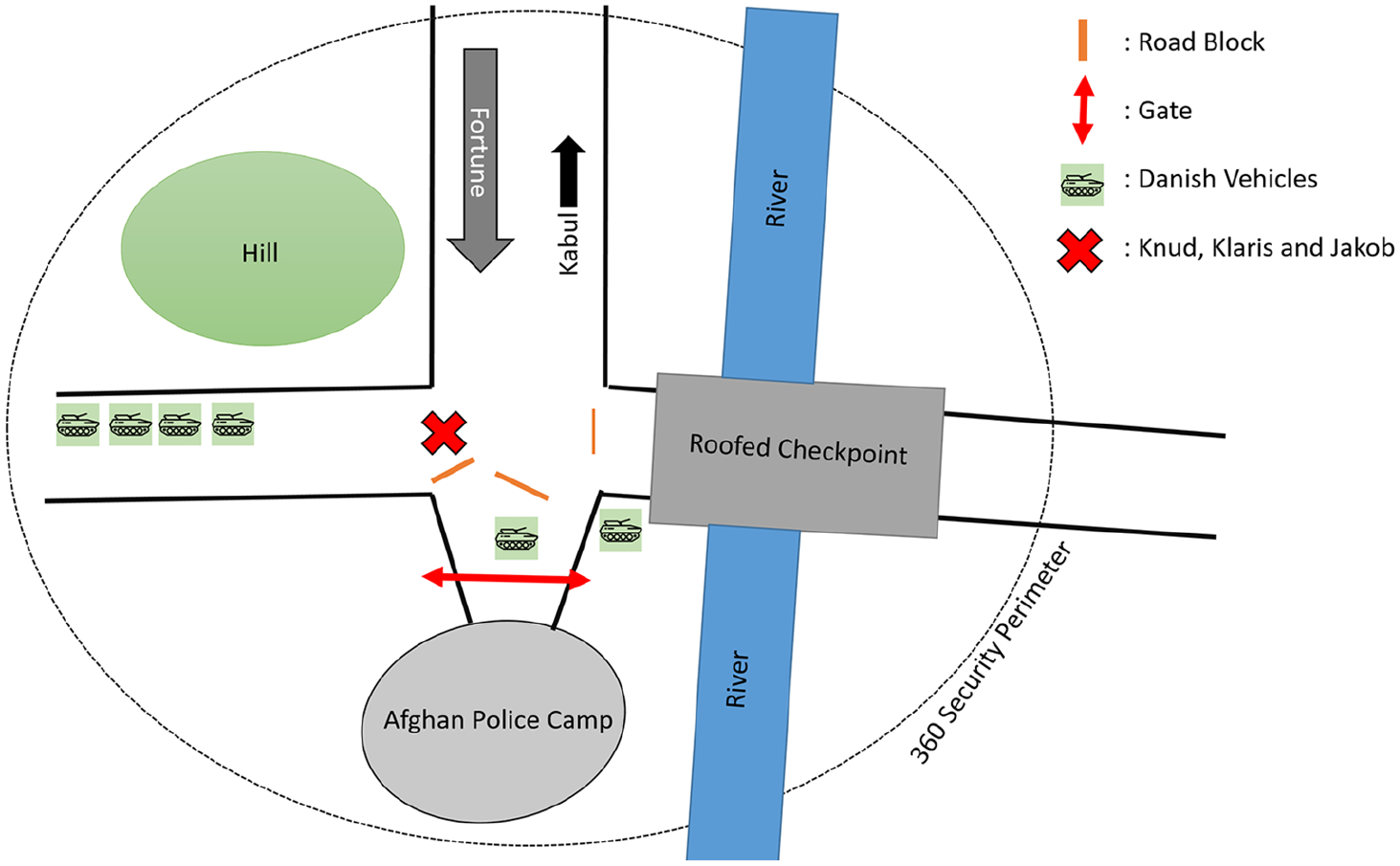
The area around the checkpoint.
The arrival of the new troops thus transformed the high-risk situation of providing security at a checkpoint, prone to attacks, into a far more unpredictable and complex situation, with four uncoordinated units present at the same time. As the situation unfolds, the video captures what seems like a reassessment of the situation and re-organization of actions.
The sequence is transcribed in detail, following standard EMCA conventions (Jefferson, 2004):
In the opening lines of this sequence, Knud (the first lieutenant), Klaris (the sergeant) and Jakob (the participant observer and second author) are discussing the situation. In line 1, Klaris offers a summary of the action consequences of the present situation (to be ready to drive if something turns up). In line 2, Knud aligns, thus producing a visibly shared understanding of the situation. Notably, through his utterance, Knud not only agrees, but makes sure that Klaris knows that he agrees, and demonstrates that he himself now knows that Klaris knows this. The soldiers are quickly achieving mutual intelligibility regarding the current situation.
Several turns later, Jakob draws attention to the fact that a British unit has suddenly and unexpectedly arrived on scene (line 8). Knud now assesses this situation as being ‘just max bread rolls and layer cake right now’ (line 20) which is a slang expression particularly used by this unit which roughly translates as the situation is going ‘belly up’. Through the next turn proof procedure, we see that he orients towards Jakob’s utterance as relevant and consequential, and they align their attention. In his subsequent response to the changing situation, he orders that the troops should ‘get down and retain ground until we just ehh have an overview’ (line 73). This new instruction is a reflection of the team’s reassessment of the situation as volatile and potentially very dangerous, hence requiring a change in the soldiers’ actions, namely to be more cautious and obtain an overview.
We thus have strong indications that the participants in situ make sense of the situation as shifting and calling for a re-organization of actions. This candidate sequence has thus been validated as being a moment of change of direction and re-organization of action, experienced as intersubjectively real for the participants themselves.
Quick reaction force preparation
The second sequence involves verbal order giving in a military camp in Afghanistan, occurring the evening before the task in question is to be performed. It fits the sensitizing concept as it is a situation in which actions are organized, as can be expected when orders are given. The location is a briefing room (a converted container) with chairs on one side, and maps, whiteboards and aerial photographs on the other side. After the order is given, the soldiers are invited to ask questions. A private, Lars, asks about the actions of the quick reaction force (QRF) which he will participate in, and which is expected to react if Viking 3, another unit, is in need of support.
Looking closely at the sequence, we see that Lars’ utterance in lines 1 and 2 works as a request for more information and clarification about the route in question. The request is based on participating in the QRF during the mission and thus displays an easily recognizable (for a professional soldier) need for precise information about the location of the other unit. Janus responds in line 3, and through the next turn proof procedure, we see that the issue is taken seriously and makes sense to Janus (who treats Lars’ utterance as meaningful and relevant). However, it turns out that Janus has no further information but provides a rather detailed account of this lack of information. Lars acknowledges this information (line 17 and 19: yes), thereby also treating Janus’ account (lines 9 to 16) as meaningful and relevant. Janus then goes on to present a solution to the problem of not knowing the exact route of Viking 3, which, to gloss lines 23 to 26, is that they (Viking 3) can be followed on radio channel three or by GPS.
In summary, we see an issue being raised in lines 1 and 2, suggesting a clarification of positions and thus a re-organization of actions as a relevant consequence. However, owing to the lack of precise information available, no re-orientation of action is displayed. Indeed, the lack of knowledge paralyses action. Thus, while watching the video suggests that this sequence fits the sensitizing concept, a closer look at the interaction reveals that the moment is in fact treated by the participants themselves as an account for a lack of re-orientation. Using the next turn proof procedure, we see that the issue raised is oriented to as relevant by the participants, and that they treat the lack of more information as legitimate, thus collaboratively leaving the issue unsolved. The interactional evidence thus shows that the participants themselves experience the situation as simply unresolved rather than involving re-orientation and re-organization of their actions. They do not seem to experience the moment in resonance with the sensitizing concept, and this sequence is thus excluded from further analysis.
Step 2 has involved an examination of the phenomenological nature of the moments captured on video, and we are left with one sequence that qualifies for further illustrative analysis.
Step 3
In step 3, we focus on how the identified moments were realized as such by the participants. We illustrate this step with a closer look at the sequence Fortune arrives, validated in step 2 to contain a moment of leadership that fits with our sensitizing concept, i.e. a change of direction and re-organization of action. A brief extract from the participant observer’s field notes helps us set the scene more clearly: Leaving our vehicle, I am surprised by how much traffic there is at the checkpoint – children with bread, dented and rusty cars, old men with things like wheelbarrows, a tanker truck, etc. – and how close they are to us and our vehicles. I encounter some Turkish soldiers wandering around without any proper safety equipment. I feel a sense of frustration in my body – what on earth are they doing here and why don’t we know that they are here? Reaching Knud and Klaris by the bridge, I see a car whose shock absorbers are completely compressed, which could indicate that the trunk is filled with explosives. Shortly after, I see some British vehicles driving toward us, and I think, are they coming too now? At the same time, I see some people moving around the top of a hill. Wow, a lot is happening now. “There’s a British call sign coming,” I say to the other two. At the verbal order the night before, we were not told that the British unit would be here. Everything now seems quite chaotic, and if something happens – like a shooting or an explosion – it will be difficult to coordinate and hard to know who is doing what. After a few moments, Knud and Klaris start communicating over the radio to the two teams. I think they’re sending good and clear messages to the soldiers, and this helps clarify the situation and minimize the increasingly numerous risks. This makes me feel a bit safer.
The participant observer’s account of the situation involves a feeling of risk in an ambiguous situation, that in the end is alleviated by the messages sent by Knud and Klaris. Based on the field notes, one could perhaps argue that it is Knud’s and Klaris’ individual expertise and capacity as leaders that results in them relatively quickly communicating clear and highly relevant messages over the radio.
However, the task for this third step is to go beyond such accounts and instead explore the very process of constructing and shaping experiences in situ, resulting in a story as expressed by the participant observer in his field notes. The task is to explore how the re-orientation and re-organization of action was interactionally accomplished, and how the participants in situ came to experience the moment in that way. Such an exploration will also provide empirical indications that the handling of the situation cannot reasonably be reduced to the formal leader’s individual capacities.
We utilize the analytical toolbox of EMCA for this step. In particular, attending to the sequential organization of interaction is helpful to explore the realization of intersubjectivity and thus social order (Heritage & Clayman, 2010; Sacks, 1992). The notion of adjacency pairs (Schegloff, 2007) refers to utterances that are chained together in the sense that a first utterance sets up an expectation for a particular next utterance. This means that the next utterance will be interpreted as the second part of the pair, regardless of syntax and vocabulary. Greetings, for instance, set up an expectation to be reciprocated, and invitations (for example, to dinner) set up an expectation of acceptance or rejection. Sequences of utterances in this way build sets of expectations, so-called preference structures (Schegloff, 2007). The focus here is firmly on what is visible in the interaction. Somewhat in contrast to interpretative approaches, this analysis is programmatically uninterested in intra-individual phenomena such as thoughts, intentions or feelings. As Emirbayer and Maynard (2011, p. 235) maintain: Conversation analysis . . . does not deny subjectivity or ‘mind’; it seeks only to gain access to how the actors themselves have access to one another’s internal cogitations (to the extent that those are consequential): namely, through what is observable and reportable about concerted behavior.
In step 2, we already noticed how Knud and Klaris cooperate in the first few lines to establish an observably shared understanding of the situation. We now turn our attention to how a shift of this understanding is realized and visible in interaction.
The participant observer’s observation in line 8 is obviously important. A closer look shows how this utterance is designed to both display his understanding of the current situation, and to make sense to the other participants. First, his utterance introduces a new topic (it is a first pair-part of a new adjacency pair), setting up an expectation for confirmation and alignment as a relevant next turn (Schegloff, 2007) and does not connect to what happened before. Second, what the participant observer says lacks any form of attention-seeking expressions, such as ‘hey guys’ or ‘look here’. He just matter-of-factly reports what he sees. Third, even though he is speaking to on-site tactical commanders, he neither addresses them in such roles (for instance through specific terms of address, such as ‘Sir’), nor does he ask for permission to interrupt and speak. Essentially, his utterance is designed for an equal, sharing his interest in who comes and goes at the checkpoint. Fourth, he utilizes distinct military vocabulary (‘call sign’) rather than for instance saying, ‘here come more vehicles’. In utilizing this specialized vocabulary, he addresses Knud and Klaris in their capacities as professional soldiers (which is consequential, but far from surprising). Moreover, it can be assumed (not least given Jakob’s own account of the risk of a blue-on-blue in which coalition forces fire on each other) that utilizing the label ‘call sign’ works as an indication of upcoming danger.
But so far this analysis consists of researcher observations regarding a single utterance. More important, in this third step of our approach, we need to pay close attention to how this is made sense of by Knud and Klaris. We achieve this by employing the next turn proof procedure. We note how the participants immediately move their bodies and shift their gaze in the direction Jakob indicates, thus visibly treating his utterance as relevant. They do not ask what he means, nor do they question the relevance of his observation. Instead, they contribute to the description of the situation in their next utterances by noting that it is ‘Fortune’. Together, their bodily movements (see Figure 2) and their brief verbal contributions work as a second pair-part to Jakob’s first noticing, visibly and audibly demonstrating that they share the same interpretation. They provide the expected contribution of aligning with the observation, but also with the (so far implicit) consequences of this being a ‘call sign’ rather than just another vehicle, which means that this could turn out to be a very dangerous development. Importantly, in line 12, Knud echoes Klaris’ utterance ‘it is Fortune’. Given that this does not add any new information, we could ask what interactional work this utterance does. Embracing the EMCA premise of ‘order at all points’ (Sacks, 1992, p. 484), we suggest that this utterance works to make the participants’ shared understanding visible to everyone. That is, while not adding any factual information, it makes it clear to all participants that their attention and understanding of the situation is aligned. It is thus an example of subtle interactional work through which the evolving situation is, on the one hand, made sense of in professional terms (Goodwin, 1994) and, on the other hand, they align and coordinate their understanding. This coordination is reasonably critical in the quickly developing high-risk situation, as indicated by the participant observer’s brief post-hoc reflection above. Professional vocabulary and extensive training are clearly important resources in this context, mobilized through the design of the participants’ utterances. In other words, re-orientation is interactionally accomplished through a collaborative process of noticing, labelling and aligning (verbally and non-verbally) with each other (Goodwin, 1994), which results in all participants being performatively constituted as a collective actor (Simpson, 2016).
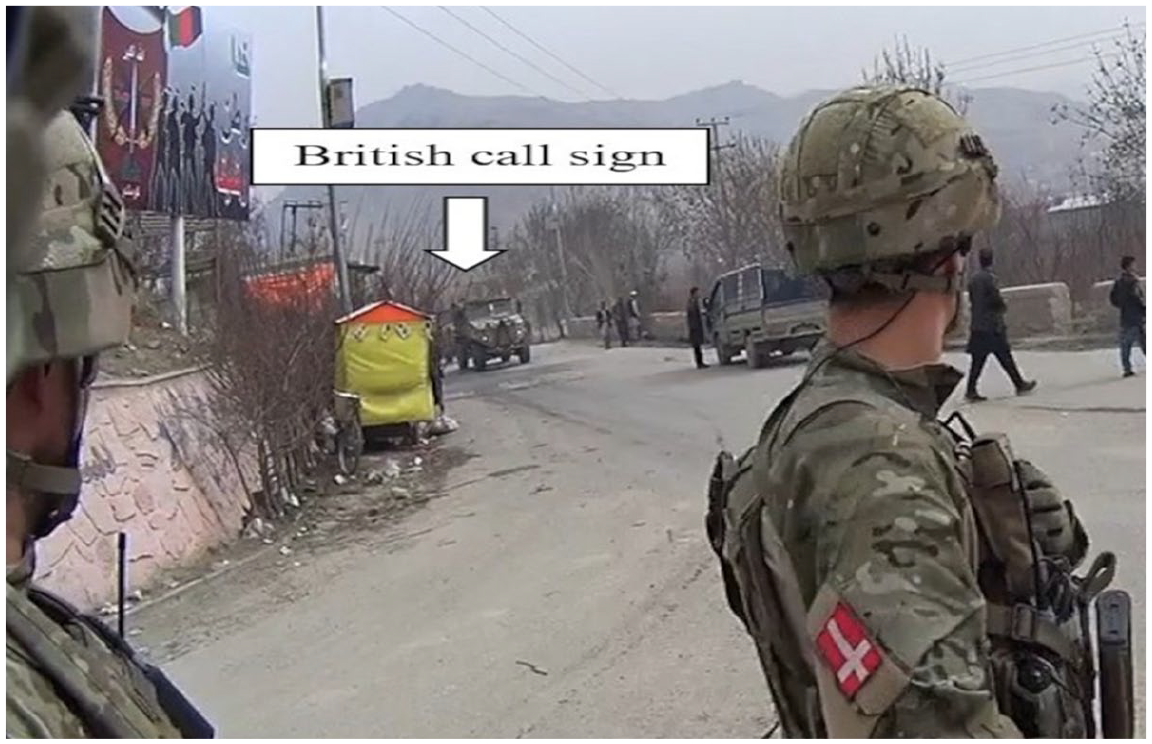
The soldiers notice the arriving vehicles.
In line 11, Knud further explicitly addresses the action implications of the new understanding of the situation, saying that they ‘really need to get a handle’ on what is happening. Following a short interruption by radio communication, this assessment is substantially developed in lines 20 to 23. As in line 11, no new factual information is provided here, so what is the interactional function of these few lines, including expressions like ‘max bread rolls and layer cake’ and Knud’s smile? We suggest that these utterances not only work to secure alignment in the participants’ assessment that this is a highly risky situation but also that they, together, are capable of handling it. Knud’s smile can possibly be understood as introducing an element of distance to the experience of risk. Beyond securing a shared understanding of the situation, participants can thus be seen to reassure each other that they can handle this, and they implicitly express trust in each other and the team. Finally, somewhat later, a new order is given by Knud on the radio (lines 70-71: ‘should something happen then initially you are to retain ground unconditionally’). Notably, this has not been checked with Klaris. He can thus be heard to speak on behalf of them both, that is, on behalf of the collective actor that has been constituted in this sequence.
In sum, the analysis in this third step has resulted in the observation of several moves and mechanisms through which the change of direction and re-organization of action was realized. These involve the design of the noticing of the arriving troops (including the role of the mobilization of military jargon), the observable alignment of attention and of understanding of the situation (including visible affirmation of risks and trust in the team), and the constitution of a collective actor, enacting a new way of organizing actions.
Step 4
In the final step, we again shift the analytical stance, this time from a focus on the participants’ own visible sensemaking, to instead interpret the findings from step 3 in terms of leadership theory. First, we need to critically examine whether and in what sense the situation identified with a sensitizing concept in the previous steps qualifies as a moment of leadership. Taking the perspective, for instance, of interpersonal influence as a necessary element of leadership (Fairhurst, 2007; Grint, 2005; Yukl, 2013), we can argue that the first noticing of the incoming vehicles qualifies as influence. What happens is not just a pointing out; rather, Jakob’s utterance is visibly designed to be responded to as relevant and legitimate. More importantly, Knud and Klaris treat the utterance as important and their alignment makes visible that they collaborate in being influenced, so to speak. Taking the perspective of reconfiguration of relationships (Crevani, 2018; Meschitti, 2019) and co-action (Sklaveniti, 2020), we have observed how the three participants visibly align with each other, constructing a temporary and situated collective actor, thereby qualifying as leadership also from these perspectives.
Any such claim about the moment qualifying as leadership can obviously be contested. An advantage of our approach is that such contestation and debate is pursued with the interaction analysis from step 3 available, making it possible to ground each interpretative claim in empirical data (which in turn was selected independently of a particular criterion for the leadership process).
The main task for the fourth step, however, is to utilize the findings from the close analysis of the realization of moments of leadership from step 3 to confirm or challenge and develop existing leadership theory. Patterns and similarities among the mechanisms and moves through which the leadership process is realized in situ are identified across sequences (Heritage & Clayman, 2010) and compared to existing conceptions.
For instance, our illustrative analysis suggests the possibility of discussing how relational configurations emerge and shift. Step 3 shows the subtle moves through which all participants align, team up and emerge as one coordinated collective actor. If similar patterns are identified in other sequences, this allows us to develop existing theoretical assumptions about the establishment, maintenance and change of relational configurations (Biehl, 2019; Crevani, 2018; Meschitti, 2019; Ryömä & Satama, 2019) through a deeper understanding of the micro-level moves through which this is accomplished.
In relation to the conceptualization of moments of leadership as turning points, the brief analysis here resonates with Lortie et al.’s (2022) observation of how moments of uncertainty result in shifting coordination. Our analysis of this single sequence suggests the possibility of extending Lortie et al.’s (2022) findings by demonstrating some of the very concrete interactional work involved in realizing such shifting patterns of coordination. Our analysis further suggests that alignment of assessments of the situation seem to play an important role that allows for a shift in coordination to happen.
In relation to existing theorizing about the leadership process, our illustrative analysis offers empirical support and substance to what Simpson (2016) calls a transactional and performative perspective. Our analysis suggests the possibility of a detailed analysis of the process through which what was described by the soldiers as floating and flexible leadership is achieved in the midst of practice. However, while several studies taking a strong process approach tend to separate the leadership process from individual actions, the type of analysis illustrated here demonstrates the importance of individual contributions, thus providing material for further theoretical development of the notion of leadership process.
Clearly, while we have utilized a single sequence for illustrative purposes, a full analysis demands patterns to be observed across several sequences.
Discussion and Conclusion
The four-step approach outlined above addresses the methodological challenges, described at the beginning of the paper, regarding empirically capturing and analysing the very nature of the in situ practices and processes of leadership. Utilizing video and audio recordings and drawing on EMCA combined with Blumer’s sensitizing concept, we demonstrate how moments of leadership as they happen can be analysed systematically in ways that support the development of compelling theoretical contributions to the post-heroic leadership literature, including but not limited to practice, process, relational and interaction-oriented studies. Central to this approach is the acknowledgement that any leadership process is necessarily produced in situ by the participants themselves. Such a perspective, however, results in two central challenges in utilizing recordings for the study of moments of leadership: how to select relevant sequences in a way that includes the participants’ own in situ sensemaking; and how to conduct a micro-level analysis of how moments of leadership are produced and made intersubjectively real as such by the participants themselves, which involves an inductive orientation, while also delivering strong contributions to leadership theory.
The approach we outline allows a unique validation of the phenomenological nature of the sequences selected for close analysis and thus handles the first challenge of data selection. While most studies obviously involve a very close examination of the empirical material, nevertheless, when attempting to make sense of what is going on (Biehl, 2019; Buchan & Simpson, 2024; Crevani, 2018; Ryömä & Satama, 2019; Simpson et al., 2018; Sklaveniti, 2020), they rarely incorporate any explicit procedures for exploring whether the participants experience the identified moments as expected by the researcher. Our procedure offers a way to supplement researcher characterization, for instance of moments when participants ‘face instability and uncertainty’ (Lortie et al., 2022, p. 6), with a close inspection of whether the participants in situ make sense of the situation in this way, as our illustrative analysis shows in step 2.
The second challenge, concerning the analysis of the in situ process of realizing moments of leadership, is handled by the capacity of the procedure to leverage the analytical resources of EMCA and similar approaches, focusing on the minute details of social interaction, in a way that enables subsequent confrontation with existing theory regarding leadership as process, practice and relationships. In this way, our proposed methodological approach goes beyond standard EMCA practices (Heritage & Clayman, 2010) by suggesting a systematic way to engage with more abstract and complex social science concepts. Further, it extends existing ethnographic and interpretative approaches (for instance, Biehl, 2019; Crevani, 2018; Ryömä & Satama, 2019) by providing a dedicated space for close analysis of the interaction from the perspective of the participants themselves. Beyond observing that the emergence of direction in team interactions seems associated with shifts in relational configurations (Crevani, 2018; Meschitti, 2019), our approach enables a detailed analysis of the subtle movements that such shifts entail. It is capable of making visible the detailed process of the construction of collaborative agency, located in the interactional domain (where individual contributions are responded to, reinterpreted and gradually transformed, and collaboration and co-ordination are interactionally achieved) as illustrated by the constitution of a temporary collective actor in step 3 of the illustrative analysis.
The analytical approach we present offers several opportunities for future research. Lortie et al. (2022) describe how collective leadership can emerge in a context in which a strict hierarchy is relevant. The approach presented here allows for an exploration of how the shifts between a hierarchical and a collective pattern of coordination are negotiated and realized in practice. Moreover, it enables an exploration of the possible role of hierarchical leadership in this process. Such studies clearly demand video (or audio) recordings that capture the subtle and fleeting moments where coordination is negotiated in practice, in periods of intense work (Lortie et al., 2022). Such studies would offer empirically grounded insights that can develop theoretical understanding of leadership configurations beyond a dichotomy of either vertical or horizontal leadership (Fairhurst et al., 2020).
Close studies of moments of leadership can further contribute to the perspective of leadership as dependent on relatively enduring, asymmetrical relationships. Analysis of recorded workplace interactions are capable of revealing how an existing relationship is leveraged and made relevant in organizational interaction, and conversely, at times made irrelevant, enabling more horizontal interactions. How such ‘parking’ (Einola & Alvesson, 2021, p. 850) of a relationship is accomplished clearly demands close attention to the minute details of interaction.
Studies of leadership emergence in teams have shown the important role of group identification as well as how changes in leadership can be related to shifts in such identification (Smith et al., 2018). Video (or audio) based studies of team interaction can help clarify how such shifts are accomplished, that is, how a team is made to see themselves in a different way. These processes reasonably involve negotiations between different ways of understanding the team and the context, somewhat similar to how the soldiers in our illustrative sequence Fortune arrives negotiate a new understanding of the evolving situation they are in. Such studies would contribute to bridging the gap between more cognitive orientation of studies of group identification and more process- and practice-oriented studies.
Further, while studies with a relational orientation have emphasized the fleeting and flexible coordination and negotiation of relationships, studies based on video (or audio) recordings employing the analytical approach presented here have a capacity to reveal just how a particular relationship is made relevant, negotiated and possibly changed. Moreover, studies focusing on the minute details of interaction could contribute to a theorized understanding of the role of such negotiated in situ relationships for coordination of action. In the studies of Biehl (2019) and Ryömä and Satama (2019), coordination is smoothly and seamlessly accomplished. Close analysis of selected moments of video recordings could help unpack the movements and mechanisms involved in realizing such smooth coordination in the flow of action.
Taken together, there are several possible routes for studies to produce rich and empirically grounded insights, that offer strong contributions to the theories of leadership as process, practice and relationship. Finally, while in this article we have addressed issues relating to leadership research, the procedures that we have put forward may be useful for researchers addressing other issues of interest to organizational scholars.
Footnotes
Acknowledgements
The authors would like to thank all the soldiers participating in the research project, as well as the editors of Organization Studies and the anonymous reviewers for their valuable advice and comments on previous versions of this article. Furthermore, the authors want to thank Gail Fairhurst, Andrea Whittle and Davide Nicolini for friendly comments on previous drafts of the paper.
Declaration of conflicting interests
The author(s) declared no potential conflicts of interest with respect to the research, authorship, and/or publication of this article.
Funding
The author(s) received no financial support for the research, authorship, and/or publication of this article.
