




Abstract
Although it is widely recognized that leadership concerns organizing future actions and mobilizing organizational actors to pursue them, our understanding of how this is accomplished in situated work interactions is relatively limited. Recent ethnographic studies have focused on leadership work resulting in the emergence of direction. This study explores the efforts involved in attempting to mobilize actors to act in such direction. Drawing on video recordings of managerial meetings in two Danish organizations, we take an ethnomethodological approach to explore in detail what is at stake in the leadership work of mobilizing future action. Our analysis demonstrates that leadership in these meetings largely consists of what we term interactional organizing work, involving three central challenges: establishing a shared understanding of what the problem at hand is, who owns the problem and is accountable for it, and how the problem should be addressed. Rather than a smooth flow of emerging direction, we see a struggle between different interests with different implications, leading us to suggest that agency be treated as less of an either individual or relational matter and consider leadership to be a collaborative process that builds and grows from individual agencies.
Keywords
Introduction
Leadership is widely understood as a process of organizing through which direction for coordinated action is established or changed and involved actors are mobilized (Drath et al., 2008; Fairhurst, 2007; Hosking, 1988; Yukl, 2013). Studies of the practical accomplishment of leadership have shown how direction of actions emerges through negotiation of expertise (Meschitti, 2019) and relational configurations (Crevani, 2018), and how such direction evolves as a consequence of particularly influential turning points in meeting conversations (Simpson et al., 2018; Sklaveniti, 2020).
However, while leadership has been conceptualized as a process of work (Crevani, 2018; Meschitti, 2019), the interactional efforts involved in moving from the emergence of direction to mobilizing action along those lines has received less empirical attention. While setting direction is an important element of leadership in the sense of “making others understand and agree about what needs to be done” (Yukl, 2013: 8), leadership also involves settling on “how to do it, and the process of facilitating individual and collective efforts to accomplish shared objectives” (Yukl, 2013: 8). Specifically, it involves mobilizing others to commit to taking action in a jointly articulated direction. A range of theoretical propositions have been presented for how to achieve this (e.g., Ford and Ford, 1995; Grint, 2005; Van Quaquebeke and Felps, 2018), but few studies have explored the challenges involved empirically. What is at stake in such circumstances is not least a fundamental delicacy of leadership, namely, how to motivate someone else’s initiative and committed action without constraining it in the very act of pushing for it. That is, the capacity of leadership to mobilize someone not just to follow, but to take action willingly and committedly.
This study takes an ethnomethodological approach to explore the micro-level details of how this leadership work is accomplished in everyday talk and interaction. Ethnomethodology (Garfinkel, 1967) and the related conversation analysis (Sacks, 1984) focus on how social and organizational reality is produced through interaction and are thus well suited for exploring the in situ practices through which direction emerges, actions are organized, and actors are mobilized to pursue them. While leadership studies have been dominated by quantitative and psychological approaches, there is a growing call for observational methods and detailed interactional analyses of leadership as a practical and discursive accomplishment and the challenges involved (Clifton, 2006, 2019; Fairhurst, 2007; Larsson and Lundholm, 2013; Svennevig, 2008; Van De Mieroop et al., 2020). Our study answers this call and the call for the use of ethnomethodology and conversation analysis in studies of organizing (Llewellyn and Hindmarsh, 2010; Samra-Fredericks and Bargiela-Chiappini, 2008).
The paper shows that mobilizing future action in the context of management meetings requires a significant amount of what we term the interactional organizing work of leadership. Analyzing video recordings of meeting interactions, we find this work to include developing a shared understanding of the problem at hand, who owns the problem and is accountable for acting on it, and how the problem could or should be addressed. In practice, actors often circumvent the work of getting to a shared understanding by developing actions and solutions for a problem, leaving the more basic issues largely unresolved (Wåhlin-Jacobsen and Abildgaard, 2020). However, such practices also tend to make ownership more problematic and mobilizing actors to commit to taking action more challenging. Our study contributes to the literature on leadership as organizing (Crevani, 2018; Hosking, 1988; Larsson and Lundholm, 2013; Meschitti, 2019) by providing a detailed specification of what occurs in the interactional organizing work of leadership, going beyond observing the emergence of direction (Crevani, 2018; Sklaveniti, 2020) to specify the work involved in mobilizing actors to commit to pursuing agreed future actions.
The remainder of the paper is structured as follows. First, we briefly review three lines of current leadership studies that are significant but insufficient for understanding the interactional organizing work of leadership. Second, we introduce our ethnomethodological conversation analytic (EMCA) approach for exploring the situated work of attempting to mobilize actors to commit to taking action, conceptualizing commitment as visible displays of committing. Third, we present an overview of the empirical setting, data, and EMCA tools. Fourth, we present our findings through three sequences of interaction, and finally, we discuss the contributions and implications of our findings.
Interactional challenges of mobilizing others to commit to future action
A range of authors have emphasized that leadership is closely connected to organizing. 1 Organizing involves identifying and making sense of actions, linking them in so-called double interacts (Weick, 1979), establishing mutual expectations and obligations (Larsson and Lundholm, 2013), and adjusting actions in response to feedback on outcomes (Lichtenstein and Plowman, 2009). Recent studies have further related the emergence of direction (Crevani, 2018; Drath et al., 2008; Meschitti, 2019) to communicatively produced turning points in conversations (Simpson et al., 2018; Sklaveniti, 2020).
However, the emergence of direction is not sufficient for organizing of future actions to be accomplished. Actors also need to commit to take such actions. We suggest that this process of mobilizing someone to take later action is an important, but hitherto less studied, aspect of leadership work. In an early study, Ford and Ford (1995) used speech act theory to develop a theoretical model specifying four types of conversation expected to be necessary for realizing change, which include initiative conversations, conversations for understanding, conversations for performance, and conversations for closure. While extensively cited, this proposed model has not been followed by much empirical research. Research on in situ leadership processes have largely taken three other routes, one focusing on leadership as a collaborative process of organizing, the second focusing on moments of leadership as significant shifts in work interactions, and the third zooming in on even more subtle interactional details of identity negotiation and establishment of mutual obligations. We briefly review these lines of research below.
First, studies of leadership as a collaborative, emergent process have explored situated organizing. Drawing on a strong process orientation, a series of studies on performance in music (Bathurst and Cain, 2013), dancing (Biehl, 2019), ballet, and ice hockey (Ryömä and Satama, 2019) have portrayed leadership as a relational phenomenon (Endres and Weibler, 2017) in which coordination seemingly emerges organically. However, other process-oriented studies have noted that leadership requires work and effort. In a study of work meetings, Crevani (2018) showed that direction emerges from a dynamic process in which “a number of simultaneously existing stories-so-far meet, co-evolve, leave, clash, return, and so on” (89). Similarly, Meschitti (2019) explored how work trajectories in a team shift as a consequence of the ability of participants to mobilize resources (such as expertise) and the resulting relational positioning. These studies demonstrate the ongoing and relational character of situated leadership processes. What is less clear is what exactly is at stake that demands work and effort amid the clash of co-existing stories, perspectives, and positions.
A second stream of research has examined significant episodes in which shifts and changes occur, that have been conceptualized as moments of leadership or turning points. Simpson et al. (2018) studied turning points as particular speech acts in work conversations, where the past, present, and a version of the future are brought together. Buchan and Simpson (2024) traced “re-orientational turning points in an unfolding leadership situation,” resulting in re-construction of a challenging situation. In contrast, Sklaveniti (2020) studied turning points as participants’ perception of when the direction shifted. In all three studies, a series of turning points were associated with significant changes in direction and coordinated actions. Focusing on action rather than discourse, Lortie et al. (2023) studied turning points as moments in which the ongoing coordination of work shifted from vertical to collective leadership. Moments of leadership are clearly consequential; however, it is less clear from these studies how such significant shifts in direction and workflow are interactionally conceived and actors are mobilized to commit to a particular line of action.
A third group of studies goes some way further to explore the constitution of moments of leadership by focusing on subtle interactional details and negotiations of identities and mutual obligations (Baxter, 2014, 2015; Clifton, 2006, 2009, 2014; Larsson et al., 2021; Larsson and Lundholm, 2013; Larsson and Nielsen, 2021; Schnurr et al., 2021; Van De Mieroop et al., 2020). For instance, Clifton (2014) explored how voicing the direction of an organization simultaneously involved claiming a leadership identity and constructing an organizational identity, Van De Mieroop et al. (2020) explored the negotiation of informal leadership positions from which the next few actions were organized, and Larsson and Lundholm (2013) explored how organizing actions was accomplished by establishing situated, task-based identities. These studies have demonstrated the extensive effort involved in the subtle identity negotiation that is an important aspect of leadership work.
However, negotiating identities (or relational configurations; Crevani, 2018) is only one aspect of the leadership work of organizing future actions. For actors to be able to commit to taking action, questions such as what is to be done, what is at stake in doing it, and why it should be done would reasonably need to be satisfactorily settled. Insofar as settling such issues involves work and effort in shifting understandings and positions (Drath et al., 2008; Grint, 2005; Yukl, 2013), we consider these negotiations to be a leadership process. In general terms, what remains unexplored by previous research is what the leadership work of organizing involves beyond emerging direction and negotiating identities and relationships. What challenges are at stake in the interactional mobilization of someone to commit to future actions? We take an ethnomethodological approach to explore such challenges.
Ethnomethodological approach
The central aim of ethnomethodology is to explore how social order is produced through everyday interaction as actors reflexively negotiate and establish shared understandings of what is taking place (Garfinkel, 1967; Heritage and Clayman, 2010; Llewellyn and Spence, 2009; Rawls, 2008). From this perspective, social order is not seen as a pre-existing state or premised on phenomena outside social interaction such as structural and institutional arrangements but as an ongoing accomplishment (Llewellyn and Hindmarsh, 2010).
The primary analytical focus of ethnomethodology and conversation analysis (EMCA; Sacks, 1984; Sidnell and Stivers, 2012) is on the methods and practices, which are called “ethnomethods” (Garfinkel, 1967; Rawls, 2008), through which actors contribute to generating shared social realities, crafting each new contribution on the basis of what the evolving interaction has offered thus far. The EMCA approach pays particular attention to subtle details of turn construction as well as bodily movements and other multimodal aspects of naturally occurring interactions (Mondada, 2011, 2019) that indicate actors’ in situ understanding of previous turns and contribute to the evolving interaction (Heritage and Clayman, 2010; Schegloff, 2007). By chaining contributions turn-by-turn, a mutually intelligible social situation is constituted. If leadership shapes organizational reality, everyday interaction is a critically important arena in which it should be identifiable (Larsson and Meier, 2023).
The EMCA approach resonates with the relational and processual focus of the previously mentioned leadership literature, but it is distinct in subscribing to a strong emic orientation and its attention to the in situ production of social reality. EMCA explicitly eschews imposing the analyst’s preferred theoretical framework (Schegloff, 1997), instead directing attention to how the participants themselves visibly make sense of and reflexively (building on what has happened so far and creatively designing the next turn) contribute to the evolving interaction. Thus, EMCA focuses on sensemaking amid and as an integral aspect of work practice (Llewellyn and Hindmarsh, 2010; Llewellyn and Spence, 2009), rather than post-hoc reflections; for example, in interviews. Applying EMCA to study leadership entails moving slightly beyond this strong emic orientation, since leadership is introduced by the researcher as a second order concept referring to a complex social phenomenon, rather than as a visible orientation of participants (Clifton and Barfod, 2024). Nevertheless, any analytical claim must be based on a solid understanding of the composition of social interaction (Greatbatch and Clark, 2018; Larsson and Meier, 2023).
The EMCA approach also directs our analytical gaze slightly differently from typical studies of commitment. In the literature, commitment has mainly been approached as a broad psychological state or readiness, defined as “volitional dedication and responsibility for a target” (Klein et al., 2012: 130). Drath et al. (2008), who consider commitment to be one of a tripartite outcome of leadership, alongside direction and alignment, similarly define it as “the willingness of individual members to subsume their own efforts and benefits within the collective effort and benefit” (647). EMCA prompts us to shift perspective to the actual engagement with specific tasks and actions. In other words, we are not interested in psychological states, but the situated practice of individuals visibly taking responsibility to pursue a specific task. The visible display of commitment is in fact what actors orient themselves toward in work situations. Consequently, this study considers leadership to be a matter of mobilizing not only acceptance or complying, which can be accomplished through commandment and coercion (Grint, 2005), but committing as visibly acting as accountable for some future action.
Considerable research employing EMCA has explored how an actor attempts to mobilize or “recruit” another actor to engage in something through everyday interactions. A prototypical format is requests, in which someone explicitly asks someone else to do something. Studies of requesting have demonstrated that these practices are fraught with tensions related to the entitlement of the requester to ask this of the recipient, who will benefit (Curl and Drew, 2008; Drew and Couper-Kuhlen, 2014), and who will have ownership of the requested actions (Rossi, 2012). The owner of an action is here understood as “the social entity that established its trajectory, that is invested in its outcome, and that is accountable for it (in positive and negative senses)” (Rossi, 2012: 431). 2 In practice, these sensitive matters are handled through the subtle, “seen but unnoticed” (Garfinkel, 1967) design of utterances, including avoiding overstepping one’s perceived entitlement by using modal verbs (such as “would” and “could”) and displaying openness to lack of knowledge concerning the recipient’s willingness and capacity to do what is asked (unknown contingencies). In summary, EMCA research on requesting practices has demonstrated that mobilizing someone to commit to an action is an interpersonally complex matter, but something that can be accomplished through a wide range of strategies and movements.
In this study, we are interested not only in how one party works to mobilize someone else to perform already clear (and in EMCA studies often immediate) actions, but the interpersonally sensitive issues of getting another to commit to taking responsibility for future action concerning a matter at hand, although it might be unclear what the action precisely entails. Drawing on the EMCA perspective, we label this the interactional organizing work of leadership. This leadership work encompasses not just single acts, but the extensive effort needed to make a future action accepted and aligned with by the recipient(s). From previous ECMA studies of workplace interactions, we know that this involves organizing in the sense of linking actions and actors (Larsson and Lundholm, 2013), navigating interpersonal sensitivities, affiliations, and disaffiliations along the way (Schegloff, 2007; Schnurr et al., 2021), and messy rather than linear phased negotiations of problems and solutions (Huisman, 2001; Wåhlin-Jacobsen and Abildgaard, 2020). We take the following as our research question:
What central challenges are involved in the interactional organizing work of leadership to mobilize actors to commit to future actions in managerial meetings?
Empirical setting and methodology
Data collection
To explore the question above, we draw on video recordings of recurrent managerial meetings in two Danish organizations, Digitalize and Learn. Digitalize is a private digital commerce company with offices across Europe and Learn is a public vocational school with two locations in Denmark. Data were collected by the first author through close observation and video recording of naturally occurring work interactions at recurrent meetings between executives, middle managers, and employee coordinators in Digitalize and Learn over an 8-month period from December 2021 to August 2022.
Audio and video recordings are essential for conducting EMCA research as they provide access to naturally occurring interactions and allow for repeated, moment-by-moment analysis of how actors visibly orient themselves to one another and their surroundings and make sense of each other’s actions (Sidnell and Stivers, 2012; Streeck et al., 2011). Video recordings are particularly preferred as they allow for fine-grained examinations into the multimodal details of situated social interactions, including speech, gaze, body movements, and gestures (Greatbatch and Clark, 2018; Gylfe et al., 2016; LeBaron and Christianson, 2021; Llewellyn and Hindmarsh, 2010). This study’s analysis concentrates on approximately 35 hours of video recordings from 23 formal meetings.
Data analysis
Approaching our data, we combine an EMCA oriented analysis of the sequential organization of recorded interactions with a sensitivity to the larger setting, drawing on our knowledge gained through the 8-month period of data collection. Through close examination of our video data, we chose sequences in which actors are discussing issues that involve future actions for someone to act upon for detailed analysis.
Our analysis of meeting sequences draws on the EMCA perspective of social interaction as sequentially ordered, in which each turn builds on previous turns and projects a reasonable following turn (Schegloff, 2007). The sequential organization of interaction often establishes normative expectations, favoring particular responses to utterances, in what is called preference structures (Pomerantz and Heritage, 2013). For instance, invitations typically project the expectation of a positive response. We pursue the strong emic orientation of the EMCA approach using the so-called “next turn proof procedure” (Sacks et al., 1974: 728), focusing on how the recipient of an utterance visibly makes sense of it and orients toward it through their next turn.
Examining our collection of recorded meeting interactions, we identified over 70 sequences during which future actions were negotiated and organized. In the findings section below we present our analysis of three selected illustrative sequences, which are transcribed using a simplified Jefferson style (Jefferson, 2004, see Appendix) and provided in their translated English version (the original Danish version is excluded due to space limitations) with participants’ names anonymized.
Findings
Given the rich detail in the sequences presented, it should be noted that we concentrate our analysis on the aspects that are particularly relevant to the focus of this paper. We include salient non-verbal details of the video data, e.g., body language and gaze, highlight main lines and add comments in the transcripts below to help the reading.
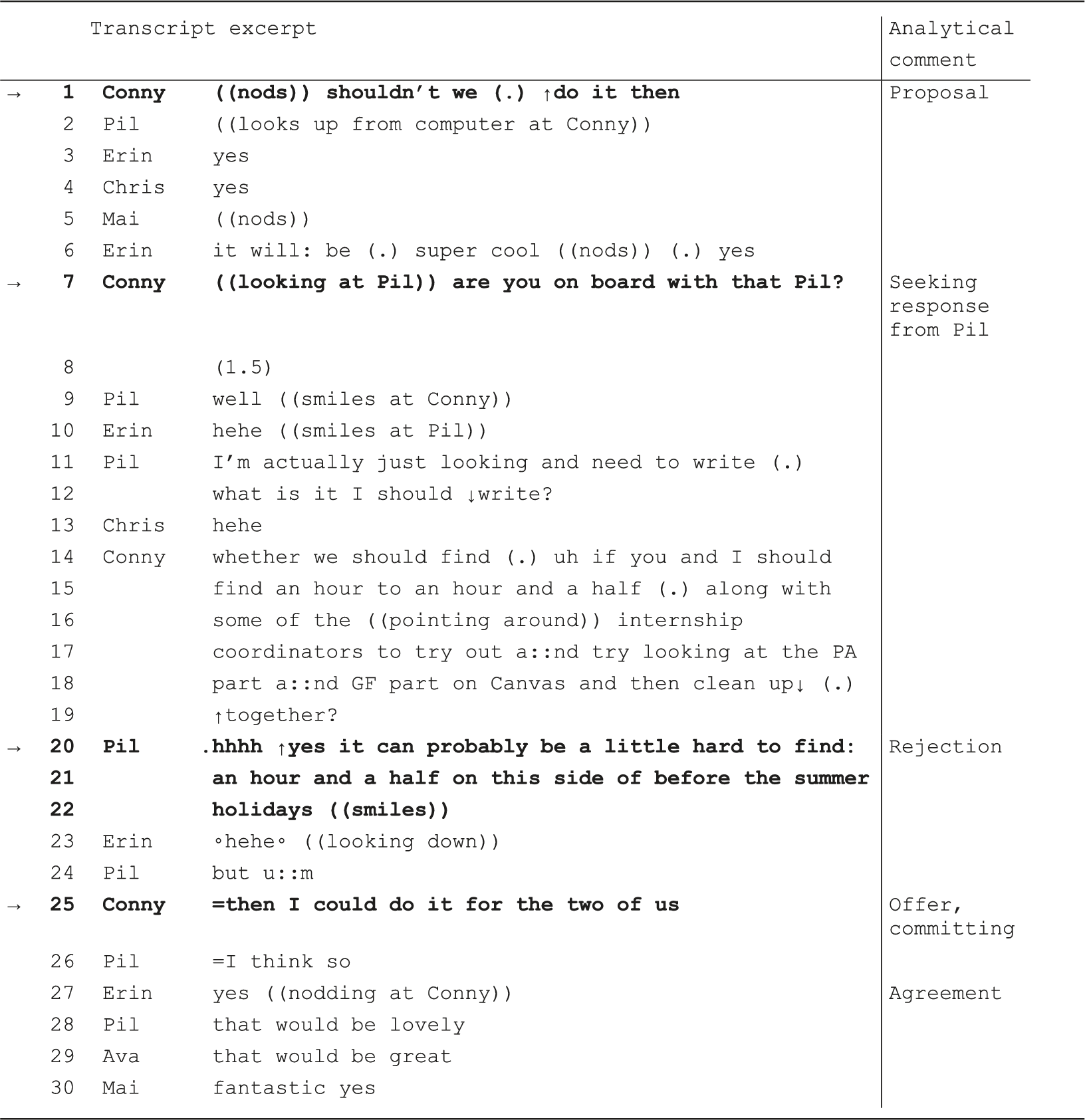
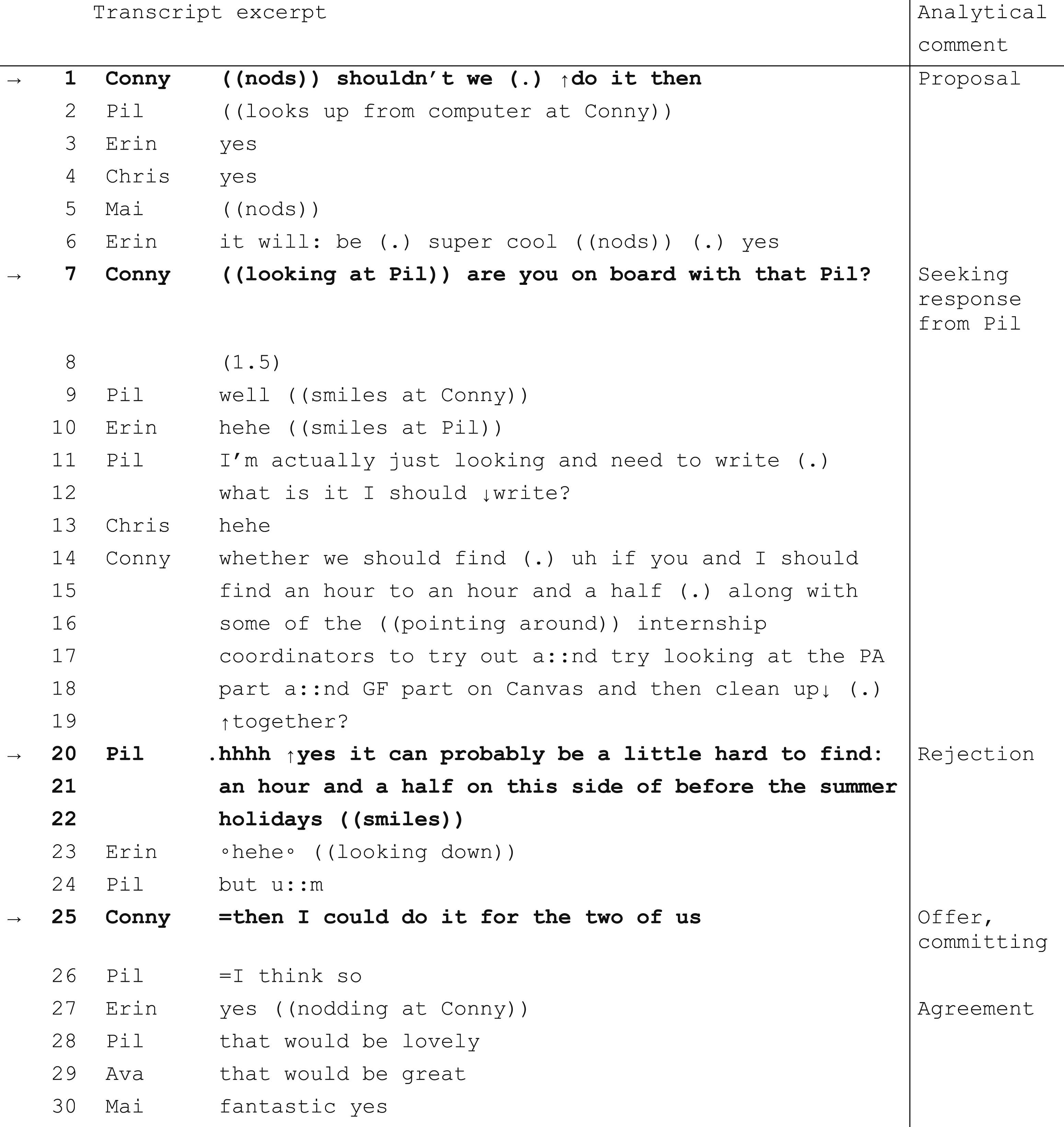
Although a lot is going on in this brief interactional episode, it illustrates a case of committing that demands little in terms of leadership work. Of interest is Conny’s use of the pronouns “we” (ll. 1 and 14) and “us” (l. 25). Since no one has yet agreed to be part of the subgroup working on the task with Conny (although they have visibly backed up the idea), the “we” is reasonably heard as indicating that regardless of who performs the task, it is on behalf of the whole group of teachers and managers. In lines 7 and 14–19, Conny explicitly attempts to recruit Pil to join her in working on the task, seeking an active response from her. However, Pil hesitates in committing (ll. 20–22) and Conny then offers to take on the task on behalf of them both (“for the two of us,” l. 25). Although she will be the one moving the task forward (including identifying some of the teachers to collaborate with), she has worked to construct a shared ownership (Rossi, 2012). Her utterance in line 25 is reasonably heard as a display of her committing to be responsible for future actions regarding this matter on behalf of the group. This is met by positive remarks from the others, and the conversation moves on to other topics. Although what exactly Conny is to do, the problem it is meant to solve, and who is accountable for what might be less clear to the reader, the important observation is that the participants treat the topic as sufficiently clear to act on, and it is solved “for all practical purposes” (Garfinkel, 1967: 15).
In contrast to the observation above, at times the organizing process involves significantly more leadership effort when trying to mobilize someone to commit to future actions. We next present two sequences in which three central challenges for the interactional organizing work can be identified.
Sequence 2
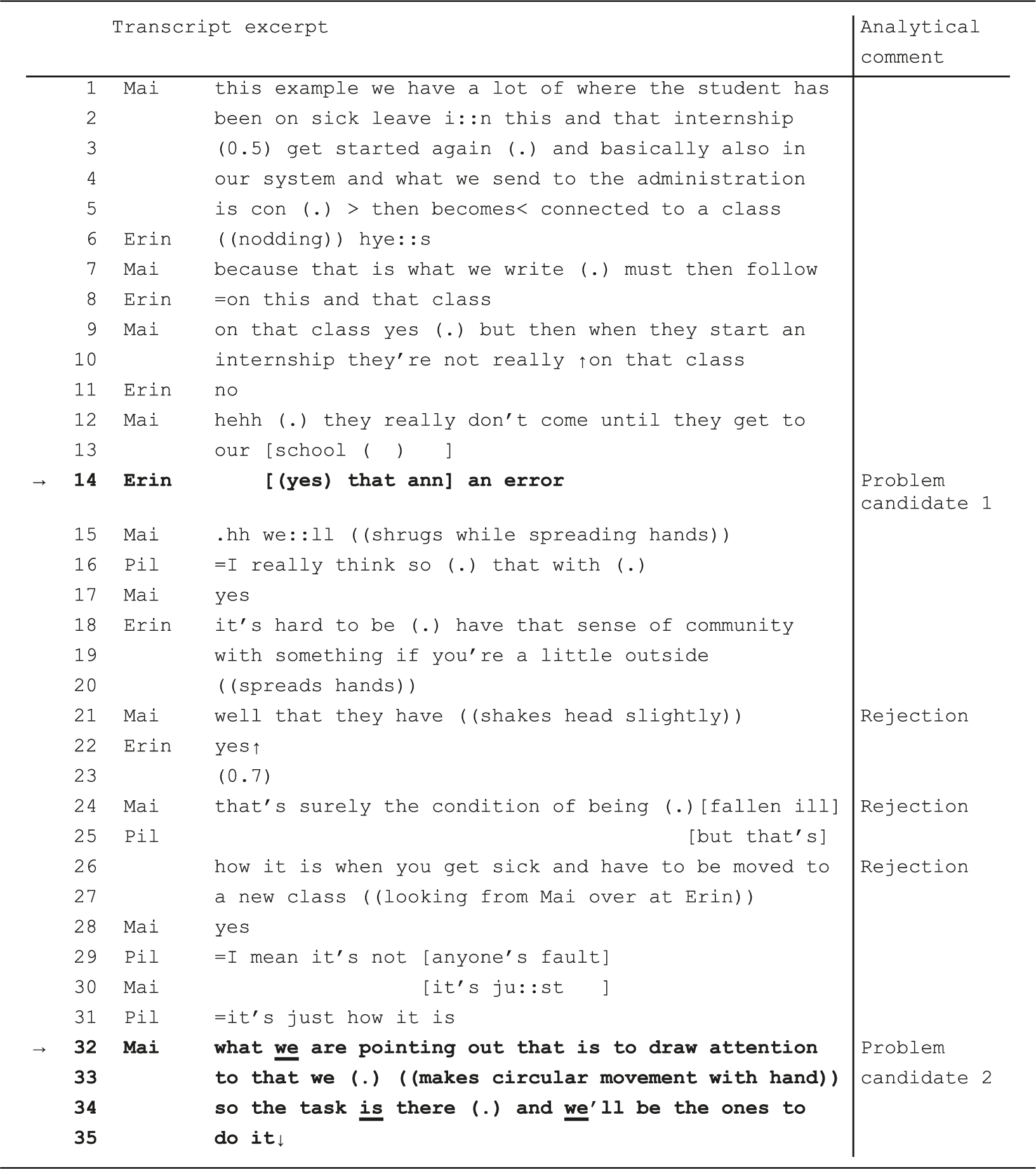
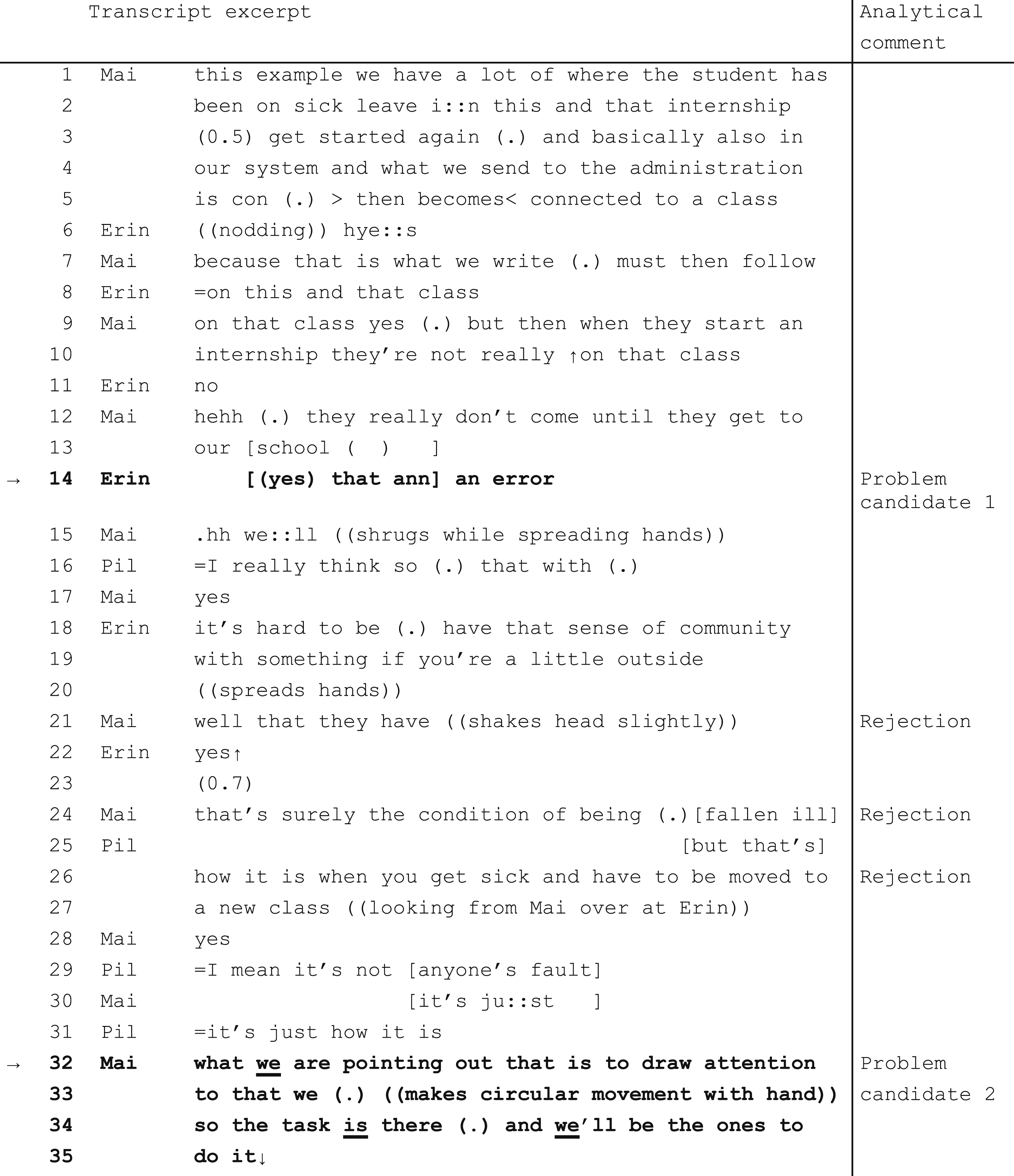
In this excerpt, two problem candidates are introduced. The first is formulated by Erin, jumping in to categorize the situation Mai is telling about as “an error” (l.14). While the preferred response would be agreement (Pomerantz, 1984), at best we get an ambivalent reaction, in the form of an audible inbreath by Mai (l. 15) followed by a prolonged “well” and shrug. Erin elaborates by suggesting that the problem concerns a lost “sense of community” (ll. 18–19), presenting a full first candidate problem formulation. This is contested in what follows, as Mai and Pil disagree (ll. 21, 24, and 25–27), both of whom characterize the situation as a condition rather than an error (ll. 29–31). In essence, the first candidate problem formulation is not accepted, the question of what the problem is remains open and the realization of future actions calls for more leadership effort.
 ’ll be the ones to do it” in lines 32–35. The emphasis on “we’ll” suggests that the problem consists in the fact that the task is currently located with the teachers, an issue related to whose problem it is. The implication that the problem concerns where the task is located rather than how it affects students, is left implicit, making the question of what to do with it ambiguous. This third challenge, the question of what should be done about the problem at hand, surfaces in the conversation that follows. We skip a few lines of silence and minimal response, after which Erin challenges the teacher’s construction of task location as problematic.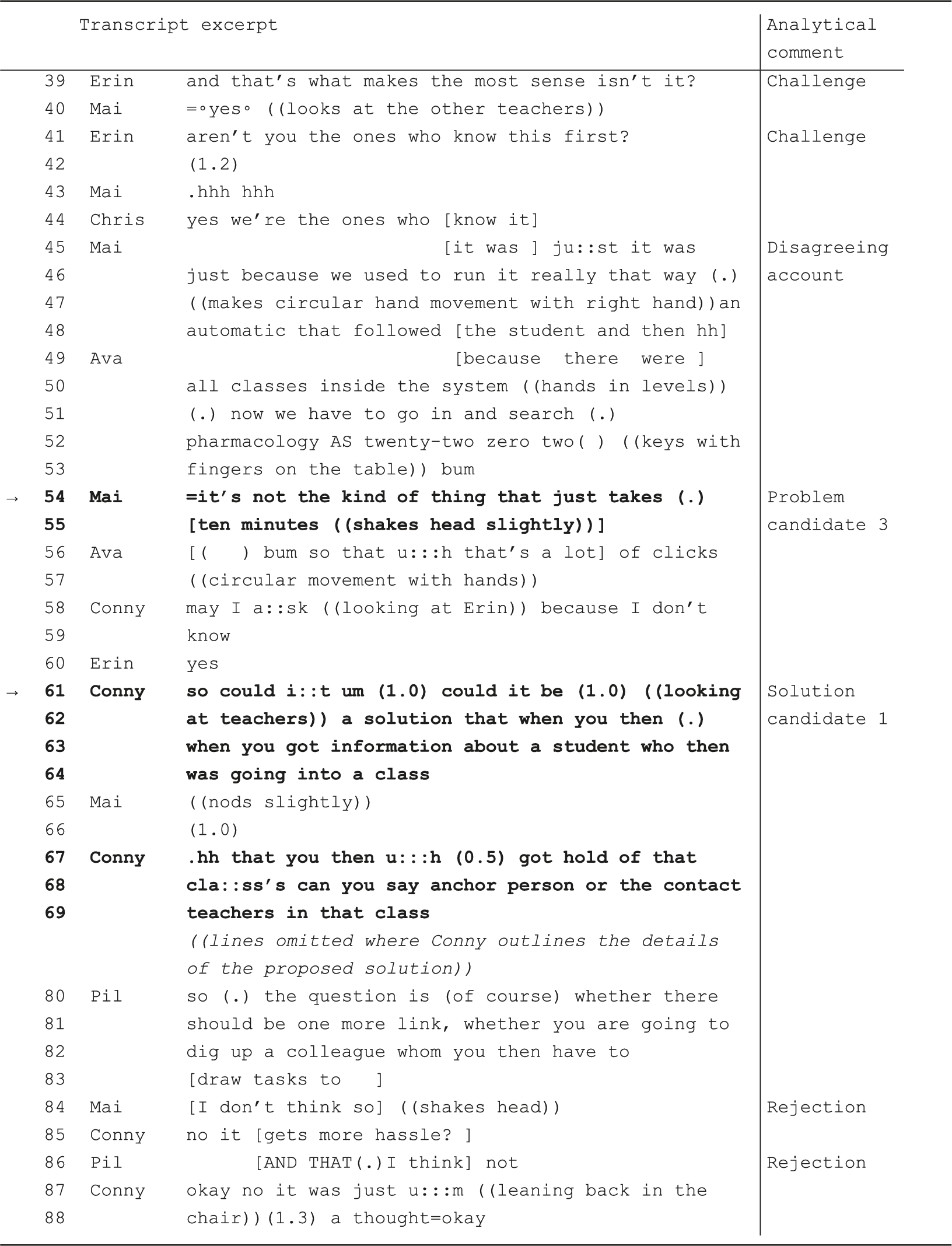
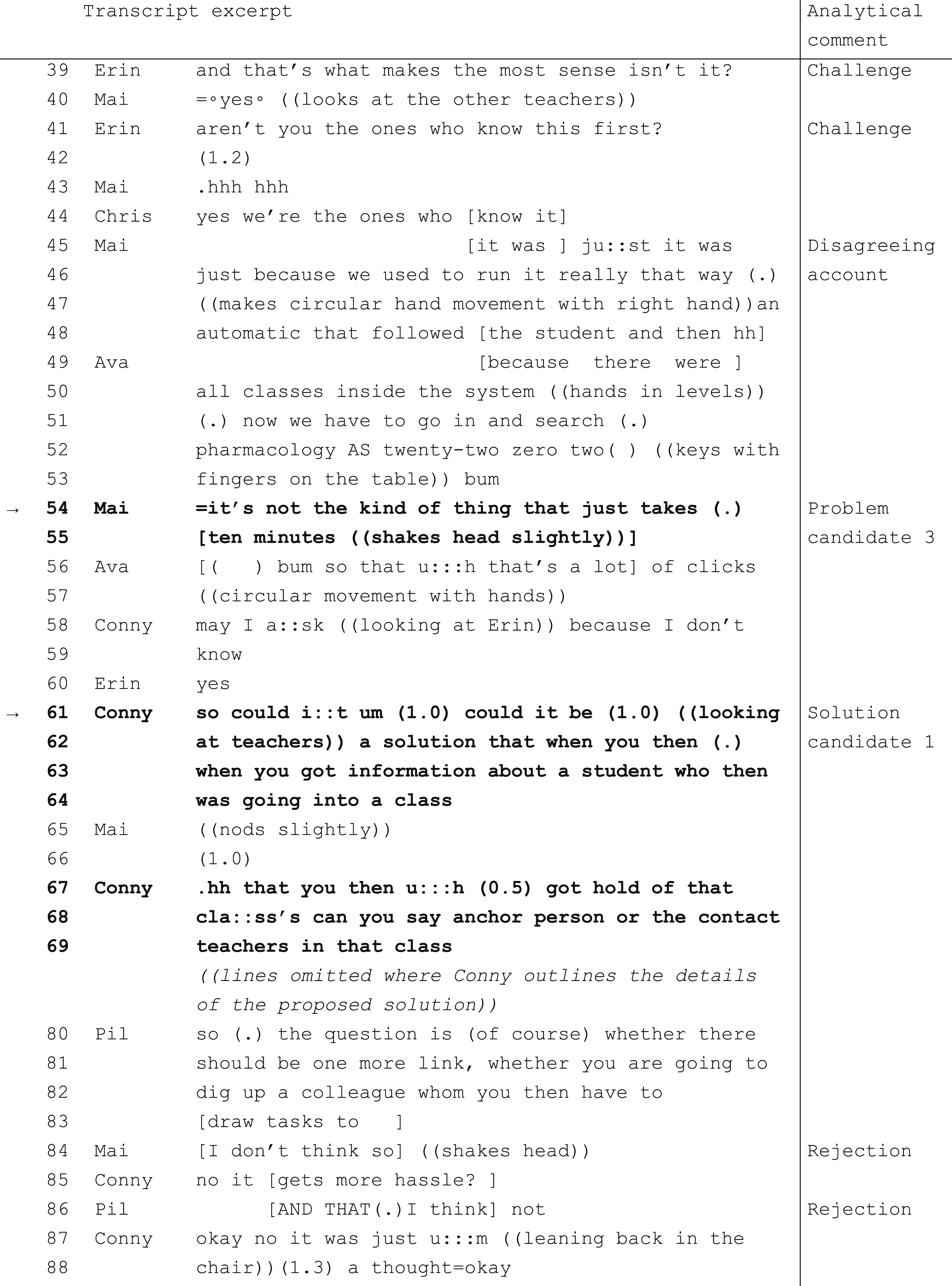
In the first lines, Erin presents an argument for the location of the task with the teachers as what “makes the most sense” (l. 39) with a negative tag question “isn’t it?”, which can work to mobilize support for the claim (Stivers and Rossano, 2010). Support is given, however softly, by Mai (l. 40), and Erin continues by elaborating her argument, asking if the teachers aren’t the ones to know first (l. 41), thereby implying that they are the ones who should act on it. In other words, a linkage between knowledge of a problem and ownership emerges in the sense of being accountable for acting on it. While Chris responds by acknowledging that it is the teachers who know first (l. 44), she does not respond to the first question of whether it makes the most sense. Nor does Mai, who rather signals disagreement, making an account for the state of affairs as changing the teachers’ traditional way of doing thing (ll. 45–48), which is supplemented by Ava (ll. 49–53). On this basis, Mai and Ava introduce a third candidate problem formulation (ll. 54–57), co-constructing it as an issue of time and effort. What we see next is Conny bringing the question of what should be done to the fore in line 61 and onward. However, the suggested solution is quickly rejected by Pil and Mai (ll. 80–86), both arguing that it introduces more work than it eliminates for the teachers.
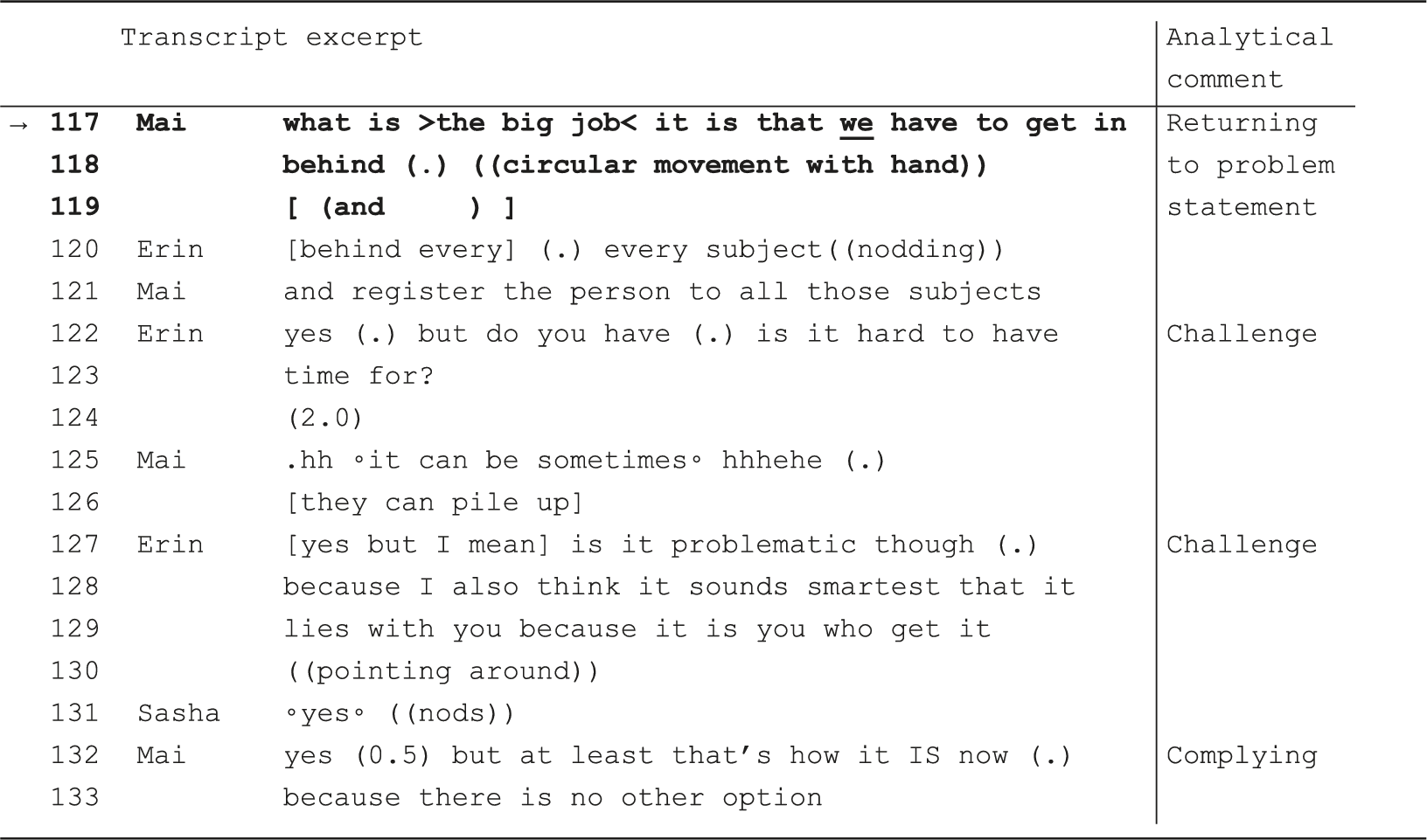
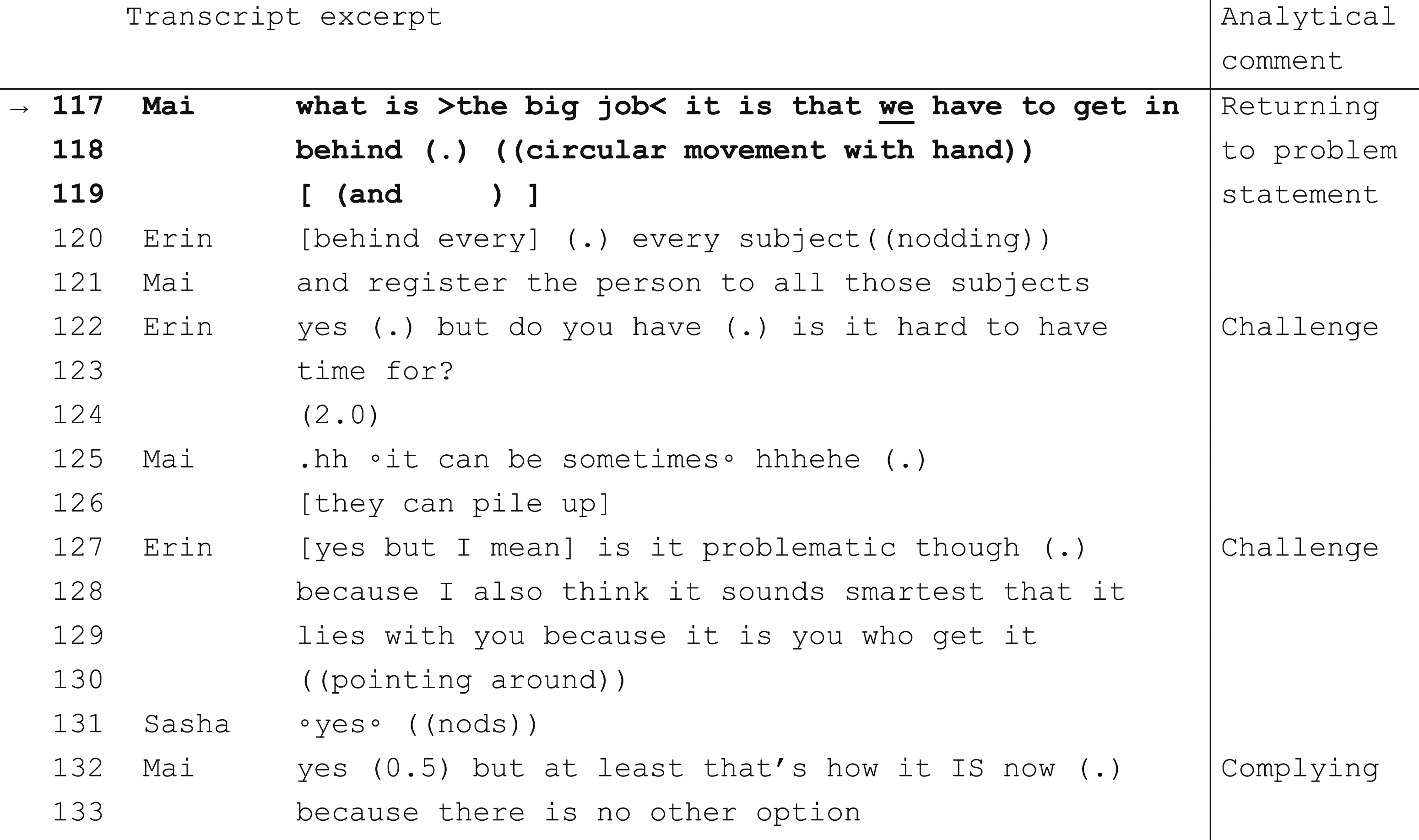
Mai characterizes the task as a “big job” and further emphasizes that “ have to” (l. 117), similar to what she did in line 32. While acknowledging the location of the task, Mai can be heard to reject ownership of it once more, positioning herself as a victim rather than an owner. Therefore, the teachers appear to want relief from the task, or they want something in return for doing it, but do not make any clear requests or suggestions. Simply presenting something as problematic may work to recruit the leaders to offer a solution as the next relevant action (as Conny did earlier), but it also prolongs the struggle to reach a shared understanding and complicates the organizing leadership work. What follows is a series of disagreements, in which Erin challenges the time issue (ll. 122–123) and the problematization of task location (ll. 127–130), asking for an account for the rejection of ownership. In lines 132–133, Mai acknowledges that “no other option” is currently available, casting herself and her colleagues as mere instruments in carrying out the task, and complying rather than committing.
In summary, the participants in this sequence engage in a leadership process of considerable interactional organizing work that revolves around the three central questions of what the problem is, whose problem it is, and what should be done about it. These issues are clearly interrelated, so that the construction of a problem depends on who is willing to take ownership of it (and vice versa) and any solution needs to be aligned with what the problem is and whose it is. As demonstrated throughout the interaction, one or more of these issues continues to be treated as unresolved by the participants; therefore, the leadership work of organizing future actions and mobilizing actors to commit to them continues, oscillating between attention to each of the three issues in a series of attempts to achieve sufficient clarity and consensus for anyone to commit to an action.
We use a final, shorter sequence to illustrate variations in the interactional organizing work of constructing and negotiating ownership, the nature of the problem, and what should be done. While the previous sequence presented a negotiation in terms of trying to avoid ownership, this sequence offers quite the opposite type of negotiation in which an actor claims unilateral ownership of an organizational issue.
Sequence 3
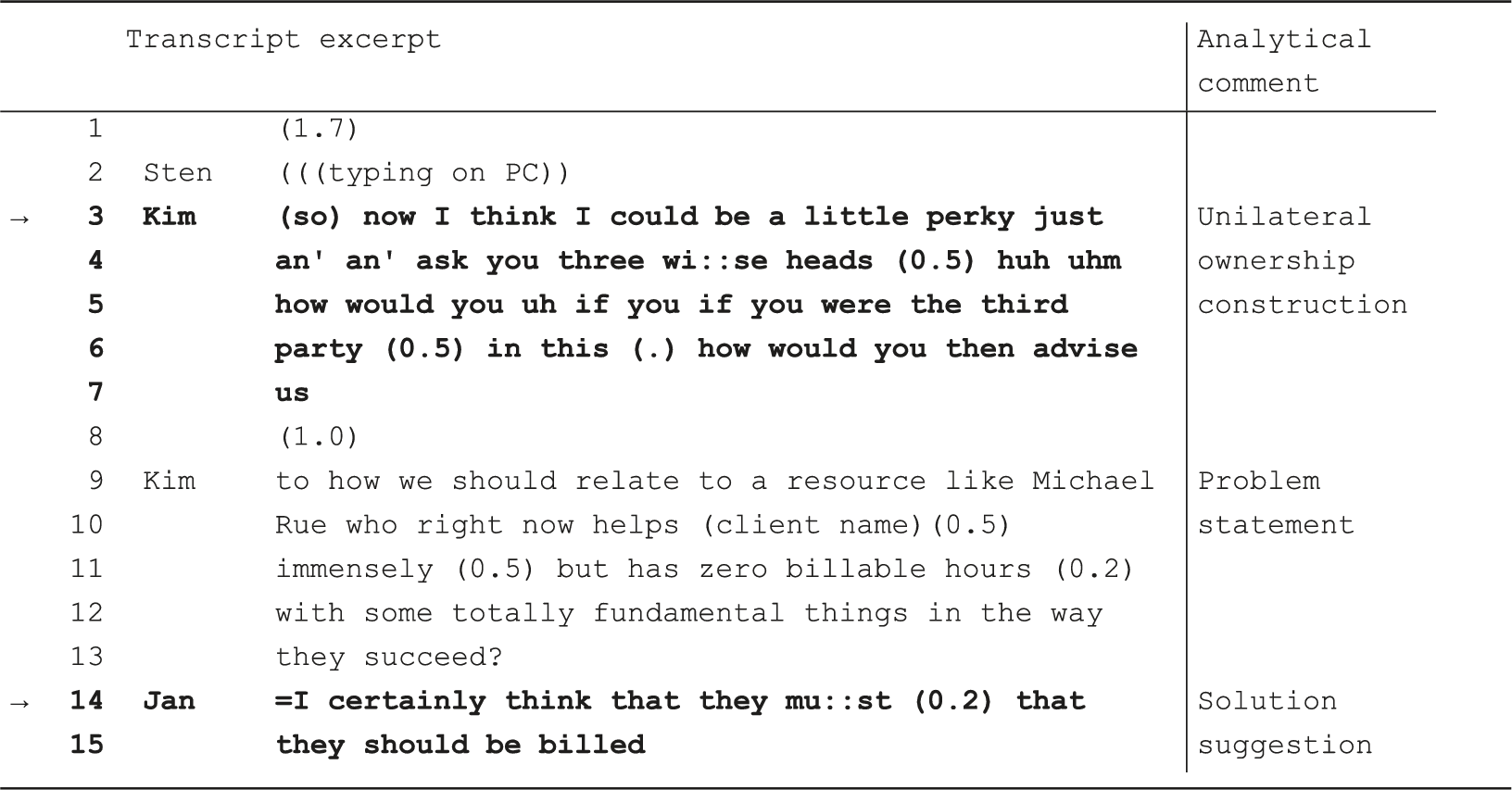
Kim presents an organizational issue regarding handling the costs of an employee doing work for other units, and the situation is delicately constructed as one of advice-giving, placing the ownership of the problem unilaterally with the unit heads. In lines 3–7, Kim is visibly building up to a social action that he does not treat as typical, carefully designing his turn. First, he uses a self-degrading characterization of being “perky,” working to mitigate the interpersonally sensitive nature of what is to come. Second, he (somewhat jokingly) positions the officers as experts (“three wise heads”) and places them in a distanced, external position (“if you were the third party”), specifically asking for their advice, thereby attributing high epistemic authority to the officers (Heritage and Raymond, 2005; Stevanovic and Svennevig, 2015), while simultaneously downplaying their formal authority and decision making right in relation to the problem at hand.
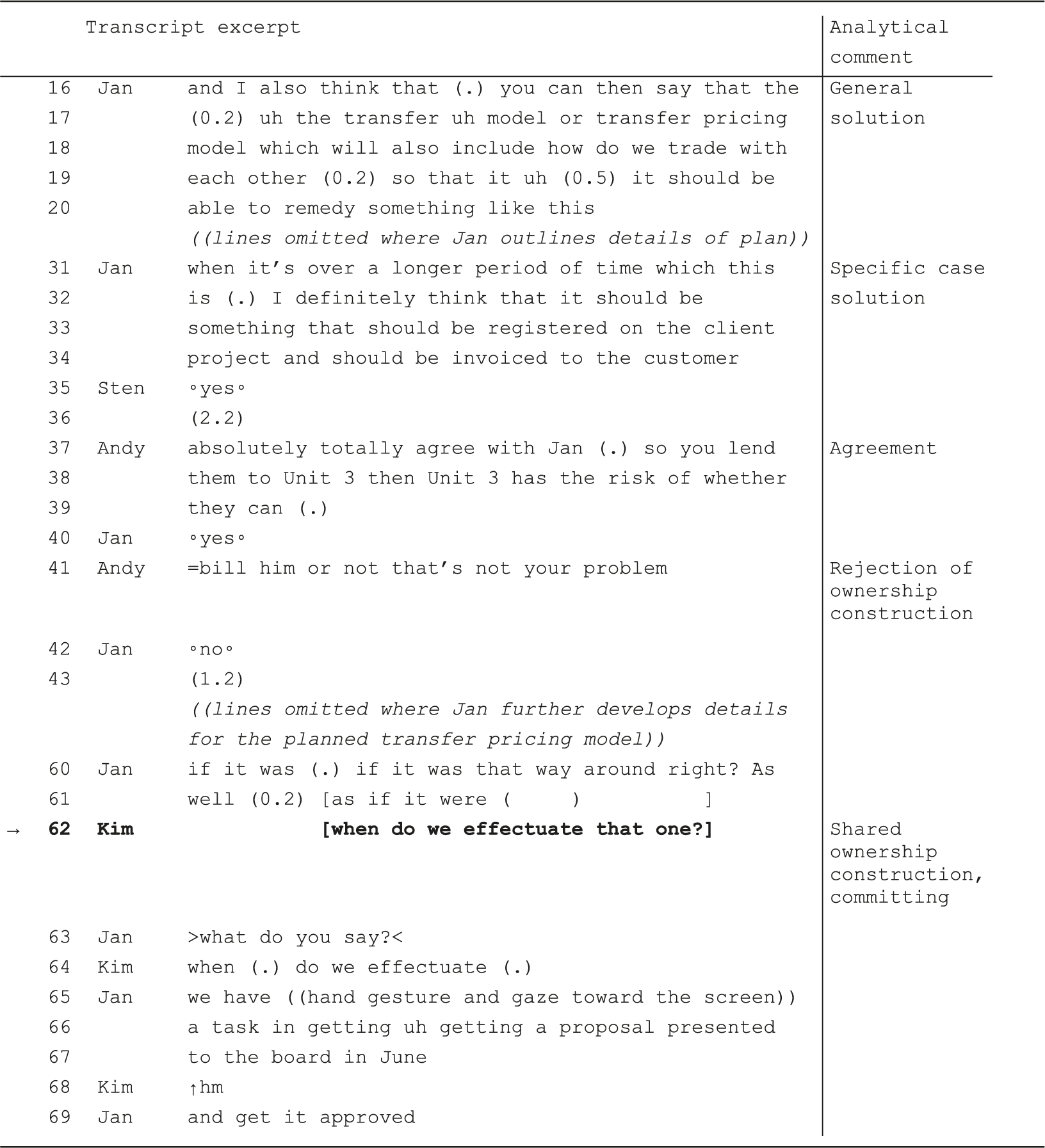
After Jan has described the transfer pricing model in some detail, Andy steps in displaying agreement (l. 37). Both Jan and Andy are hearable stating clear stances, using adjectives such as “definitely” (l. 32) and “absolutely” (l. 37). Then, in line 41, Andy explicitly states that when people are lent to other units, the issue of invoicing is “not your problem,” in direct contrast to the previous stance taken by Kim, claiming ownership over the issue. Instead, Andy places ownership with the loaning unit. In these lines, we see a moment of leadership in terms of shifting the construction of (ownership of) the issue, accomplished through interactional organizing work.
Importantly, the interactional organizing work here involves the introduction of a transfer pricing model that changes the context of the presented problem of loaning people across units, preparing the ground for the explicit change of ownership in line 41. Rather than being a matter that the unit heads autonomously manage, a general model is in the making offering rules and procedures for handling the matter. Therefore, it simultaneously represents a solution to the problem and constrains unit heads’ autonomy, who now no longer have the same rights and responsibilities in the ongoing leadership work. By introducing the model, the nature of the problem is also transformed. It is no longer a matter of relatively idiosyncratic exchanges between business units, handled by the unit heads, but a matter of implementing a new organizational routine and structure across units.
Finally, the new version of the situation is accepted by Kim in line 62, stepping in (in overlap) to ask when they will effectuate the model, now using the pronoun “we”, hearable as orienting to it as a shared project and the model as something that is already decided. In this way, he claims partial ownership of the problem as being part of effectuating the solution and visibly committing to take action. At this moment, he treats the construction of the problem, ownership, and solution as clear enough to act on; that is, the organizing work is finalized “for all practical purposes” (Garfinkel, 1967: 15) for the moment and the episode of leadership comes to an end.
In summary, this sequence demonstrates that leadership consists of significant interactional organizing work, involving negotiating the nature of a problem, ownership of it, and what should be done. Obviously, many things can be at stake in such leadership processes. While in the previous sequence we demonstrated how leadership work can be challenged by multiple parties not wanting to claim ownership over an organizational issue and by lack of clarity in relation to the nature of the issue, in this sequence, the central dynamic tension instead revolves around several parties claiming ownership over an issue, which is transformed accordingly.
Discussion
The leadership work of organizing future actions and mobilizing actors to commit to them in management meetings often demands considerable time and effort, which we refer to as interactional organizing work. Our analysis shows that this work involves managing the central questions of what the problem consists of, who owns the problem, and what should be done about it. The collaborative mobilization of actors to commit to future action depends on temporarily settling such questions. Notably, handling these challenges does not necessarily mean working out the details. In contrast, our analysis demonstrates that the level of clarification needed is a member’s concern (Heritage and Clayman, 2010), that is, a matter of when and how the participants find it sufficiently clear to move on with practical action. Our findings bring substance and detail to understanding leadership as a dynamic and relational process (Endres and Weibler, 2017; Lichtenstein and Plowman, 2009) of organizing (Hosking, 1988; Larsson and Lundholm, 2013), and in particular, to the understanding of leadership as work (Crevani, 2018; Meschitti, 2019; Simpson et al., 2018). Our analysis makes several contributions to the existing leadership literature.
First and foremost, our study extends and brings specificity to the notion of leadership work. Previous studies has almost exclusively emphasized direction setting as central to leadership work. Crevani (2018: 88) argues that “leadership work is about providing or creating direction in organizing processes,” Buchan and Simpson (2024: 82) emphasize that “it is the generation of … new directions that constitute leadership work,” and Sklaveniti (2020: 548) define leadership as “an ongoing process signifying the pursuit of direction in the production of a space for co-action.” Our findings extend this focus by demonstrating the significant effort involved in the so far less focused aspect of mobilizing actors to commit to taking future actions. The identification and analysis of this work is largely enabled by the strong emic orientation of an EMCA inspired exploration, with the focus firmly placed on what the participants are visibly orienting toward and attempting to do (while bracketing theoretically derived expectations on the leadership process and placing less emphasis on the content of talk than on the actions performed). This is a question of not only “the variety of resources involved in this process” (Meschitti, 2019: 624), but of how and to what end those resources might be deployed. We have identified three such central challenges.
The first challenge concerns what the problem consists of, aligning with Larsson and Lundholm’s (2013) and Crevani’s (2018) observations that constructing the issue at hand is an ongoing process. Moreover, our analysis shows that such work involves the moral relationship between a particular actor and the constructed problem in terms of accountabilities, rights, and obligations. The second challenge concerns who owns the problem at hand, which involves who is to take action to handle a problem, and more importantly, who is to be accountable for those actions and who is invested in the outcome (Rossi, 2012). Our analysis reveals intriguing variations in the leadership work to establish a shared understanding of ownership and accountability. In Sequence 1, Conny engaged in extensive interactional work to ensure that the task was collectively owned. In Sequence 2, an important matter seemed to be that the teachers risked being made accountable for a task they would prefer not to commit to, and consequently, they tried to avoid unilateral problem ownership. Conversely, Sequence 3 presented an example of leadership work in the direction of claiming unilateral problem ownership. In the last two examples, the construction of ownership was challenged, and the interactional organizing work of getting to committed action was prolonged. Clearly, this challenge involves not only obligations toward other organizational actors in terms of future actions and accountabilities (Larsson and Lundholm, 2013), but also rights such as the right to act and to decide what should be done in relation to a problem or task at hand. This leads to the third challenge concerning
Taken together, identifying these challenges as central to the leadership process of interactional organizing work significantly extends the notion of leadership work and demonstrates the very process itself. While several studies have observed that shifts and changes occur (Lortie et al., 2023; Simpson et al., 2018) or that smooth coordination is realized in the here and now, our close analysis reveals some of the details of how this is realized at the micro-level of turn-by-turn interaction. Moreover, our close analysis demonstrates that not all topic shifts are significant turning points (Simpson et al., 2018; Sklaveniti, 2020). For instance, whereas Sequence 1 ends with displays of successful handling of the issue, the shift in Sequence 2 from attention to what the problem at hand consists of is not oriented to in this way. Instead, the move to other aspects of organizing work is hearable as an attempt to approach the situation from another angle, as the interactional challenge remains. Importantly, the EMCA-informed analysis reveals such differences as a matter of participant sensemaking, as the participants themselves visibly orient to these topic shifts in different ways, regardless of any theoretical characterization of a significant moment. As a result, leadership work that aims to enable future actions emerges as a struggle, where issues of importance for the actors are at stake and the interaction is characterized by clashes, detours, and re-formulations, rather than a smooth flow of coordination and re-orientation (Biehl, 2019; Ryömä and Satama, 2019; Simpson et al., 2018).
Second, our analysis suggests that more is at stake in the work of leadership than identity negotiation and construction, which has been the primary focus of previous studies of leadership in interaction (Clifton, 2014; Schnurr et al., 2021; Van De Mieroop et al., 2020). While establishing a situated identity as a leader can be associated with authority and rights to, i.e., shape the direction of the conversation (Van De Mieroop et al., 2020) or influence the formulation of issues (Holm and Fairhurst, 2018; Meschitti, 2019), our analysis shows that the organizing work of leadership also involves issues such as ownership and accountability in relation to a problem at hand. And while most interaction studies have focused on identity negotiation in the current conversation, our interest is in the mobilization of actors to visibly commit to future actions as a central, albeit underexplored, aspect of leadership that stretches beyond the confines of here and now in projecting future accountability. While a temporary identity claim can be accepted in the ongoing conversation, it does not imply that someone is prepared to be held accountable for actions in the future.
A third contribution to the existing literature concerns the notion and location of agency. While process oriented leadership studies have largely located agency in the flow of interaction (Crevani and Endrissat, 2016; Endrissat and von Arx, 2013; Simpson et al., 2018) and eschew notions of individual agency, our detailed analysis demonstrates that collaborative engagement in interactional organizing work results from a variety of projects that different actors (individual and collective) attempt to pursue, that at times clashes with projects pursued by other actors. This suggests a perspective of leadership as involving individual agency (to pursue specific ambitions and interests) that plays out on the social arena of dynamic interaction, in which “[a]gents are in constant interaction, exchanging information, learning, and adapting their behavior in locally coherent ways” (Lichtenstein and Plowman, 2009: 618). In our analysis, the collaboratively accomplished leadership work of mobilizing committed action results from tensions and friction, where moral positions, responsibilities, and accountabilities are at stake. Rather than treating agency as either individual or relational, our analysis strongly suggests considering the collaborative process as consisting of a series of individual agentic moves. Therefore, our perspective challenges the distinction made when “the focus is on the work achieved socially rather than on what leaders do” (Crevani, 2018: 87). While we certainly agree with the futility of a priori defining some actors as leaders and attributing all agency to them, we suggest a nuanced understanding of the leadership process as consisting of nothing else than what actors do. As individual contributions that emerge from attempts to pursue a variety of interests clash and are reacted to, a social process of interactional organizing work emerges.
Conclusion
Leadership as an organizing process centrally involves the interactional work of mobilizing others to commit to future actions. Rather than a smooth process of organically emerging direction (Biehl, 2019; Endres and Weibler, 2017; Ryömä and Satama, 2019), this study demonstrates leadership as entailing a struggle with different interests and implications that involves handling questions such as what the problem consists of, what should be done about it, and the ownership and accountability for acting on it. The identification of these three questions throws light on the effort needed for leadership to result in the mobilization of actors to visibly commit to future action. Our study extends and brings significant details to existing literature on leadership as organizing work (Crevani, 2018; Meschitti, 2019; Simpson et al., 2018). While clashes, frictions, contestations, and reconstructions have previously been identified, the analysis presented here adds an important understanding of what is at stake and what challenges demand effort. In conversational dynamics, topics emerge, change, disappear, and re-emerge as the work shifts between the central questions. Clearly, it is through close analytical attention to ongoing interaction that such details of organizing work can be identified.
Our findings raise several questions for future research. While our study has identified three core challenges, studies can possibly extend these to other contexts. Moreover, while our study focuses on management meetings with a particular, relatively free-flowing interaction format, other interactional environments such as project meetings and informal one-on-one conversations could yield deeper insights into the dynamic relationship between the challenges. Finally, while our study has revealed some of the interactional complexities involved in ownership constructions for the first time in leadership literature, many questions remain. For instance, the extent to which ownership can be shared and how different accountabilities can co-exist, merge, or conflict over time, which would bring insights into the dynamics of shared and distributed leadership (Denis et al., 2023).
Footnotes
Declaration of conflicting interests
The author(s) declared no potential conflicts of interest with respect to the research, authorship, and/or publication of this article.
Funding
The author(s) disclosed receipt of the following financial support for the research, authorship, and/or publication of this article: Partly funded by Innovation Fund Denmark.
