




Abstract
Climate change impacts are intensifying but experienced unevenly. In response, calls for transformative adaptation—rather than incremental approaches that fail to address root causes—are growing. Transformative adaptation entails systemic shifts in political, social, and economic structures to reduce vulnerability for humans and non-humans alike. This paper examines leadership responses to escalating climate impacts in New Zealand, asking what forms of adaptation are being enacted and what should be enacted through a responsible leadership lens. Drawing on discursive analysis of public documents and interviews with 16 key stakeholders, the study finds that predominant leadership practices remain largely insufficient. These approaches promote incrementalism that fragments collective action and weakens climate policy. The paper argues for a shift toward responsibility-oriented leadership that centres stakeholder relationships and collective agency. In doing so, it seeks to advance leadership and organizational scholarship, and to inform public debate on climate adaptation and systemic transformation.
Introduction
The rapid succession of weather extremes such as perpetual droughts in East Africa, relentless flooding in Australia, Spain, Pakistan, and Nigeria, and wildfires in the United States and Canada, provide graphic evidence that global warming as the result of human-induced greenhouse gas (GHG) emissions is lethal and intensifying. Human interventions to eliminate, reduce and lessen harm are generally described as the process of ‘adaptation’. In its latest report in 2022, the United Nation’s Intergovernmental Panel on Climate Change (IPCC) defined adaptation as “The process of adjustment to actual or expected climate and its effects. In human systems, adaptation seeks to moderate or avoid harm or exploit beneficial opportunities. In some natural systems, human intervention may facilitate adjustment to expected climate and its effects” (IPCC, 2022: 2898). Human intervention can take multiple forms from raising houses to managed retreat or shifting populations and settlements out of harm’s way (Ajibade and Siders, 2021). Making room for nature is another example (Van Alphen, 2020; Yu et al., 2020).
Implicit in IPCC’s definition is the notion that climate change requires a response to the consequences of our actions: humans created climate change and must, therefore, solve it and adapt. This response should be directed towards each other and/or ‘natural systems’ to facilitate optimal realignment with the climate breakdown. Relationality in the sense of a duty to respond to the needs of ‘others’ including non-human species is inferred. ‘Maladaptation’, on the other hand, is defined as “actions that may lead to increased risk of adverse climate-related outcomes, including via increased greenhouse gas emissions, increased or shifted vulnerability to climate change, more inequitable outcomes, or diminished welfare, now or in the future” (IPCC, 2022: 7). Maladaptation can result from ignorance to climate impacts but also the conscious avoidance of taking leadership (Christophers, 2019; Sinha et al., 2024).
This paper examines the nature of the predominant leadership response to climate change but in particular, to adaptation, which is a subset of action, separate, but related to mitigation. We inquire into the extent to which ‘adaptation leadership’ is enabling ‘transformative’ adaptation or whether it is merely reaffirming the ‘incrementalist’ status quo approach and, in the process, creating or exacerbating maladaptation. To date, scholars in leadership, organization and management studies (OMS) and in the interdisciplinary field of climate change, have tended to frame adaptation leadership using a resilience framework (O’Hare et al., 2016). The operating assumption underlying this framework is that effective leadership should focus on rebuilding the status quo.
Transformative change in the context of climate adaptation --the specific focus of this paper-- has thus far been advocated by only a handful of leadership scholars (Bendell and Read, 2021; Gosling, 2021, 2024; Maher et al., 2023). This is despite growing calls at the global governance level for transformation by organisations like the IPCC. Rather, leadership studies has proffered theories that are adaptive orientated (Uhl-bien & Arena, 2018) and are generally focused at the organizational-level (Ferry et al., 2024) primarily taking a crisis perspective view (Harrison et al., 2019). This event-focused, inward-looking perspective means that processual, gradual issues such as sea level rise or temperature increases are generally ignored. The tendency then is to focus on the acute symptoms not the phenomenon itself (Harrison et al., 2019). We recognise and applaud the large body of literature that advocates systemic leadership which has been applied to sustainability issues and generally covers organizations and/or private sector leadership (e.g., Redekop, 2010, 2024; Western 2019). This paper, by contrast, explicitly focuses on climate change adaptation in particular with an interest in public leadership.
Taking note of the sustainability leadership literature, we depart from the mainstream status quo stance on climate adaptation and draw on responsibility-oriented leadership scholarship (Jackson et al., 2023; Kempster and Jackson, 2021; Pless and Maak, 2011; Pless et al., 2012). Most notably we draw on a sustained line of inquiry (Kempster and Jackson, 2021, 2023; Kempster et al., 2011) that has striven to foreground the substantial role that shared purpose plays in promoting responsible leadership. We apply this theoretical thinking on the question of responsibility leadership to explore adaptation leadership in New Zealand. This empirical case has been selected because New Zealand, as a tectonic-active island, is recognised as being extremely vulnerable to climate impacts (IPCC, 2022). It is also the locus of heavily engaged and contentious political debate on adaptation leadership. New Zealand is not alone in facing these challenges and questions about what forms of leadership are best suited to meet these (Carbanaro, 2024; Ripple et al., 2024; Siders et al., 2021; Thaler, 2021; Williams et al., 2017). This case serves to offer insights for other nation-states especially OECD countries.
Based on a discourse analysis of key adaptation documents supported by interviews conducted with a cohort of adaptation stakeholders we will show that current forms of adaptation leadership that are practiced in New Zealand affirm the status quo rather than promote comprehensive change. We argued that this type of leadership could well catalyze and deepen existing maladaptation if left to drift. The line of questioning we open up about New Zealand’s approach to adaptation and whether it inhibits change contributes to leadership research and the debate on adaptation leadership. This paper advances leadership research by focusing on adaptation in detail rather than generically discussing climate change or even more broadly sustainability as one grand challenge (Grint, 2022, 2024).
It explicitly disentangles climate adaptation from climate mitigation to bring out the particular nuances of adaptation. However this is viewed as one strand of the ‘polycrisis’ (Tooze, 2022) and so we acknowledge the interconnected nature of climate change (mitigation and adaptation) with biodiversity, justice, poverty and inequality. We also contribute to the research on responsible and systemic leadership (e.g., Carroll 2016; Ferry et al., 2024; Jackson et al., 2023; Redekop 2024; Wester 2019) by applying recent scholarship to an empirical case. In terms of wider societal impact, this paper enjoins with engaged adaptation academics (Shi and Moser, 2021; Sider et al., 2021) and governance bodies such as the IPCC that are advocating for transformative not just incremental adaptation.
The paper is structured as follows. First, we provide an overview of the key concepts of climate adaptation and examine the rising calls for deep, systemic responses that upend the business-as-usual approach. We then explore the leadership and OMS literatures to show that across these literatures most of the attention has been focussed on mitigation. When adaptation is discussed including in the interdisciplinary sustainability literature, scholars tend to employ a narrow resilience orientation rather than a transformative one. We argue that a responsible leadership lens should be brought to bear in adaptation research and outline how this has been done in our case of New Zealand. From this analysis we argue that adaptation leadership must facilitate not hinder deep, interconnected change. Towards this end, we contend that responsibility-oriented leadership that is attuned to relationality provides an optimal approach because it counteracts incremental, business-as-usual adaptation responses and heads off the possibilities of maladaptation. This approach is considerably informed by the sustainability leadership that advocates for a collaborative and systemics approach to leadership (see also Williams, 2010).
Overview of climate adaptation
Climate adaptation approaches
The climate adaptation literature distinguishes between two main types of adaptation: incremental and transformative adaptation (IPCC, 2022; Shi and Moser 2021). Incremental adaptation involves marginal changes over a short time period within existing parameters. The mode is managerial with the aim to control via available risk management techniques and tools. Incremental approaches view climate-related weather events as discreet occurrences that require disaster resilience type interventions. The PARA planning framework depicted in Figure 1 exemplifies this approach (i.e. Protect, Accommodate, Retreat, Avoid). Interventions take the form of one-off investments in hard infrastructure such as sea walls, levees, flood control gates, fortification of critical infrastructure (roads, water mains, telecommunications) and the elevation of buildings on pilings or platforms. Soft or non-physical infrastructure can also act as incremental adaptation interventions ranging from flood management to insurance products like parametric insurance which provides payouts based on predefined parameters or weather triggers (e.g., wind speed, rain precipitation). Market-based insurantial solutions such as risk-based pricing also fit into this category. The PARA framework. [Source: MfE 2020].
Incremental approaches are likely to preserve the status quo unless the reforms actively work to change the underlying social relationships and power dynamics that have led to existing vulnerabilities (IPCC, 2022). Critics of incrementalism further suggest that what is required is a fundamental shift that addresses the material, relational and normative factors that hold the current systems in place (Shi and Moser, 2021). Informed by post-humanist perspectives the objective is to disrupt Western Enlightenment ideas of ‘the human’ as the ‘fundamental reference point’ (Braidotti, 2013). This theoretical approach to adaptation seeks to dislodge dualisms such as human/non-human and culture/nature (Fox and Alldred, 2019) which are believed to underpin and drive the climate breakdown. Scholars argue that incrementalism does not address these problematic binaries but reaffirms them by contesting rather than accepting and valuing co-existence with non-humans and nature’s ‘force’. These authors contend that incrementalism could lead to maladaptation as well as the continuation, and possible exacerbation of injustices (IPCC, 2022). Moreover, in light of the withdrawal from the Paris Agreement by the United States, it is even more likely that transformative action will be usurped by status quo approaches.
Transformative adaptation conversely “refers to a change in the fundamental attributes of natural and human systems” (IPCC, 2022: 7). The IPCC’s generic definition is advanced by others who see transformation as an approach that involves upending and disrupting the current economic paradigm. For example, frame it as “a process leading to marked and qualitative change and processes that lead to fundamentally different forms of thinking, actions, systems, and structures.” (55–56). Tschakert et al. (2019) also see it as a process but add that transformative adaptation “challenges, and ultimately replaces, dominant development trajectories” (2019: 168). Drawing on Brockhaus et al., 2017; Brown et al., 2013 assert that this change is irreversible. Notably, these definitions emphasize the depth of change as a key aspect. Whereas an incremental approach to climate adaptation is centred on safeguarding the existing system, transformative adaptation aims to build resilience via changing system(s) and in doing so reducing or avoiding harm altogether.
There is growing consensus across academia, civil society and governing bodies that incrementalism should make way for transformative actions. The IPCC now notes that even if countries were able to make emissions reductions sufficient to meet the Paris Agreement transformative adaptation would still be necessary (IPCC, 2022). Viewed primarily as a process, transformative adaptation is guided by principles of ethics and justice. The end result of this process could lead to either hard or soft infrastructure solutions; but these are designed and implemented to work for broader social equity goals and are assessed against achieving these. The literature commonly cites four principles to the process of transformative adaptation: (a) recognitional equity; (b) procedural equity; (c) distributional equity and (d) intergenerational equity or how justice and injustice are perpetuated or changed through generations (see Hellin et al., 2022; Shi and Moser, 2021). In the absence of these principles, any change will likely be less than transformative and fail to address underlying vulnerabilities (Hellin et al., 2022).
In contrast to incremental adaptation, transformative adaptation generates considerable complexity and uncertainty. In this context, leadership that can coordinate across multiple levels and sectors; pay attention to distributional equity and justice; and help shift mindsets and paradigms has been highlighted as being key to initiating and supporting this transformational approach (IPCC, 2022; Lloyd and Carroll, 2022). Other leadership capabilities singled out are the ability to create coalitions and collaborations. Hellin et al. have noted that “while technological innovations are critical, enabling social, institutional and governance factors are the actual drivers of the transformative process” (2022: 3). Leadership then with its capacity to catalyse action and induce change is at the forefront of the growing calls for transformative adaptation. The next section will turn towards the literature on ‘adaptation leadership’ first within leadership, organisation and management studies and then within the considerably wider interdisciplinary scholarship in climate change literature.
Leadership on climate adaptation
Academic accounts of climate adaptation as opposed to discussions of generic climate change leadership or sustainability in leadership and OMS fields are still quite rare. There is a prolific literature on sustainability to consider and draw on, but this has not made climate adaptation an explicit (Redekop, 2010, 2024; Western, 2019). Frequently, ‘adaptation’ is taken as a given and subsumed under the catchall of ‘climate change’ and the yet broader term of ‘sustainability’. At best it is cited alongside, but often in the shadow of mitigation and the mission to reduce emissions (Grint, 2022). When adaptation does feature it is frequently placed in a conventional resilience frame (e.g., Hazy and Uhl-Bien, 2015; Uhl-Bien and Arena, 2018). These studies generally complement the large body of literature on how firms can strategically reorganize and adapt their business models and supply chains to climate impacts (Galbreath and Tisch, 2018). The objective is to maintain profitability.
A second body of scholarship is less common and focuses on the niche concept of ‘deep adaptation’ (Bendall and Read, 2021). These studies advocate for a type of leadership that can guide and thrive in the midst of mass disruption at proportional, catastrophic levels. Deep adaptation refers to actions that acknowledge the inevitability of societal and ecological collapse (Gosling and Case, 2013). It constructs a worldview based on a sense of inevitability that the tipping points will be breached (Lenton et al., 2019) and cause mass destabilisation for which humans should prepare. Although the theoretical starting point in these two approaches are substantially different, they both take a realist approach to climate change and seek some form of survival or continuation of human organisations and society.
Conventional studies reimagine climate change as a bundle of risks that can be controlled and managed (Maguire and Hardy, 2013). The explicit purpose of leadership in this context is to navigate the organisation through the wicked problem of climate change. Continuation rather than forging change or accepting extinction is seen as the essential work of leadership. Underpinning this is the notion that climate change can be led, managed and controlled by competent leaders. Nalau exemplifies this approach when she defines adaptation leadership as the “set of skills and mindset needed to consider both short- and long-term ramifications of climate change, make decision on how to adapt, while taking charge of new opportunities in an inclusive manner” (2023: 313). The skills she lists are future visioning, comprehending risks, and information literacy. From the perspective of this literature leadership is preoccupied with building successful “change management” to “enable companies and organisations to stay relevant in a changing climate” (Nalau, 2023: 306).
Conversely, scholars of deep adaptation view leadership as the art of realising the ‘4 Rs’: ‘Resilience’, ‘Relinquishment’, ‘Restoration’ and ‘Reconciliation’ that was developed by Jem Bendell (2021). ‘Resilience’ involves helping to build the capacity of systems, communities, and individuals to recover from the impacts of climate change and societal disruptions. ‘Relinquishment’ refers to letting go of unsustainable practices, systems, or ways of life that exacerbate and contribute to the crisis. ‘Restoration’ aims to heal and restore natural ecosystems, social structures, and relationships that have been damaged, aiming to create a more sustainable and harmonious way of living. ‘Reconciliation’ is about reconnecting relationships with “those we have fallen out with” by “enhancing amity and goodwill” (Gosling, 2021:220). Adaptation leadership then is conceptualised as a fundamental shift away from the status quo rather than focusing on the maintenance of it. Connecting with non-humans and other humans is seen as a critical part of what leadership needs to do to enable transformation to occur.
This point about the necessity for fundamental change has also been made by Maher et al. (2023) in their discussion of the relocation of people, services and assets in the face of extreme climate impact generally referred to as managed retreat. The authors suggest that adaptation should depart from transactional forms of planned relocation to facilitate novel opportunities and minimise long-term harm. To make this happen they suggest a place-based approach that is sensitive to the dynamics of location, ecosystems and people’s connections to each other, non-human species and the land (see also Kaak, 2010). This wider stakeholder perspective is guided by recognising and seeing the duty to others, in the broader sense beyond humans. They conclude that: “To achieve positive leadership for managed retreat, we must take a responsible, long-term, place-based stakeholder perspective that is focused on cross-sectoral collaboration” (2023: 219). Thus the authors note that to be considered as effective and successful, adaptation leadership should approach managed retreat from a position of a strong and nuanced attunement to location.
Within the climate change interdisciplinary literature, most adaptation leadership is instrumentalised as another policy tool or is used to describe the ‘ambitious’ actions of cities, states, and other governing entities (Gilson, 2021; Hofstad and Vedld, 2021; Skjærseth 2017). Although a growing number of scholars are now becoming focused on transformative action this has not crossed over into discussions on adaptation as a subset of climate change(Sider et al., 2021). Therefore, the tendency to treat leadership as just another management tool persists. This positioning of leadership reflects the dominance of planning, policy studies and disaster management in mainstream climate adaptation discussions. This approach is best exemplified by Meijerink et al. (2013, 2015) who adapt Complexity Leadership Theory (CLT) (Uhl-Bien, 2006) to formulate a list of essential adaptation leadership functions for enacting policy and planning solutions. These functions follow a rationalist policy process from stakeholder engagement through to policy decision-making, implementation, communication and monitoring. Following CLT, adaptation leadership is conceptualised as being distributed among a network of agents whose overarching goal is to operationalise adaptation policy. In a similar vein Vignola et al. (2017) select leadership styles they consider to be most appropriate to each stage of the adaptation policy cycle.
Adaptation leadership is also used to describe the actions of entities. Here it is common to define leaders as cities, regions (e.g., the EU), international organizations (e.g., UN, ASEAN) states (e.g., Sweden) that are ‘agents of change’, ambitious and able to influence others and unify multiple stakeholders (Wurzel et al., 2019). These studies tend to view the purpose of adaptation leadership as coordinating across societies and between levels of government (Shi, 2019). The aim is to build resilience in the face of extreme weather events. Studies in this vein draw on natural disaster and crisis management scholarship. The administrative context is considered important with the perception that sophisticated stakeholder engagement and management is key to successful policy implementation. However, the emphasis is still placed on ‘policy success’ and, as such, follows Meijerink’s et al.’s (2015) instrumentalist approach but with a stronger geopolitical base.
An outlier to the general incrementalist approach in the interdisciplinary climate change literature has been presented by Crosweller (2022; see also Crosweller and Tschakert, 2020) who calls for relational models which are future-oriented and attuned to crises but ultimately seek to reduce human and non-human suffering as impacts worsen. This work is closest to Bendell and Gosling’s work (2021) on deep adaptation and also Maher et al. (2023) in its critique of status quo approaches that lock-in anthropocentrism and climate change denialism. Crosweller and Tschakert (2020) similarly suggests that leadership needs to pay attention to interconnections and make room for grief. They powerfully conclude that, “the circumstances of the mounting climate crisis likely require leaders, and all of us, to deepen our relatedness to others and our understanding of loss and suffering. This will require addressing leadership challenges associated with the longer-term temporal dimensions of disaster causation and ways to extend relational framings of leadership into these dimensions” (2020:9).
The objective in this paper is to suggest that adaptation leadership which responds to the imperative for deep change is critical. Whereas research on ‘grand challenges’ is growing less attention is being paid to the nuanced demands required of leadership when facing the escalation of climate-related weather events. There are still remarkably few studies in OMS (Bendall and Read, 2021; 2021; Maher et al., 2023) that take seriously the need for a transformative approach to adaptation even though it is now widely recognised as unavoidable. We build on aspects of relatedness that feature in these critical studies as well as those that advocate a systems-led approach (Redekop, 2024). Drawing on recent conceptualisations of responsible leadership (Jackson et al., 2023; Kempster and Jackson, 2021; Maak and Pless, 2019) we argue that to enable transformative adaptation leadership, acknowledging relatedness and then acting from a fundamental point of responsibility must be positioned at the centre. This positioning must actively challenge the incremental approach to adaptation. The following section introduces this theoretical framework.
Responsible ‘adaptation leadership’
This paper is situated within the critical work on responsibility within leadership and applies this to the context of climate adaptation. Although there is not one definition of responsible leadership the most frequently cited is Maak and Pless (2006) who define it as “a relational and ethical phenomenon, which occurs in social processes of interaction with those who affect or are affected by leadership and have a stake in the purpose and vision of leadership relations” (103). Other definitions include Lin et al. (2020) who describe it as “a leader’s ethical act of inspiring others through his/her motivating, communicating with, empowering and convincing employees to engage with responsible development and positive changes” (2020: 1). In a systematic review, Jackson et al. (2023) identified four broad characteristics, functions and actions of responsible leadership: (1) a multi-stakeholder orientation; (2) morally and ethically driven; (3) seeks to balance profit and societal outcomes; and (4) leadership that is able to influence subordinates to be involved in achieving common good for the organisation’s wider stakeholders.
Central to our discussion on adaptation leadership is the fundamentally relational nature of leadership which permeates all four of these orientations. As Carroll (2016) drawing on Young (2006, 2011) and others (e.g. Lloyd and Carroll 2022) argue, ‘responsible leadership’ is at its essence about social responsibility and connected obligations to others (Waldman and Galvin, 2008). Responsible leadership widens what counts as a stakeholder beyond the shareholder and strictly those classed as ‘followers’ to stakeholders-at-large. This could mean organisational members, communities, the environment and non-human-species. Thus, Carroll writes, “at its core we could argue is both a desire to move away from a sense of corporate and executive leaders having or exercising less than robust ethics and a move towards the host of major global, social, environmental, and cultural issues that beset the contemporary world.” (Carroll, 2016). Responsibility-orientated leadership thus puts relationships at the centre of leadership, displacing individualistic concepts of what it means to lead and why we lead. An example of this is what Lloyd and Carroll (2022) have developed as ‘co-leadership’ in the context of the global governance response to climate change.
In their recent survey and reappraisal of responsible leadership Jackson et al. (2023) approvingly note the stronger focus on the relational, collective, purposeful and holistic components of responsible leadership (See also Cikaliuk et al., 2022; Curran, 2021). This work is highly pertinent to transformative adaptation not only because it underscores relationality (e.g., ‘we/us’ vs. ‘me’) but convincingly argues that good outcomes matter and should primarily guide the enactment of leadership. If transformative adaptation is the purpose or outcome, then this should be reflected in the form leadership takes. To reiterate, transformative adaptation as opposed to incremental adaptation is based on an obligation to others to ensure justice underpins all adaptation actions. To be considered ‘successful’ the pathway to adaptation must be founded on principles of ethics and justice. This is essential to reduce or avoid harm and is consistent with the IPCC’s broad definition of adaptation. As such, responsibility to others which is inferred in the principles of restorational, procedural, distributional, intergenerational equity (Hellin et al., 2022) must be fundamental to leadership responses. Adaptation leadership then is responsibility-oriented leadership that seeks a ‘just adaptation’ for multiple stakeholders not only the ‘me’ but the ‘we’ with purpose as the guiding light to ensure this. To paraphrase Hellin et al. (2022), adaptation leadership that does not take responsibility to others as its core function is not leadership for transformative adaptation; it is incremental adaptation leadership. These forms of leadership are more likely to eventually lead to maladaptation and could perhaps qualify as examples of ‘irresponsible’ leadership in so far that ignorance should not count as an excuse.
In order to examine current adaptation leadership practices and evaluate the extent to which they are enabling systemic change or inhibiting it we draw on Kempster and Jackson’s (2021) framework which asks us to investigate the purpose of leadership, for whom and why and we apply this to the case of New Zealand. For example, we ask do adaptation actions in New Zealand deliver wider benefits to ‘we/us’ or narrow versions of ‘me’? This line of inquiry provokes us to consider the degree to which leadership is aligned to stakeholders for the benefit of many or is it myopically focused on shareholders. In the case of adaptation ‘me’ examples are individualistic approaches such as sea walls and insurance-risk based pricing whereas a ‘we’ approach is solidaristic, communal and underpinned by the equity-based principles outlined above.
In the next section we introduce our methods and delineate the case of adaptation leadership in New Zealand. This country was selected because it is in the process of designing a national adaptation framework and questions regarding leadership are being actively debated. The concentrated nature of these discussions is, however, not unique, and the case offers insights into dynamics playing out in other high-income countries which face similar trade-offs and tensions related to what the leadership response should be to climate impacts and thereafter, what the consequences would be of taking this course of action (Simms et al., 2021). In low-income countries affected by climate change the discussion often rests on whether or not historically high emitting countries that have contributed the most to current level of emissions should compensate for the damage they are experiencing (UNEP 2023). Thus questions posed in the New Zealand case can also be seen as being directly relevant to the global governance discussion on leadership and responsibility.
Research methods
The empirical study presented in this paper is based on the discursive analysis of 35 selected documents supplemented with 16 semi-structured interviews with stakeholders who were identified as being close to the formation of New Zealand’s adaptation strategy. Three stages comprised data collection followed by data analysis. First, we set parameters to the study and decided to focus on the time period between 2021 to 2024. After a major flood in July 2021, a public and highly contentious debate surfaced regarding the pending withdrawal of private insurance from precarious locations and the prospect of permanent relocation of communities who lived and conduct business in these locations. Questions and concerns were raised in the media by insurance companies, banks, the property industry, academia and the government about who should lead the response. In these accounts leadership was conflated with responsibility and, therefore, paying costs. Both responsibility and leadership were inextricably financialized. At the same time the government began public consultations on a programme of action for adaptation which again placed the concept of leadership at the forefront of discussions. These conversations continued and are still prominent. We completed our research in August 2024.
The second stage of data collection involved assembling 35 key documents that were released from 2021 to 2024. Documents were selected based on the key word “adaptation”. This wide search helped to build a picture of the political-economic context. We targeted documents that were publicly available on government and organisational websites via Factiva, and New Zealand-specific media sites INNZ and Newztext. Organizations were selected based on their engagement in adaptation policymaking at the national level. These included banks, insurers, property council, planners, insurance councils, the Climate Change Commission (CCC), environmental NGOs such as Forest & Bird and the Environmental Defence Society (EDS). Key ministries included Ministry for the Environment (MfE), the Treasury, the Ministry of Business, Innovation and Employment (MBIE) and the Reserve Bank. The types of documents collected were parliamentary reports, policies, policy briefs, submissions, ministerial advice and strategic documents, sustainability reports, annual reports, and publicly available policy documents and position statements. Media documents ranged from local to nationwide news sources as well as blogs.
In the third data collection stage 16 semi-structured interviews were conducted to supplement the document analysis. Interviewees were selected from media items, personal contacts and by utilising snowballing techniques. We also attended adaptation meetings, webinars and conferences such as the Insurance Council New Zealand (ICNZ) Conference 2022 and the Climate Change and Business Conference (CCBC) in 2022 and 2023. Interviews were approximately 50 minutes in length and were anonymous, transcribed and accompanied with field notes which were taken whilst interviewing. Questions were posed that emphasised participants’ interpretation of what leadership and governance meant in the context of extreme and frequent climate-related weather events; the role of private sector, individuals, communities and government; and their responsibilities, and viewpoints on adaptation solutions and policies. For example, we asked what they believed to be the current nature or form of adaptation leadership? What is the role of government and private sector? What form of adaptation should New Zealand follow? The aim of the interviews was to understand at a broad level how adaptation leadership was currently being framed and should be framed.
After completing data collection we then carried out discourse analysis in three steps. The first step involved importing the corpus of material collected into NVivo for open coding to condense and organise data. To further refine our analysis searches were made using the keyword ‘Leader/ing/ship’. These were then grouped by actors (e.g., ‘Insurers’, ‘NGOs’, ‘Academia’, ‘Government’ etc). Second, using Jackson and Kempster’s framework (2023) bodies of texts were then arranged under classificatory nodes: Adaptation Leadership for ‘What’, ‘Why’ and ‘Whom’. In the third step patterns and dominant themes were then identified through axial coding by reviewing the material under each node and seeking connections and relationships across nodes. We sought to find convergence and divergence in perspectives and to gain insights into the reason for these. What emerged was resounding agreement among the main actors on the purpose of adaptation leadership (the ‘What’). However substantial differences existed on the rationale for adaptation leadership (‘Why’) and who benefitted (‘Whom’). Although on the surface actors agreed on the purpose this may not necessarily end in complete accord. This is because core issues such as who should assume leadership responsibilities remains contested. In the next section we introduce the research setting followed by the findings.
Research context
New Zealand is a ‘risky’ place. Most of its major cities, as well as numerous towns and other settlements, are either coastal or built on floodplains (IPCC, 2022). Climate change is expected to exacerbate existing hazards. Rising sea levels, land subsidence, increased rainfall, and amplified pluvial and fluvial flows will affect coastal communities and inland low-lying areas. From a built environment perspective 750,000 people and 500,000 buildings worth over an estimated $145 billion are located near rivers and in coastal areas already exposed to extreme flooding (MfE, 2020). Those most threatened are indigenous Māori, people with disabilities, and low-income communities. Māori as kaitiaki (guardians) of their ancestral and cultural landscape will be disproportionately affected, as will Māori interests, values, practices. Ecosystems and species in intertidal zone, estuaries, dunes, coastal lakes and wetlands are at risk due as well as from the spread of invasive species (MfE, 2020).
New Zealand passed its first climate change legislation in 2002. This was modernized to align with the Paris Agreement commitment in 2015 under the Climate Change Response (Zero Carbon) Amendment Act 2019. In the Amendment Act policy actions were included to ensure New Zealand could meet the Paris target of limiting emissions to 1.5°C across all greenhouse gas emissions and “prepare for, and adapt to, the effects of climate change”. These include producing an Emissions Reduction Plan (ERP) for mitigation and a National Adaptation Plan (NAP) which is underpinned by a National Climate Change Risk Assessment (NCCRA). The Act stipulates that the NCCRA and NAP must be carried out every six years. During this period a Parliamentary Select Committee hearing was conducted to explore options for adaptation specific legislation. These activities were carried out and the NAP, NCCRA prepared and published under the Labour-led coalition government (2017-2023).
Following the election of the National-led coalition government (2023) an entirely new programme of work was initiated. Early in 2024 the Government released its Climate Strategy and announced that it would initiate work to develop a national ‘Adaptation Framework’. It stipulated that the objectives of the Adaptation Framework were to minimise expected fiscal costs; ensure responses and funding support to property owners; improve climate risk and response information flows; address market failures and support market efficiency and that people have the incentive and ability to manage risk. To start with it conducted a cross-party inquiry. The terms of reference for this inquiry included roles and responsibilities, and risk and response information sharing alongside investment and cost-sharing frameworks discussed below. In contrast to the former government this inquiry was governed by the Finance and Expenditure Select Committee (FEC) as opposed to the Environment Committee. In September 2024 a final report on their findings was presented to the House.
Findings
Adaptation leadership responses.
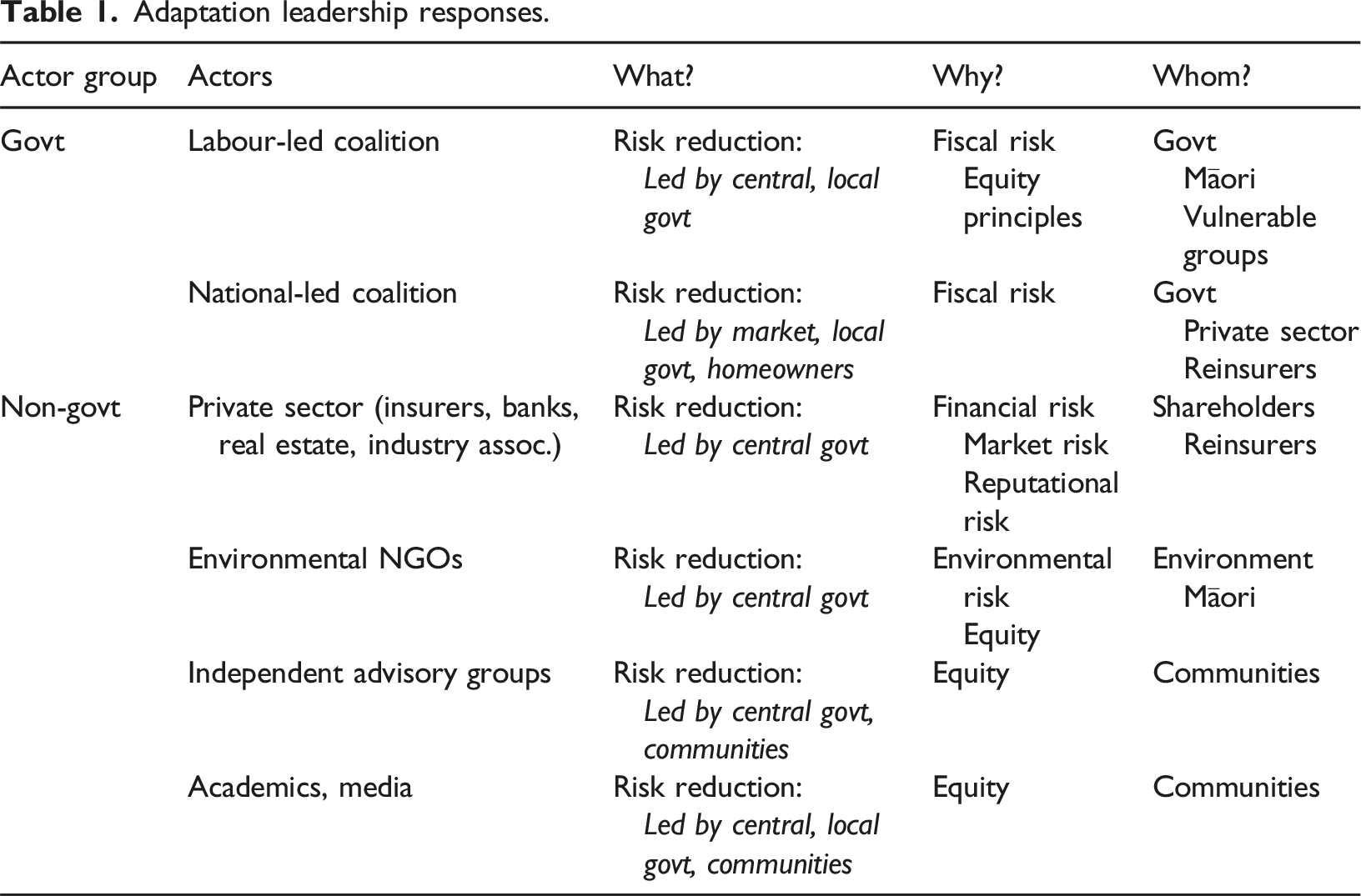
Adaptation leadership for what?
Government actors
In 2020 the Labour-led coalition government published New Zealand’s inaugural National Adaptation Plan (NAP). The plan laid out the long-term strategy for adaptation. At this point across government actors the purpose of adaptation leadership was to provide clarity on roles and responsibilities, foster collaboration, help reduce risk and address vulnerabilities. The emphasis was on pre- and post-event time periods. This is reflected in the NAP statement below: The goals for our long-term adaptation strategy, which are to reduce vulnerability to the impacts of climate change; enhance adaptive capacity and consider climate change in decisions at all levels and to strengthen resilience (MfE, 2022: 14)
During this period the government framed leadership as being shared between local and central government. The government proposed to adopt a government subsidised insurance plan to intervene in the looming ‘market failure’ by partnering with insurers. Below is an example from the NAP in which the government describes its responsibilities and local governments’, noting that responsible action encompasses post-recovery as well as welfare for communities: Central government will take a leadership role in partnership with local government. It also supports vulnerable individuals through the welfare system… Local government is at the centre of risk management planning and response because most hazard events occur at the local or regional scale. Climate change is felt locally, so local government will maintain its central role in helping communities to understand and respond together. (MfE, 2022: 25)
Although at this time government expected that individual citizens should also assume some responsibilities, the focus of its adaptation strategy was to primarily develop leadership between government agencies and local councils. In essence, it presented a moderated version of devolved responsibilities. The government also made space for Māori leadership and acknowledged past injustices. So, despite taking an incremental approach the government paid some attention to principles of equity underpinning transformative adaptation. It stated: Economic inequity means that some Māori businesses and workers have less capacity to adapt. Climate-related costs and disruptions could entrench those inequities. At the same time, Māori knowledge of sustainable practices and holistic economic models offer unique ways to adapt. If properly resourced, Māori can take a leadership role in adaptation. (MfE, 2022: 157)
However, the National-led coalition government has subsequently reframed the purpose of adaptation leadership and shifted away from equity towards more of an incremental approach. Therefore, solutions now focus on protecting and fortifying property through hard infrastructures and markets-based instruments to incentivise individual actions. This is partly the result of private industry lobbying, NGO advocacy, and increased awareness of costs; but more particularly the explicit intention of the new government to maintain the status quo and not regulate or intervene in markets and homeowners’ decision-making. Since its election in November 2023, two key documents have been released both of which demonstrate the focus on market solutions and devolved adaptation leadership. Below is an excerpt from ‘The Government’s climate strategy’ document (2024b): “Households, businesses and our economy are already feeling the effects of climate change. We have seen what severe weather can do to infrastructure and property, and how that disrupts our supply chains and communities. That’s why we need to work together to reduce the impacts of climate change and prepare for its future impacts.” (MfE, 2024b)
Non-government actors
The private sector, environmental groups, academics and other non-government actors broadly agreed with both governments that the purpose of adaptation leadership should be to reduce risk. However, differences with the government view were expressed regarding who should play a leadership role. This has been expressed most strongly by insurers who support risk reduction but see this as primarily the responsibility of central government to lead as an ‘enabler’. In their effort to evade responsibilities the industry has tried to redefine the ‘object at risk’ as communities and not whether or not assets are insured or not. Accordingly, it is central government who should lead given they are mandated to protect citizens. This viewpoint is represented below in ICNZ’s submission on the inquiry into climate adaptation: Climate change is a societal problem. Adaptation will require coordination across central government, councils, the private sector and affected communities. We would strongly encourage central government to take a leadership role to bring all parties together to focus on an adaptation strategy. (ICNZ, 2024)
Environmental NGOs, media, academics and others similarly agreed that the focus should be on preparing for climate change and reducing risks. Like the insurance industry they saw this as an endeavour that should be led by central government. In a 2023 report on the adaptation options for managed retreat the Environmental Defence Force (EDS) made the case for why central government should lead and not local government in the case of managed retreat: “Central government is the key actor in managed retreat. It has the authority to legislate how managed retreat will occur and has responsibility to protect the national interest. It can raise significant funds via taxes, investments, and offshore debt. Local government is more constrained. It has limits on how much it can borrow and how high it can raise rates.” (Peart et al., 2023:16)
Adaptation leadership for why?
Government actors
Whereas the primary purpose of adaptation leadership was to reduce risks was generally agreed on, the underlying rationale was not shared between the governments. For the National-led government the sole reason for adaptation leadership is to minimize fiscal costs. This was also of concern for the Labour-led government but sat alongside other concerns including equity and justice particularly for Māori and vulnerable communities. In its design of the new Adaptation Framework (MfE, 2024b), the government (‘the Crown’) states on its website regarding this work programme: The overall aim to minimise the total cost to the Crown and society from the impacts of natural hazards on where people live and work and the associated infrastructure. This will include managing the Crown’s fiscal exposure.
In a Ministry for the Environment Cabinet Paper (2024a) discussing the workstreams to develop the countries’ new adaptation framework, the government elaborated on how the current lack of clarity on leadership could lead to climate change becoming a fiscal cost: Responsibilities and decision making are currently fragmented and leave significant challenges, including after a disaster occurs. If New Zealand does not address these issues, it is likely to mean a significant increase in costs, challenges to fiscal sustainability and substantial financial and non-financial impacts on individuals. (MfE, 2024a: 2)
Most if not all government documents are replete with references to costs. Climate change is rendered primarily as a threat to property and as a corollary, housing prices, investment in property markets, insurers, homeowners and the banking system. If insurance is unable or unwilling to carry the cost of rebuilding damages to property, then either the government, local government or individuals must pay. The perception of this risk drives how the government contextualises and ‘manages’ climate change. It does not want to ‘pick up the tab’ for climate change. Taking a leadership role would infer this.
Non-government actors
Private sector actors primarily consider the rationale for adaptation leadership in terms of profitability. They co-opt equity principles and argue for risk reduction measures to protect profitability. For insurers this means that premiums can be kept ‘affordable’ and they can avoid reputational damage by ‘insurance retreat’ and further regulation. Banks, in turn, are able to continue lending because homeowners are insured, and property prices remain a valuable investment option. The point of contestation is who should pay for this and take responsibility. Unlike government actors, the private sector see climate leadership firmly as the central government’s role with secondary action being needed from local government and individuals. This is reflected in a recent public statement made by an insurance company CEO: The Government’s focus on adaptation and recent investment in flood protection is a good start, but we need to do more so that communities who are exposed to the impacts of climate change can be safe and resilient.
NGOs and other civil society organization such as the Climate Change Commission view the rationale for adaptation leadership as an ethical duty to lessen harm to humans and non-humans including the environment regardless of their own organizational risks and concerns. They take an equity angle that draws on transformative adaptation principles. Risk reduction then should be designed, implemented and measured with this in mind. The stances by these organizations are closer to transformative adaptation than the position taken by successive governments and the private sector. The motivation for risk reduction to be ethical can be seen in the comments from in the Climate Change Commission’s (CCC) recent 2024 progress report on the government’s actions on adaptation: Currently, the country largely has a ‘pay as you go’ model, where insurance and government compensation pick up the tab for damages… Good leadership, inclusive planning and decision-making, and participation by the community, is important to ensure that people’s needs are met. Effective leadership is important when coordinating emergency management during and after a disaster. (CCC, 2024: 4)
Adaptation leadership for whom?
Government actors
The government’s priority is to lessen its own fiscal risks so that the benefits of this approach might flow through to its citizens. But within this broad category of citizens some are likely to benefit more than others. These secondary beneficiaries to the government’s approach are those who have a stake in the property market (i.e. insurers, banks and property owners, investors and global reinsurers). This group would be the biggest winners. Other stakeholders that would be positively impacted are construction and engineering services, risk management service providers, private consultancy firms, planners, property developers. Whereas stakeholders who may be negatively affected by the government adaptation approach are non-human species and ecosystems, renters, low-income homeowners, Māori and low-income communities and councils.
The focus on protecting and defending against climate change is also likely to undermine and divert other adaptation responses such as managed retreat. At some point, some locations will become unhabitable, and movement of whole human settlements will be necessary. The hard infrastructure mindset may delay this shift and could undermine climate policies including mitigation approaches which rely on risk pooling, taxation or regulation. Climate action is widely viewed in the literature as a collective problem that must be solved collectively to avoid free riding. Although at first glance it could be argued that the government’s approach is inclusive and participatory, on closer examination it excludes stakeholders who could be considered vulnerable most especially ‘the environment’. For example, in its climate strategy (2024a) the government describes the beneficiaries, absent from this is any consideration for non-humans nor low-income or historically marginalised groups: Our communities and properties are better protected from severe weather events and the cost of repair is minimised. People have easy access to information and guidance on potential future risks to property and community. Interruptions to business operations are minimised during and after severe weather events. (MfE, 2024a)
Non-government actors
Adaptation leadership in the view of the private sector was also found to ‘me’ rather than ‘we/us’ focused. The reason for this tendency is a well-established strategy of insurers to use moral persuasion to sell their products (Ericson et al., 2003). In the context of the debate, insurers promote themselves as benevolent guardians of ‘the people’ in the face of catastrophes and disasters. They are advocates and vocal supporters of the government’s approach but are strongly defensive about taking a leadership role. The intermingling of the economic and moral dimensions is exemplified below in an interview with an insurance industry representative: I think there is a huge danger in focusing solely on an insurance and residential cover. I’m not saying that those are unimportant aspects, but that is just focusing on the impact of property. And, not necessarily looking at the impact on people. But there are many other impacts on people obviously, so the social trauma of experiencing repeat flood events or the life and safety issues for children and elderly people. Or people that have mobility issues in flash floods or you know, cultural issues, the environment, and economic impacts, none of these are insured.
Here we can see insurers rendered as being sensitive to the needs of communities and wider society. But under closer scrutiny insurers and banks are primarily concerned about their shareholders, reinsurers and profitability. Avoiding regulation and reputational damage is a major concern (Nyberg and Wright 2016). Their rendition of adaptation leadership ultimately protects their own organizational resilience. Moving out from this insurance and banks also care about reputational damage. This translates into communities being considered as stakeholders, but this group by necessity is lesser priority than the priority that must be given to shareholders.
Whereas private sector actors and the current government in particular have a narrow ‘me’ understanding of stakeholders; for the environmental NGOs, academics, the media and independent bodies the definition of who should benefits is wider. It ranges from Māori to the environment and low-income communities. This is notable in an EDS report which is critical of hard infrastructure-only approaches and suggests that environmental implications must be considered: From a biophysical and ecological perspective, the adaptation response which is adopted in the face of climate and other risks is particularly significant. This is because a resort to hard protection structures such as sea walls, groynes and breakwaters will result in ‘coastal squeeze’ and adverse effects on indigenous species, ecosystem functioning and associated ecosystem services. (Peart et al., 2023: 25)
This report states clearly that the environment is a stakeholder that should be considered in any adaptation strategy or approach taken by leadership. Similarly, Māori should be paid specific attention. EDS (2024) also suggest that, before the government designs an adaptation framework it must select guiding principles and that these should be democratically consulted and openly debated. Other submitters to the government’s select committee hearing meetings in 2024 on the Adaptation Framework took a similarly wider stakeholder stance and included the environment, low-income communities.
Discussion and conclusion
Based on a discourse analysis of key adaptation documents supported by interviews we found that current forms of adaptation leadership in New Zealand are affirming the status quo rather than promoting transformative change and, as such the prevalent leadership approach could well catalyse and exacerbate maladaptation if left to drift. Although we found evidence that key stakeholders from government and non-government groups were aligned on the purpose (‘What’) of adaptation leadership, there was considerable divergence on the rationale (‘Why’) and for whom adaptation leadership should benefit (‘Whom’). Also concerning was the avoidance of any actor to take an explicit responsible leadership position. Central governments, concerned about fiscal costs, and in particular the recently elected National-led coalition, has taken a pro-market approach that believes that leadership should be devolved to individual homeowners and the market. This has encouraged actions such as the construction of personal sea walls (Williams 2022). It has also provided insurance with a governance role to direct behaviour via pricing risk. These do not seek to address underlying inequities and leave intact the business-as-usual mindset and systems that create climate change. In contrast, some non-government actors advocated responsible leadership that focused on non-humans and low-income groups.
The English term ‘responsibility’ was first recorded in the 16th century, but its etymological roots can be traced further back to use in the German language in the 1300s where it meant “to adhere, to be faithful to the will of God” (Franzini Tibaldeo, 2023: 300). In England the word referred to practices in the Christian church involving the recitation of liturgical ‘responses’ and took on a public rather than private meaning. But with time, it evolved to encompass the notion of being capable of answering questions, facing accusations, or meeting requests. Thus at its core to be responsible refers to “being capable of owning’s one actions” and “collective accountability” (Trnka and Trundle, 2017:4). As Young (2006) notes, we are obliged to each other at least by “virtue of the social processes that connect us” (102). In this paper we have showed that New Zealand’s emerging form of adaptation leadership leans towards incrementalism, cutting off recognition of our collective ties and obligation to others.
We contend that climate adaptation leadership should be responsibility-oriented to align with a transformative approach in which relational and equity principles figure prominently. Currently they do not, and as a result, New Zealand is at risk of exacerbating the conditions and inequities of climate change and with it the collective underpinnings of climate policy. Our advocacy of responsible climate change leadership aligns strongly with the call for ‘hopeful leadership’ research and action that Jaser and Tourish (2024) have so compelling argued for in their introduction to the recent special issue of this journal on ‘Leadership and the Future of Humanity’. It also builds on extant literature in sustainability on system-led approaches (e.g., Redekop 2024; Satterwhite 2010). Aligned with these authors, we are similarly guided by “he continuous belief in and search for possible and better futures, even if they are imperfect” (Jaser and Tourish 2024, 249). There can be no more important work for leadership scholars to be engaged in.
Footnotes
Declaration of conflicting interests
The author(s) declared no potential conflicts of interest with respect to the research, authorship, and/or publication of this article.
Funding
The author(s) received no financial support for the research, authorship, and/or publication of this article.
