




Abstract
This Leading Questions article explores how academics in business schools can contribute to mobilising action on climate change. Given the pressing nature of this issue and the magnitude of the ongoing crisis, inaction merely perpetuates an economic system that fuels increasing greenhouse gas emissions, leading to an uninhabitable planet. Given the urgency of actions, what responsibilities do scholars have in their research and teaching? By addressing the question, ‘What am I supposed to do?’, the article presents four potential roles for academics—the Provocateur, the Catalyst, the Dissident, and the Rebellion—all aimed at raising awareness of this critical challenge and fostering collective climate activism on campus and within civil society. These activities do not centre on individual responsibilities for environmental issues; rather, they represent academic leadership in mobilizing collective responses aimed at challenging the structural injustices of fossil fuel-dependent corporate capitalism.
Keywords
‘What am I supposed to do?’ is a question, in various forms, that I am often asked when presenting or teaching on the topic of climate change. One of the more memorable instances occurred when I was teaching an MBA class on climate change and the role of business. This lecture took place in Newcastle, Australia, a city known for its coal industry. The Port of Newcastle is the largest coal port in the world, and many of the participants in the class were directly or indirectly involved in the coal industry. After delivering a somewhat confrontational lecture about the urgency of climate change and the role of fossil fuels, including coal, in the current climate catastrophe, one of the attendees exclaimed: ‘I’m a manager for a coal company, with many employees. I also have a wife and kids. What am I supposed to do?’ I responded that there is no contradiction in managing a coal company, while protesting with their kids against the lack of climate actions, voting for stronger climate legislation, or supporting the workers in the company in transitioning away from the coal industry.
I suggested that, when it comes to climate change, almost all citizens of the global North (including Australia) are hypocritical; their lives are not aligned with necessary climate change actions. However, this hypocrisy also provides the possibility for mobilising for stronger climate actions. It is possible to capture part of the split identity or interest—the part concerned about climate change, the future of their kids, or the current suffering from catastrophic weather events—in mobilising for change.
When I present or lecture on climate change related topics, this question is occasionally directed towards me, sometimes almost as an accusation: ‘What are you doing to address climate change?’ I usually respond by mentioning my research and teaching on climate change, the opinion pieces I write, my occasional news appearances, and the (too infrequent) climate protests I attend. However, I often feel this response is inadequate, leaving me somewhat deflated.
The leading question I will discuss in this essay is then ‘What am I supposed to do?’ More specifically, I will attempt to address this question as a business school academic researching the climate catastrophe. I engage with the concept of academic leadership, understood not as administrative management but as influencing students and broader society in acting on climate change. My aim is not to provide a definitive answer but to reflect on the roles and activities through which business school academics might respond. I begin by clarifying what I mean by academic leadership and then draw on recent discussions of intellectual activism (Contu, 2018, 2020; Manning, 2024; Rhodes et al., 2018) that challenge current management education. Moving beyond critical pedagogy, I situate activism in the wider society and propose four academic activist roles—the Provocateur, the Catalyst, the Dissident, and the Rebellion—to raise awareness and support climate action on campus and in civil society. Each of these roles includes suggested activities aimed at politicising the classroom, the campus, and the public sphere. Hopefully, these roles can give directions for academic leadership on climate change and assist in discussing the responsibility of academics in business schools.
Academic leadership
Academic leadership in universities has long been conceived primarily as the administrative management of faculty and resources (Rowley and Sherman, 2003). Following a neoliberal turn, including new public management in universities, senior roles shifted from collegial service to executive management, with administrators replaced by leaders (Learmonth and Morrell, 2021; Macfarlane et al., 2024). However, rather than confining leadership to top administrators, or even individual positions, a more relational perspective on academic leadership would see it as produced through interactions between leaders and other social actors (Cunliffe and Eriksen, 2011). At its core, leadership involves social and interpersonal processes that mobilise action toward meaningful change (Larsson and Alvehus, 2023). With leadership a social construct, it is the processual interaction that brings about what can be seen as leadership. In the context of universities, that encompass how academics engage students, colleagues and the community in creating and enacting transformative agendas that give scholarship societal meaning.
In this view, academic leadership becomes not merely the management of academics but the mobilisation of academic communities for meaningful change. Viewing leadership as a relational social construction does not exempt individual actors from responsibility. To the contrary, and considering academic teaching and research practices, it promotes reflection on these academic practices. Teaching and research do not simply describe or represent reality but bring realities into being (Contu, 2020). These practices do not only pass on knowledge but also defines what counts as recognized knowledge. It is therefore important to expose the social norms promoted in academic conduct and being open to changing those norms. Recognising this type of academic leadership moves academic knowledge production from developing theory, or inward thinking, towards acting and change. The more important concern is perhaps what type of change and the responsibility of the academic in leading this change.
Discussions around responsible leadership in business is useful in pointing towards the broader responsibilities of academics in promoting change (Maak and Pless, 2006). In particular, the part of the literature that draws upon Iris Marion Young (2011) in arguing that if your actions contribute to structural processes that produce injustice, you have responsibilities to remedy these injustices (Lloyd et al., 2024; Voegtlin, 2016). This responsibility is forward-looking and collective: it does not hinge on personal culpability but on one’s connection to ongoing social structures that cause harm, calling for joint action with others to change those structures. It is therefore fulfilled through collective and participatory practices that build shared capacity to transform unjust systems rather than by isolated acts of charity or compliance. Responsible academic leadership would then mean engaging with social actors in addressing those injustices that can be contributed to the universities and their historical conduct.
Academic leadership in business schools is connected to a particular historical institution, with a founding purpose in the United States and much of Western Europe to legitimise management as a profession and the importance of business in society (Engwall et al., 2016; Khurana, 2007). Through standardisations and accreditations, coupled with an increasingly competitive labour market that prioritises publication in top-ranked management journals, this legitimation has been strengthened and maintained beyond the more autonomous business schools in the United States and Europe (Nyberg and Wright, 2023). The control of the academic workforce through the demands of different rankings has largely been internalized by academics using them for advancing their careers (Clarke and Knights, 2015).
This institutional legacy and its self-reinforcing metrics highlight how academic leadership is enmeshed in structural processes of professional legitimation and career discipline, underscoring the need to reconceive responsibility as a collective political practice aimed at transforming these systemic conditions rather than assigning individual blame. I will argue that it is the structural processes of injustice permeated by business schools that delineate the responsibility of academic leadership when it comes to climate change. Therefore, encouraging action on an urgent issue like climate change can be viewed as a distinct form of responsible academic leadership.
Academic activism in the era of climate catastrophe
The literature on academic activism in organization and management theory is calling for scholars to actively participate in the creation of a better world (Contu, 2020; Manning, 2024). ‘Academic activism’ overlaps with any form of activism, but here I refer to academics using their legitimacy as scholars and their intellectual work to advocate for social and political change. Academic activism challenges dominant narratives, critiquing social injustices, and offering transformative ideas based on critical analysis and research. Coming from critical management studies (CMS), this includes colonialism (Lund and Tienari, 2019), racism (Dar et al., 2021), class (Zulfiqar and Prasad, 2021), and economic inequalities (Cunliffe and Linstead, 2009). Overall, it is a critique of the neoliberal university that has become a handmaid of corporate capitalism by supporting the status quo (Fotaki and Prasad, 2015), which is particularly pertinent for business school teaching and research fostering short-termism and greed (Parker, 2018).
The prioritisation of corporate capitalism over social and environmental concerns by business schools is evident in the context of climate change. In collaboration with Chris Wright, I investigated the extent of climate change research in top management journals (Nyberg and Wright, 2023). We found that between 2007 and 2018, only 0.2% of publications in leading management journals mentioned ‘climate change’ in their titles, keywords, or abstracts. In contrast, similar searches for terms like ‘growth,’ ‘competitiveness,’ and ‘profit’ yielded markedly different results: there were 50 times as many articles on these topics compared to climate change during the same period (Nyberg and Wright, 2023). This is perhaps unsurprising, given that business schools in the United States and much of Western Europe were founded by managerial elites to legitimise the goals of growth and profitability (Engwall et al., 2016; Khurana, 2007); yet, it highlights how business schools legitimise and promote practices that contribute to environmental degradation.
It is evident that both management research and teaching reinforce an economic system—corporate capitalism—reliant upon cumulative growth exceeding planetary boundaries. Capitalism is growth-dependent, and economic growth is the key driver of greenhouse gas emissions (Nyberg et al., 2023). This is what we in earlier work refer to as ‘creative self-destruction’: capitalist competition expands production by increasing energy and material throughput, which undermines the conditions for future capitalist production through environmental destruction (e.g., CO2 emissions) (Wright and Nyberg, 2015). Despite national pledges to international agreements (e.g. the Paris Agreement) and corporate commitments to carbon neutrality or ‘net zero,’ greenhouse gas emissions continue to rise, further warming the planet: 2023 was the hottest year since records began, and the world passed the 1.5°C degree benchmark in 2020 (McCulloch et al., 2024). Thus, it is becoming evident that global warming will not be limited to 1.5°C or stay well below the 2°C above pre-industrial levels stipulated by the Paris Agreement, with catastrophic implications for communities and habitats. The primary reason for this lies in capitalism’s growth agenda, which is legitimised and promoted in business schools.
In arguing for academic leadership to address climate change, I do not intend to blame individual academics for their research and teaching. This would be to deny the complexity of the problem: not only are academic’s careers and livelihood dependent on reproducing the dominant economic thinking in research and teaching (Clarke and Knights, 2015), declining public funding for universities since the 1970s has led to university dependence on private-sector partnerships and fee-paying international students (with a majority often found in the business school) (Hiltner et al., 2024). This, combined with the corporatization of Western universities (Parker, 2018), renders universities not only vulnerable to corporate capture but also active promoters of corporate capitalism. Thus, academic leadership needs to be placed within universities partaking in the structural injustice of climate change that systematically privilege those who profit most from plundering nature over those least responsible for ecological degradation (e.g., dispossessed peoples, Indigenous communities, the global poor) (Fraser, 2022). It is in the participation of these social structures producing injustice that form the responsibility of academic leadership. Business school academics sustain these climate injustices through their teaching and research and, therefore, share the responsibility to address them (Young, 2011).
The four types of academic activism described below are suggestions for how academics can assume some of this responsibility in a collective context. The emphasize is on mobilising collective action as an academic leader, joining with others (e.g., colleagues, students and other groups) to address climate change. While the labels are types of personification, the aim is to broaden the notion of responsible leadership beyond (i) individual position and authority (Lloyd et al., 2024) and (ii) organizational boundaries (Voegtlin, 2016) in addressing the social processes connecting business schools to structural injustices around climate change. The different types can be mixed and matched, with individual discretion on how to lead academic activism collectively.
Four types of academic activism
Academic leadership in climate action can be understood as operating along a spectrum between contemplation and emancipation. With the idea of academic leadership for influencing climate action, both contemplation and emancipation—or thinking and acting—seek to stimulate change. The difference lies in how this change is pursued. With contemplation, I do not suggest that scholars are merely interpreting the world; to the contrary, it is about thinking with students and broader society in raising awareness to address climate change. Emancipation is on the other end of the spectrum, which is about actively participating in bringing about change. An example is the Scientist Rebellion network of academics, which engages in non-violent civil disobedience. While this group also seeks to raise awareness, its active participation in protests places it further toward the emancipation end of the contemplation-emancipation spectrum (see Figure 1). Forms of academic leadership or activism.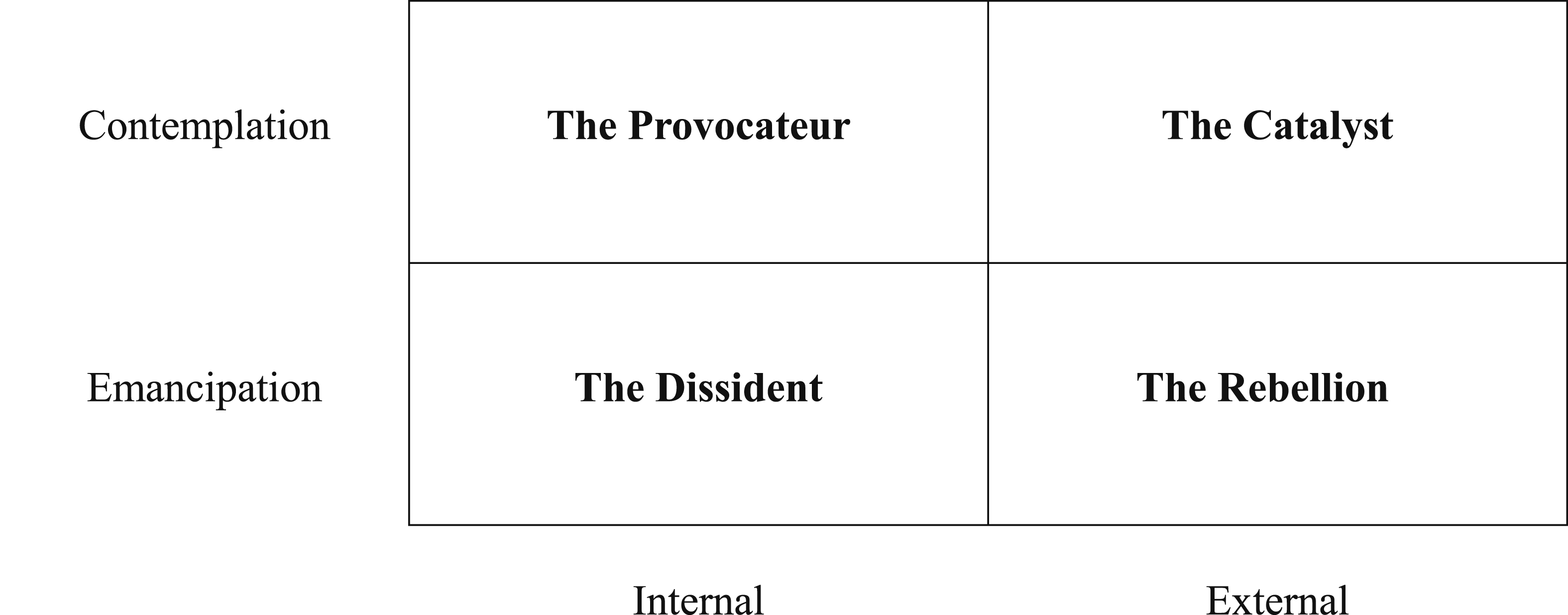
These forms of critical academic leadership can be performed either internally within the university or externally in broader society. For example, through critical pedagogy (Freire, 1968), scholars can raise awareness of climate change in their roles as teachers. Academics can also engage in broader societal debates by writing opinion pieces or participating in protests. To systematically unpack the different roles of business school academics, these two continuums—contemplation versus emancipation, and internal versus external engagement—define four types of academic leadership for mobilising climate action (see Figure 1): the Provocateur, the Catalyst, the Dissident, and the Rebellion. The names of the four types are intended for playful identification by academics challenging the status quo and how they may act at different times and in different settings. The roles and activities suggested below are inspired by a long history of struggles for equality, freedom, and environmental causes. I hope to do these struggles justice, and that some of the ideas presented may be applicable to other current and future challenges.
The provocateur
Within Critical Management Studies (CMS), there is a longstanding and active debate surrounding critical pedagogy (e.g. Barros et al., 2024; Grey, 2004; Hibbert, 2013). Informed by Paulo Freire’s pedagogy (1968, 1973), teaching is viewed as a form of intellectual activism that promotes social transformation (Contu, 2018; Grey, 2004). The Provocateur role involves exposing students to questions that critically examine the dominant economic paradigm (Fotaki and Prasad, 2015) and uncovering the underlying assumptions that sustain prevailing forms of management knowledge (Cunliffe and Linstead, 2009). Knowledge is connected to power (Foucault, 1980), with the Provocateur identifying the power relations that uphold the status quo and marginalise certain groups and their knowledge.
In challenging current institutions, critical pedagogy shifts away from the traditional ‘banking model’ of higher education, in which teachers ‘deposit’ information into passive students who receive and memorise it (Curtis, 2024; Freire, 1968). Instead, it employs a dialogical approach, where teachers and students co-create knowledge. According to McCarthy and Grosser (2023), this approach requires empathy to help students understand their position within the dominant system and challenge inequalities. By providing a space for reflection on their position, students can develop their capacity to liberate themselves and society (Hibbert, 2013). Through the three pillars of dialogue, empathy, and reflection (Manning, 2024), classrooms can become spaces for raising awareness of and addressing inequalities.
Mobilising for climate action means that academics lead the way in challenging universities’ current institutional practices that support economic growth and fossil fuel dependence. Indeed, teaching concepts such as ‘sustainability’ can, if taken to its original meaning in the Brundtland Commission’s report (WCED, 1987), challenge the possibility of continued economic growth (Wright and Nyberg, 2016). While business have incorporated climate change language, such as ‘sustainability’ and ‘net-zero’ in support of business-almost-as-usual (Wright and Nyberg, 2017), considering the current overshoot (Malm and Carton, 2024), teaching to sustain humanity within the carrying capacity of the planet is revolutionary.
Critical pedagogy is essential for questioning the assumptions taught in business schools that prevent teachers and students from recognising the implications of business school practices. The Provocateur uses the classroom as a space for challenging the normalisation of hyper-consumption and reflecting upon the inherent unsustainability of business schools’ research and teaching. In a chapter with my colleague Chris Wright (Wright and Nyberg, 2016), we detail a teaching activity that starts the reflection on climate change and planetary boundaries (Rockström et al., 2009) called the ‘fishing game’. In summary, students, grouped around a table, take on the roles of individual businesses competing under time pressure for a limited fish stock (represented by paper clips on the table). Initially believing it to be a ‘winner takes all’ game, they quickly deplete the ‘fish’ on the table, realising there is little left to allow regrowth for the next ‘season’ (the second round of the game). Through reflection and dialogue, the students learn the need for collaboration (rather than competition) in managing scarce or finite resources. This is merely one of many examples of consciousness-raising methods that can be applied in the classroom (for further examples and stimulating questions, see also Contu, 2020; Curtis, 2024; McCarthy and Grosser, 2023). The Provocateur’s approach highlights the potential of critical pedagogy to transform the classroom into a space where students engage with the pressing realities of climate change while developing the critical thinking and collaborative skills needed to address the systemic issues driving greenhouse gas emissions.
The Provocateur is a reformist academic leader who seeks to disrupt the business school from within by questioning both the content and methods of teaching (Kjærgaard et al., 2024). This form of academic leadership for climate action involves fostering critical thinking and dialogue with students to create an empathetic space for reflecting on and questioning the established power structures that business schools currently uphold. The Provocateur leverages scholarship to empower students to address climate change through dialogue and critical reflection.
The catalyst
While the Provocateur focuses on raising awareness within the university, particularly in the classroom, the Catalyst mobilises change across broader society. Within universities, there are now efforts to create strict boundaries between the campus and surrounding society. The neoliberal university has become an increasingly closed and restricted space. Staff and students have badges to access what were previously public spaces and, in many universities, students cannot reach their lecturers’ offices. Recent university demonstrations in support of Palestine also show universities’ willingness to use violence against their own students by sending in the police to break up peaceful protests. The Catalyst is working to blur this created boundary by both opening up the halls of the university to the public and engaging scholarly in the public sphere.
The mobilising of the catalyst does not necessarily mean that the public is prevented from seeing their own interest (Horkheimer, 1972), suffering from some form of false consciousness. Rather, the Catalyst provides alternative means to meet societal demands. The critical unmasking of current power structures is then not directed towards the population in freeing them from their shackles; it is directed towards the institutions reifying domination and legitimising the status quo. The Catalyst shows the contingent and, therefore, changeable social reality (Benhabib, 1986). The contemplative critique raises awareness of alternative interpretations that are challenging dominant institutions.
This can be done by creating spaces for critical scholarship on campus that are open to the public through, for example, public seminars, livestreams, and reading clubs. Alternatively, the Catalyst can engage in the public sphere by writing opinion pieces, participating in public debates, or through other means of raising awareness of inequalities and political and environmental struggles. As an academic leader, the Catalyst drives change by raising awareness of critical issues.
In academic leadership on climate change, numerous climate scientists engage in public and political spheres to highlight the urgent need for action. For example, climatologist and geophysicist Michael Mann, known for the ‘hockey stick’ graph illustrating global temperature trends (Mann, 2012), has frequently spoken publicly about the implications of his research. Mann has engaged with the public through film, television, radio, press, and talks. Facing death threats (McKie, 2012), Mann has also testified before the United States Congress, publicly taking on climate denialist politicians. However, as a Catalyst, Mann does not support protests such as stopping traffic or (pretending to) defacing paintings (Mann, 2022). Scientists communicating their findings to a general audience is generally not a critical endeavour; however, considering the polarization of climate change, climate advocacy by scientists against fossil fuels and in support of renewable energy is a form of climate activism. It challenges the status quo and makes reified social structures political, especially in business schools. The Catalyst in business schools is confronted with incivility, and it requires academic leadership to face fossil fuel supported think tanks and organisations questioning their integrity and legitimacy. Thus, when it comes to climate change, ‘truth-telling’ by using the best available scientific evidence is a form of critique, since it challenges, directly or indirectly, the status quo of fossil-fuelled corporate capitalism.
The Catalyst is an academic leader visible in the public sphere. For business school academics, this includes exposing the limits of carbon markets, the false claims behind carbon offsets, the unrealistic long-term targets of net-zero or carbon neutrality, and the dangerous unintended consequences of climate technologies like geoengineering, as well as revealing the ‘illusion’ of green consumption. The Catalyst mobilises climate action by raising awareness of these ‘false’ solutions and offering alternatives in the form of ‘real utopias’ (Wright, 2020). By engaging with the public and bridging the gap between academia and society, the Catalyst transforms the university into a collaborative space for critical thought, supporting collective action to address climate change.
The dissident
The Dissident is an action-oriented academic leader who creates spaces for critique and activism on campus. The Dissident uses the university, including the business school, as a space for elevating marginalized voices. Its emancipation comes from the community and the Dissident fosters space for activism on campus. These critical spaces further develop a horizontal student-teacher pedagogy by giving a voice to those directly affected by crises. Academic leadership involves protecting or participating in activism, using academic legitimacy to support the movement. There is no need for unmasking domination, since the students have the capacity to see through the doxa (Boltanski, 2011). Since there is no need to clear the grounds of illusions or unmask ‘real’ interests, academic leadership is here about supporting the development of alternatives. The Dissident takes a critical stand in building coalitions and uses the campus as a critical space for action. The goal is emancipation by those oppressed and the Dissident supports these activities.
A recent example of faculty support for student activism occurred at Columbia University, where faculty members stood up for their students’ right to peacefully protest. On April 16, 2024, Columbia University President Nemat Shafik authorised the New York City Police Department’s Strategic Response Group to dismantle a pro-Palestinian Gaza solidarity encampment on campus. In full riot gear, the police attacked the Gaza solidarity encampment and arrested over a hundred student protesters who, according to the police, ‘were peaceful, offered no resistance whatsoever’ (Srinivasan, 2024). In response, on April 22, more than a hundred faculty members from Columbia University held a rally protesting the arrests and suspensions of their students, expressing solidarity with the student activists. These academic activists supported student encampments on university lawns and protested in support of student activism. The protests can be seen as assemblies (Butler, 2015), with the academics enacting a ‘we’ with the students in protesting against those in power supporting the status quo.
In acting on climate change, the Dissident can initiate various protest activities on campus and create spaces for activists. A key step is to stop the fossil fuel industry’s influence on research and teaching. Recent studies have found that the fossil fuel industry has embedded itself in universities in countries such as the United States, the United Kingdom, Canada, and Australia. Fossil fuel companies and affiliated foundations fund research, sit on governing boards, host recruitment events, and advise curricula, among other things (Hiltner et al., 2024; Lachapelle et al., 2024). These relationships influence research outcomes that are biased toward the fossil fuel industry, with implications for university teaching and policies. Staff can join and support protest networks working to end this influence. For example, the Campus Climate Network campaign, launched in 2022, seeks to ‘end the toxic influence of fossil fuel money on climate change-related research in universities’ (Fossil Free Research, 2023), and Fossil Fuel Divestment: Colleges & Universities is part of a global social movement to end fossil fuels and build a world of community-led renewable energy (Fossil Free, 2024). To resist the fossil fuel industry’s co-optation of higher education, business school academics can create spaces for these protest organisations and sign petitions urging universities to cease accepting funding from the industry.
To halt the acceleration of climate change impacts, fossil fuels must remain in the ground. The Dissident supports movements advocating for fossil fuel-free campuses. By supporting these issues, business school academics develop alliances with colleagues from other faculties, students, and social movements in reshaping the purpose of business schools, including what is seen as valuable scholarship and good teaching practice. Through these coalitions, the business school can be reconfigured to support alternative practices focusing on teaching sustainable, inclusive, and democratic management practices that address global challenges such as climate change (Parker, 2018). Business school scholars are in a position to reclaim the space of business schools and construct a collective identity around the demands to keep fossil fuels in the ground.
The Dissident is more radical than the Provocateur by creating space for marginalized voices on campus and lending legitimacy to movements that construct an antagonism towards the fossil fuels as a ‘sin’ industry. The Dissident’s academic leadership influences action on climate change by taking part in redefining the campus as a political field. Like other social institutions, universities—especially business schools—have suppressed marginalised voices and overlooked alternative ways of organising. The Dissident reactivates the university as a space for debates on how to develop a just and equitable transition towards a society living within planetary boundaries.
The rebellion
The Rebellion serves as an intellectual mentor for climate activism beyond the campus, using their academic credentials to support activism. As an academic leader, the Rebellion seeks to shape social movements, directly or indirectly, toward social justice and addressing issues like inequality and climate change. There is a fine line between, on one hand, academic leadership through mentoring activism or being a scholarly activist, and, on the other, simply being an academic who is also an activist. For the purposes of this essay, the distinction lies in using scholarly work or academic credentials to lend legitimacy to activism.
A key example of an influential scholarly activist is David Graeber, who played a pivotal role as both an intellectual and activist in the Occupy Wall Street movement. Graeber supported the movement through direct participation in public occupations and by shaping its anti-capitalist message. As an anthropologist and anarchist, Graeber helped popularize concepts like the ‘99%’ versus the ‘1%,’ framing economic inequality as a central issue and highlighting the concentration of wealth and power among the few (Graeber, 2011). As a scholar, Graeber was instrumental in promoting the movement’s horizontal, leaderless structure, advocating for consensus-based decision-making that rejected traditional hierarchies (Graeber, 2013). Graeber’s ideas on debt, capitalism, and direct action inspired many within Occupy to see economic justice as inseparable from social justice, providing a theoretical and practical framework for the movement’s goals and tactics.
An example of using academic credentials to legitimise activism is the aforementioned Scientist Rebellion. Scientist Rebellion is a group of scientists advocating for urgent climate action through direct, non-violent disruptions that draw attention to the climate crisis (https://scientistrebellion.org/). They use their academic legitimacy to raise awareness and add credibility to climate demonstrations. Members use their scientific backgrounds to lend weight to their activism, sometimes risking their careers by participating in controversial actions or openly criticising climate inaction within academic and political circles. As Disruptors, they often wear lab coats during public demonstrations to emphasise the authority and urgency of scientific knowledge on climate change. The group also engages in civil disobedience, including sit-ins, road blockades, and other non-violent disruptions, to pressure governments and institutions to adopt stronger climate policies. The Scientist Rebellion also educates the public by emphasising the gap between scientific recommendations and current policies. These tactics aim to bring scientific urgency into public discourse, using the credibility of scientists to call for radical change in response to the climate crisis.
Another form of public mentoring on climate action is achieved by Andreas Malm, a Swedish scholar and climate activist, who advocates for more radical approaches to climate activism. As a Rebellion of the status quo, Malm emphasises the necessity of direct action and strategic property destruction to combat climate change. In his book How to Blow Up a Pipeline: Learning to Fight in a World on Fire (Malm, 2021b), Malm argues that sabotage and property damage are logical tactics in the fight against human-caused climate change. The book, which was turned into a Hollywood movie (Goldhaber, 2022), developed justifications for more disruptive forms of protests. As an influential academic leader on climate change, Malm (2021a) has sparked debates on the necessity and morality of more aggressive tactics, pushing the movement to consider a broader range of strategies in the fight against climate change.
The Rebellion, both in the form of mentoring activists and taking part in climate actions, challenges the notion that scholarly critique should remain abstract or neutral, advocating instead for scholarship that not only critiques the status quo but also suggests actionable responses to systemic issues such as climate change. By linking theoretical analysis with a call for direct action, the Rebellion positions scholarship as a driving force for the climate movement, insisting that intellectual critiques must translate into practical, transformative responses to the climate emergency. This form of academic leadership leverages intellectual authority to drive tangible social and political transformation. Through varied approaches—whether supporting grassroots movements, lending legitimacy to activism, or advocating for more radical tactics—the Rebellion expands academic activism beyond the traditional boundaries of scholarship to actively influence public discourse and shape movements for climate justice.
Discussion and conclusion
In response to the initial question of ‘What am I supposed to do?’, I have outlined four different roles that academics can enact and identify with. There are numerous activities that are associated with each of these roles—ranging from critical pedagogy to dismantling fossil fuel infrastructure. This essay aims to rally business school academics to leverage their research and teaching to address climate change. While I am not in a position to suggest which role, if any, my colleagues should adopt or which activities to pursue, working in business schools that are perpetuating climate injustices make us responsible for challenging the assumptions underlying business school teaching and research. Not critiquing these assumptions or acting against them sediment the ideas of economic growth and profit maximisation that are destroying the planet. That is, assisting in furthering injustices.
However, the four roles outlined above entail specific practices of academic activism framed through the notion of responsible academic leadership. Conceiving responsible leadership as a socially constructed phenomenon that emerges through relations and interactions (Cunliffe and Eriksen, 2011) highlights potential contradictions in its enactment. In delineating these four types, I have illustrated concrete activities for challenging the power structures sustained by business schools in the context of climate change. Yet, emphasising such roles also risks re-centring the individual leader—the very actor-centric view that scholarship on responsible leadership seeks to transcend (Kars-Unluoglu et al., 2025; Liu, 2017)—thereby undermining the conditions for responsible leadership itself.
The responsibility towards others emerges in situ and acting according to my own pre-conceived knowledge cannot serve as the basis for responsibility to others’ needs. This raises the question of when acting responsibly (according to your limited and incomplete knowledge) in correcting past injustices means acting irresponsible towards the demands of your students, colleagues and the society you are embedded in. Although responsible leadership is built on relationships (Cunliffe and Eriksen, 2011), taking responsibility in challenging the status quo requires stepping beyond the norms that hold those relationships together, even risking their rupture. Because acting responsibly always carries uncertainty and risk, such leadership can only unfold by remaining open to the possibility of what might appear as irresponsibility (Zueva-Owens, 2020). Ultimately, responsible academic leadership entails navigating this tension rather than resolving it.
Another reason for my reluctance to urge specific actions from colleagues is the rising hostility towards climate change activists (Irwin et al., 2022). By marking peaceful protests as violent and protesters as extremists, politicians and governments around the world have reclassified citizens’ environmental engagement. Civil society groups report that 200–300 environmental activists or ‘defenders’ are murdered each year for their efforts to oppose activities like logging, mining, large-scale agribusiness, hydroelectric dams, and other infrastructure projects (Sovacool and Dunlap, 2022). Acting on climate change carries an increasing risk to physical and mental well-being.
Less violent, but still detrimental to careers, academics who engage in activism, particularly in areas like climate change, often face criticism, both from within the academic community and from the public. Scholarship generally comes with an assumed or expected objectivity, and a strong advocacy stance may lead to accusations of allowing political beliefs to influence research. Academic activism in polarising areas like climate change can harm an academic’s credibility in the eyes of their peers, policymakers, or the public. As a result, taking a leadership stance on climate change can attract institutional backlash, leading to job insecurity, difficulties in securing funding, and limited publication opportunities. In what can be seen as a dire warning, the University of Leicester made numerous scholars redundant in what was simultaneously an attack on academic freedom and trade union organisation (Burrell et al., 2024). More recently, at Columbia University, philosopher Judith Butler and other faculty were reportedly named in a letter handed to authorities (Swanson, 2025), highlighting how activist scholarship can expose academics to external surveillance and political pressure.
More substantially, there are good reasons for scholars not subscribing to the idea of an intellectual giving lessons or advice on political choice or action (Foucault, 2020). As business school academics, who are we thinking with, and whom are we seeking to emancipate? Those most vulnerable to climate change impacts are those whose voices are not heard. As business school academics, we cannot speak for climate refugees or other victims of extreme weather events—they understand far better than we do what needs to change (Spivak, 2010). The four roles outlined above are about responsibility to cultivate spaces for those most affected to be heard. The absent voices need to be made present. The critique, then, involves allowing these voices to challenge that which is seen as natural or inevitable and opening up a world (or worlds) of multiple agencies and experiences (Nyberg and De Cock, 2022). This requires first recognising the suffering and violence experienced by those who are not heard, and second, embracing the voices and experiences that destabilise existing hierarchies and institutions.
While I have outlined roles as personification, addressing climate change within business school is a collective responsibility. For academic leadership in business schools, the responsibility is associated with the work of teaching and researching within a particular institutional setting. Recognizing the coupling of (i) the dominant economic thinking taught and researched within business schools with (ii) the climate crisis, stipulates an obligation to act, in some form. Doing nothing is not an option since it sediments the status quo; inaction contributes to environmental degradation.
With knowledge and power interwoven (Foucault, 1980), there is no neutral position. Teaching students about shareholder supremacy or product marketing is a performance that supports the status quo. Thus, colleagues who argue that our roles as researchers and teachers should be neutral are, in effect, supporting current dominant regimes. In teaching or research, there is no outside of power since power is connected to the knowledge produced. Through research, we create knowledge that we use for teaching, and this knowledge serves some purposes over others. Recognising this, we, as business school academics, have a collective responsibility to create knowledge and foster learning that supports climate action. Knowledge production in universities ‘matters’ because it brings specific realities and relations into being—we, as academics, take part in producing the world (Contu, 2020). With campuses already politically reactivated, business school academics face a choice: to lead for or against environmental change. There is no neutral arena for research and teaching.
Footnotes

Funding
The author received no financial support for the research, authorship, and/or publication of this article.
Declaration of conflicting interests
The author declared no potential conflicts of interest with respect to the research, authorship, and/or publication of this article.