



Abstract
This qualitative study explored the gendered constructions of good management by men school leaders. The research participants were 30 men school leaders in Israel, selected through purposive sampling. The study aimed to identify the dominant discourses of masculinity and how they shaped ideal school leadership practices. The authors conducted semi-structured interviews with the participants and used thematic analysis to explore the data. The findings suggest that the participants constructed good management using two prototypes of masculinity: hegemonic and caring. Hegemonic masculinity was associated with traditional managerial styles, such as being focused on the task and achieving excellence, using charismatic-visionary behaviours and a focus on resources and organizational structure. By contrast, caring masculinity involves more empowering behaviour styles, concern for others, and the distribution of power. To be regarded as good managers, some participants adopted an androgynous management style, indicating the ongoing struggles associated with the gender experiences of current men leaders.
Introduction
The literature indicates that gender is an important aspect that must be considered when thinking about and researching leadership (Ayman and Korabik, 2010; Ely et al., 2011; Vinkenburg et al., 2011). Gender and the dynamics it produces create challenges that must be addressed by scholars. Failing to take gender into account in leadership research restricts the generalizability of findings (Ayman and Korabik, 2010). Although in many Western countries the teaching force is predominantly feminine, men dominate school leadership roles as principals and mid-level managers to a far higher extent than their numeric representation. For example, 89% of primary school teachers in the United States (NCES, 2013a) and 88% in the United Kingdom (UK) (Paton, 2013) are women, but only 64% of public primary school principals in the United States (NCES, 2013b) and 65% in the United Kingdom (O'Conor, 2015) are women. In Israel, 81% of teachers are women, whereas 29% of principals in elementary schools and 49% in high schools are men (OECD, 2021). This makes gender-related school leadership concerns especially relevant to research (e.g. Fuller, 2014; Grogan, 2014; Msila, 2013; Shaked et al., 2019; Weinstein et al., 2021).
Studies have examined gendered perceptions of effective management in schools among women, revealing that various aspects of managerial behaviours in schools embody elements of femininity, masculinity or a combination of both (i.e. androgyny) (Arar and Oplatka, 2013; Grogan and Shakeshaft, 2011; Oplatka, 2001). Some of these, mainly the masculine ones, have been suggested to develop over time in new and experienced women leaders based on role models and as a result of role pressures (e.g. Arar and Oplatka, 2013; Coleman, 2003; Gill and Arnold, 2015). The gendered perceptions of effective managerial behaviours among men educational managers have not been investigated.
The present work explored the ideal managerial behaviours of men educational managers and how these behaviours express different versions of masculinity. Masculinity is defined as what it entails to be a man and behave in a manly way (Nash, 2018). The present study was based on qualitative interviews aimed to uncover the meanings men school leaders hold. First, the article reviews the relevant literature on gender, masculinity and gendered perceptions of management. Next, it outlines the research context and method, after which we present the findings and discuss the contributions and implications of the study.
Theoretical background
Gender and leadership
Gender is a multi-faceted concept that encompasses a visible demographic aspect, psychological aspects (e.g. gender stereotypes, gender identification and gender-role beliefs and values), social interaction aspects (e.g. social role prospects and enactment) and an attributed status aspect (power, resources and privileges) (Ayman and Korabik, 2010). Gender is therefore generally described as a social hierarchical concept capturing prospect and oppression as well as an emotive concept representing identity and one's cohesiveness (Horton, 2018).
When gender is a central focus of leadership study, it is often approached from one of three recognized theoretical perspectives (Ayman and Korabik, 2015): psychological, social structural, or interpersonal interaction. The psychological viewpoint seeks to comprehend the leader's underlying mental structures, including gender schema, gender identity, gender-role attitudes and values. In Western civilizations, a divide exists between masculine, detached, and instrumental vs. feminine, affective and communicative logic (Chaplin, 2015), and these distinctions affect normative leadership behaviours and results for men and women. The social structural view emphasizes status inequalities because it argues that gender is a crucial status indicator that influences how others regard leaders. According to this viewpoint, the favoured gender that is accorded greater status is much more probable to be seen as effective by others and to hold positions of leadership. The likelihood of discrimination against women increases in men-dominated work settings and professions (Galea and Chappell, 2022). The interpersonal interaction viewpoint focuses on how leaders interact at work with supervisors, peers and subordinates. This approach combines aspects of the psychological and social structural viewpoints in its perception of interpersonal relationships based on both observable demographic-related and hidden gender-related beliefs about oneself and others. These interactions are believed to be driven by gender-related situational variables (e.g. a gender-typed activity or a dominant gender group in the organization) that position gender as an active and conspicuous feature in a particular setting. As a result, men and women leaders have distinct social contacts with people of different genders at work, and these interactions have varying effects. The present study adopted the first theoretical perspective because it investigated the gender schema, specifically the gendered preconceptions of men school leaders related to good management.
Masculinity
Nash (2018) defined masculinity as the cultural understanding of what it is to be a man or manly, and to act accordingly. Connell (2020) argued that in any given period, there is a cultural diversity of masculinity but not all masculinities are perceived to be equivalent. Connell coined the phrase ‘hegemonic masculinity’, which represents the conventional belief that men should demonstrate traits like power, achievement, lack of emotion and control, which are superior to all other representations of manhood and femininity (Connell, 2015, 2020). It has been suggested that the cultural model of hegemonic masculinity has widespread roots because individuals with alternate expressions of manhood and femininity continue to accept and implicitly support it (Hunter et al., 2017). According to Connell, all men are assessed against the norm of hegemonic masculinity and must continually negotiate with it, while alternative kinds of masculinity are subjugated to it or excluded (Hunter et al., 2017). Since the 2000s, in the West, increasing social and academic attention has been paid to caring masculinity, a widespread and competitive alternative to hegemonic masculinity (Hunter et al., 2017; Jordan, 2020). Caring masculinity (or ‘feminine masculinity’, see Smoliak et al., 2022) represents the belief that men should exhibit traditionally feminine-stereotyped characteristics, such as affective expressiveness, sensitivity, dependability and caring, while still considering them to be part of their masculinity (Hunter et al., 2017; Jordan, 2020). Men who adopt caring masculinity are sometimes called ‘new’ men (Smith, 2016).
Being a man in education
Men in nontraditional jobs were found to differ in their traits, attitudes and values from other men working in more traditional jobs. For example, Chusmir (1990) compared men in traditional jobs with those in nontraditional women-dominated jobs and found that the latter were more liberal and valued extrinsic incentives less. Apart from the unique individual differences between men in traditional jobs and their women counterparts, men in nontraditional occupations, such as primary school teaching, experience other forms of influence. Men teachers often notice external attention being paid to their masculinity (McDowell and Klattenberg, 2019). In particular, those who are teaching young students experience a need to negotiate tensions in their gender identity. For example, Allan (1994), who interviewed 15 men elementary school teachers in the United States, reported that they felt conflicted because they were expected to act as men role models in a job and environments that were dominated by women. To negotiate these gender identity tensions, men in nontraditional occupations used strategies to re-establish their masculinity by distancing from the feminine elements (Simpson, 2014).
Chusmir (1990) suggests that being a man in a nontraditional job has advantages such as psychological wellbeing, and a sense of meaning. But men enjoy also more tangible advantages in these situations. Men working in nontraditional jobs often benefit from their minority status; they were frequently assumed to be on one hand more authoritarian and career-oriented, and on the other receive special consideration as a minority (Williams, 2023). Similar results were reported in educational research. Thornton and Bricheno (2000) explored UK primary teachers’ perceptions of their careers, involvement and how gender affected these issues. The researchers found that women and men teachers indicated different areas of concern and influence on their careers, and a disproportionate promotion of men in the system.
Masculine and feminine management styles
Research on gendered constructions of management has been conducted in various countries around the world, including the United States and Israel, in traditional as well as modern societies (Arar and Oplatka, 2013; Grogan and Shakeshaft, 2011; Oplatka, 2001). These studies on school leadership have primarily focused on women, and often used traditional depictions of masculinity and femininity, which are also known as hegemonic masculinity and hegemonic femininity. Several scholars have argued or found evidence that there were no significant differences between men and women school leaders concerning their management traits and practices, and that both genders tended to use masculine and feminine traits and practices, forming an androgynous management style (Christman and McClellan, 2008; Coleman, 1996; Fuller, 2010; Pounder and Coleman, 2002). Some scholars have argued that the androgynous leadership style is considered the most effective or desirable approach (MacBeath, 1998; Kruger, 2008; Oplatka, 2004; Regan and Brooks, 1995). This style challenges the traditional ‘gender binary’ framework (Hyde et al., 2019). This position remains non-consensual, however, as many other works indicate two distinct management styles: feminine and masculine.
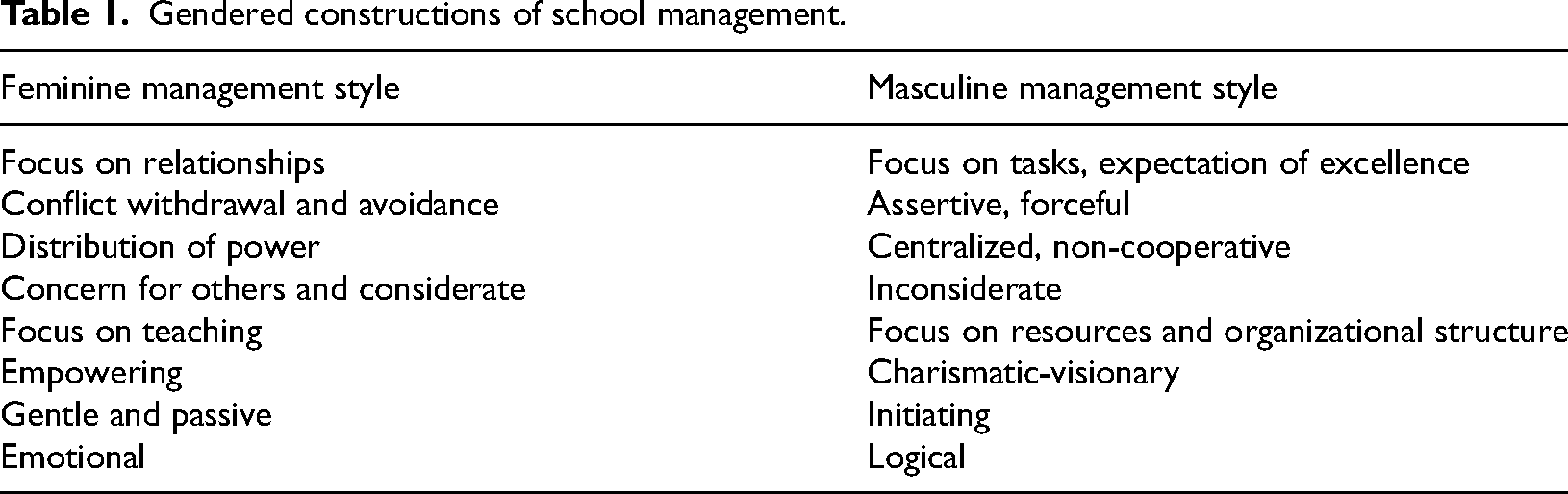
The literature suggests that the feminine management style is characterized by a focus on relationships and concern for others, as well as conflict avoidance and a more equal distribution of power (Arar, 2018; Arar and Oplatka, 2013; Barkol, 2006; Hall, 1996; Glazer, 1991; Grogan and Shakeshaft, 2011; Oplatka, 2001; Shakeshaft, 1989; Tabin and Coleman 1991; Williamson and Hudson, 2002). Women managers also tend to prioritize teaching and empowering others (Arar, 2018; Arar and Oplatka, 2013; Barkol, 2006; Grogan Shakeshaft, 2011; Williamson and Hudson, 2002), while exhibiting gentle and at times passive behaviour (Arar and Oplatka, 2013). Emotionality and emotional intelligence are commonly associated with the feminine management style (Barkol, 2006; Grogan and Shakeshaft, 2011; Sachs and Blackmore, 1998; Shakeshaft, 1989). Overall, these characteristics suggest that a feminine management style seeks to create a supportive and collaborative work environment, with a strong emphasis on building and maintaining positive relationships between team members (Tabin and Coleman 1991; Williamson and Hudson, 2002).
By contrast, school leaders who adopt a masculine management style are portrayed in this literature as prioritizing the task at hand and expecting excellence from their team members (Arar and Oplatka, 2013; Shakeshaft, 1989). They are often assertive and forceful, following a centralized and non-cooperative approach that may be perceived as inconsiderate by others (Arar and Oplatka, 2013; Oplatka, 2001; Shakeshaft, 1989; Williamson and Hudson, 2002). They tend to focus on resources and organizational structure (Grogan and Shakeshaft, 2011), may exhibit a charismatic-visionary leadership style by actively taking the initiative (Arar and Oplatka, 2013; Oplatka, 2001) and use logical processes in their decision making (Arar and Oplatka, 2013). A comparison of the two styles is presented in Table 1.
Gendered constructions of school management.
Method
The study asked the following research question: How do men school leaders construct good school management, and how do these constructs rely on gendered discourses of masculinity and leadership styles? Thus, to investigate gendered perceptions related to the good management of men school leaders, we opted for a qualitative study strategy. An inductive qualitative technique is optimal for collecting detailed information about an understudied and poorly understood phenomenon where the participants’ viewpoints and the surrounding environment cannot be separated from the phenomenon itself (Merriam and Tisdell, 2016). The study received institutional review board (IRB) authorization.
Research context
In Israel, the vast majority of the teaching force is feminine, and only 14.5% of primary school and 29% of high school teachers are men (OECD, 2021). By contrast, 29% of principals of elementary schools and 49% of high schools are men (OECD, 2021). A survey of the social status ranking of professions in Israel indicated that teachers are near the bottom, with a score of 3.81, below physicians (5.16), high-tech workers (5.05), lawyers (4.35) and members of the military (3.95) (Trabalsi Haddad, 2022). Because of variations in work hours and promotions to leadership positions, Israeli men teachers earn 10% more than their women peers (Israeli Central Bureau of Statistics, 2022). According to the Taub Center (2019), Israel has a fertility rate of 3.1, which is higher than many other Western countries, such as the United States, which has a rate of 1.8. Additionally, a UN database 1 indicates that 53% of Israeli households have at least one member under the age of 20, compared to 34% in the United States. Given that 60% of teachers in Israel are between the ages of 30–49 (Israeli Parliament, 2018), being a parent with young children at home is common. 2 The secular public education in Israel is considered more liberal and feminist-oriented than the religious public one, which is considered more conservative and patriarchal (Herzog, 2006; Rapoport, 2013).
Participants and procedure
The data for this analysis were part of a wider research project exploring the masculinity of school leaders who are fathers. The rationale for selecting parents was that it was common to be a teacher and a parent. For example, a study during COVID-19 in greater Cincinnati in the United States involving 703 teachers reported that 63% of the respondents had at least one child at home (Kotowski et al. 2022). In addition, few life events have a comparably transforming effect on one's masculinity as becoming a father (Enderstein and Boonzaier, 2015). As men become fathers, in their 30s (e.g. the average age of new dads in the United States is 30.9, Russ, 2017), this change in one's view of masculinity affects 30–40 years of one's professional career. School leaders who are fathers can provide valuable insights into views of masculinity because they have personal experience of balancing traditional gender roles with professional responsibilities, leading to a more nuanced and developed perspective on masculinity.
We used purposive sampling because we sought to learn from individuals who had first-hand contact with the phenomenon under investigation and whose stories can furnish a wealth of information about its nature (Patton, 2015). We sought a wider representation of secondary school leaders because as noted above, in Israel, there are twice more men teachers and men principals in secondary than in primary schools (OECD, 2021). Thirty Jewish men school leaders participated in the study: 25 principals and 5 coordinators. In our sample, about half the participating school leaders held in general hegemonic views of masculinity. About two-thirds of leaders articulated what can be labelled nurturing parenting views; the rest expressed more instrumental and authoritarian parenting views. In the sample, 56% of school leaders reported meaningful or equal involvement in child rearing. This percentage was higher in certain sub-groups: 71.4% for those with non-hegemonic views of masculinity and 63.6% for those who expressed nurturing parenting perspectives. The participants’ demographics are presented in Table 2.
Participants’ demographics.
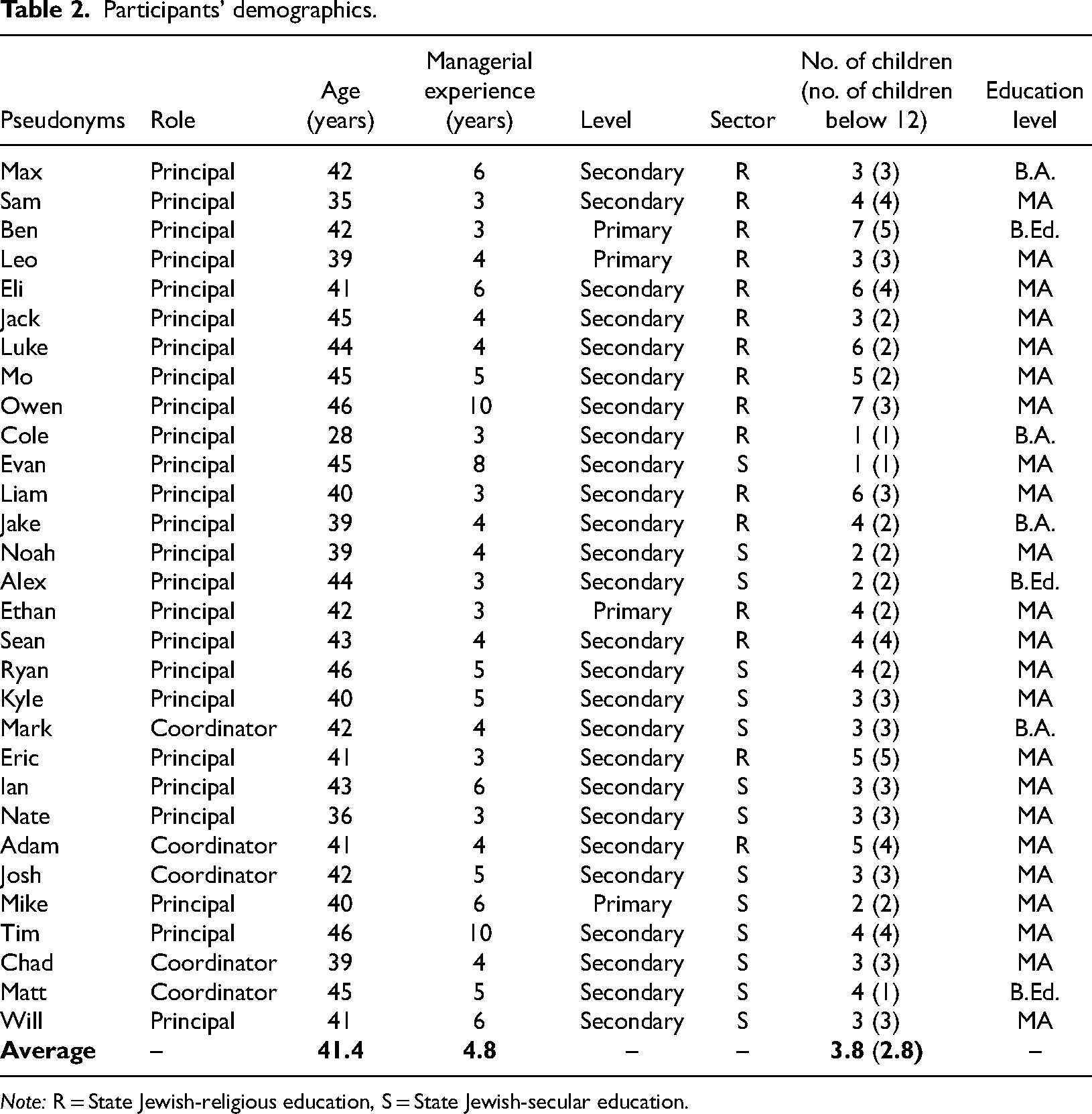
Note: R = State Jewish-religious education, S = State Jewish-secular education.
To collect the data, we chose semi-structured interviews, which provided deep insights into the meaning-making of participants (Patton, 2015). We conducted one interview with each participant. The interviews were conducted in a private context, either face to face in a school or out of school setting, or via videochat, each interview lasting between 40 and 80 min. The interview protocol included questions such as ‘Can you describe your administrative position in the school?’ ‘Can you describe what is a good manager in your view?’ ‘Can you describe what you do at home?’ ‘Does being a father affect your work life? If so, how is it manifested?’ ‘Does being a manager affect your family life? If so, how is it manifested?’ Every interview was audio-recorded and transcribed. All identifying information in the transcripts has been replaced by pseudonyms.
Data analysis
We conducted both inductive and deductive thematic analyses of the interview data (Braun and Clarke, 2012). To analyze the data inductively, we followed Huberman and Miles (2013): we conducted open coding by labelling the data and mapping analysis to discover relationships and collapse the data into themes. The two authors separately assessed the interview data. We reviewed the transcripts to identify the pertinent portions of text and manually sorted the data. We coded the segments with the intent of maintaining the meaning of the labels as close as possible to that of the participants (Patton, 2015). The following are examples of inductive descriptive codes that arose at this level: ‘Acknowledges every person's strengths’, ‘builds a personal relationship’, ‘makes others stronger’, ‘wants to improve all the time’, ‘knows how to lead and sweep people off their feet’, and ‘creates certainty’. We then searched for recurring themes in the data. For example, codes such as ‘acknowledges every person's strengths’ and ‘makes others stronger’ were clustered into the empowerment theme. Next, the deductive step involved reviewing the literature on gendered management traits and practices in the school leadership scholarship. We then reread the interview transcripts from a deductive perspective. The literature and subsequent discussion of the authors had a significant impact on the theoretical foundation and language used in this work. This stage produced several themes that were refined and relabelled. For example, the theme labelled ‘strong leadership’ in the inductive stage was divided into two separate themes: assertive and charismatic. The themes ‘shows concern for others’ and ‘is considerate’ were merged into one. Collaborative conversations assisted researchers in refining the analysis, reducing bias, and enhancing credibility (Archibald, 2016).
Findings
After reading the accounts of men school leaders about what they considered to be effective management styles, we identified several gendered management styles discussed in the literature: (a) a masculine management style, which we referred to as ‘the hegemonic masculine management style’ (N = 11), (b) a feminine management style, which we referred to as ‘the caring masculine management style’ (N = 7) and (c) ‘the androgynous management style’ (N = 12). Some differences emerged when we compared sub-groups of school leaders by their education level, religious background of the school in which they worked and type of communities in which they lived (see Table 3). More hegemonic masculinity and less caring masculinity was expressed by those with master's degree level education than by those with bachelor's degree level education; more androgynous views were described by those living in rural communities than by those living in urban communities. It is possible that men with a master's degree are more competitive and achievement oriented, and therefore more likely to lean towards traditional notions of masculinity. Conversely, the unique cultural and social dynamics of rural communities tend to attract men with more balanced views of masculinity. Furthermore, the relaxed nature of these communities, characterized by close-knit bonds and a strong emphasis on mutual support, may encourage a more inclusive perspective on gender roles and identities.
Prevalence of gendered leadership styles among different groups.
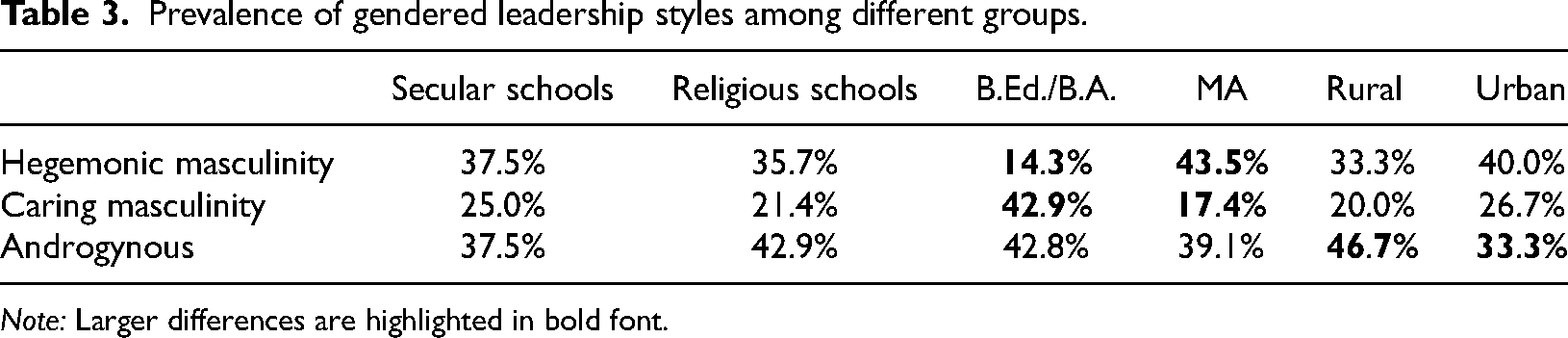
Note: Larger differences are highlighted in bold font.
Theme 1: good management as a hegemonic masculine management style
The hegemonic masculine management style was characterized by an emphasis on task accomplishment and achieving excellence, charismatic-visionary leadership and a focus on resources and organizational structure.
The dominant narrative of the hegemonic masculine management style perceptions was focused on the task at hand and the expectation of excellence. One principal (Jack) emphasized the importance of constantly striving for improvement and not becoming complacent, suggesting that everything else can be learned: ‘A good manager is a manager who at the core is constantly striving to improve, not resting on his laurels, this is the most important thing. Everything else can be learned, that's how it seems to me’. Another principal noted the centrality of focusing on a task: A good manager is a manager who has goals, he has goals and he knows how to operate this entire array of teams, of teachers, of children, for the benefit of the credo that he lives by. […] It needs something related to the task. In my opinion, the most important task is to promote education, and achieving quality education requires setting and working towards clear goals and objectives. You define some kind of goal, for example, living in a certain way. And you’re now building the entire setup for this. (Ethan)
Focus on task and excellence was a clear indication of the traditional gendered nature of management, specifically emphasizing hegemonic masculinity. Jack and Ethan's excerpts suggest that a good manager should have a relentless drive for improvement and focus on achieving objectives. This echoes traditionally masculine traits such as competitiveness, assertiveness and being goal-oriented. These attributes reflect a top-down management style, often associated with a traditional masculine rationality valuing the achievement of organisational results over all outcomes (Bierema, 2009), in particular emotional and interpersonal considerations.
Participants with a hegemonic masculine management outlook also advocated a charismatic-visionary focus. One principal (Evan) emphasized the importance of managers’ ability to lead and inspire their team: ‘I think he knows how to manage his people, I mean knows how to lead and have people follow him, he has a vision. I mean he has a very clear path that can be followed’. Another principal (Ethan) said: ‘A good manager can look into the future, dream about it, take his team to dream [along with them], come back to reality, and start working and organizing things so that this dream really comes true’. From this perspective, a manager's role is not only to manage day-to-day tasks but also to provide a clear and inspiring vision of the future that motivates his team to work toward a common goal. The idea that leaders should possess a clear vision and charisma is associated with the traditional concept of the ‘heroic leader’ capturing hyper-masochistic masculinity (Spector, 2023).
Finally, the interviews also reflected participants’ focus on resources and organizational structure: one principal said: A good manager is someone who first of all knows how to recruit good people to the team and then knows how to get the best out of everyone. That they all know their role and would be able to use their strengths for the benefit of the entire system. (Sean)
The emphasis on resources, such as talented individuals, and organizational structure can be seen as reflecting the hegemonic masculine trait of control. This is because there is an underlying power dynamic in the organizational realm when it comes to the selection of personnel and the implementation of training procedures (Wright, 2016). The focus on systematizing, organizing and optimizing the structure of a team and its members to extract maximum productivity from them mirrors masculine traits of dominance and rationality.
Theme 2: good management as a caring masculine management style
The caring masculine management style was characterized by focusing on developing the strengths of team members, combined with empathy, and concern for others. Participants in this category also emphasized the distribution of power and delegation of responsibilities to others.
Empowering narratives were a central aspect of views reflecting the caring masculine management style expressed by participants. For example, one religious principal said: It's like developing a kid in an appropriate manner, following his/her natural talents, there's developing a teacher in accordance with his/her natural talents. It's knowing how to let every educator work in his/her domain, because if he/she is in his domain… then he/she will be good and use his/her strengths… Let's say someone is now strong in music, so let him/her bring that to the world. There's someone strong in [disciplinary] boundaries, there's someone strong in graciousness. (Max)
Another principal emphasized: … knows how to reflect their strengths to the people in front of him. And not only that but also to support these strengths, to see how this strength is integrated into the organization, the school… and really to develop the school through the strengths of the team in such a way that the person who's a member of the team also feels that he/she is doing what is best for him/her. He/she does what he/she is strong at, and he/she also feels that he/she is doing that because he/she enjoys it and the school also benefited. (Sam)
This approach fulfils and empowers team members by allowing them to do what they are good at and enjoy doing, simultaneously benefiting the school. Overall, the caring masculine management style views expressed by these participants focus on empowering individuals and leveraging their strengths, rather than imposing rigid expectations or control. This breaks with the traditional masculine trait of dominance, promoting instead qualities associated with nurturing and feminine emotional intelligence (Thory, 2013).
Participants who displayed caring masculine management styles also emphasized the importance of power distribution within a team. One principal (Ian) described the good manager as ‘one who manages to make the team develop, and lead, and initiate, and bring to light their strengths and their passions, and create in them a sense of meaning and responsibility toward the school’. Similarly, one coordinator (Josh) emphasized the importance of seeking help, support and advice from others rather than relying exclusively on oneself. These views suggest that effective caring masculine management involves empowering team members and sharing power rather than maintaining a strict hierarchy or dominating leadership style. This situation reflects a shift from a hierarchical management style, which is commonly associated with traditional masculinity, to a more democratic and inclusive leadership approach often associated with femininity (Hovden, 2010).
Lastly, the third most frequent topic expressed by these participants was their concern for others and their considerate behaviour towards their team members. For example, Ben said: It's very important to me that the staff members feel good, feel that they’re being seen. This also produces managerial conflicts, yes? That is, sometimes a teacher needs to travel to 1, 2, 3, and 4 and the system needs exactly the opposite, that is, if he/she is traveling there is no one in the class. And in this balance, I need to see where the right match is between the needs of the system that I also represent and the team member. But I think the motto is always if I can, I’ll go with the staff member, and I think it's also mainly because I trust the staff members a lot. I know that 99 percent, maybe I exaggerate, 90 percent of the staff members here, if they really need something at home, they’ll give everything [in return] at work.
This approach was motivated by the managers’ trust in their staff and their belief that staff members would reciprocate by working hard and contributing to the organization. Overall, the caring masculine management style views expressed by these participants reflect a concern for the wellbeing and happiness of team members, demonstrating a desire to create a positive and supportive work environment. This emotional and considerate approach is traditionally linked to feminine managerial qualities, such as empathy, compassion and nurturing (Costa et al., 2017).
Theme 3: good management as an androgynous management style
Participants with an androgynous management style incorporate elements of both hegemonic masculine and caring masculine management styles into their approach to management. These individuals recognize the importance of achieving tasks and goals, vision, using resources and organizational structure, but they also prioritize the wellbeing and personal development of their team members.
In their accounts, these participants emphasized the importance of setting a clear vision and goals while also showing empathy and support for their team members. For example, one principal stated: A good manager is a person who knows how to analyze situations, who knows how, in the light of that analysis, to build some kind of long-term process to promote the school. Also he cares about people and loves people and wants to take care of their wellbeing on one hand and on the other hand also knows how to set the necessary boundaries. A person who has some kind of vision, that is to say, he wants to promote some kind of a better future picture, and he builds the goals and the process toward that move. (Mike)
Another principal reflected a similar duality: A good manager is the one who manages to see the employee before the task; sometimes it's very difficult. But once again, he's with the workers on the mission, he's with them, and they feel that he has their back, that he gives them his backing. But yes [he] sets goals and drives forward always. Always strives to be, to improve, to improve, to specialize, to be more professional. (Eric)
The ability to analyze situations, build long-term processes and promote the school, together with a concern for people's wellbeing and setting necessary boundaries, as noted by Mike, demonstrates an integration of both instrumental and empathic approaches to management. Similarly, Eric spoke about seeing ‘the employee before the task’ and giving them support, at the same time setting goals and always striving to improve. This illustrates the duality of the androgynous management style: combining the task-focused, goal-driven elements of hegemonic masculinity with the empathetic, people-first approach of caring masculinity. The literature suggests that men are socially privileged to adopt an androgynous leadership style, as more men leaders are viewed favourably as both empowering and strong (Katila and Eriksson, 2013). Overall, the accounts of participants with an androgynous management style reflected a balanced approach to management that values both the achievement of tasks and caring for team members. By incorporating elements of both hegemonic masculine and caring masculine management styles, these individuals were able to create effective and supportive work environments that foster both productivity and wellbeing.
Discussion
The findings of this study provide valuable insights into men school leaders’ gendered constructions of good management. The results suggest that men school leaders tend to have diverse and complex views of masculinity, which incorporate elements of both hegemonic and caring masculinity into their managerial perceptions. The study expanded the knowledge base that until now has focused on women school leaders (Arar and Oplatka, 2013; Coleman, 1996; Grogan and Shakeshaft, 2011; Oplatka, 2001).
The study makes several contributions. First, it provides a key synthesis that can be used in future research on gender perceptions of school leaders. Table 1 presents existing claims and evidence on hegemonic masculinity and femininity and constructs them as opposites. This makes the exploration of hegemonic gendered narratives of good management as well as of opposing narratives easier. This enabled the discovery of three prototypes of gendered constructions of good management by men school leaders based on hegemonic masculinity and caring masculinity outlooks. It demonstrates that the equation ‘think manager = think men’ (Gherardi and Murgia, 2014), which was largely accepted by women school leaders as well (Oplatka, 2001), is in the process of changing dramatically. Caring masculine and androgynous management styles were adopted by two-thirds of our men sample. Although the literature suggests that primary schools are typically characterized by a feminine culture, which implies that principals should adopt feminine management behaviours, and that secondary schools have a predominantly masculine culture, requiring masculine management behaviours (Eyal and Berkovich, 2023), we did not find differences between elementary and high schools. Possibly, current changes in gendered perceptions at the societal level (Smith, 2016) are stronger than organizational differences.
Second, the study promotes a new understanding of the dominant components of hegemonic masculinity, caring masculinity and androgynous narratives of good management. The view of hegemonic masculinity was associated with managerial approaches that prioritize tasks and strive for excellence through the use of charismatic and visionary behaviours, and with a focus on organizational structure and resource management. Conversely, caring masculinity was associated with managerial styles that empower others, demonstrate concern for their wellbeing and involve a more equitable distribution of power. This is not to say that men are viewed by subordinates as more charismatic or more task-focused, given that evidence suggests otherwise (Kark et al. 2023), but that societal gender stereotypes, despite destabilization of the hegemonic ones in recent decades, remain dominant (Brescoll, 2016). In the narrative of caring masculinity, components considered to be highly feminine in Western society, such as emotional and relationship focus, were much less dominant, contrary to previous research indicating the centrality of emotional issues in the daily managerial routine of men school leaders (Gill and Arnold, 2015). Thus, the caring masculinity narrative and androgynous narrative were still greatly affected by the perception of traditional hegemonic masculinity. Moreover, even today, men working in schools, in particular primary schools, need to confront societal stigma around their masculine identities (Hookway and Cruickshank, 2022). Thus, consistent with Simpson's (2004) research, we also found that men working in nontraditional occupations faced challenges in negotiating their gender identities and adopting strategies to reaffirm their masculinity. In this sense, the choice of less feminine and more masculine dominant components in hegemonic masculinity, caring masculinity and androgynous narratives of good management reflects such a strategy.
The study has several limitations. First, because of the relatively small sample size, caution must be exercised in generalizing its findings to a larger population of men school leaders. Second, the study was conducted in a certain cultural and social setting of modern society in Israel. Therefore, it is advisable to be cautious when generalizing the findings to other settings. Further research in other countries and societies is recommended. Third, although the present study adopted a ‘gender binary’ (women vs. men) conceptualization, common in gender studies research (e.g. Silver et al. 2019), recently objections have been raised to this conceptualization by academics who brought evidence from neuroscience, endocrinology, and psychological that challenges the notion of strict sexual dimorphism. There is also growing research on and social acknowledgment of transgender and non-binary people (Hyde et al., 2019). Future research on school leadership is advised to pay attention to these developments.
The results of this study have important implications for leadership development and training programs in the education sector. By recognizing and acknowledging the different gendered constructions of good management, these programs can help promote more diverse and inclusive leadership styles, which in turn can lead to better outcomes for students, teachers and schools as a whole. The findings may also contribute to a broader discussion on gender and leadership in the educational workplace, and to challenging traditional gender roles and stereotypes to promote gender equality.
Footnotes
Declaration of conflicting interests
The authors declared no potential conflicts of interest with respect to the research, authorship, and/or publication of this article.
Funding
The authors disclosed receipt of the following financial support for the research, authorship, and/or publication of this article: This work was supported by the Israel Science Foundation (grant number 1609/22).
