




Abstract
Given the demanding nature of their managerial positions and obligations, school leaders frequently struggle with work–family conflict. This qualitative study investigates the lived experiences of work–family conflict and coping mechanisms used by male school leaders. Semi-structured interviews were conducted with 60 male school leaders. The findings describe the perception of management as demanding; the degree of involvement in raising the children; work–family conflict experiences and strategies for dealing with them. The findings revealed that all school leaders experienced work–family conflicts and difficulties in meeting the requirements of their professional positions and household chores. Differences between the participants were found in the level of experiencing the conflict. The study revealed a connection between the perception of the management role as a demanding one and a high level of work–family conflict, and between coping strategies associated with an internal locus of control and a low level of work–family conflict. The study contributes to the broader understanding of the work–family conflict of male educational leaders in the West at times of changing notions of manhood and fatherhood, offering insights for policymakers and school leaders on improving workplace conditions, promoting sustainable effective leadership and achieving better work–family balance.
Introduction
Many people's lives revolve around the combined duties of work and family, yet striking a balance between the two domains may be difficult, especially for those in demanding professional roles (Allen et al., 2020). School leadership positions are of this type, marked by a great deal of responsibility, long hours and intense emotional demands (Wang et al., 2023). Leaders of educational organisations are responsible for managing personnel, supervising academic programmes, attending to the requirements of parents and students, and guaranteeing adherence to administrative regulations (Aslanargun, 2015; Miller, 2009). These professional obligations frequently extend beyond the typical workday, making it difficult to maintain a work-family balance.
Because of its effects on both human wellbeing and organisational performance, work–family conflict has attracted a great deal of interest in organizational research (Allen et al., 2020). Work-family conflict refers to a type of role conflict where the demands of work and family are seen as incompatible, meaning that involvement in one area inevitably causes strain or difficulty in the other (Foley, 2023). This conflict can take many forms – behaviour-based, strain-based, or time-based – all of which are relevant to school leaders’ experiences (Vannoy, 2022). Given its potential to affect leaders’ personal wellbeing, professional performance and the general operation of schools, it is important to understand the work–family conflict they experience.
Because of the special demands of their position, work–family conflict is a particularly pressing issue for school leaders who must frequently attend personal and group meetings with staff and other shareholders, do paperwork and attend school functions and community events. Often the workload extends into the night (Grissom et al., 2015). Furthermore, handling crises and maintaining relationships at work may be emotionally taxing, causing a great deal of stress (Hayes et al., 2022; Wang, 2024). The expectations regarding family responsibilities, which differ by marital status, parental responsibilities and cultural standards, exacerbate these difficulties (Kabesa and Berkovich, 2023, 2024). The interaction of these elements makes school administrators an important demographic for researching work–family conflict.
Despite the importance of the topic, few studies have examined the work–family conflict faced by school leaders, with most focusing on female samples (Loder, 2005; Moorosi, 2007; Wrushen and Sherman, 2008) or including a more balanced representation of both genders (Cansoy et al., 2021; Hu et al., 2016; Yang et al., 2021), and no research has been conducted on male school leaders only. This study contributes to the literature by addressing three main goals. First, it investigated the views of school leaders on managerial and home duties. Second, it explored their work–family conflicts, both high and low, and how these were associated with their views on managerial and home duties. Third, it explored the leaders’ approaches to coping with work-family conflict and how effective these approaches were.
Literature review
Work–family conflict
Work and home are two crucial areas of life that often interact, at times leading to conflict (Greenhaus and Beutell, 1985; Halford et al., 1997). Work–family conflict is prevalent in modern societies where individuals juggle the roles of employee, partner and parent (Hassan et al., 2010). Work–family conflict is ‘a form of inter-role conflict in which the role pressures from work and family are mutually incompatible in some respect. That is, participation in the work (family) role is made more difficult by virtue of participation in the family (work) role’ (Greenhaus and Beutell, 1985: 77). The literature identifies three types of possible conflict between work and family (Beigi et al., 2018 ; Greenhaus and Beutell, 1985; Steiber, 2009): (a) time-based, in which the time requirements of one role harm performing the second (e.g. managers need to work long hours and get home after the children are asleep); (b) strain-based, including load pressure, sense of insecurity, hardships and shortage of resources and psychological rewards (e.g. the strain experienced by nurses working in understaffed shifts with difficult clients affects their home life); and (c) behaviour-based, in which the two roles require different behaviours (e.g. the police officer who is expected to behave aggressively at work and to relax at home). Studies have suggested a fourth type of conflict, which is psychological and involves individuals’ continued worry or rumination about the role not being played at a given moment, which hampers concentration on the role being played (Van Steenbergen et al., 2007). The routine of maintaining both engagements daily can be taxing because unplanned situations (e.g. caring for a sick child) may add stress and conflict (Erdamar and Demirel, 2014). The negative effects can manifest both ways, but commonly work interference with family is higher than family interference with work (Hassan et al., 2010). Work–family conflict has a negative effect, among others, on work-related stress, job satisfaction, commitment to the organisation, employee performance, life satisfaction, family-related stress, family performance and general psychological strain (Allen et al., 2020; Michel et al., 2011). It is also related to poor mental and physical health (Allen, 2001) and is a significant predictor of burnout (Recuero and Segovia, 2021). Extremely high levels of work-family conflict can result in dismissal from work or divorce (Erdamar and Demirel, 2014).
Work–family conflict in education
Work–family conflict has been widely studied in various professions, including military personnel and high-tech workers (Campaniço Cavaleiro et al., 2019), but limited research exists on this topic about school leaders (Yang et al., 2021). Research on work–family conflict has often centred on women, a trend especially evident in education, where most studies involve female teachers (McLaughlin and Muldoon, 2014). There is a notable research gap concerning male educators and managers, which may be related to the perception that teaching is a female-dominated profession, especially at the primary level, although in practice school leaders’ demographics are more diverse (Berkovich, 2018).
Role conflict theory suggests that holding multiple conflicting roles increases stress and reduces work engagement (Linzer et al., 2002; Zhang et al., 2023). For example, Li (2018) found a negative correlation between work–family conflict and teacher commitment, showing that higher conflict leads to lower motivation. Female teachers generally report higher levels of work–family conflict than their male counterparts (Sonali, 2023), possibly because of societal norms and expectations about gender roles and childcare (Korabik, 2015). Young teachers or those with young children are particularly vulnerable in these conflicts (Ayo et al., 2009; Ben-Uri et al., 2022; Cinamon and Rich, 2005). Recent research indicates that female teachers often feel pressured to balance both home and work responsibilities, sometimes opting for part-time roles to manage them (Brown, 2023). However, this choice frequently comes with persistent guilt, a toll on emotional well-being, and a negative impact on career leadership aspirations (Brown, 2023; Smith, 2016). Teachers experiencing extreme levels of conflict often choose to leave the profession (Cinamon and Rich, 2005; Wang and Wang, 2024), with the highest rate among female teachers aged 30–39, many of whom are new mothers (Sheppard, 2023). Older teachers may experience less conflict as they have developed coping strategies over time and their children have become more independent.
In a study by Cinamon and Rich (2005) on 200 female teachers in Israel, researchers classified participants into three groups: those who prioritised family, those who prioritised work and those who valued both equally. Teachers in the third group experienced higher work–family conflict than the others. The study indicated that various factors, including personal traits, family context and organizational practices, influenced these experiences.
Despite social change toward equality, women generally remain more committed to family roles (Dowd, 2012; Guendouzi, 2006; Wojnicka and Kubisa, 2024). Teaching is often viewed as a family-compatible job, contributing to the higher number of female than male teachers. But teaching demands extend beyond school hours, affecting personal life (Berkovich and Eyal, 2020; Hargreaves and Tucker, 1991). Recent studies suggest that male school leaders’ perspectives on the importance of home roles are shifting in both progressive and conservative populations in the West. This change aligns with the growing popularity of ‘new manhood’ and modern fatherhood ideals, which are becoming increasingly prevalent (Kabesa and Berkovich, 2023, 2024).
Work–family conflict among school leaders
School leaders face dual challenges: balancing their work–family conflict and supporting their staff and students (Loder, 2005). Leaders often work long hours – approximately 60 h per week – under significant pressure (Yang et al., 2021). Research by Mahfouz (2020) found that leaders feel guilty because they generally prioritise their professional responsibilities over their families, indicating that the needs of the school often overshadow personal life.
School leaders have a substantial workload, involving diverse tasks and often low-priority duties, such as attending ceremonial events (Oplatka, 2017). This workload has increased over time, with modern demands for accountability and performance adding to the pressure (Darmody and Smyth, 2016; Wang et al., 2023). Accountability requires leaders to cope with political, legal and bureaucratic challenges while maintaining professional standards (Leithwood, 2005). This heightened responsibility can cause stress and negatively affect decision making (Ball, 2016).
Several studies have explored school leaders’ experiences of the work-family conflict. Wrushen and Sherman (2008) interviewed eight female principals in the US and reported on their struggle to balance family and work. Some described hesitating to get married and have children because of the pressure exercised by the two domains. Moorosi (2007) interviewed 28 South African female school principals and reported similar experiences of work–family conflict and struggle. Loder's (2005) qualitative study of 31 female educational administrators showed that they attempted to balance conflicts between work and family roles. Loder reported that generational characteristics affected the emphasis they placed on the two roles, with administrators born before the 1960s prioritising the family role. Thus, individuals with more traditional views of their family role displayed less of a sense of conflict because their priorities were clearer.
Only recently knowledge about male school leaders’ experiences of work-family conflict has been developed. Hu et al.'s (2016) quantitative study explored work-family conflict in a mostly (81.4%) male sample of Chinese school principals and discovered that it had a negative influence on the principals’ subjective wellbeing. Yang et al. (2020) also used quantitative research to investigate work-family conflict in a largely (70.3%) male sample of Chinese school principals and found a negative connection between work-family conflict on one hand and principals’ work engagement and job satisfaction on the other. One qualitative study of Turkish assistant principals (15 men out of 18 participants) reported on the negative effect of demanding work requirements on family relationships (Cansoy et al., 2021). The study described psychological work–family conflict. For example, one participant was quoted as saying: ‘We are criticised for thinking about school or work-related issues because although your body is here, your mind or soul is not here. They say: Your mind is somewhere else, what are you thinking about? You are not here!’ (Cansoy et al., 2021: 8).
Coping with work–home conflict: A resource perspective
Ten Brummelhuis and Bakker (2012) formulated the resource perspective on the work-home interface, which describes how resources influence interactions between work and home domains. Its foundation is the conservation of resources (COR) theory, which holds that resources – like abilities, energy and social support – are essential for controlling demands and accomplishing objectives in both domains. COR theory emphasises the preservation, protection and accumulation of resources as central to coping with stress (Hobfoll, 1989; Hobfoll et al., 2018). According to the resource perspective on the work–home interface, work and home are intertwined and experiences in one area affect the other through resource transfer (Demerouti et al., 2016). For example, when demands in one area deplete resources needed for the other (e.g. long work hours diminishing family energy), negative consequences manifest as a work–family conflict.
Resource spirals are among the key ideas: a gain spiral happens when resources are accumulated and lead to more advantages across domains, whereas a loss spiral happens when resources in one domain are depleted and cause losses in another (Ten Brummelhuis and Bakker, 2012). The COR theory offers two types of coping strategies with an emphasis on resource management. One type focuses on personal resource management such as time, energy, skills or emotional assets to mitigate stress and restore work–life balance (Hobfoll, 1989; Sonnentag and Fritz, 2015). The second type emphasises leveraging resources shared among individuals, such as social support in and out of the work, or community networks to ease stress (Hobfoll et al., 2018; Ten Brummelhuis and Bakker, 2012).
These coping strategies are in line with existing research. Personal resource management reflects personal choices and behaviours, for example, ensuring ‘quality time’ with one's children (e.g. planned family outings, playtime, providing emotional support, etc.) (Snyder, 2007) or delegating to manage work stress and reduce conflict (Shelton, 2006). Shared resource utilisation focuses on family support or a supportive organizational community that acknowledges employees’ dual roles (Mauno and Rantanen, 2013).
Method
To investigate participants’ perspectives and document their subjective experiences, this study used a qualitative research technique and a phenomenological design (Van Manen, 2017). In particular, the study adhered to the descriptive phenomenological framework, which aims to identify the general essence of widely experienced phenomena (Gill, 2014; Giorgi, 1975). The Institutional Review Board (IRB) of the authors’ university granted ethical approval (number 3436) before data collection began.
We used purposeful sampling, which selects candidates with a wealth of information pertinent to the studied issues, to choose the participants (Campbell et al., 2020). Sixty male Israeli school leaders made up the sample; these included 47 principals, 2 vice-principals and 11 coordinators. All the participants had young children between the ages of 0 and 11 (Fagan, 2021). These age groups were chosen because, in contrast to teenagers, they are heavily dependent on parental care. Because conventional gender roles and attitudes toward parenting are more prevalent in ultra-Orthodox Jewish and Arab communities, where alternative viewpoints are less acceptable (Alhuzail and Segev, 2021), the study included only secular and national-religious Jewish male school leaders. We used invitations disseminated on teachers’ social networks to attract participants. We contacted those who showed interest and described the goal and methodology of the study to them. Participants signed an informed consent form and were guaranteed anonymity and secrecy. Participation was entirely optional.
We used semi-structured interviews to collect data, ensuring flexibility to meet participant concerns while enabling in-depth investigation of predetermined topics (Roulston and Choi, 2018). The interviews were transcribed by a qualified provider. We used thematic analysis, a technique for finding, examining and summarising patterns and themes in data, to examine the transcripts (Naeem et al., 2023). Deductive and inductive methods were also used. To create preliminary descriptive codes, we first examined the transcripts for trends and topics (Huberman and Miles, 2002). Following a comprehensive search of the literature about the concerns raised by the analysis, we conducted a second, deductive assessment of the transcripts based on theoretical ideas derived from the literature. We combined scholarship and empirical evidence in this iterative process. To investigate the frequency of subthemes, quantitative analysis supplemented the thematic analysis (Newing, 2010).
We used several methods to increase the credibility of the study. Two researchers independently examined the data as part of investigator triangulation, which was followed by conversations to resolve conflicts and refine themes until data saturation (Pratt et al., 2022). To recognise and address the researchers’ prejudices, values, and experiences that could have influenced the study, we used reflexivity (Creswell, 2007). Finally, we provided a clear picture of the participants’ experiences by using detailed thick descriptions when presenting the findings (Hamilton, 2020). These steps ensured that the study are credible, transferable, reliable and confirmable, all of which met the standards put forth by Lincoln and Guba (1985).
Limitations
Despite its significance, the study has several noteworthy limitations. First, although there is evidence that socioeconomic status shapes the negative effects of work–family conflict (Kim and Cho, 2020), the current study did not explore how these factors may influence male school leaders’ work–family conflict. Additionally, the study did not take into account the partners’ employment status or whether they were engaged in demanding careers that heightened work-family conflict. Future research could examine the intersection of socioeconomic factors and partners’ employment with male school leaders’ work–family conflict. Second, given evidence that, despite major changes such as COVID-19, workplaces continue to pressure men to work as usual and disregard home ‘interruptions’, it is important to acknowledge the role of societal expectations placed on male leaders (Lee et al., 2023). Additionally, other societal expectations shape perceptions of effective school leadership, often aligning with traditionally ‘masculine’ traits and behaviours (Berkovich, in press). Further research is needed to explore how a range of societal expectations related to men's work and ‘masculine’ effective school leadership intersect with male school leaders’ work–family conflict. Third, the study did not address whether male school leaders experiencing higher levels of work-home conflict are underperforming at work. Some evidence suggests that employees’ work–family conflict experiences (as noted by employees and supervisors) are linked to lower supervisory perceptions of worker effectiveness (Li et al., 2017). The actual impact on performance and the perception of school leaders as effective (and possibly its effect on career progression) warrant further exploration.
Findings
To understand the experience of conflict in educational management, we analysed participants’ perceptions of the role of school management, particularly whether they viewed it as imposing a demanding or reasonable workload. Of the 60 participants, 45 indicated that management was demanding and 15 perceived it as reasonable.
Perception of school management duties
Perception of school management as demanding
Most participants (n = 45) described management as highly demanding, a prevalent view of both new and experienced managers. The challenge of balancing work and family life, compounded by the extensive and complex nature of managerial duties, often results in significant personal sacrifices. Participant 5 articulated this challenge: ‘A manager needs to work harder […] Even when I'm at home my head is busy at work. I receive calls even at night. The mentality of a manager is different’. This statement shows the unrestricted nature of management responsibilities, indicating that work extends into personal time, creates mental strain and disrupts family life. Participant 35 echoed similar sentiments: The management job is exhausting and requires significant time, even at odd hours—late at night, in the evenings. I do it willingly and with satisfaction, but it comes at a price. As a manager, I may need to set boundaries, but in education, I don't believe there's ever a true ‘stop’ because I must always be available for the students.
These accounts indicate that managers frequently prioritise work over family, time constraints being a clear indicator of this imbalance. For many, educational management carries an additional sense of duty, as Participant 14 noted: If you chose to be an educator, then you decided that your private life comes second. This is your moral duty […] I have to look after [students] more than my child because they’ve been entrusted to me.
This excerpt illustrates the deep sense of responsibility inherent in educational management, where personal life often becomes secondary to professional obligations.
Perception of school management as reasonable
Fifteen participants, mainly with more than four years of experience, described the role as manageable. They attributed this balance to accumulated experience and effective work mechanisms. Participant 23 explained: ‘I'm at the stage where things at work are balanced, including time and proper conduct, and this lends you some freedom […] Your supervisors don't grind you either and understand that you have a family’. This view illustrates how support and realistic expectations can lead to a balanced approach, allowing managers to allocate time effectively between work and home. Similarly, Participant 50 noted: ‘I think it's going great. I arrive on time and don’t stay too long. Home is far more important’.
Involvement in family duties
Equal involvement in family duties
The participants’ involvement in household and childcare tasks varied. None claimed to be more involved than their partner. Seventeen participants reported equal involvement, often describing themselves as ‘full partners’. Participant 14 stated: ‘I manage to juggle everything [work and home], and my wife and I share almost everything […] Three evenings a week I try to be with [the children] during important hours’. Participant 49 noted: ‘I'm fully committed to parenting – morning, evening, showers, brushing teeth, books, stories, classes, education – everything’. These accounts demonstrate that shared responsibility at home requires structured planning, reflecting a rational, almost managerial approach to family duties.
Significant involvement in family duties but less than the partner
A third of the participants (n = 22) reported significant involvement in raising their children and handling household chores but consistently pointed out that their engagement was less extensive than their partners. They viewed themselves as part-time partners, contributing but not matching the spouses’ level of involvement: ‘We try to be partners, but there's no doubt she does more. My job requires me to stay longer hours or take calls at home while I'm with the kids’ (Participant 43). Participant 3 summarised this sentiment: First of all, I'm part of it, but in terms of time, it's clear that my wife does more. I participate in everything: shopping, errands, and getting the children ready but there is no doubt that my wife is more involved in raising the children. She is more free and engages with them daily […] This doesn’t mean that I don’t or that I’m not significant enough.
This participant's statement reflects a common perception: although fathers engage in various child-rearing activities, their wives take on more because of their greater availability. Nevertheless, participants felt that their involvement, although limited in time, was meaningful. They distinguished between the quantity of time spent and its qualitative effect. Participant 6 echoed this sentiment: I think I’m a meaningful presence at home. It is important that if you’re at home, then really be with the children. My team knows that Monday through Wednesday from 5:00 p.m. to 8:00 p.m., I’m not available […] I also do chores like shopping, so that my wife won't collapse under the burden. It's very important for me to have dinner with the children and put the little ones to bed. There are times when I am very important to them, but normally my wife does much more at home.
Minimal involvement in family duties
Despite efforts to maximise quality time, some participants reported minimal involvement in child-rearing and chores. A third of the participants (n = 21) revealed that the main responsibility fell on their partner, who was more available: ‘My wife is the backbone of our home – most household tasks fall to her. That doesn’t mean I don’t contribute, but she takes on the majority’ (Participant 51). Participant 23 expanded: In terms of time with the children, I’m not present much. I usually spend two hours a day at best […] The gentle care of showers and changing, that's my wife. I take the children to kindergarten and participate in decisions, but my wife has a hard job all the time.
This excerpt reflects a division between hands-on caregiving and decision-making tasks, with caregiving often considered ‘grunt work’ and decision making seen as ‘white collar’. Participant 13 expressed dissatisfaction with his limited involvement: The degree of my involvement is very low […] It's not the quantity but the quality. But I won’t lie; I’m not there enough for the children. I comfort myself with the thought that if I were a high-tech worker or business owner, I’d be no less absent.
Experiences of work–family conflict
The leaders’ views of school management duties and their involvement in family duties were related to their description of high and low work–family conflict experiences (Table 1).
Crosstab between perceptions of management duties, level of involvement in family life and work–family conflict.
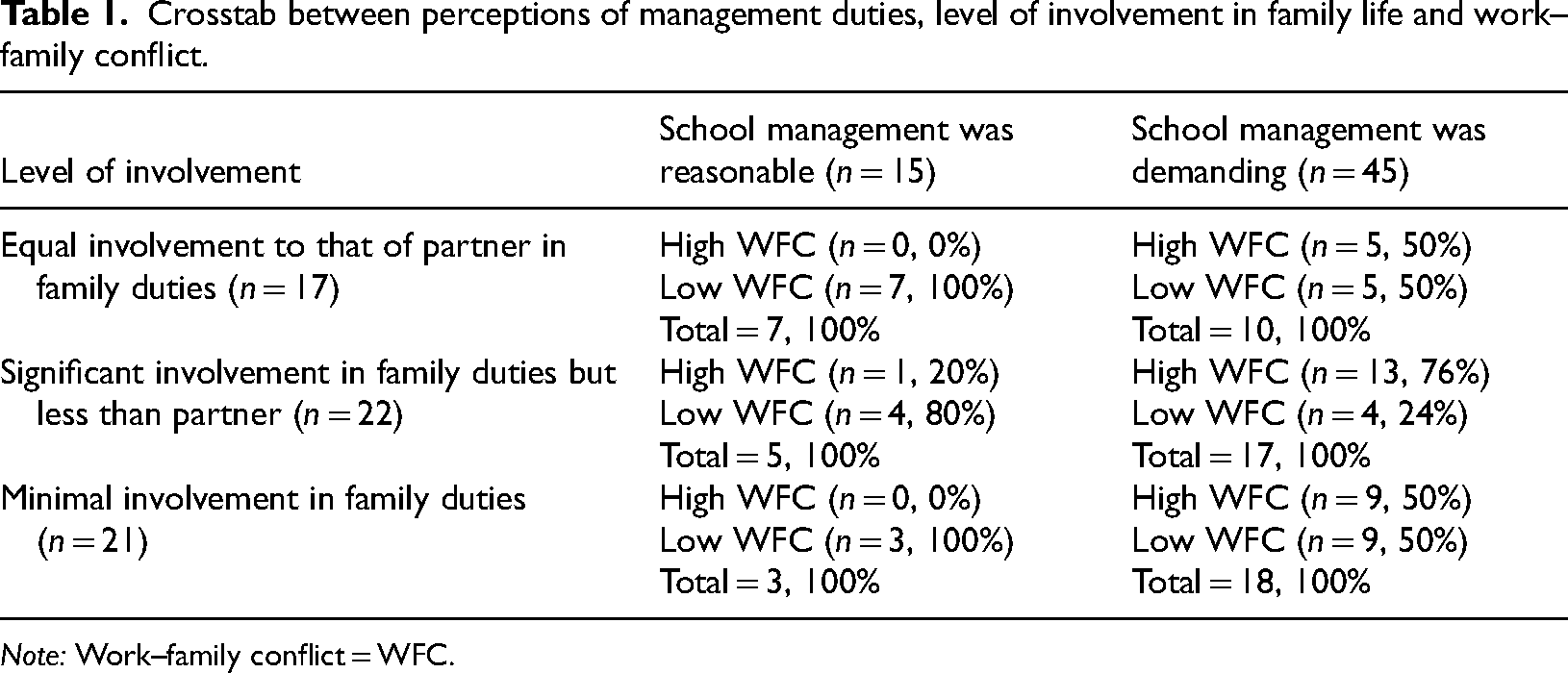
Note: Work–family conflict = WFC.
High degree of work–family conflict
All participants reported experiencing work-family conflict to some degree. Twenty-eight described high conflict levels with negative emotions and personal costs. The ‘paradox of fatherhood’ emerged, showing a gap between the desire to be a good father and reality. Participant 9 conveyed this struggle: Home is more important than anything. I constantly recommend to others how to combine work and family, but I don’t do it myself. One day everything will end, and you will be left alone with only your home. I know my children and I are paying a price. In the end, we live day to day with the inertia of life. There are prices to pay.
Participant 5 illustrated the discrepancy between intentions and actions: ‘I preach, but I don't practise what I preach. I would tell my team about setting boundaries at home, while I didn’t set such boundaries properly for my own children’. This gap between words and deeds led to guilt and stress. Participant 1 reported: ‘Sometimes I come home with a guilty feeling of not being there all day, and go wash dishes instead of being with my girls’. This illustrates the emotional toll of balancing work with family obligations.
Stress and its consequences were common themes. Participant 5 noted, ‘As a manager, you constantly feel stress at an unbearable level. There are busier periods, but you’re always busy’. Participant 29 depicted the tangible consequences of work interfering with family moments: ‘My son started first grade this year, and I went with him, but I wasn’t really there. I was on my phone and spent only five minutes fully attending. It didn’t do us any good’. Participant 58 expanded: ‘Everyone asks where I am. My wife says I’m not home, work says I’m not there, school says I’m missing. Honestly, I don’t know where I am’. These narratives reveal a consistent struggle by participants to balance their roles, with many feeling that their contributions at home were overshadowed by work demands, resulting in stress, guilt and limited involvement.
Low work–family conflict
Thirty-two participants described experiencing a low-intensity work-family conflict. Their language conveyed the idea that although tension was present, it was manageable or infrequent. For example: There is tension but it is not that dramatic […] Over the years I understood that I’m just another screw at home and at work, and not everything depends on me, and it's relaxing. I try to take life in stride (Participant 20).
The participant described a balanced approach, accepting limited control over both work and family responsibilities, which reduces stress. This perspective reflects an understanding that prioritizing duties equitably can alleviate conflict: ‘Entering management was a strategic decision for us as a couple. I don’t feel like I’m sacrificing family life for it’ (Participant 38). Others indicated that despite workload challenges, a positive outlook can mitigate stress: There is an inherent tension that is always present but the tension is reasonable. The tension also makes us stretch ourselves and be more creative in life […] In time, it gets better (Participant 3).
The participant perceived stress as a growth factor that improves with time, framing tension as a catalyst for development. Another respondent noted the pride that comes from balancing demanding work with family life: I see the workload in a positive light. My daughter asks me, ‘Dad, is it true that you’re a manager?’ They are proud of me […] Sometimes I come home tired, but the price I pay is not high (Participant 19).
This outlook reframes work pressure as a source of family pride, suggesting that a supportive home environment can reduce perceived conflict.
Coping strategies for managing work–family conflict
Coping strategies were of two types: personal resource management and shared resource utilization. Most participants (n = 35) favoured the strategy of personal resource management, suggesting that a personal mindset and habits are key to minimising conflict. Of these 35, only 15 reported high conflict (42%), whereas a strategy of reliance on the management of shared resources was associated with higher levels of conflict (62%) (Table 2).
Crosstab between coping strategies and level of work–family conflict.

Note: Four participants did not account coping strategies.
Personal resource management
Participants (n = 35) frequently emphasised the importance of personal resource management. Twenty participants highlighted their time management strategies, specifically setting designated times to be home with family. For example: I learned to balance work and home by arriving earlier and sometimes spending the evening with my wife after the kids are asleep, being present (Participant 51). Even today, I could have stayed at work another hour and arrived home at six instead of five, but I choose to be with my kids and family (Participant 52).
Another key aspect of personal resource management involved setting boundaries to work pressures to fully devote attention to children (n = 19). The following quotes illustrate this: I’ve established a routine where from 16:30 to 20:30, I handle only emergencies. This minimises work interruptions at home (Participant 56). I create clear separations. I come home, put my phone aside completely, and disconnect (Participant 49).
Shared resource utilization
Participants (n = 21) also described strategies for handling conflicts in their immediate circles of family and work environments. Six participants emphasised communication with friends and family, particularly their relationship with their partner. Participant 7 noted the importance of open communication: Share with the wife what you are doing. Sit down and tell her about the successes and struggles, so that she feels that she's important and a partner in your work. It's the small phone calls to her, to give her the feeling that you see her, that you understand her.
Eleven participants saw the work environment as essential for managing conflicts, highlighting the importance of workplace culture with clear work–home boundaries and flexible arrangements (remote work, flexible hours). Seven participants saw promoting autonomous teams and a distributed work model as effective in reducing home–work tensions. Participant 8 suggested: ‘Build a team that will be compatible with your vision and needs. That way they will manage without you, and your home will be more relaxed.’ Only one interviewee (Participant 42) reflects a proactive approach to work–life balance, emphasising social and professional support: Balancing work and home is a goal I actively monitor. I talk about it, seek guidance, and attend clinical training sessions weekly.
He actively seeks guidance and training to refine their ability to manage both responsibilities. It reflects a proactive commitment to seeking support in maintaining harmony between work and home life.
Discussion
This qualitative study addressed the underexplored experiences of male school leaders in balancing work and family, complementing the extensive research on their female counterparts (Loder, 2005; Moorosi, 2007; Wrushen and Sherman, 2008). The study expands our understanding of perceptions of male leader's dual duties and how these perceptions are related to work–family conflict. The study also reveals various coping approaches and their effectiveness.
The study offers several contributions. First, it expands existing knowledge on the personal costs leaders incur as a result of their leadership work. The majority of participants described the leader's role as demanding, aligning with global and Israeli studies that attest to the heavy workload associated with school leadership (Oplatka, 2017). This study focused on subjective workload (French and Caplan, 1972), exploring participants’ internal feelings of work stress specifically related to managerial duties. The subjective experience is often consistent with the objective workload. For example, a study in China showed that principals worked 50–60 h a week, with additional work at home (Yang et al., 2021). Many male school leaders interviewed noted a strong commitment to students that often came at the expense of family life, evident in both time investment and a continuous sense of obligation. These results resonate with findings by Emsile and Hunt (2009) showing that men often invest more time in work, resulting in work–family conflict. Similarly, research on Canadian school leaders indicated that they prioritised students over their families, contributing to long work hours that extended into their personal time (Wang et al., 2021). The present study found a direct link between perceiving the leader's role as demanding and experiencing high work–family conflict; by contrast, leaders who considered the workload as manageable experienced lower levels of conflict.
A second key contribution of the study is its exploration of practical aspects of home duties such as the level of the fathers’ involvement in childcare. None of the male participants reported being more involved in domestic duties than their partners. These findings echo research indicating that, despite advancements in gender equality, men remain less committed to family responsibilities than women (Dowd, 2012; Guendouzi, 2006). The COVID-19 pandemic is said to have created conditions that challenged traditional gender roles, but evidence suggests that in many contexts, men's home roles remained unchanged (Tahir et al., 2022), or they took on caregiving tasks selectively, leaving the majority of the burden on women (Wojnicka and Kubisa, 2024). This was also partly influenced by workplace expectations, as men were expected to prevent family-related interruptions from affecting their work (Lee et al., 2023). Nevertheless, nearly a third of the participants reported equal participation in family life. Almost all participants who were not primary caregivers noted the importance of ‘quality time’ with their children, which they defined as structured activities and child-centred interactions (Snyder, 2007). This is consistent with evidence that recent progressive views of masculinity and fatherhood are becoming part of male school leadership in the West (Kabesa and Berkovich, 2023, 2024), resulting in the intensification of stress induced by the dual roles. Role conflict theory suggests that the result of individuals juggling multiple demanding roles is often stress and reduced work engagement (Linzer et al., 2002). A study applying this theory to teaching staff found a negative correlation between work–family conflict and job involvement, with higher conflict leading to lower work motivation (Li, 2018).
Third, the study shed light on the work-family conflict experienced by male leaders and their coping with it, an underexplored educational administration topic. All participants reported experiencing work–family conflict to varying degrees, consistent with findings showing a strong connection between high-investment jobs and elevated work–family conflict (Erdamar and Demirel, 2014). The experiences of Israeli leaders align with the global literature indicating that male educational leaders often face substantial work–family conflict. For example, a US phenomenological study found that leaders commonly experienced this conflict because of job dedication and a lack of work–life balance support (Garcia, 2015). Another study on school leaders found that work–family conflict was prevalent and reduced job satisfaction (Yang et al., 2021). Most participants used problem-focused strategies, in Lazarus and Folkman's (1984) terms, consistent with previous research suggesting that men more often adopt this approach (Recuero and Segovia, 2021) than emotion-focused strategies. The findings revealed that most participants (n = 35) resorted to personal resource management, reflecting agentic locus of control that may be linked to the managers’ tendencies and masculine non-communal tendencies. This strategy emerged as highly effective: few school leaders using these methods reported high work–family conflict. By contrast, many of the participants using shared resource utilization as a strategy experienced high levels of conflict. School leaders relying on personal resources suggest one of two possibilities: (1) a fear that acknowledging weakness is associated with help seeking (Nir, 2009) or (2) individuals who rely on their ability to control outcomes experience less conflict, consistent with studies on work locus of control (Spector, 1988). Therefore, it is possible that the personal resource management reflects a traditional masculine mindset of self-control among male school leaders in the West (Kabesa and Berkovich, 2023, 2024). School leaders relying on shared resource utilization may have a more communal leadership perspective, or it may suggest that the conflict is spiralling out of control.
The study findings have significant ramifications for policymakers in education and acting school leaders. First, to enhance school leaders’ wellbeing and performance, policymakers must acknowledge the work–family stress leaders face and establish robust support networks, for example, by giving school leaders the option to fund additional middle leadership posts and one-on-one mentorship. This entails providing leaders with personal and social resources to better manage the difficulties they encounter. Second, policymakers have a major role in normalising and supporting male school leaders’ active work–home balance. Strategies such as flexible work arrangements and parental leave policies inclusive of fathers could help foster a more equitable division of labour at home (de Laat et al., 2023), ultimately benefiting both male school leaders and their partners. Third, school leaders are urged to examine their responsibilities more closely, consider the challenges they face daily, and use personal and social resource management that gives them greater control over how they handle work and family obligations.
Conclusion
The current study sheds light on the complex realities male school leaders face in navigating work–family conflict. It underscores how the high demands of leadership roles in schools can intensify tensions between professional duties and family life. All participants reported experiencing conflict, but its intensity varied based on their perceptions of responsibility and the coping strategies they employed. Notably, those with an internal locus of control demonstrated greater resilience and effectiveness in managing these challenges. These findings emphasise the urgent need for targeted support, through progressive policies, that reflect the evolving dual roles of male leaders. Promoting meaningful work–life integration is not only beneficial for individual well-being but also essential for sustainable and effective leadership in education.
Footnotes
Declaration of conflicting interests
The authors declared no potential conflicts of interest with respect to the research, authorship, and/or publication of this article.
Funding
This work was supported by the Israel Science Foundation (grant number 1609/22).
