




Abstract
This article systematically reviews 35 empirical articles on the topic of networks and career advancement into academic leadership positions. Our objectives in this systematic review are to clarify (a) the functions that networks fulfil, (b) the outcomes of these functions in terms of career advancement and (c) whether networks are likely to result in more or less career advancement for women compared to men. Four databases were searched using the PRISMA (preferred reporting items for systematic reviews and meta-analyses) approach to select eligible studies published between 1990 and 2019. We distinguish three different functions that networks may fulfil: operational, developmental and strategic. Mixed results are found for the operational and developmental network functions, while the results suggest that the strategic function contributes to career advancement, particularly for men. The reason for this can be found in the masculine academic context. Our findings implicate that a solution involving equal network opportunities needs to be taken up by the academic community as a whole. To further develop the research field, we call for (a) more consistent conceptualisation, (b) more attention to the multiple functions of networks and networking behaviour and (c) more advanced study designs.
Introduction
An increasing amount of attention is being paid to gender inequality in academia and the relatively low proportion of women in academic leadership positions (AAUP, 2020; European Commission, 2019). Women enter academia in similar or sometimes in greater numbers than men, but only about a quarter of them reach the associate or full professorship position (AAUP, 2020; Diezmann and Grieshaber, 2019; European Commission, 2019). Women are also under-represented as heads of institutions in the higher education sector; they fulfil 22% of these positions in Europe (European Commission, 2019).
There are two dominant types of explanation for the lack of representation of women in academic leadership positions (Diezmann and Grieshaber, 2019; Powell, 2019a). One of these types – person-centred explanations – concentrates on individual factors such as age, ethnicity and motivation (Baker, 2010; Diezmann and Grieshaber, 2019). Universities are regarded as meritocratic institutions that are committed to academic excellence (O’Connor et al., 2017). In these meritocratic systems, academics are evaluated on their achievements, and other factors such as age or gender should not play a role (Nielsen, 2016). Nowadays, more and more research examines career advancement from an institutional perspective, or apply the so-called situation-centred explanations (Powell, 2019a). Several authors claim that non-meritocratic elements are (even more) important to advance in academia (Šadl, 2009; Van den Brink and Benschop, 2014). In particular, promotions to the top levels of academic hierarchy are more likely to be based on relationships than on objective assessments and performance (O’Connor et al., 2017).
One institutional factor that is consistently mentioned as being important for academic career advancement is the extent to which persons have powerful contacts in academia, and, as such, the depth in which they are embedded within networks (Wolff and Moser, 2010). As described in the seminal work of Granovetter (1983) on this topic, networks provide technical, social and strategic capital that may help to advance in one's career. Academics rely, for instance, on information about funding and research opportunities that circulate in formal and informal networks. Variation in networks occurs due to the levels of formality, their members, and resources that can be shared (Granovetter, 1983). In more recent years, attention has also been paid to the importance of diversifying network contacts and the functioning of different types of networks (Diehl et al., 2020; Ibarra, 2015; Ibarra et al., 2010). Research on career advancement viewed from a network perspective is examined in several fields such as management, education and medicine. This review study, therefore, contributes to the literature by gathering an overview of the scattered evidence in the different fields that examine this topic.
Scholars argue that the accessibility of work-related networks can be regarded as a gendered issue (Diehl et al., 2020; Forret and Dougherty, 2004; Ibarra et al., 2010). However, it is unclear to what extent networks in academia – and which network functions in particular – are likely to result in the career advancement of women compared to men. It is important to unravel this relationship, given the importance that policy makers inside and outside academia attach to creating equal career opportunities and being a diverse and inclusive institution.
The purpose of this review is, therefore, to determine the functions that networks fulfil and to discuss the impact of these functions in relation to career advancement into academic leadership positions for men and women. When referring to higher ranks of academia in this review, we focus on both faculty leadership positions (i.e. associate professor and full professor) and administrative leadership positions, such as the position of department chair or (vice) dean. This article continues in the next section with our methods for analysing the literature. After that, we present the findings, and explain the implications of our findings with reference to research, theory and practice.
Method
To provide a comprehensive overview of the current state of knowledge, we conducted a systematic literature review. This was performed following the guidelines of the PRISMA framework 1 to ensure the quality of the review process (Liberati et al., 2009).
Search strategy
To find eligible studies, four electronic databases were searched in July 2019. The last search was conducted on 25 July 2019. Network research has drawn attention from different academic disciplines. Therefore, we applied the search strategy to two general databases and two discipline-specific databases. Scopus and Web of Science are comprehensive databases in the social sciences while Sociological Abstracts and ABI/INFORM ensure that a sociological perspective and a management perspective are also covered. In addition, we continued to monitor studies that were published in the period August–December 2019 using the Web of Science database.
For a study to be included in the review, it had to deal with three key terms: (a) network, (b) gender synonyms and (c) career advancement into an academic leadership position. We are aware of the existence of multiple synonyms of these terms but uninformed about all variations in the different research fields that examined our topic. For instance, among variations of the key term career advancement is career progress, and more specific terms, such as appointment, promotion, mobility, surviving and academic agency are also used. Moreover, the key terms – academic leadership position and networks – also have many variants. Adding more search terms, however, reduces the workability of the search query and may still lead to missing important papers on the topic. Therefore, the search was conducted in several steps. We started with a very broad search strategy and then narrowed down results by manually filtering all results in consecutive steps in order not to miss any papers due to the heterogeneity in terminology. Before we explain these steps in depth, we will first describe the report and study eligibility criteria.
Scope of review
Articles were included if they met the following three report eligibility criteria. Firstly, only articles written in English were selected; secondly, only studies published in (online) peer-reviewed journals were considered; and thirdly, only articles published in the period from 1990 to 2019 were retrieved. The year 1990 was chosen as this year is close to the publication date of the seminal work of Ibarra (1993) on personal networks of women and minorities in management. Articles were included if they also met all the following study eligibility criteria:
Study design. We included peer-reviewed articles with either a quantitative, qualitative or mixed study design. Studies had to contain empirical research. Purely theoretical and conceptual papers were excluded. Topic and study population. Studies had to primarily deal with network(s) as the independent variable and academic advancement into academic leadership positions as the dependent variable. We defined the independent variable as follows: ‘Networks are channels through which tacit and overt knowledge about the world of work is passed on’ (Coleman, 2010: 770). Networks vary according to their size, levels of formality, their members and the resources that can be shared (Granovetter, 1983). As a result, diverse terms are used to describe various types of networks such as peer networks, co-authorship networks, or mentoring networks, and there are also broader distinctions based on, for instance, formal or informal networks. As we are uninformed about all variations in the different research fields that examine our topic, and because we wanted to focus on the network perspective, we chose to focus on the search term ‘network’ as common denominator. We defined the dependent variable as moving up in an academic leadership rank by which we refer to both faculty leadership positions (i.e. the associate professor and full professor positions) and administrative leadership positions (i.e. academic management positions at the level of department chair, (vice) dean, or functions at the executive level). Thus, studies on advancement at the level of lecturers and assistant professor positions were excluded. Studies that addressed multiple academic levels needed to consist of ≥ 50% senior academic participants or the results needed to be split up per rank to be included in the review. Articles also needed to pay attention to gender outcomes. Study perspective. We included two perspectives regarding academic leadership positions. Firstly, we included studies in which participants’ own perspectives were taken and which addressed factors that had influenced their career advancement into those positions. Secondly, we included studies in which participants reported in general on career advancement into leadership positions.
Selection process
Our article selection process encompassed four steps. In the first step, we started our search in the four databases with the key terms network, gender and a simplified version of the career advancement key term. This latter term was, due to the complexity and heterogeneity of terminology in the various academic fields, split in three consecutive steps. The details of the database search strategy are shown in Online Appendix 1. This search query – without filtering to a specific time period – generated 21,406 results: 14,116 hits within Scopus; 3,506 in Web of Science; 2,312 in Sociological Abstracts; and 1,472 in ABI/INFORM. We scanned the abstracts, titles and keywords of all publications on the report eligibility criteria. As a result, 4,294 publications were excluded, and 17,112 articles remained. We then checked for duplication and, from this, 14,669 remained. The overall study selection process is shown in Figure 1.
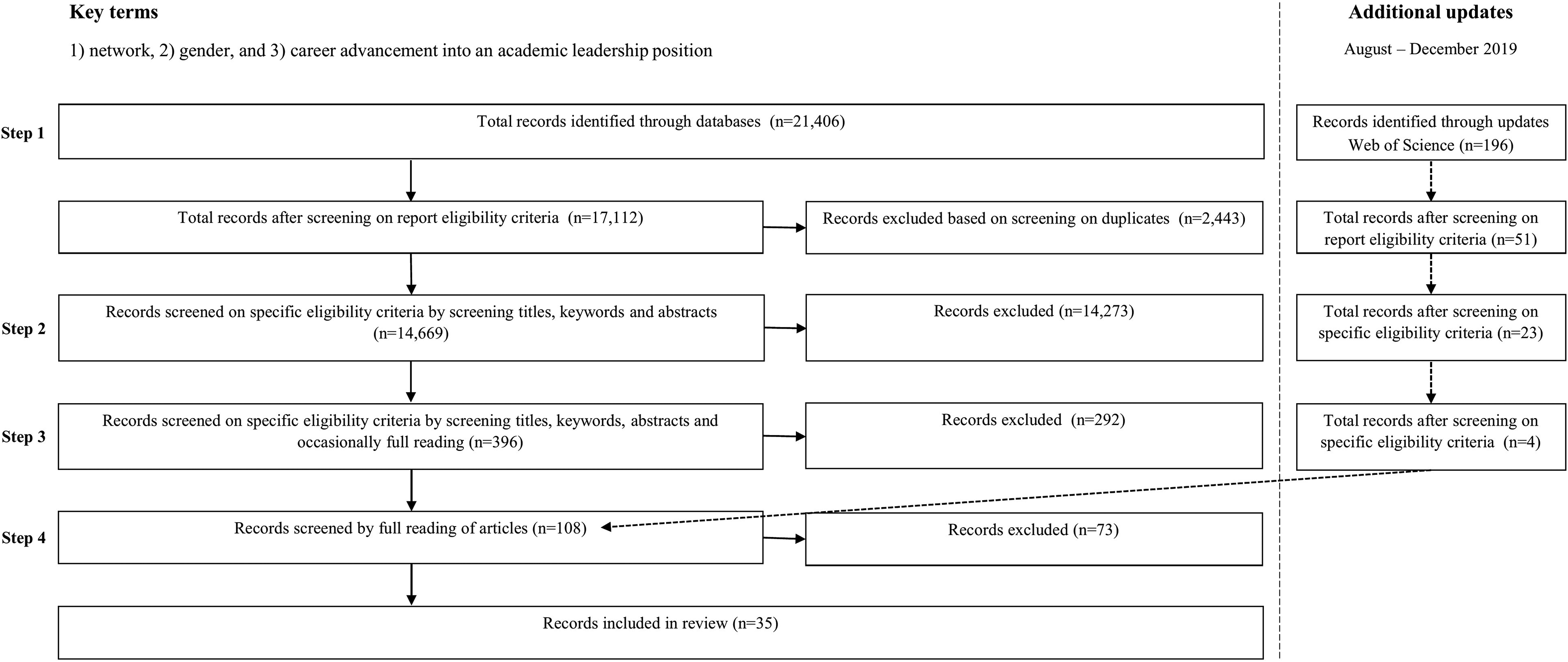
Flowchart of study selection.
In the second step, we manually screened the results of step 1. We read all titles, abstracts and keywords of all 14,669 articles to see whether these focused on career advancement in an academic context, considering the multiple synonyms and heterogeneity in terminology. As a result, 14,273 publications were excluded, and 396 articles deemed potentially eligible. In step 3, we checked, again manually, whether the remaining 396 articles indeed focused on academic career advancement into academic leadership positions following further refinement of the key term. As a result of this phase, 292 publications were excluded. The additional method, updates via the Web of Science database, resulted in four potentially eligible articles. The total number of articles for full reading in step 4 resulted, therefore, in 108 articles.
In step 4, all 108 included articles were examined for their eligibility, and the full text was read. To have a systematic set of articles, studies were coded based on our own coding scheme that consisted of ten predefined codes 2 . The eligible records were checked by this review's first author for a full reading, and the second author assessed about 20% of the articles to ensure the reliability of the study selection. We contacted three authors of potentially eligible articles to ask for clarification about used definitions and measurements. This final check led to the inclusion of 35 articles: 7 quantitative, 2 mixed-method and 26 qualitative studies. We excluded 73 articles in this final phase for several reasons, with the main reason being that these articles did not entirely match our topic criteria. For instance, we excluded articles in which the dependent variable (n = 41) was examined as earnings (i.e. salary) or research productivity, or in which the independent variable (n = 22) was examined as departmental prestige. In addition, studies were excluded that did not meet our criterion about the type of participants (n = 10).
Results
General results
Figure 2 shows the distribution of year of publication (1990–2019) among the articles that were included in this review. As can be seen, research attention to this topic started to grow in the last decade. While the first articles were from 2000, there were four articles published in 2019 3 . As is also shown in the same figure, the research field is dominated by qualitative research (n = 26, 74.3%). The 35 included articles were published in 30 different journals, which confirms the scatteredness of this research field. Articles were published in sociology, education, management and medicine journals. The most prolific journals (with at least two published articles) were Academic Medicine; Compare: A Journal of Comparative and International Education; Employee Relations; and Gender and Education.
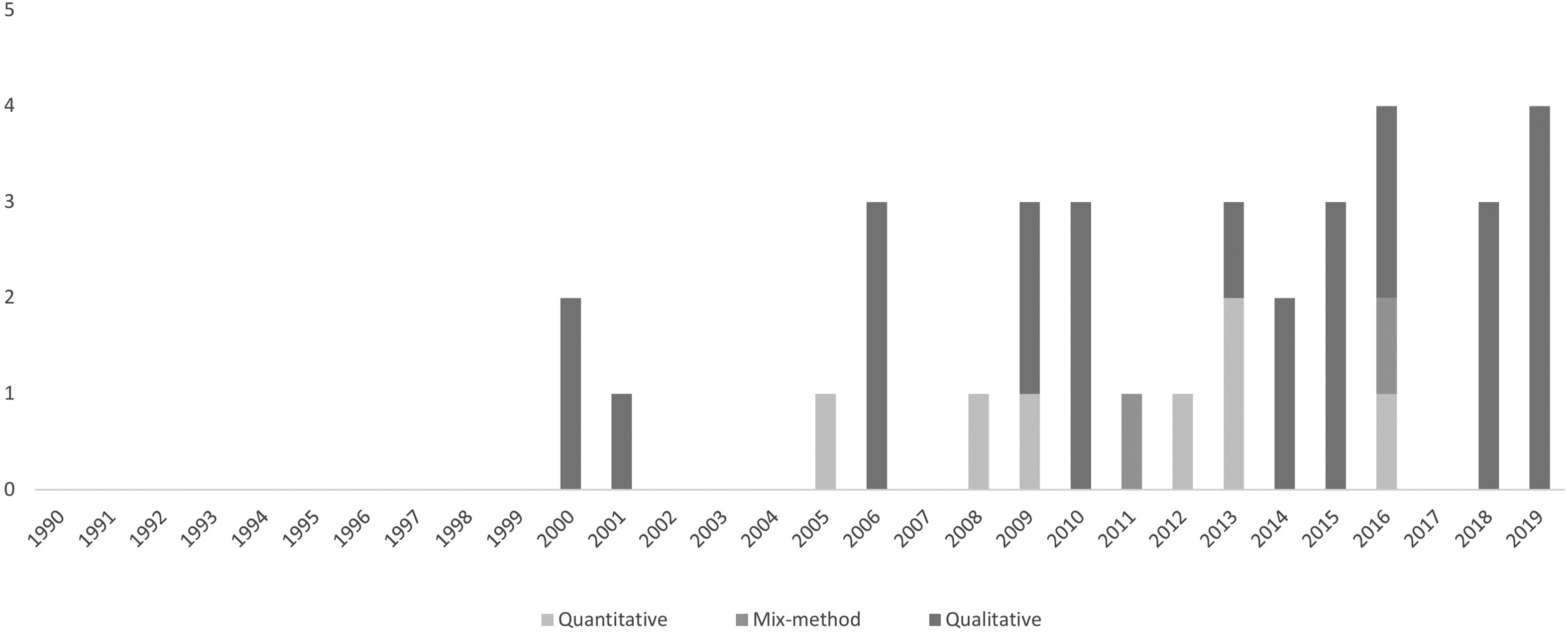
Number of publications on networks and career advancement into academic leadership positions per year.
Table 1 summarises the main characteristics of these studies. Most of them drew on cross-sectional designs (n = 33, 94.3%), typically collecting data by interviewing academics in leadership positions about advancement barriers at a single point in time. Moreover, most studies focused on academic leadership positions (n = 20, 57.1%) while a few studies focused on a broader sample of positions (n = 15, 42.9%). Career advancement can be approached from two perspectives: first, it can be defined from an objective angle as the number of promotions in one's career (Dries et al., 2008); or, second, it can be assessed as a subjective judgment about career advancement, such as career progress satisfaction (Powell, 2019b). This second approach was taken in the majority of studies (n = 29, 82.9%). Many studies focused on men and women (n = 20, 57.1%); fewer took a women-only approach (n = 15, 42.9%). We did not find any men-only samples. Finally, most studies were conducted in English-speaking countries, with the USA as frontrunner (n = 10).
Overview of studies (n = 35).
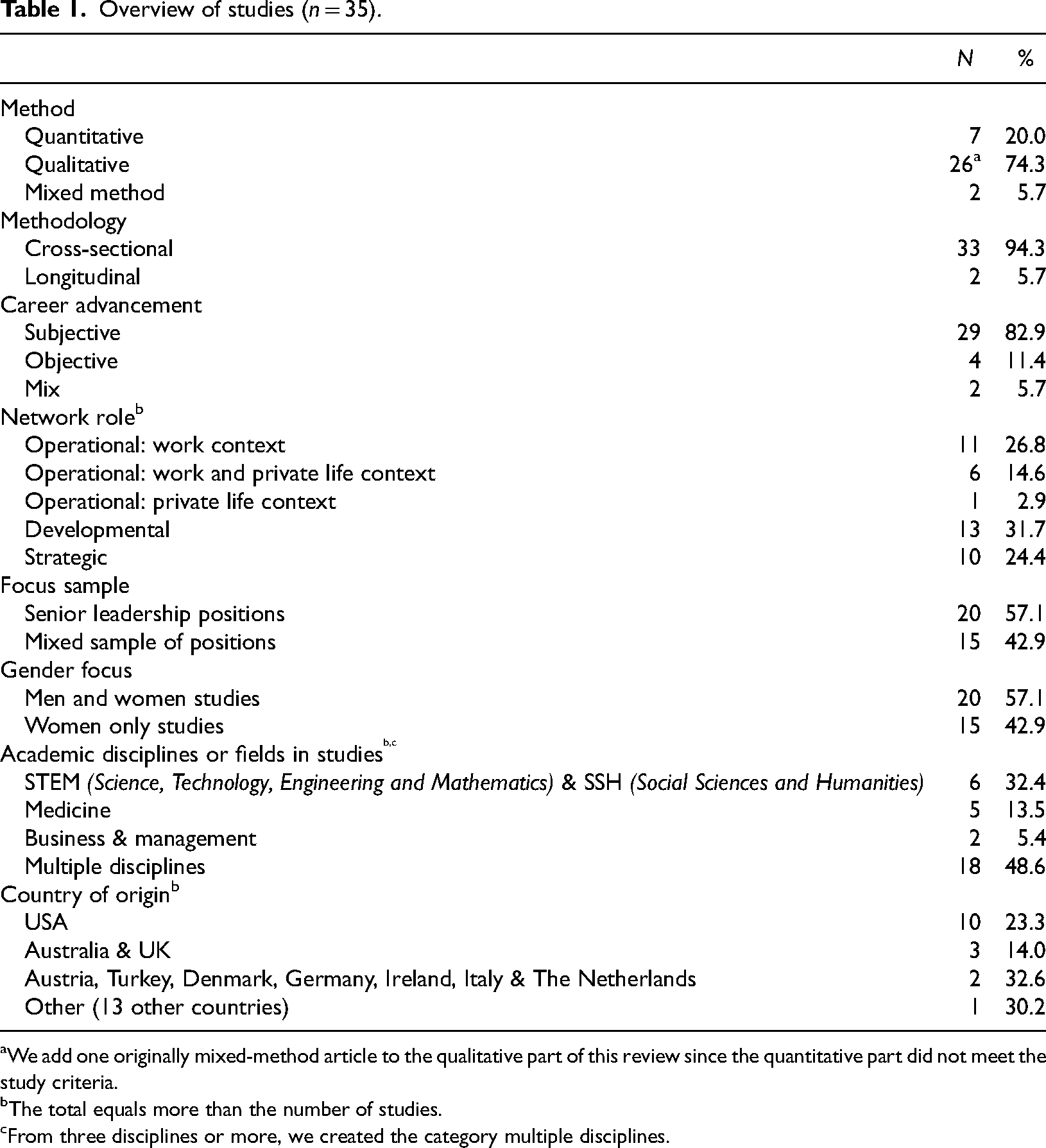
We add one originally mixed-method article to the qualitative part of this review since the quantitative part did not meet the study criteria.
The total equals more than the number of studies.
From three disciplines or more, we created the category multiple disciplines.
In general, the quantitative studies were more specific about the definition and conceptualisation of networks than the qualitative and mix-method studies. Overall, what most definitions have in common is that networks consist of professional relationships that academics have with other members of the scientific community. However, a considerable number of authors did not present a specific definition at all. This may be related to the fact that in 12 studies (n = 34.3%), the authors presented the topic of networks merely as one of the factors in their article.
Which function do networks fulfil for academics?
Relationships in networks are mainly used to obtain and exchange resources (Wolff and Moser, 2010). Resources can be gained from various stakeholders in and around the academic community, such as (invisible) colleagues, co-authors, HR, supervisors and other influential insiders. However, not all stakeholders have the same experience and access to resources. Also, the quality of resources may differ. Discrepancy in resources and types of support leads to the different functions that networks may fulfil (Granovetter, 1983; Ibarra and Hunter, 2007).
Based on the articles, we distinguished three functions that networks fulfil: operational, developmental and strategic. Each network function is associated with a specific purpose and resource(s). For example, we considered studies that examined network relationships aimed at accomplishing daily work activities, such as with colleagues and research collaborators, to fall into the operational function category. In contrast, we put all articles that researched hierarchical relationships under the strategic function category. Studies that focused on exchanging resources regarding development in any form were placed in the developmental category. The three functions that we distinguished are explained along with examples that show the range of variation in network connections in the academic context.
In the absence of any specific classification for academic networks, we used these distinctions to build on the network classification as used in the seminal study of Ibarra and Hunter (2007). The identification of network functions according to this classification is not an easy task due to the unique features of the academic setting. Boundaries between internal and external contacts are, for instance, more blurred in academia than in the private sector due to the sharing of research activities among ‘invisible colleagues’ worldwide. Therefore, where necessary, we adjusted the features to accommodate the academic context. For example, we deviate from the original term ‘personal networks’ as this term creates unwanted tension between non-work and work relationships, whereas personal relationships can also exist in the work context.
This distinction between the operational, developmental and strategic function should be regarded as ideal network functions rather than clear-cut categories. Moreover, in practice, these functions could overlap which means that one network could fulfil multiple functions. While most of the articles examined one function of networks, six of them examined two functions of networks as shown in Figure 3. The numbers in the figure correspond with the numbers in Online Appendix 2.
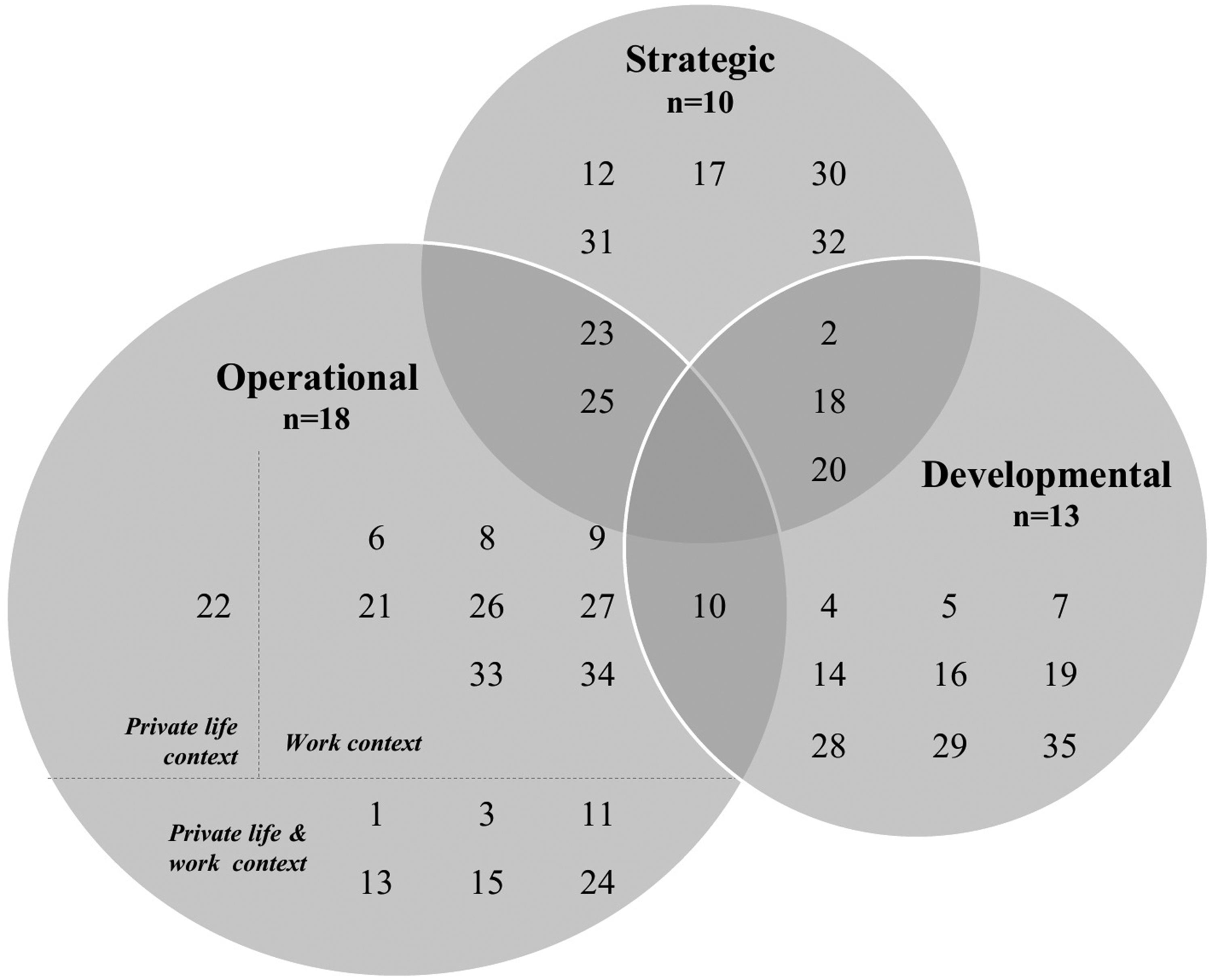
Overview distribution of studies based on the three functions of network.
Operational function
Operational networks aim to manage daily work responsibilities (Vongalis-Macrow, 2014) and, accordingly, relations in operational networks are oriented toward current work demands (Ibarra and Hunter, 2007). As can be seen in Table 1, 18 studies in our review examined the effects of operational networks. How they studied the operational role of networks can be illustrated in three ways. First, some studies focused on local work relationships, such as intra-organisational research connections (Warner et al., 2016), and local advice ties (Dabos and Rousseau, 2013). Second, some studies broadened their scope and looked at work relationships with peers inside and outside an institution or research field, such as ties with reputed scientists and laboratories (e.g. Parker and Welch, 2013; Röbken, 2009). Third, seven studies examined the operational role from non-work relationships, also called kin relationships (e.g. Abalkhail, 2019; Hart, 2016; Perna, 2005). We positioned these studies in this category because private-life-relationships aim to support the academic to get through the daily work situation.
Developmental function
Developmental networks are built to boost professional and personal development. Members of a developmental network can be found in several places inside and outside their own organisation. These kinds of networks arise outside the usual operational circles of academics, with the aim of creating a safe space to learn and develop (Ibarra and Hunter, 2007). In total, 13 articles focused on the developmental role. Development on the professional and/or personal level is reached because of contacts that offer, for instance, social and mental career support (Coleman, 2010), mentorship embedded in a broader social network context (Miller-Friedmann et al., 2018; Thanacoody et al., 2006) or insights regarding improvement of research capacities and behaviour (Masika et al., 2014). Some studies have gathered evidence on the dyadic aspect of developmental networks. Despite the fact that a network consisting of one-on-one relationship with a mentor is small in size, these mentors may introduce their mentee to their own social network or provide contextual signals of ability regarding the mentee in external academic communities (Pezzoni et al., 2012; Yedidia and Bickel, 2001). These practices are likely to affect career opportunities as they increase the reach of the mentee's academic network.
Strategic function
Relationships in a strategic network consist of contacts with hierarchical higher-ranked persons in the field. These members are called brokers in the network literature and may open doors to new career opportunities (Ibarra, 1993). From these persons, support or insider information about, for instance, invisible vacancy requirements is desirable to advance (Ibarra and Hunter, 2007). Regarding this function, we identified 10 studies, some of which focused on recruitment practices from both the perspective of the potential academic leadership candidates (Vázquez-Cupeiro and Elston, 2006) and from the perspective of department heads (Nielsen, 2016), or gatekeepers (Van den Brink and Benschop, 2014). Other studies have paid explicit attention to the role of a scout (Van den Brink, 2011) or sponsor (Ayyala et al., 2019; O’Connor et al., 2020) in a broader strategic network. These relations can be analysed from a network perspective because they contribute to the visibility of the individual and are therefore viewed as effective career accelerators (Ayyala et al., 2019; O’Connor et al., 2020).
What are the outcomes of the different network functions?
In the previous section, we identified three different functions of networks: operational, developmental and strategic. In the following, we first summarise the impact of these functions regarding career advancement in academic leadership positions for men and women. The results in the operational category are separated into two sections: one focusing on purely work-context networks and one focusing on private-life-context networks. Next to those different network functions, we will shed light on networking behaviour with which we refer to getting access to networks, and actual practices in networks. This further reflection is needed because the optimal functionality of a network depends on the behaviour of the network members.
Operational networks: work context
We find mixed evidence of the impact of operational relationships on career advancement. Some studies reported that these operational relationships, mainly consisting of peers in their own organisation or abroad, are beneficial for career advancement (i.e. McNae and Vali, 2015; Warner et al., 2016). For example, Baker (2010) noticed that networks consisting of local colleagues are helpful for career advancement because these ties can serve as a source of stimulating insights, or these contacts may serve as important referrals. These positive findings appear to be inconsistent with those of other studies (i.e. Gersick et al., 2000). Dabos and Rousseau (2013) demonstrated, for instance, that collegial friendship networks did not show significant results with respect to career advancement. In line with this insight, Weber and Ladkin (2008) stated that internal relationships were perceived as a less important career strategy for full professors. Some studies highlighted the role of national context in the impact of operational relationships. For instance, the findings of Pezzoni et al. (2012) indicated that ties with external scientists – so-called invisible colleagues – were positively related to promotion changes in France; however, these colleagues did not have a significant effect in the Italian context (Pezzoni et al., 2012).
Operational networks: private life context
Work-related relationships can be enabling and constraining, as illustrated above. Due to an absence of or lack of access to networks within the institution, women in particular are more likely to rely on kin networks (Abalkhail, 2019; Hart, 2016). Pritchard (2010) stated that in situations in which work-related networks were poor, a family could form a positive synergy with the work domain. However, kin networks could provide fewer professional resources at the university than work-related networks (Pritchard, 2010).
Developmental networks
We find more consistent findings related to the impact of developmental networks on career advancement into leadership positions. All these studies revealed how mentorship networks were found to be essential as a social support instrument for the advancement of women in the academic work environment (Miller-Friedmann et al., 2018). Women seem to particularly benefit from a same-gender mentor-protégé relationship (Thanacoody et al., 2006; Yedidia and Bickel, 2001). In male-dominated disciplines, this condition for effective mentoring is difficult to achieve because of the scarcity of female mentors (O’Connor et al., 2020). As a result, men are more likely than women in practice to benefit from a mentoring relationship.
In terms of larger social developmental networks, which most of the studies in this category have investigated, the findings are more mixed. Here, Terosky et al. (2014) and O’Meara and Stromquist (2015) found that self-selected female developmental networks positively contributed to providing hands-on tools to reach the necessary goals to become full professor. Masika et al. (2014) also indicated that involvement in the developmental project increased the confidence of the female participants and presented them with new coping skills. The design of these developmental networks has brought women faculty into spaces not organised by disciplinary expertise and outside everyday practices. As a result, these developmental networks contribute to insights into difficult work events and institutional barriers (Coleman, 2010) and offer safe spaces to address them (O’Meara and Stromquist, 2015). However, some studies also reported negative consequences of women-only developmental networks. Women-only developmental networks are temporary in nature and less stable because when women rise in the academic hierarchy, their peer network support falls away, and, as a result, women become isolated (Chesterman and Ross-Smith, 2006). Therefore, for the purpose of career advancement, it seems essential both to build up exclusive female developmental networks and to participate in mixed gender networks (Fritsch, 2015).
Strategic networks
In contrast to the varying findings related to the outcomes of the previous networks, the studies included in the strategic network category consistently revealed a strong influence of strategic ties in relation to academic career advancement. In particular, relationships with sponsors or recruitment gatekeepers are examined. A sponsor puts the protégé forward for career advancing possibilities by for example nominating someone for an academic position or by providing financial resources that contribute to the development of a new research line (Ayyala et al., 2019; O’Connor et al., 2020). Focusing on recruitment and selection practices, senior academics such as rectors and vice-chancellors act as decisive actors (Özkanlı and White, 2009). Appointments are frequently made in local lobbies where priority is given by gatekeepers to inner-circle candidates, resulting in a kind of ‘inbreeding’ (Van den Brink and Benschop, 2014; Vázquez-Cupeiro and Elston, 2006).
In strategic networks, it is not clear for all academics which persons play a critical role due to discretionary patterns of interaction. Moreover, these strategic contacts can be difficult to approach for outsiders and, in addition, these relationships can be costly in terms of financial and time investments (Kuzhabekova and Almukhambetova, 2019). It seems a challenge for women in particular to benefit from these influential gatekeepers (Özkanlı and White, 2009) and to get access to sponsors as men are more often sponsored than women (Ayyala et al., 2019; O’Connor et al., 2020).
Networking behaviour
In general, attending conferences, forming intellectual communities and participating in professional association memberships were acknowledged as important career advancement strategies (Harford, 2018; Weber and Ladkin, 2008). However, several studies included in this review indicated that there are differences between male and female academics in access to and participation in these social networks (e.g. O’Connor et al., 2020; Parker and Welch, 2013; Šadl, 2009; van den Brink and Benschop, 2014; Yedidia and Bickel, 2001). For instance, some studies pointed to the fact that some women were not aware of how to ‘make the network work for them’ in terms of career advancement (O’Connor et al., 2020). Moreover, several obstructed organisational practices were reported, such as excluding women from academic networks (e.g. Baker, 2010) or blocking an academic in terms of visibility in their organisation and research field (Ayyala et al., 2019). Here, women told more stories than men about harm in network relationships (Gersick et al., 2000) and they used networks more for ‘companionship’ and ‘comfort’ (Chesterman and Ross-Smith, 2006).
Some of the studies claimed that women do not actively engage in searching for entries in networks. For instance, Ledwith and Manfredi (2000) reported that no women in their study mentioned that they networked actively in the interests of themselves, or women in general. Hence, the main influences in the progress of females were described as ‘serendipitous’ networks (Ledwith and Manfredi, 2000), by using a ‘no-planning’ approach during their career (Šadl, 2009). This observation needs to be further detailed as some women might choose not to engage in work-related networks because of cultural roles and restrictions in the Arab Middle-Eastern context and Cyprus, respectively (Abalkhail, 2019; Socratous, 2018). This insight suggests that, in some contexts, the mental and social sacrifices regarding participation in networks seem higher than the academic career benefits for women.
Overall, it is important to highlight that networking behaviour is shaped by the context. For instance, social (desirable) behavioural patterns and other (gendered) contextual practices are at play (McNae and Vali, 2015). Consequently, academia, as a male-based working environment, provide – in some cases – career experiences that induce cautious responses in women (Harford, 2018; O’Connor et al., 2020).
Discussion
Answering the first part of our research question, we distinguished three functions of networks that can be linked to specific relationships: (a) operational, (b) developmental and (c) strategic. Most of the articles in our review examined the operational function of networks (n = 18), while the focus on the developmental (n = 13) and strategic (n = 10) role is approximately equally distributed as shown in Figure 3. The operational function was thereby separated into two sections: one focusing on purely work-context networks and one focusing on private-life-context networks. Note that in the search strategy we focused on studies that examined career advancement from a network perspective. Consequently, papers focusing on specific network relationships such as mentoring, sponsoring or coaching in relation to career advancement without explicitly using a network perspective are excluded from this study. A second note concerns the disregard of the network effects per type of academic leadership in this review. Due to the nature of the included studies, it was not always possible to make a distinction between types of academic leadership (i.e. faculty vs administrative), as more than a third of the studies combined results under the heading of ‘senior academic leadership positions’.
The distinction of three functions of networks raises the question of which interactions in networks are the most beneficial for career advancement. Our findings support the claim that networks contribute to career advancement. In particular, studies into the strategic function of networks revealed convincing evidence about the impact of strategic ties, whereas mixed evidence was offered regarding the impact of operational and developmental relationships. However, we need to be careful with these conclusions due to the lack of insights into network practices, and methodological rigor. These findings bring us back to the seminal work of Granovetter (1983) examining the impact of weak and strong network ties. Weak ties increase the reach of the network, and the diversity among members and resources (Granovetter, 1983). In contrast, strong ties bond similar academics (Ibarra, 1993). Resources obtained through these strong ties are therefore more likely to be redundant (Granovetter, 1983). We argue that contacts in strategic networks more often consist of weak ties, while contacts in operational networks mainly consist of strong ties. In terms of career advancement, certain weak and strong ties are essential to advance, though the weak ties seem most decisive (Granovetter, 1983; Ibarra, 2015).
Studies on this topic particularly reported that women experienced difficulties with accessing networks and making the network work for them. They therefore relied on kin networks or on peer networks organised outside their institutional field. However, non-work relationships may be seen as an inferior level of networks because these relationships provide expressive resources, such as social support and friendship, that – relatively speaking – have less impact on academic advancement. What is apparent is that some academics – again, particularly women – did not actively network at all (Ledwith and Manfredi, 2000; Šadl, 2009). Although networking behaviour is an individual characteristic, notable factors outside the individual, such as the organisational culture, affect interaction patterns. These contextual factors consequently shape an individual's opportunities and constraints for network formation and development.
In some of the included studies, the impact of the network composition in terms of gender was explored, particularly in the developmental and strategic network categories. These studies showed that due to the predominance of men in crucial recruitment positions, the pool of potential candidates is restricted with women at a disadvantage (Özkanlı and White, 2009; Van den Brink, 2011). In addition, Thanacoody et al. (2006) and Yedidia and Bickel (2001) claimed that same-gender mentor-protégé relationships are vital to the advancement of women into leadership positions. These insights suggest that women continue to be disadvantaged due to the limited number of senior female academics. However, on the other hand, we want to emphasise that, according to other studies, senior female academics are more likely than their male counterparts to underestimate the abilities and career commitment of other women (Fritsch, 2016). In addition, some female academics struggle with the idea of other women occupying leadership positions (Harford, 2018).
In response, academic institutes can develop organisational policies aimed at improving diversity and inclusion practices such as imposing a gender quota or offering training. More women are currently placed in several departmental committees than before (Hart, 2016). These appointments often happen because of the need to comply with diversity legislation. While Özkanlı and White (2009) point towards the beneficial contribution of diversity legislation frameworks, Hart (2016) demonstrated that some diversity strategies may disadvantage women because – due to the small numbers of women in senior positions – they are frequently recruited to participate in large numbers of committees but these duties take time away from crucial activities (Hart, 2016). Moreover, according to van den Brink and Benschop (2014), changes in policies and practices can be met with a certain resistance by both men and women. Promoting women into key positions will therefore not automatically make it easier for other women to advance their career as (un)conscious stereotypes and ingrained practices may still be at play (van Veelen et al., 2019).
Further research directions
We noted insufficiently covered areas that call for further research. To this end, we present recommendations clustered around three themes:
Although some studies provided a comprised definition of networks and career advancement, we found that both concepts are still undefined in many studies or defined in divergent ways due to the heterogeneity in terminology. The lack of conceptual consistency makes it difficult to systematically compare outcomes and to draw overall conclusions. In order to gain more insight into this phenomenon, further research and its description must become more detailed into what type of relationships are examined, and which resources are exchanged under which conditions. In particular, it is highly relevant to explore in-depth the impact of different types of relationships within networks. In addition, a distinction can be made between hierarchical and non-hierarchical relationships in networks. Career advancement indicators are often static and do not indicate progress. More objective measures would be helpful in gaining a comprehensive view of career progress into academic leadership positions. Therefore, in line with Pollitzer et al. (2018), we recommend developing an indicator that reflects career progress over time.
We echo the claim of Parker and Welch (2013) that attention to different network functions can provide additional insights. Future research is encouraged to further operationalise the three network functions. Please note that a network can fulfil different network functions simultaneously. We consider it important to examine how academics use their work-related networks in particular and to what extent this use of networks is influenced by gender, discipline, academic position and contextual influences. The role of private-context networks should not be neglected, but appears to be less relevant for academic career advancement based on the results of the reviewed studies. All in all, more research is needed in which the more hidden (social) mechanisms in the relationship between networks and career advancement are unravelled. Interestingly, not one of the studies we reviewed focused explicitly on the impact of changes at the tie level. We argue that newly created ties may increase indirect or direct career advancement, whereas dropped ties could decrease career advancement possibilities. Future research should therefore pay attention to changes in contacts, and the impact of these changes on career advancement.
The research field is dominated by qualitative research. As a result, less is known about the generalisability of the findings. In addition, empirical studies are mainly cross-sectional and therefore do not allow for causality to be addressed. With the exception of the two quantitative longitudinal articles in this review (Pezzoni et al., 2012; Warner et al., 2016), this method has seldom been applied in this field. Thus, there is a need for longitudinal research. International and discipline comparative studies were also rare in this review, although findings do suggest that the impact of networks on career advancement vary across contexts (Özkanlı and White, 2009; Pezzoni et al., 2012). Actual networking behaviour in the ‘heat of the moment’ is difficult to capture in survey and solely interview research. Therefore, to further examine the subtleties in networking practices within social contexts, we recommend executing qualitative research methods such as group observations, or ethnographies in combination with interviews. In addition, we encourage research whereby attention is paid to the networking behaviour of women in comparison to men.
Conclusion
This systematic review examined 35 empirical studies at the intersection of networks and career advancement into academic leadership positions. The research reviewed 7 quantitative, 2 mixed-method and 26 qualitative articles that were published between 1990 and 2019. These articles cover the various fields in which this topic is examined. To increase our empirical and conceptual understanding of this topic, we examined which functions networks fulfil and the outcomes of these functions regarding career advancement into academic leadership positions for men and women. Our review provides an overview of which types of networks, in an academic setting, have been researched in recent years. By doing so, this review complements the review by Zacher et al. (2019) in which they examined the role of individual characteristics and contextual factors on the career development of academics. However, in that study, senior career stages and the topic of networks in particular were not included.
Overall, our findings show – with some caution – that in academia, where there is a lack of objective description of excellence and promotion criteria, relationships with strategic actors are crucial for career advancement into leadership positions. The studies that examined the other two network functions showed mixed results. Although scholars frequently state how important networks are for career advancement in academia, the reality is that scientific knowledge on this topic is fragmented. To achieve more conceptual consistency between studies, we encourage future researchers on this topic to view networks in line with the definition of Coleman (2010), in which the exchange process of technical, social and strategic capital between actors is underlined. Furthermore, we encourage longitudinal research into the contextual conditions under which networks are built, maintained and used by women compared to men. If academic organisations want to successfully address diversity and equal opportunities among their senior staff, broader cultural and systemic changes are needed. A solution involving equal network opportunities needs to be taken up by the academic community as a whole.
Supplemental Material
sj-docx-1-ema-10.1177_17411432211034172 - Supplemental material for Gender, networks and academic leadership: A systematic review
Supplemental material, sj-docx-1-ema-10.1177_17411432211034172 for Gender, networks and academic leadership: A systematic review by Daphne L van Helden, Laura den Dulk, Bram Steijn and Meike W Vernooij in Educational Management Administration & Leadership
Footnotes
Acknowledgements
The authors thank the four anonymous reviewers for their insights and suggestions.
Declaration of conflicting interests
The author(s) declared no potential conflicts of interest with respect to the research, authorship, and/or publication of this article.
Funding
The author(s) received no financial support for the research, authorship, and/or publication of this article.

Supplemental material
Supplemental material for this article is available online.
Notes
Author biographies
References
Supplementary Material
Please find the following supplemental material available below.
For Open Access articles published under a Creative Commons License, all supplemental material carries the same license as the article it is associated with.
For non-Open Access articles published, all supplemental material carries a non-exclusive license, and permission requests for re-use of supplemental material or any part of supplemental material shall be sent directly to the copyright owner as specified in the copyright notice associated with the article.
