




Abstract
This article proposes a new method to detect the kidnapped robot problem event in Monte Carlo localization. The method is designed in such a manner that it can provide accurate detection across all time instances, whether the robot can still recognize part of the environment or is totally lost after kidnapping. The proposed method uses the sensor reading of the robot to determine if robot’s displacement at particular time instance is considered a natural displacement or not. A series of simulations are designed to measure the accuracy of detection and how it compares to other methods. The simulations show that the proposed method outperforms the methods of detection based on the weight of particles.
Keywords
Introduction
In mobile robotics localization, the kidnapped robot problem is defined as a condition when the robot is instantly moved to other position without being told during the operation of the robot. 1 –4 The detection of kidnapped robot is one of the most difficult problems in Monte Carlo localization (MCL). 5 This is due to the nature of particle filter used in MCL itself, where the convergence process of hypotheses (called particles) causes the absence of particles in some areas, leading to a localization failure if the robot is kidnapped to that area.
Kidnapped robot problem does not often happen in practice; however, it is often used to test the ability of algorithm to recover from global localization failures. Furthermore, the mechanical and sensor faults can lead to condition similar to kidnapping, thus the detection of this event can be used as fault detection. 6
For decades, several approaches are used to detect and solve kidnapped robot problem. Some solutions are based on visual recognition, such as the ones found in Majdik et al. 7 and Andreasson et al. 4 These approaches, however, are limited to the robot with visual-based sensor, such as camera. Some other approaches are more flexible by using the intrinsic parameters of the MCL itself instead of depending on the type of sensor used. Augmented MCL proposed by Thrun et al. 1 and MCL with mixture distributions 1,3,8 are some examples of this category.
In augmented MCL, random particles are injected in each iteration so that the possibility of particles’ absence in kidnapping destination area is reduced. These random particles are drawn from either uniform distribution over pose space or the posterior of the measurement. MCL with mixture proposal distribution combines regular MCL sampling with its dual distribution.
Despite its flexibility, the former two methods do not clearly draw a line between detection and recovery of kidnapping. This creates a problem when the concern is not only in the re-localization but also the needs to know when the kidnapping really happens, such as in fault detection.
Other solutions that also depend on intrinsic parameters of MCL can be found in Zhang et al. 5 and Yi and Choi. 9 Zhang et al. 5 use maximum weight of current particle set as the parameter to detect the kidnapping event. Yi. and Choi 9 use similar parameter; but instead of purely using current weight they use the entropy of the information which can be extracted from the weight. These two approaches address the detection and recovery separately, as what we prefer.
The rest of the article is organized as follows. In the section “Bayes filter and Monte Carlo localization” Bayes filter and MCL are briefly explained. The section “Definition of the terms in kidnapping” explains the definition of some terms used throughout the article. The section on “Map and measurement model” explains the characteristics of the map used in the article and the measurement model employed in all simulations. The section on “Review on existing methods” reviews the last two methods for kidnapping detection. The method we propose is then delivered in detail in the section “Proposed method.” The section on “Simulation results” delivers the simulations result of the comparison between the proposed method and the Maximum Current Weight (MCW). The final section discusses the conclusion and the possible improvement to the method.
Bayes filter and MCL
In mobile robot localization practice, it is almost impossible for a robot to know exactly its coordinates and heading (collectively known as pose) in the given map. Rather, the robot should infer the data from environment. The obtained state is then called belief. The belief of the robot is defined as

This posterior is the probability distribution over the state

MCL is a Bayes-based localization algorithm. It provides a powerful tool to calculate posterior bel(∗), given measurement and control data, 1,10 Bayes filter is based on Markov world assumption, that is, past and future data are independent if one knows the current state st. 1 By implementing Bayes rule and this Markov world assumption, the belief posterior can be defined as

The term
Bayes filter gives freedom to the choices of representation for the posterior. MCL represents the posterior bel(st) by a set St of N weighted samples distributed according to the posterior. 1,9 The density of the samples proportionally represents the likelihood of the robot’s pose being there

Each particle
The basic MCL algorithm, as summarized by Thrun et al. 1 and Zhang et al., 5 is depicted in Table 1. It accepts previous state St−1, past controls ut, past measurements zt, and map information m.
The Monte Carlo localization algorithm.

Definition of the terms in kidnapping
Before going further, we have to determine the definition of kidnapping detection and criteria of successful detection. We define kidnapping detection as the process detecting the time t, where 1 ≤ t ≤ T, when kidnapping happens. It does not detect the place from where the robot has been kidnapped or where it is kidnapped to. Kidnapping point is defined as the time instance t when the robot is kidnapped. We also define the criteria of successful detection as follows. The detection should occur only once, since we consider single kidnapping event. The time of detected kidnapping should be the same as the real kidnapping.
These two criteria are used to test the accuracy of the proposed method. Lastly, the recovery/relocalization process is defined as a method to localize the robot after the kidnapping event. We use recovery and relocalization interchangeably in this article.
Map and measurement model
Landmark-based map is used in this article. In this work, all landmarks have no feature distinguishing one from another, similar to corridor-based map with walls surrounding the robot, acting as the landmarks. That is, the robot can measure the distance and heading to the landmarks, without having any knowledge of the landmark involved. If we denote the range by r and bearing by ϕ, the sensor reading of the landmark at any time instance t can be defined as

With
Assuming all sensor readings are independent of each other, the probability of detecting particular features at any time instance t can be expressed as

The measurements of the landmarks can then be modeled by simple geometry as in equation (7)

Here
Review on existing methods
In this section, we will discuss two existing methods of kidnapping detection. The first one is the entropy method. 9 This approach utilizes the measure of information contained in the particle set. This information measure is called entropy and can be expressed as

The kidnapping event detection is defined as

The second approach is included in Zhang et al., 5 which uses maximum current weight as the trigger for kidnapping event detection. This method can be written as

These two methods are derived from similar parameter, which is the current set of particles. In the environment such as corridor map or our landmark map, particles do not have to be near the true pose of the robot to obtain similar reading with robot’s sensor. Any particle can give similar information about its surrounding, provided that the landmarks’ positions are similar to the ones seen by the robot.
This problem will in turn reduce the ability to accurately detect the kidnapping event. One example of the problem is depicted in Figure 1.
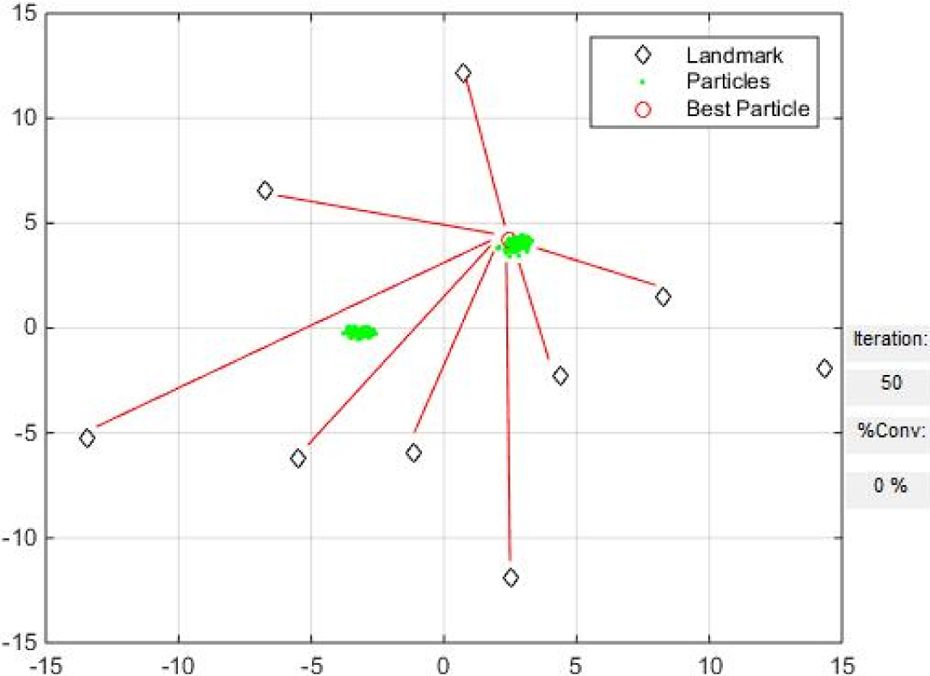
An example of kidnapping instance. The red straight line describes the sensor reading of the best particle.
In this example, the robot is being equipped with a range sensor of rmax = 7. At t = 50, the robot is kidnapped to (−30, 30), well beyond the maximum range of the sensor. At this moment, the reading of robot’s sensor will be maximum, that is, r = rmax. The same reading could be obtained by the best particle (red circle) since there are no landmark within its range also. This causes the parameter
On the other hand, many particles are already converged around the best particle, but some particles are converging on different clusters. The difference in the weight between these particle sets will then reduce the entropy, thus nulling according to equation (9). In addition, kidnapping to such an area where the robot could never read any landmark will keep the entropy high because the reading of the robot stays the same while the reading of the particles does not change much. This may give multiple kidnapping detection, while in reality it happens only once.
Using particle set as the parameter for the detection is too unpredictable, especially in featureless map. Therefore, a novel detection strategy is needed.
Proposed method
In this article, we propose a new approach to detect kidnapping event based on robot’s sensor reading. In this method, we define a parameter

That is, the change in distance to the nearest landmark detected between two consecutive time instances. The detector for kidnapping event is then expressed as

Threshold α defines the furthest natural displacement of the robot, that is, displacement to which the change can still be considered as due to the natural movement of the robot. The parameter we used in equation (11) can be depicted as in Figure 2. In this example, the robot is moving from A to B. In this case, the furthest possible distance the robot can travel can be achieved when the robot is already aligned with the landmark. From the figure, it can be seen that the maximum possible distance the robot can travel naturally can be defined as

δt is the discretized time step of the robot and ∊ is a free parameter called compensation factor to cover the possibility that the robot is moving further by the noise. The higher the ∊, the more selective it is to detect kidnapping; however, it will inevitably reduce the sensitivity. Assuming constant velocity, equation (13) can be reduced to

An example of robot’s movement to achieve furthest possible distance in between two consecutive time intervals. Here the robot is aligned to the landmark C such that there is no need to do rotational motion, thus maximizing translational displacement.

An example of robot’s movement to achieve furthest possible distance in between two consecutive time intervals. Here the robot is aligned to the landmark C such that there is no need to do rotational motion, thus maximizing translational displacement.
Simulation results
A series of simulations are run to test the performance of the proposed method compared to the other two. Each test with a single time instance of kidnapping event is run using 15 × 15 landmark-based map with 10 randomly placed landmarks. There are 100 time instances of kidnapping,
The number of successful kidnapping detection is then calculated for each tk and divided by 100 to obtain the percentage of success rate. An example of the map used and the desired trajectory of the robot is depicted in Figure 3.

One instance of the map and the desired trajectory of the robot.
Because the MCW fails in detection without recovery, other types of tests are devised. In these tests, the recovery strategy is implemented at the time step right after the kidnapping point
Table 2 shows the experiment setup applied for all simulations. All simulations are run on Windows® [version Windows 10 Education] machine 64-bit with 4 GB RAM.
The Monte Carlo localization (MCL) simulation setup.

In-map kidnapping detection test
For the first test, the robot is kidnapped to a place in the map that is within the cover of relocalization process. It should be noted here that in this scenario no exclusion problem occurs, that is, the robot can detect all the landmarks in the map. The kidnapping event is expressed as follows
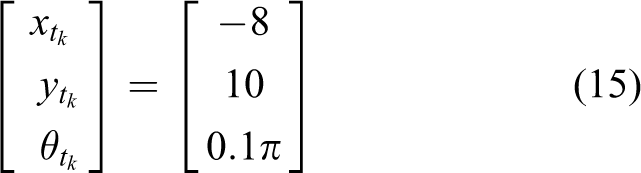
The result of the simulation is depicted in Figure 4.

Detection accuracy for in-map kidnapping scenario.
Out-of-map kidnapping detection test
This test is to see how the three methods handle the situations when the robot is kidnapped such that no landmark is read (totally lost) and thus the relocalization fails. The kidnapping event is defined as

The results of the test is depicted in Figure 5.

Detection accuracy for out-of-map kidnapping scenario.
Conclusion and future works
A new method in detecting the kidnapping event in MCL is proposed. Unlike other method, the proposed method uses the sensor reading of the robot directly between two consecutive time frames to determine whether the displacement of the robot is normal or not. A series of simulations are run to test the accuracy of the method across all kidnapping points. It shows that the proposed method outperforms maximum current weight method and entropy method during both in-map kidnapping scenario where the robot may still read some landmark and a total lost scenario where robot could not find any landmark within the range.
The method only relies on the range-based sensor without relying on any aspects of localization. Therefore, in future we plan to investigate the ability of the proposed method under different localization frameworks. Other plan including the application on real robot with TurtleBot as the platform, and investigation on the case of multiple kidnapping problem.
Footnotes
Declaration of conflicting interests
The author(s) declared no potential conflicts of interest with respect to the research, authorship, and/or publication of this article.
Funding
The author(s) received no financial support for the research, authorship, and/or publication of this article.