Output-feedback proportional-integral-derivative-type control with multiple saturating structure for the global stabilization of robot manipulators with bounded inputs
Open accessResearch articleFirst published online September, 2016
Output-feedback proportional-integral-derivative-type control with multiple saturating structure for the global stabilization of robot manipulators with bounded inputs
An output-feedback proportional integral derivative-type control scheme for the global regulation of robot manipulators with constrained inputs is proposed. It guarantees the global stabilization objective—avoiding input saturation—releasing the feedback not only from the exact knowledge of the system structure and parameter values but also from velocity measurements. With respect to previous approaches of the kind, the proposed controller is expressed in a generalized form whence multiple saturating structures may be adopted, thus enlarging the degree of design flexibility. Furthermore, experimental tests on a two-degree-of-freedom direct-drive manipulator corroborate the efficiency of the proposed scheme.
The classical proportional-integral-derivative (PID) control law has been frequently implemented in industrial manipulators.1–3 This is mainly due to the practical certainty on the achievement of the regulation goal experienced through its simple linear structure.4 A simple structure that avoids involving the system model and exact knowledge of the system parameters.2 Nevertheless, through the classical PID linear structure, it has not been possible to derive a global proof of the closed-loop stability properties experimentally observed. This is why alternative nonlinear versions of the PID controller, mainly oriented to guarantee global regulation, have been developed for instance in Arimoto,5 Kelly6 and Santibáñez and Kelly.7 However, these algorithms implicitly assume that actuators can furnish any required torque value. Unfortunately, this is impossible in practice in view of the saturation nonlinearity that generally relates the controller outputs to the plant inputs in actual feedback systems. Furthermore, disregarding such natural constraints may lead to unexpected behaviors and/or degraded closed-loop performances.8,9 For this reason, bounded PID-type approaches have been further developed. For instance, semiglobal regulators with different saturating PID-type structures have been proposed in a frictionless setting by Alvarez-Ramrez J and colleagues.10,11 The closed-loop analysis in these works was carried out using singular perturbation methodology. Through such a methodology, the authors show the existence of some suitable tuning, mainly characterized by the requirement of small enough integral action gains and sufficiently high proportional and derivative ones. Furthermore, the first globally stabilizing bounded PID-type control scheme, that the authors are aware of, was previously achieved by Gorez.12 The control algorithm developed therein was carried out through the explicit consideration of friction forces on the system open-loop dynamics. The resulting algorithm gives the alternative to include or disregard velocities in the feedback. Nevertheless, the approach presented by Gorez12 is quite complex. This inspired other researchers to find alternative bounded PID-type structures. Such efforts gave rise, for instance, to the Saturating-Proportional Saturating-Integral Saturating-Derivative (SP-SI-SD) type algorithm. This was developed by Meza et al.13 via passivity theory and later on by Su et al.14 through Lyapunov stability analysis. A Saturating-Proportional-Derivative Saturating-Integral (SPD-SI) type controller was further proposed by Santibáñez et al.15 More recently, a state-feedback PID-type scheme with a generalized saturating structure, that includes both the SP-SI-SD and SPD-SI as particular cases, was presented by Mendoza et al.16 In particular, Su et al.’s work14 includes a velocity-free version of the presented controller by involving the dirty derivative. Further concerns on the bounded input problem have led to the additional consideration of the saturation effects of the electronic control devices of practical PID regulators.17,18 Exponential and/or global asymptotic stabilization conditions were obtained under such natural restrictions for several implementation structures that are common in industrial robots.
The above-cited bounded PID-type approaches give a solution to the formulated problem under input constraints and restricted data. In this direction, output-feedback schemes, like the velocity-free extensions of the algorithms presented by Gorez12 and Su et al.,14 are particularly important. This is so since they achieve regulation not only without the need for the exact knowledge of the system structure and parameter values but also through the exclusive feedback of the position variables. This proves to be particularly useful when velocity measurements are unavailable, which seems a common practical situation. However, how dirty-derivative-based output-feedback PID-type bounded schemes with alternative saturating structures (different to the SP-SI-SD one) can be designed and analytically supported is not yet clear. Although this has already been treated in the state-feedback context,16 it remains an unsolved problem within the dirty-derivative-based output-feedback framework, where the analytical complication is considerably higher. A solution to such an open problem is not only motivated by the implicated analytical challenge but also by the nice performance expectations generated by analog saturating structures in gravity-compensation-type state-feedback contexts.19 These arguments actually constitute the main motivation of the present work, which aims at giving a formal solution to the referred unsolved problem. As a result, an output-feedback PID-type control scheme with generalized saturating structure for the global stabilization of robot manipulators with bounded inputs is contributed here. With respect to previous approaches of the kind, it increases the degree of design flexibility through its generalized form that permits the implementation of multiple saturating structures. The proposed scheme finds potential applications in numerous types of autonomous robot systems, saving these from undesirable behaviors due to actuator saturation, releasing them from the need for speed sensors, and opening new control design possibilities to improve their closed-loop behavior. The result is developed through formal analysis based on Lyapunov stability theory. Furthermore, experimental tests on a two-degree-of-freedom (DOF) direct-drive manipulator support the analytical developments.
Preliminaries
Let X ∈ ℝm×n and y ∈ ℝn. Throughout this article, Xij stands for the element of X at its i th row and j th column and yi represents the i th element of y. 0n denotes the origin of ℝn and In the n × n identity matrix. ∥ ⋅ ∥ represents the standard Euclidean norm for vectors, that is, , and induced norm for matrices, that is, where is the maximum eigenvalue of XTX. For a continuous scalar function , ψ′ represents its derivative, when differentiable, D+ψ its upper right-hand (Dini) derivative, that is, , with at points of differentiability (Appendix C.2 in Khalil20), and ψ−1 its inverse, when invertible. Consider the n-DOF serial rigid robot manipulator dynamics with viscous friction21
where q, are, respectively, the position (generalized coordinates), velocity and acceleration vectors. is the inertia matrix, which is a continuously differentiable symmetric matrix function being positive definite and bounded on the whole configuration space, that is
, for some constants . is the Coriolis and centrifugal (generalized) force vector, with (the Coriolis matrix) satisfying
, for some constant kC ≥ 0,
, where denotes the rate of change of H, that is, with , i,j = 1,…,n, and actually
. is the viscous friction force vector, with being a positive definite constant diagonal matrix whose entries fi>0, i = 1,…,n, are the viscous friction coefficients, such that
, where . is the gravity force vector, with U(q) being the gravitational potential energy, or equivalently
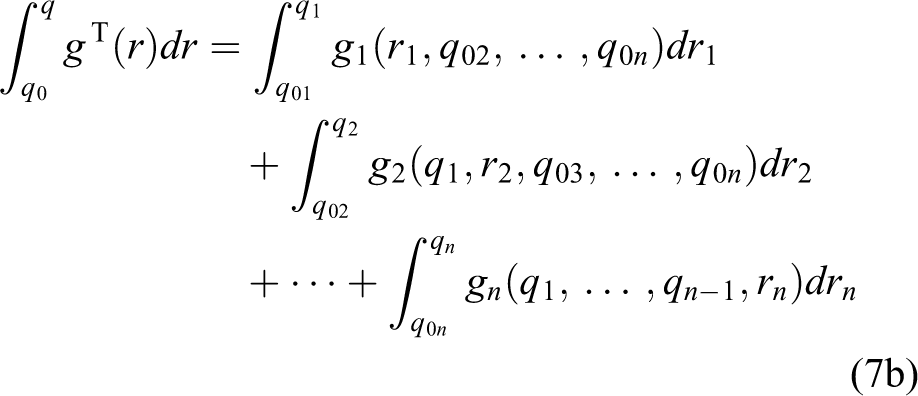
for any . From the conservative character of , for any , the inverse relation is independent of the integration path (Khalil et al., p. 120).20Equation (7b) considers integration along the axes. This way, on every axis (that is at every integral in the right-hand side of (7b)), the corresponding coordinate varies (according to the specified integral limits) while the rest of the coordinates remain constant.
This work is addressed to robots whose gravity force term g(q) is a continuously differentiable bounded vector function with bounded Jacobian matrix . Equivalently, manipulators whose gravity force vector components, gi(q), i = 1, … , n, satisfy
, for some positive constant Bgi, and , j = 1, … , n, exist and are continuous and such that
, for some positive constant kg, and consequently , . This is satisfied, for instance, by robot manipulators having only revolute joints (Kelly et al.,21§ 4.3).
Finally, τ ∈ ℝn is the external input force vector, whose elements τi, i = 1, … , n, are assumed in this work to be constrained by a given saturation bound Ti > 0, that is, , i = 1, … , n. More precisely, letting ui represent the control variable (controller output) relative to the i th DOF, we have that
where sat(⋅) is the standard saturation function, that is, . From equations (1) and (10), one sees that (see (8)), ∀i ∈ {1,…,n}, is a necessary condition for the robot manipulator to be stabilizable at any desired equilibrium configuration . Thus, the following assumption turns out to be important within the analytical setting considered here.
Assumption 1., , for some scalarα ≥ 1.
The control scheme proposed in this work involves functions fulfilling the following definition.
Definition 1. Given a positive constant M, a nondecreasing Lipschitz-continuous function is said to be a generalized saturation with bound M if
,
,
If in addition
when
for some positive constant L ≤ M, σ is said to be a linear saturation for (L,M).
Lemma 1.Let be a generalized saturation with bound M
and let k be a positive constant. Then,
1.;
2. such that , ;
3., ;
4., ;
5., ;
6., ;
7. as ;
8. if σ is strictly increasing then, for any constant , is a strictly increasing generalized saturation function with bound .
Proof. The proof of items 1, 2, 5–8 is found in López-Araujo et al.,22 while items 3 and 4 are proven in Zavala-Rió et al.23
□
The proposed control scheme
Consider the following generalized output-feedback bounded PID-type control law
where , for any constant desired equilibrium position vector . are the output vector variables of the integral-action dynamics, defined as
and the velocity estimation auxiliary subsystem, defined as
Under time parametrization of the system trajectories, the integral-action dynamics in equations (12) adopts the (equivalent) integral-equation form , for any initial vector values . For any , and , with , i = 1, … , n, being linear saturation functions for and , i = 1, … , n, being strictly increasing generalized saturation functions with bounds MIi, such that
i = 1, … , n. is a continuous vector function satisfying
, for some positive constant κ, and
i = 1, … , n, , for suitable bounds MPi and MIi of and . are positive definite diagonal matrices—that is, , , and with kPi>0, kIi>0, ai>0, bi>0, ∀i = 1, … , n—such that
with κ as defined through (15a). Finally, ε (in equations (12)) is a positive constant satisfying
(observe that by inequality (16b): ), with , , , and (observe that by inequalities (16a) and (14): ), being the positive bound of , in accordance with item 2 of Lemma 1, and μm, μM, kC, fm, fM, Bgi and kg as defined through the system properties expressed by inequalities (2), (3), (6), (8) and (9).
Remark 1. Note that is not involved in any of the expressions in equations (11)–(13). In fact, is estimated online through the auxiliary subsystem in equations (13), driven by as input variable. Its output variable ϑ gives the estimated vector value of . As a matter of fact, the auxiliary subsystem in equations (13) gives rise to the so-called dirty derivative of . This is the derivative of (or the velocity vector ) with each of its components going through a first-order low pass filter. This is commonly done in practice to bound the high-frequency gains, giving rise to a causal (approximated) derivative operator.
Remark 2. In order to preserve the main feature of PID-type controllers, the vector function sd in equation (11) shall not involve any term of the open-loop system dynamics (whether as online or desired compensation) or the exact value of any of its parameters. In general, sd will include a computed-derivative-action term (acting on the estimated velocity vector) and may involve some form of the proportional and/or the integral ones, as illustrated in Appendix 1.
Remark 3. It is important to note that, depending on the specific choice of the vector function sd, Assumption 1 may be required to be satisfied with some α strictly greater than unity. This arises as a requirement to guarantee the feasibility of the simultaneous fulfillment of (15b) and inequalities (14). For instance, in the particular control structure cases presented in Appendix 1, such a feasibility is achieved by requiring α = 3, as pointed out in Remark 5. A similar condition on the control input bounds has been required by other approaches where input constraints have been considered.24 In some saturating PID-type schemes from previous references, a similar or analog condition on the control input bounds remains implicit, by requiring corresponding parameters to be high enough to satisfy conditions coming from the stability analysis and simultaneously low enough to fulfill the input-saturation-avoidance inequalities.
Closed-loop analysis
Consider system (1),(10) taking as defined through equations (11)–(13). Let us define the variable transformation
with such that , or equivalently , i = 1, … , n (notice that their strictly increasing character renders σIi invertible). Observe that the satisfaction of (15b), under the consideration of (10), shows that
Hence, under the consideration of the variable transformation (18), the closed-loop dynamics adopts the (equivalent) form
where . Observe that, by item 1 of Lemma 1, the elements of , that is, , i = 1, … , n, turn out to be strictly increasing generalized saturation functions.
Proposition 1.Consider the closed-loop system in equations (20), under the satisfaction of inequalities (14), the conditions on the vector function sd stated through expressions (15), and Assumption 1 with suitable value of α. Thus, for any positive definite diagonal matrices A, B, KI and KP such that inequalities (16) are fulfilled, and any ε satisfying inequality (17), global asymptotic stability of the closed-loop trivial solution is guaranteed with , i = 1, … , n, ∀t ≥ 0.
Proof. By (19), one sees that, along the system trajectories, , . This proves that, under the proposed scheme, the input saturation values, Ti, are never attained. Now, in order to carry out the stability analysis, the following scalar function is defined
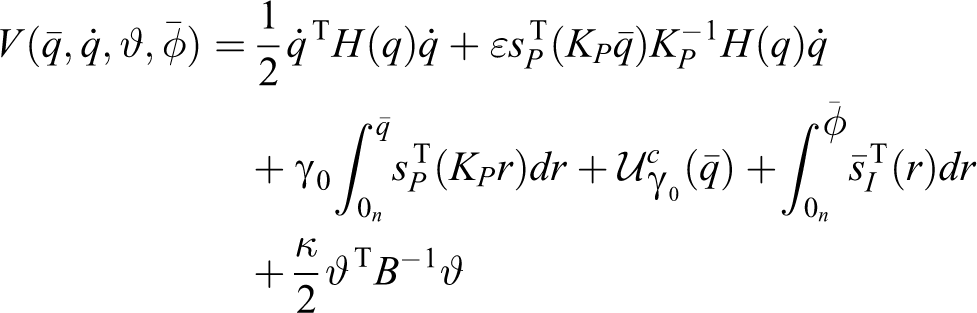
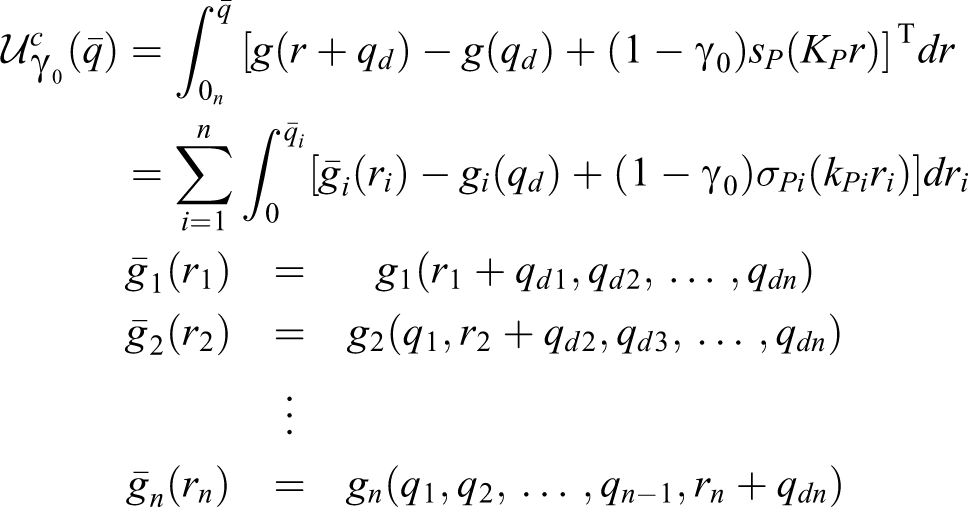
where , and recall that represents the gravitational potential energy. Note, by recalling equations (2), that the defined scalar function can be rewritten as
and γ0 is a constant satisfying
(observe, from inequality (17) and the definition of β0, that ). Under this consideration, turns out to be lower-bounded by
with and (note that by inequality (21) and the definition of β0: and ); this is proven in Appendix 2 of Mendoza et al.16 From this, inequality (2) and item 5 of Lemma 1, we have
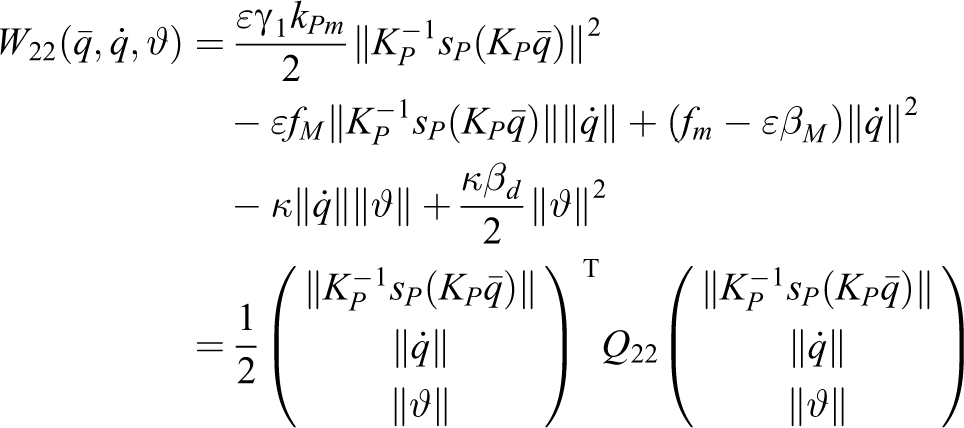
By inequality (21), is positive definite (since with , in accordance to inequality (17), any γ0 satisfying (21) renders Q11 positive definite) and observe that as . Further, from equations (22), items 6 and 7 of Lemma 1 and the positive-definite and diagonal characters of B, it is clear that the three last terms in the right-hand side of (23) are radially unbounded positive definite functions of , and ϑ respectively. Thus, is concluded to be positive definite and radially unbounded. Its upper right-hand derivative along the system trajectories, (see section 6.1A of Michel et al.25), is given by
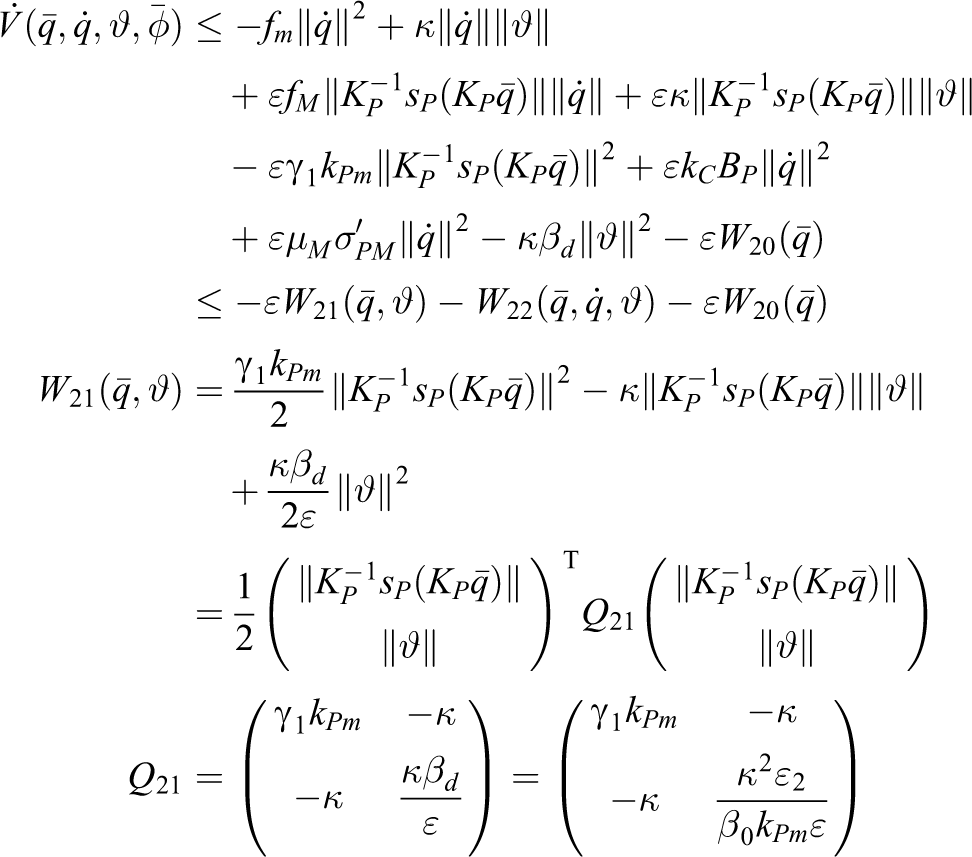
where , and have been replaced by their equivalent expressions from the closed-loop dynamics in equations (20), equations (4)–(5) have been used and . The resulting expression can be rewritten as
with γ1 being a constant that satisfies
(from inequality (17) and the definition of β0, one verifies, after simple developments, that ; in particular, ). Under this consideration, turns out to be lower-bounded by
with , and (notice, from inequality (24) and the definition of β0, that di > 0 and h > 0, hence ci > 0). This is proven in Appendix 3 of Mendoza et al.16
From this, inequalities (2), (3) and (6), items 2 of Lemma 1 and (b) of Definition 1, and the positive definite character of KP, we have that
Let us further note that by (16), we have that , that is , . From this and inequality (16), we get
By inequality (24), and are positive definite (since with , in accordance to inequality (24), any γ1 satisfying (30) renders Q21 and Q22 positive definite). Further, from equations (25), it is clear that W20 is a positive definite function of . Hence, with . Furthermore, from the closed-loop dynamics in equations (20), we see that (at any on with , the resulting unbalanced force term acts on the closed-loop dynamics forcing the system trajectories to leave Z). Therefore, by the invariance theory (Michel et al.25, §7.2)—more precisely, by Corollary 7.2.1 of Michel et al.25—, the closed-loop trivial solution is concluded to be globally asymptotically stable, which completes the proof.□
Remark 4. Let us note that the fulfillment of inequalities (14), (16)–(17) is not necessary but only sufficient for the closed-loop analysis to hold. This permits a breach tolerance margin without destabilizing the closed loop.
Experimental results
In order to corroborate the efficiency of the proposed scheme, several real-time control tests were implemented on a two-DOF robot manipulator. The experimental setup, shown in Figure 1, is a two-revolute-joint mechanical arm (on a vertical plane) located at the Instituto Tecnológico de la Laguna, Mexico. The robot actuators are direct-drive brushless servomotors operated in torque mode: that is, they act as torque sources and receive an analog voltage as a torque reference signal. Joint positions are obtained using incremental encoders on the motors. In order to get the encoder data and generate reference voltages, the robot includes a motion control board based on a DSP 32-bit floating point microprocessor. The control algorithm is executed at a 2.5 millisecond sampling period on a PC-host computer. Further technical information on this robot, as well as its model and parameter values, can be found in Reyes and Kelly.26
Experimental setup: two-DOF robot manipulator.
For the experimental manipulator, inequalities (2), (3), (6), (8) and (9) are satisfied with μm = 0.088 kg m2, μM = 2.533 kg m2, kC = 0.1455 kg m2, fm = 0.175 kg m2/s, fM = 2.288 kg m2/s, Bg1 = 40.29 N m, Bg2 = 1.825 N m and kg = 40.373 N m/rad. The maximum allowed torques (input saturation bounds) are T1 = 150 N m and T2 = 15 N m for the first and second links, respectively. From these data, one easily corroborates that Assumption 1 is fulfilled with α = 3.
The proposed scheme in equations (11)–(13) was tested in every one of the forms presented in Appendix 1. That is, in the SP-SI-SD form—with — that is
with the saturation functions involved in sD—that is , i = 1, 2—being generalized saturations with bounds MDi, and the involved bound values satisfying
i = 1, 2. The SPD-SI form—with —that is
with bound values fulfilling
i = 1, 2. The Saturating-Proportional-Integral-Derivative like (SPID-like) form—with —that is
with the saturation functions involved in s0—that is , i = 1, 2—being linear saturation functions for , and the involved linear/generalized saturation function parameters satisfying
i = 1, 2. And the SP-SID form—with —that is
with bound values fulfilling
i = 1, 2. Letting (observe that this is a linear saturation with L=M) and
with 0<L<M, the saturation functions used for the implementation were defined as: , , , i = 1, 2, in the SP-SI-SD case; , , i = 1, 2, in the SPD-SI case; , , , i = 1, 2, in the SPID-like cases; and , , i = 1, 2, in the SP-SID case. Let us note that with these saturation functions, we have , ∀i∈{1,2}. As a consequence, for all the four controllers, inequalities (15a) and (16b) are satisfied with (see equations (39)).
For comparison purposes, additional experimental tests were implemented using the output-feedback version of the bounded PID-type controller presented in Su et al.14 The choice was made taking into account the analog nature of the compared algorithms: globally stabilizing via output feedback developed in a bounded-input context, and the recent appearance of Su et al.14 That is
with η being a (sufficiently large) positive constant and for any . In place of equations (30c), the work of Su et al.14 defines , which imposes the auxiliary variable initial condition (or, equivalently, in the context of equations (30c)). Instead, equations (30c)—or their (equivalent) time representation — keeps the required auxiliary dynamics while permitting any initial condition for φ (or, equivalently, for φc in the context of equations (30c)). This proves to be more appropriate in the global stabilization framework considered in Su et al.14 (and what is generally expected from an approach developed within such a framework). For the sake of simplicity, this algorithm is subsequently referred to as the S10 controller.
At all the experiments, the desired joint positions were fixed at (rad), that is rad for the shoulder and rad for the elbow. The initial conditions were (the home position), and, for the algorithms obtained through the proposed scheme, was taken so as to have , while was taken for the S10 controller in view of the way it is presented by Su et al.14
The control and saturation function parameter values were set so as to achieve pre-specified performance requirements. Two such performance requirements were a priori considered. The first one consisted in getting closed-loop responses with small transient peak values (whether as overshoot or undershoot) within a tolerance margin level of 40% of the desired position value at every link. The second aimed at achieving closed-loop responses with stabilization times shorter than five seconds. Both such requirements were achieved through a single test by each one of the algorithms obtained from the proposed scheme. On the contrary, the tuning procedure presented by Su et al.14 permitted the S10 controller to achieve the first requirement only through long stabilization times, and the second only with high transient peak values, but not both requirements simultaneously. The resulting control and saturation function parameter values are presented in Table 1. One can corroborate that inequalities (16)–(17) are fulfilled by all the controllers obtained through the proposed scheme, as well as the corresponding saturation-avoidance inequalities (26)–(29) (through which (15b) is guaranteed).The considered performance requirements were achieved under an additional control-parameter adjustment procedure that does not only take into account the conditions obtained through the closed-loop analysis (in the eponymous section) but also adopts the spirit of performance-oriented tuning methods.27 Guidelines are given in Appendix 2. The tunings for the S10 controller are labeled as S10a and S10b for the peak and stabilization-time requirements respectively. This labeling is subsequently used to differentiate from the tests under tunings S10a and S10b.
Control parameter values.
Parameter
SP-SI-SD
SPD-SI
SPID-like
SP-SID
S10a
S10b
units
6000
6000
7000
6000
N m/rad
kP1
74
108
N m
500
500
350
500
N m/rad
kP2
8.5
11.5
N m
900
900
900
175
N m/rad
kI1
40.5
40.5
N m
1500
1500
700
1
N m/rad
kI2
1.9
1.9
Nm
2
2
2
2
N m s/rad
kD1
10.5
0.5
N m
2
2
2
2
N m s/rad
kD2
4.5
0.1
N m
a1
60
60
60
60
10
60
s−1
a2
60
60
60
60
210
40
s−1
b1
5
5
5
5
15
70
s−1
b2
5
5
5
5
210
20
s−1
ε
0.024
0.024
0.021
0.024
s−1
η
30
170
s/rad
MP1
81
81
81
81
N m
MP2
7
7
7
7
N m
MI1
41
48
41
41
N m
MI2
2
5
2
4
N m
LI1/2
N m
MD1
22
M01
125
N m
MD2
5
M02
14
N m
Figures 2 and 3 show the experimental results. One sees from the graphs that in all the experiments the control objective is achieved avoiding input saturation. In order to establish a comparison criterion, a performance index was evaluated for every controller: the integral of the square of the position error (ISE), that is (with tf the final time of the experiment). We further show evaluations of the stabilization time, taken as , and the largest transient peak (LTP) at every link, measured as a percentage of the corresponding desired position. For each one of the considered quantifications (ISE, ts, LTP), the lowest estimated value indicates the best evaluated performance. Table 2 shows the resulting evaluations.
Position errors.
Control signals.
Performance index evaluations.
Perf. index
SP-SI-SD
SPD-SI
SPID-like
SP-SID
S10a
S10b
ISE
0.2633
0.2242 ✓
0.2731
0.2454
0.3023*
0.5327**
ts
1.3227 ✓
1.6623
1.4945
1.8879
>5**
4.9134*
LTP
link 1
27.9%
7.3% ✓
28.1%
38.8%**
19.3%
32.6%*
link 2
16.6% ✓
30.9%
35.5%*
24.8%
23.3%
141.3%**
One sees from the obtained values that the controller with the lowest ISE index evaluation was the SPD-SI algorithm (indicated by a check mark). On the other hand, the algorithm with the highest ISE index value is the S10 controller (indicating through asterisks the two higher ones, with double asterisk for the highest). The rest of the evaluations give an analog idea on the system performance at every implementation. They confirm that the algorithms obtained from the proposed methodology were able to meet both pre-specified performance requirements through a single test. On the other hand, the S10 controller is the one with the highest number of largest index evaluations.
Conclusions
Up to the submission of the present article, a methodology for the design of output-feedback bounded PID-type controllers for robot manipulators with constrained inputs, leading to multiple saturating structures, was lacking in the literature. For instance, it was not clear how to get a velocity-free version of the SPD-SI state-feedback structure of Santibáñez et al.15 Such an open problem was tackled in this work, leading to a generalized design method and the corresponding closed-loop analysis, developed with the required rigorous formality. The proposed scheme gives rise to bounded PID-type controllers with multiple saturating structures, extending the degree of design flexibility when velocity measurements are not available. For instance, it does not only extend the SPD-SI approach to such a velocity-free context and includes the SP-SI-SD as a particular case, but it also offers the possibility to generate innovative saturating structures as thoroughly shown. In addition, the design and analysis were further addressed so as to include not only smooth, but also nonsmooth (Lipschitz-continuous), saturation functions in the control structure. Further efforts made possible the corroboration of the analytical developments through experimental tests on a two-DOF manipulator, which showed the efficiency of the proposed controller. The contributed approach is thus concluded to find potential applications in numerous types of autonomous robot systems, saving these from undesirable behaviors due the actuator saturations, releasing them from the need for speed sensors, and opening new control design possibilities to improve their closed-loop behavior.
Footnotes
Acknowledgement
Victor Santibáñez thanks Victor de León Gómez for his invaluable help during the experimental essays.
Declaration of conflicting interests
The author(s) declared no potential conflicts of interest with respect to the research, authorship, and/or publication of this article.
Funding
The author(s) disclosed receipt of the following financial support for the research, authorship and/or publication of this article: Marco Mendoza was supported by CONACYT, Mexico. Victor Santibáñez was supported by CONACYT (project number 134534) and TNM (Tecnológico Nacional de México), Mexico.
Appendix 1
On the basis of bounded algorithms from previous references, several particular control structures arise through the proposed generalized scheme. For instance, let be a positive definite diagonal matrix. An SP-SI-SD type algorithm13,28 is obtained by defining
giving rise to
where, for any , , with , , being generalized saturation functions with bounds MDi, and the involved bound values satisfying
An SPD-SI type scheme15,19 is obtained by defining
where, for any , , with , i = 1, …, n, being linear saturation functions for , and the involved linear/generalized saturation function parameters satisfying
whence, by virtue of item (c) of Definition 1, we have that , giving rise to
Furthermore, the general character of the proposed scheme permits the generation of control laws with innovative saturating structure. For instance, an SP-SID type controller can be obtained by defining
resulting in
with bound values fulfilling
One can verify that in all the above cases the expressions (15a) and (15b) are satisfied. In particular, the input-saturation-avoidance requirement stated through (15b) is accomplished through the fulfillment of inequalities (32), (34), (36) and (38). Furthermore, from item 4 of Lemma 1, one sees that in every one of the above cases in (31), (33), (35) and (37) satisfies inequality (15a) with
, , and respectively being the positive bounds of , , and , in accordance with item 2 of Lemma 1.
Remark 5. Observe that the input-saturation-avoidance conditions for the particular control structures presented in this appendix, that is inequalities (32), (34), (36) and (38), imply that . On the other hand, the satisfaction of inequalities (14) implies that . Hence, for the specific choices of sd presented in equations (31), (33), (35) and (37), the feasibility of the simultaneous fulfillment of inequalities (14) and the corresponding input-saturation-avoidance condition—(32), (34), (36) or (38), respectively—is ensured by requiring the satisfaction of Assumption 1 with α = 3. Other particular choices of sd in the generalized scheme (11) could require different values of α ≥ 1.
Appendix 2
The performance-oriented tuning procedure used to obtain the experimental results shown in the eponymous section is sketched as follows:
Set the saturation function parameters (MPi, MDi, , MIi, LPi) so as to guarantee the satisfaction of inequalities (14) and (26)–(29).
Set low control gains, under the consideration of (16a).
Adjust the velocity-estimation-subsystem parameters (ai, bi) under the consideration of (16b), fixing ai such that 1/ai be six to 10 times the sampling period of the controller, and bi < ai to reduce inertial effects (inherent to the velocity estimation dynamics), such as oscillations.
Run simulations/experiments with coefficient ε adhering to (17), if possible, or as small as the closed-loop stability permits it. If the resulting closed-loop response is satisfactory then stop, otherwise perform the following steps.
Increase integral gains, kIi, so as to strengthen the elimination of position errors, aiming at reducing stabilization times.
Increase proportional gains, kPi, in order to reduce the rise time (speed up the closed-loop response).
Increase derivative gains, kDi, in order to reduce inertial effects (particularly added by the integral actions), such as the overshoot.
Repeat steps 3–4.
References
1.
RoccoP. Stability of PID control for industrial robot arms. IEEE T Robotic Autom1996; 12(4): 606–614.
2.
KasacJNovakovicBMajeticD. Robot positioning of robot manipulators with mixed revolute and prismatic joints. IEEE T Autom Contr2006; 51(6): 1035–1040.
3.
Orrante-SakanassiJHernández-GuzmánVMSantibáñezV. New tuning conditions for semiglobal exponential stability of the classical PID regulator for rigid robots. Int J Adv Rob Syst2015; 12(143): 1–13.
4.
KumananDNagarajB. Tuning of proportional integral derivative controller based on firefly algorithm. Systems Sci Control Engineer2013; 1(1): 52–56.
5.
ArimotoS. Fundamental problems of robot control: Part I, innovations in the realm of robot servo-loops. Robotica. 1995; 13(1): 19–27.
6.
KellyR. Global positioning of robot manipulators via PD control plus a class of nonlinear integral actions. IEEE T Autom Contr. 1998; 43(7): 934–938.
7.
SantibáñezVKellyR. A class of nonlinear PID global regulators for robot manipulators. In: Proceedings of the 1998 IEEE international conference on robotics and automation, Leuven, Belgium, 16–20 May 1998, pp.3601–3606.
8.
ChenBSWangSS. The stability of feedback control with nonlinear saturating actuator: time domain approach. IEEE T Autom Contr1998; 33(5): 483–487.
9.
CorradiniMLCristofaroAOrlandoG. Robust stabilization of multi input plants with saturating actuators. IEEE T Autom Contr2010; 55(2): 419–425.
10.
Alvarez-RamrezJKellyRCervantesI. Semiglobal stability of saturated linear PID control for robot manipulators. Automatica2003; 39(6): 989–995.
11.
Alvarez-RamrezJSantibañezVCampaR. Stability of robot manipulators under saturated PID compensation. IEEE Trans Control Syst Technol2008; 16(6): 1333–1341.
12.
GorezR. Globally stable PID-like control of mechanical systems. Syst Control Lett1999; 38(1): 61–72.
13.
MezaJLSantibáñezVHernándezVM. Saturated nonlinear PID global regulator for robot manipulators: Passivity-based analysis. In: Proceedings of the 16th IFAC world congress, Prague, Czech Republic, 3–8 July 2005, pp.1341–1346.
14.
SuYMüllerPCZhengC. Global asymptotic saturated PID control for robot manipulators. IEEE Trans Control Syst Technol2010; 18(6): 1280–1288.
15.
SantibáñezVKellyRZavala-RioA. A new saturated nonlinear PID global regulator for robot manipulators. In: Proceedings of the 17th IFAC world congress, Seoul, Korea, 6–11 July 2008, pp.11690–11695.
16.
MendozaMZavala-RioASantibáñezV. A generalised PID-type control scheme with simple tuning for the global regulation of robot manipulators with constrained inputs. Int J Control2015; 88(10): 1995–2012.
17.
SantibáñezVCamarilloCMoreno-ValenzuelaJ. A practical PID regulator with bounded torques for robot manipulators. Int J Control Autom Syst2010; 8(3): 544–555.
18.
YarzaASantibáñezVMoreno-ValenzuelaJ. Global asymptotic stability of the classical PID controller by considering saturation effects in industrial robots. Int J Adv Rob Syst2011; 8(4): 34–42.
19.
Zavala-RioASantibáñezV. Simple extensions of the PD-with-gravity-compensation control law for robot manipulators with bounded inputs. IEEE Trans Control Syst Technol2006; 14(5): 958–965.
KellyRSantibáñezVLoriaA. Control of robot manipulators in joint space. London: Springer, 2005.
22.
López-AraujoDJZavala-RioASantibáñezV. A generalized scheme for the global adaptive regulation of robot manipulators with bounded inputs. Robotica2013; 31(7): 1103–1117.
23.
Zavala-RioAMendozaMSantibáñezV. An output-feedback PID-type global regulator for robot manipulators with bounded inputs. In: Proceedings of the 11th IFAC symposium on robot control, Salvador, Brasil, 26–28 August 2015, pp.94–100.
24.
ColbaughRBaranyEGlassK. Global regulation of uncertain manipulators using bounded controls. In: Proceedings of the 1997 IEEE international conference on robotics and automation, Albuquerque, NM, 20–25 April 1997, pp.1148–1155.
25.
MichelANHouLLiuD.Stability of dynamical systemsBoston: Birkhäuser, 2008.
26.
ReyesFKellyR. Experimental evaluation of model-based controllers on a direct-drive robot arm. Mechatronics2001; 11(3): 267–282.
27.
YuWLiXCarmonaR. A novel PID tuning method for robot control. Ind Robot2013; 40(6): 574–582
28.
SantibáñezVKellyR. Global regulation for robot manipulators under SP-SD feedback. In: Proceedings of the 1996 IEEE international conference on robotics and automation, Minneapolis, MN, 22–28 April 1996, pp.927–932.