




Abstract
A large number of literature has shown that high expression of X inactive-specific transcript (XIST) is associated with poor prognosis and metastasis of cancer in patients. However, most of this literature is limited by the small sample sizes and discrete outcomes. Therefore, a meta-analysis was performed to investigate the relation between XIST expression and tumor node metastasis (TNM) stage, lymph node metastasis, distant metastasis, and overall survival of cancer patients. We searched for literature in PubMed, Embase, and Web of Science. The pooled hazard ratios (HRs) or odds ratios (ORs) with 95% confidence intervals (CIs) were calculated to evaluate the association of XIST expression with prognosis and clinicopathological characteristics of cancer patients. Finally, a total of 14 articles involving 1123 patients were included in this meta-analysis. The results suggested that high expression of XIST has a significant relationship with a relatively poor overall survival for patients with malignant tumors (HR 1.82; 95% CI 1.32, 2.52; P = 0.0003). Moreover, high expression of XIST was significantly associated with poor TNM stage (OR 3.64; 95% CI 2.62, 5.07; P < 0.0001), lymph node metastasis (OR 2.39; 95% CI 1.65, 3.46; P < 0.0001) and distant metastasis (OR 2.84; 95% CI 1.90, 4.23; P < 0.0001). In conclusion, high expression of lncRNA XIST may be a predictive factor of poor prognosis in human cancers.
Introduction
Until now, the incidence and mortality of patients with malignant tumors have been increasing, which has become one of the main causes of death worldwide. 1 Although there has been significant progress in the treatment of cancer patients, the prognosis of cancer patients is still poor due to the advanced stage diagnosis, where the condition was then inoperable. 2 As a result, it is of great significance to find a new molecular marker for early diagnosis and prognosis of human cancers.
Long non-coding RNAs (lncRNAs) are a class of RNA with a length greater than 200 nucleotides, and does not encode proteins. 3 LncRNAs have a wide range of biological functions, which mainly include two aspects of the regulation of transcription and protein activity.4,5 Recently, more and more studies have found that there is a significant difference in the expression level of lncRNAs between normal tissues and tumor tissues.6,7 Evidence shows that lncRNAs can affect the proliferation, apoptosis, invasion, and metastasis of tumor cells through the modification, transcription, and post-transcriptional regulation of chromosomes, which are well-connected with the occurrence and development of malignant tumors. 8 Therefore, lncRNAs are expected to become new tumor markers and therapeutic targets.
X inactive-specific transcript (XIST) is an lncRNA required for transcriptional silencing of the X chromosome in female mammals, which plays an important role in the inactivation of the X chromosome. 9 In recent years, increasing evidence has shown that XIST is closely related to the occurrence and progression of many human cancers.10,11 Studies have shown that XIST is highly expressed in various human cancers, such as non-small cell lung cancer, 12 breast cancer, 13 and primary hepatocellular carcinoma. 14 Yao et al. 15 demonstrated that knockdown of XIST could inhibit cell proliferation, migration, and invasion, thereby inhibiting tumor growth. Moreover, Ding et al. 16 suggested that high expression of XIST was significantly associated with a relatively poor prognosis and metastasis for cancer patients. These results indicated that XIST could act as a potential biomarker for the prognosis of human cancers. However, most of this literature is limited by the small sample sizes and discrete outcomes. For all we know, no systematic meta-analysis has been conducted to analyze the relationship between the expression of lncRNA XIST and the relevant clinical outcomes. Thus, we conducted a meta-analysis to investigate the prognostic value of XIST and to consider if XIST expression could act as a predictive factor for survival in human cancers.
Materials and methods
Search strategy and literature selection
The PubMed, Web of Science, and Embase databases were searched. Key words used were: “XIST or X inactive-specific transcript or ncRNA XIST or XIST RNA or XIST gene product” and “long non-coding RNA or lncRNA or noncoding RNA”, and “cancer or tumor or carcinoma or neoplasm” and “prognosis or prognostic or survival or metastasis”. The search ended in October 18, 2017, with no lower date limit. References cited in an identified study were also searched manually to triage other appropriate articles.
Inclusion and exclusion criteria
Inclusion criteria included: (a) articles investigating the expression of lncRNA XIST in any human cancers; (b) the expression level of lncRNA XIST was measured in tumor tissues obtained from surgical patients, and the patients were grouped based on the expression level of XIST; (c) papers to compare XIST expression with prognosis of cancer patients and clinicopathological features such as tumor node metastasis (TNM) stages, lymph node metastasis, and distant metastasis; (d) papers that were published in the English language; and (e) papers with adequate information provided to assess odds ratio (OR), hazard ratio (HR), and their 95% confidence intervals (CI).
Excluded criteria included: (a) letters, case reports, reviews, and meeting abstracts without adequate information; (b) studies without sufficient relevant data; and (c) experimental specimens as animals or human cells.
Data extraction and assessment
The data from each eligible study were extracted independently by two investigators (YS and CFF). The main characteristics of studies were shown as follows: (a) the first author of the article; (b) time of publication; (c) study location; (d) tumor type; (e) sample size; (f) detection method; (g) TNM stage; (h) metastasis analysis; (i) Survival analysis; (j) Hazard ratios; and (k) Newcastle–Ottawa Scale (NOS). Based on the NOS, 17 the quality of each of the available studies in our meta-analysis was assessed. Any disagreement between the two investigators were resolved by a third investigator.
Statistical analysis
For the quantitative aggregation of survival outcomes, HRs and their 95% CI were used to assess the relationship between XIST expression and overall survival (OS). The most accurate method was to obtain the HR value and its 95% CI directly from the study, or calculated them through the parameters provided in the article: O-E statistics and variance. Otherwise, the HR values were extracted from Kaplan–Meier curves by Engauge Digitizer 4.1 Software. Study heterogeneity was assessed by using the Q statistical test or the I2 statistic. For studies with P > 0.1 or I2 ⩽ 50%, we considered there was no evidence of heterogeneity in the included studies, therefore the fixed-effects model (the Mantel-Haenszel method) would be used. When P ⩽ 0.1 or I2 > 50%, a certain degree of heterogeneity may exist between these studies, therefore the random-effects model (the DerSimonian and Laird method) would be chosen. Furthermore, if there was a significant degree of heterogeneity, it would be explored through subgroup meta-analyses. For the pooled analysis of the correlation between LncRNA XIST expression and clinical pathologic features, ORs and their 95% CIs were combined to assess the effect. We performed all of the above statistical analyses by Review Manager 5.3 (RevMan version5.3).
Sensitivity analysis was performed by continuous omission of individual studies. Detection of publication bias in the meta-analysis was assessed by Beggʼs test, and P < 0.05 showed statistical significance. Both were performed by Stata 12.0 Software.
Results
Study characteristics
A total of 157 studies were included after searching the databases (Figure 1). Finally, 14 papers with 1123 patients were enrolled in our meta-analysis, which were based on the inclusion and exclusion criteria. Detailed information of the 14 articles is shown in Table 1.18-31 Studies were mainly carried out in China and published from 2015 to 2017. Ten different types of cancer were included in this meta-analysis: two colorectal cancers (CRC), two non-small cell lung cancer (NSCLC), two osteosarcoma (OS), two gastric cancers (GC), one hepatocellular carcinoma (HCC), one pancreatic cancer (PC), one esophageal squamous cell carcinoma (ESCC), one nasopharyngeal carcinoma (NPC), one cervical cancer (CC), one glioma. The expression level of lncRNA XIST was measured in tumor tissues obtained from surgical patients. HR values were obtained directly from the publication and extracted from the Kaplan–Meier curve. The NOS scores of all the articles were ⩾ 7.
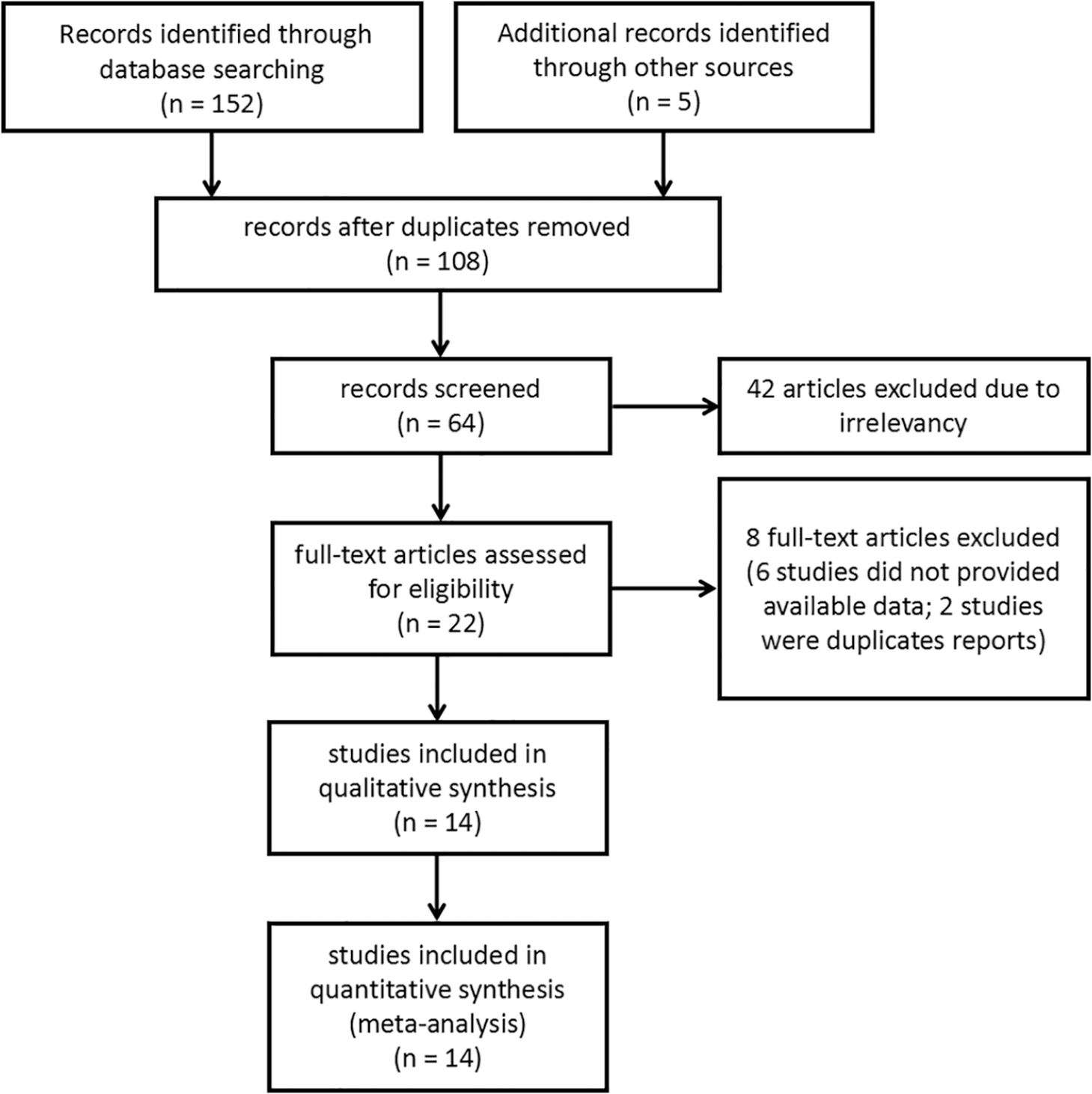
Flowchart showing selection of studies for inclusion in the meta-analysis.
Characteristics of the included studies.
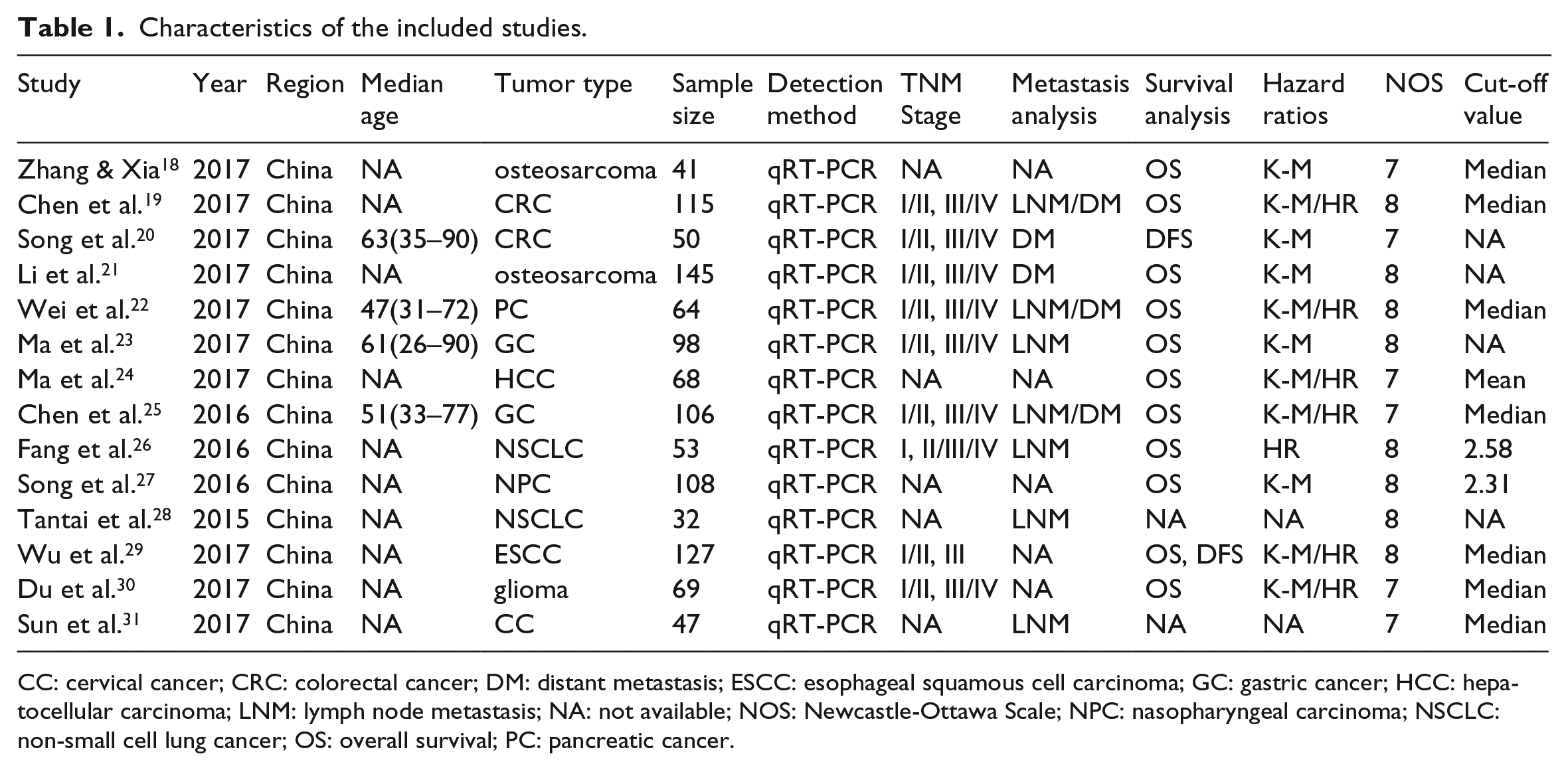
CC: cervical cancer; CRC: colorectal cancer; DM: distant metastasis; ESCC: esophageal squamous cell carcinoma; GC: gastric cancer; HCC: hepatocellular carcinoma; LNM: lymph node metastasis; NA: not available; NOS: Newcastle-Ottawa Scale; NPC: nasopharyngeal carcinoma; NSCLC: non-small cell lung cancer; OS: overall survival; PC: pancreatic cancer.
Relationship between XIST expression and OS in cancer patients
Meta-analysis of the relationship between XIST expression and OS was performed based on the results of 11 articles, which included 994 patients. As shown in Figure 2, high expression of lncRNA XIST was significantly related to relatively poor OS in different types of human cancer (HR 1.82; 95% CI 1.32, 2.52; random-effect model). However, a significant degree of heterogeneity was found in the meta-analysis (I2 = 79%; P < 0.00001). Thus, we performed a subgroup analysis to explain the heterogeneity in OS (Table 2). The subgroup analysis was mainly conducted on sample size (n > 100 or n ⩽ 100; Supplement 1(a)), tumor system (digestive system neoplasms, respiratory system tumors or other systemic tumors; Supplement 1(b)), and the methods of getting HR values (from the publication or from the Kaplan–Meier curve; Supplement 1(c)). As shown in Supplement 1, the results of the subgroup analysis indicated that the high expression levels of XIST had an unfavorable impact on OS in all the factors above, except the small sample size group (n ⩽ 100: HR 1.69; 95% CI 0.80, 3.57; P = 0.17). Moreover, we found that significant heterogeneity mainly existed in the digestive system neoplasms group (I2 = 78%; P = 0.0004) while there was no heterogeneity in the respiratory system tumors group (I2 = 0; P = 0.38), and small heterogeneity in the other systemic tumors (I2 = 48%; P = 0.15).
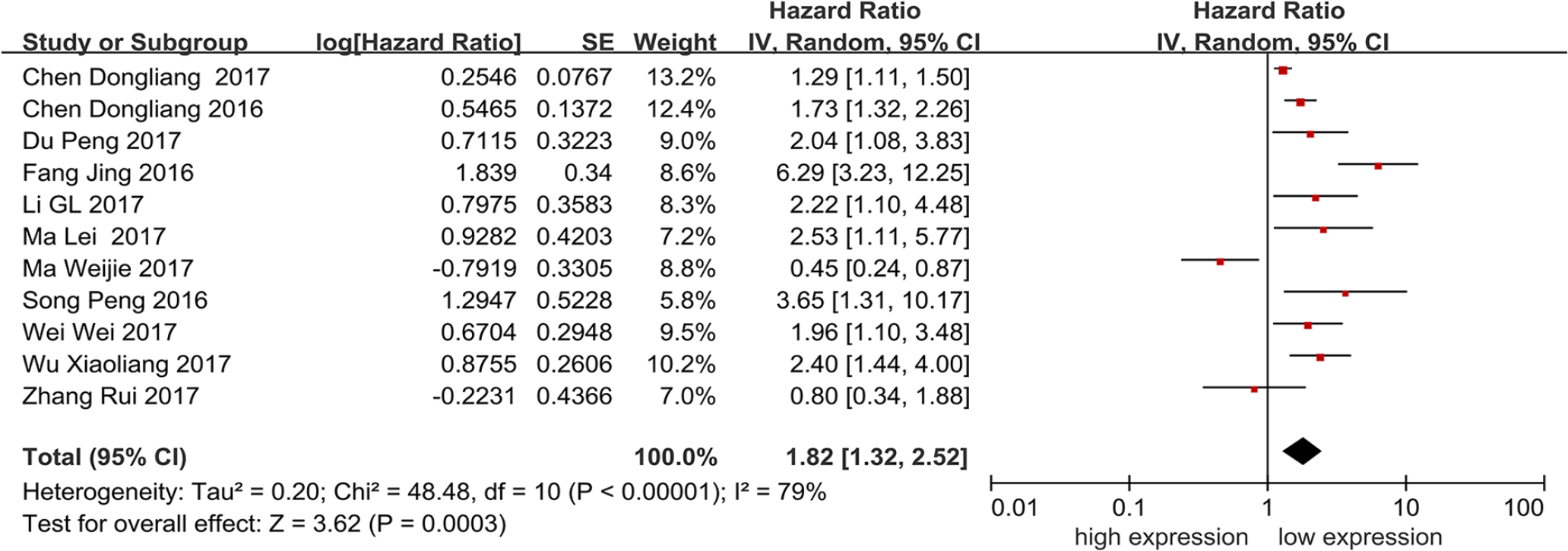
Meta-analysis of the effects of XIST expression on the overall survival of cancer patients. Results are presented as individual and pooled HR and 95% CI.
Stratified analysis of pooled hazard ratios.
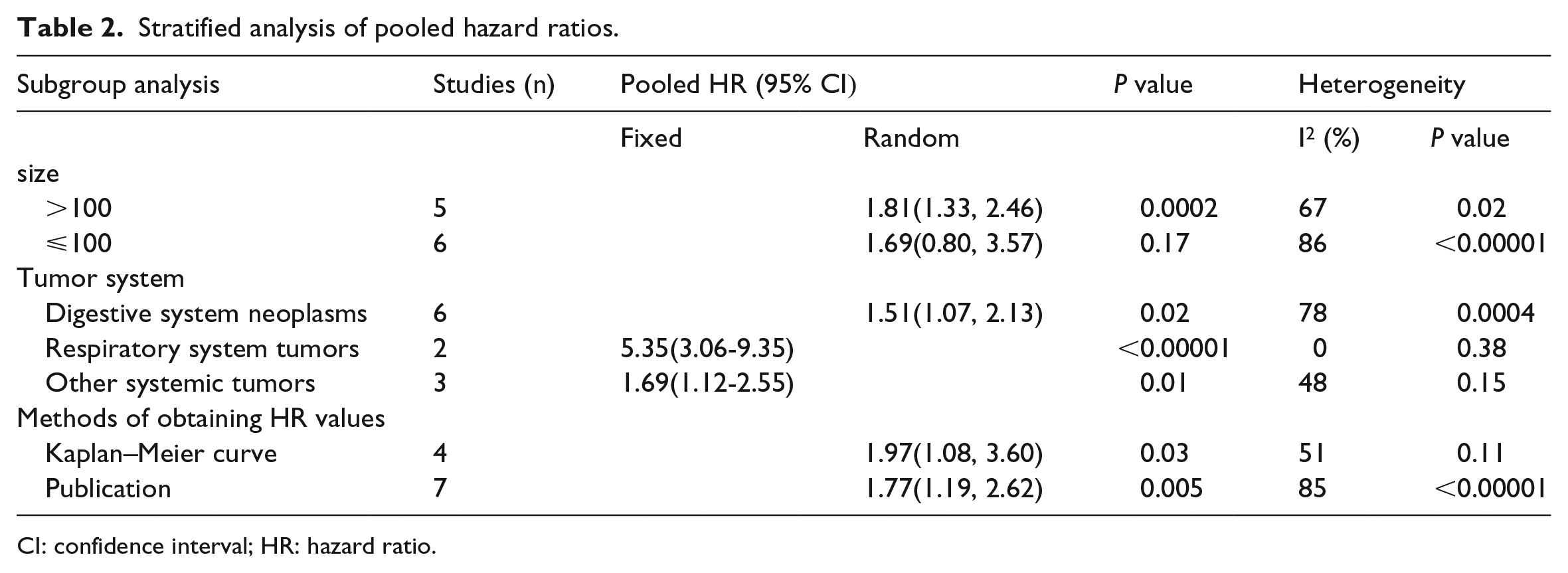
CI: confidence interval; HR: hazard ratio.
Relationship of XIST expression with clinicopathological features
The relation between XIST expression and the clinicopathological features in different types of human cancer were also evaluated. As shown in Supplement 2, seven studies with 647 patients performed the association between XIST expression and TNM stage. Our results revealed that a high expression level of XIST was apparently related to high tumor stage (III/IV vs. I/II: pooled OR 3.64; 95% CI 2.62, 5.07; I2 = 25%; fixed-effect model). Seven articles including 515 patients reported the relationship between XIST expression and lymph node metastasis (Supplement 3). In contrast to the low XIST expression group, the incidence of lymph node metastasis was significantly higher in the high XIST expression group (yes vs. no: pooled OR 2.39; 95% CI 1.65, 3.46; I2 = 24%; fixed-effect model). As for distant metastasis, five articles with 480 patients were included in the meta-analysis (Supplement 4). These results showed that patients with increased XIST expression were highly prone to distant metastasis (yes vs. no: pooled OR 2.84; 95% CI 1.90, 4.23; I2 = 0; fixed-effect model).
Publication bias
As shown in Supplement 5, we performed Begg’s test to assess the publication bias. This test showed that there was no publication bias in all groups owing to all P values > 0.05.
Sensitivity analysis
Sensitivity analysis showed that the pooled HRs were not significantly influenced by excluding any single article (Supplement 6). Thus, the result of the pooled HRs was relatively stable and credible.
Discussion
LncRNAs are a major component of noncoding sequences in the human genome where the sequences transcribed into lncRNAs are 10 to 20 times more than the sequences encoded into protein.32,33 With the development of sequencing technology and biotechnology, it was demonstrated that lncRNAs may participate in many diseases, such as rheumatoid, 34 neurodegenerative, 35 and cardiovascular. 36 Moreover, high expressions of lncRNAs have been found in various human cancers, and play a vital role in the carcinogenesis and aggressive progression of human cancers. 37 Thus, the prognostic value of lncRNAs should be further investigated.
LncRNA XIST is a product of the XIST gene and it can raise inhibitory complexes on the female X chromosome, induce inactivation of the X chromosome, maintain the balance of gene chromosome dose between the two sexes, and affect the differentiation and proliferation of the cells. 38 Increasing evidence has demonstrated that XIST has been found to be upregulated in several malignant tumors, such as cervical squamous cell carcinoma, 39 hepatocellular carcinoma, 40 and human nasopharyngeal carcinoma. 27 Furthermore, numerous of studies have shown that the high expression of XIST has a significant relationship with the occurrence, growth, infiltration, and diffusion of tumor cells. 26 For example, Mo et al. 14 have shown that XIST was responsible for hepatocellular carcinoma cell proliferation, and exerted its function through the miR-139-5p/PDK1 axis. Ma et al. 23 revealed that high expression of XIST enhanced GC cells growth and invasion through repressing miR-497, which controlled its downstream target MACC1. Furthermore, Sun et al. 31 demonstrated that high expression of XIST was significantly associated with cervical cancer lymph node metastasis and XIST could promote cervical cancer cell proliferation, migration, invasion, and epithelial-mesenchymal transition (EMT) by modulating the Wnt/β-catenin signaling pathway. Moreover, Liu et al. 41 reported that lncRNA XIST plays a crucial role in tumor progression and metastasis by inducing EMT in breast cancer. Thus, XIST could serve as a new molecular marker for the prognosis of various cancers.
This is the first meta-analysis to systematically analyze the relationship between the expression of lncRNA XIST and the OS of patients with cancer. Our analysis combined all the outcomes of 994 patients suffering from therioma from 11 individual studies, indicating that high expression of lncRNA XIST significantly predicted relatively poor OS for patients with malignant tumor (HR 1.82; 95% CI 1.32, 2.52; random-effects model). Subgroup analysis indicated that high expression of XIST had an unfavorable impact on OS in digestive system neoplasms (HR 1.51; 95% CI 1.07, 2.13; random-effects model), respiratory system tumors (HR 5.35; 95% CI 3.06, 9.35; fixed-effects model) and other systemic tumors (HR 1.69; 95% CI 1.12, 2.55; fixed-effects model). Moreover, high XIST expression was significantly associated with poor TNM stage (III/IV vs. I/II: pooled OR 3.64; 95% CI 2.62, 5.07), lymph node metastasis (yes vs. no: pooled OR 2.39; 95% CI 1.65, 3.46) and distant metastasis (yes vs. no: pooled OR 2.84; 95% CI 1.90, 4.23).
In this meta-analysis, we found highly significant heterogeneity for OS in the included studies. Although we used random-effects models and fixed-effects models during the pooling of data, the source of heterogeneity was not clear. Sensitivity analysis also did not help to identify the source of heterogeneity in this article. In order to explain the heterogeneity in OS, a subgroup analysis was conducted. A subgroup analysis showed that the digestive system neoplasms group may be the main source of heterogeneity.
However, there were several limitations in our meta-analysis. First, a potential source of bias may be correlated with the method of calculating HRs. Where HRs were not directly obtained from the articles, we calculated them from the data offered in the papers and, in other cases, we had to calculate HRs from the survival curves, supposing that censored observations were identically distributed. This method cannot completely remove inaccuracy during the extraction of the survival rates, although two authors (CFF and YS) offered graphical representation of the survival curves. Thus, HRs extrapolated from the papers may be less reliable than when obtained directly from published statistics. Second, this meta-analysis contains only published studies, and this may lead to publication bias. Finally, the available data do not assess whether XIST expression may affect the response to specific therapeutic regimens. Therefore, in order to reduce the bias, we affirmed a detailed protocol before initiating the study, conducted a careful search for published articles, and used explicit methods for data analysis.
In conclusion, this meta-analysis revealed that high XIST expression was significantly associated with poor OS and clinicopathological features, such as TNM stage, lymph node metastasis, and distant metastasis in cancer patients. LncRNA XIST expression may be a predictive factor of poor prognosis in human cancers.
Supplemental Material
Supplemental_Material – Supplemental material for Long non-coding RNA XIST expression as a prognostic factor in human cancers: A meta-analysis
Supplemental material, Supplemental_Material for Long non-coding RNA XIST expression as a prognostic factor in human cancers: A meta-analysis by Shuai Yin, Jiayu Dou, Guifang Yang and Fangfang Chen in The International Journal of Biological Markers
Footnotes
Author contributions
JD revised the paper and made some improvements; JD proofread the manuscript; GY gave her insights to this article; YS conceived and designed the meta-analysis; SY and FC analyzed the data; SY and FC searched the literature; and SY wrote the paper. SY and FC contributed equally to this paper.
Declaration of conflicting interest
The author(s) declared no potential conflicts of interest with respect to the research, authorship, and/or publication of this article.
Funding
The author(s) disclosed receipt of the following financial support for the research, authorship, and/or publication of this article: This study was supported by Hubei Province Health and Family Planning Scientific Research Project (WJ2018H0018).

Supplemental material
Supplemental material for this article is available online.
References
Supplementary Material
Please find the following supplemental material available below.
For Open Access articles published under a Creative Commons License, all supplemental material carries the same license as the article it is associated with.
For non-Open Access articles published, all supplemental material carries a non-exclusive license, and permission requests for re-use of supplemental material or any part of supplemental material shall be sent directly to the copyright owner as specified in the copyright notice associated with the article.
