




Abstract
Objective
The objective of this study was to investigate whether interleukin-1 (IL-1) gene polymorphisms are associated with susceptibility to Behçet’s disease (BD) and clinical manifestations of the disease.
Methods
In this cross-sectional study, we enrolled 110 patients with BD and age-and gender-matched 120 healthy controls. Five polymorphic regions of the IL-1 gene including rs 1800587 (IL1A-889 C/T), rs 2234650 (IL1R1), rs 16944 (IL1B-511 C/T), rs 315952 (IL1RN), and rs1143634 (IL1B-3954 C/T) were analyzed by using the real-time polymerase chain reaction system. Allele frequencies and genotypes were compared between groups. p ≤ 0.05 was accepted as statistically significant.
Results
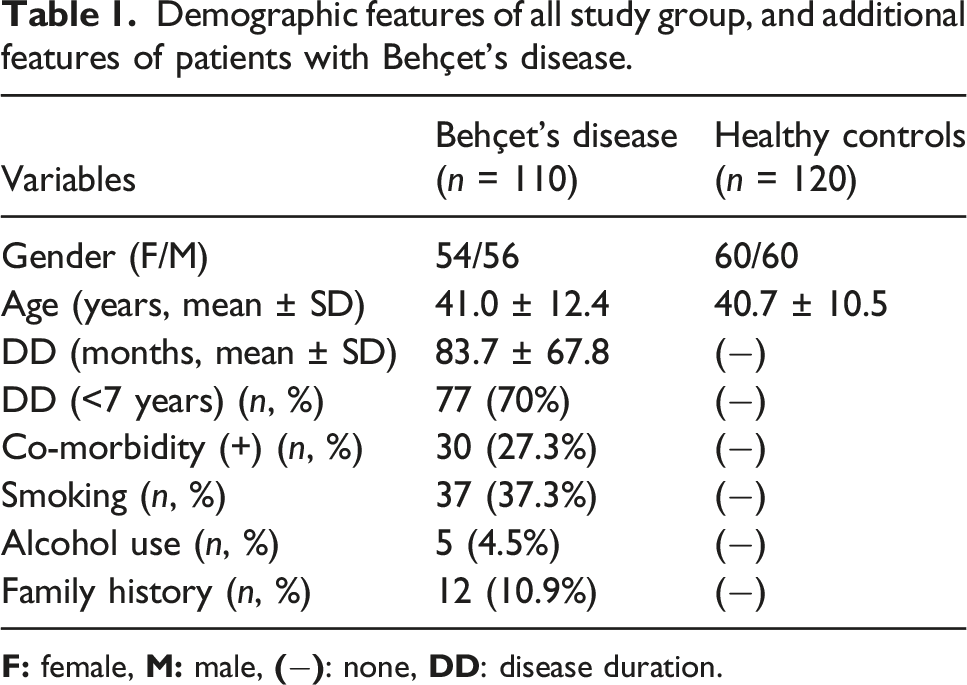
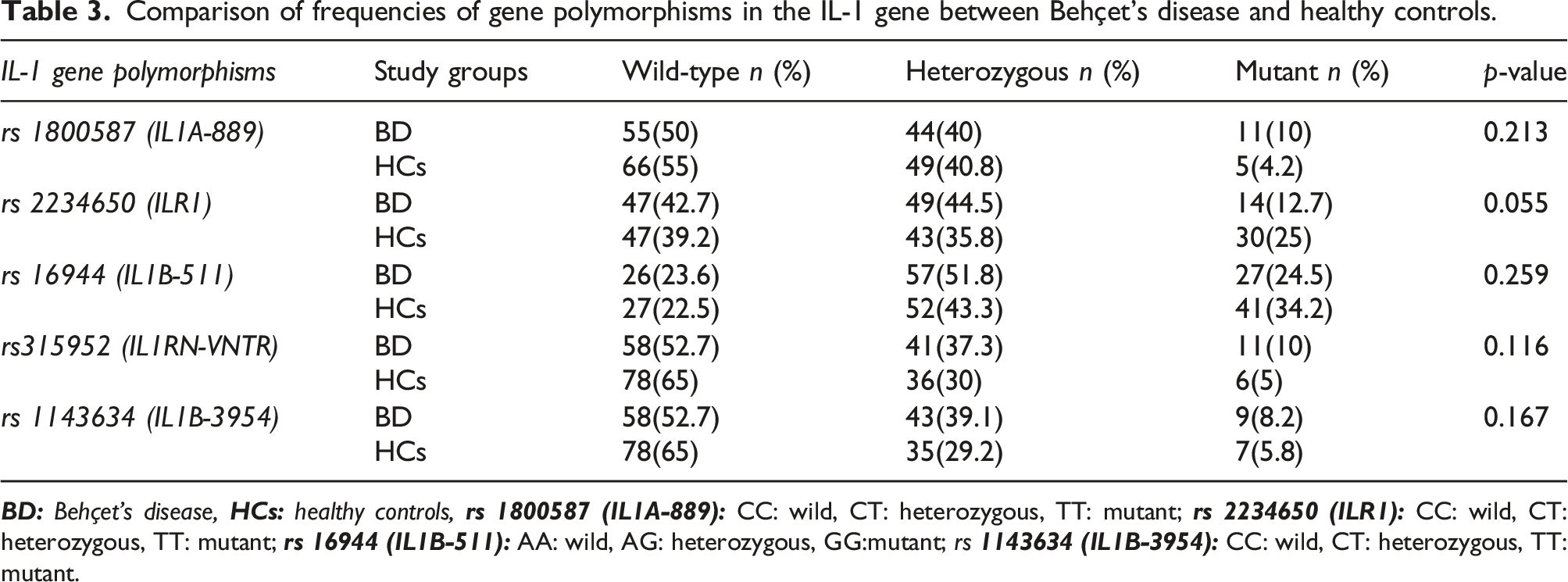
The mean age of the patients with BD was 41 ± 12.4 years. The two groups were similar in terms of the age and gender distribution. The vast majority of BD patients had mucocutaneous involvement. The mean disease duration was 83.7 ± 67.8 months among the patients. The frequencies of each polymorphism in the IL-1 gene were similar between patients with BD and healthy controls.
Conclusion
The frequencies of variable IL-1 gene polymorphisms were similar between patients with BD and healthy controls.
Introduction
Behçet’s disease (BD) is a chronic systemic inflammatory disorder characterized by recurrent oral aphthae, genital ulcers, and uveitis. Although its prevalence is quite variable between countries, the ancient silk road between Europe and China is the most affected area globally. 1 The prevalence of the disease in Turkey was reported in the range of 80–420/100.000 in various studies. 2 Today it is believed that BD occurs in immunogenetically susceptible subjects via environmental agents such as infectious triggers. 3 Few studies from Germany showed the incidence of the disease depends on ethnicity and genetic factors rather than environmental factors. 4 The regional distribution of the disease in the world and family history support the genetic predisposition. 5 The strongest genetic susceptibility is attributed to the HLA-B51 allele (54–76% positive), especially in Turkish and Japanese patients with BD, located in the major histocompatibility complex (MHC) locus on chromosome 6. 6 Although its role in disease pathogenesis has not yet been clearly explained, it is thought to cause hyperfunction in neutrophils and neutrophil extracellular traps (NETs). Recently, HLA-B51 was also related to antigen-specific CD8+ T-cell activation in BD. 7
Besides, tumor necrosis alpha (TNF-alpha)-103T/C promoter polymorphism is associated with the disease. 8 MIC-A (MHC class I chain-related gene-A) gene polymorphism has also been related to BD. 9
Interleukin-1 (IL-1) family have three cytokines including IL-1α, IL-1β and IL-1 receptor antagonist (IL-1Ra). While there is a balance between IL-1 and IL-1Ra under normal conditions, this balance is disrupted in IL-1-related autoimmune diseases. This may be explained by the inability of IL-1Ra to suppress IL-1. 10
Today, there are many controversial results in the Literature related to IL-1 gene polymorphisms in BD. There are an accumulated number of meta-analyses on this subject day by day. Liang Y et al. investigated the effect of multiple cytokine gene polymorphisms, including IL-1, in BD. Although the study had positive results for TNF-α and IL-10 gene polymorphisms, there was no significant evidence for IL-1α and IL-1β polymorphisms related to BD susceptibility. 11
Despite these negative results, the IL-1 cytokine family is known as responsible for polygenic autoinflammatory diseases such as BD, and IL-1 blockade has an effective role in many cases, proved by lots of clinical trials. 12 So, we investigated the frequency of polymorphisms of the IL-1 gene family in our study population, and especially their relationship with clinical findings in BD.
Methods
Study design, data collection, and analysis
This study was approved by the local ethics committee of Pamukkale University (approval number 22/1, and date 2014) by following the Helsinki declaration. This study was also supported by the 2014 TPF034 project of the Pamukkale University Scientific Research Projects Coordination Unit.
Inclusion and exclusion criteria for subjects
In this cross-sectional study, we enrolled 110 patients with BD and age-and gender-matched 120 healthy controls. All of the BD patients were initially diagnosed in our rheumatology outpatient clinic at Pamukkale University School of Medicine from 2010 to 2014 based on established international criteria. 13 Written informed consent was obtained from all subjects before the study.
Inclusion criteria were defined as having inactive disease, being older than 18 years, and being a volunteer for healthy controls (HCs) and patients. Exclusion criteria were accepted as having other inflammatory and/or autoimmune rheumatic diseases, chronic systemic diseases, infectious diseases, smoking and/or alcohol addiction, and drug use. All demographic features and clinical involvements of the disease were comprehensively noted.
Genomic deoxyribonucleic acid (DNA) isolation was obtained by using the real-time polymerase chain reaction (RT-PCR) method from blood samples. The concentrations and purity levels of genomic DNA were determined by measuring the absorbance values at 260 and 280 nm in spectrophotometric models. Five polymorphic regions of the IL-1 gene, including rs 1800587 (IL1A-889 C/T), rs 2234650 (IL1R1), rs 16944 (IL1B-511 C/T), rs 315952 (IL1RN), and rs1143634 (IL1B-3954 C/T) were analyzed using the Light Cycler R 480 RT-PCR system (Roche, Germany). Allele frequencies and genotypes were compared between the groups.
Statistical analysis
All statistical analyses were performed using (SPSS program version 11.0, SPSS Inc, Chicago, IL, USA). Kolmogorov Smirnov and Shapiro Wilk tests were used to determining normal distribution. Continuous variables were defined as the mean ± standard deviation and median (minimum-maximum values), and categorical variables were defined by number and percent. For independent group comparisons, we used independent samples t-test when parametric test assumptions were met, and the Mann-Whitney U test and Kruskal Wallis Variance Analysis were used when parametric test assumptions were not met. X2 compatibility test was applied to the patients and healthy control group. p ≤ 0.05 was accepted as statistically significant.
Results
Demographic features of all study group, and additional features of patients with Behçet’s disease.
Clinical manifestations of patients with Behçet’s disease.

Comparison of frequencies of gene polymorphisms in the IL-1 gene between Behçet’s disease and healthy controls.
Comparison of the association between clinical manifestations and gene polymorphisms in patients with Behçet’s disease.

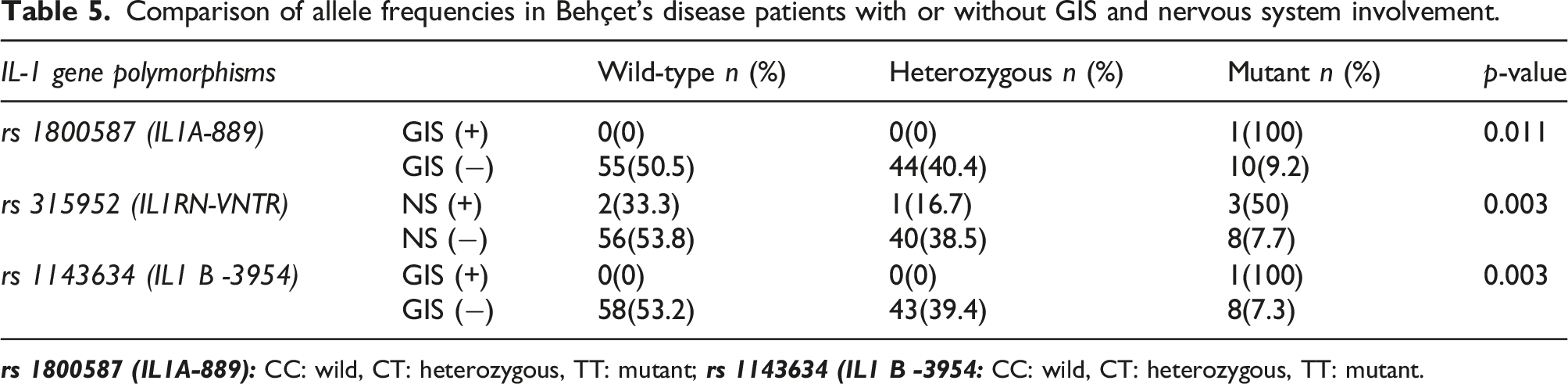
Comparison of allele frequencies in Behçet’s disease patients with or without GIS and nervous system involvement.
Discussion
As a result, IL-1 gene polymorphisms were similar between patients with BD. Despite the small patient size, we think that our study contributes to the related Literature in terms of its results. If we can examine the similar and different studies, we can list the following. Coskun M et al. did not also observe any difference in allele frequencies of IL-1alpha-889, IL-1beta-511, and IL-1 receptor antagonists in BD as in our study. 14 This year, the newest meta-analysis also revealed no association between IL-1B-511C/T polymorphism and the development risk of BD. 15 Ozcimen AA et al. reported no association between frequencies of IL-1Ra, IL-1α and IL-1R gene polymorphisms and susceptibility to BD. 16 We enrolled more individuals than in the above-mentioned study and also found no association. The five gene polymorphisms related to the IL-1 gene were not found more often in BD than in healthy controls. However, there are many suggestive trials in the related Literature, even in the same national cohorts. Inheritance of specific polymorphisms of interleukin 1 (IL-1) A and IL-1B was investigated in patients of Turkish origin. The combined genotype of IL-1A-889 and IL-1B + 5887 CC/TT was more frequently seen in BD than in controls. 17 In 2016, a comprehensive meta-analysis revealed an association between BD and the TT + TC genotypes of the IL-1A-889 C/T polymorphism, especially in a Turkish population. 18
Besides, few polymorphisms were differently distrubuted between in some organ involvements when compared with patients without the specific organ involvements. There are only six neurological and one gastrointestinal patients. It would not be appropriate to generalize the results since the specific organ involvement is very low. Firstly, mutant IL1RN-VNTR polymorphism was seen in the patient with nervous system involvement. Gromadzka G et al., investigated IL1RN intron 2 VNTR polymorphism in one of the neurodegenerative disorders, Wilson’s disease. 19 According to the results of this study, while polymorphism within genes for interleukin-1 receptor antagonists is not associated with disease presentations, it is related to the earlier onset of the disease. However, in another study, the IL-1Ra VNTR variant was not related to the risk of BD in a Turkish population. 20 The mutant IL1RN-VNTR polymorphism was seen in patients with CNS involvement, whereas wild-type was more often seen in patients without CNS involvement.
IL-1β as a member of the IL-1 cytokine family, is also related to gastric acid secretion, amplifies inflammation, and reveals possible gastric tumorigenesis; literature involves many studies searching IL-1B-3954C > T polymorphism in patients with gastric cancer and/or precancerous gastric lesions. Despite supportive results, most of them found no association. 21 Majumder P et al. investigated IL-1 gene polymorphisms, including IL-1B-3954C > T and IL1A-889C/T in the Indian population. Both of them were found to be risky for chronic periodontitis. 22 Although results are controversial in the Literature, they shed light on IL-1 gene association with GIS involvement. In our study, the presence of the mutant rs 1800587 (IL1A-889 TT) and the mutant rs 1143634 (IL1 B −3954 TT) was more likely to be found in BD patients with GIS involvement. However, wild-type alleles of the rs 1800587 and rs 1143634 were more often seen in patients without GIS involvement.
Several single nucleotide polymorphisms (SNPs) are related to increased inflammatory chemokines and/or cytokines (such as IL-1) and, ultimately, immune dysfunction, more intensive vascular inflammation, and injury. 23 Talaat RM et al. detected increased IL-17 and IL-6, as well as a reduction in IL-10 in Behçet patients. 24 Reduced IL-10 levels were related to gastrointestinal complications in their study. Although we hypothesized that pathogenic IL-1 production might result from functional polymorphisms, we could not measure concurrent serum cytokine levels in the study. This is one of the limitations of the study. Also, we had a relatively minor study group for recruiting the patients voluntarily. We could not perform a power analysis for sample size. We included all inactive patients with BD during the study period. The control group was matched only according to age and gender. The patient group was not homogeneous according to disease manifestations, and more patients with each organ involved in the disease may provide more accurate results in the future.
Conclusion
The frequencies of variable IL-1 gene polymorphisms were similar between patients with BD and healthy controls in the Turkish population. However, more comparative studies with an increased-sized patient population, including multiple ethnicities, could provide more accurate further results. Also, a comprehensive examination of all papers related to this subject is necessary for precise knowledge.
Footnotes
Author contributions
Conceived and designed the analysis; ÜÖ, FU, ET, VÇ, Collected the data; ÜÖ, FU, ET, VÇ, Contributed data or analysis tools; FU, ET, VÇ, Performed the analysis; ÜÖ, FU, ET, VÇ, Wrote the paper; FU, ET, VÇ.
Declaration of conflicting interests
The author(s) declared no potential conflicts of interest with respect to the research, authorship, and/or publication of this article.
Ethics approval
This study was approved by the local ethics committee of Pamukkale University (approval number 22/1, and date 2014) by following the Helsinki declaration. This study was also supported by the 2014 TPF034 project of the Pamukkale University Scientific Research Projects Coordination Unit.
Funding
This study was also supported by the 2014 TPF034 project of the Pamukkale University Scientific Research Projects Coordination Unit.
Informed consent
Written informed consent was obtained from all subjects before the study.
Trial registration
This clinical trial was not registered because the study is a cross-sectional study not a randomized controlled study.
