



Abstract
This paper employs to discuss the cilia induced flow of a compressible Jeffrey fluid with variable characteristic of thermal conductivity. Thermal conductivity is thermally variable. Effects of thermal radiation and MHD are also explored. The velocity slip at the wall is also considered. Flow equations have been modeled mathematically and tackled analytically using regular perturbation method. A proper attention is given to plot and discuss the behavior of quantities of interest against the relevant parameters. We explore growth of temperature with Mach number but this growth is strongly visible in supersonic regime as compared to the subsonic regime. The discoveries of the current model have noteworthy yields, which can be pertinent in various areas of aircraft industry, geophysics, biological transport processes, and in the operation of other mechanical devices.
Introduction
Cilia are small, slim, and tiny hair-like organelles exists at the outline of certain cells. The significant capacities performed by cilia include movement, alimentation, respiration, and tactile capacities. They adopt a significant part in cell cycle and furthermore in the progress of humans and animals. Two kinds of cilia comprises motile and non-motile cilia. Motile cilia in human respiratory parcel clears the organic fluid and bring out residue from lungs. The latter one is essential cilia and act as sensory organelles. They participate in signaling between cells. For instance, they help in legitimate urine stream by flagging the kidney cells. Additionally they empower the exchange of significant particles from one side of the light-sensitive cells to another in the retina. Ciliary-prompted peristalsis shows up altogether in different organic transport cycles, for example; in biomedicine, physiology and atomic reactors. Theoretical study on ciliated structures can be found in the literature.1,2 Theory of propulsion of micro-organism by cilia is directed by Blake. 3 A suitable modeling approach for multi-cilia configurations is analyzed by Gueron and Liron. 4 They presented a general method for the investigation of metachronism; a process in which swing of cilia tips form a travelling waves. The respiratory tract and the esophagus are genuine examples of peristaltic stream in a ciliated tube. Radhakarishnamacharya and Sharma. 5 deliberated the peristaltic transport of a self-assertive micro-organism settle in a channel containing a viscous fluid. Maqbool et al. 6 explored MHD Jeffrey fluid flow persuaded by cilia in an inclined tube. They adopted lubrication approach and observed an increment in the amplitude of pressure gradient with cilia length. MHD effect on metachronal beating of cilia for Casson fluid model is examined by Akbar and Khan. 7 A direct relation of velocity profile with Hartman number is perceived near the channel walls while reverse relation is perceived at the center of channel. Krishna Kumari et al. 8 carried out combined impact of peristalsis and cilia on motion of MHD Micropolar fluid. Very recently Hasen and Abdulhadi 9 studied MHD effect on peristaltic transport for Rabinowitsch fluid in cilia channel with porous medium. An oscillatory nature is investigated for pressure gradient as well as heat transfer. While velocity profile is parabolic in nature with greatest incentive at the center of channel.
Compressible fluids have caught the eyes of researchers as a result of their common applications in the development of planes, airplane channels, vehicles at high speed, and supersonic air streams. Existing literature shows that only few attempts explore the impact of MHD on peristaltic flows of compressible fluids. Basic studies on the solution of equations of compressible viscous fluids are addressed in Maccormack 10 and Guerra and Gustafsson. 11 In both studies solutions are obtained numerically. Mekhmier et al. 12 analyzed the impression of MHD on compressible Maxwell fluid prompted by a progressive wave in a porous microchannel and examined a lower stream rate for slip fluid comparative with the non-slip fluid. Abdelsalam and Vafai 13 explored the consequence of magnetic field on compressible Jeffrey fluid flowing in a microfluidic channel under peristalsis. Some more attempts regarding compressible fluid flow have been provided in the studies.14–16 Physiological progression of biomedical compressible fluids in a symmetric ciliated channel is examined by Saleem et al. 17 They explored a declination in Jeffrey fluid fluctuation as it switches from hydrodynamic to hydromagnetic fluid therefore retardation time diminishes.
Thermal radiation is one of the imperative variables controlling the heat transfer. Heat transfer alongside radiation has gotten a subject of various exploration because of its noteworthy contributions in atomic plants, aircrafts, gas turbines and so forth. The thermal radiation ends up being more noteworthy whenever high temperature zone is taken into account. Very recently Khan and Rafaqat 18 explored the peristaltic stream of compressible Jeffrey fluid with the impact of MHD and radiation. They observed that Reynolds number and radiation number are responsible for increment of temperature of the fluid while Prandtl number indicates a decrement in temperature. We can find applications of this problem in fluid transport mechanism specifically in biological systems. Since nature of biological fluids is electrically conducting and cilia are attached on the lining of lungs which protects the lungs from harmful substances (dust particles, bacteria etc.) by a highly viscous fluid containing various proteins showing the relevance of cilia prompted flow of MHD compressible Jeffrey fluid in the respiratory tract of humans.
All these examinations are done assessing consistent physical properties of the fluid but variable attributes of physical properties commanded for practical conditions. The study of heat transfer with variable thermal conductivity is significant in dealing with physical problems. Hussain et al. 19 deliberated the heat transfer of MHD Jeffrey fluid with peristalsis and variable thermal conductivity. Hayat et al. 20 considered 3D stretched stream of Jeffrey fluid with radiation and varying thermal conductivity. They investigated reduction in temperature with increasing Prandtl number. Some ongoing researches concerning the effect of heat transfer along with the variable thermal conductivity are quoted in Refs.21–24 In all the above mentioned attempts thermal conductivity is presumed to be linearly varying function of temperature. Khan et al. 25 inspects heat and mass transfer on a third-grade MHD fluid with chemical reaction and variable reactive index. Analysis of heat transfer of squeezing unsteady nanofluid with the impact of inclined magnetic field and varying thermal conductivity is explored by Lahmar et al. 26 They realized a decrement in heat transfer due to the existence of varying thermal conductivity. Further exploration about heat transfer with varying thermal conductivity could be understood through.27–29
As far as author could possibly know thermal effects on compressible fluid flow with variable fluid properties have not been done in the existing literature. In this paper transport characteristics of 2D flow of MHD compressible Jeffrey fluid inside a ciliated channel is deliberated. The main novelty of this work is to intend the combined influence of heat transfer and thermal radiation on cilia driven transport when thermal conductivity is thermally variable. This study is sorted out as follows: the physical detailing of this problem is presented in section 2. The perturbation technique used to comprehend our system of equations is given in section 3. The numerical results are interpreted via graphs in section 4. In the last section, all results are summarized.
Problem formulation
In order to designate the physical model of present study mathematically, we consider a symmetric channel of uniform width 2d, with
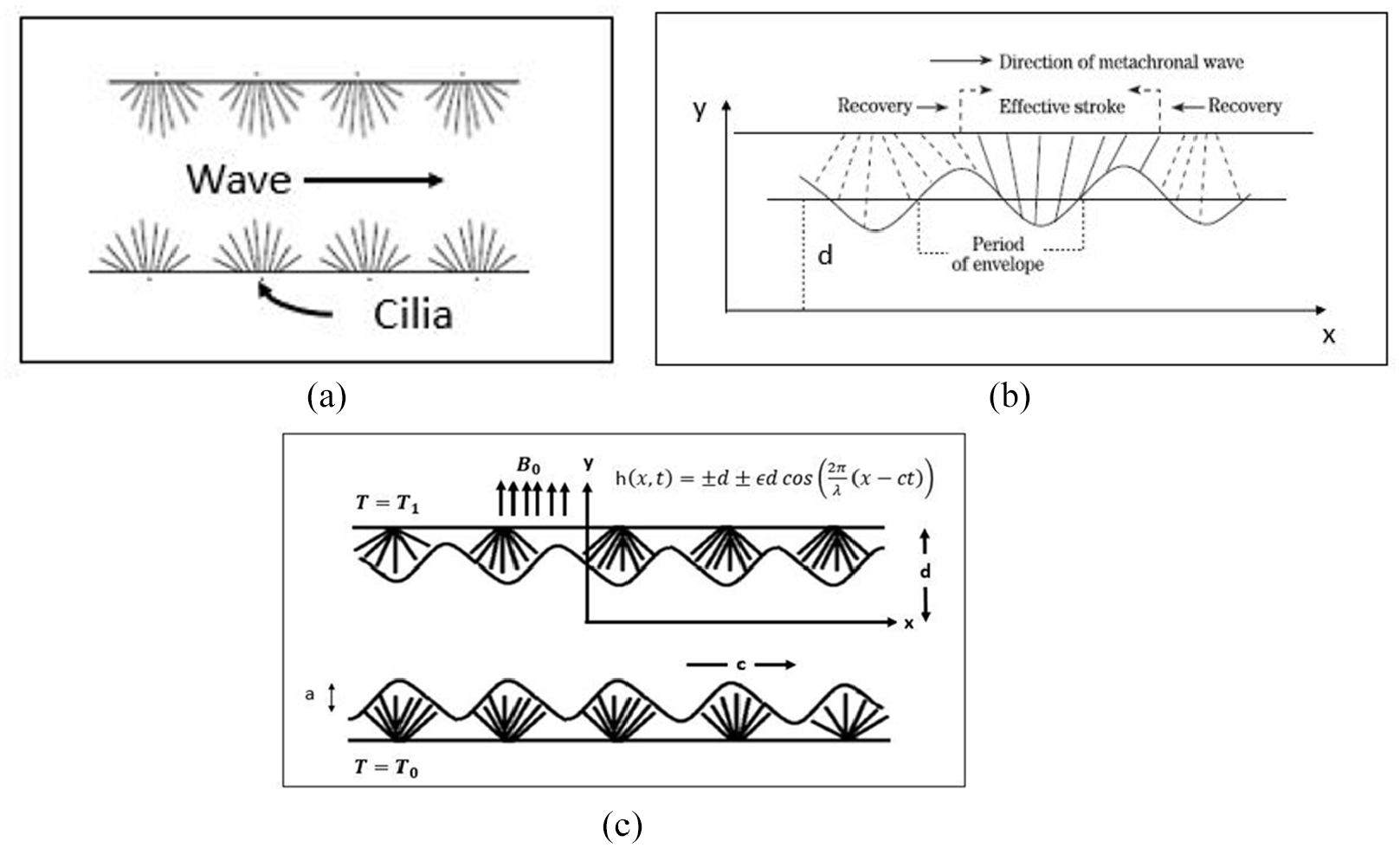
(a) Ciliated channel, (b) metachronal wave pattern, and (c) illustrative showing flow domain and its physical parameters.
The density in terms of pressure is given as,

with the solution,

where the reference pressure and reference density are
The governing equations of the flow are 18




where viscous dissipation term is given by

Thermal conductivity as a linear function of temperature is given as 27

Many studies explored the nature of different pattern of cilia tips. Here, we assume the elliptic nature of cilia tips. The parametric equations for the beating pattern of cilia as proposed by Sleigh 1 and Lardner and Shack 2 can be expressed mathematically as

where

The velocity of cilia tips are


The suitable boundary conditions are



We allocate the following non- dimensional variables as
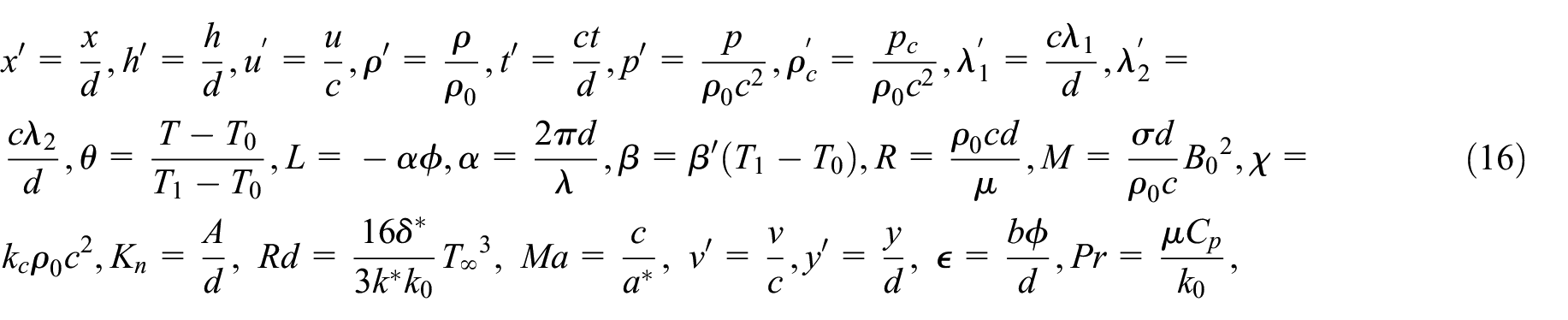
where
In term of equation (16), equations (2–10) and equations (13–15) reduce to



in which primes have been dropped.
Solution of the problem
For steady parallel flow case in which

where
When

Pure peristalsis
18
is considered here in which
Now consider

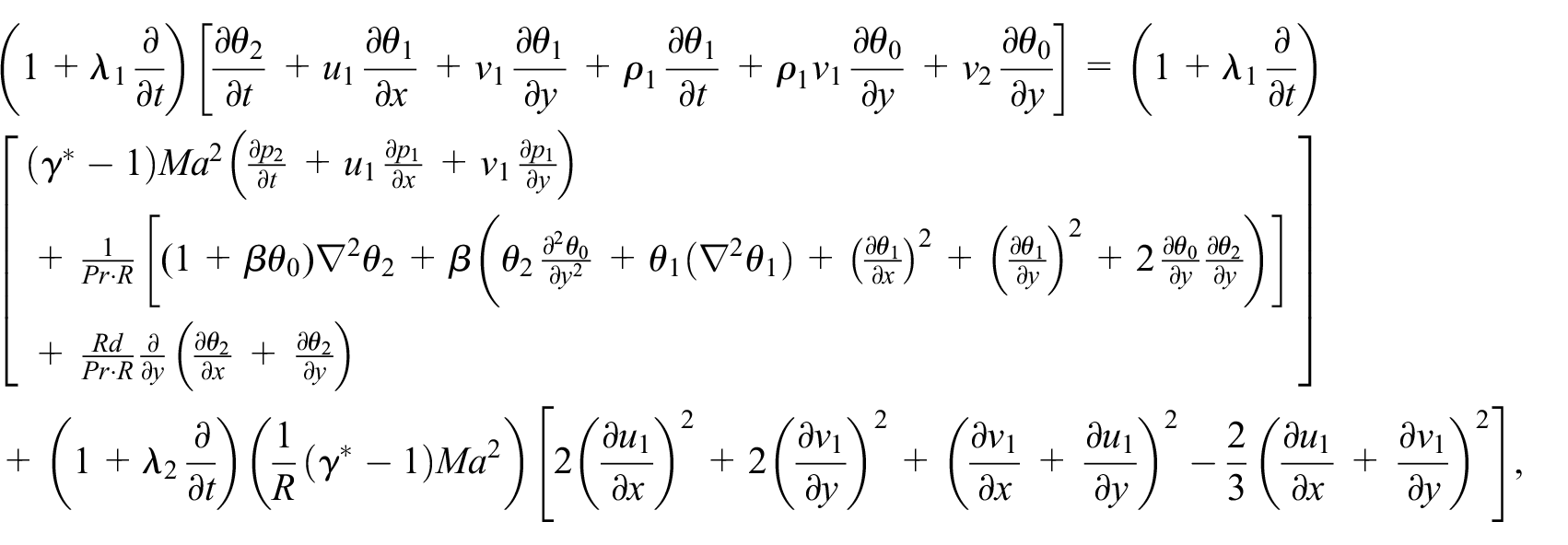
We use regular perturbation method to solve the above non-linear equations. The perturbed solution assumptions of the velocity components, pressure, temperature, the viscous dissipation and density are as follows:

The following system was obtained after incorporating expansion (30) into (17–26) and equating
for





For






Here we obtained the boundary condition by following the same strategy as proposed by Mekheimer et al. 12 and Khan and Rafaqat 18
We adopt the solution in the form

and

where overbar denotes the complex conjugate.
Incorporating equations (33) and (34) into equations (31) and (32), we get these sets of following first-order and second-order equations, respectively:








where
To accomplish the main equations we follow the same approach as given by Mekheimer et al., 12 and which was trailed by Khan and Rafaqat 18 later. Thus, we neglect the long calculations and locate the first-order solution for the pressure, velocity, and temperature. We stifled here the prolonged expression for second order solution of heat transfer.


The parameters and complex constants are characterized in Appendix.
It may be noted that if we substitute


Results and discussion
This section is dedicated to illustrate the change in perturbation function, mean axial velocity and temperature profile for pertinent parameters.
Figures 2 to 6 depicts the effect of

Variation in perturbation function

Variation in perturbation function
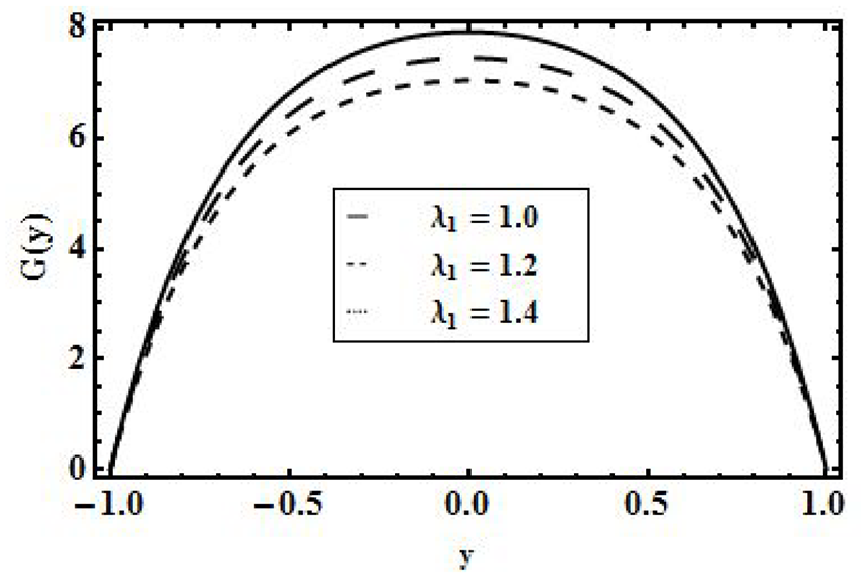
Variation in perturbation function

Variation in perturbation function
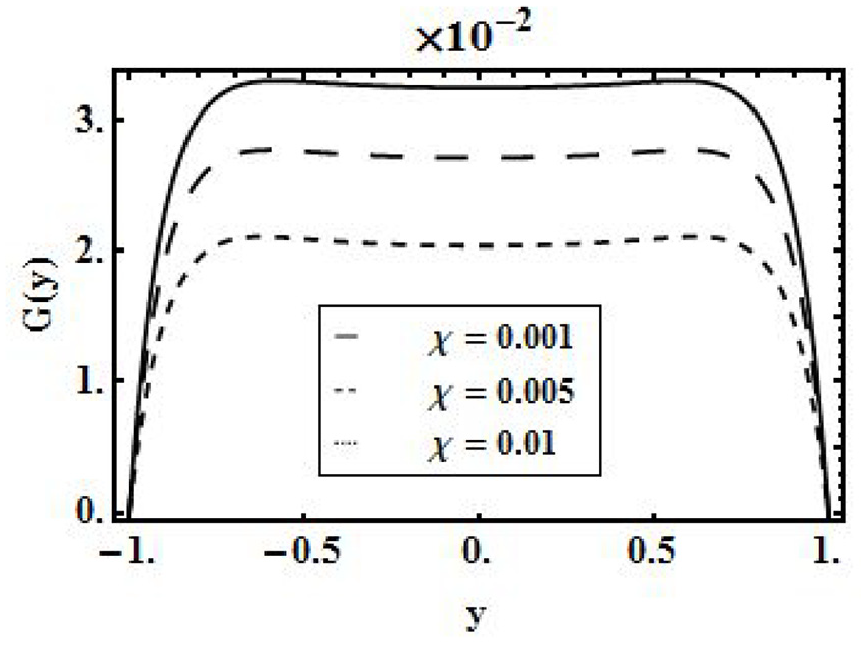
Variation in perturbation function
Outcomes of emerging variables involved in present analysis on mean axial velocity can be examined from Figures 7 to 11. Figures 7 and 8 explicate the variation trend of mean axial velocity against

Variation in mean axial velocity towards
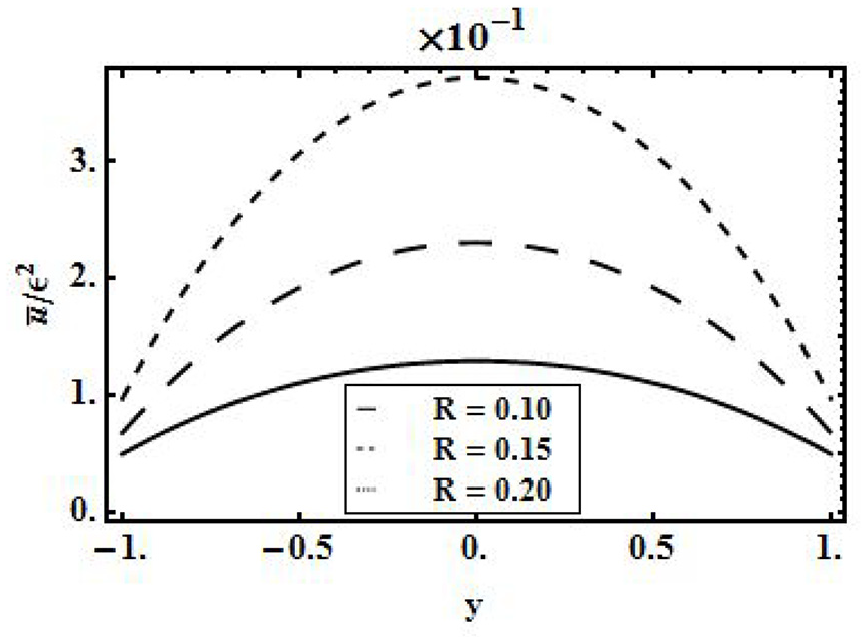
Variation in mean axial velocity towards

Variation in mean axial velocity towards

Variation in mean axial velocity towards
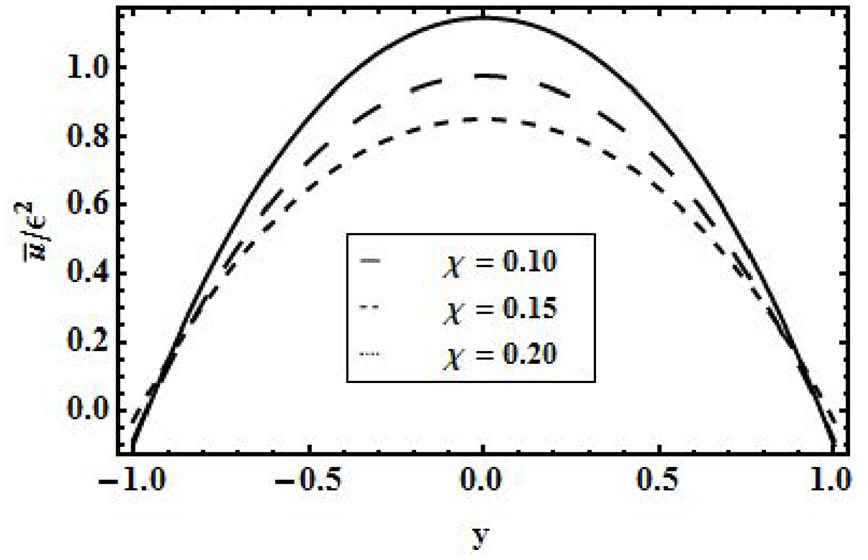
Variation in mean axial velocity towards
The variation trend of temperature against emerging parameters are inferred in Figures 12 to 19. Figure 12 witnessed the growing impact of variable thermal conductivity on temperature. Figures 13 to 15 made to see the effects of
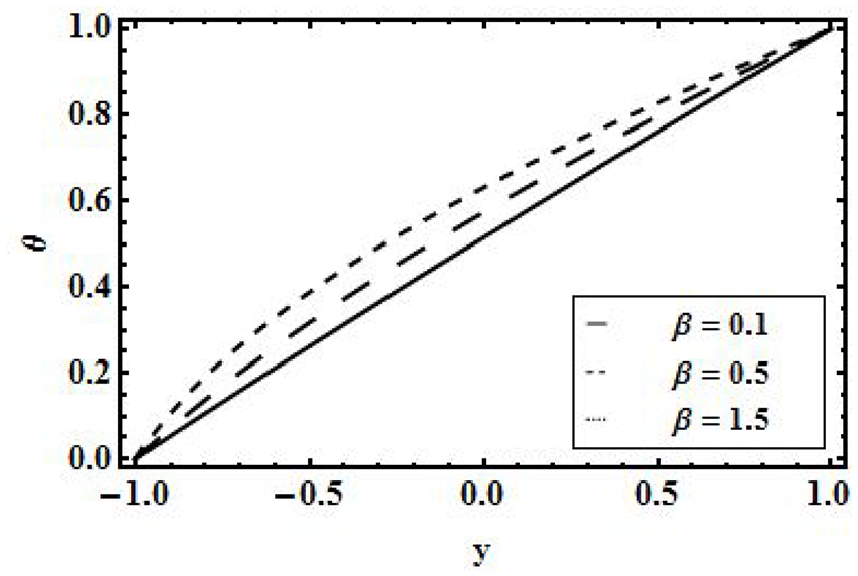
Variation in temperature towards

Variation in temperature towards

Variation in temperature towards
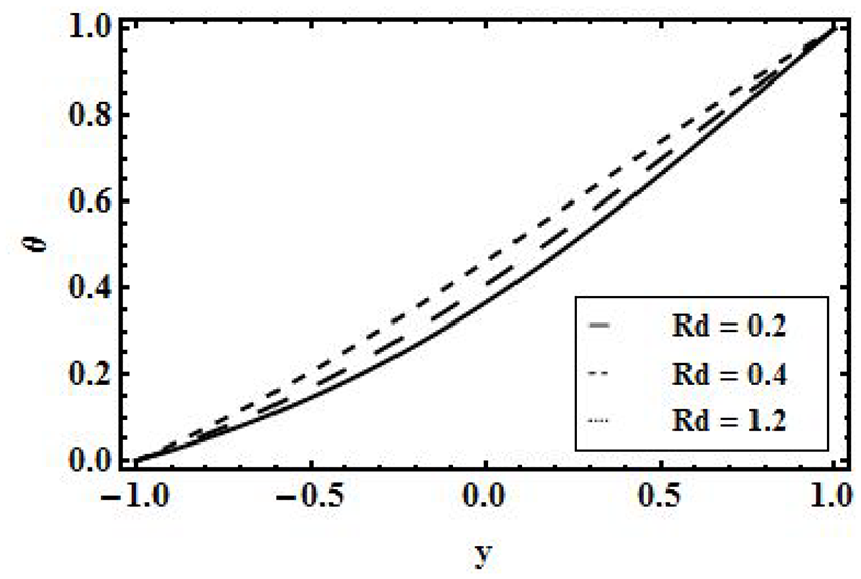
Variation in temperature towards

Variation in temperature towards

Variation in temperature towards

Variation in temperature towards

Variation in temperature towards
Conclusion
This study presents heat transfer analysis of a compressible Jeffrey fluid with variable thermal conductivity. It also incorporates the impact of MHD and radiation on cilia induced flow. The worth mentioning points of the performed analysis can be concisely written as:
A decaying nature of velocity perturbation function has been reported for all emerging parameters.
The mean axial velocity depicts a direct relation with
Velocity profile diminishes at the center of the channel but increases close to the walls by rising compressibility parameter.
The temperature profile against variable thermal conductivity parameter exhibits a similar behavior to that of mean axial velocity towards
It is analyzed that variational trends of temperature with Mach number are direct. Also, these effects are strongly analyzed in supersonic region while weak trends are investigated in subsonic region.
Footnotes
Appendix
The parameters and variables found in section 3 for the first order and second order solution are given as
where
where
The functions
where
Handling Editor: J Svalastog
Declaration of conflicting interests
The author(s) declared no potential conflicts of interest with respect to the research, authorship, and/or publication of this article.
Funding
The author(s) received no financial support for the research, authorship, and/or publication of this article.
