



Abstract
The exploration of various nanoparticles has become a focal point for researchers, driven by its potential applications in both industry and medicine. Nanoparticles can be incorporated in several shapes and sizes, hence this paper examines the nanofluid’s performance in a peristaltic channel under the impact of combined external applied electric and magnetic fields, in addition to thermal radiation and Joule heating effects. The present study also examines the non-isothermal characteristics with no slip convection for four distinct nanoparticles, namely Iron oxide (
Keywords
Introduction
Nanofluids, which are suspensions of nanoparticles in a base fluid, have attracted considerable attention because of their advanced thermophysical properties, including thermal conductivity and convective heat transfer coefficients. These unique characteristics make nanofluids favorable for various applications in industries such as electronics cooling, solar thermal systems, biomedical engineering, and heat exchangers. Recent literature in the field of mathematics has focused on modeling the behavior of nanofluids to understand their flow and heat transfer mechanisms better under different flow conditions and nanoparticle concentrations. Firstly, the notion of nanofluids was offered by Choi 1 who presented an improvement in thermal conductivity of fluids by adding small amount of nanoparticles. Additionally, mathematical analyses have contributed to understanding the fundamental interactions between distinct nanoparticles and the base fluid, thereby facilitating the modification of nanofluids with enhanced properties modified to specific applications. Dykman and Khlebtsov 2 studied the applications of gold nanoparticles in biology and medicines. Sayed et al. 3 explored the slippery aspects of non-Newtonian material flow with peristaltic motion. Kothandapani and Prakash 4 evaluated the magnetized Jeffrey nanomaterial flow by considering the peristaltic motion. Nadeem et al. 5 conducted a study to analyze hybrid nanofluid over a curved surface. Results showed improved heat transfer rate for the hybrid nanofluid compared to the conventional nanofluid. Liu et al. 6 studied silver nanoparticles for treating breast cancer cells. This work highlighted the benefits of AgNPs for the generation of heat in breast cancer cells by targeting intracellular infections. Eshgarf et al. 7 studied single-phase and two-phase models of nanofluid to investigate the heat transfer rate. Furthermore, heat transfer analysis of nanofluid flowing modulated inside a double-pipe heat exchanger that includes spindle-shaped turbulators is presented by Izadi et al. 8 Results revealed that incorporating such turbulators enhances thermal efficiency when compared to smooth pipe. Additionally, Khan et al. 9 addressed the thermal applications of couple stress nanofluid subjected to triple diffusion effects and bioconvection. The investigation further incorporated variable viscosity and thermal conductivity, along with linear thermal radiation. The study highlighted the importance of triple diffusion in improving the heat and mass transfer rates. Some inquiries pertaining to the nanofluids can be observed via.6,10–15
Peristalsis, the contraction and relaxation of muscles, serves as a fundamental mechanism in various physiological processes, including digestion, blood circulation, and urinary system function. This wave-like motion enables efficient movement of substances such as food, blood, and waste through tubes or channels. Experimental study of peristaltic flow was presented by Latham. 16 Shapiro et al. 17 used ‘long wavelength and low Reynolds number’ assumptions to investigate the peristaltic viscous fluid. Rao and Mishra 18 investigated the peristalsis of power law fluid via asymmetric porous tube. Their findings highlighted the influence of wave shape and porous wall properties of wavy channel. Further, Pandey and Tripathi 19 explored peristaltic flow of Casson fluid via finite channel. The findings showed insights into the influence of Casson fluid rheology on peristaltic motion, offering a better understanding of flow dynamics in the esophagus. Also, Rachid and Ouazzani 20 examined the MHD peristalsis of Jeffrey fluid flow confined between a pair of deformable coaxial tubes having unequal wavelengths. Shahzad and Awan 21 conducted a study on the flow of heated Rabinowitsch fluid through an elliptic vertical peristaltic duct. The study provided insights into peristaltic flow in non-Newtonian systems. In addition, peristalsis together with nanofluids reveals new techniques for developing microfluidic technologies and refining their performances in various applications that is, biomedical, analytical, and industry. Akbar et al. 22 presented a model to explore nanofluid flow through peristaltic channel, considering slip boundary conditions. Abbasi et al. 23 analytically studied peristaltically induced flow of nanomaterial through porous medium. Also, temperature-dependent characteristics of distinct nanoparticles, influencing peristaltic flow behavior in nanofluids is explored by Abbasi et al. 24 Their study contributed to understanding the role of nanoparticle features in boosting heat transfer efficiency. Ebaid et al. 25 adopted Homotopy Perturbation method to investigate flow of blood-based gold nanoparticles with a heat source via peristaltic conduit. The findings suggested potential applications of utilizing gold nanoparticles in cancer treatment. Numerous efforts have been recorded by researchers.26–30 Moreover, Li et al. 31 analyzed turbulent Reynolds number at the regular, converging, and diverging outlets: Dynamics of air, water, and kerosene through y-shaped cylindrical copper ducts. Also, Animasaun et al. 32 explored half-cycle length of converging circular wavy duct with diverging-outlet.
Electro-magneto hydrodynamics (EMHD) and radiation properties display two interesting factors that can considerably affect the peristaltic performance of nanofluids. Researchers can involve the motion and delivery of nanoparticles within the nanofluid under external electric or magnetic fields, so varying the peristaltic pumping features. Besides, radiation effects, can affect the thermophysical properties of nanofluids, leading to deviations in the peristaltic flow behavior. Understanding the relationship between EMHD and radiation effects on nanofluid peristalsis is beneficial for various biomedical applications, including drug delivery systems and hyperthermia treatment. Prakash et al.
33
investigated the combined effects thermal radiation and thermal wall slip on MHD electroosmotic flow of nanofluid in asymmetric peristaltic conduit. Hasona et al.
34
explored the influence of thermal radiation and MHD effects on the flow of nanofluid in peristaltic channel, with application to radiotherapy and thermotherapy in cancer treatment. Abbasi et al.
35
examined the peristaltic flow of Prandtl nanofluid modulated by electroosmosis with radiation and joule heating effects via tapered channel. In addition, Akbar et al.
36
investigated the MHD peristaltic transport of radiative MWCNT-Ag/C2H6O2 hybrid nanofluid with fluctuating characteristics. Besides, Saba et al.
37
presented a study that considered combined effects of electric and magnetic fields on two-phase nanofluid flow through a curved peristaltic channel. Further related work can be seen in References 38–42. Incorporating different nanoparticles such as Gold (Au), Silver (Ag), Iron oxide (
In existing study, the authors have selected the nanoparticles of five different shapes that is, cylinders, spherical, blades, tetrahedrons, and platelets. Peristaltic phenomenon of Four distinct nanoparticles, namely Gold (Au), Silver (Ag), Iron oxide (
Problem development
Peristalsis of nanoparticles that is, Copper (Cu), Iron oxide (

where

Here α0 represents the dimensional variable viscosity parameter,

The thermal conductivity that is, Hamilton-crosser’s (H-C) model of two-phase fluid is as follows 24 :

Where,

Nanoparticles shape with their shape factor. 36
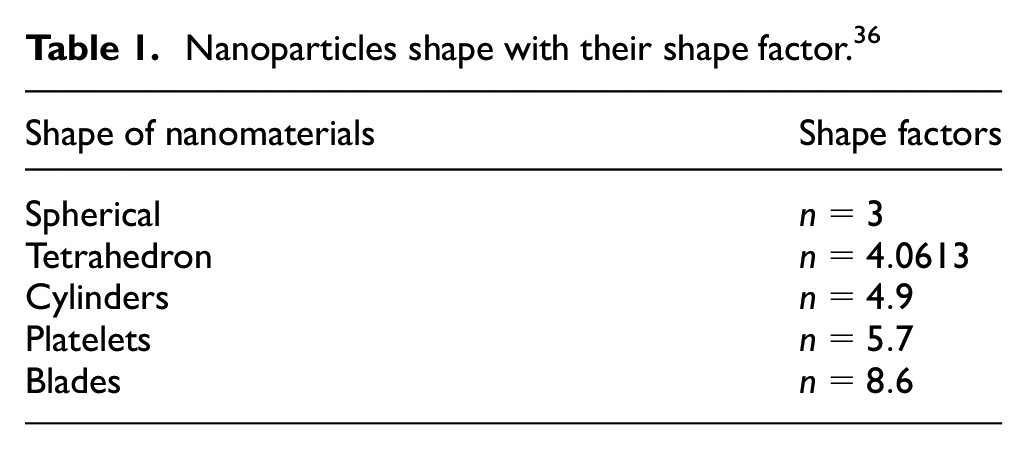
Here K0 represents the base fluid’s thermal conductivity at constant temperature, while

The expressions detailing the electric conductivity, effective heat capacitance, thermal expansion, and density of nanofluids are provided as 24 :

The Ohm’s law relationship is given as:

Here

From Gauss’s law:

where ε and

Comparison of equations (10) and (11) leads to the Poisson equation as:

The net charge density is defined by the Boltzmann distribution which is:


where
Using equations (13) and (14) in equation (12) and employing the Debye-Huckel assumption, Poisson’s equation takes form:

where
In the X-direction, the radiative heat flux is assumed insignificant when compared to the Y-direction. According to the Rosseland approximation perspective, the radiative heat flux (

Here,

After employing equation (17), equation (16) becomes:

Table 2 represents the physical parameters values corresponding to water and multiple nanoparticles. Here,
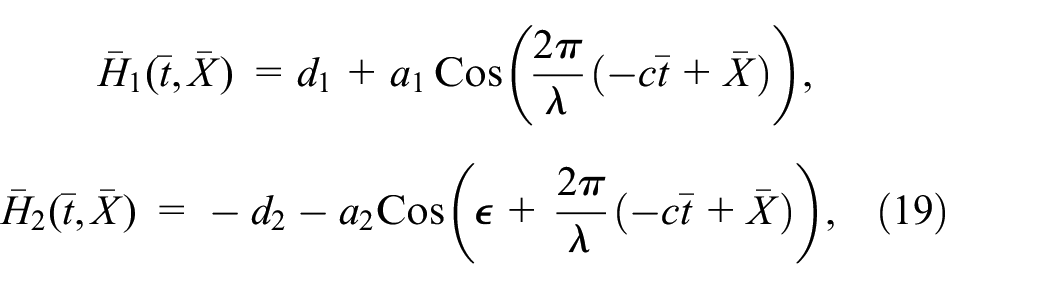
where



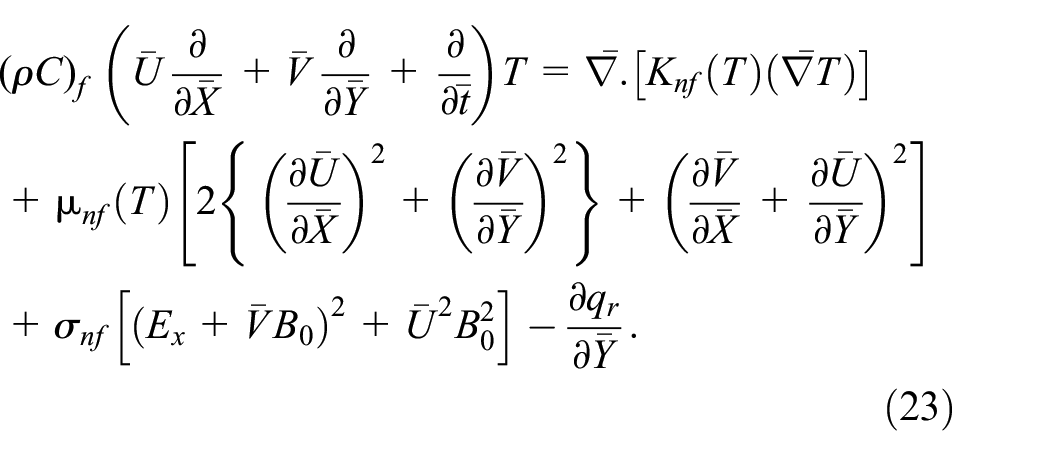
Where
Numeric values of the thermo-physical characteristics. 24

The conversions from the laboratory (

After implementing the above aforementioned relationships, the modeled equations in the wave frame adopt the form:


The dimensionless variables and parameters are characterized as:

Where
Applying the stated dimensionless constraints, considering the weaker Reynolds number and long wavelength approximation, equations (24)–(27) and the peristaltic wall expression simplify to:
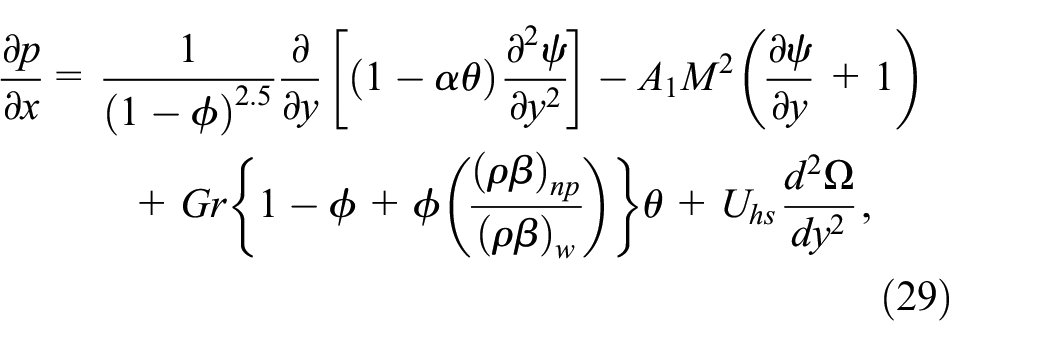


Where

The convective conditions are given as3,4:
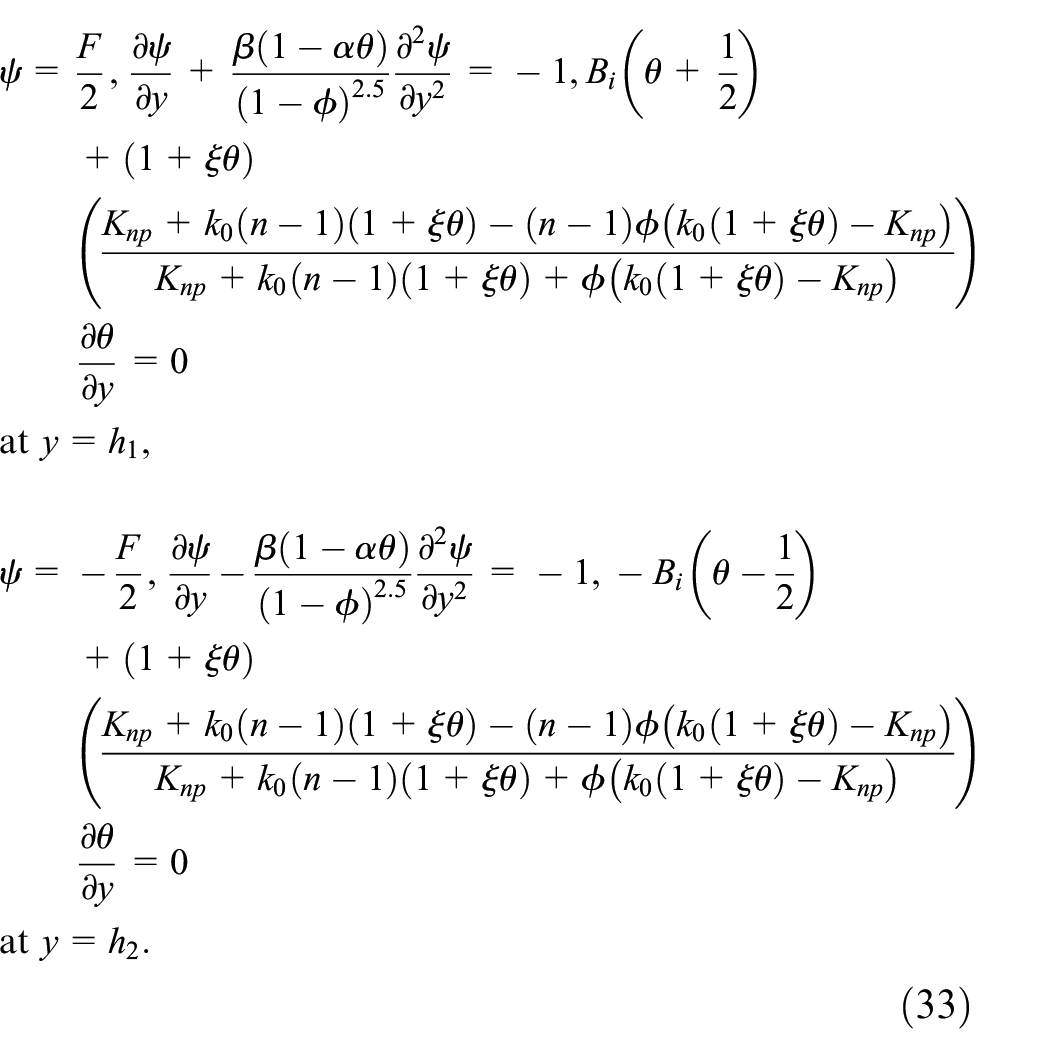
Here,
Dimensionless volume flow rates in fixed

where

The resulting nonlinear systems presented in equations (29)–(31), along with conditions (33), are complex. As analytical solution is not readily attainable and time-consuming, it is necessary to adopt a numerical scheme to tackle these equations. Hence build-in routine NDSolve in Mathematica which is based on highly effective and efficient shooting method is utilized. Some of the advantages of using NDSolve are as follows:
Consistently adjust variables such as
Demonstrates accuracy and remains unconditionally stable.
Also, Figure 1 shows the flowchart of the solution procedure.
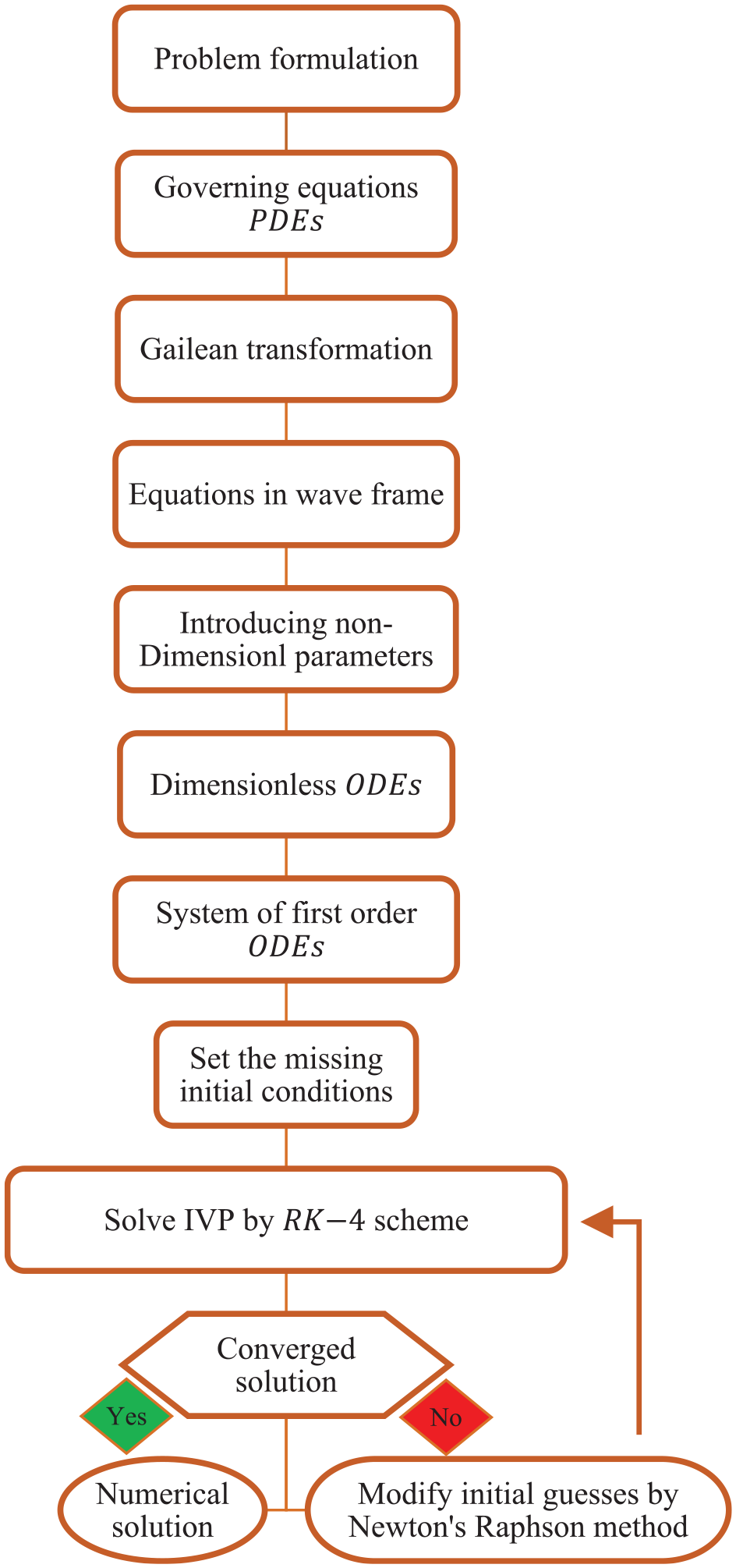
Flow chart of solution methodology.
Discussion
In this section, acquired numerical data has been observed to explore the effects of evolving constraints on heat transfer rate, temperature and velocity of
This portion focuses the effects of various parameters on the velocity, temperature, and heat transfer rate plots via graphs. Solutions for different flow constraints are discussed that is, M the Hartman number,
Velocity profile analysis
The variations in velocity are illustrated in Figures 2 to 9. Figure 2 demonstrated an increasing trend near channel’s center with an increase in the ‘

Velocity profile for
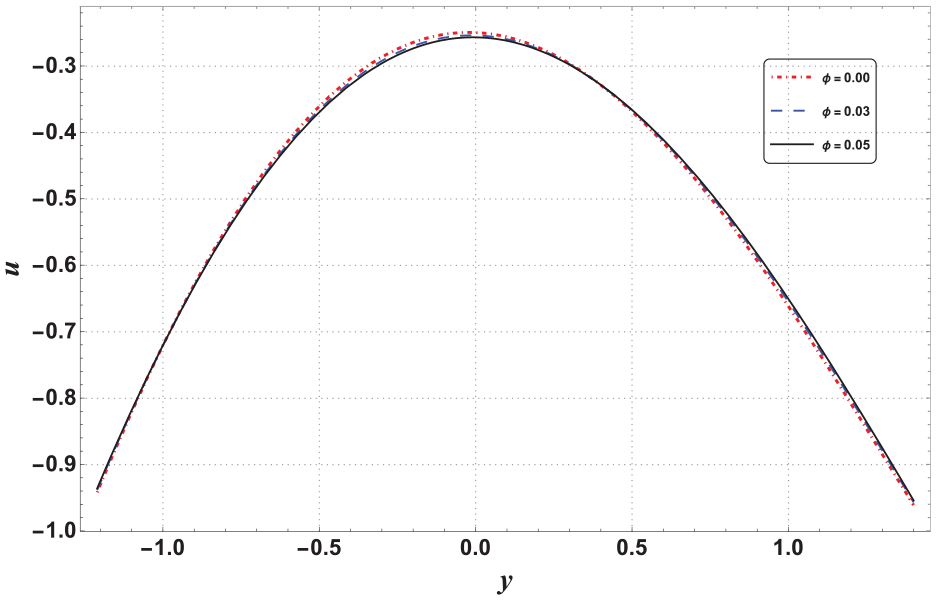
Velocity profile for

Velocity profile for

Velocity profile for

Velocity profile for

Velocity profile for
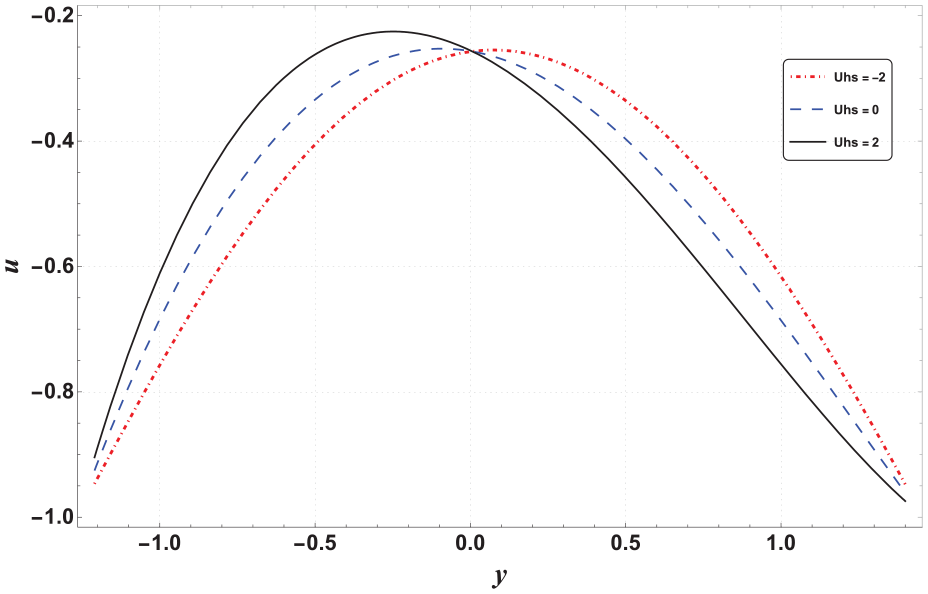
Velocity profile for
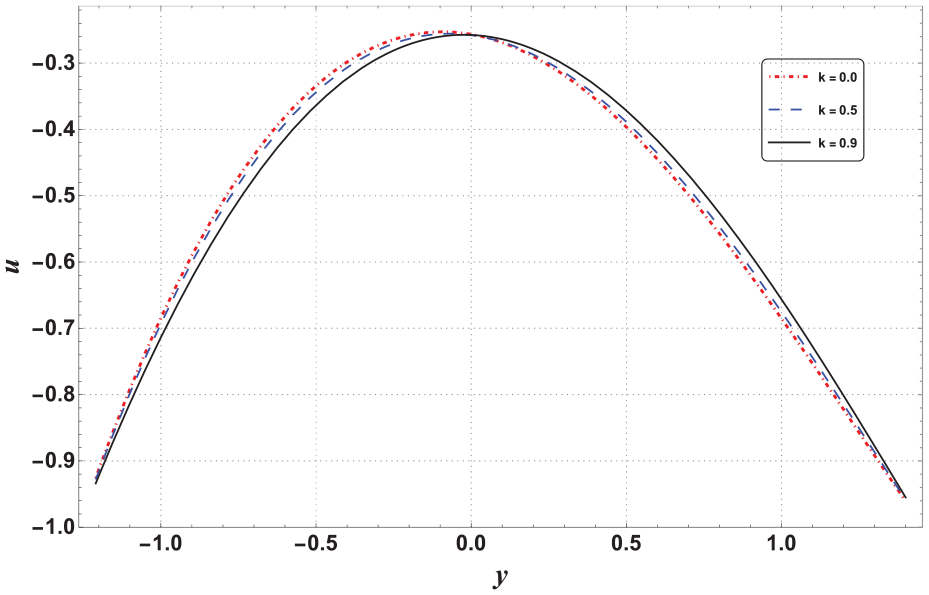
Velocity profile for
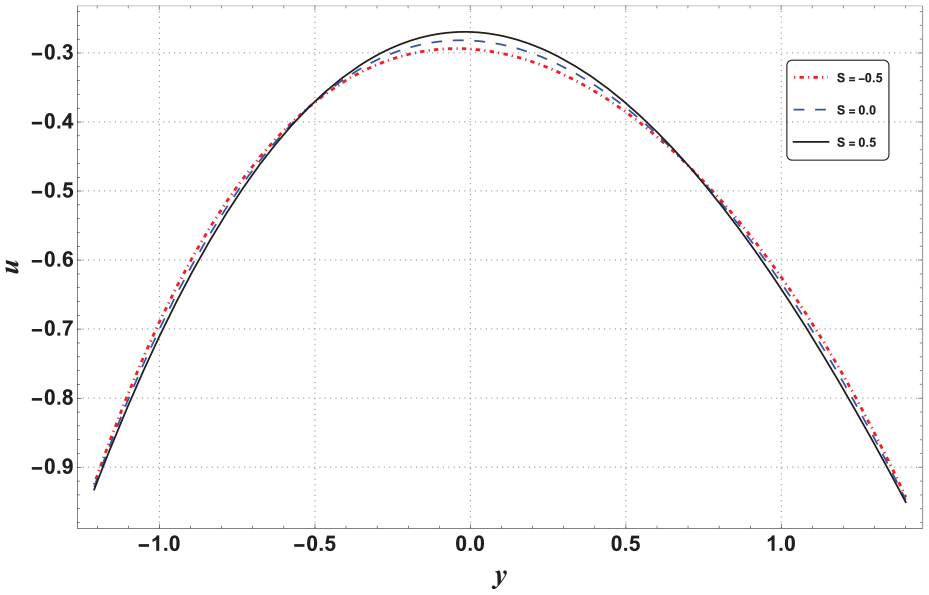
Velocity profile for

Velocity profile for

Velocity profile for shape factor.
Temperature profile analysis
Temperature dispersals resulting from variations in parameters are showed through Figures 13 to 20. Figure 13 illustrates that a rise in ‘
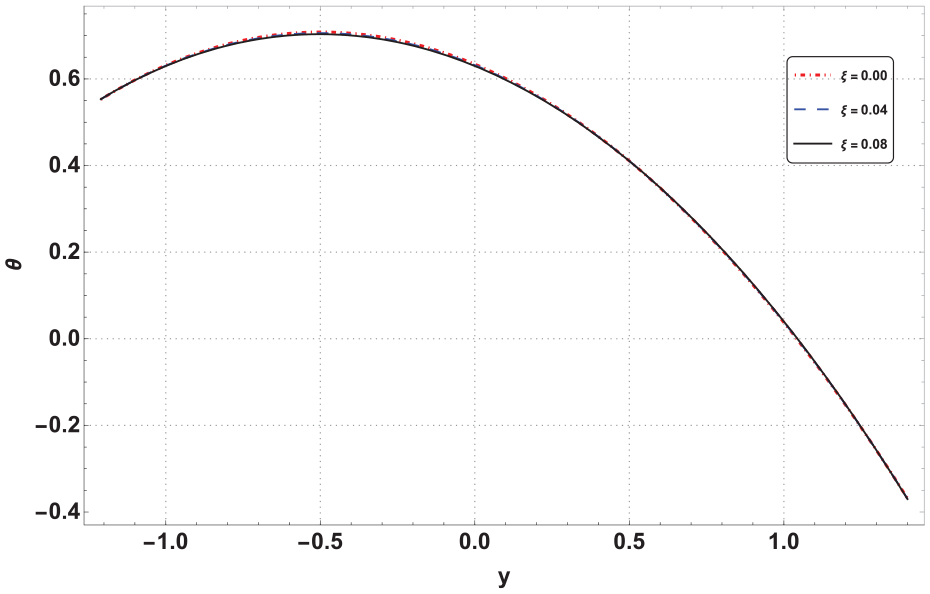
Temperature profile for

Temperature profile for

Temperature profile for

Temperature profile for

Temperature profile for
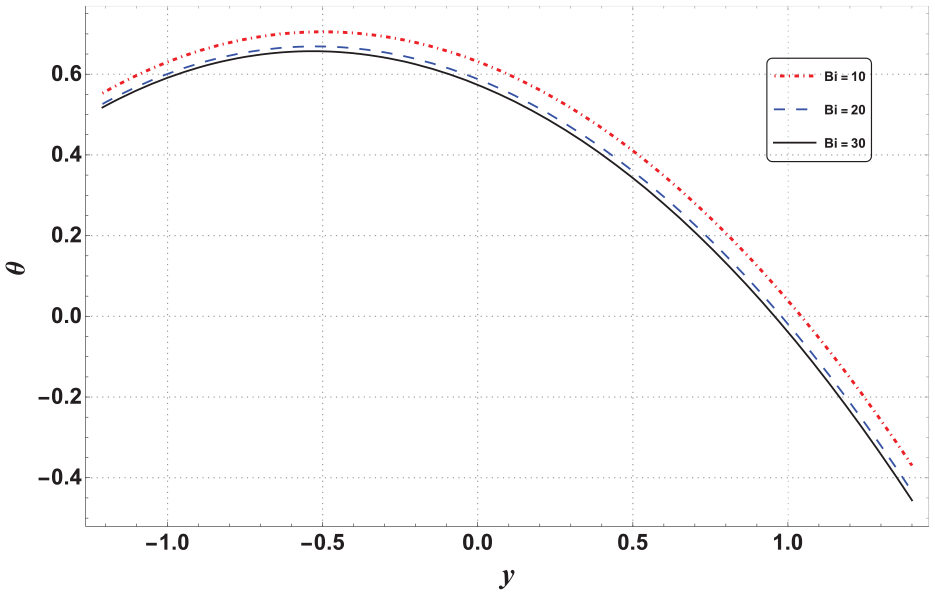
Temperature profile for

Temperature profile for

Temperature profile for
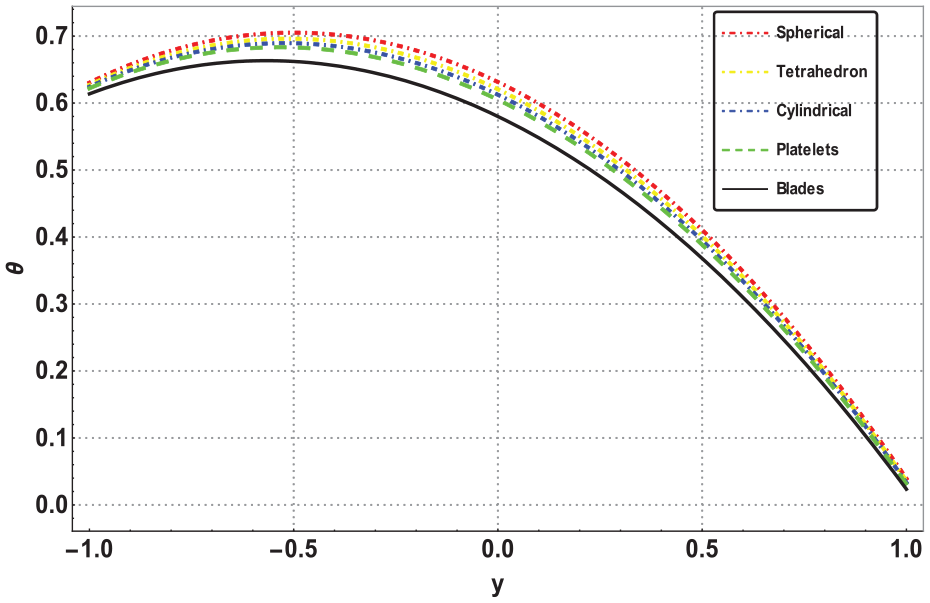
Temperature profile for shape factor.
Rate of heat transmission
This section is comprised of two portions. In first portion bar charts shown through Figures 22 to 26 are studied to analyze the presentation of heat transfer rate of four nanoparticles Gold (Au), Silver (Ag), Iron oxide (

Heat transfer rate for
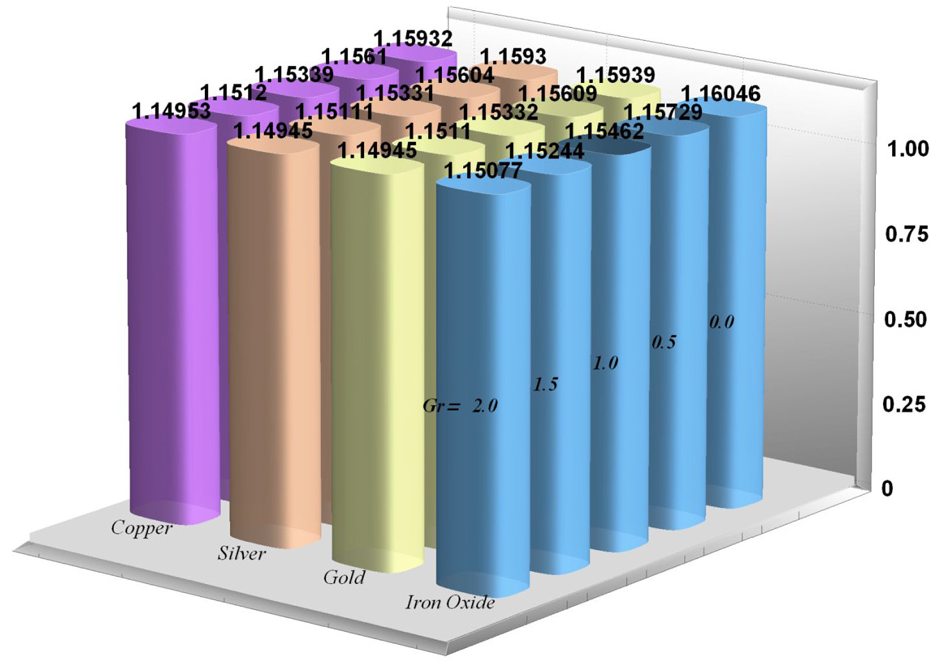
Heat transfer rate for

Heat transfer rate versus S for various nanoparticles.

Heat transfer rate versus Uhs for various nanoparticles.

Heat transfer rate versus for various nanoparticles.

Heat transfer rate versus for various nanoparticle shapes.

Heat transfer rate versus S for various nanoparticle shapes.

Heat transfer rate versus for various nanoparticle shapes.
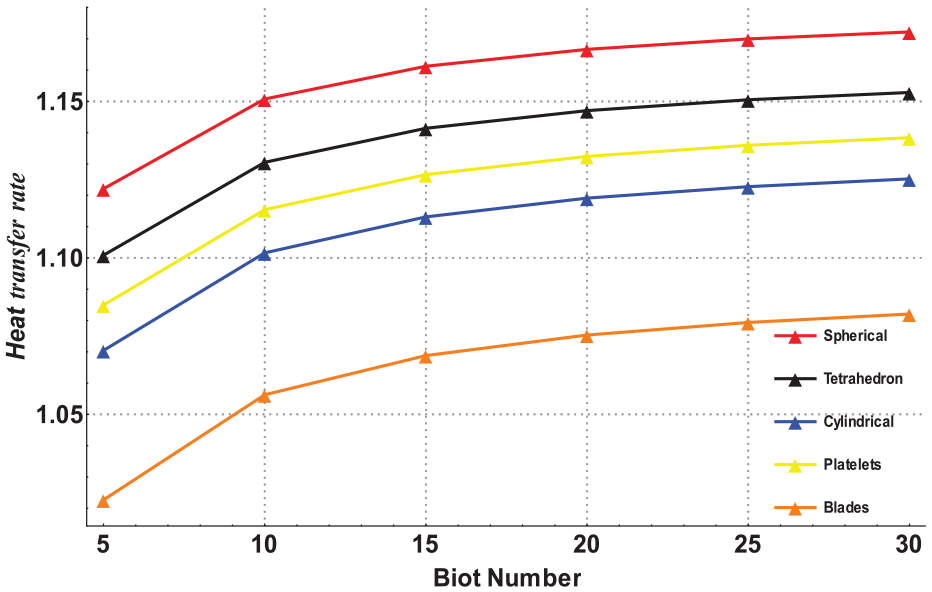
Heat transfer rate for

Heat transfer rate for
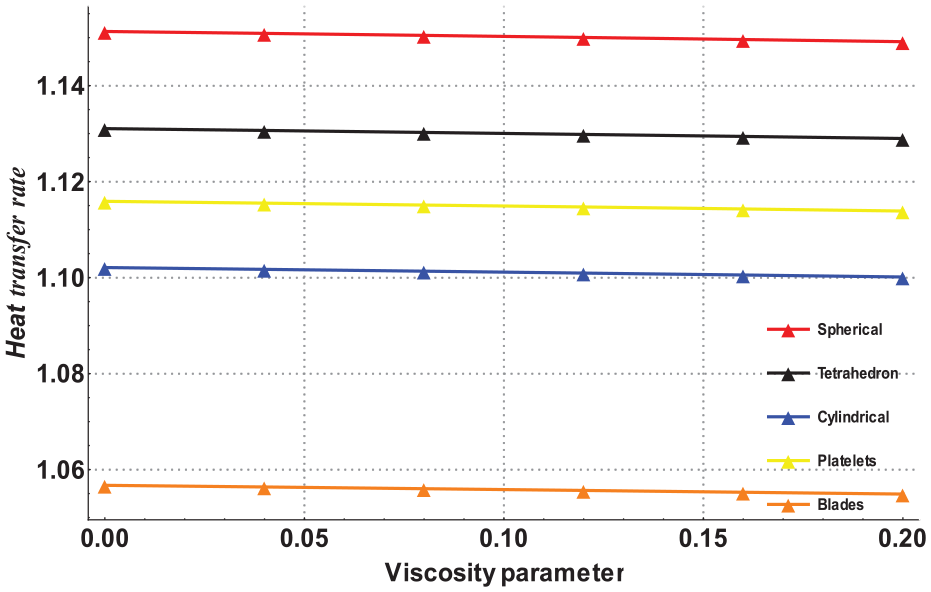
Heat transfer rate for

Heat transfer rate for
Comparison for different nanoparticles
Alike behavior is seen for both
Comparison for different shapes
Heat transfer rate is seen to be decreased for enhancement in
Comparison of nanoparticles shapes of thermal conductivity
In this portion evaluation of two nanoparticles of thermal conductivity for different shapes that is, are provided through Figure 34(a)–(e).

(a–e) Thermal conductivity for different nanoparticles.
Figure 34(a) to (e) portrays that thermal conductivity inclines to grow when temperature rises. Likewise, thermal conductivity for
Conclusions
This study develops a mathematical model to examine a nanofluid flow via peristaltic channel. It mainly investigates the impact of non-isothermal features, including temperature dependent thermal conductivity and viscosity, on performance of the fluid. A comparative analysis of various nanoparticle shapes is carried out to inspect their effects on velocity and temperature profiles. The study assesses how different parameters influence the thermal transport across distinct types of nanoparticles. The collective effects of thermal radiation and electro-magneto-hydrodynamic forces are also studied to offer a comprehensive understanding of the system’s thermal performance. This study shows potential applications across numerous sectors. In aerospace, automotive, microelectronics, and power generation systems, nanoparticle and EMHD effects can improve cooling systems for high-performance devices by boosting heat transfer. In biomedical applications that is, hyperthermia therapy and drug delivery systems, it can improve thermal treatment techniques, design nano-drug carrier and temperature regulation, especially using
Silver
Heat transfer rate of iron oxide-water nanofluid is improved by up to
The outcomes for energy transmission rate, temperature, and velocity are stronger for spherical nanoparticles comparative to other shapes.
Radiation effect helps to control the thermal by approximately
Iron oxide
The heat transfer rate for blades is greater than the other shapes whereas spherical nanoparticles have lower transfer rate near lower wall, but opposite trend is seen near upper wall.
An increase in nanoparticles concentration
Joule heating parameter significantly enhances velocity and temperature of the nanofluid.
This study develops the theoretical understanding of nanofluid by representing the essential role of nanoparticle geometry, comparative thermal efficiency of different nanoparticles, interaction of thermal radiation with EMHD flow in non-isothermal situations and proposes practical guidance for the design of thermally effective systems in microfluidics.
Furthermore, the improved thermal conductivity performance for silver nanoparticles over others is consistent with results supported by prior work that is, Abbasi et al., 2022, yet this study diverges by showing that this advantage is shape-sensitive and context-dependent under radiation and electromagnetohydrodynamic effects. Hence these finding highlight a critical distinction such as performance of nanoparticles when properly shaped and thermally stabilized in a flow domain influenced by external and magnetic fields.
However, the assumption of uniform particle distribution may restrict applicability to complex biological or industrial systems where particle aggregation plays a vital role. While absence of entropy generation analysis also limits thermodynamic understanding into the system’s irreversibility.
Future studies could address these limitations by incorporating irregular and complex geometries using hybrid nanofluids and non-Newtonian rheology. Such extension could advance the generalizability and engineering relevance of the current finding.
Footnotes
Handling Editor: Sharmili Pandian

Funding
The author(s) received no financial support for the research, authorship, and/or publication of this article.
Declaration of conflicting interests
The author(s) declared no potential conflicts of interest with respect to the research, authorship, and/or publication of this article.
Data availability statement
No data was used for the research described in the article.