This article studies the flow induced by cilia for a compressible Jeffrey fluid. The investigation is carried out for electrically conducting magnetohydrodynamic fluid in a space of porous media. The fluid flows inside a two-dimensional symmetric channel. The flow is demonstrated considering small magnetic Reynolds number and velocity slip at the wall. Perturbation technique is used in finding the solution. For different values of parameters, the net axial velocity is computed up to second-order calculations. It is interesting to note that Jeffrey fluid fluctuations decline as it changes from hydrodynamics to hydromagnetic fluid and as a consequence the retardation time turns out to be weak.
Cilia are the microscopic, hair-like structure which tend to move around the cell. Cilia are present on maximum number of cells in human physique. Motile and non-motile cilia are two different parts of cilia. All along the surface, the presence of waves spreading is the main aspect of cilia cells. Such type of waves is called metachronal waves, they propagate in all directions, and are observed in the study by Guirao and Joanny.1 Under the effect of heat transmission, metachronal beating is discussed by Nadeem and colleagues.2 Other significant features of cilia are mentioned in previous works.3–7
Propagation of waves along elastic walls causes the generation of peristaltic flow. Blood inside the small blood vessels can transfer through peristaltic flow. Collaboration of peristaltic and pulsatile transport under the effect of hall current was discussed by Gad.8
Electrically conducting and magnetic properties of a fluid is studied in magnetohydrodynamics (MHD). Many researchers examined MHD flow of a viscous and electrically conducting fluid. Existence of pressure gradient for MHD-bounded sheets are discussed by Gribben.9 Continuity equation, temperature equation, Cauchy momentum equation, and Ampere’s Law ignoring displacement current are all MHD equations. Although, for manipulation of a fluid, periodic wave movement might look of small use. Acoustic flowing is the cure of oscillatory fluid movement by inertial nonlinearity.10–13 Ultrasonic radiation on the flow of water or oil was investigated by Chen.14
Flowing of a fluid through a porous medium is a focus of common attention and has appeared as a distinct field of examination. A material that contains pores is termed as a porous medium, which is mostly considered by its porosity. Electrical conductivity, permeability, and tensile strength are sometimes obtained by assets of its components. Poromechanics is defined as study of deformation of compact frame and behavior of porous medium. Darcy’s law is used to define the flow that occurred in porous medium. These distinct effects decline the turbulence in the flowing fluid. By reduction of turbulence region, one can easily study the rate of heat transfer and temperature fluid, velocity, and Lorentz forces.15–19
Effects of compressibility in a microchannel that was made by conformity surface acoustic movement with compliant walls were examined by Mekheimer and Abdel-Wahab.15
In microchannels, Knudsen number is the quantity where , which is the relation between mean free path and distance measure. For continuum flows, Knudsen number is very small. Gao and Jian16 examined the MHD flow of a Jeffrey fluid in a circular microchannel by considering relaxation time greater than retardation time. The results according to in a microchannel for various flow rules are investigated in Jha et al.17 and Schaaf and Chambré.18
In porous medium, flow of compressible fluid along peristaltic mechanism is given in Aarts and Ooms.11 Effect of weak and non-Newtonian compressible flow with wall slip is studied by Damianou et al.19 In microchannel, effects of relaxation time of Maxwell fluid mixed with the magnetic field was studied by Mekheimer and Abdel-Wahab,15 which was extended by Mekheimer et al.20 Recently, Gao and Jian16 considered the circular microchannel and studied the effect of an incompressible, MHD Jeffrey fluid. Peristaltic motion is also considered in human body as an example of tightening and easing of cardiac muscles. The effects of heat transfer on peristaltic transport of a third-grade fluid have been studied by Vafai et al.21 Some recent studies on MHD, porous medium, and non-Newtonian fluids are cited in the previous studies.22–27
The purpose of this article is to study the effect on microchannel due to porous medium, magnetic field, and cilia under symmetric boundary conditions. Flow is generated by wavy motion of a compressible Jeffrey fluid in a microchannel under constant magnetic field. We assume that compressible fluid is stationary, which lies inside the microchannel (i.e. the zero-order pressure gradient ignored at the beginning). The analysis is interpreted via graphs.
Mathematical model
Consider a compressible, electrically conducting Jeffrey fluid in a two-dimensional symmetric network which is ciliated. Constant magnetic field acting in y-direction is analyzed and the induced magnetic field is neglected. Introducing the Cartesian coordinates with x-axis along centerline and y-axis normal to it as shown in Figure 1. The wall at y = h(x,t) is ciliated and the flow phenomena occur due to the pressure. The fluid medium is considered to be porous.
Geometry of the problem.
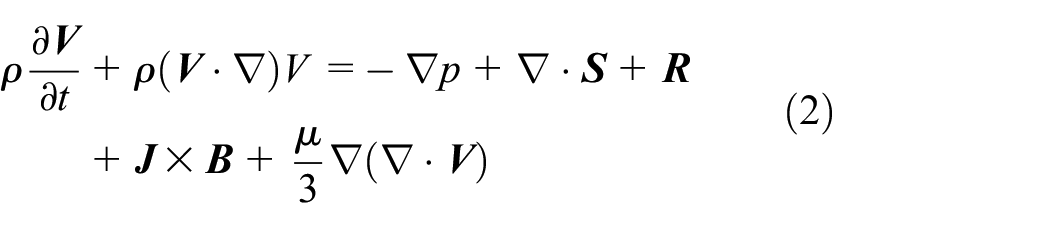
The governing flow equations for compressible Jeffrey fluid in general form are stated as
where are the respective dynamic viscosity, density, pressure, and time, whereas, J, V, and B examines the electric current, velocity vector, and magnetic vector.
For Jeffrey fluid extra stress tensor S is defined as
In which and are the relaxation and retardation times, is the first Rivlin–Ericksen tensor which is given by
Darcy’s resistance R is defined as
where , K (>0). The conducting fluid passes through uniform magnetic field . For small magnetic Reynold number, induced magnetic field is ignored and body force is , electric fields are ignored only the magnetic field B is present, so the current becomes ( is the conductivity of electric filed).
Characteristic response of fluid to compression is given by equation
represents compressibility of the liquid. The solution of equation (5) is
Here, signify the density and identify the reference pressure.
In component for continuity and momentum, equation for Jeffrey compressible fluid takes the following form
Envelope of cilia tips is defined as
which can be taken as boundary for flow domain. Sleigh28 observed different patterns of cilia motion, it is assumed that cilia tips can move in elliptical paths, that is, cilia tips in horizontal position is
Here, is the reference position of the particle and is the measure of elliptical motion. Also, a is amplitude, wave speed is denoted by c and is wavelength.
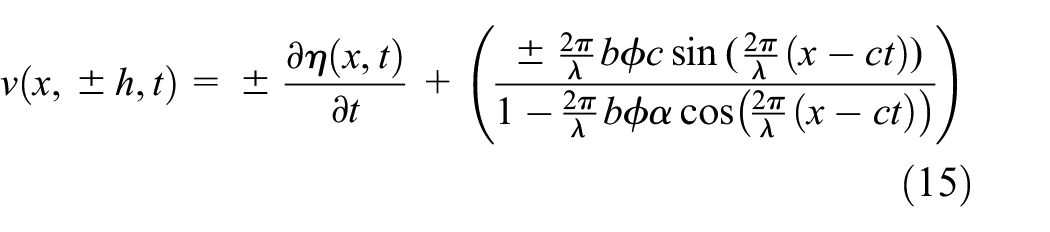
Thus, cilia velocity components are
The appropriate boundary conditions for cilia are
Introducing non-dimensional variables and parameters
These parameters represent the wave number, amplitude ratio, compressibility parameter, Reynolds number, magnetic parameter, and slip parameter.
Using these variables the above equations become
where
Solution of the problem
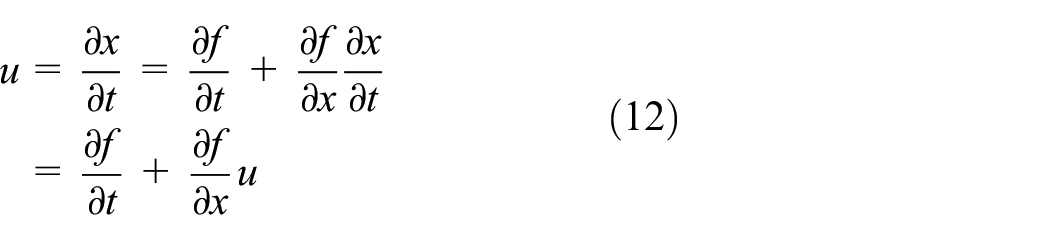
For solving system of equation, we assume steady case in which , v = 0, and taking pressure gradient constant, that is, .
For this boundary value problem exact solution is given as
where .
The case for no-slip condition can be removed when
Perturbation solution
To find the solution of above nonlinear equations we use the regular perturbation method. For that we define the perturbed unknown quantities for small values of in the following form
Equating the like powers of , we obtain the following.
For
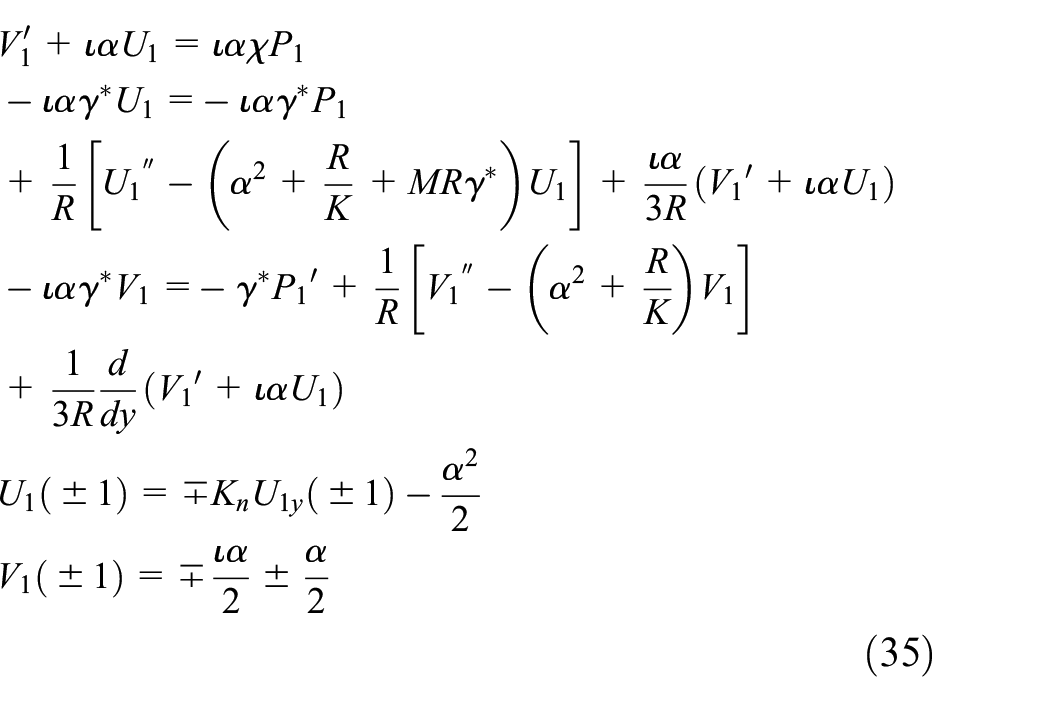
For
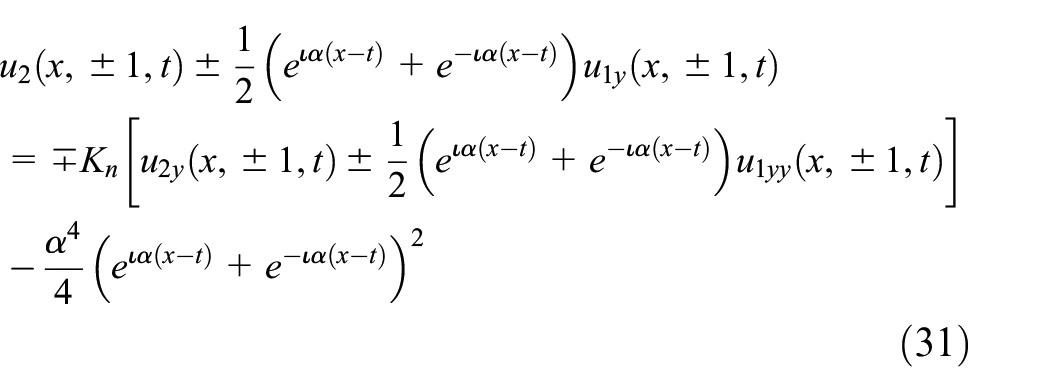
Equations (22) and (23) represent the boundary condition using Taylor expansion method about also use these expansions into boundary conditions and using equation (26) we write sines and cosines in exponential powers.
For
For
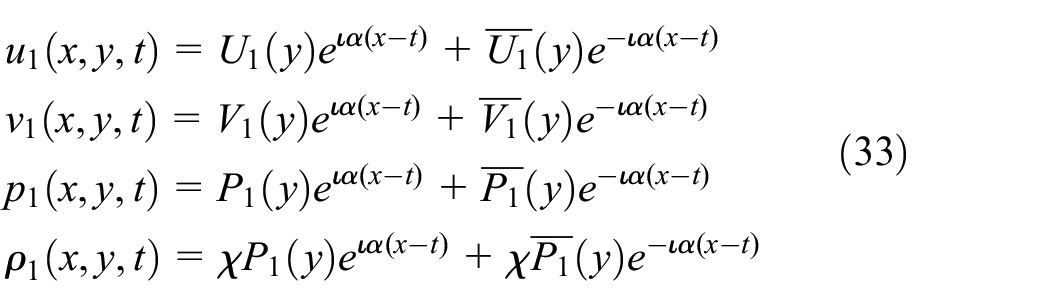
The solutions of above systems can be obtained with the help of following supposed form of solutions for all the systems
Here, overbar denotes the complex conjugate.
With the help of these solutions, the above boundary value problems take the form
Here, complex parameters are
Aarts and Ooms11 presented the procedure for the solution of equations and Mekheimer and Abdel-Wahab15 also followed the respective techniques.
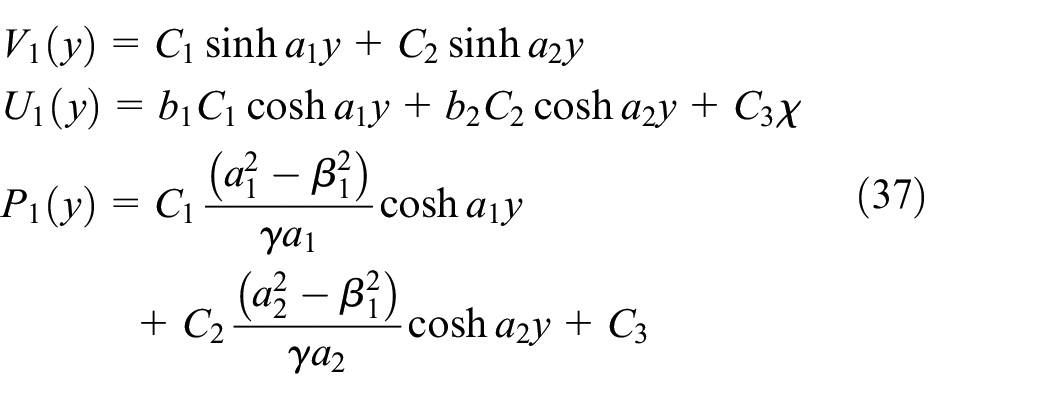
Thus, by omitting the lengthy calculations solution of first-order equations for velocity and pressure, one have
Perturbation function of mean velocity is defined as
All the constants appear in above equations are defined in Appendix.
Results and discussion
Figure 2(a)–(e) gives the change in behavior of G(y) with respect to y which occurs due to change in conduct or character of parameters. For MHD perturbation function, various values of M are considered. Figure 2(a) shows that when magnetic field is increased then G(y) is reduced, reason being the current J×B defined in equation (2), by increasing M by means of which the perturbed velocity becomes flat. Figure 2(b) shows the increasing effect of K on G(y). It is seen that G(y) moves toward the wall when K is varied. Figure 2(c) and (d) displays the behavior of perturbation function G(y) for retardation and relaxation times when M = 0. Figure 2(c) shows that has increasing effect for perturbation function for M = 0. Also, combined effects of M and are shown in Figure 2(d). Figure 2(d) shows that has decreasing effect on perturbation function for M = 0. Figure 2(e) shows effect of compressibility parameter on perturbation function. By increasing , graph of velocity perturbation decreases.
Perturbation function G(y) for variation of mean velocity: (a) K = 0.5, , (b) M = 0, R = 15, , (c) , (d) , and (e) .
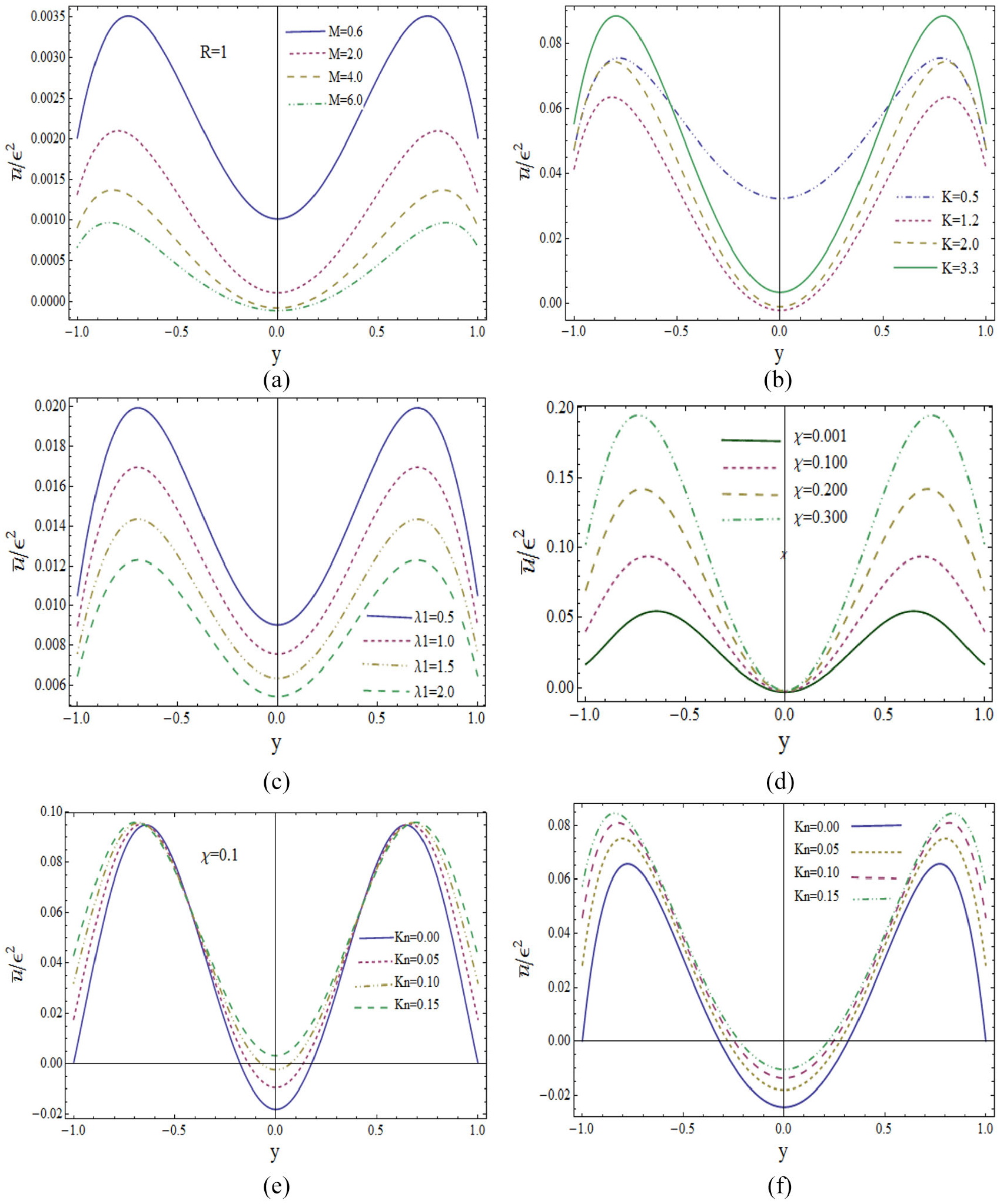
Figure 3(a)–(f) shows the change in mean velocity with y for various values of M, , , K, Kn, and . Figure 3(a) shows that for R = 1, magnetic number is increased. Mean flow distribution decreases by increasing the magnetic parameter and obtain a backward flow. It is interesting to note that backward flow for non-Newtonian fluid is less than for Newtonian fluid. In Figure 3(b), it is to be noted that by increasing the values of K mean flow decreases, this is because the permeability parameter allowed more fluid to pass through the pores, but when K≥2 mean flow increases, thus velocity of the fluid is more for large permeability parameter. Figure 3(c) shows that for an increasing backward flow occurs in neighboring focus line, and the mean axial velocity increases. Figure 3(d) and (e) shows the combined consequence of Kn, on mean velocity spreading, for χ < 0.5 backward flow occurs on center line, and by increasing Kn mean axial velocity also increases. Figure 3(d) shows that by increasing the value of there occurred decreasing effect for mean axial velocity. Figure 3(e) shows that for increasing Kundsen number Kn, the mean axial velocity also increases. Figure 3(f) shows the compressibility effect that by increasing the values of and Kn mean flow distribution increases.
The mean-axial velocity distribution for: (a) R = 1, K = 1, 1.2, 0.4, , (b) R = 5, , , , (c) R = 1, K = 1.3, 1.5, , (d) R = 10, K = 3.3, 0.7, 0.4, , (e) R = 10, K = 1.3, 0.9, 0.4, , and (f) , .
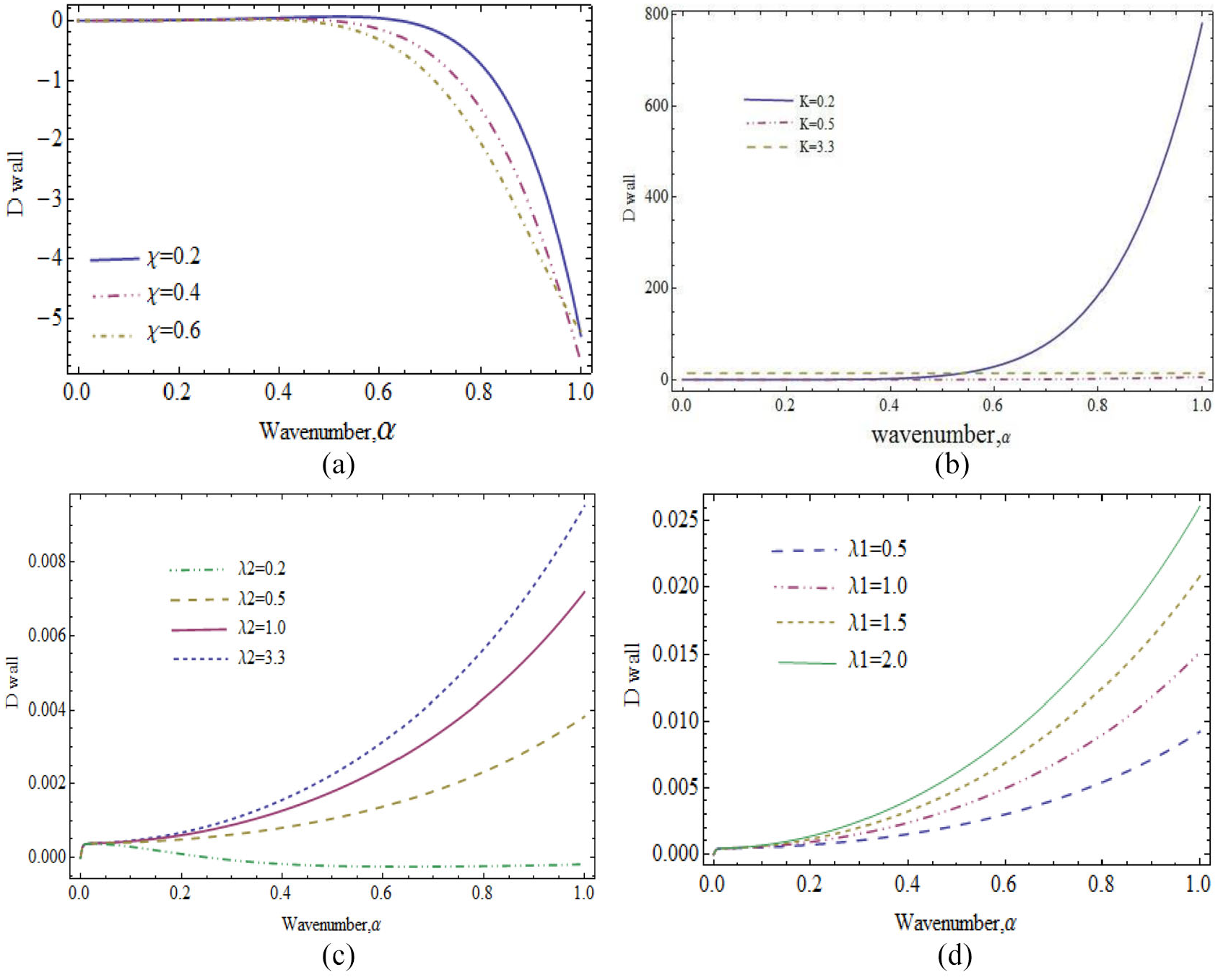
Figure 4(a)–(d) shows that changes occurred in where with respect to wavenumber for different values of K, , and . Figure 4(a) shows that for any value of , decreases by increasing the values of . Figure 4(b) depicted that decreases by increasing values of for any value of . It is shown by Figure 4(c) that is much greater for Jeffrey fluid than that for Maxwell fluid. It is also observed that values of increase rapidly, which depicts that effects of viscoelasticity are more evident for larger values of . Figure 4(d) shows the variations of in presence of M. It is to be noted that for M = 2 effects on increase by increasing values of
Change in with wavenumber : (a) R = 10, K = 1.5, M = 2, , (b) R = 10, , M = 0.5, , (c) R = 10, , M = 1.5, , and (d) R = 10, , M = 2, .
Conclusion
The research work of peristalsis and cilia on the flow of MHD compressible Jeffrey fluid made by surface acoustic wave through micro-parallel plates over a porous medium is analyzed, the main points of the problem areas are as follows:
For no-slip fluid, velocity perturbations G(y) are large.
The permeability parameter has growing result on G(y) and has reducing effect on velocity at boundaries.
With the existence of retardation time the flow becomes slow.
Oscillations decompose with an increase in magnetic parameter, and retardation effect becomes weak.
Perturbed velocity becomes flat around centerline for high values of magnetic field and Reynolds numbers.
Occurrence of porous medium in symmetric channel reduces the flow in case of no-slip condition with peristalsis effect associated with ciliated effect.
For Newtonian fluid, magnetic field is higher and for micropolar fluid magnetic fluid is small, also magnetic field is smaller as transverse magnetic field increases.
Footnotes
Appendix 1
Variable and parameters for first-order solution are
Using boundary conditions, the complex constants for second-order solutions are
Handling Editor: James Baldwin
Declaration of conflicting interests
The author(s) declared no potential conflicts of interest with respect to the research, authorship, and/or publication of this article.
Funding
The author(s) received no financial support for the research, authorship, and/or publication of this article.
ORCID iD
Sohail Nadeem
References
1.
GuiraoBJoannyJF. Spontaneous creation of macroscopic flow and metachronal waves in an array of cilia. Biophys J2007; 92: 1900–1917.
2.
AkbarNSKhanZHNadeemS. Metachronal beating of cilia under influence of Hartmann layer and heat transfer. Eur Phys J Plus2014; 129: 176.
3.
CorderoJRVLaugaE. Waving transport and propulsion in a generalized Newtonian fluid. J Nonnewton Fluid Mech2013; 199: 37–50.
4.
GueronSGurevichKL. Energetic considerations of ciliary beating and the advantage of metachronal coordination. Proc Natl Acad Sci USA1999; 96: 12240–12245.
5.
ShapiroEMSharerKSkrticS, et al. In vivo detection of single cells by MRI. Magn Reson Med2006; 55: 242–249.
6.
MisraJCMaitiS. Peristaltic pumping of blood in micro-vessels of non-uniform cross-section. J Appl Mech2010; 79: 1–28.
7.
KhaderiSNden ToonderJMJOnckPR. Fluid flow due to collective non-reciprocal motion of symmetrically-beating artificial cilia. Biomicrofluidics2012; 6: 014106.
8.
GadNS. Effect of Hall currents on interaction of pulsatile and peristaltic transport induced flows of a particle–fluid suspension. Appl Math Comput2011; 217: 4313–4320.
9.
GribbenRJ. The magnetohydrodynamic boundary layer in the presence of a pressure gradient. Proc R Soc Lond A Math Phys Sci1965; 287: 123–141.
10.
TsiklauriDBeresnevI. Non-Newtonian effects in the peristaltic flow of a Maxwell fluid. Phys Rev E2001; 64: 036303.
11.
AartsACTOomsG. Net flow of compressible viscous liquids induced by travelling waves in porous media. J Eng Math1998; 34: 435–450.
12.
QiQJohnsonREHarrisJG. Boundary layer attenuation and acoustic streaming accompanying plane-wave propagation in a tube. J Acoust Soc Am1995; 97: 1499–1509.
13.
BeilFWWixforthABlickRH. Investigation of nano-electromechanical-systems using surface acoustic waves. Physica E: Low Dimens Syst Nanostruct2002; 13: 473–476.
14.
ChenWI. Influence of ultrasonic energy upon the rate of flow of liquids through porous media. PhD Thesis, West Virginia University, Morgantown, WV, 1969.
15.
MekheimerKSAbdel-WahhabiAN. Effect of wall compliance on compressible fluid transport induced by a surface acoustic wave in a microchannel. Numer Methods Partial Differ Equ2011; 27: 621–636.
16.
GaoCJianY. Analytical solution of magnetohydrodynamic flow of Jeffrey fluid through a circular microchannel. J Mol Liq2015; 211: 803–811.
17.
JhaBKAinaBAjiyaAT. MHD natural convection flow in a vertical parallel plate microchannel. Ain Shams Eng J2015; 6: 289–295.
18.
SchaafSAChambréPL. Flow of rarefied gases (Princeton aeronautical paperbacks), vol. 8. Princeton, NJ: Princeton University Press, 1961.
19.
DamianouYGeorgiouGCMoulitsasI. Combined effects of compressibility and slip in flows of a Herschel–Bulkley fluid. J Nonnewton Fluid Mech2013; 193: 89–102.
20.
MekheimerKSKomySRAbdelsalamSI. Simultaneous effects of magnetic field and space porosity on compressible Maxwell fluid transport induced by a surface acoustic wave in a microchannel. Chin Phys B2013; 22: 124702.
21.
VafaiKKhanAASajjadS, et al. The study of peristaltic motion of third grade fluid under the effects of Hall current and heat transfer. Z Naturforsch A2015; 70: 281–293.
22.
MekheimerKSWahabAN. Net annulus flow of a compressible viscous liquid with peristalsis. J Aerospace Eng2011; 25: 660–669.
23.
SelimefendigilFÖztopHFChamkhaAJ. Mixed convection of pulsating ferrofluid flow over a backward-facing step. Iran J Sci Technol Trans Mech Eng2019; 43: 593–612.
24.
KumarBSethGSNandkeolyarR, et al. Outlining the impact of induced magnetic field and thermal radiation on magneto-convection flow of dissipative fluid. Int J Therm Sci2019; 146: 106101.
25.
MenniYAzziAChamkhaA, et al. Effect of wall-mounted V-baffle position in a turbulent flow through a channel: analysis of best configuration for optimal heat transfer. Int J Numer Methods Heat Fluid Flow2019; 29: 3908–3937.
26.
GhalambazMZadehSMHMehryanSAM, et al. Analysis of melting behavior of PCMs in a cavity subject to a non-uniform magnetic field using a moving grid technique. Appl Math Model2020; 77: 1936–1953.
27.
MehryanSAMTahmasebiAIzadiM, et al. Melting behavior of phase change materials in the presence of a non-uniform magnetic-field due to two variable magnetic sources. Int J Heat Mass Transf2020; 149: 119184.
28.
SleighM. An example of mechanical co-ordination of cilia. Nature1961; 191: 931–932.