



Abstract
This research inspects the liquid film flow of the nanofluid in a permeable medium with the consequence of thermal radiation over a stretching sheet. The viscidness and thermal conduction of the nanofluid varies with temperature in such a manner that the thermal conductivity considered in direct relation while the viscosity considered inversely proportional to the temperature field. The invariable magnetic field applies vertically to the flow field in the existence of entropy generation. For the above-mentioned nanofluid study, Buongiorno’s model is used. The leading equations are changed into a set of third- and second-order nonlinear coupled differential equations. These nonlinear ordinary differential equations are solved using the optimal approach of homotopy analysis method. The physical appearance of the modelled parameters based on the liquid film thickness is mainly focused. Furthermore, the influence of embedded parameters like variable viscosity parameter
Keywords
Introduction
Liquid film flow is the significant natural phenomena. The raised extensive interest and its huge applications in the area of industries, engineering and technology in a last few years clarify its importance in nature. The practical application related to the investigation of thin film flow is an inspiring relationship between fluid mechanics and fluid dynamic. The most popular technological uses can establish in the freezing of electronic procedures, 1 absorption, 2 vaporization, 3 ink-jet printing 4 and self-assembly of nanoparticles. 5 The key role of liquid film flows is in coating phenomena. To maintain the ideal rate and best performance in fibre and wire coating industry, the liquid film plays a vital role to control friction within the heat and mass transfer. 6 The stretching materials like rubber and plastic materials have also a key role in the field of industry and engineering. Keeping in view all of the above applications, Wang 7 was the central to explore liquid film flow on a time-dependent stretched surface. The similar research was further extended by Usha and Sridharan. 8 The heat transfer consequence of the liquid film investigation on the parallel sheet was considered by Liu and Andersson. 9 To solve the problem using numerical methods and also deliberate the limited flow constraints. Aziz et al. 10 studied the consequence of inner heat production on stream in a thin fluid film at a time depending extending sheet. Recently, Tawade et al. 11 investigated thin liquid flow over a time depended extending surface in the existence of thermal radioactivity and magnetic field. They used Newton–Raphson and Runge-Kutta Fehlberg methods for the solution problem. Andersson 12 was the pioneer to study the flow of a thin film of non-Newtonian fluids in a time-dependent starching sheet by considering the power law model. Khan et al. 13 examined the steady flow of liquid film on an extended/contracted surface. They studied the variable fluid properties of the liquid film using the concept of variable thickness of the film. Qasim et al. 14 studied the nanofluid thin film on a time-dependent stretching sheet taking Buongiorno’s model. Liu and Andersson have examined the time-dependent flow of a thin film over a stretching surface.
Entropy generation is one of the main factors of fluid flow and has very common applications in physical science. Several researchers have done a lot of work on it in different fields of science and technology. In the literature, vary less work is available in case of thin films nanofluid flow. Bejan15,16 was the first who inspected the entropy production in essential convective heat transmission. Liu and Lo 17 investigated entropy production in mixed convection magnetohydrodynamic (MHD) flow in perpendicular channel using numerical techniques. Nano liquids are the suspensions of nanoparticles and base liquid utilized for the upgrade of heat exchange and thermal conduction.
Heat transmission and entropy production in a fully developed mixed convection flow using nanofluids in perpendicular channel universal was examined by nanofluids. Srinivasacharya and Bindu 18 entropy production in a micropolar fluid flow over an inclined plate. Qing et al. 19 investigated the entropy production on the MHD Casson nanofluid flow on a permeable stretching/shrinking sheet. Abolbashari et al.20,21 worked on logical modelling of entropy production for Casson nanofluid flow persuaded by an extending surface. Freidoonimehr and Rahimi 22 investigated the properties of thermophoresis and Brownian motion on nanofluid heat transmission and entropy production. Afridi et al. 23 examined the entropy generation in the fluid flow over an extending surface with convection. Bhatti et al. 24 studied the numerical reproduction of entropy production with thermal radioactivity on MHD Carreau nanofluid near a shrinking sheet. Abas et al. 25 studied the entropy production on nanofluid flow through a horizontal Riga plate. Khan et al. 26 have examined the impact of the entropy generation considering the flow of the Powell–Eyring fluid between the two rotating discs. In their study, they analysed the magnetic and thermo-diffusion effects.
Chauhan and Olkha 27 have studied the Slip flow and heat transfer of a second grade fluid in a porous medium over a stretching sheet considering power-law model. Liu 28 studied flow and heat transmission of an electric conducted fluid of second grade in a permeable surface on an extending sheet having a transverse magnetic field. Siddeshwar and Mahabaleshwar 29 studied consequence of radioactivity and heat transfer on MHD flow of visco-elastic fluid and heat transfer on a stretched surface.
The heat transfer and magnetic effect are mainly using in the different technologies and industrial fields. In the recent literature, Soomro et al. 30 and Haq et al.31–33 examined the nanofluid flow for the rapid heat transfer using the different geometries.
In the field of science and engineering, most of mathematical problems are multifaceted in their nature and the exact solution is almost very difficult or even not possible. So for the solution of such problems, numerical and analytical methods are used to find the approximate solution. One of important and popular technique for the solution of such type problems is the homotopy analysis method (HAM). It is a substitute method and its main advantage is applying to the nonlinear differential equations without discretization and linearization. Liao34–39 was the first one to investigate this scheme for the solution of nonlinear equations and generally proved that this method is rapidly convergent to the approximated solutions. Also, this method provides series solutions in the form of functions of a single variable. Solution with this method is important because it involves all the physical parameters of the problem and we can easily discuss its behaviour. Due to its fast convergence, many researchers Abbasbandy et al.,40–42 Rashidi and Pour, 43 Waris et al. 44 and Noor et al. 45 used this technique to solve highly nonlinear and coupled equations.
Physical parameters in dimensionless form are normally happening in the variety of problems. How to control them by defining their range of validity is a big issue. In this article, a mathematical approach is offered to identify the correct range of physical parameters implementing the analytic approximate HAM as used by Turkyilmazoglu.46–48
According to the above important discussion, the aim of the present work is to extend the idea of Qasim et al. 14 for further study by including the entropy generation terminology in the nanofilm flow and using the clue of varying viscosity and varying thermal conductivity terms. The study is also enlarged by the inclusion of porous media and thermal conductivity effects. For simplicity, the modelled equations have been considered in steady state. 13
Problem formulation
The nanofluid stream over a contracting/extending sheet is pondered in such a form, to the point that its viscosity and thermal conductivity are fluctuating while its density stays consistent. The Cartesian directions are established in such a way that ox is identical and y is vertical to the sheet. The constant sheet at
The temperature field in the flow is defined as


The appropriate boundary condition for the flow configuration is given as13,14,44,45


where
According to the Reynolds model, the dimensionless temperature-dependent viscosity can be expressed as
Here

Introducing the succeeding similarity transformations

in which prime identifies the derivative with respect to


The non-dimensional thickness of the liquid film
The boundary constraints of the problem in the dimensionless form are as follows

The physical constraints after generalization: where
The attentive physical quantities are the skin friction coefficient

where

are the shear stress, heat and mass fluxes at the surface, respectively. Using the associated expressions for dimensionless skin friction coefficient

where

is the local Reynolds number based on the stretching velocity.
Entropy generation analysis
The volumetric entropy production of viscid fluid is defined as

The mention equation specifies, entropy production has two features, first is the conduction consequence which is also named heat transmission irreversibility (HTI) and the second one fluid friction irreversibility (FFI) and diffusive irreversibility (DI). Whereas the last two terms are due to the magnetic and porosity terms. The features entropy production can be expressed as

The entropy generation number

where

The relative importance of the sources of entropy generation is an important factor for the engineers and this important measurement is the Bejan number

The similarity transformation alters the Bejan number

Solution by HAM
Equations (8)–(10) and the resulting boundary restrain equation (11) are estimated by HAM. The solutions surrounded the auxiliary constraints
The primary estimates are selected for the given problem similar as in Khan et al. 13

The linear operators elected are

These linear operators have the consequent properties

Wherever
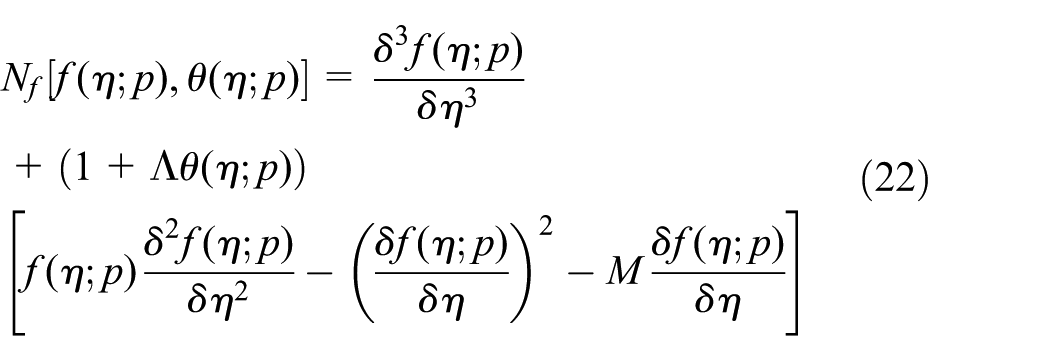
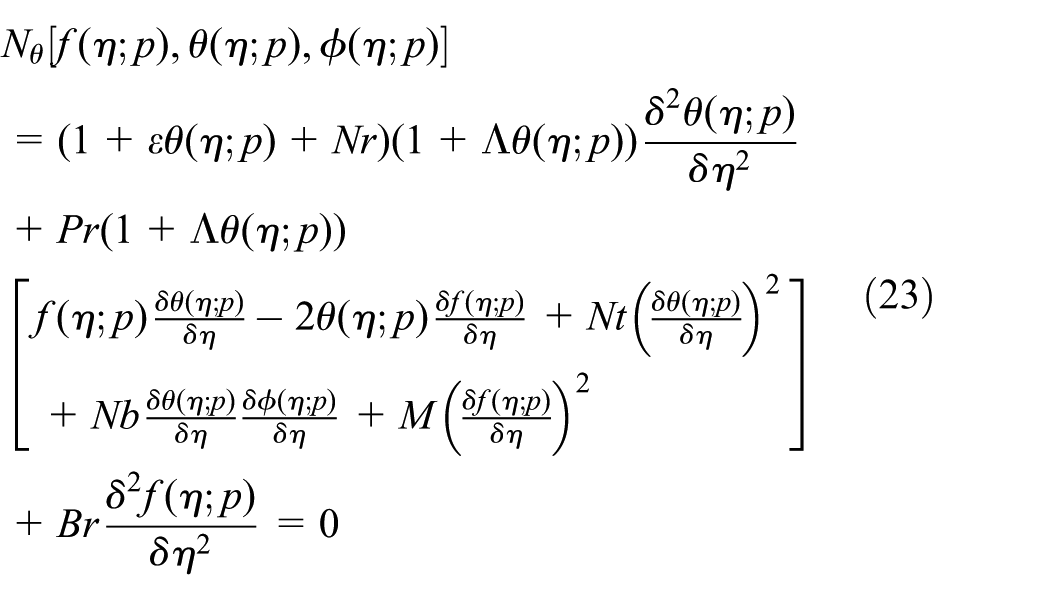

The fundamental solution process by HAM is clear in the literatures29–40 the 0th order scheme form equations (9)–(11) as


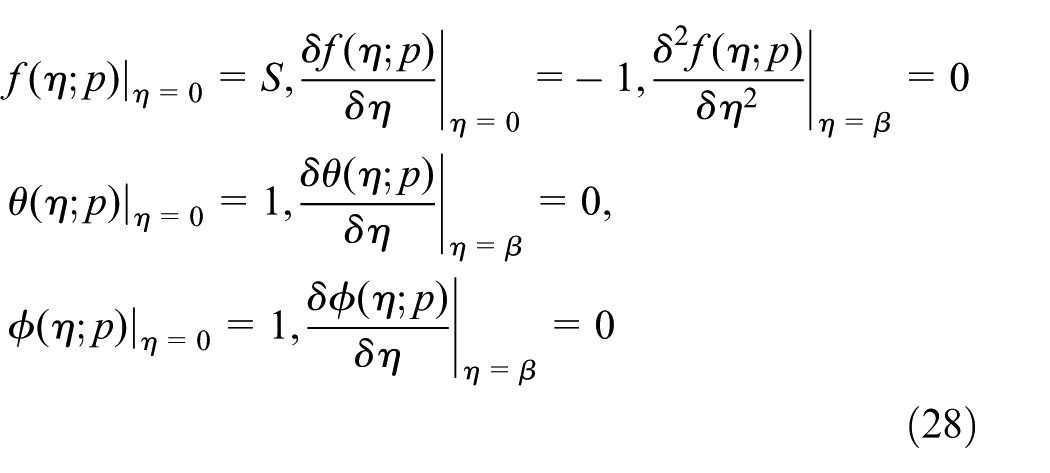
The correspondent boundary constraints are
Wherever

Increasing

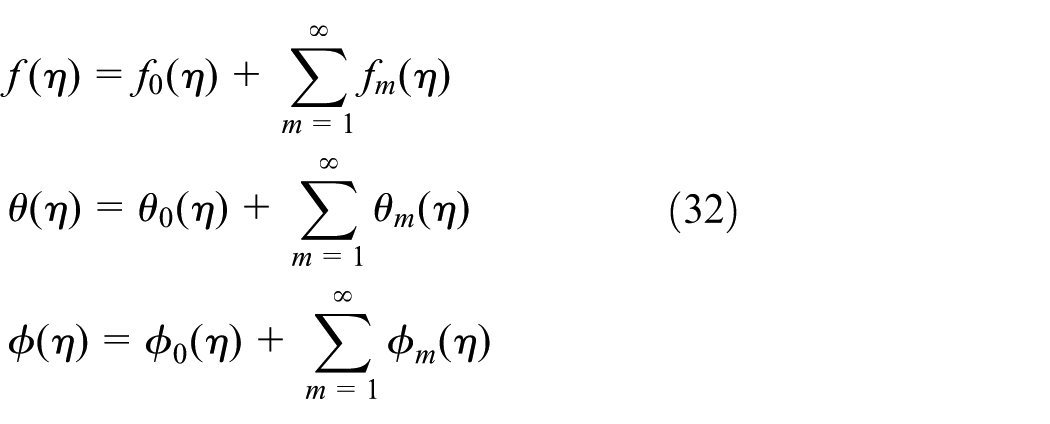
where

The secondary restrictions
The mth order scheme satisfies the subsequent

The consistent boundary situations are

Here


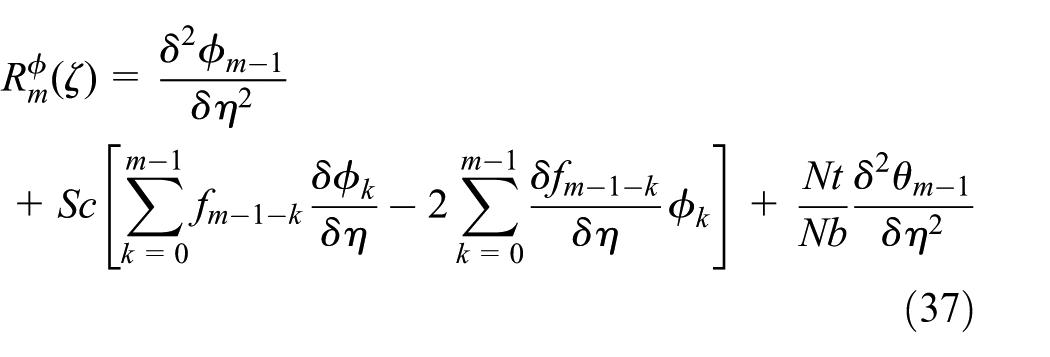
where

HAM solution convergence
The convergence of equations (23)–(25) exclusively be influenced by the auxiliary limitations
Results and discussion
The fluid of viscous flow behaviour is deliberated by describing the whole parameters. Figure 1 explains the geometry of the problem. Figures 2–4 show the

Geometry of the problem.

The graph of

Show the

The graph of

Deviations in velocity, pitch
The characteristics of magnetic parameter

Deviations in velocity, pitch

Deviations in the temperature field

Deviations in the temperature field
The effect of

Deviations in the temperature field
Figure 10 represents the consequence of viscosity factor
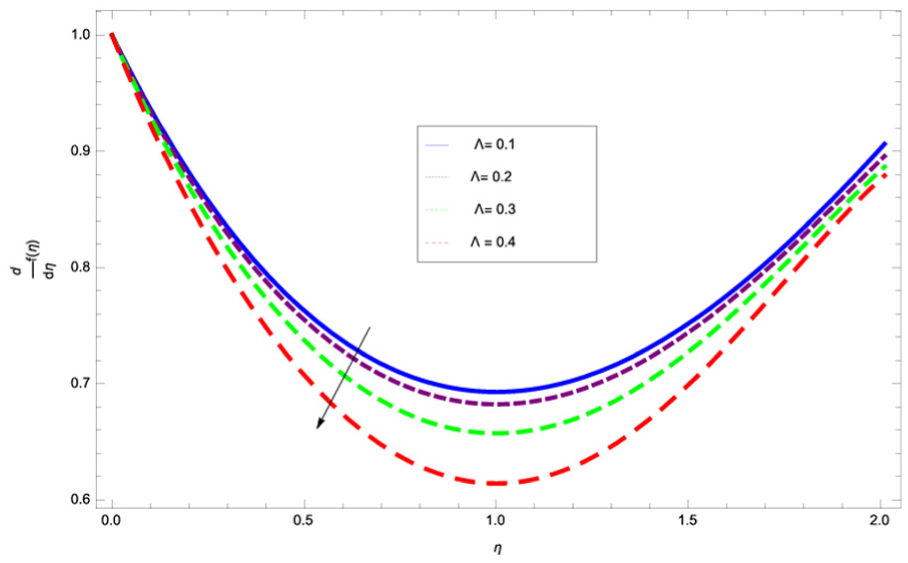
Deviations in the velocity ground

Deviations in the temperature field
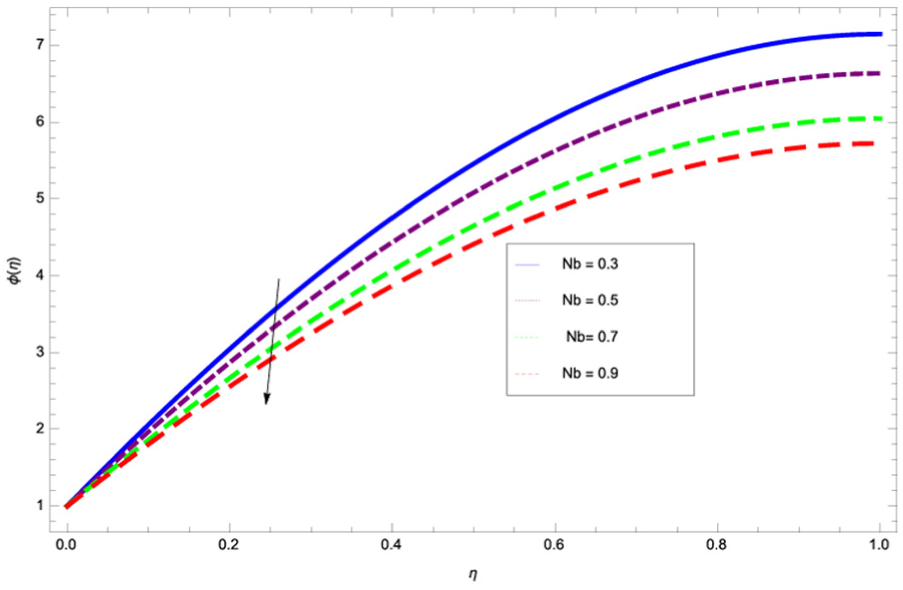
Deviations in the concentration field

Variations in the velocity field
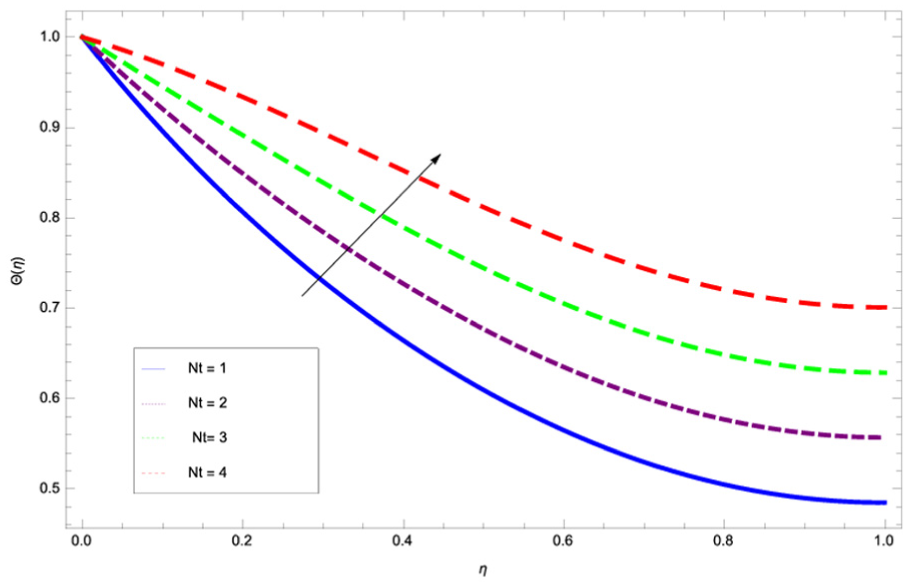
Deviations in the temperature field

Deviations in the concentration field

Deviations in the concentration field
Figure 17 represents the effect of magnetic parameters

Deviations in the entropy function
Figure 18 demonstrates the effect of Prandtl number

Deviations in entropy function
The effect of the magnetic parameter

Deviations in Bejan number
The closed agreement of the present work and Qasim et al. 14 has been displayed in Figures 20–22 for the velocity, temperature and concentration fields, respectively.
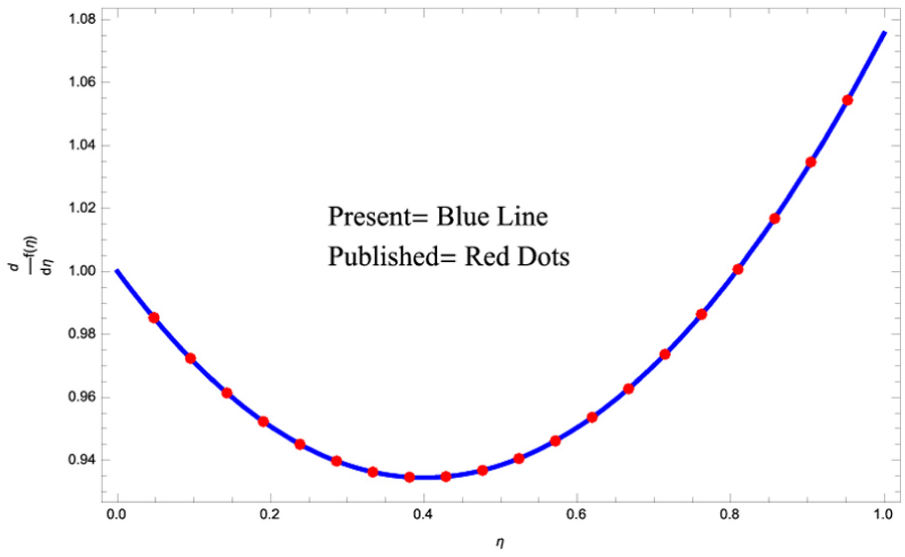
Represent the relationship of Qasim et al.
14
and present result for velocity
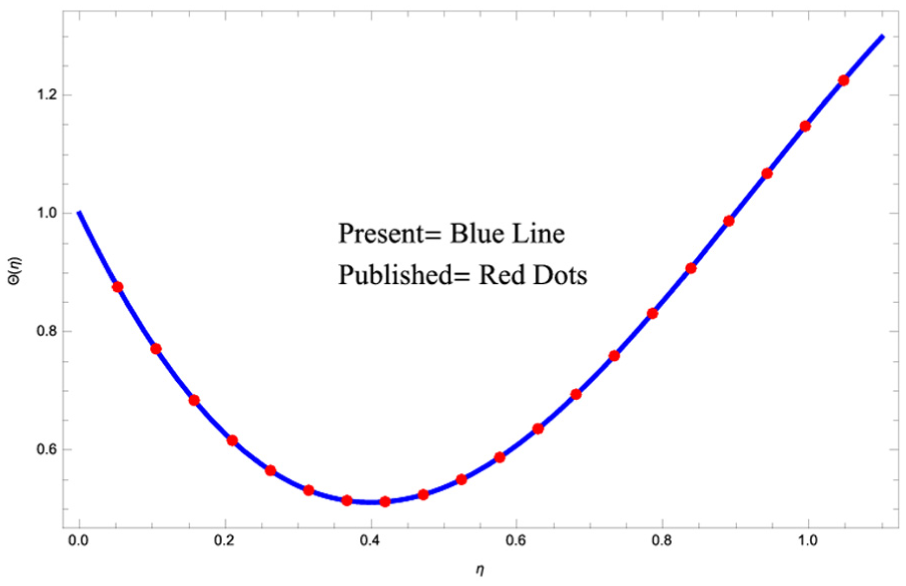
Represent the relationship of Qasim et al.
14
and present result for temperature pitches

Represent the relationship of Qasim et al.
14
and present result for concentration pitches
The parametric range of all the physical constraints, velocity, temperature and concentration profiles has been obtained and plotted in Figures 23–27. In these figures, the desired error is achieved by the HAM method with the testing of the maximum and minimum values the physical parameters involved in the problem. The values of the parameters are selected to control the residual error and the minimum error achieved is up to

Represent the range of the parameters

Represent the range of the parameters
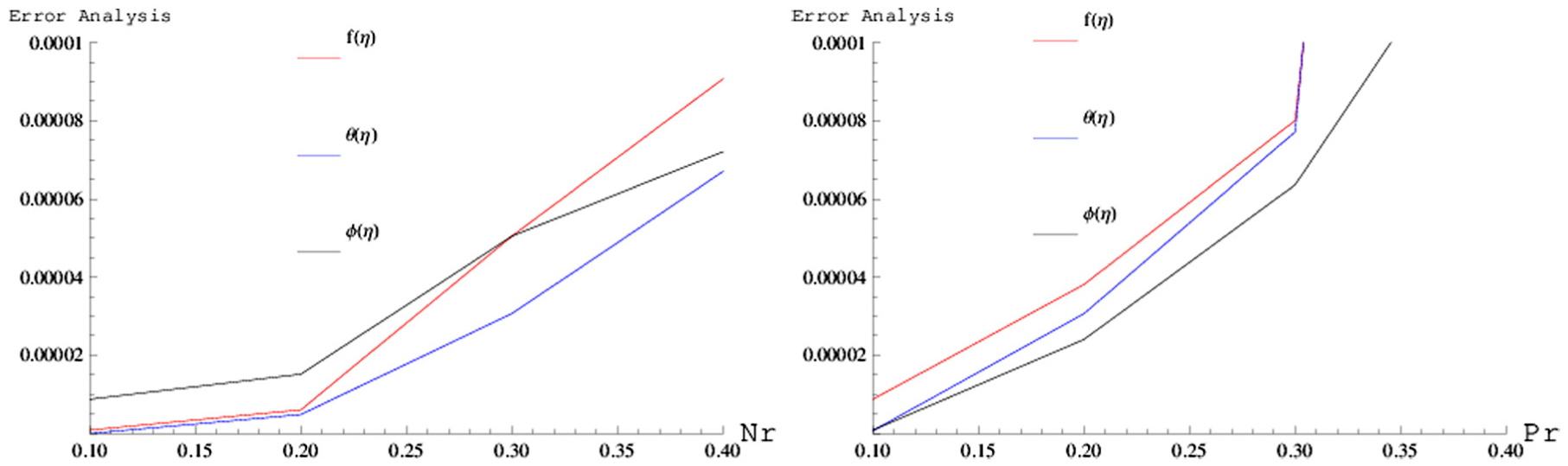
Represent the range of the parameters
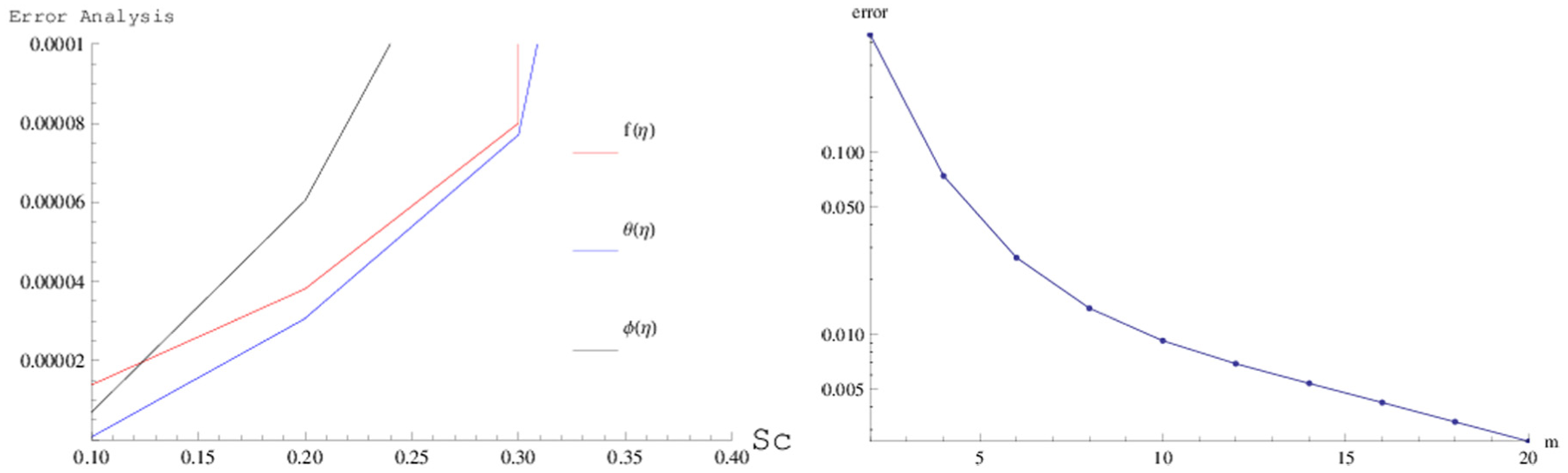
Represent the range of the parameter

Represent the residual error for the temperature
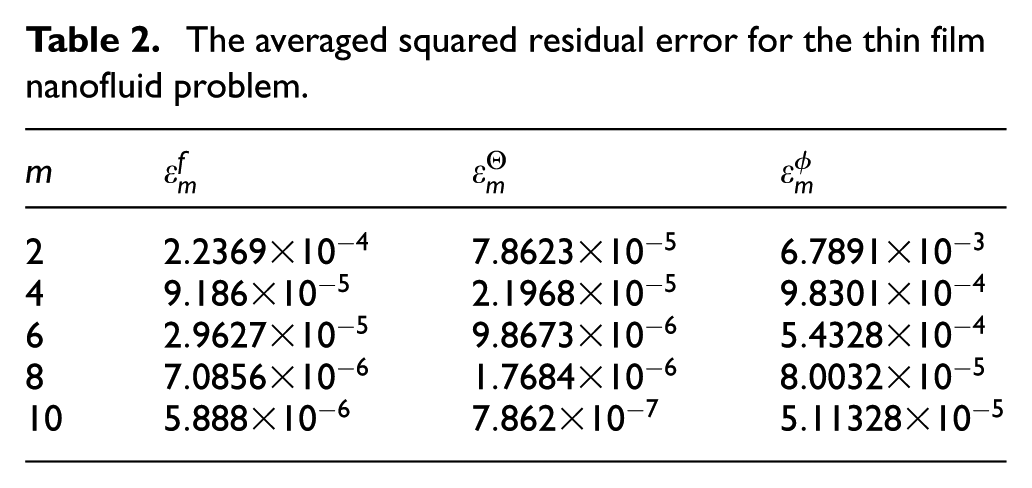
Table 1 shows the extension of the present work with the published work. The validation of the HAM method has been attained with the numerical outputs in the form of average squared residual error for the thin film nanofluid problem in Table 2.
Literature on the nano-liquid film with variable fluid properties.

The averaged squared residual error for the thin film nanofluid problem.
The convergence of the results is presented in Table 3 and it is detected that momentum and temperature gradient equality converges to 30th order of calculations while the concentration equality converges up to 31th order of calculations. The important physical quantities of skin friction coefficient, local Nusselt number and Sherwood number under the effect of embedded parameters have been displayed in Tables 4–6. The large quantities of magnetic parameter
The convergence of HAM problem solutions, when

HAM: homotopy analysis method.
Sketch of the

Sketch of the

Sketch of the

Conclusion
The nanofluid flow, selecting a thin layer over an extended/contracted sheet, has been demonstrated in this research. The published exertion of Khan et al. 13 and Qasim et al. 14 has been extended with the inclusion of entropy regime. The extension has also been enlarged with the attachment of variable viscosity and thermal conductivity. Also the porosity and thermal radiation terms included in the present work. The nonlinear equations have been solved using the optimal approach (optimal homotopy analysis method [OHAM]). The authentication of the work has been linked to the numerical method. The comparison of the present work and published work has been compared with the elimination of non-similar terms.
The concluded remarks are highlighted as:
The flexible viscosity and thermal conductivity effects have been observed through graphs and discussed.
The effects of Brownian motion and thermophoresis constraints have mainly focused and the observation have been notified on the variable thickness of fluid film with flexible fluid properties.
The Entropy regime and the impact of physical parameters related to entropy have also been focused.
The impact of the magnetic field and Brinkman number versus the Bejan number has been observed.
The thermal radiation effects have been perceived on the flow pattern and it is observed that the variable thickness of the liquid film is more affected as compared to the uniform thickness of the layer.
The impact of the various parameters versus the skin friction coefficient, Nusselt number and Sherwood number has been observed numerically.
Residual error and optimal values have been calculated and the range of each physical parameter has also been observed.
The recent research has been compared with the published work and much closed agreement has been achieved.
According to the prevailing literature, this is the first effort concerning the flexible, fluid properties considering nanofluid film with variable thickness.
Footnotes
Acknowledgements
The authors are very thankful to the Academic Section of the Higher Education Department Khyber Pakhtunkhwa for their moral and financial support. T.G. modelled the problem and solved. I.K. and E.B. participated in the physical discussion of the problem. I.H., I.U. and M.S. participated in the convergence controlling procedure and range of the parameters. M.A.K contributed in the numerical portion of the manuscript. All authors recited and acknowledged the final manuscript.
Handling Editor: Bo Yu
Author note
Muhammad Shuaib is now affiliated to Department of Basic Sciences, University of Engineering and Technology, Peshawar, Pakistan.
Declaration of conflicting interests
The author(s) declared no potential conflicts of interest with respect to the research, authorship and/or publication of this article.
Funding
The author(s) received no financial support for the research, authorship and/or publication of this article.