




Abstract
For hard rock drilling in coal mine, the drilling efficiency and service life of polycrystalline diamond compact bit are very low. To overcome these shortcomings, the bionic technology is applied to the design and processing of polycrystalline diamond compact bit. The bit body and polycrystalline diamond compact cutter are designed as bionic structures, and the test of the bionic polycrystalline diamond compact bit is carried out. Test results show that, when drilling in fine sandstone with hardness greater than 9, the performance of the bionic polycrystalline diamond compact bit is significantly improved. Comparing with the Φ113-mm concave polycrystalline diamond compact bit, the service life and drilling efficiency of the A-type bionic polycrystalline diamond compact bit increase by 54% and 230%, respectively, the service life and drilling efficiency of the B-type bionic polycrystalline diamond compact bit increase by 345% and 204%, respectively, which show that the bionic design of polycrystalline diamond compact bit can provide a new research idea for hard rock drilling in coal mine. Also the test results indicate that, when processing the bionic polycrystalline diamond compact cutter, the linear cutting process will cause thermal damage to the diamond layer of polycrystalline diamond compact cutter, while the cold grinding process shows higher comprehensive performance, therefore the one-time synthesis of bionic polycrystalline diamond compact cutter is the future research direction.
Introduction
Drilling construction is the main technical means to solve problems such as gas drainage, water exploration, and stratum structure prediction, and it is of great significance for the safe production of coal mines in China. However, with the increase in coal resource consumption, the mining depth is constantly increasing, and the probability of drilling hard, complex formations such as nodules is growing. 1 , 2 “A workman must sharpen his tools if he wants to do his work well,” as a pioneer of rock breaking, the performance of drill bit directly determines the efficiency and cost of drilling construction.
At present, the concave polycrystalline diamond compact (PDC) drill bit (Figure 1) is mainly used in underground coal mine drilling, and the purpose of reducing the deflection of near horizontal hole can be achieved by utilizing the features of the concave structure. In addition, the concave PDC bit has been widely used due to its advantages of simple structure, simple processing, and low cost. 3 , 4 However, with the increasing formation hardness and drillability, the cost performance of the concave PDC bit is getting lower and lower, the drilling efficiency and service life of the bit are low, especially when drilling in deep holes the drill pipe needs lifting and lowering frequently, which not only causes high labor intensity, but also increases the drilling costs and construction period significantly. For solving the above problems, many scholars have carried out the PDC bit optimization design research, such as improving the performance of PDC cutter, changing the pattern of PDC cutter arrangement, and so on, finally some achievement has been made.5–8 However, there are few studies on the design of PDC bit for hard rock drilling in near-horizontal holes in coal mines.

Schematic of three-wing concave PDC bit.
After millions of years of nature’s survival of the fittest, the organism has evolved to complex body structures with non-smooth surface form to adapt to the environment and meet the needs of survival. Based on bionic engineering, it is found that the “bio-coupling” structure formed by the interaction of morphology, structure, and materials has the functions of wear resistance, resistance reducing, and desorption, and the effect is remarkable.9–12 Therefore, this article combines the bionic technology with PDC bit to provide a new bit design idea to solve the problem of low drilling efficiency in hard rock.
Bionic design of PDC drill bit
Biological prototype
The mole lives underground all the year round, its feet are large and turned outwards, its claws are powerful, which is good for earthmoving. Its body is covered with short silky dark brown fluff, and the tip of the hair is not fixed in a certain direction, which is very suitable for running around in a narrow tunnel. 13 , 14 The mole’s forefoot is short and thick, its claw toes are of different lengths, and the front of its toes are rounded (Figure 2). All of these structural features are beneficial to release the internal stress of the soil, reduce the cutting resistance, and prevent the stick resistance. The mole’s claw has an excellent mechanical function with high mining efficiency, which provides a good research idea for the development of new PDC bits.

Structure of claws of the mole.
Bionic design of bit body
The design of the concave PDC bit is based on the principle of full bottom hole coverage. The advantage of this bit is that it is simple in structure and easy to be processed, but it is not conducive to improve the drilling efficiency. So in this article, the bionic design of the PDC bit is carried out by virtue of the advantage of the mole’s structure.
Bionic design of the crown shape
The front claws of the mole are of different lengths and are arranged in a stepped shape, and the front of the toe shows circular arc transition form. Based on this structure, the crown of the bit is designed into an arc shape with a certain inner cone angle (Figure 3). This crown shape, on the one hand, can stabilize the bit, reduce transverse vibration, and the distribution area of the cutter is large, which is beneficial to extend the life of the bit; on the other hand, the contact form between the PDC cutter and the rock is improved, the cutters are arranged in stratified and staggered form, which can enlarge the cutting free surface, realize the multi-track, multi-layer, and equal-volume rock-breaking modes. Finally, the crown shape is beneficial to improve drilling efficiency and promote uniform wear of the PDC cutter.
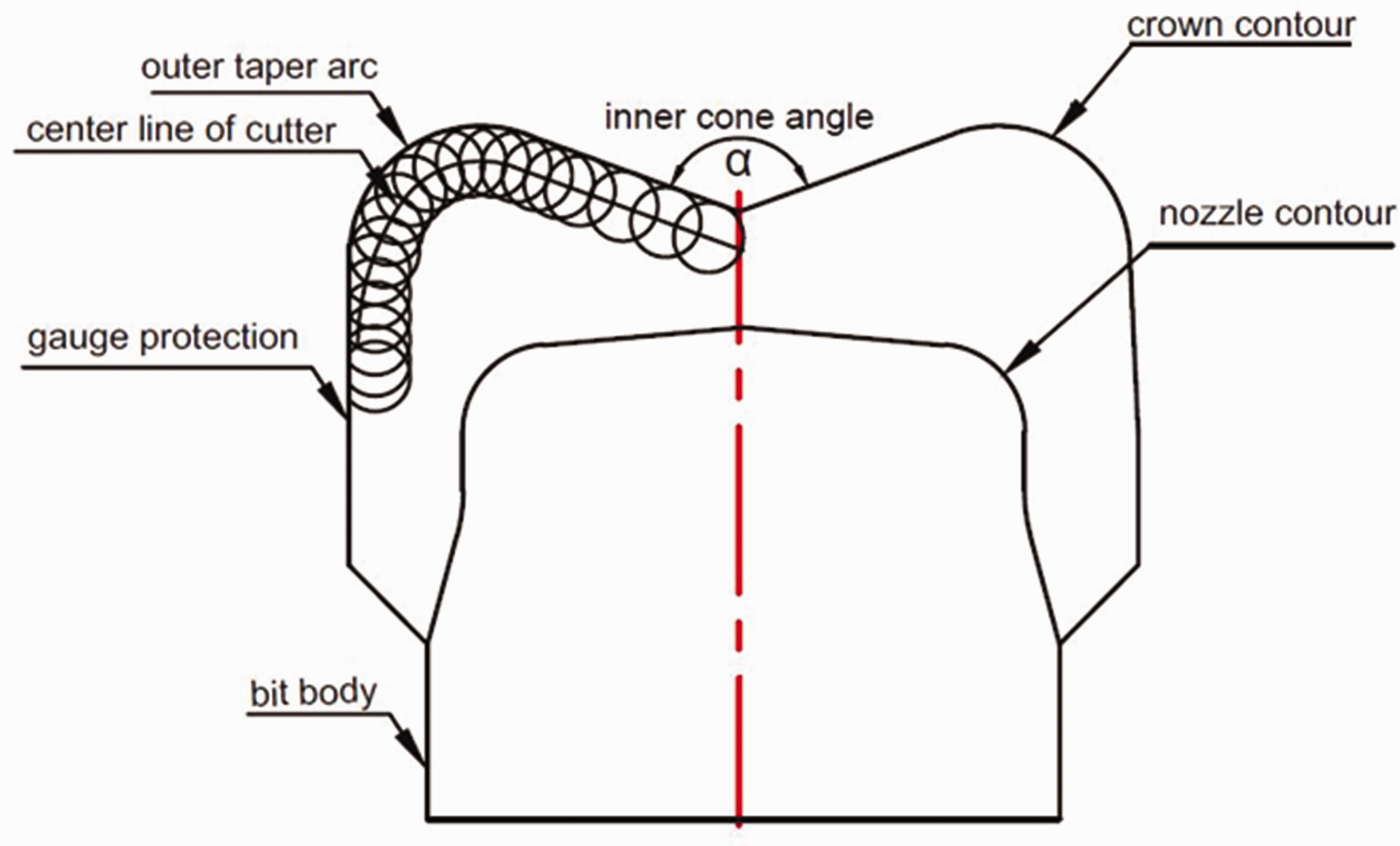
Bionic design of the crown shape.
Bionic design of the cutter arrangement
The length of the mole’s front claw is different, the middle toe is the strongest, and they show a certain dynamic angle when excavating. Based on this structure, the cutter arrangement of the PDC bit is optimally designed. First, on the basis of equal cutting pattern, the cutter density of the key parts of the drill bit is improved, and the high-performance PDC cutter is selected to reduce the probability of PDC cutter damage in the key parts. Second, the back rake angle of the PDC cutter is adjusted, with the increase of the rock hardness, the back rake angle increases gradually, the smaller the back rake angle, the stronger the ability of the cutter to penetrate into the rock (Figure 4). However, as the back rake angle increases, the cutter bears lager cutting load, and becomes more vulnerable to damage, so the value of the back rake angle is generally between 10° and 20°. Finally, to remove the cuttings quickly and reduce repetitive cutting, the side rake angle should be controlled between 3° and 8° according to the previous test.

Bionic design of cutter pattern.
Bionic design of the gauge surface
The non-smooth surface morphology of the biological surface has the characteristics of wear resistance, resistance reduction, and desorption, which has been widely used in many industries.15–17 For the matrix PDC drill bit, on the basis of placing diamond polycrystalline and hard alloy on the gauge surface, the bit gauge surface is designed to be non-smooth, which can further improve the wear resistance of the gauge, reduce the bit rotary resistance, and have the anti-counterfeiting effect. The design of the non-smooth structure is mainly to determine the relevant dimensions of each non-smooth unit, such as stripe spacing and height, and so on, and the gauge surface should be easy to be processed. Figure 5 is a schematic diagram of the designed biomimetic PDC bit.

Schematic of bionic PDC bit.
Bionic design of the PDC cutter
The PDC cutter is synthesized by cemented carbide and diamond micro-powder under high temperature and high pressure. Considering the processing technology and rock-breaking mechanism, the bionic design of PDC cutter is carried out from two aspects: first, the surface of the diamond layer is designed into several grooves (A-type); second, the diamond edge is designed into a multi-step micro-arc structure (B-type; Figure 6).
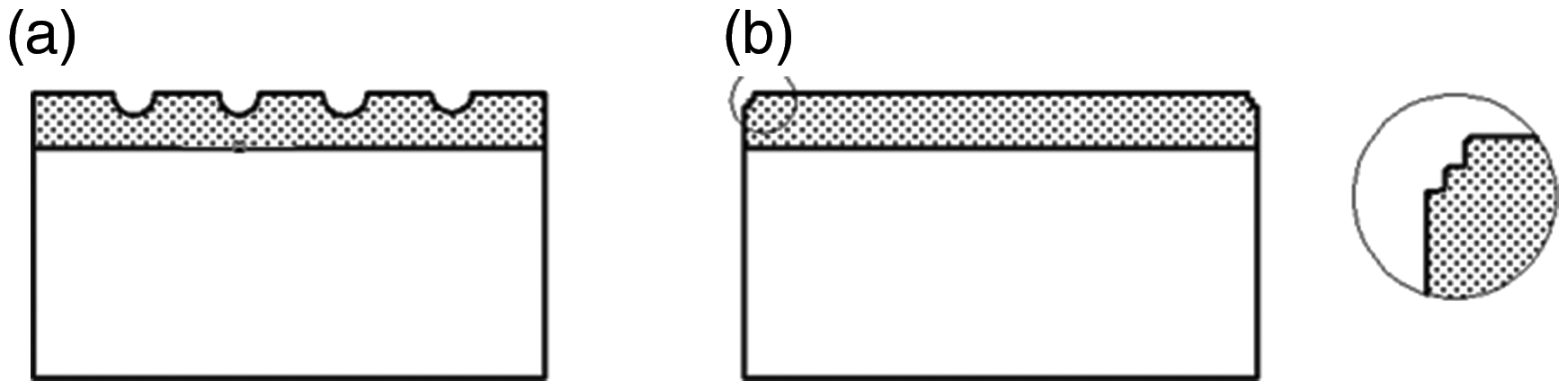
Bionic design of PDC cutter.
According to the above bionic design idea, a batch of bionic PDC cutters is processed. For the processing of A-type bionic PDC cutter, considering the processing technology and cost, the groove shape of non-smooth surface is formed by wire cutting on the cutter’s diamond surface, the number of the processed grooves is 2–5, and the corresponding numbers are A2–A5. For the processing of B-type bionic PDC cutter, the micro-arc structure of the diamond edge is processed, then under the cooling condition, the diamond grinding wheel is used to grind the micro-arc structure into multi-step shape, the number of the processed step is 2 and 3, and the corresponding numbers are B2 and B3. A common plane PDC cutter is selected for the comparison test, the number of the cutter is P1.
The bionic PDC cutters were welded into bolt drill bits to verify its performance (Figure 7) and the micro-drilling test was carried out by the self-developed micro-drilling test bench (Figure 8). 18
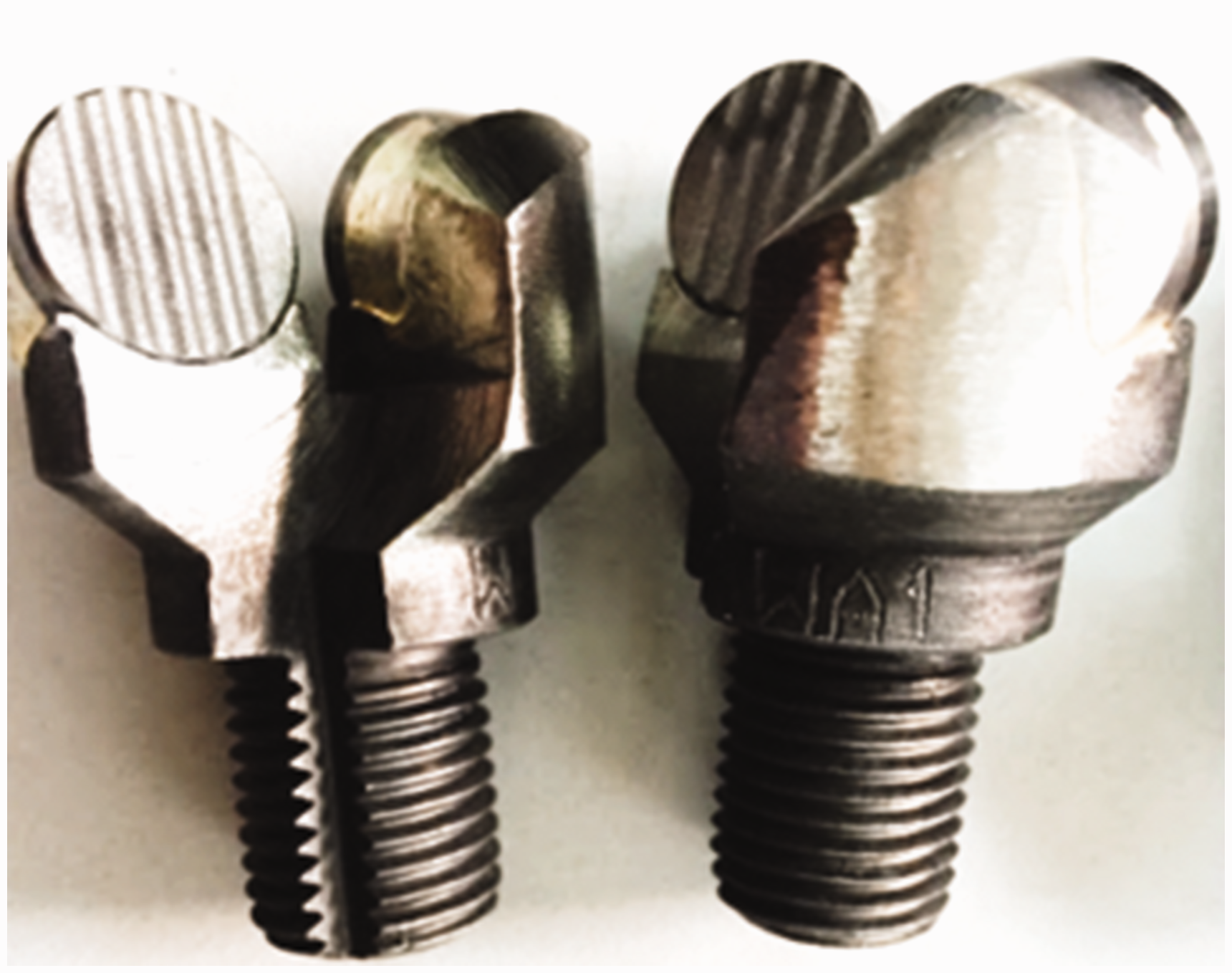
Bionic anchor bit.

Micro-drilling test equipment.
The rock sample was made of fine sandstone, the experimental parameters and results are shown in Table 1.
Test results of bionic PDC cutting performance.

From Table 1 it can be seen that the average drilling efficiency of bionic PDC cutter is significantly higher than that of common plane PDC cutter, but the breakage of A-type cutter is more, the cutter with four grooves has the best performance. The performance of B-type cutter is relatively stable, but the cutting efficiency is lower than that of A-type PDC cutter. Therefore, A4 and B2 bionic PDC cutters are selected for field test.
Producing of bionic PDC drill bit
The structure of the bionic PDC drill bit is complex, so pressure-less impregnation method is used to machining the bit body. The main processing steps are as follows: first, the negative mold is made by means of three-dimensional (3D) printing technology, then rubber mold is made by turning the negative mold over, and the ceramic mold is made by turning the rubber mold; second, adjusting the formula to mix the matrix, then assembling the steel body and the mold, filling the voids between the mold and the steel body with matrix powder and impregnated solder; finally performing the sintering operation and the heat preservation.
After cleaning the bionic bit body, the bionic PDC cutters are brazed to the bionic bit body which strictly abides the brazing process rules. The bionic PDC bit is shown in Figure 9.

Trial production of bionic PDC bit.
Field test of bionic PDC drill bit
Test site and formation conditions
The test site is located in Panyi Coal Mine of Huainan Mining Group. ZDY4300LP crawler drill rig, ZBQ-25/5 mud pump, and Φ73/63.5-mm wide blade spiral drill pipe were used. The drilling hole design is shown in Figure 10. The average hole depth was 41.2 m and the inclination angle was 51°–90°. Previously, the Φ113-mm concave PDC drill bit was used, the number of the used concave PDC drill bit was 860, the total footage was 25,772 m, and the average footage per drill bit was 29.9 m.

Design of drilling hole.
The drilled rock formations include: (1) medium-fine sandstone (f > 9): mainly light gray-white fine sandstone with thin or interbedded fine sandstones, thickness of 16.95 m; (2) interbedded with fine sandstone: gray sand muddy structure, thickness of 4 m; (3) medium and fine sandstone (f > 9): medium sandstone, grayish white medium grain structure with a small amount of coarse grain composition unclear, thickness of 5.8 m; (4) fine sandstone (f > 9): light gray white, thickness of 8.55 m; (5) mudstone: gray partial dark gray, thickness of 3.15 m; (6) 11-2 coal: black, semi-bright coal, thickness of 1.59 m; (7) sand mudstone: light gray, thickness of 4.18 m; (8) 11-3 coal: grayish black, thickness of 0.35 m; (9) fine sandstone (f > 9): light grayish white, thickness of 6.41 m.
Test results and analysis
The preferred A-type and B-type bionic PDC cutters were brazed on the bionic bit body, and Φ113-mm bionic PDC drill bits were processed. The results are shown in Table 2.
Field test data comparison.

From Table 2 it can be seen that, compared with the Φ113-mm concave PDC bit used in the field, the service life and drilling efficiency of the bionic PDC bit are significantly improved. For A-type PDC drill bit, the service life increases by about 54%, and the drilling efficiency increases about 230%; for B-type PDC drill bit, the average service life increases by about 345%, and the drilling efficiency increases by about 204%. In particular, the B-type bionic PDC bit has a higher cost performance.
The damage of A-type bionic PDC cutter mainly occurs in the diamond layer of the linear cutting process, which is mainly characterized by the peeling of the cutting layer, rather than the overall peeling of the diamond layer (Figure 11). It can be seen that thermal damage of the cutter occurred because of the linear cutting processing; while the B-type bionic PDC cutter exhibits higher impact toughness, its damage form is wear indicating that the bionic PDC cutting edge processed by the grinding method is more suitable for hard rock drilling.

Damaged form of bionic PDC cutter.
Conclusion
From the perspective of bionic engineering, the application of bionic technology to the design and processing of PDC drill bit provides a new research idea for solving the problems of short bit life and low drilling efficiency in hard rock drilling in coal mines. For the hard rock such as fine sandstone with f > 9, the performance of the developed bionic PDC drill bit is obviously improved. Compared with the Φ113-mm concave PDC bit, the service life of A-type bionic PDC drill bit increases by about 54%, and the drilling efficiency is improved by about 230%; while the average lifetime of the B-type bionic PDC drill bit increases by about 345%, and the drilling efficiency increases by about 204%. The secondary processing of the diamond layer of PDC cutter by linear cutting technology will cause thermal damage to the PDC cutter. However, the cold grinding processing of the bionic PDC cutter shows higher comprehensive performance, which indicates that one-time synthetic technology of the bionic PDC cutter is the future research direction.
Footnotes
Handling Editor: James Baldwin
Declaration of conflicting interests
The author declared no potential conflicts of interest with respect to the research, authorship, and/or publication of this article.
Funding
The author disclosed receipt of the following financial support for the research, authorship, and/or publication of this article: This research was supported by the Fundamental Research Funds of “13th Five-Year Plan” major National Science and Technology Project (grant number 2016ZX05045-003) and the Fundamental Research Funds of TIANDI Science & Technology Co., Ltd. (grant number 2018-TD-MS071).
