




Abstract
Polycrystalline diamond compact bit is the main rock-breaking tool of gas drainage borehole. In order to investigate the influence of geometric parameters of polycrystalline diamond bit on its drilling performance, the integrated force model of polycrystalline diamond bit pressed into rock was established. The stress analysis results show that the tooth rake angle, pressing depth, and horizontal tangential displacement are the main factors to influence the normal load and the axial load of polycrystalline diamond bit. There is an optimal tooth rake angle value of polycrystalline diamond bit cutter when it is used in the soft coal seam. The drilling experiment system was built to verify the drilling performance of drill bits with different geometric structure and different tooth rake angle through drilling the soft coal wall. The experiment results show that the drilling torque and feeding resistance of polycrystalline diamond bit are higher than that of the wing bit at the beginning of drilling the soft coal wall. With the increase in the drilling depth, the feeding resistance of wing bit will increase to exceed that of the polycrystalline diamond bit. So the polycrystalline diamond bits should be selected to drill the gas drainage borehole in soft coal seam. The polycrystalline diamond bit with bigger tooth rake angle cannot cut and break the coal rock effectively, which will reduce the drilling efficiency and the feeding speed. When the tooth rake angle is smaller, polycrystalline diamond bit cannot cut in coal wall effectively, which will increase the feeding resistance. So the polycrystalline diamond bit with tooth rake angle of 15°–20° is suitable for the gas drainage borehole in soft coal seam. With the increase in the rotary speed of polycrystalline diamond bit, the cutting thickness of coal rock decreases and the horizontal tangential displacement increases. When the rotary speed of polycrystalline diamond bit is 290 r/min, the mean drilling torque and mean feeding resistance of polycrystalline diamond bit reach the minimum. Therefore, in order to reach the optimum drilling performance, the working parameters of low drilling pressure and high rotary speed are usually selected during the actual gas drainage borehole in soft coal seam.
Keywords
Introduction
Polycrystalline diamond compact (PDC) bit is the main rock-breaking tool of gas drainage borehole. PDC bit has not only the hardness and the wear resistance of the diamond but also the strength of the hard alloy material. It can cut and break the coal rock quickly and has a long service life in the condition of low drilling pressure and high rotary speed. Therefore, PDC bit is widely used in the industry of coal mining and oil drilling.
QM Ma and RH Wang 1 analyzed the cutting zone of PDC bit and established the mechanical model of PDC bit cutter broken rock. EE Andersen and JJ Azar 2 investigated the influence of pressure on PDC bit performance. U Atici and A Ersoy 3 used the regression analysis to develop the prediction model of cutting specific energy based on the damage energy data of the rock. MC Jaime et al. 4 established the finite element modeling of rock cutting in the drilling process. J Wang and D Zou 5 discussed the mathematical relationship between the tangential and positive forces on unit cutting area. J Zhang and J Li 6 indicated that the way of cutting rock was determined by the size of drilling pressure, and the change of rotary speed should be changed according to the physical property of coal rock. TO Prokhorovska et al. 7 established a finite element model of PDC drill bit to study the relationship between the oscillation amplitude of PDC bit and the cutting depth. X Zhu and H Li 8 established the dynamic rock-breaking simulation model of PDC bit cutter to analyze the influence of the caster angle, side rake angle, cutting depth, and confining pressure on the rock-breaking efficiency. Z Wang and Y Zhou 9 analyzed the relationship between the working angle of composite cutter and the volume of broken coal with the finite element simulation method. X Han et al. 10 established a three-dimensional force model of PDC bit cutter to study how to select the cutter rake angle parameter of PDC bit under different coal rock hardness. From these researches, the rock-breaking mechanism of PDC bit was studied. Their theoretical analysis of rock breaking by PDC bit provides a rich theoretical basis for us to analyze drilling parameters of PDC bit.
K Miyazaki et al. 11 proved that the drilling performance of PDC bit was better than that of carbide bit through the impact experiment. T Ohno et al. 12 changed the shape of PDC drill bit to improve the durability of PDC bit. L Wei et al. 13 put forward the drilling rate equation of PDC bit to predict the work efficiency and provided guidance for the field operation. DN Minh 14 studied the influence of rock hardness on the wear resistance of PDC bit cutter. X Li et al. 15 investigated and analyzed the primary failure modes of PDC cutters withstanding different combined loads. H Wang et al. 16 analyzed the influence of the torsional impact on the drilling effect of PDC bit and found that the torsional impact could make PDC bit drill smoothly. A Depouhon and E Detournay 17 studied the self-excited axial and torsional vibration under the interaction of the bit and rock. V Kanyanta et al. 18 found that the frequency of occurrence of the impact load did not affect the fatigue strength. LA Sinor et al. 19 designed a PDC bit with the low-friction-gauge technology to improve the bit life. From these researches, the wear and service life of the PDC drill bit was studied. But in the field of gas extraction drilling in soft coal seam, the influence of geometric parameters of drill bit on the drilling performance was less researched. Therefore, the mechanical model of PDC bit considering the influence of the geometric parameters was established. The drilling experiment system was built to verify the drilling performance of PDC bit with different geometric structure during the gas drainage borehole in soft coal seam.
Drilling mechanics analysis of PDC bit
In the process of gas drainage borehole, the bit cutter of PDC bit is inclined to press in and cut into the coal rock. So the PDC bit is subjected to the normal load and the axial load.
Force analysis of PDC bit cutter pressed into coal rock vertically
Assuming that the PDC bit cutter is vertically pressed into the elastic coal rock under the normal load
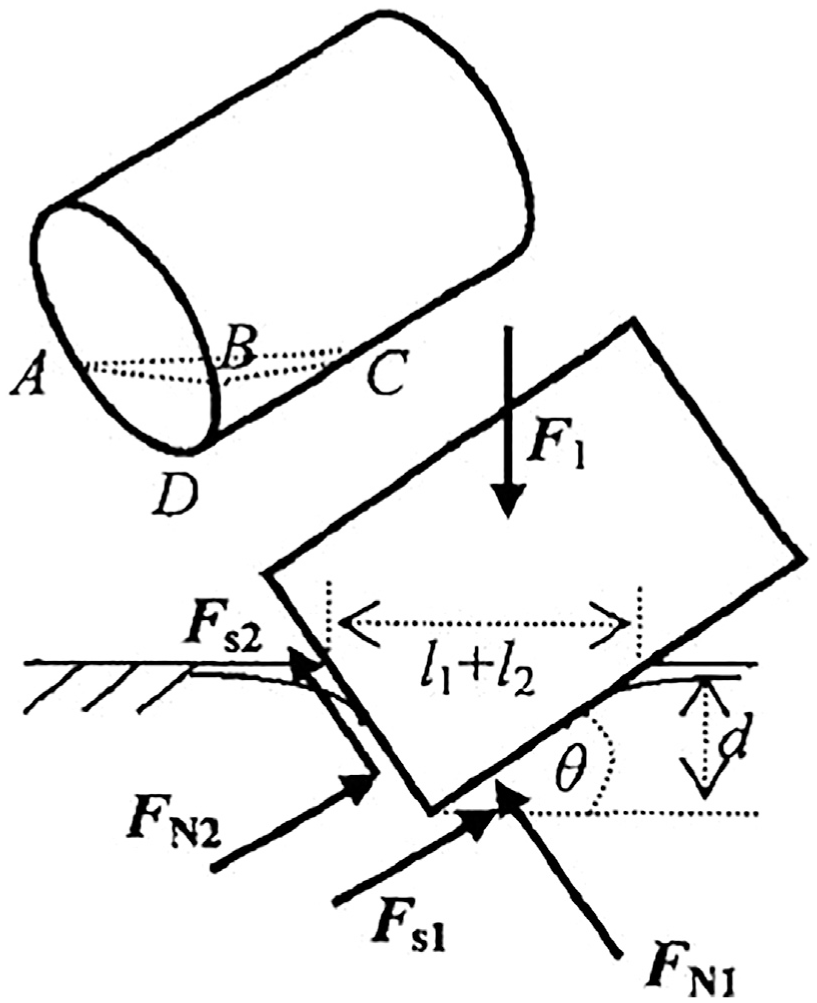
Vertical pressing force diagram of PDC bit cutter.
In order to simplify the calculation, the movement of PDC bit vertically pressed into the coal rock is decomposed into two parts. One part is the cylindrical surface contact under the pressure
According to the contact analysis of the cylindrical surface, the contact pressure

where
According to the contact stiffness of the cylindrical flat bottom, the contact pressure

where
When the inclined PDC cylinder is pressed into the coal rock by the normal load
According to the principle of equivalent effect, the reaction force of the rock in the vertical direction to the PDC bit cutter

So

where


Force analysis of PDC bit cutter pressed into coal rock horizontally
Supposing that there is a horizontal tangential displacement s under the action of the tangential load F2 when the pressing depth of the PDC bit cutter is d, the contact pressure of the contact surface according to the relationship between the contact stiffness and the contact pressure is shown in Figure 2. So

where

Horizontal force diagram of PDC bit cutter.
The friction force

Force analysis of single inclined PDC bit cutter pressed into coal rock
After ignoring some minor factors, the force diagram of single PDC bit cutter is shown in Figure 3.
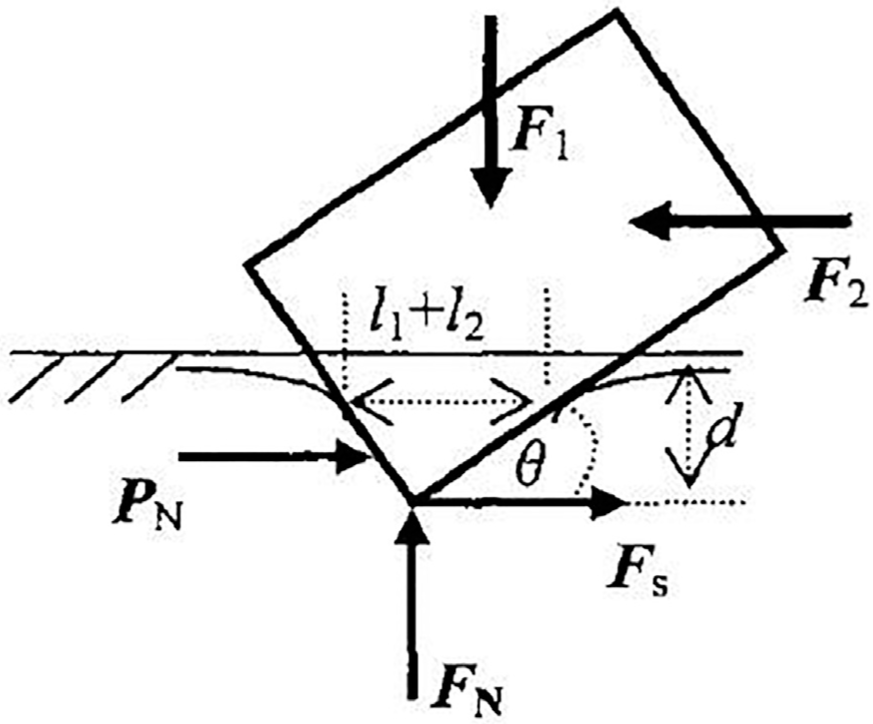
Force diagram of single inclined PDC bit.
According to the limit equilibrium principle, the following formulas can be obtained


Then

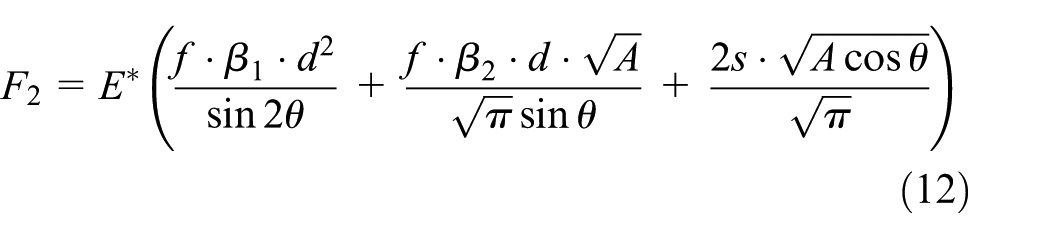
It can be seen that
The axial load

Relationship between axial force and tooth rake angle.

Relationship between tangential load and tooth rake angle.
From Figures 4 and 5, it can be seen that the axial force and tangential load are minimum when the tooth rake angle is about 23°. The PDC bit cutter can cut into the rock efficiently. So there is an optimal tooth rake angle value of PDC bit cutter when it is used in the soft coal seam.
Experimental research on tooth rake angle of drill bit in soft coal wall
Establishment of drilling experiment system
The drilling experiment system is mainly composed of power system and test system which can test the drilling performance of PDC bit and other types of drill bits. It is shown in Figure 6.

Drilling experiment table.
The power system is mainly composed of ZDY1900S full hydraulic drilling machine, confining pressure device, pumping station, control table, and air compressor. The confining pressure device exerts pressure on the test coal wall based on the actual confining pressure of underground coal seam. The full hydraulic drilling machine can be controlled by the control level of the control table to feed and rotate the drill bit and drill the test coal wall. The rotary speed adjustment range is 80–300 r/min and the feeding speed is 0~3 m/min. The air compressor provides the pneumatic strength to discharge the drilling cuttings from the bottom of the drill hole.
The test system is mainly composed of the LWGY-15A flow sensor, FST800-201G222A-16B pressure sensors, flow digital display meter, and YSV dynamic signal acquisition. According to the flow and pressure signals, the drilling torque and feeding resistance can be calculated.
The actual output torque of the drill bit is

where
The feeding resistance of the drill bit is

where
Drilling performance of drill bits with different structure in soft coal wall
Wing bit and PDC bit are two kinds of drill bits used in gas drainage borehole in soft coal seam. In the experiments, both the wing bit and PDC bit have three wings. The diameters of the wing bit and PDC bit are 94 mm. In this study, the PDC bit with tooth rake angle of 15° and the wing bit are tested in the soft coal wall which are shown in Figure 7.

PDC bit and wing bit.
When the rotary speed and feeding speed of PDC bit is 190 r/min and 0.5 m/min, respectively, the hardness Protodyakonov’s coefficient of coal wall is f = 1.03, and the confining pressure of coal wall is 7 MPa; the curves of drilling torque, feeding resistance of the PDC bit and the wing bit are shown in Figures 8 and 9.

Drilling torque of PDC bit and wing bit.

Feeding resistance of PDC bit and wing bit.
From Figures 8 and 9, it can be obtained that the drilling torque and feeding resistance of PDC bit is higher than that of the wing bit. But with the increase in the drilling depth, the feeding resistance of wing bit tends to be consistent with that of PDC bit. The reason is that the wing bit tends to crawl to the lower right of the borehole with the increase in the drilling depth; the borehole tends to be bent, which leads to the increase in the feeding resistance. PDC bit has a guaranteed direct structure which can keep the borehole straight. Therefore, the feeding resistance of PDC bit remains constant. If the drilling depth of the wing bit continues to increase, the feeding resistance of the wing bit will increase and exceed that of the PDC bit.
At the same time, the hard alloy blades of wing bit are easy to be damaged if it meets with the harder coal rocks which are included in the soft coal seam. While the tooth density of PDC bit is higher than that of the wing bit, which make the load of PDC single tooth reduced. The wear performance of PDC bit is better, and the service life is longer than these of the wing bit. So the PDC bits should be selected during gas drainage borehole in soft coal seam.
Drilling performance of PDC bit with different tooth rake angle in soft coal wall
Through the drilling coal wall test of PDC bits whose tooth rake angle is 5°, 10°, 15°, and 20°, respectively, the drilling torque and feeding resistance are obtained. The PDC bits used in our experiments are three wings inner concave composite PDC bits which have eight blades. The diameters of the PDC bits are 94 mm. The PDC bits with tooth rake angle of 5°, 10°, 15°, and 20° are shown in Figure 10.

PDC bits with different tooth rake angle.
When the rotary speed and feeding speed of PDC bit is 190 r/min and 0.5 m/min, respectively, the hardness Protodyakonov’s coefficient of coal wall is f = 1.03, and the confining pressure of coal wall is 7 MPa; the curves of drilling torque and feeding resistance of PDC bits with different tooth rake angle are shown in Figure 11 and 12.

Drilling torque curves of PDC bits with different tooth rake angle.
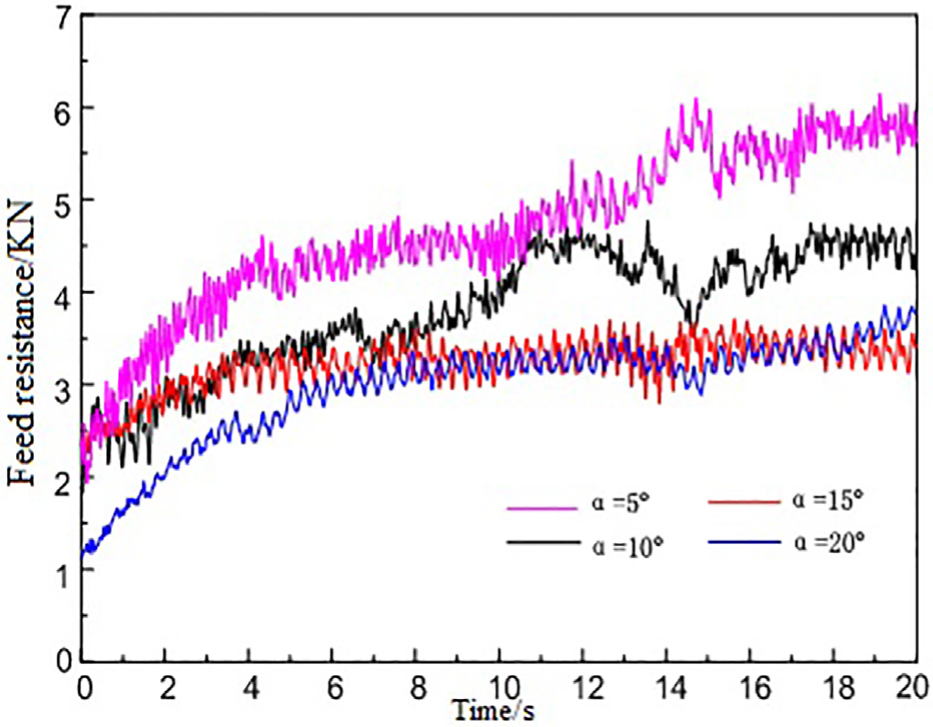
Feeding resistances curves of PDC bits with different tooth rake angle.
The mean values of drilling torque and feeding resistance can directly reflect the load magnitude of PDC bits. The fluctuation degree can indirectly reflect the drilling and crushing process of coal rock and the hardness change of coal seam. From Figures 11 and 12, it can be gotten that the drilling torque and feeding resistance increase with the increase of the tooth rake angle of PDC bit cutter during the start phase of drilling. With the drilling depth of PDC bits increasing, the drilling torque and feeding resistance of PDC bits with tooth rake angle of 15° and 20° tend to be same. At the same time, the values of the drilling torque and feeding resistance change alternately.
It can be seen that the drilling torque and feeding resistance of PDC bit with tooth rake angle of 20° are lower than that of PDC bit with tooth rake angle of 15° during the start phase of drilling. But the mean values of drilling torque and feeding resistance of PDC bit with tooth rake angle of 20° are higher than these of PDC bit with tooth rake angle of 15°. The fitting trend curves of drilling torque and feeding resistance of PDC bits with different tooth rake angle are shown in Figures 13 and 14.
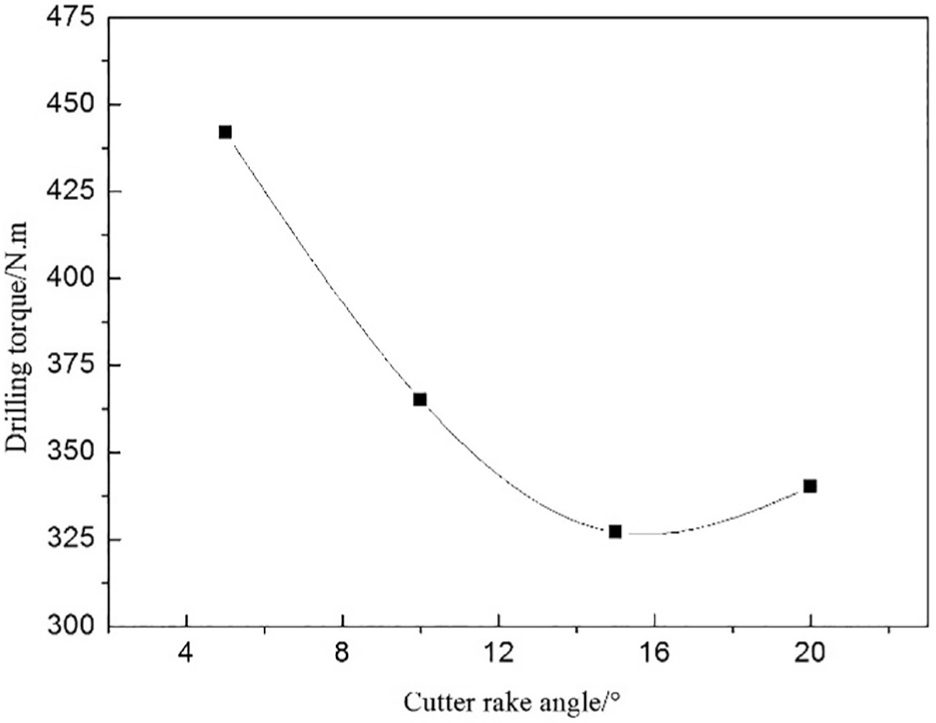
Trend curves of drilling torque of PDC bits with different tooth rake angle.

Trend curves of feeding resistance of PDC bits with different tooth rake angle.
From Figures 13 and 14, it can be seen that the drilling torque and feeding resistance of PDC bit with tooth rake angle of 15° reach the minimum value when the drilling conditions of PDC bits are same. Previous designers believed that the increase in the tooth rake angle of PDC bit can improve the wear resistance and impact resistance of PDC bit. Therefore, PDC bit usually adopts the bigger tooth rake angle such as 20°, even greater values. But there is no obvious improvement in the service life of PDC bit, and the drilling speed is obviously reduced in soft coal wall. The PDC bit with bigger tooth rake angle cannot cut and break the coal rock effectively, which reduce the drilling efficiency and the feeding speed. When the tooth rake angle is smaller, PDC bit cannot cut in coal wall effectively, which increase the feeding resistance.
Through the analysis of test results, the PDC bit with tooth rake angle of 15°–20° is suitable for the gas drainage borehole in soft coal seam.
Working parameters selection of PDC bit during gas drainage borehole in soft coal wall
The pressing depth of PDC bit cutter is inversely proportional to the rotary speed and proportional to the feeding speed. And the horizontal tangential displacement is proportional to the rotary speed when the diameter of PDC bit is constant. In order to study the drilling performance of PDC bit under different pressing depth and horizontal tangential displacement, the feeding speed of PDC bit is set as a constant.
When the feeding speed of PDC bit is 0.5 m/min, the hardness Protodyakonov’s coefficient of coal wall is f = 1.03, and the confining pressure of coal wall is 7 MPa; the curves of drilling torque and feeding resistance of the PDC bit with the tooth rake angle of 15° at different rotary speed are shown in Figures 15 and 16.
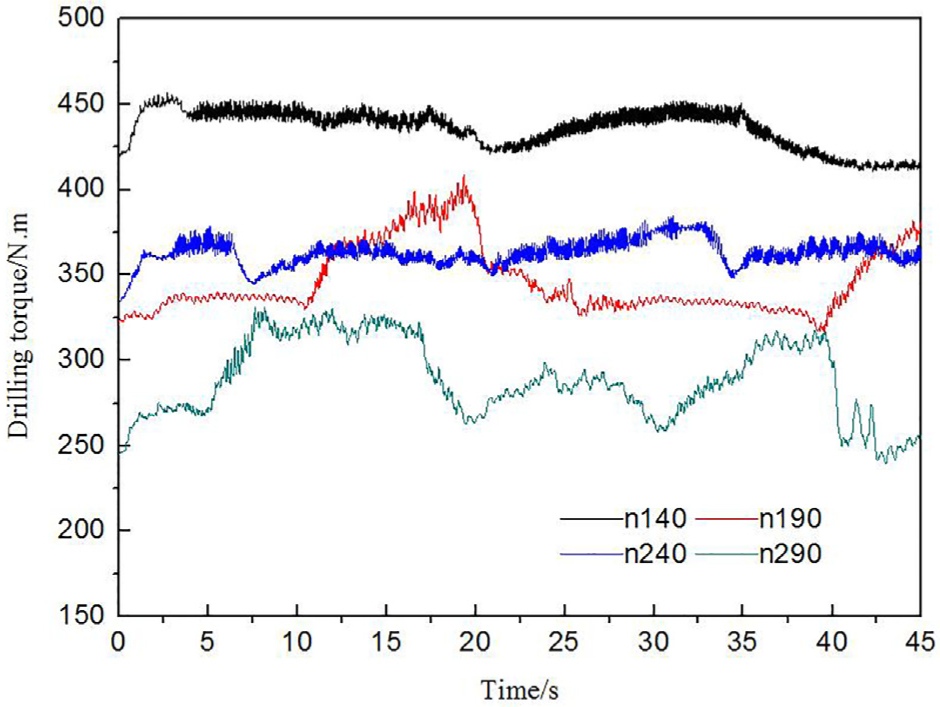
Drilling torque of PDC bit at different rotary speed.

Feeding resistance of PDC bit at different rotary speed.
The drilling performance statistical analysis of PDC bit at different rotary speed is shown in Table 1.
Drilling performance statistics of PDC bit at different rotary speed.

From Table 1, it can be seen that the pressing depth of PDC bit cutter is inversely proportional to the rotary speed when the feeding speed is constant. The greater the rotary speed is, the smaller the pressing depth is while the greater the horizontal tangential displacement. With the increase in the rotary speed of PDC bit, the cutting thickness of coal rock decreases while the horizontal tangential displacement increases. So under the comprehensive effect of the pressing depth and horizontal tangential displacement of PDC bit cutter, the mean drilling torque at rotary speed of 240 r/min is greater than that at rotary speed of 190 r/min. When the rotary speed of PDC bit is 290 r/min, the mean drilling torque and mean feeding resistance of PDC bit reach the minimum. Therefore, in the actual gas drainage borehole in soft coal seam, the working parameters of low drilling pressure and high rotary speed are usually selected.
Conclusion
Through the force model analysis of PDC bit and the drilling performance experiment researches, the proper geometric parameters of PDC bit will improve the drilling performance of PDC bit during the gas drainage borehole in soft coal seam. The following conclusions can be drawn as follows:
The drilling torque and feeding resistance of PDC bit are higher than that of the wing bit at the beginning of drilling the soft coal wall. But with the increase in the drilling depth, the feeding resistance of wing bit will increase to exceed that of the PDC bit. The wear performance of PDC bit is better, and the service life is longer than these of the wing bit. So the PDC bits should be selected during gas drainage borehole in soft coal seam.
The PDC bit with bigger tooth rake angle cannot cut and break the coal rock effectively, which reduce the drilling efficiency and the feeding speed. When the tooth rake angle is smaller, PDC bit cannot cut in coal wall effectively, which increases the feeding resistance. The results show that the PDC bit with tooth rake angle of 15°–20° is suitable for the gas drainage borehole in soft coal seam.
With the increase in the rotary speed of PDC bit, the cutting thickness of coal rock decreases while the horizontal tangential displacement increases. When the rotary speed of PDC bit is 290 r/min, the mean drilling torque and mean feeding resistance of PDC bit reach the minimum. In order to reach the optimum drilling performance, the working parameters of low drilling pressure and high rotary speed are usually selected during the actual gas drainage borehole in soft coal seam.
Footnotes
Handling Editor: Davood Younesian
Declaration of conflicting interests
The author(s) declared no potential conflicts of interest with respect to the research, authorship, and/or publication of this article.
Funding
The author(s) disclosed receipt of the following financial support for the research, authorship, and/or publication of this article: This work was supported by the National Natural Science Foundation of China (grant number 51404096), Henan Province Science and Technology Project (grant number 162102210229), and Henan province youth backbone teachers funding scheme (grant number 2015GGJS-067) and Henan province education department applied research project fund (grant number 15A440004).