




Abstract
This article concentrates on two-dimensional magnetohydrodynamic stagnation flow of Jeffrey liquid on a nonlinearly stretching sheet which possesses variable thickness. Simultaneous impact of melting as well as thermal stratification is specifically investigated in this study due to their tremendous involvement in plenty of natural and industrial processes. Internal heat generation and presence of chemical species are considered to ponder at heat transfer properties. Series solution has been obtained by solving the developed nonlinear problems. Physical behavior of various controlling parameters such as velocity, thermal, and concentration fields are investigated. It has been found that temperature field decays due to higher intensity of thermal stratification parameter, but thickness of thermal boundary layer boosts up. Larger Deborah number results in incremented velocity field. For uplifted wall thickness parameter, velocity field depreciates. Concentration field declines for enhanced parameters of homogeneous as well as heterogeneous reaction. Moreover, velocity is decreasing function of porosity parameter.
Keywords
Introduction
No doubt phenomena of melting heat transfer along with solidification have acquired mentionable importance for innovative technological and industrial processes. Several researchers have explored characteristics of melting heat process due to its splendid application in preparation of semiconductor materials, optimal energy utilization, welding procedure, magma solidification, and so on. Roberts 1 made pioneer effort to describe phenomena of melting process of ice kept in hot stream. Tien and Chao 2 disclosed the aspects of forced convection by taking melting process into consideration. Sheikholeslami and Rokni 3 presented a study on heat transfer via melting process in nanofluid flow with magnetic effects. Impact of melting heat phenomena with chemical species on viscoelastic fluid flow was analyzed by Hayat et al. 4 Sheikholeslami and Rokni 5 discussed melting process and magnetic effects of nanofluid flow considering the Buongiorno model. Farooq et al. 6 analyzed features of stretching phenomena in melting process for dual stratified flow of viscous nanofluid. Melting heat transfer along with nonlinear radiative effects in Sisko fluid flow was scrutinized by Soomro et al. 7
There exists extensive involvement of homogeneous as well as heterogeneous reactions in abundant systems which possess chemical reactions. Several of these chemical reactions are totally unable to proceed; however, some of them can occur in slow speed except for the case of presence of catalyst. Scientists have found complex interaction between both these types of reactions. Applications of such reactions are found in several biochemical systems, fog formation as well as dispersion, ceramics, polymer production, food processing, and so on. A quite early attempt in this regard was made by Merkin, 8 who discussed the influence of homogeneous and heterogeneous reactions in view of boundary layer flow. Hayat et al. 9 investigated the effect of melting heat and homogeneous–heterogeneous reaction on Jeffrey fluid flow over a stretching cylinder. Kameswaran et al. 10 discussed the aspects of chemical species in nanoliquid flow, which is induced when stretching phenomena is executed on sheet. Powell–Eyring fluid flow while taking chemical species into consideration was described by Hayat et al., 11 while Khan et al. 12 encountered Casson fluid flow along with the aspects of chemical species. Properties of chemical species in three-dimensional (3D) Burger fluid flow were disclosed by Khan et al. 13 Moreover, Shaw et al. 14 analyzed these types of reactions in the flow of micropolar fluid through porous medium.
Plenty of features for stretching flows of non-Newtonian fluids are being still explored by researchers and scientists. This inspiration is because of several applications of such flows in fiber technology, food products, wire coating, pharmaceuticals, physiology, crystal growth, and so on. It is not possible to analyze properties of non-Newtonian fluids by means of single constitutive relationship. Jeffrey model represents the rate-type fluids which interpret relaxation as well as retardation time behaviors. Jeffrey model explains the linear viscoelastic features of fluids which are extensively applicable in the polymer industries. Ahmad and Ishak 15 discussed magnetohydrodynamic flow of Jeffrey liquid over a vertical stretching sheet which is entrenched in porous medium. Das et al. 16 investigated the influence of slip condition in the presence of radiation and melting process for the flow of Jeffrey liquid. Some important aspects of Soret and Dufour effects for Jeffrey flow have been addressed by Khan et al. 17 while taking Newtonian heating into consideration. Dalir 18 studied the attributes of entropy generation and mechanism of heat transfer for the case of Jeffrey liquid flow induced because of a stretching sheet. Gaffar et al. 19 scrutinized radiative aspects for the flow of Jeffrey fluid over vertical plate in semi-infinite domain.
Hayat et al. 20 obtained series solutions by employing homotopy analysis method (HAM) for investigating Burgers fluid flow caused due to stretching sheet. By extending their work, Hayat et al. 21 discussed features of Newtonian heating in the flow of Burgers fluid while retaining stagnation point. In this study, the authors operated HAM to attain series solution. Liao 22 employed HAM for the case of nonlinear differential equations. Hayat et al. 23 used HAM to analyze stratification effects with slip conditions in Casson fluid flow. Study regarding velocity slip and nanoparticles in the flow of nanofluid was carried out by Zhu et al. 24 by making use of homotopy analysis. Utilizing procedure of HAM, Hayat et al. 25 investigated aspects of Newtonian heating and chemical species in the flow of carbon nanotubes. Waqas et al. 26 introduced HAM in the study where they analyzed Powell–Eyring fluid flow using the Cattaneo–Christov theory. Hayat et al. 27 described flow of carbon nanotubes over a melting surface which possesses variable thickness. Moreover, they obtained series solutions with HAM.
Literature is evident for several attempts that have been made to investigate behavior of non-Newtonian fluids over stretching surfaces. However, researchers seemed to be less focused to study such flows over sheets possessing variable thickness. Due to extensive utilization of stretching phenomena in several industrial procedures, we have employed nonlinear stretching process to study flow properties. Here, we have tried to explore combined features of melting process and thermal stratification in Jeffrey fluid flow toward a sheet which possesses thickness of variable nature and further is embedded in porous medium. Internal heat generation and homogeneous–heterogeneous reaction have also been considered to characterize heat transfer analysis. Stagnation point has been retained here. Utilizing appropriate transformations, the subsequent two-dimensional (2D) nonlinear momentum, energy and concentration equations have been transformed into Ordinary differential equations (ODEs) of highly nonlinear nature. Series solutions have been obtained by making use of the homotopic analysis procedure. Velocity, thermal, and concentration profiles are investigated for several pertinent variables involved in the considered problem.
Mathematical formulation
Steady and incompressible 2D Jeffrey fluid flow toward variable thickness surface embedded in porous medium is considered here. In the present situation, surface is taken at
Similar diffusion coefficients for both species have been taken here. For cubic autocatalysis, an advanced model has been followed regarding homogeneous reaction 8

Representation of first-order catalytic isothermal reaction is

Obviously, A and B interpret chemical species; however, their concentrations are signified by a and b, respectively. Moreover, rate constants are characterized by


and involved boundary conditions are

We have chosen u for the interpretation of velocity component in x direction and v for y direction;
Using suitable transformations in the following form

Equation (1) leads to automatic satisfaction of incompressibility condition, while next four equations (2)–(5) take form


corresponding boundary conditions can be interpreted in the following way


where prime symbolizes differentiation with respect to “


Pr expresses the Prandtl number, parameters for the strength of homogeneous and heterogeneous reaction are signified by K and

It can be noticed that melting parameter takes its form by the union of Stefan numbers for liquid

By making use of equations (17), (18), and (24), we attain

along

Mathematically

where

Respective dimensionless expression is given as follows


Local Reynolds number is given below in its mathematical form

Homotopic procedure
Homotopic analysis method is utilized to construct series solution for considered problem. Prominent advantage of this method is the provision of choice to select initial guesses and linear operators and utilizing this choice, we have selected them


Next, we attain below stated operators


where arbitrary constants are denoted by
Deformation of zeroth order




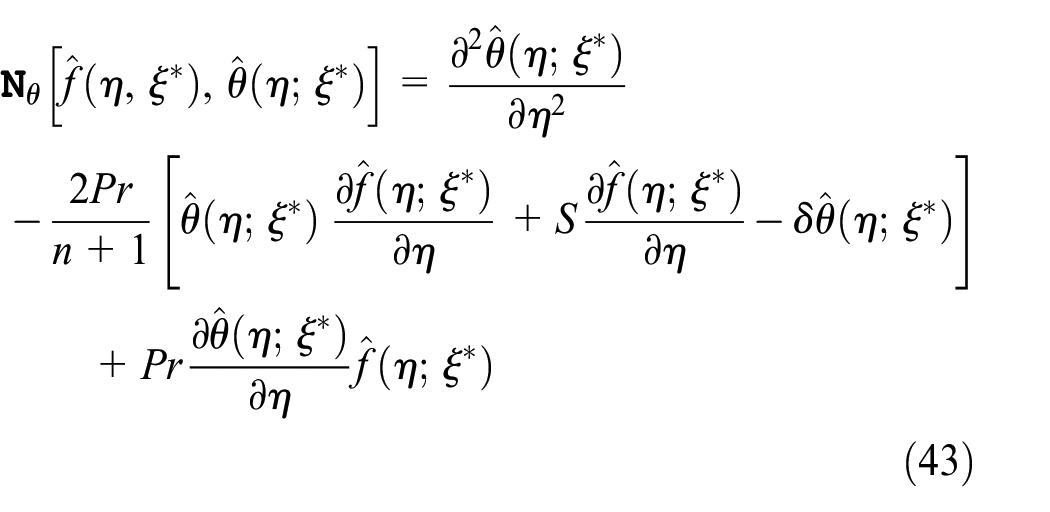

where
Deformation of the mth order









For


We have presented the attained general solutions



Using boundary conditions, we write

Convergence analysis
By utilizing HAM, one can feel great ease in convergence region adjustment for series solutions. Problem under consideration constitutes a part of

Geometry of problem.

The h-curves for f(0) and g(0).

The h-curve for θ(0).
The
Discussion
Characteristics of numerous parameters have been analyzed here on thermal

Pictorial view of
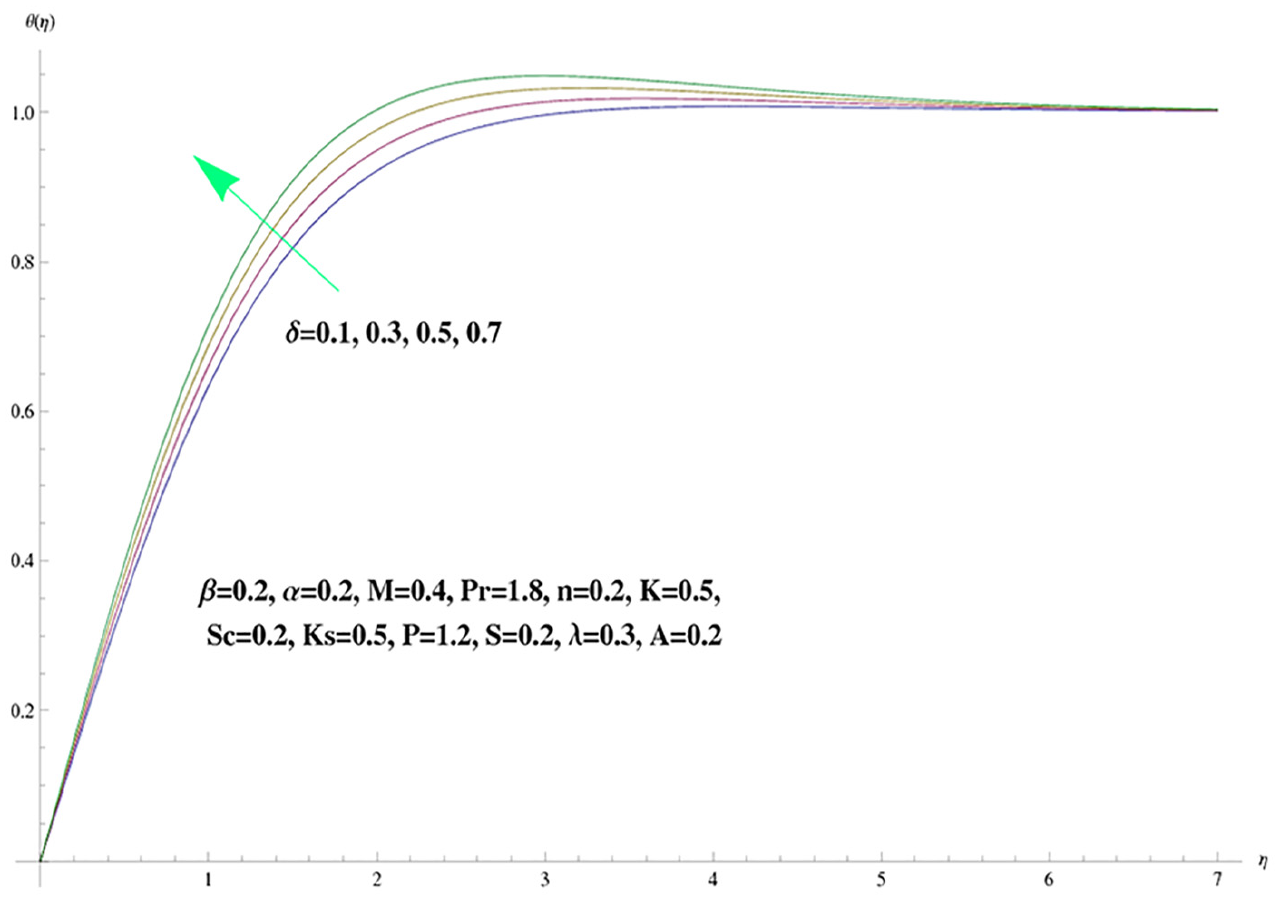
Pictorial view of
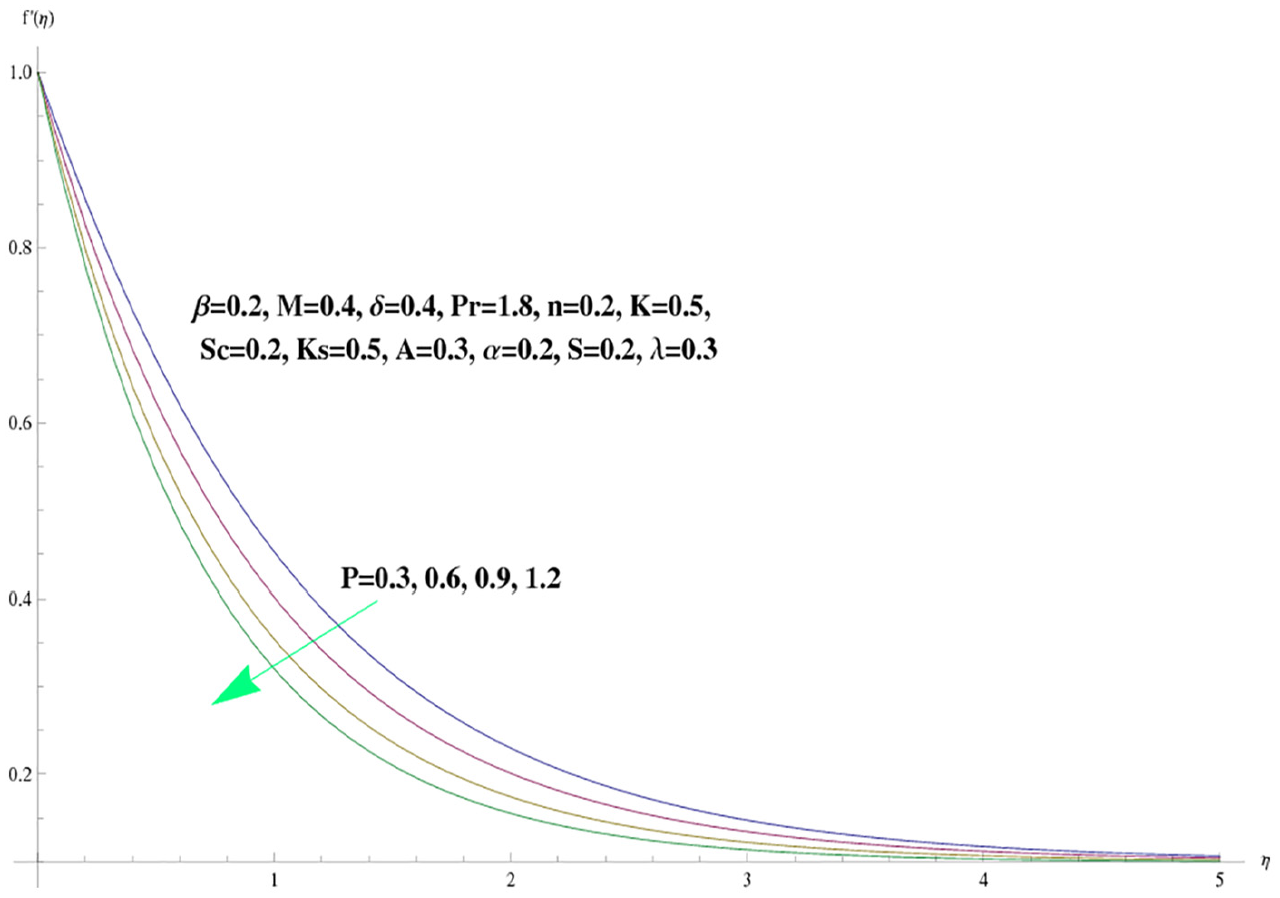
Pictorial view of P against f′.
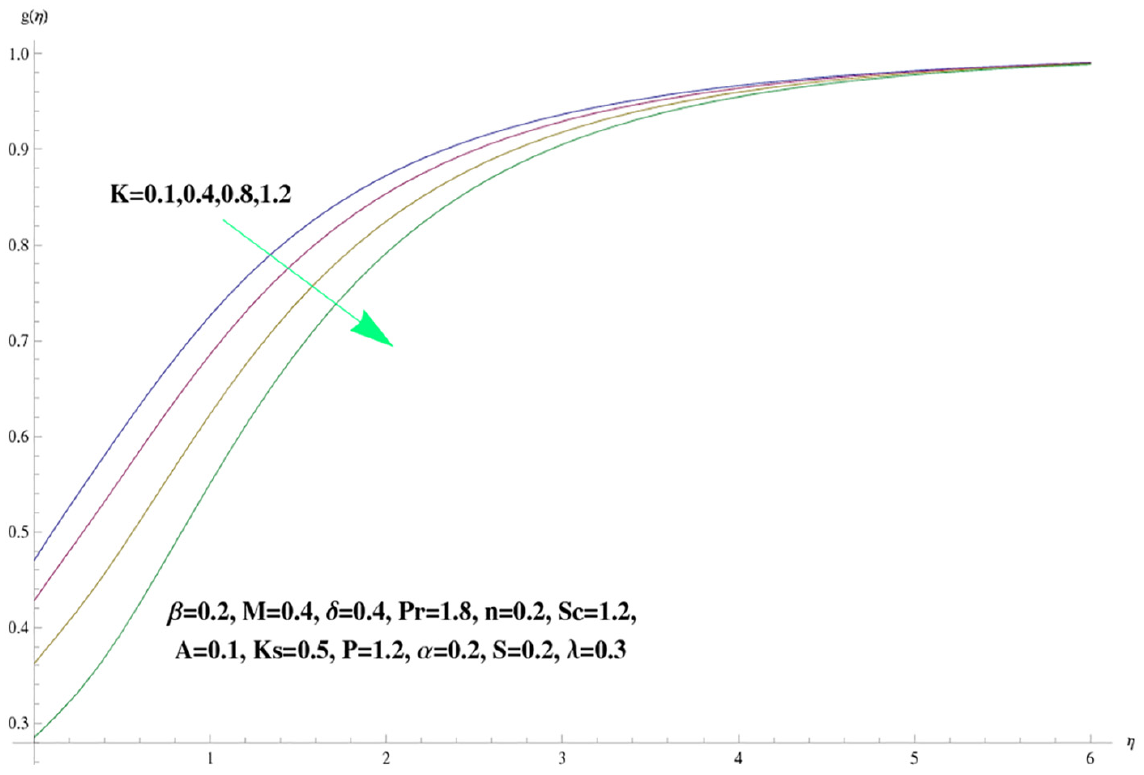
Pictorial view of K against g.

Pictorial view of
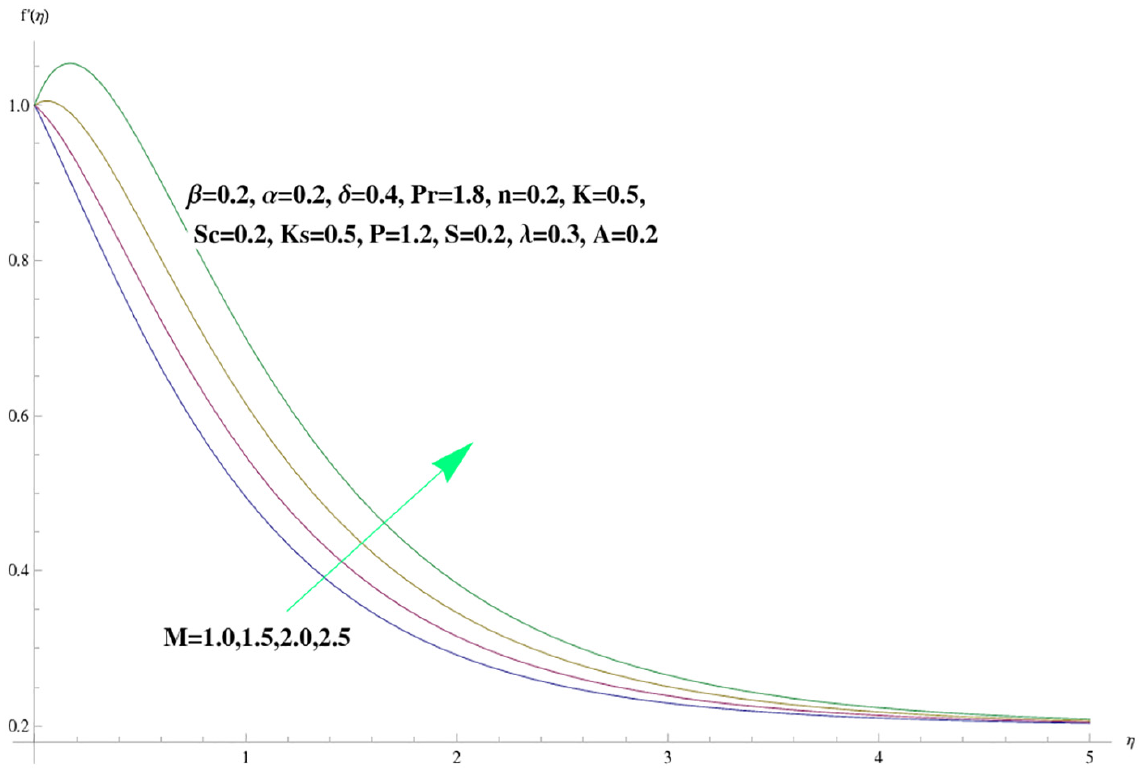
Pictorial view of M against f′.

Pictorial view of M against

Pictorial view of Sc against g.
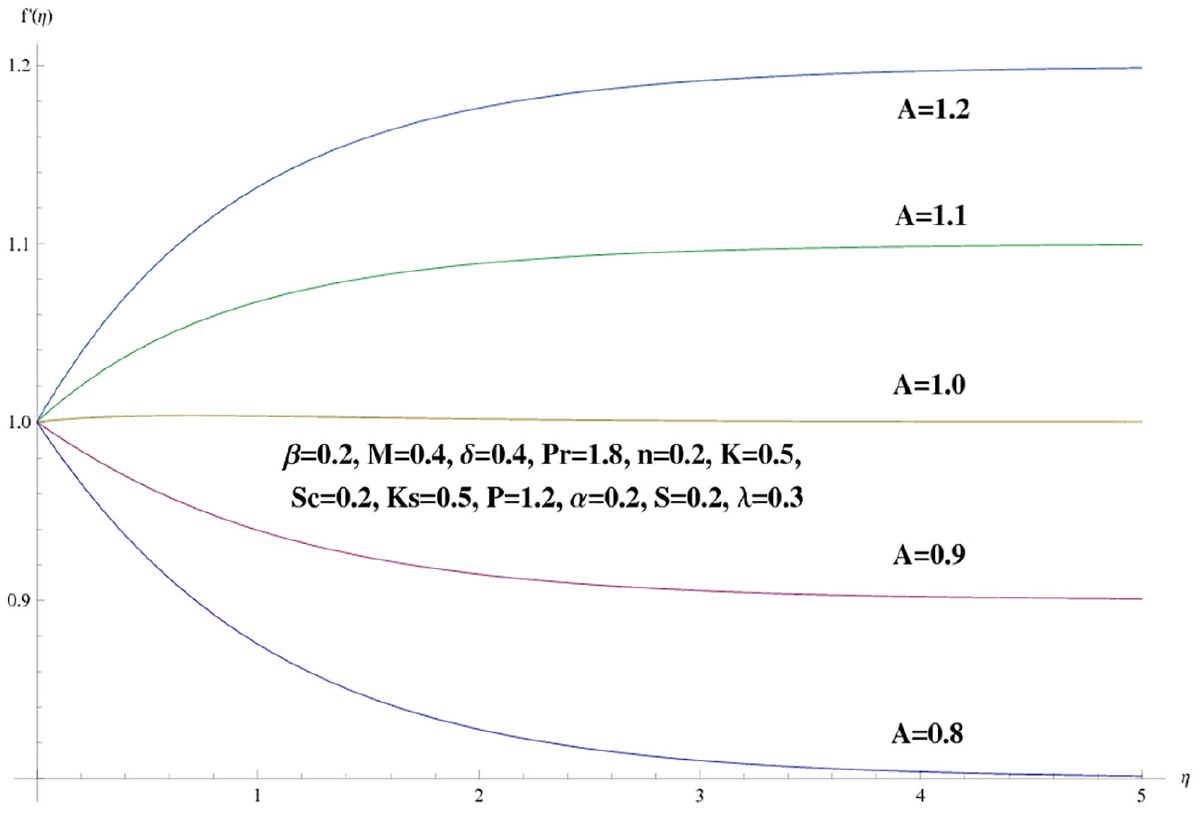
Pictorial view of A against f′.

Pictorial view of
S
against

Pictorial view of

Pictorial view of

Pictorial view of
Concluding remarks
Aspects of chemical species and melting process have been addressed in flow of Jeffrey liquid toward a sheet of variable thickness. Effect of heat generation (internal) has also been considered. Concluding remarks are summarized as follows:
Velocity field grows up for progressive Deborah number
For uplifted wall thickness parameter
Velocity profile declines for higher porosity parameter P. Incremented porosity leads to weaker permeability which ultimately reduces velocity.
Temperature profile decays, whereas velocity field shows opposite behavior for rise in melting parameter M. Rate of heat transfer shows progressive behavior for higher M from fluid at higher temperature toward the surface which is melting, and it ultimately causes reduction in thermal field. Higher melting parameter gives rise to convection from heated fluid to melting surface which tends to enhance velocity of fluid.
Higher heat generation parameter
This study has several motives and prospects for future research work. Stagnation point flows of non-Newtonian fluids along with melting heat transfer can be elaborated for different aspects like nonlinear stratified flows over a cone or cylinder with variable thickness. Application of the Cattaneo–Christov theory along with heat and mass transfer and chemical aspects in stagnation point flows could also be a possible extension for future work.
Footnotes
Appendix 1
Handling Editor: James Baldwin
Declaration of conflicting interests
The author(s) declared no potential conflicts of interest with respect to the research, authorship, and/or publication of this article.
Funding
The author(s) received no financial support for the research, authorship, and/or publication of this article.
