The numerical analysis for two-dimensional oblique stagnation point flow with the magnetohydrodynamic effects of an incompressible unsteady Jeffrey fluid model caused by an oscillatory and stretching sheet has been presented in this article. The Brownian motion and thermophoresis impacts are taken into consideration. The similarity transformation technique is implemented on the governing partial differential equations of the Jeffrey fluid model to obtain a set of nonlinear coupled ordinary differential equations and then these resulting equations are numerically computed with the help of BVP-Maple programming. The variation in the behavior of velocity, temperature, and concentration profile influenced by the governing parameters, has been explicitly explored and displayed through graphs. The numerical results are highlighted in tabular form and through these outcomes, the skin friction coefficient, Nusselt number, and Sherwood number have been investigated. These physical quantities rise for gradually increasing the Hartmann number and ratio of relaxation to retardation time. However, these reduce for gradually growing Jeffrey fluid parameter.
The study of stagnation point flow becomes a very popular field of interest nowadays. Many researchers are exploring the facts of this flow for various types of fluids and for different setups such as orthogonal or nonorthogonal. Several scientists and researchers studied different sorts of surfaces where this phenomenon takes place like stretching, shrinking, lubricated, oscillatory, and many others. The stagnation point flow was first investigated by Hiemenz.1 He studied the boundary layer procedure for a fluid flow towards an obstacle and a straight wall as well. He implemented a similarity transformation method on the mathematical fluid model and attained a series solution. Later, this model was investigated by Howarth2 for three dimensions. Rott3 considered steady orthogonal stagnation flow. The non-orthogonal case was first explored by Stuart.4 A mathematical fluid model for oblique stagnation flow was evaluated by Tamada.5 Mahapatra and Gupta6 investigated the MHD flow at the stretching sheet under the stagnation point region. Akbar et al.7 discussed the MHD flow of nanofluid at the stretching surface under the stagnation point region. They found the results of radiation effects and convective boundary conditions at the stretching sheet. Rehman et al.8 investigated the heat and mass transfer of the nonlinear stretching surface under the stagnation point region. Besthapu et al.9 highlighted the impact of slip and thermal radiation on the nonlinear stretching sheet under the stagnation point region. Few authors have been discussed the stagnation flow at a stretching surface under various assumptions see Nadeem et al.10 and Waini et al.11 Choi and Eastman12 provided the concept of nanofluids which became very valuable in many applications in the industry because nanofluids are very effective for increment in thermal conductivity. Buongiorno13 took the influence of Brownian motion and thermophoresis into consideration and created a fluid model incorporated with these effects. Stagnation point flow was investigated by Mahapatra and Gupta14 for viscoelastic fluid over a flat deformable sheet. An important result of oblique stagnation point flow with MHD effects was deduced by Borrelli et al.15,16 The oblique stagnation flow takes place if and only if the applied magnetic field and dividing streamlines are in the same direction. A model of second-grade fluid with the well known Buongiorno model was provided by Nadeem et al.,17 the results indicated that the stretching velocity has an impact on the formulation of the boundary layer. Khan et al.18 investigated a series solution technique to observe the oblique stagnation point flow for the viscous nanofluid along with the slip and magnetic impacts. Flow and heat transfer investigation was taken into the account by Mehmood et al.19 for the stagnation point flow of the Jeffrey nanofluid model which was obliquely hitting the stretched plate and involved with the Buongiorno model. The stagnation point flow was explored on a curved surface by Nadeem et al.20 The dual solutions for an oscillatory shrinking and stretching sheet were attained by Nadeem et al.21 Nadeem et al.22 evaluated results for micropolar nanofluid with magnetic and slip impacts, where the surface was stretching and oscillatory and taken in a porous medium. Nanofluid flow discussed by authors (see the Saif et al.23 and Haq et al.24) for different assumptions.
Ahmed25 obtained non-similar solutions for the natural convection boundary layer flow of a micropolar nanofluid on to a vertical permeable cone with variable wall temperatures. Ahmed26–28 provided the results for nanofluid flows in inclined enclosures for the porous medium. Ahmed29 analyzed a dusty hybrid nanofluid flow in wavy enclosures containing a volumetric heat source and utilized the SIMPLE techniques to obtain the pressure terms for both the considered nanofluid and dusty particles based on the control volume solver. Hsiao30 examined the stagnation nano energy conversion problems for conjugate mixed convection heat and mass transfer with EMHD effects on to a stretching surface. The energy conversion problem was investigated by Hsiao31–33 for non-Newtonian fluids with magnetic effects in order to observe the heat transfer enhancement.
This current research work is concerned with the analysis of oblique stagnation point flow with the MHD impacts of Jeffrey fluid model on to an oscillatory and stretching sheet. The impacts of Brownian motion and thermophoresis are also included. The governing PDEs have been derived for Jeffrey fluid and a similarity transformation method is applied to convert these equations into a set of nonlinear coupled ODEs. The resulting equations have been numerically solved through the use of BVP-Maple software. Graphical and tabular results are presented with the aim of interpreting the behavior of concentration, temperature, velocity fields, Nusselt number, skin friction coefficient, and Sherwood number, in the consequence of variation in governing parameters. Nobody has evaluated the combined effects of MHD oblique stagnation point flow for the Jeffrey fluid on to an oscillatory stretching sheet with Brownian motion and thermophoresis effects. The involved parameters for heat and mass transfer are discussed for both the cases of stretching parameter for less and greater than one. Therefore, the results of the present work are new in literature.
Mathematical formulation
Let us consider an unsteady oblique stagnation point flow of an incompressible Jeffrey fluid with magnetohydrodynamic effects, caused by a sheet which is supposed as oscillatory and stretching. This sheet is oscillating harmonically in its own plane with velocity and the stretching velocity is . The flow is considered in two dimensions where the fluid is striking obliquely to the surface and a uniform magnetic field of strength is applied parallel to the dividing streamlines, where the effect of induced magnetic field is negligible as . The Maxwell’s equations for the magnetic field are as follows,
Where and the external magnetic field is , as reported by Borrelli et al.16 The effects of thermophoresis and Brownian motion are also considered. Schematic diagram of the considered problem is presented in the Figure 1.
Geometry of the problem.
The governing flow field equations are given as follows,
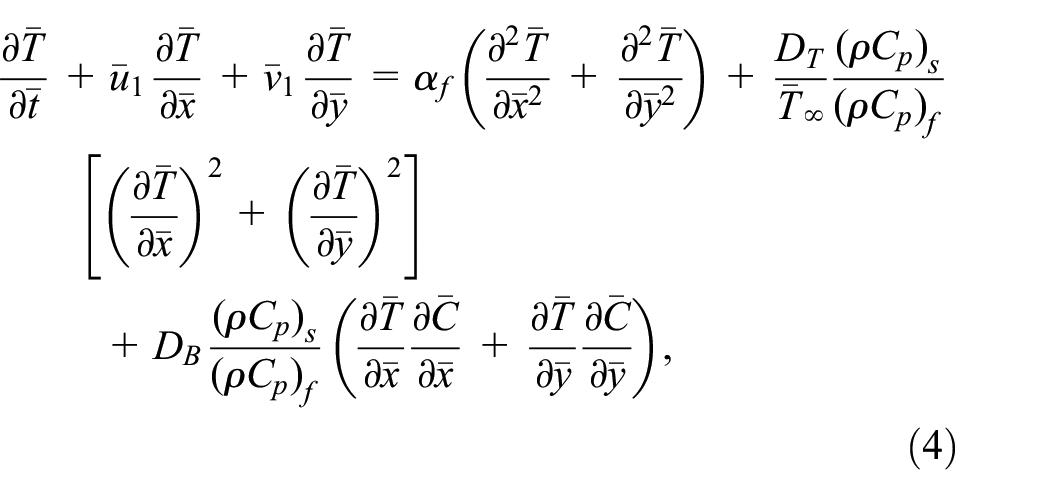
The energy and concentration equations as reported in Buongiorno13 are given as,
Let be the difference between reference and ambient temperature and be the difference between reference and ambient concentration.
The boundary conditions for equation (1) to (5) are as follows
The conditions and in (6) indicate that the stagnation point is at . The streamlines are hyperbolas whose asymptotes are given as
Let us suppose the components of velocity as
These velocity components are substituted in governing equations. The pressure field is eliminated by comparison of equation (2) and equation (3) using .
The flow equations took the form
The boundary conditions (6) become
From (10), the asymptotic solution of and is given as
The dimensionless variables are assumed as
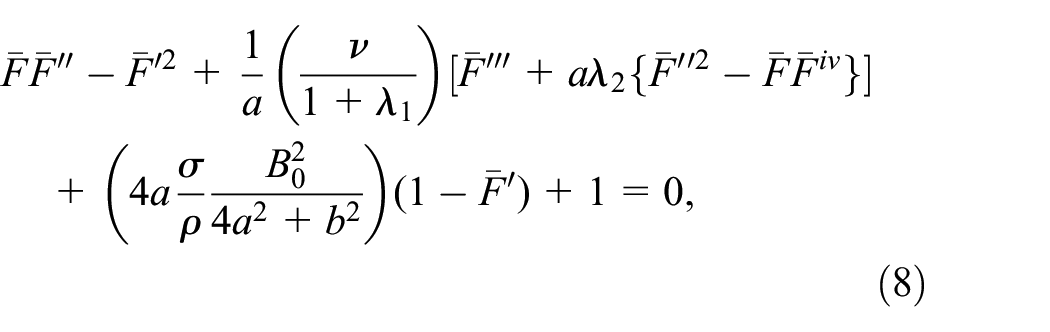
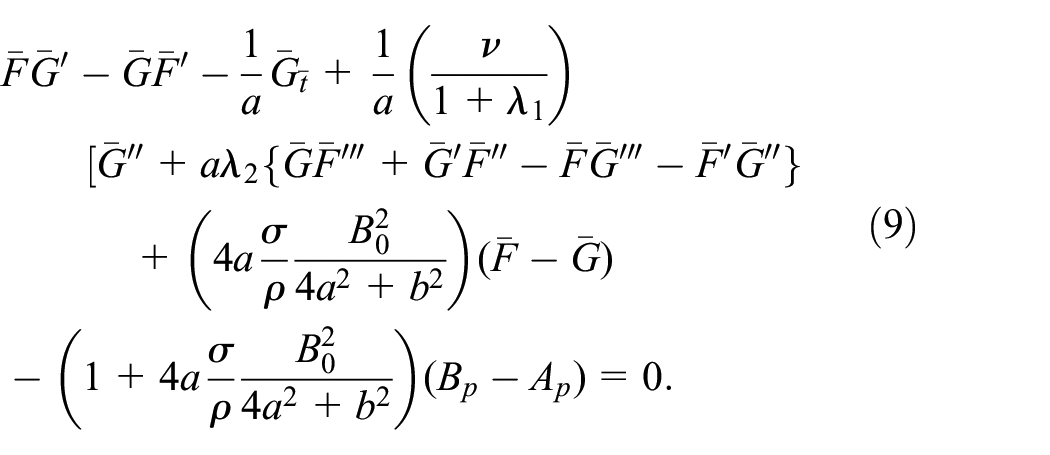
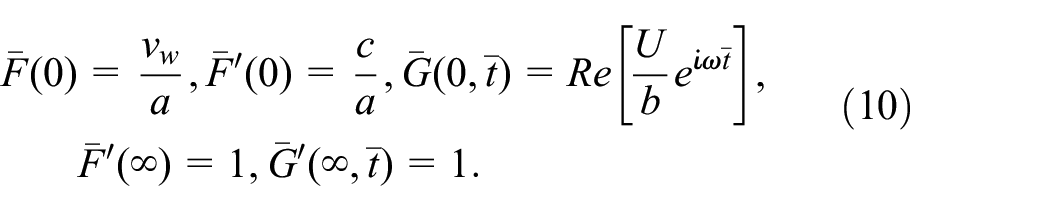
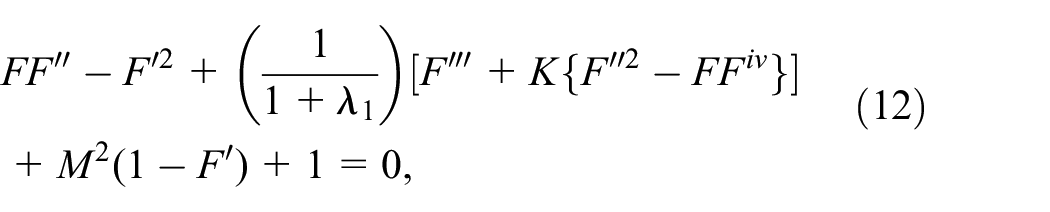
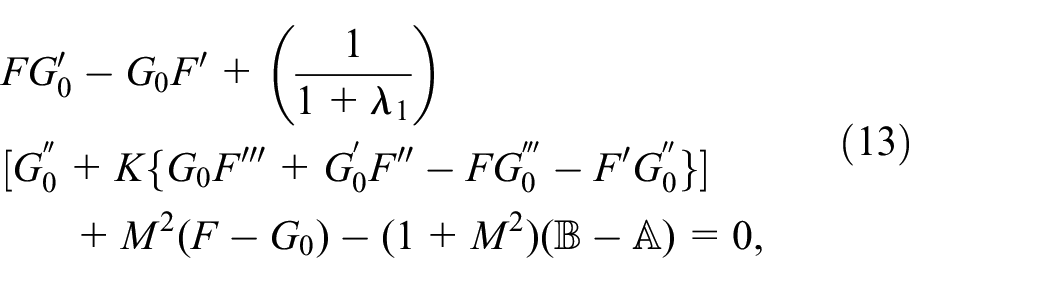
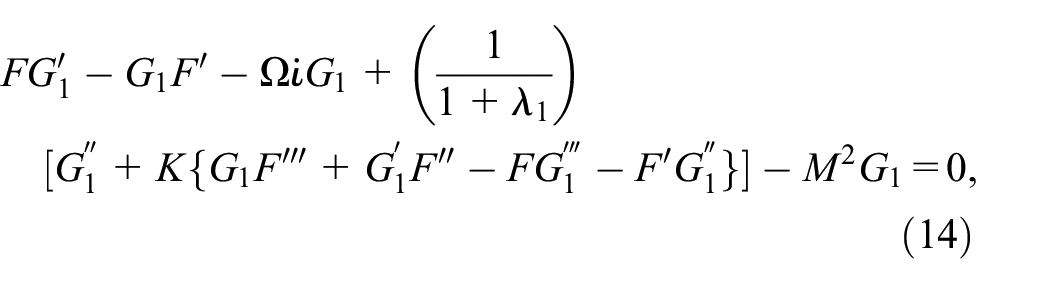
The dimensionless form of flow field equations is obtained by utilizing (11) and it is given as follows
with the conditions
where
is ratio of relaxation to retardation time, is retardation time, is Jeffrey fluid parameter, is stretching parameter, is Brownian motion parameter, is thermophoresis parameter, is suction parameter, is Prandtl number, is Hartmann number, and is Schmidt number.
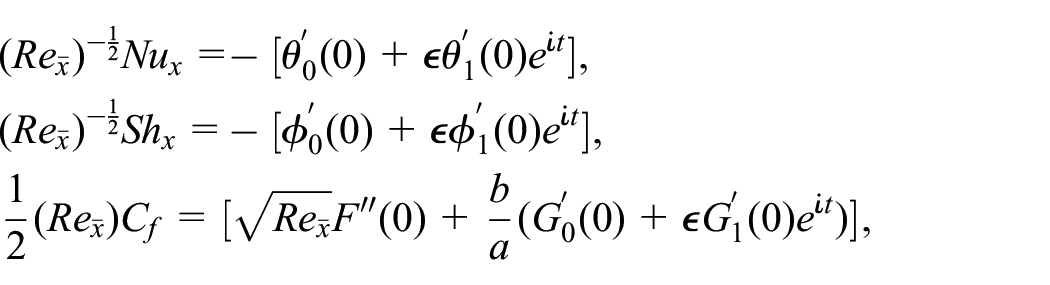
The Nusselt number , Sherwood number , skin friction coefficient , local heat flux , mass diffusion flux , and local surface shear stress are represented as follows
With the help of similarity variables (11), the above relations took the form as
where local Reynolds number can be expressed as .
The stagnation point , the point of maximum pressure and the point of zero skin friction are the three main points at the surface. The stagnation point is derived from
At the point of maximum pressure, the fluid velocity becomes zero. From the conditions and in (6), the pressure can be obtained by using . Therefore, the point of maximum pressure is given as
The point of zero skin friction is given as
The ratio is same for all angle of incidence, that is
Solution procedure
The equations (12), (13), (15), and (17) along with their boundary conditions (19) have been numerically solved utilizing BVP solution method in Maple software. The series solutions of equations (14), (16), and (18) have been obtained for the small values of frequency parameter .
The equations (12) to (18) with their associated boundary conditions (19) have been numerically computed with the help of Maple software. This section concerns with the graphical representation of variations in velocity , concentration and temperature profiles caused by the governing physical parameters of the considered fluid flow. These are Hartmann number , Jeffrey fluid parameter , suction parameter , the ratio of relaxation to retardation time , Brownian motion parameter , stretching parameter , Schmidt number , thermophoresis parameter , and Prandtl number . The physical quantities Sherwood number , coefficient of skin friction , and Nusselt number are investigated through numerical outcomes which are highlighted in tables.
Plots for , velocity component , and its gradient are depicted in Figure 2 for some fixed values of involved parameters, that is, , , , and .
Plots showing , , and for , , , and .
Figure 3 illustrates that how the velocity profile varies with variation in , , , and . The impact of stretching parameter is very significant in this flow as the behavior of is found opposite for and . Results of other parameters , , and are opposite when these vary with fixed and . In Figure 3(a), (b), and (d), the variations of , , (respectively) are considered to determine the behavior of . The increasing behavior is indicated when , and increase with while decreasing behavior is revealed when , and increase with . Figure 3(c) portrays the decreasing behavior of for variation in with and depicts the increasing behavior of for variation in with . Figure 3(e) displays the variation in for with other fixed parameters.
Plots for against: (a) , (b) , (c) , (d) , and (e) .
The behavior of velocity profiles is portrayed in Figure 4. For , value of plays a significant role, as the results for positive values of appear to be opposite than the negative value of . The streamlines will be more oblique towards the left side of the stagnation point when increases. Increment in , and with fixed causes a rise in . On the other hand, these parameters with fixed cause a reduction in . shows the decreasing behavior when increases with fixed and it is shown in Figure 4(c).
Plots for against: (a) , (b) , (c) , and (d) .
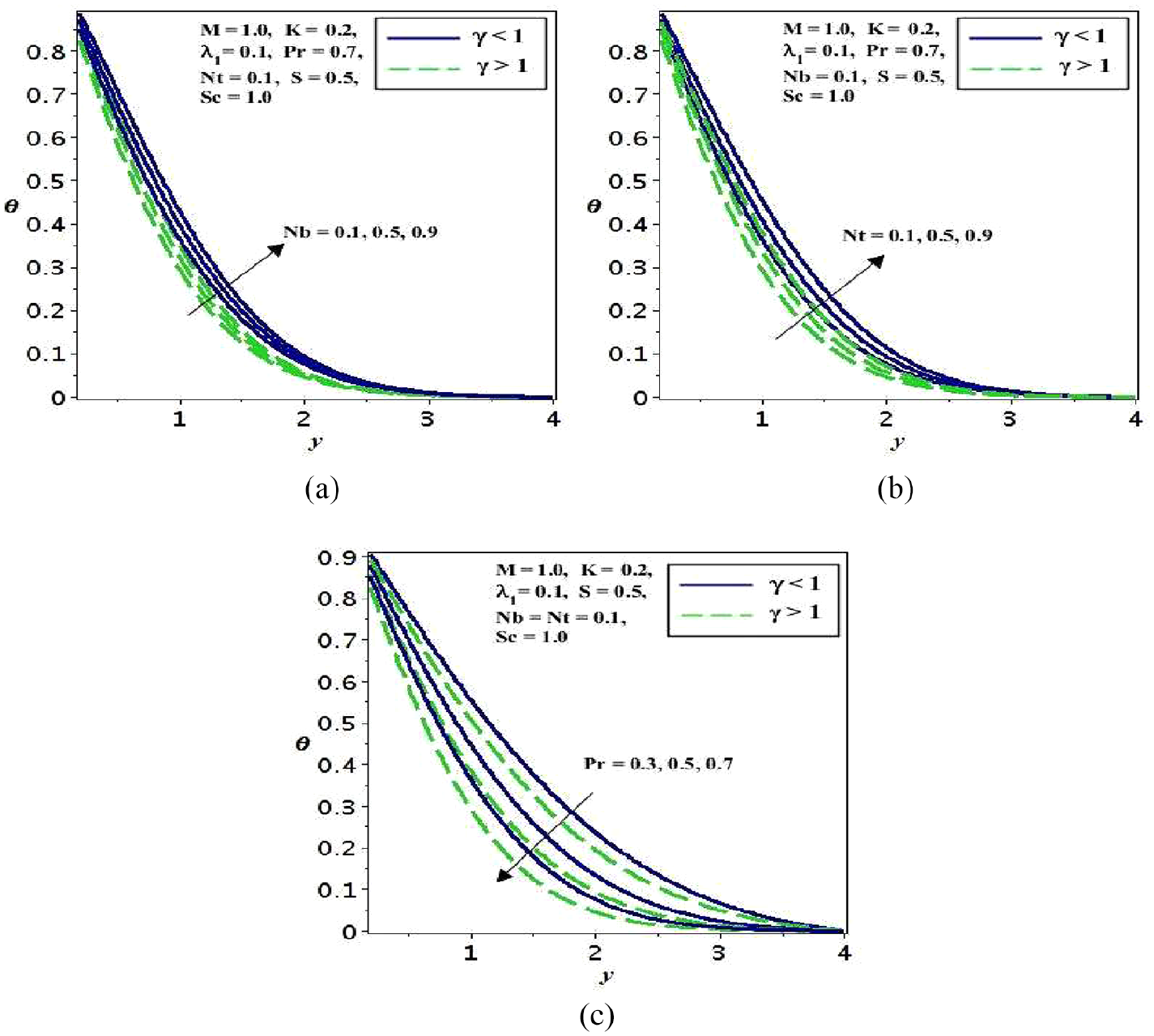
The variations in temperature profile due to the influence of parameters , , , , and are portrayed in Figures 5 and 6. It is detected from Figure 5(a) that decreases when is increasing with fixed but profile appears to be reverse when increasing is taken with fixed . Figure 5(b) displays that the profile decreases with higher values of parameter for both fixed and . Increasing parameter tends to decrease gradually, this result is depicted in Figure 5(c).
Plots for temperature profile against: (a) , (b) , and (c) .
Plots for temperature profile against: (a) , (b) , and (c) .
Figure 6 displays the graphical results for variations in temperature due to increment in parameters , and . The graphs show that the increasing and are responsible for the increase in temperature and increasing causes to decrease the temperature profile. These results are observed in both and cases and displayed in (Figure 6(a)–(c)) respectively.
The influence of parameters , , , , and on concentration profile is sketched in Figures 7 and 8. The variations in profile in consequence of increment in parameters , and are shown in Figure 7. Figure 7(a) exhibits the decreasing response of in the result of increase in with , on the other hand an increase in profile can be seen with increase in with . Figure 7(b) presents that, gradually increasing values of tend to decrease profile for both and . Figure 7(c) shows the behavior of is decreasing, caused by increment in .
Plots for temperature profile against: (a) , (b) , and (c) .
Plots for concentration profile against: (a) , (b) , and (c) .
Figure 8 illustrates the behavior of profile influenced by parameters , and for both and . Figure 8(b) reveals that the concentration profile increases when gradually increases and Figure 8(a) and (c) indicate that the concentration profile behaves as a decreasing function with increase in and respectively.
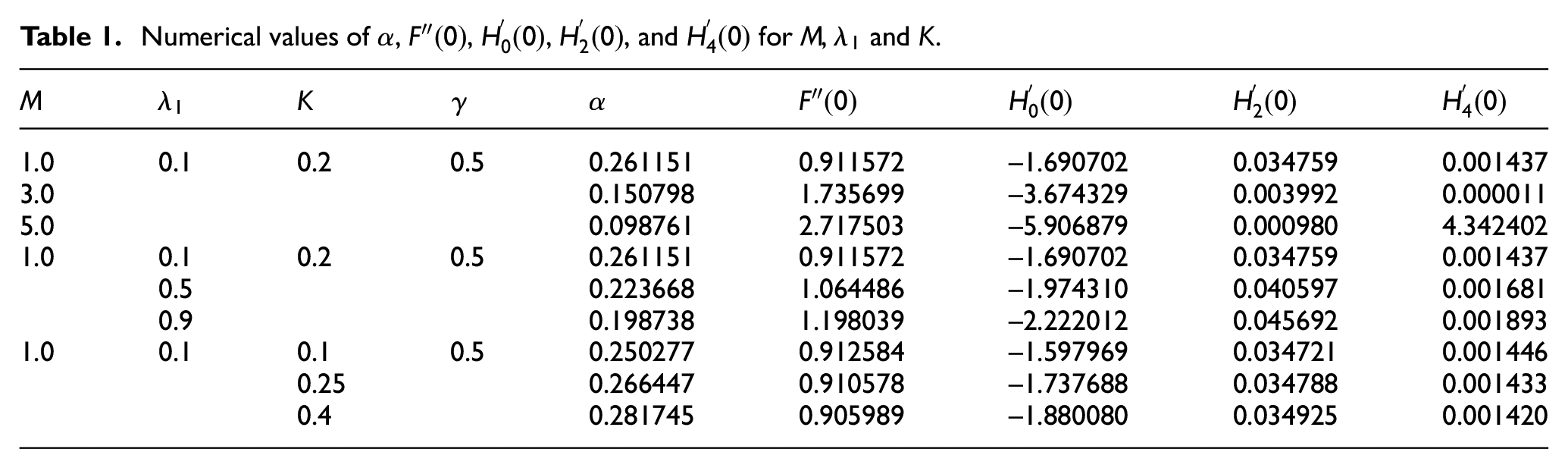
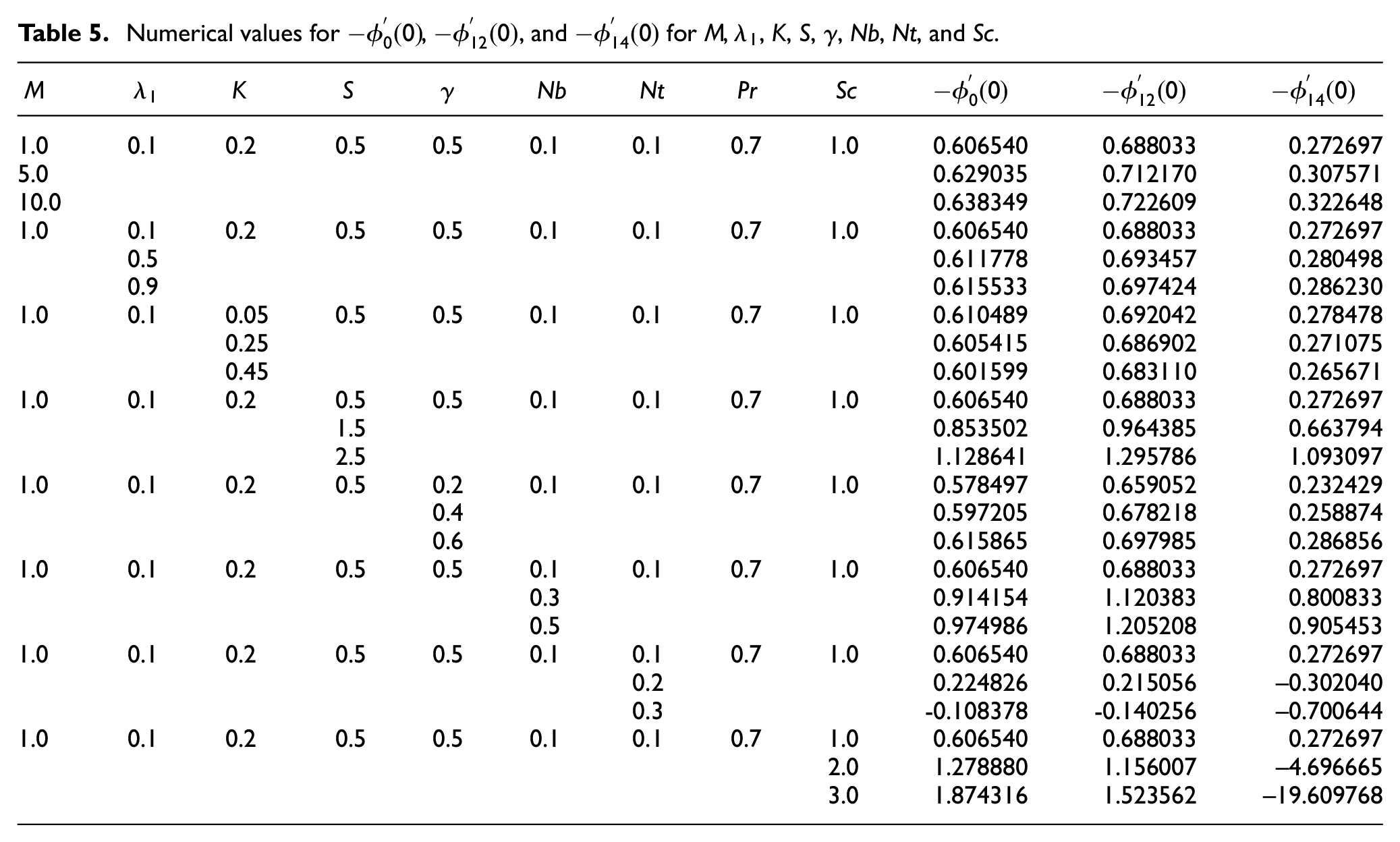
The behavior of physical quantities , and that is influenced by the increasing value of governing parameters, can be observed through the tabular values enlisted in Tables 1, 4 and 5. The numerical values of and are displayed in Table 1. decreases for the increasing and while it increases for increasing . The numerically computed values of , and are enlisted in Table 2 for some fixed values of . To validate our numerical values a comparison is made for a limiting case with the results reported by Malvandi et al.34 in Table 3. A good agreement is found with the previously published data.
Numerical values of , , , , and for , and .
1.0
0.1
0.2
0.5
0.261151
0.911572
−1.690702
0.034759
0.001437
3.0
0.150798
1.735699
−3.674329
0.003992
0.000011
5.0
0.098761
2.717503
−5.906879
0.000980
4.342402
1.0
0.1
0.2
0.5
0.261151
0.911572
−1.690702
0.034759
0.001437
0.5
0.223668
1.064486
−1.974310
0.040597
0.001681
0.9
0.198738
1.198039
−2.222012
0.045692
0.001893
1.0
0.1
0.1
0.5
0.250277
0.912584
−1.597969
0.034721
0.001446
0.25
0.266447
0.910578
−1.737688
0.034788
0.001433
0.4
0.281745
0.905989
−1.880080
0.034925
0.001420
Numerical values of and for , , and .
1.0
0.1
0.2
0.5
−0.261151
1.007541
0
0.561360
0.261151
0.115181
3.0
0.1
0.2
0.5
−0.150798
1.302075
0
0.763295
0.150798
0.224515
5.0
0.1
0.2
0.5
−0.098761
1.317502
0
0.757434
0.098761
0.197366
1.0
0.1
0.2
0.5
−0.261151
1.007541
0
0.561360
0.261151
0.115181
1.0
0.5
0.2
0.5
−0.223668
1.048176
0
0.598303
0.223668
0.148430
1.0
0.9
0.2
0.5
−0.198738
1.074272
0
0.622349
0.198738
0.170426
1.0
0.1
0.1
0.5
−0.250277
0.970416
0
0.554411
0.250277
0.138407
1.0
0.1
0.25
0.5
−0.266447
1.027773
0
0.566328
0.266447
0.104869
1.0
0.1
0.4
0.5
−0.281745
1.092974
0
0.585306
0.281745
0.077641
Comparison for the variation in and when with the results reported by Malvandi et al.34
The behavior of skin friction coefficient can be determined with the help of tabulated values of in Table 1. An increment in is shown for the increasing and while a reduction in is shown for increasing . The behavior of can be seen through Table 4. The evaluated results reveal that shows an increment for gradually increasing , , , , and . However, it shows reduction for growing values of , and . Table 5 reports the increment and reduction in . increases for gradually growing parameters , , , , , and but it decreases for increment in parameters and .
Numerical values of , , and for , , , , , , , and .
1.0
0.1
0.2
0.5
0.5
0.1
0.1
0.7
1.0
0.766766
1.061854
1.101256
5.0
0.796625
1.082151
1.118731
10.0
0.810641
1.092223
1.127887
1.0
0.1
0.2
0.5
0.5
0.1
0.1
0.7
1.0
0.766766
1.061854
1.101256
0.5
0.773251
1.066159
1.104823
0.9
0.778038
1.069359
1.107521
1.0
0.1
0.05
0.5
0.5
0.1
0.1
0.7
1.0
0.771368
1.064852
1.103661
0.25
0.765459
1.060999
1.100573
0.45
0.761056
1.058113
1.098278
1.0
0.1
0.2
0.5
0.5
0.1
0.1
0.7
1.0
0.766766
1.061854
1.101256
1.5
1.271841
1.484864
1.509985
2.5
1.835775
1.956334
1.971706
1.0
0.1
0.2
0.5
0.2
0.1
0.1
0.7
1.0
0.723744
1.030233
1.072804
0.4
0.752534
1.051426
1.091863
0.6
0.780894
1.072177
1.110567
1.0
0.1
0.2
0.5
0.5
0.1
0.1
0.7
1.0
0.766766
1.061854
1.101256
0.5
0.651222
0.860776
0.940039
0.9
0.549348
0.693287
0.801936
1.0
0.1
0.2
0.5
0.5
0.1
0.1
0.7
1.0
0.766766
1.061854
1.101256
0.5
0.655789
0.856601
0.890186
0.9
0.563820
0.681608
0.666476
1.0
0.1
0.2
0.5
0.5
0.1
0.1
0.3
1.0
0.477691
0.672921
0.687110
0.5
0.628462
0.880194
0.907291
0.7
0.766766
1.061854
1.101256
Numerical values for , , and for , , , , , , , and .
1.0
0.1
0.2
0.5
0.5
0.1
0.1
0.7
1.0
0.606540
0.688033
0.272697
5.0
0.629035
0.712170
0.307571
10.0
0.638349
0.722609
0.322648
1.0
0.1
0.2
0.5
0.5
0.1
0.1
0.7
1.0
0.606540
0.688033
0.272697
0.5
0.611778
0.693457
0.280498
0.9
0.615533
0.697424
0.286230
1.0
0.1
0.05
0.5
0.5
0.1
0.1
0.7
1.0
0.610489
0.692042
0.278478
0.25
0.605415
0.686902
0.271075
0.45
0.601599
0.683110
0.265671
1.0
0.1
0.2
0.5
0.5
0.1
0.1
0.7
1.0
0.606540
0.688033
0.272697
1.5
0.853502
0.964385
0.663794
2.5
1.128641
1.295786
1.093097
1.0
0.1
0.2
0.5
0.2
0.1
0.1
0.7
1.0
0.578497
0.659052
0.232429
0.4
0.597205
0.678218
0.258874
0.6
0.615865
0.697985
0.286856
1.0
0.1
0.2
0.5
0.5
0.1
0.1
0.7
1.0
0.606540
0.688033
0.272697
0.3
0.914154
1.120383
0.800833
0.5
0.974986
1.205208
0.905453
1.0
0.1
0.2
0.5
0.5
0.1
0.1
0.7
1.0
0.606540
0.688033
0.272697
0.2
0.224826
0.215056
−0.302040
0.3
−0.108378
−0.140256
−0.700644
1.0
0.1
0.2
0.5
0.5
0.1
0.1
0.7
1.0
0.606540
0.688033
0.272697
2.0
1.278880
1.156007
−4.696665
3.0
1.874316
1.523562
−19.609768
Conclusion
The numerical investigation of the mathematical problem of two-dimensional oblique stagnation point flow with the MHD effects of incompressible unsteady Jeffrey fluid induced by an oscillatory and stretching sheet has been presented in this article. The numerical solutions of this problem are evaluated with the help of problem-solver BVP MAPLE. The variations in velocity, concentration, and temperature profiles influenced by the governing physical parameters are depicted in graphs. The numerical values are also displayed in tables for the investigation of physical quantities Nusselt number, skin friction coefficient, and Sherwood number. The results are summarized as follows:
The increasing behavior of is detected for increasing , , and with fixed . with fixed tends to decrease profile. The results are opposite when .
Velocity profile behaves as an increasing function of growing , , and with fixed and behaves as a decreasing function for growing with . The results are the opposite in the case of .
and profiles decrease with growing for case.
, , and cause to decrease while and cause to increase it for both cases of .
profile shows decreasing the behavior to increasing , , and for both cases of .
Skin friction coefficient boosts up with higher values of and while reverse results are shown for increasing .
Nusselt number enhances for gradually growing values of , , , , and , and reduces for increasing , , and .
Sherwood number rises for gradually increasing , , , , , and . However, it reduces for growing and .
Footnotes
Appendix
Acknowledgements
All the authors are thankful to Prof. Muhammad Azam, Department of English, Govt. College Jauharabad for correcting the paper grammatically and improving its language as well.
Handling Editor: James Baldwin
Authors’ contributions
A.U.A. and N.A.: did the mathematical formulation; S.A.: performed the solutions; A.U.A. and S.A.: performed the numerical simulations and plotted the results; N.A. and S.A.: analyzed and discussed the results; A.U.A., S.A., and N.A.: wrote the paper. All the authors contributed equally. All authors have read and approved the final manuscript.
Declaration of conflicting interests
The author(s) declared no potential conflicts of interest with respect to the research, authorship, and/or publication of this article.
Funding
The author(s) received no financial support for the research, authorship, and/or publication of this article.
ORCID iDs
Aziz Ullah Awan
Nadeem Abbas
References
1.
HiemenzK.Die Grenzschicht an einem in den gleichformigen Flussigkeitsstrom eingetauchten geraden Kreiszylinder. Dinglers Polytech J1911; 326: 321–324.
2.
HowarthL. CXLIV. The boundary layer in three dimensional flow.—Part II. The flow near a stagnation point. London Edinburgh Dublin Philos Mag J Sci1951; 42: 1433–1440.
3.
RottN.Unsteady viscous flow in the vicinity of a stagnation point. Q Appl Math1956; 13: 444–451.
4.
StuartJT.The viscous flow near a stagnation point when the external flow has uniform vorticity. J Aerosp Sci1959; 26: 124–125.
5.
TamadaK.Two-dimensional stagnation-point flow impinging obliquely on a plane wall. J Physical Soc Jpn1979; 46: 310–311.
6.
MahapatraTRGuptaAS.Magnetohydrodynamic stagnation-point flow towards a stretching sheet. Acta Mech2001; 152: 191–196.
7.
AkbarNSNadeemSHaqRU, et al. Radiation effects on MHD stagnation point flow of nano fluid towards a stretching surface with convective boundary condition. Chin J Aeronaut2013; 26: 1389–1397.
8.
RehmanFUNadeemSHaqRU.Heat transfer analysis for three-dimensional stagnation-point flow over an exponentially stretching surface. Chin J Phys2017; 55: 1552–1560.
9.
BesthapuPHaqRUBandariS, et al. Thermal radiation and slip effects on MHD stagnation point flow of non-Newtonian nanofluid over a convective stretching surface. Neural Comput Appl2019; 31: 207–217.
10.
NadeemSAminAAbbasN.On the stagnation point flow of nanomaterial with base viscoelastic micropolar fluid over a stretching surface. Alex Eng J2020; 59: 1751–1760.
11.
WainiIIshakAPopI.Hybrid nanofluid flow towards a stagnation point on a stretching/shrinking cylinder. Sci Rep2020; 10: 1–12.
12.
ChoiSUSEastmanJA. Enhancing conductivity of fluids with nanoparticles. ASME Fluids Eng Div1995; 231: 99–105.
13.
BuongiornoJ.Convective transport in nanofluids. J Heat Transfer2006; 128: 240–250.
14.
MahapatraTRGuptaAS.Stagnation-point flow of a viscoelastic fluid towards a stretching surface. Int J Non Linear Mech2004; 39: 811–820.
15.
BorrelliAGiantesioGPatriaMC.MHD oblique stagnation-point flow of a micropolar fluid. Appl Math Modell2012; 36: 3949–3970.
16.
BorrelliAGiantesioGPatriaMC.MHD oblique stagnation-point flow of a Newtonian fluid. Z Angew Math Phys2012; 63: 271–294.
17.
NadeemSMehmoodRAkbarNS.Non-orthogonal stagnation point flow of a nano non-Newtonian fluid towards a stretching surface with heat transfer. Int J Heat Mass Transf2013; 57: 679–689.
18.
KhanAUNadeemSHussainST.Phase flow study of MHD nanofluid with slip effects on oscillatory oblique stagnation point flow in view of inclined magnetic field. J Mol Liq2016; 224: 1210–1219.
19.
MehmoodRNadeemSSaleemS, et al. Flow and heat transfer analysis of Jeffery nano fluid impinging obliquely over a stretched plate. J Taiwan Inst Chem Eng2017; 74: 49–58.
20.
NadeemSKhanMRKhanAU.MHD stagnation point flow of viscous nanofluid over a curved surface. Phys Scr2019; 94: 115207.
21.
NadeemSKhanMRKhanAU.MHD oblique stagnation point flow of nanofluid over an oscillatory stretching/shrinking sheet: existence of dual solutions. Phys Scr2019; 94: 075204.
22.
NadeemSUllahNKhanAU.Impact of an oblique stagnation point on MHD micropolar nanomaterial in porous medium over an oscillatory surface with partial slip. Phys Scr2019; 94: 065209.
23.
SaifRSMuhammadTSadiaH, et al. Hydromagnetic flow of Jeffrey nanofluid due to a curved stretching surface. Physica A2020; 551: 124060.
24.
HaqRURazaAAlgehyneEA, et al. Dual nature study of convective heat transfer of nanofluid flow over a shrinking surface in a porous medium. Int Commun Heat Mass Transfer2020; 114: 104583.
25.
AhmedSE.Modeling natural convection boundary layer flow of micropolar nanofluid over vertical permeable cone with variable wall temperature. Appl Math Mech2017; 38: 1171–1180.
26.
AhmedSE.Non-Darcian natural convection of a nanofluid due to triangular fins within trapezoidal enclosures partially filled with a thermal non-eq38 porous layer. J Therm Anal Calorim. Epub ahead of print May2020. DOI: 10.1007/s10973-020-09831-4.
27.
AhmedSE.Caputo fractional convective flow in an inclined wavy vented cavity filled with a porous medium using hybrid nanofluids. Int Commun Heat Mass Transfer2020; 116: 104690.
28.
AhmedSE.FEM-CBS algorithm for convective transport of nanofluids in inclined enclosures filled with anisotropic non-Darcy porous media using LTNEM. Int J Numer Methods Heat Fluid Flow. Epub ahead of print June2020. DOI: 10.1108/HFF-01-2020-0042.
29.
AhmedSE.Natural convection of dusty hybrid nanofluids in diverging-converging cavities including volumetric heat sources. J Therm Sci Eng Appl2020; 13: 1–17.
30.
HsiaoKL.Stagnation electrical MHD nanofluid mixed convection with slip boundary on a stretching sheet. Appl Therm Eng2016; 98: 850–861.
31.
HsiaoKL.Combined electrical MHD heat transfer thermal extrusion system using Maxwell fluid with radiative and viscous dissipation effects. Appl Therm Eng2017; 112: 1281–1288.
32.
HsiaoKL.Micropolar nanofluid flow with MHD and viscous dissipation effects towards a stretching sheet with multimedia feature. Int J Heat Mass Transf2017; 112: 983–990.
33.
HsiaoKL.To promote radiation electrical MHD activation energy thermal extrusion manufacturing system efficiency by using Carreau-Nanofluid with parameters control method. Energy2017; 130: 486–499.
34.
MalvandiAHedayatiFGanjiDD.Slip effects on unsteady stagnation point flow of a nanofluid over a stretching sheet. Powder Technol2014; 253: 377–384.