



Abstract
Post-stroke paralysis, whereby subjects loose voluntary control over muscle actuation, is one of the main causes of disability. Repetitive physical therapy can reinstate lost motions and strengths through neuroplasticity. However, manually delivered therapies are becoming ineffective due to scarcity of therapists, subjectivity in the treatment, and lack of patient motivation. Robot-assisted physical therapy is being researched these days to impart an evidence-based systematic treatment. Recently, intelligent controllers and brain–computer interface are proposed for rehabilitation robots to encourage patient participation which is the key to quick recovery. In the present work, a brain–computer interface and assist-as-needed training paradigm have been proposed for an upper limb rehabilitation robot. The brain–computer interface system is implemented with the use of electroencephalography sensor; moreover, backdrivability in the actuator has been achieved with the use of assist-as-needed control approach, which allows subjects to move the robot actively using their limited motions and strengths. The robot only assists for the remaining course of trajectory which subjects are unable to perform themselves. The robot intervention point is obtained from the patient’s intent which is captured through brain–computer interface. Problems encountered during the practical implementation of brain–computer interface and achievement of backdrivability in the actuator have been discussed and resolved.
Keywords
Introduction
The recovery of upper limb motions and strengths in patients with damaged neuromuscular system via robotic rehabilitation devices is a promising way of enhancing existing treatments and their efficacies. Various reasons may cause limb dysfunctions, including stroke, spinal cord injuries, or even ligament rupture. According to the World Health Organization, about 15 million people globally suffer from Cerebro-Vascular Accidents (CVAs) each year and up to 65% of these need limb recovery procedures. 1 Only in the last 15 years, the number of CVA or stroke patients is increased by 40%, which is the result of a more intense pace of living, deterioration of ecology, and increased aging population. 2 Considering these statistics, development of new and efficient ways of rehabilitation is just as important as implementation of improved prevention strategies.
For the last 20 years, robotics-based therapy was steadily paving its way for becoming an essential practice in rehabilitation medicine.3,4 According to the systematic review of Kwakkel et al. 5 on the upper limb recovery using robot-aided therapy, repetitive, meaningful, labor-intensive treatment programs implemented with robotic devices provide positive impact for the restoration of functional abilities in human limbs. In medical terminology, a device that provides support, and aligns or improves the function of movable limbs is known as orthosis, and robotic devices intended to provide such treatment are called robotic orthoses. 6 Particularly, two key directions gained major attention in the medical engineering research: robot-assisted therapy and functional electrical simulation (FES) therapy. The FES therapy describes a technique that stimulates weakened or paralyzed muscles on a human limb by applying electric charges externally. The goal of FES therapy is to reactivate the neural connections between a muscle and human’s sensorimotor system to enable patients’ ability to control their limbs without assistance. 7 In the study by Popovic and others, the functional electrical therapy (FET) was applied with the use of surface electrodes and it was used to stimulate arm fingers of patients, this therapy has demonstrated positive therapeutic effects. 8 It was revealed that daily 30-min therapy for 1-month period allowed improvement in movement range, speed, and increased strength in muscles. There are also side effects of FES-based treatment such as pain and irritation on the affected area, autonomic dysreflexia, increased spasticity, broken bones, and mild electric shocks from faulty equipment. However, the robot-assisted rehabilitation is non-invasive and free from above risks, and it is preferred for the rehabilitation of stroke survivors.
The important advantage of robotic devices is that they can reduce the burden on health care workers who traditionally had to conduct labor-intensive training sessions for patients. Equipped with sensors, intelligent controllers, and haptic and visual interfaces, robotic orthosis can have a potential to put the recovery process to a new level by collecting relevant data about various health parameters (pulse rate, body temperature, etc.) and adjusting the training modes accordingly. Besides the positive impacts of robot-based rehabilitation, the reliability of robot-based assistance is still questionable and adversely it may worsen the recovery progress made before, and that depends on the type of assistance control robot employs. 9 Assist-as-needed (AAN) control type has become one of the prominent strategies recently which has been recommended positively from clinical trials. 10 In order to stabilize the system, AAN-based approach has become subject to be researched by scientists. In the work done by Wolbrecht, AAN control is obtained from the adaptive control by incorporating novel force to address and decrease the system’s parametric errors. 11 There are also other works which propose AAN type of control for their systems;12–14 however, there are no works which have incorporated both BCI (brain–computer interface)- and AAN-based control approach into the system.
Owing to the recent advances in biosensors, especially in their robustness and signal processing, robot controllers equipped with bio-sensing are able to achieve intelligence with less complex algorithms. One of the most recent applications of BCI is in the domain of orthoses.15–17 Newer instances of orthoses combine latest advances in control theory and brain activity. Berlin Technical University in cooperation with Korean University created an exoskeleton to maneuver lower limbs. A feature of this work is the use of non-invasive electroencephalography (EEG). The study involved 11 healthy men aged 25 to 32 years. 18 First upper limb exoskeleton controlled by BCI was proposed by AA Frolov et al. 19 Authors concluded that BCI inclusion improves the movements of the paretic hand in post-stroke patients irrespective of severity and localization of the disease. In addition, it was shown that duration of the training also increases effectiveness of rehabilitation.
Based on the letters on the screen, it was possible to determine native language of the patient in the work done by Vasileva. 20 In this work, non-invasive EEG had been used. However, it was noted that non-invasive devices have less accuracy than professional medical EEG equipment. To improve signal detection, Agapov et al. 21 have developed advanced algorithm of processing visually evoked potentials. To visualize stimuli, “eSpeller” software was developed.
Motivated by the above-mentioned successes and advances, in the present work, possible use of BCI is investigated in the rehabilitation robots for the treatment of stroke survivors. The aim of this work is to develop EEG-based mechatronic system that can receive electrical brain signals, detect emotions and gestures of the patient, and intelligently control robotic arm. In addition, to ensure smooth and compliant movement of the rehabilitation robot and improve treatment efficacy, AAN control paradigm is also considered. This research used EEG package and a controller to develop BCI system and realize AAN-based control. Developed system can help patients to control robot with their thoughts and enhance their participation in the rehabilitation process. Methodology of the current work is explained in the “Methodology” section, and in the subsequent sections, results are discussed before drawing conclusions from this research work.
Methodology
EEG sensor
In order to register the brain activity, 16 EEG electrodes distributed around the patient’s head have been used. To provide more information which is related to motor imaginary signals, the frequency characteristics were extracted from the data by converting them from the time domain to the frequency domain. Furthermore, to distinguish between movement intentions and rest positions, bandpass filter in the range of 5 to 40 Hz was used.22,23 Since EEG data set recording can be very large, the powerful surface Laplacian technique was applied to lower the risk of influence from the neighboring neurons on the crucial cerebral cortex neurons. 24 Finally, only dominant frequency of 13 to 30 Hz, also known as beta wave frequency, was featured according to Gropper et al. 25 This band distinction was benchmarker as a sensible area of resting brain activity.
Abiding by the previous works associated with EEG signal processing in Iáñez et al. 26 and Hortal et al., 27 the feature selection was reduced to the group of 29 features, which later were used for the further classification and predictive model construction.
After receiving data using an EEG, algorithm needs to determine the desired effect for the user. Input data for this algorithm are EEG signals recorded during the demonstration of stimuli. In most of the currently existing studies on this subject, the problem of classifying signals is divided into three large subtasks:
Preprocessing the signal (in order to remove noise components);
Formation of a feature space;
Classification of objects in the constructed feature space.
It should be noted that the greatest influence on the final quality of the classification is made by the extent to which the task of forming the feature space was successfully accomplished. The general scheme of operation of BCI is depicted in Figure 1.

Block diagram of BCI interface.
Preprocessing
Preprocessing of the signal is performed to remove artifacts (spontaneous muscle contractions, blinking, etc.) and to neutralize the existing noise components. In addition, information of interest is contained in a predefined frequency range, and the remaining components are considered less informative. Several preparations are carried out to enhance signal quality:
Removing a constant amplitude offset;
Bandpass filtering;
Robust transformation;
Electrode selection.
In this work, digital Butterworth filter is used. Digital Butterworth filter is a family of methods for processing a discrete signal in order to isolate or suppress certain frequency components of a signal. High-pass filters, low-pass filters, bandpass filters, and band-stop filters are allocated. A common class of digital filters is a linear digital filter, which can be given by its generalized difference equation

Here, i and j are used for integer-line intervals containing zero value. If
Butterworth filters are a family of non-recursive single-pass filters, the distinguishing feature of which is the smoothness of their amplitude–frequency response at frequencies where the signal is skipped. 28
Construction of a feature space
Since dimensionality of BCI system is usually large and the training set (session of catching EEG signals) is small, the direct application of classification will likely give worse results. Therefore, character space construction stage is the most important process of resolving this problem. The challenge here is that there is no single method exists for finding a new feature space. Researchers have to confront with the need to search for a feature space for the effective solution of a particular task delivered using specific equipment.
There are several most commonly used methods:
Blind source separation methods: These are based on the assumption that recorded signals for the multichannel devices are a mixture of signals from different sources and attempts to identify sources with some assumptions about their nature. 29
Morphological signs methods: Such methods describe changes in the amplitudes of neurophysiological signals occurring during a certain period of time. Often used strategy for dividing the background activity and waves of P300 consists of a low-pass filter or a filter with a certain bandwidth with the subsequent possible thinning of the signal. The fact is that most of the components of the P300 wave are concentrated in the low-frequency range, and therefore, described procedure allows neutralizing the influence of redundant information.
The Fourier Transform methods: Following this, analysis of signals is carried out by decomposition into “basic” functions, each of which corresponds to a certain frequency. In this way, one can analyze the degree of expression of oscillations of a certain frequency. While Fourier transform uses sinusoids as the basis functions, for discrete signals that occur in the task of constructing a BCI, discrete Fourier transform (DFT) is applied.
Wavelet transform methods: Integral transformation is a convolution of a wavelet function that has many characteristic properties with a signal. By analogy with the Fourier transform, a certain decomposition of the original signal occurs. For discrete signals, a discrete wavelet transform is used.
Common spatial pattern filter method of decomposition of a multichannel EEG signal: Here, the problem of classification of multidimensional signals into two classes is considered. The purpose of the method is to decompose the original signal into additive components in such a way as to maximize the dispersion of the first components and minimize the variance of the latter for the objects of the first class and achieve a reverse situation for the objects of the second class.
The construction of feature space of BCI was implemented based on morphological sign method, where waves of P300 are considered in more detail.
Classification
An important stage in the operation of the interface is the training of the classifier, which distinguishes significant stimuli at the final stage of the experiment. The classifier applied in the present work is a module that performs multiple training on the allocation of a single feature vector from a set of vectors and further verification of this vector on a learning classifier. This work has applied linear discriminant analysis (LDA), which is a classification algorithm that divides the input set into two classes. Such model has been presented in the work.
30
Implementation starts with dividing initial sample S by two subsamples S1 and S2, where each contains n1 and n2 vectors respectively. Expected value
Expected values are given below:


Correlation matrix ‘C’ can be given by


Classification result ‘y’ based on some input x

Experiment
The mechatronic system together with BCI and the AAN-based controller was tested on 10 healthy subjects and implemented with the usage of EEG sensor, controller board on the upper limb robotic exoskeleton which allows elbow flexion and extension activities. The ethical approval has been received from local Institutional Research Ethics committee. Methods discussed in the previous section are used in conjunction with EEG software, which are exploited as main preprocessing tool. This software is used to control the servo motor, which is being used to actuate the upper limb rehabilitation robot.
The principle of Mental Commands detection suite operates in a following way. The brain sensor recognizes user’s intention to perform certain physical action by analyzing the brainwave activity. There are 12 various actions that can be detected with the device, 6 of which are directions (left, right, up, down, push, and pull) and other 6 are rotations (forward, backward, right, left, clockwise, and counterclockwise). In order to assist subject’s thinking intention and motivate him, animated virtual 3D (three-dimensional) cube is established as shown in Figure 2, which moves away and comes back.
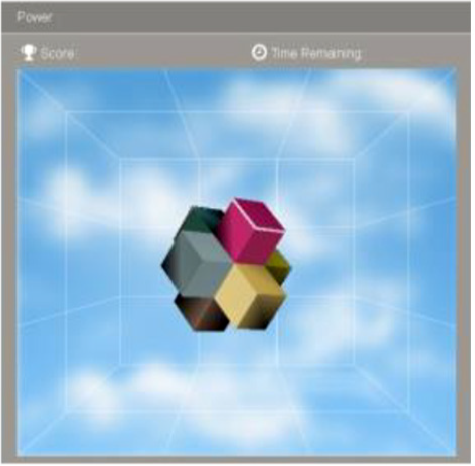
Animated virtual 3D cube for training purposes.
The Mental Commands detection is activated by training the assigned action and additional neutral action. The proposed BCI in this experiment operates in a following way.
At first, the connection between reading device and a client server in the development environment is being set. The initial data are necessary for the subsequent development of the filter and classifier training. It is necessary to approach responsibly and minimize the factors distracting and dispelling the user’s attention, since the training sample from the point of view of the classifier is always reliable. User training is necessary to improve the ability to concentrate on the current task. As an initial reference, the proposed model uses “neutral” state. It is one of the most important trainings, because other trained Mental Commands are based on the distinction from “neutral” state. It is recommended to imagine mediation or reading process. During the filter generation stage, direct user participation is not required. A spatial filter allows to increase the quality of the received signal by using other electrodes except the directly located ones above the working area of the brain. Classifier based on the method of LDA is used, which divides the sample into two classes. The interface makes analysis of input signals and creates personalized patterns for each person. As neutral state is trained first, newly measured Mental Commands can be detected more precise.
For the training purpose, initially, appropriate action is selected. Subsequently, it is required to start visualizing correspondent action. In this work, “lift” action is required to be trained; therefore, the cube in the display is lifted using thoughts. Application gives training period (8 s), during which maximum focus on action is performed by subjects. Experience shows that additional gestures increase the accuracy of actions. Finally, training recordings must be saved or rejected. It is recommended to make several training trials for each action to ensure successful data training.
The link of trained features with special keystrokes is done in order to allow acquisition of outputs from software and further translation to the controller by creating logical mapping according to Table 1.
Logical mapping.

During the experiment, the “lift” and “drop” Mental Commands are used to control motor, which correspond to the flexion and extension of the device, respectively.
Robotic orthosis design
The entire BCI system is used with an upper limb rehabilitation robot, which is actuated with the use of electric linear actuator (ELA) and controlled using brain sensing and force sensing systems. The ELA is used as a basic mechanism for controlling elbow movements. To fix and guide the arm on a reference trajectory, supporting aluminum mechanism was constructed in the way as shown in Figure 3. Moreover, a movable closed chain linkage was formed between robot and the actuator, which positively affects the system. The closed chain linkage allows the human joint to remain aligned with the robot joint during various arm motions. Thereby, it is ensured that there is no relative motion between human joint and the robotic joint.

Conceptual design of the upper limb rehabilitation robot using ELA.
The experimental procedures relied on carrying out elbow flexion/extension in the sagittal plane driven by the upper limb robot (Figure 4(a)–(c)).

(a) ELA actuated upper limb rehabilitation robot, (b) upper limb rehabilitation robot in use, and (c) robotic orthosis in use with EEG sensor.
AAN paradigm
Traditional robotic arms are usually very bulky and may exert very high torques, which can cause damage to the users’ limbs. The present research aims to develop a simple rehabilitation device, which can be used to perform daily tasks and increase voluntary participation of patients during rehabilitation therapy. Hence, the resulting concept has to consider safety measures and ease in delivering the treatment.
During the rehabilitation treatments, subject’s participation is crucial, and therefore, the robotic assistance should only be provided when a subject fails to follow commanded trajectory with his or her capabilities. This kind of approach is termed as assist-as-needed control approach. 31 In the present research, this control goal is achieved through a simple scheme of interaction force control.
The interaction force between the human limbs and the robot is controlled using zero vector as the commanded force. A simple proportional controller used for force control can also help in achieving backdrivability in the actuation system. This further means that the actuator can be driven backward with ease to provide safe human interaction.
The only source of compliance in the motor is from the inherent belt drive, and thereby the actuator and sensor can be modeled as two-mass system shown in Figure 5. Here,



Illustration of interaction force with sensor and motor parameters.
The overall force controller was implemented in joint space for the elbow motions (Figure 6). The combined dynamics of the robotic orthosis and human subject is provided by

Here,

Overall force controller implemented in joint space.
Owing to the application of this force controller with zero vector as the commanded force, the robot is actuated to maintain zero interaction force between robot and the subject. This further means that if the subject can apply force in either direction, the actuators will move the robot in the same direction so as to achieve zero commanded force. Nevertheless, the robot will not be actuated if the subject cannot move his or her limbs. In such a condition, when the subject cannot move limbs and the robot is not moving, the BCI comes into picture. The subject is asked to think of “lift” or “drop,” and this brain signal controls the motor as explained in Step 6 of the “Experiment” section.
This proposed AAN approach allows performing the elbow flexion and extension motions by the subjects more voluntarily, allowing subject’s involvement in the treatment for a quick recovery.
Results
As a result of the AAN approach implementation, motor actuation was achieved in a desired manner. In other words, whenever input “a” was entering monitor board, the robot’s flexion motion was obtained, and for a keystroke “b” on the monitor, extension motion was obtained. The force controller to realize AAN approach was also successfully implemented. Results from the AAN approach are shown in Figure 7. The interaction force variation with time during extension and flexion trajectories (averaged for 10 healthy subjects) is shown here. Since zero commanded force has been achieved with less than 3% error, which is insignificant value to be experienced by the user and therefore it means that the user will not feel it. So, the controller is able to achieve zero commanded force with some variation.

Resulting interaction force from the proposed force controller implemented to achieve AAN control approach.
The average value of the interaction forces observed over the time interval as shown in Figure 7 was found to be
Experiments of elbow flexion and extension using BCI were conducted in two different ways. First, the “lift” and “drop” trainings were performed with the cube on monitor using brain signals. Out of 50 attempts, only 39 attempts were executed correctly (with 78% of accuracy). Correctness of experiments was observed by counting printed keystrokes on the monitor board. For “lift” action, left eye blink, and for “drop” action, right eye blink gestures were used. With gesture included, the accuracy of brain signal reading was increased to 88%.
Discussion and conclusion
An upper limb robot is proposed here which is controlled using AAN-based approach and BCI augmented supervisory control action. The contribution of this work is that it implemented and incorporated both BCI and AAN controller into the robotic rehabilitation device and see how they perform on human arm for the training purposes. The implemented AAN scheme supports the elbow movements of subjects whenever there is an intention/effort from a user to move the arm. The user’s effort is captured through a force and pressure sensitive sensors, and is termed as interaction force signal which is further used in a force controller. The force controller works with commanded interaction force as a zero vector, and thereby moves the robot in a direction to minimize the interaction force. Obviously, the robot will be moved in the same direction as the subject is trying to move in order to minimize the interaction force. In this control mode, subjects can move the robot actively while the robot behaves completely passive. Such approach is aimed at motivating the subject to complete commanded trajectory with own efforts. However, in case if the subject is not capable of moving limbs at all, he or she is asked to think in terms of “lift” or “drop” signals which will activate the BCI system to intervene. The robot, in BCI mode, actively completes the trajectory in an assistive manner where the subject is completely passive. This proposed approach has only been tested on 10 healthy subjects, and satisfactory results have been obtained. In general, AAN approach is activated when the subject can move the limbs only partially, in the case when limbs cannot be moved at all due to different reasons, BCI approach comes into handy, since it allows to direct subject’s limbs using only brain signals as the input. During this work, authors have reviewed existing approaches for solving the problems of constructing BCIs. Introduction of BCI and outline on types of sensing EEG signals have been included. Details on EEG data processing are also provided, including main steps as preprocessing, construction of feature space, and classification.
Lately, authors have started working on advanced learning algorithms such as deep learning to enhance the accuracy of brain signal interpretation. The force controller to achieve AAN paradigm needs further work regarding its stability evaluation and robustness. Therefore, the future work shall be carried out in these two important directions besides design improvements of the rehabilitation robot for increased flexibility and increasing number of degrees of freedom; moreover after the safety of the proposed system is ensured, it is planned to test the system on subjects with impairments in their limbs due to neurological or other disorders in order to analyze the effects of current type of rehabilitation system with BCI and AAN control approach.
Footnotes
Handling Editor: James Baldwin
Declaration of conflicting interests
The author(s) declared no potential conflicts of interest with respect to the research, authorship, and/or publication of this article.
Funding
The author(s) disclosed receipt of the following financial support for the research, authorship, and/or publication of this article: This work was carried out as part of the Subproject, “ReLive, a platform for neurorehabilitation with support of artificial intelligence, No. APP-IIC-18/027P,” funded by the Project “Stimulating Productive Innovation,” supported by the World Bank and the Government of the Republic of Kazakhstan. Grant holder is “First Project” LLP.
