The most favorable gift of modern science is nanofluid. The nanofluid can able to move freely through micro channels with the spreading of nanoparticles. Due to improved convection between the base liquid surfaces and nanoparticles, the nano suspensions express high thermal conductivity. Also, the benefits of suspending nanoparticles in base fluids are increased heat capacity, surface area, effective thermal conductivity, collision, and interaction among particles. This research aim to study squeezing flow of carbon nanotubes based on water (H2O) in rotating channels. Entropy generation is evaluated and for this purpose, second law of thermodynamics is employed. The influences of thermal radiation, viscous dissipation, and applied magnetic field on nanofluid are taken into account. The flow of the nanofluid is considered in unsteady three dimensions. The transformed ordinary differential equations (ODEs) are solved by homotopy analysis method with the help of similarity variables. Results obtained for single and multi-wall carbon nanotubes are compared. Plots have been presented in order to examine how the velocities, temperature, and entropy profiles become affected by numerous physical parameters. Generally, the velocity profiles escalate when the upper plate of the channel moves toward the lower stretching one and reduces when the upper plate is moving away from the lower one. The velocity profile in y-direction escalates with the escalation in nanoparticle volume fraction and suction parameter while the rotation parameter bids dual behavior with the escalating values. The velocity profile in x-direction bids the oscillatory behavior with the enhancement in nanoparticle volume fraction, rotation parameter, and magnetic parameter. The physical properties of carbon nanotubes, thermo physical properties of carbon nanotubes and nanofluid of some base fluids, and thermal conductivity of carbon nanotubes with different volume fractions are shown through tables.
Presently, the goal of many investigators is to examine the nanotechnology which was presented by Choi1 in 1995. He brings into being higher thermal conductivity of nanofluids than base fluids such as ethylene glycol and water. Nanofluid is one of the key parts of the nanotechnology which is potential heat transfer fluid. Carbon nanotube (CNT) nanofluids have many application in structural materials (textiles, body arms, concrete, polyethylene, sports equipment, bridges, flywheels, fire protections), electromagnetic (buckypaper, light bulb filament, magnets, solar cells, electromagnetic antenna), electroacoustic (loudspeaker), chemicals (air pollution filter, water filter, chemical nanowires, sensors), mechanicals (oscillator, waterproof), optical, electrical circuits, interconnects, transistors, cancer treatment, cardiac autonomic regulation, in drug delivery, platelet activation, tissues regeneration, super capacitors, thin film electronics, actuators, and so on. Due to these applications the researchers are busy to work on CNTs. Kang et al.2 revealed the precise results of Choi by testing experimentally. The preparation impacts of CNT nanofluid stability has been inspected by Ganji et al.3 Haq et al.4 reported that single-walled carbon nanotubes (SWCNTs) have higher Nusselt number and skin friction than multi-walled carbon nanotubes (MWCNTs) by considering water as a base fluid. Liu et al.5 deliberated by studying ethylene glycol and synthetic engine oil in the existence of MWCNTs that ethylene glycol with CNTs have higher thermal conductivities than ethylene glycol suspension without CNTs. The theory of nanofluid paste over an exponentially stretching sheet has been presented by Nadeem and Lee.6 With Reynolds’ model and Vogel’s model, Ellahi et al.7 analytically probed the series solution of non-Newtonian nanofluids. Nadeem et al.8 numerically studied the magnetohydrodynamic boundary layer flow of Maxwell fluid over a stretching sheet in the presence of nanoparticles. The other related studies to boundary layer flow can be seen in Nadeem and Haq.9,10 Sheikholeslami11 numerically examined the nanofluid free convection in a porous enclosure under the impact of electric field. Shah et al.12 investigated the micropolar nanofluid flow of Casson fluid between two rotating parallel plates with hall effect. Nasir et al.13 investigated the three-dimensional rotating flow of magnetohydrodynamic SWCNTs over a stretching sheet under the influence thermal radiation. Dawar et al.14 examined the magnetohydrodynamic CNTs Casson nanofluid and radiative heat transfer in rotating channels. Sheikholeslami15 analyzed the nanofluid flow magnetic field in a porous media considering magnetic field and Brownian motion. The other related studies of Sheikholeslami can be seen in the literature.16–26
Entropy is a disorder of a system and surrounding. It occurs when heat transmission occurs, because some additional movements happen when it moves, for example, molecular vibration and friction, displacements of molecules, kinetic energy, and spin movements, due to which loss of useful heat occurs and thus heat cannot be transmitted fully into work. Chaos in a system and surrounding created due to these additional movements. This microscopic chaos results in macroscopic level occurs because of some unnecessary irreversibilities. For example, electric resistance, friction, mixing of fluids, unstained expansion, chemical reaction, inelastic deformation of solids, and unnecessary heat transmission in finite temperature difference. The entropy generation was originally formulated by Bejan27 over an unsteady stretching surface. Sarojamma et al.28 has examined the entropy generation on a thin film flow. Along with an inclined permeable surface, Soomro et al.29 recently examined numerically the entropy generation in magnetohydrodynamic (MHD) water-based CNTs. Mansour and Sahin30 examined the entropy generation rate in a laminar viscous flow in a circular flow and have deliberated that the entropy generation rate is high near the wall than that of the center of the pipe. Rashidi at al.31 examined entropy generation over a permeable stretching sheet. The related study about entropy generation can be seen in the literature.32–35 The flow of nanoparticles in a rotating system through entropy generation has been examined by Hayat et al.36 The flow of nanofluids with spherical heat source/sink through entropy generation has been examined by Nouri et al.37 Over a stretching surface, the flow of Jeffery nanofluids through entropy generation has been examined by Dalir et al.38 The unsteady squeezing flow of viscous fluid through entropy generation has been examined by Ahmed et al.39 The related studies about entropy generation can be seen in Rashidi et al.40–42 Afridi et al.43 investigated the second law analysis of boundary layer flow with energy dissipation and variable fluid properties over an exponentially stretching sheet through entropy generation. They found that entropy generation can be minimizing by escalating viscosity parameter and reducing the operating temperature. Some important study of nanofluid with respect to their modern application can be seen in the literature.44–51
The focal intention of this inspection is to examine the three-dimensional squeezing flow of CNTs nanofluids considering MHD and thermal radiation impacts through entropy generation. The influences of emerging parameters are deliberated through graphs. The formulated problem has been solved by homotopy analysis method (HAM).52–58 The impacts of emerging parameters on velocities profiles, temperature profile, entropy generation, Bejan number, skin fraction coefficient, and local Nusselt number have been shown through graphs and discussed in detail as well. The formulation of the problem is presented in section “Problem statement.” In section “Entropy analysis and Bejan number,” the formulation of entropy generation and Bejan number is presented. In section “Solution by HAM,” the results and discussion of the graphs is presented. The analytical solution of the problem is presented in section “Results and discussion.” The central points of this investigation are presented in section “Conclusion.”
Problem statement
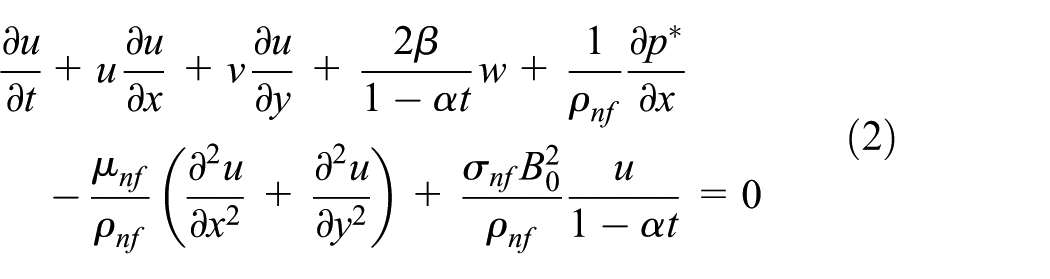
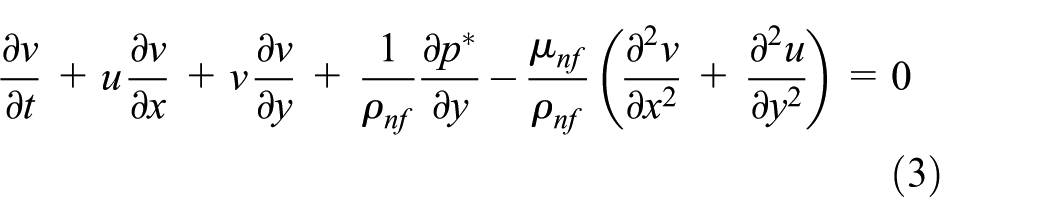
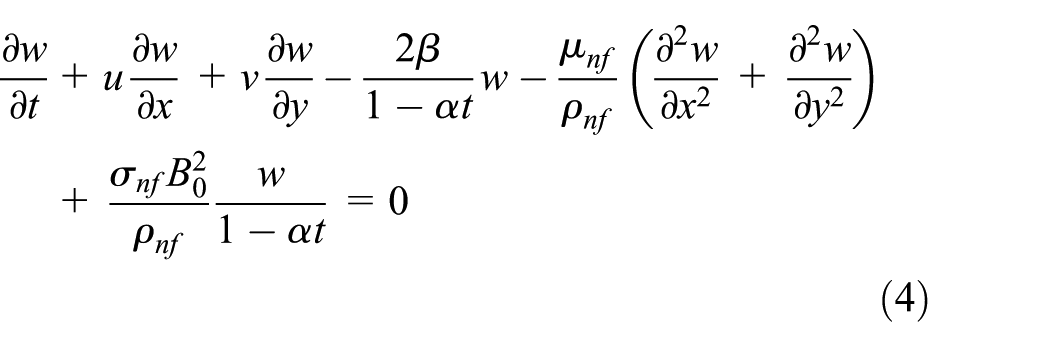
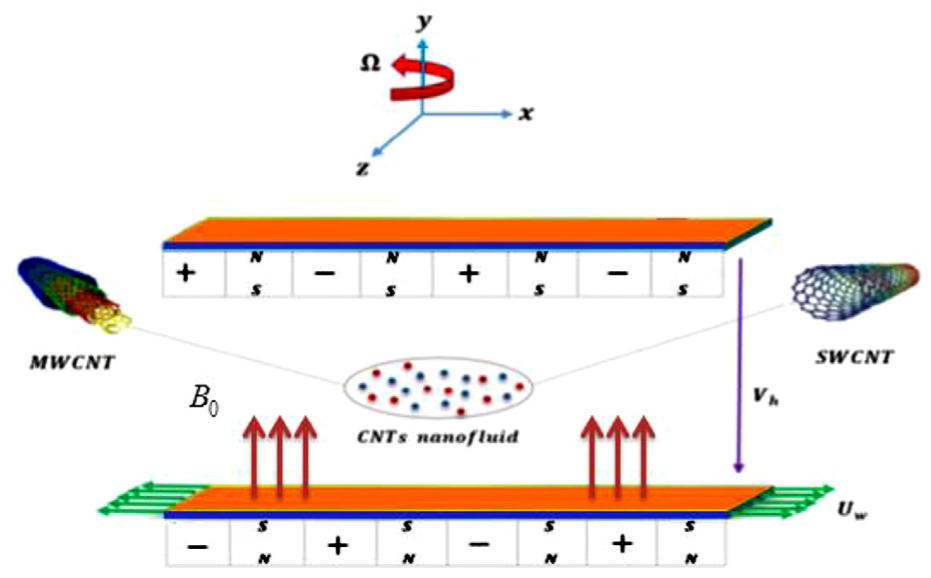
Consider three-dimensional squeezing flow of CNTs nanofluids (SWCNT, MWCNT-nanoparticles) based on water in a rotating channel with fixed and porous lower wall. The magnetic field is taken along y-direction and the nanofluid flow taken under the influence of thermal radiation. The lower wall of the channel is stretched along with velocity along x-axis and along y-axis. The channel height is varying with stretching out and shriveling from top to bottom of the walls. This height change follows from . For the stated problem, all the assumption and conditions are expressed in equation (9). The modeling of this problem is as follows52
Here are the components of velocity. Also indicate the modified pressure, electrical conductivity, dynamic viscosity, density, heat capacitance, temperature, and radiative heat flux, respectively (Figure 1).
Geometrical representation of the problem.
The thermal flux is defined as follows
where is Stefan-Boltzman constant and is the absorption coefficient. By Taylor series expansion, in terms of is defined as follows
The boundary conditions for the above stated problem are as follows
The density of the nanofluid is as follows
The heat capacity of the nanofluid is as follows
The dynamic viscosity of the nanofluid is as follows
The thermal conductivity of the nanofluid is as follows
The electrical conductivity of the nanofluid is as follows
Here, are the density of CNTs, the fluid density, volume fraction of nanoparticles, the thermal conductivity of base fluid and CNTs, respectively.
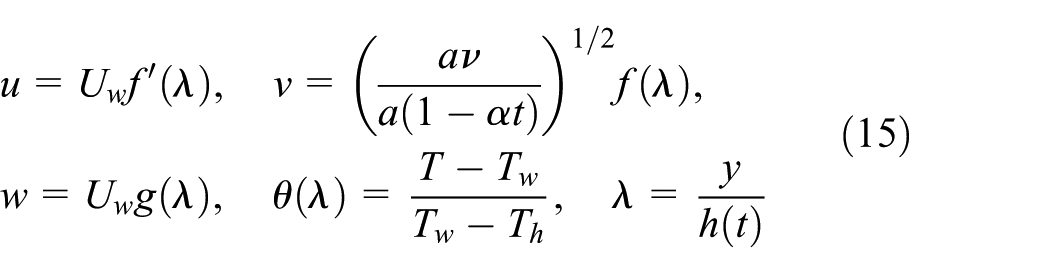
In order to simplify equations (1)–(4), (8), and (9), the following definitions are given
Here is the velocity function along x-axis, y-axis, rotational velocity function, and dimensionless temperature function, respectively, and is the local similarity variable.
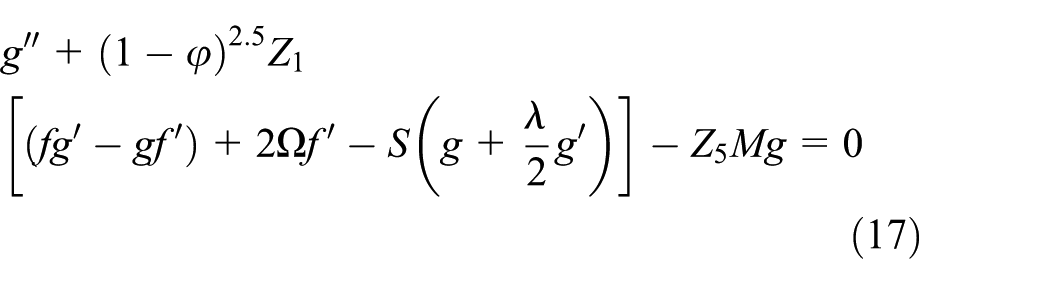
In equations (16)–(19), the followings parameters and numbers are rotation parameter, squeezing parameter, radiation parameter, magnetic parameter, suction parameter, Prandtl number, Eckert number, and modified Eckert number. Also, and .
The skin fraction coefficient and local Nusselt number are defined as follows
After simplifying equations (20) and (21), and are defined as follows
where is the local Reynolds number.
Entropy analysis and Bejan number
Entropy is a disorder of a system and surrounding. It occurs when heat transmission occurs, because some additional movements happen when it moves. The loss of useful heat occurs due to kinetic energy, spin movements, and so on and thus heat cannot be transmitted fully into work. Due to these additional movements, Chaos in a system and surrounding created. For the above stated problem, the local entropy generation rate is53
where is the characteristics entropy generation and dimensionless temperature, respectively, whose expression are given by
The non-dimensional form of equation (25) is as follows
The Bejan number Be is defined as follows
It is obvious from equation (28) that the Bejan number takes values from 0 to 1. leads to the case of irreversibility, due to magnetic field and fluid fraction dictate over the heat transfer irreversibility, while shows domination of irreversibility due to heat transfer on entropy generation. leads to the case where the irreversibility due to heat transfer is same as the sum of the irreversibility due to magnetic fields and fluid fraction.
Solution by HAM
To solve equations (16)–(18) with the boundary condition (19), we use HAM with the succeeding process.
The initial suppositions are chosen as follows
The are taken as follows
which have the succeeding properties
where the general solution of the problem have constants:
The resultant non-linear operators are indicated as follows
The secondary constraints are selected such that the series (40) converges at , changing in equation (40), we get
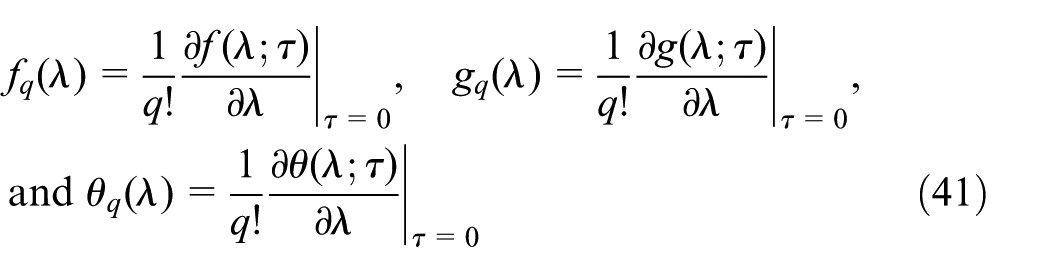
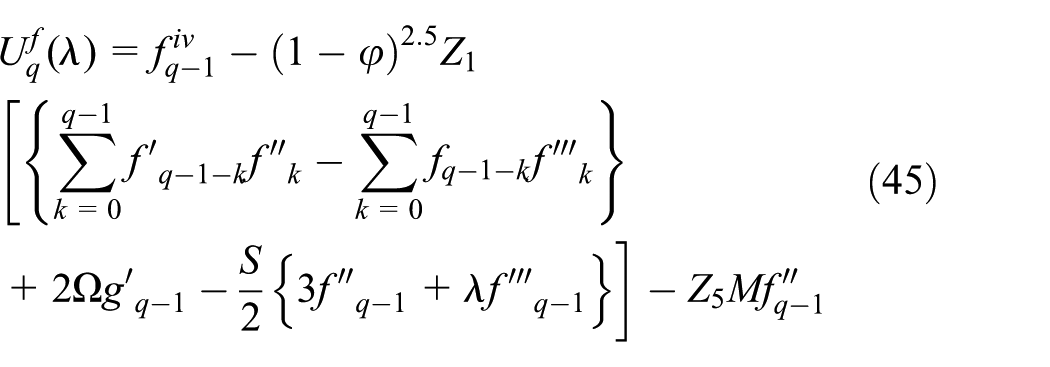
The -order problem satisfies the following
The equivalent boundary conditions are as follows
Here
where
Results and discussion
In this segment, we have briefly studied the influence of emerging parameters and non-dimensional numbers on linear and angular velocity functions , temperature function , entropy generation , Bejan number , skin fraction coefficient and local Nusselt number for both SWCNTs and MWCNTs based on water . These emerging parameters and non-dimensional numbers are nanoparticle volume fraction , rotation parameter , squeeze parameter , suction parameter , radiation parameter , magnetic parameter , Eckert number , and modified Eckert number , respectively.
Velocity functions and
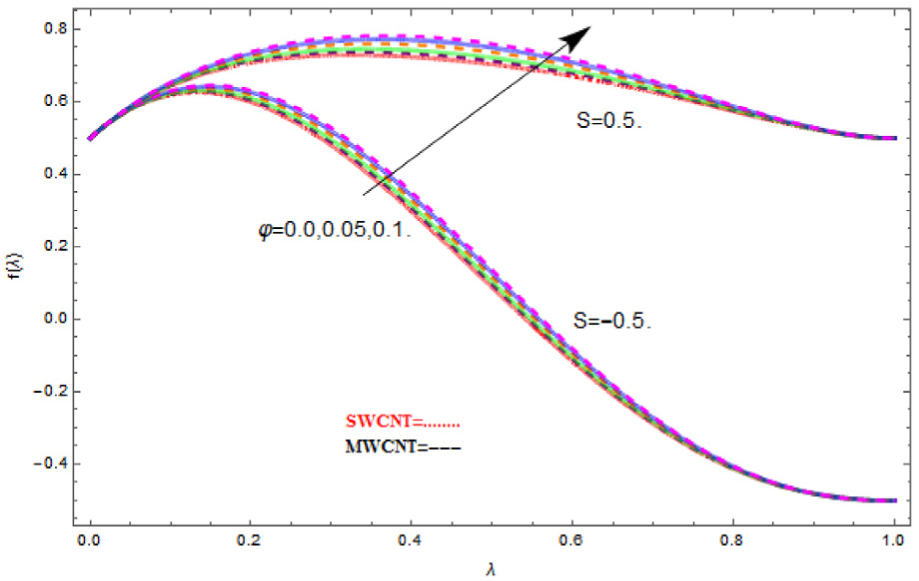
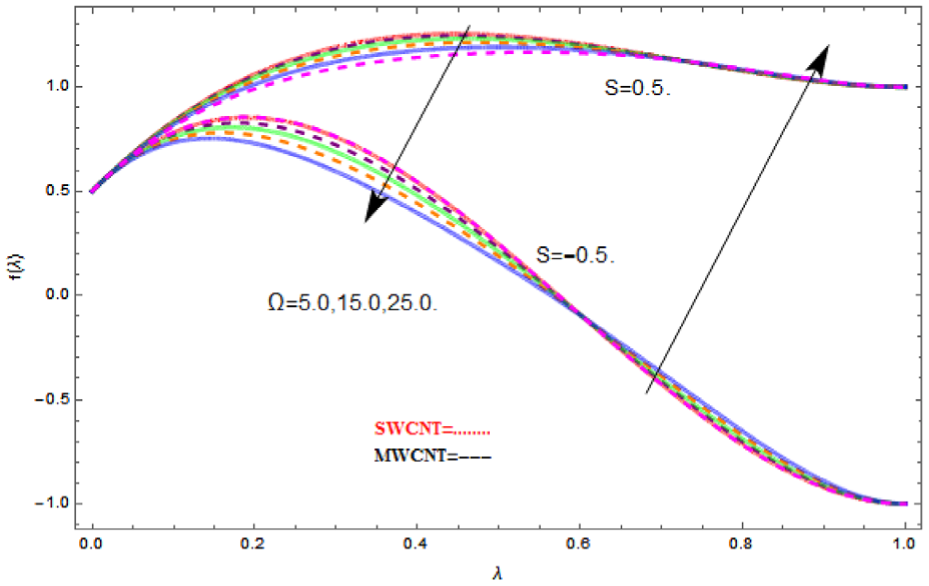
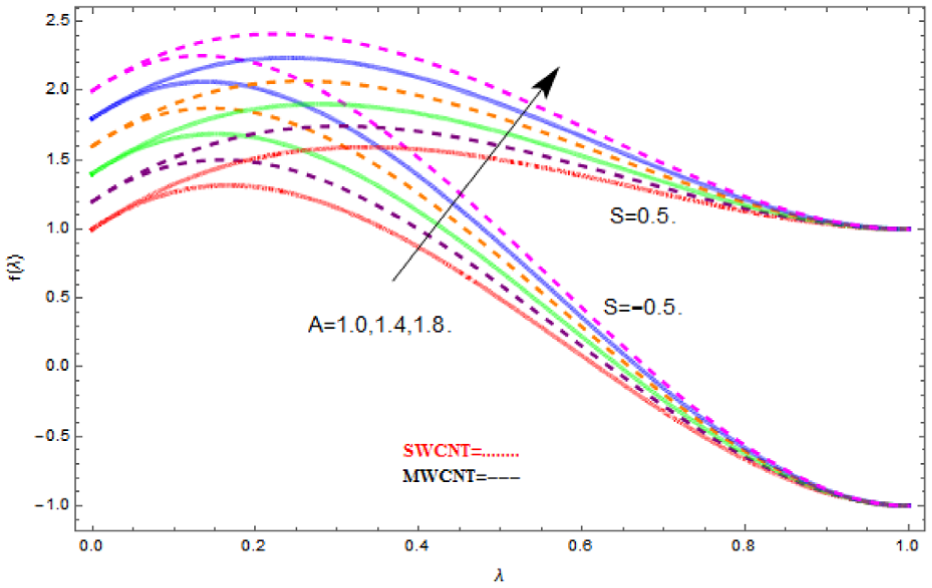
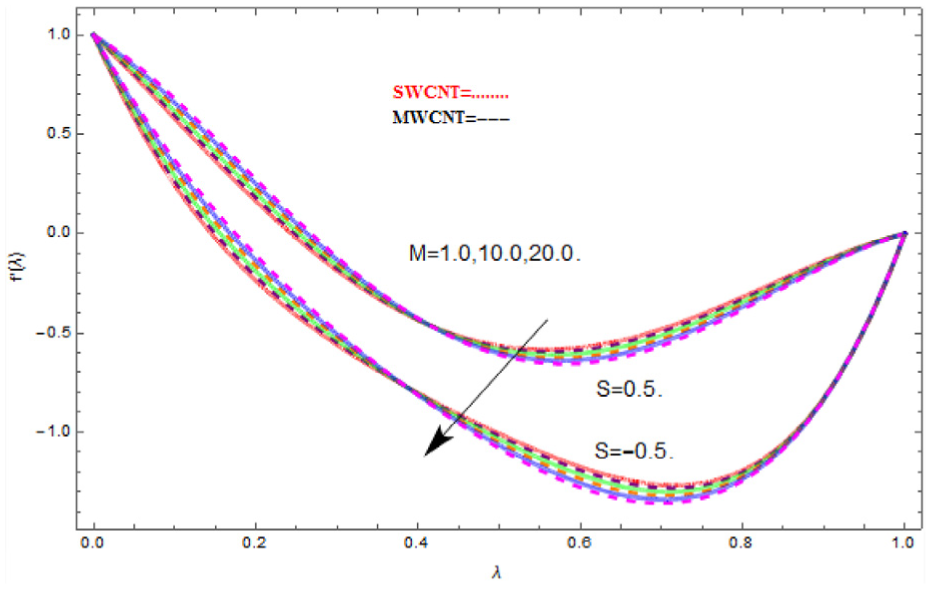
Figures 2–16 are plotted to see the influence of emerging parameters and non-dimensional numbers on linear and angular velocity functions for both SWCNTs and MWCNTs based on water . The impacts of nanoparticle volume fraction with increasing amount on are shown in Figures 2–4. Figure 2 indicates the impact of on . From here, we see that the increasing values of shows enhancement in velocity function in y-direction for both SWCNTs and MWCNTs. This leads us to the claim that permanently has a superior value at that of . This is due to the fact that the density of SWCNTs is greater than those of MWCNTs. Figure 3 is plotted to see the impact of on . In the interval , the increasing rate of nanoparticle in velocity function along x-direction is declining, while in the interval the variation in nanoparticle volume fraction along x-direction shows escalation. It should be illustrious that when , the variations in velocity function along x-direction are higher. When , then this leads to the enhancement in rotational velocity function . This result is shown in Figure 4. It is also observed that has bigger value for the case of MWCNTs than those of SWCNTs. It should be noteworthy that has larger value at than that of . The impacts of rotation parameter on are shown in Figures 5–7. It can be understood from Figure 5 that gives dual behavior on . It can also be seen that the escalation in shows reducing behavior in the interval for both cases of SWCNTs and MWCNTs, while in the interval shows escalating behavior with the escalating values of rotation parameter. It is significant to mention that values of for MWCNTs is greater than those of SWCNTs. Also the velocity at is higher than that of . Figure 6 displays the impact of rotation parameter on . From here, we see that expresses an oscillatory behavior comparative to the variation in rotation parameter. At closed distances to the upper and lower wall of the channel, the increase in the rotation parameter, in the intervals and has decreased in both cases of SWCNTs and MWCNTs. But in mean position of the channel , the escalating behavior is observed. Figure 7 shows the impact of rotation parameter on . From here, we see that the variation in has reverse relationship with . We see from here that for the case of MWCNTs, the velocity function is always higher than those of SWCNTs, and when the velocity enhances more quickly compared to when . The impacts of squeezing parameter on are shown in Figures 8–10. Figure 8 depicts the impact of S on . From here, we see that the increase in the squeeze parameter enhances the velocity function in y-direction. Also, the velocity increases when the channel is contracted and the velocity reduces when the channel is stretched out . Similar impacts can be seen in Figures 9 and 10. In the dominant area of the channel, there is a reverse flow that produced a noteworthy decline in the velocity, while at the upper and lower walls of the channel, this reverse slowly vanishes. Figures 11–13 are schemed to see the impact of suction parameter on . In both and cases, the increasing suction parameter enhances the velocity in y-direction, which is shown in Figure 11. Due to the fluid suction in the area near to the lower wall of the channel, a significant enhancement in velocity is observed. It should be noted that the velocity is enhanced by MWCNTs more than those of SWCNTs. Figure 12 indicates the relationship between the distribution rate of nanofluid velocity and . From here, we see the reverse relationship between and . The rise in results decline in . It is interesting to mention that the reverse flow is greater when as compared to . In addition in the case of MWCNTs is larger than those of SWCNTs. The same result is plotted for the rotational velocity function in Figure 13. With the difference that in the case of SWCNTs has been reduced more those of MWCNTs. Figures 14–16 are plotted to see the impact of magnetic parameter on velocity functions . According to Lorentz force theory, the opposing of the flow is due to the existence of in electrically conducting fluid. This opposing force inclines to reduce the velocity of the flow. Figures 14 and 16 show reducing behavior in velocity functions , while in Figure 15, the velocity function shows reduction behavior in the interval . This behavior is due to the stretching of the lower plate. In Figure 14, it interesting to mention that the reverse flow is greater when as compared to . This behavior is due to the opposing force of . Also, we see from the figures that for the case of MWCNTs, the velocity functions are always higher than those of SWCNTs.
Influence of on .
Influence of on .
Influence of on .
Outcome of on .
Influence of on .
Influence of on .
Influence of S on .
Influence of S on .
Influence of S on .
Influence of A on .
Influence of A on .
Influence A on .
Influence of M on .
Influence of M on .
Influence of M on .
Temperature function
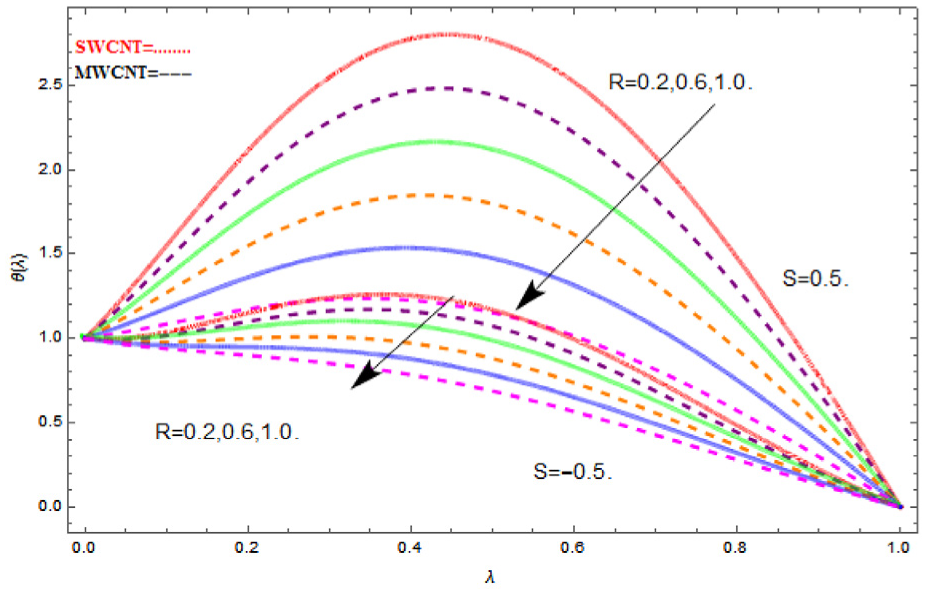
Figures 17–22 are plotted to see the influence of emerging parameters and non-dimensional numbers on temperature function for both SWCNTs and MWCNTs based on water . Figure 17 shows the relationship between and . From here, we see that the variation in is reducing with the escalating values of . The case where the channel is contracted or the case where the channel is stretched out, this result is identical for both cases of SWCNTs and MWCNTs. Figure 18 shows the impact of on . From here, we see that growing in both cases and increases the nanofluid temperature for both SWCNTs and MWCNTs. Figure 19 shows the impact of M on . From here, we see the increasing behavior in with the increasing values of magnetic parameter. Figure 20 indicates the impact of on . The temperature function reduces with escalation in for both cases and . This behavior physically understands as the enhancement in heat transfer rate and the decline in caused by enhancement in . It should be noted that is more declined for the case of SWCNTs than those of MWCNTs when , but this result is opposite when . There is a direct relationship between and , and . The influence of and on for both and cases are shown in Figures 21 and 22, respectively. This direct relationship physically represents the relationship between the velocity and , and hence the kinetic energy. Escalating Eckert number escalates the intermolecular collision and this escalates the temperature function. In addition, the temperature function for MWCNTs increases more than those of SWCNTs in the case of , it is due to the fact that MWCNTs has less amount of thermal conductivity than the SWCNTs which results the reverse impact obtained in the case of .
Influence of on .
Influence of S on .
Influence of M on .
Influence of R on .
Influence of Ec on .
Influence of on .
Entropy analysis (Ns) and Bejan number (Be)
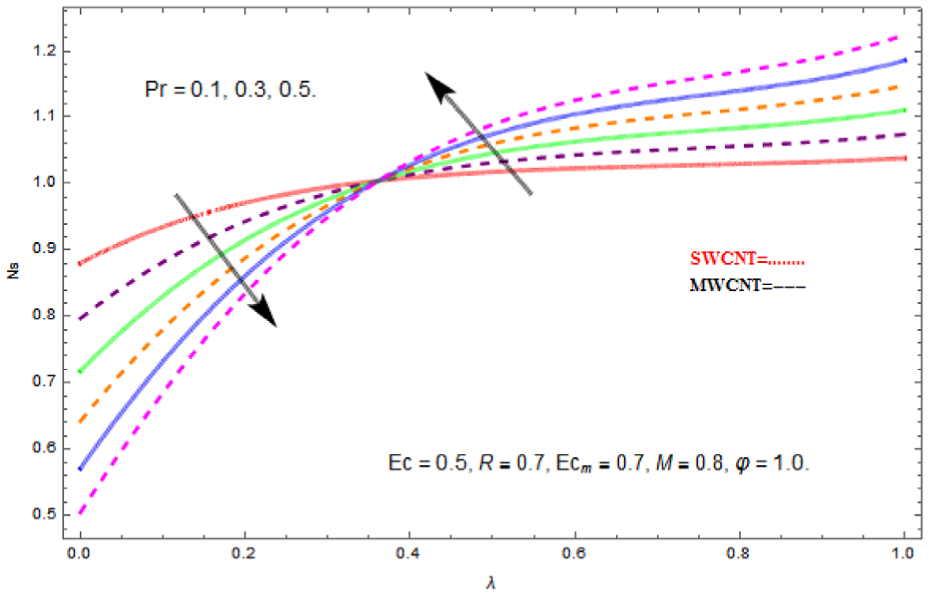
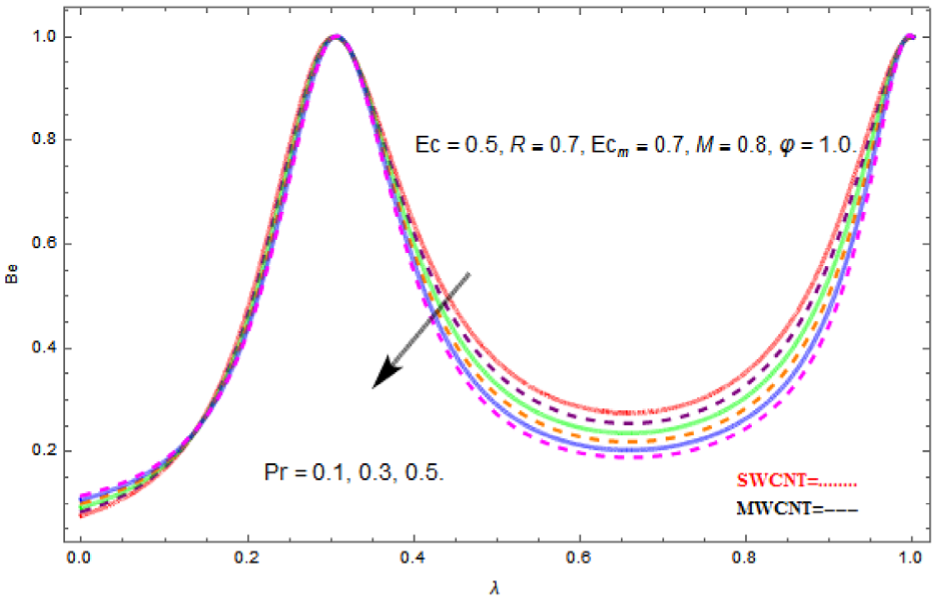
Figures 23–32 are plotted to see the impact of emerging parameters and non-dimensional numbers on entropy generation rate and Bejan number for both SWCNTs and MWCNTs. Figure 23 is plotted to see the impact of on for both cases of SWCNTs and MWCNTs. From Figure 23, we observed that as the radiative parameter becomes higher entropy generation rate across the channel escalates. This is due to the enhancement in emission of . The impact of on is depicted in Figure 24. The rise in results the enhancement in for both SWCNTs and MWCNTs. Figure 25 illustrates the influence of on . The escalating values of shows dual behavior in . In the region , it shows increasing behavior, while in the region , it shows decreasing behavior. Figure 26 depicts the escalating behavior in with the escalation in . Figure 27 depicts the impact of on . From here, we see that gives dual behavior with the escalation in . While from Figure 28 we have seen that the escalation in gives decreasing behavior in . Figure 29 illustrates the impact of on . The escalating gives dual behavior in . In the region , the modified Eckert number gives increasing behavior, while in the region , the modified Eckert number gives reducing behavior. The Influence of on is shown in Figure 30. We have seen the increasing behavior in with the escalation in . Figure 31 illustrates the impact of on . From here, we have seen decreasing behavior in the region , while in the region , we have seen the escalating behavior in with the escalation in . The escalating gives decreasing behavior in , which is shown in Figure 32.
Influence of R on Ns.
Influence of R on Be.
Influence of Ec on Ns.
Influence of Ec on Be.
Influence of M on Ns.
Influence of M on Be.
Influence of on Ns.
Influence of on Be.
Influence of on Ns.
Influence of on Be.
Skin fraction (Cf Rex1/2) and local Nusselt number (Nu Rex1/2)
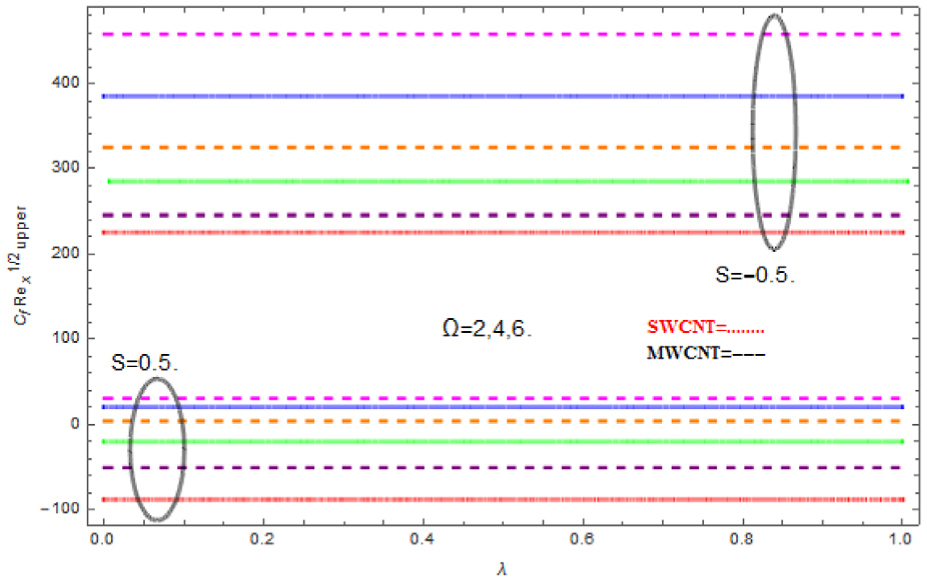
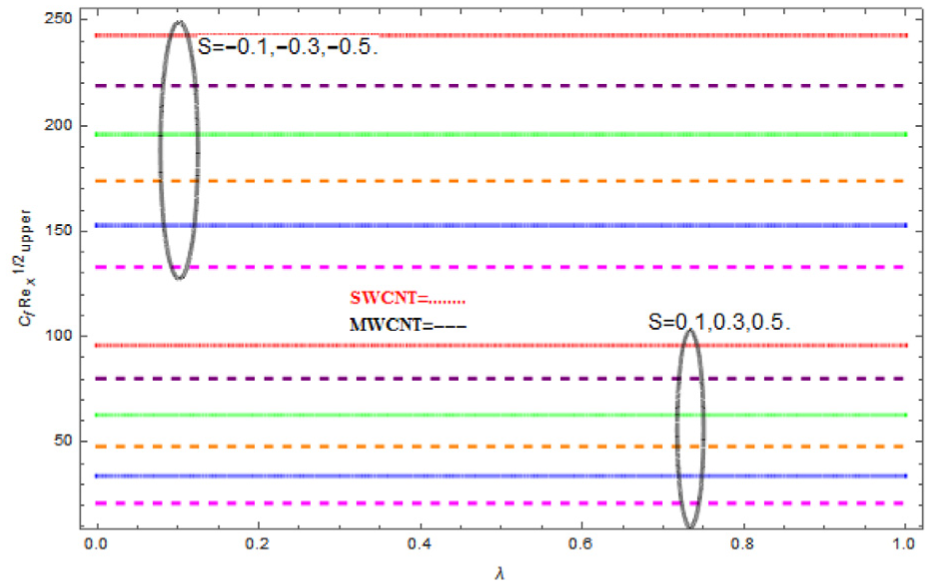
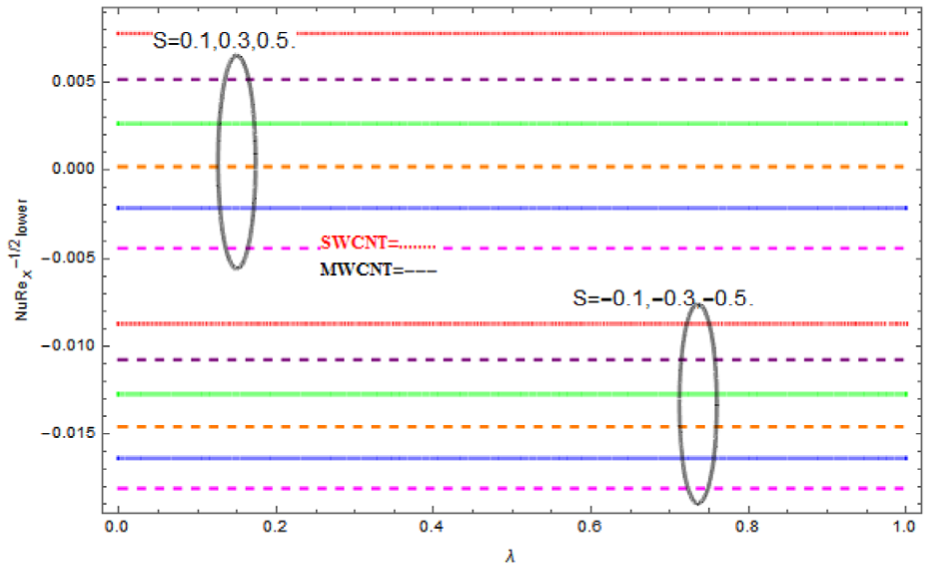
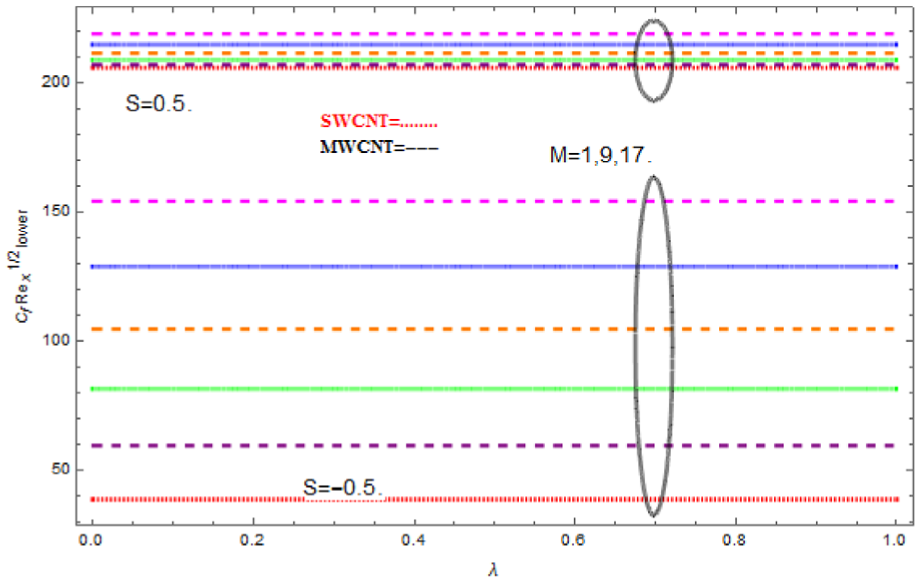
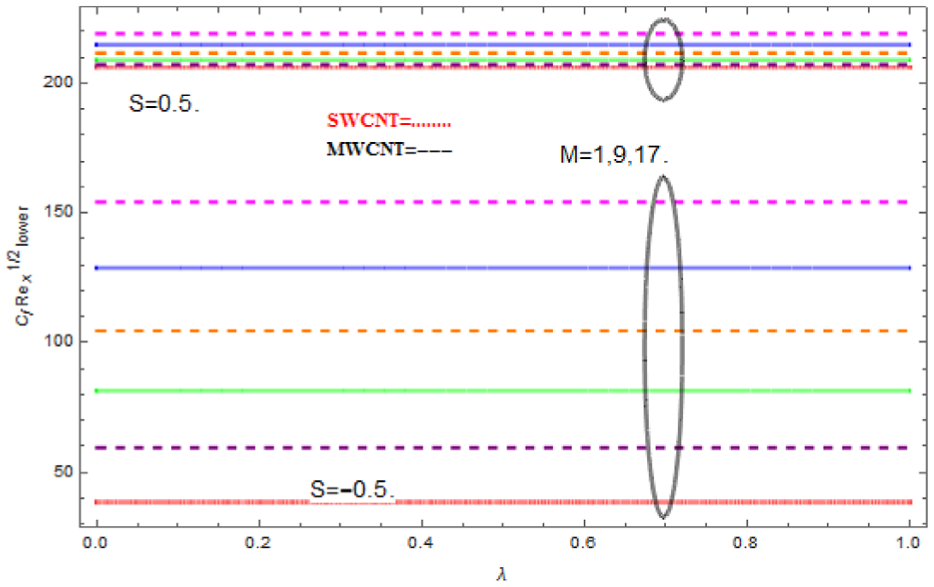
Figures 33–42 are plotted to see the impact of emerging parameters and non-dimensional numbers on skin fraction coefficient and local Nusselt number for both SWCNTs and MWCNTs. Figures 33 and 34 illustrate the influence of on at both lower and upper walls of the channel. The surface drag force reduces with the escalation in at the lower wall of the channel in both and cases, which is shown in Figure 33. In addition, when the upper and lower walls are separated further more from each other, reduces abundance more. Also in the case of MWCNTs, the skin fraction coefficient has reduced more than those of SWCNTs. While reverse impact can be seen at the upper wall of the channel, which is shown in Figure 34. Figures 35–38 depict the impact of squeezing parameter on and at both upper and lower walls of the channel. Generally, escalating squeeze parameter, the increase at the lower wall of the channel and reduces at the upper wall of the channel. In addition, at the lower wall of the channel, has reduced in the case of SWCNTs than in that of MWCNTs. Also, there is a direct relationship between and at the lower wall of the channel, while at the upper wall of the channel there is a reverse relationship between and . Figures 39 and 40 depict the impact of on at both upper and lower walls of the channel. It can be seen from both figures that the increase in increases and reduces at both lower and upper walls of the channel in both and cases. In addition, has increased in the case of MWCNTs than those of SWCNTs, while reduced in the case of SWCNTs than in that of MWCNTs. Figures 41 and 42 depict to see the effect of on at both lower and upper walls of the channel. When the upper wall moves to the lower wall of the channel, the escalating escalates . It is obvious from the figure that escalating in the case of SWCNTs is more than those of MWCNTs.
Influence of on .
Influence of on .
Influence of S on .
Influence of S on .
Influence of S on .
Influence of S on .
Influence of M on .
Influence of M on .
Influence of R on .
Influence of R on .
Tables 1–3 are schemed to study the Physical properties of CNTs, thermo physical properties CNTs and nanofluids of some base fluids, and thermal conductivity () of CNTs with different volume fraction , respectively.
Entropy generation investigation in three-dimensional squeezing flow of CNTs based on water has been done. The influences of thermal radiation, viscous dissipation, and applied magnetic field on nanofluid are taken into account. SWCNTs and MWCNTs are used in this model. The impacts of embedded of parameters are shown graphically. The concluding remarks of this investigation are listed below:
The velocity profile in y-direction escalates with the escalation in and , and gives dual behavior with the escalating values, while with the escalation in , the velocity function gives decreasing behavior.
The velocity profile in x-direction reduces with the escalation in and gives the oscillatory behavior with the enhancement in , , and .
The velocity profile escalates with the escalation in and reduces with the escalation in , , and .
Generally, the velocity profiles escalate with the decrease in and reduce with escalation in .
The temperature function escalates with the escalation in , , and and reduces with the escalation in and .
The entropy generation escalates with the escalation in , while , , , and have dual behavior on .
The Bejan number escalates with the escalation in , , and , while declines with and .
The skin fraction coefficient escalates with the escalation in , , and , while reduces with the escalation in .
The skin fraction coefficient enhances with the enhancement in while reduces with and .
The local Nusselt number escalates with the enhancement in , while reduces with .
The local Nusselt number increases with the escalation in , while reduces with .
Footnotes
Handling Editor: Oronzio Manca
Declaration of conflicting interests
The author(s) declared no potential conflicts of interest with respect to the research, authorship, and/or publication of this article.
Funding
The author(s) received no financial support for the research, authorship, and/or publication of this article.
ORCID iDs
Abdullah Dawar
Zahir Shah
Waris Khan
References
1.
ChoiSUS. Enhancing thermal conductivity of fluids with nanoparticles. In: Proceedings of the ASME international mechanical engineering congress and exposition, San Francisco, CA, 12–17 November 1995, pp.99–105. New York: ASME.
2.
KangHUKimSHOhJM.Estimation of thermal conductivity of nanofluid using experimental effective particle volume. Exp. Heat Transfer2006; 19: 181–191.
3.
GanjiDDHatamiM.Squeezing Cu–water nanofluid flow analysis between parallel plates by DTM-Padé method. J Mol Liq2014; 193: 37–44.
4.
HaqRUNadeemSKhanZHet al. Convective heat transfer in MHD slips flow over a stretching surface in the presence of carbon nanotubes. Phys B Condens Matter2015; 457: 40–47.
5.
LiuMSLinMCCTeHIet al. Enhancement of thermal conductivity with carbon nanotube for nanofluids. Int Comm Heat Mass Trans2005; 32: 1202–1210.
6.
NadeemSLeeC.Boundary layer flow of nanofluid over an exponentially stretching surface. Nanoscale Res Lett2012; 94: 7: 94.
7.
EllahiRRazaMVafaiK.Series solutions of non-Newtonian nanofluids with Reynolds’ model and Vogel’s model by means of the homotopy analysis method. Math Comput Model2012; 55: 1876–1891.
8.
NadeemSHaqRUKhanZH.Numerical study of MHD boundary layer flow of a Maxwell fluid past a stretching sheet in the presence of nanoparticles. J Taiwan Inst Chem Eng2014; 45: 121–126.
9.
NadeemSHaqRU.MHD boundary layer flow of a nanofluid past a porous shrinking sheet with thermal radiation. J Aerospace Eng2015; 28: 02995.
10.
NadeemSHaqRU.Effect of thermal radiation for megnetohydrodynamic boundary layer flow of a nanofluid past a stretching sheet with convective boundary conditions. J Comput Theor Nanosci2013; 11: 32–40.
11.
SheikholeslamiM.Numerical investigation of nanofluid free convection under the influence of electric field in a porous enclosure. J Mol Liq2018; 249: 1212–1221.
12.
ShahZIslamSAyazHet al. Radiative heat and mass transfer analysis of micropolar nanofluid flow of Casson fluid between two rotating parallel plates with effects of hall current. J Heat Trans2018; 141: 02240.
13.
NasirSIslamSGulTet al. Three-dimensional rotating flow of MHD single wall carbon nanotubes over a stretching sheet in presence of thermal radiation. Appl Nanosci2018; 8: 1361–1378.
14.
DawarAShahZIslamSet al. Magnetohydrodynamic CNTs Casson nanofluid and radiative heat transfer in a rotating channels. J Phys Res Appl2018; 1: 17–32.
15.
SheikholeslamiM.CuO-water nanofluid flow due to magnetic field inside a porous media considering Brownian motion. J Mol Liq2018; 249: 921–929.
16.
SheikholeslamiM.Numerical investigation for CuO-H2O nanofluid flow in a porous channel with magnetic field using mesoscopic method. J Mol Liq2018; 249: 739–746.
17.
SheikholeslamiMShehzadSA.Numerical analysis of Fe3O4–H2O nanofluid flow in permeable media under the effect of external magnetic source. Int J Heat Mass Tran2018; 118: 182–192.
18.
SheikholeslamiM.Influence of Lorentz forces on nanofluid flow in a porous cavity by means of Non- Darcy model. Eng Comput2017; 34: 2651–2667.
19.
SheikholeslamiMRokniHB.Numerical simulation for impact of Coulomb force on nanofluid heat transfer in a porous enclosure in presence of thermal radiation. Int J Heat Mass Tran2018; 118: 823–831.
20.
SheikholeslamiMShehzadSALiZet al. Numerical modeling for Alumina nanofluid magnetohydrodynamic convective heat transfer in a permeable medium using Darcy law. Int J Heat Mass Tran2018; 127: 614–622.
21.
SheikholeslamiMLiZShafeeA.Lorentz forces effect on NEPCM heat transfer during solidification in a porous energy storage system. Int J Heat Mass Tran2018; 127: 665–674.
SheikholeslamiM.Influence of magnetic field on nanofluid free convection in an open porous cavity by means of Lattice Boltzmann method. J Mol Liq2017; 234: 364–374.
24.
SheikholeslamiM.Magnetohydrodynamic nanofluid forced convection in a porous lid driven cubic cavity using Lattice Boltzmann method. J Mol Liq2017; 231: 555–565.
25.
SheikholeslamiM.CuO-water nanofluid free convection in a porous cavity considering Darcy law. Eur Phys J Plus2017; 132: 55.
26.
SheikholeslamiM.Numerical investigation of MHD nanofluid free convective heat transfer in a porous tilted enclosure. Eng Comput2017: 34: 1939–1955.
27.
BejanA.A study of entropy generation in fundamental convective heat transfer. J Heat Trans1979; 101: 718–725.
28.
SarojammaGVajraveluKSreelakshmiK.A study on entropy generation on thin film flow over an unsteady stretching sheet under the influence of magnetic field, thermocapillarity, thermal radiation and internal heat generation/absorption. Commun Numer Anal2017; 2: 141–156.
29.
SoomroFAHaqRUKhanZHet al. Numerical study of entropy generation in MHD water-based carbon nanotubes along an inclined permeable surface. Eur Phys J Plus2017; 132: 412.
30.
MansourRBSahinZ.Entropy generation in developing laminar fluid flow through a circular pipe with variable properties. Heat Mass Trans2005; 42: 1–11.
31.
RashidiMMMohammadiFAbbasbandySet al. Entropy generation analysis for stagnation point flow in a porous medium over a permeable stretching surface. J Appl Fluid Mech2015; 8: 753–765.
32.
BégOARashidiMMKavyaniNet al. Entropy generation in hydromagnetic convective on Karman swirling flow. Int J Appl Math Mech2013; 9: 37–65.
33.
SrinivasacharyaDBinduKH.Entropy generation in a micropolar fluid flow through an inclined channel. Alexand Eng J2016; 55: 973–982.
34.
QingJBhattiMMAbbasMAet al. Entropy generation on MHD Casson nanofluid flow over a porous stretching/shrinking surface. Entropy2016; 18: 123.
35.
IshaqMGoharAShahZet al. Entropy generation on nanofluid thin film flow of Eyring–powell fluid with thermal radiation and MHD effect on an unsteady porous stretching sheet. Entropy2018; 20: 412.
36.
HayatTRafiqMAhmadBet al. Entropy generation analysis for peristaltic flow of nanoparticles in a rotating frame. Int J Heat Mass Tran2017; 108: 1775–1786.
37.
NouriDPasandideh-FardMOboodiMJet al. Entropy generation analysis of nanofluid flow over a spherical heat source inside a channel with sudden expansion and contraction. Int J Heat Mass Tran2018; 116: 1036–1043.
38.
DalirNDehsaraMNourazarSS.Entropy analysis for magnetohydrodynamic flow and heat transfer of a Jeffrey nanofluid over a stretching sheet. Energy2015; 79: 351–362.
39.
AhmadSKhanMIHayatTet al. Entropy generation optimization and unsteady squeezing flow of viscous fluid with five different shapes of nanoparticles. Colloid Surf A: Physico Eng2018; 554: 197–210.
40.
RashidiMMAbelmanSMehrNF.Entropy generation in steady MHD flow due to a rotating porous disk in a nanofluid. Int J Heat Mass Tran2013; 62: 515–525.
41.
RashidiMMKavyaniNAbelmanS.Investigation of entropy generation in MHD and slip flow over a rotating porous disk with variable. Int J Heat Mass Tran2014; 70: 892–917.
42.
RashidiMMAliMFreidoonimehrNet al. Parametric analysis and optimization of entropy generation in unsteady MHD flow over a stretching rotating disk using artificial neural network and particle swarm optimization algorithm. Energy2013; 55: 497–510.
43.
AfridiMIQasimMMakindeOD.Second law analysis of boundary layer flow with variable fluid properties. J Heat Trans2017; 10: 104505.
44.
DasSBanuASJanaRNet al. Entropy analysis on MHD pseudo-plastic nanofluid flow through a vertical porous channel with convective heating. Alexand Eng J2015; 54: 325–337.
45.
SethGSSarkarSMakindeOD.Combined free and forced convection couette-hartmann flow in a rotating channel with arbitrary conducting walls and hall effects. J Mech2016; 5: 613–629.
46.
MkwizuMHMakindeODNkansah-GyekyeY.Numerical investigation into entropy generation in a transient generalized Couette flow of nanofluids with convective cooling. Sadhana Acad Proc Eng Sci2015; 40: 2073–2093.
47.
MakindeODKhanWAAzizA.On inherent irreversibility in Sakiadis flow of nanofluids. Int J Exergy2013; 2: 159–174.
48.
AdesanyaSOMakindeOD.Entropy generation in couple stress fluid flow through porous channel with fluid slippage. Int J Exerg2014; 15: 344–362.
49.
SheremetMAOztopHFPopIet al. Analysis of entropy generation in natural convection of nanofluid inside a square cavity having hot solid block: Tiwari and Das’ model. Entropy2016; 18: 9.
50.
SheremetMAPopIÖztopHFet al. Natural convection of nanofluid inside a wavy cavity with a non-uniform heating: entropy generation analysis. Int J Nume Meth Heat Fluid Flow2017; 27: 958–980.
51.
KhanUSyedNAMohyud-DinT.Numerical investigation for three dimensional squeezing flow of nanofluid in a rotating channel with lower stretching wall suspended by carbon nanotubes. Appl Therm Eng2017; 113: 1107–1117.
52.
ShahZDawarAIslamSet al. Darcy-Forchheimer flow of radiative carbon nanotubes with microstructure and inertial characteristics in the rotating frame. Case Stud Therm Eng2018; 12: 823–832.
53.
KhanAShahZIslamSet al. Darcy–Forchheimer flow of micropolar nanofluid between two plates in the rotating frame with non-uniform heat generation/absorption. Adv Mech Eng2018; 10: 1–16.
54.
ShahZBonyahEIslamSet al. Radiative MHD thin film flow of Williamson fluid over an unsteady permeable stretching. Heliyon2018; 4: e00825.
55.
JawadMShahZIslamSet al. Darcy-Forchheimer flow of MHD nanofluid thin film flow with Joule dissipation and Navier’s partial slip. J Phys Commun2018; 2: 11.
56.
KhanNZuhraSShahZet al. Slip flow of Eyring-Powell nanoliquid film containing graphene nanoparticles. AIP Adv2018; 8: 115302.
57.
KhanASNieYShahZet al. Three-dimensional nanofluid flow with heat and mass transfer analysis over a linear stretching surface with convective boundary conditions. Appl Sci2018; 8: 2244.
58.
KhanAShahZIslamSet al. Darcy–Forchheimer flow of micropolar nanofluid between two plates in the rotating frame with non-uniform heat generation/absorption. Adv Mech Eng2018; 10: 1–16.