



Abstract
The characteristics of water-based hybrid nanofluid flow when passing over an exponentially stretchable sheet with velocity and thermal slip factors are presented. This article provides a concept for a hybridized fluid comprising copper and cobalt iron oxide nanoparticles (NPs) dispersed into a base fluid (water). In addition, physical observations of the heat absorption behavior, the Darcy effect, the thermal radiation, and viscous dissipation are also taken into account. Because of their strong thermophysical properties, copper and cobalt iron oxide NPs are used in a wide range of applications in the engineering and medical fields. To study the dynamics of these NPs, a system of partial differential equations (PDEs) has been generated that forms a highly nonlinear coupled model. The PDE system is converted into nondimensional ordinary differential equations (ODEs) with the aid of similarity replacements. The semi-analytical homotopy analysis method (HAM) is applied to the set of dimensionless ODEs obtained to find the solution. Two engineering parameters, the Nusselt number and the skin friction, are plotted versus various parameters of the hybridized fluid using bar charts. It was observed that the no-slip condition, the suction parameter, and the Darcy–Forchheimer medium enhanced the thermal profile of the hybridized fluid.
Keywords
Introduction
To reduce both costs and energy use significantly, intensification of thermal transfer is essential. Currently, advancements in science and technology are encouraging orders for compact devices with extraordinary features, the highest possible performance, precise operating characteristics, and long lifetimes. As a result, engineers and scientists have worked extensively on heat transmission analysis to upgrade the existing industrial work. A new class of nanotube suspensions created by Choi 1 demonstrated the enormous improvement in the thermal transport characteristics of these solid suspensions, which were called nanofluids, when compared with ordinary fluids. Nanofluid technology has proven to be a helpful tool in the development of oils and lubricants with higher performance. Nanofluids play vital roles in various industrial applications, including fabrication of paints and coatings, paper printing, power generation, cancer therapy, ceramics manufacture, drug delivery, and food production. Punith et al. 2 investigated nanofluid (ferromagnetic) flow with regard to the impact of a magnetic dipole over a stretching sheet and calculated that the thermal gradient was improved by augmentation of the Brownian motion and thermophoresis, with the Stefan blowing condition causing the nanofluid to display high heat transfer. Bhatti and Michaelides 3 analyzed nanofluid flow over a Riga plate in terms of the Arrhenius activation energy and found that the fluid’s concentration profile was improved by augmentation of the activation energy; in this regard, the Brownian motion increased the temperature profile. Ullah 4 found that a reduction in the Nusselt number occurred as a function of the Brownian motion and thermophoresis parameter with a decreasing temperature gradient; however, a reduction in the Sherwood number also occurred as a function of the Brownian motion and the thermophoresis parameter under a similarly decreasing temperature gradient. Alsallami et al. 5 clearly explained the thermal transfer gradient and nanofluid flow behavior above a porous plate in terms of the impact of slip conditions; they claimed that addition of nanoscale particles with high thermal conductivity and a large volume fraction represents the best way to increase heat flux in nanofluids, but their simulation results contradicted the results reported previously by other researchers.6–14
With regard to the development of these technologies, a new class of fluids for heat transfer has been introduced in the literature and has led to technological updates worldwide; these fluids are known as hybrid nanofluids. A nanofluid is the combination of a base fluid with a single type of added nanoparticle, while the hybrid nanofluid is an extension of the nanofluid that was invented by dispersion of dual or multiple types of nanoscale particles with sizes of less than 100 nm and excellent thermal conductivity when immersed into the base fluid. Algehyne et al. 15 investigated the attributes of a mixture of hybrid nanofluids over a heated plate exchanger and determined that the mixture provides the maximum coefficient of heat transfer. Al2O3+H2O has a higher pressure drop than the other hybrid nanofluid, with a value that is slightly higher than that of water. Ullah et al. 16 described an examination of the flow of a hybridized fluid across a curvy surface, and found that when injection and suction were compared, the hybrid nanofluid achieved a higher heat transfer rate than the simple nanofluid. Hussain et al. 17 investigated a computational model for hybridized fluid dynamics under convective conditions on a rotating sheet. Their results showed that as the stretching ratio increased, the velocity profiles of the CuO and TiO2 hybrid base fluids decreased, while their velocity curves increased. Rashid et al. 18 provided insight into the flow behavior of hybrid nanofluids with a physical perception of mixed convection over a vertical surface fixed by a porous medium, revealing that there are dual solutions for opposing flows. Zhao et al. 19 studied the improvement in the thermal transmission of a hybridized fluid containing Ag+CuO+H2O NPs; their research showed that the chemical reaction, thermal gradient, and heat generation characteristics of the hybrid nanofluid were higher than those of nanofluids based on a single nanoparticle type, even in the presence of radiation. Tlili et al. 20 proposed a model of hybrid nanofluid (methanol) 3D flow based on magnetohydrodynamics (MHD) over a surface with uneven thickness and slip factors. Their results determined that the thermal transfer rate of the hybridized fluid was significantly greater than that of the corresponding nanofluid. The Lorentz force effect was also smaller on the hybridized fluid when compared with the effect on the nanofluid. Usman et al. 21 proposed a model of hybrid nanofluid MHD thin film flow over an unsteady spinning disk that considered the impact of couple stress, and the percentage improvement caused by heat transfer was calculated and shown graphically. Their investigation established that the hybridized fluid has a higher heat transmission capability when compared with that of conventional nanofluids. Ullah 22 also investigated nanofluid and hybridized fluid flow with entropy generation in thermal structures. Many more articles are available in the literature that specify that the hybrid nanofluid represents an important alternative solution to traditional thermal systems.23–32
A stretchable sheet with the fluid motion characteristics described above in fluid mechanics terms is highly significant for both biomedical sciences and industrial processes. The ability to obtain a similar solution for fluid flow passing over a stretching sheet was first studied by Crane. 33 However, when compared with the stretching scenario itself, the flow passing over such a stretchy sheet received little attention. Alharbi et al. 34 stated that the flow over a shrinking sheet is a backward flow. With regard to this statement, Rashid et al. 35 explored the research on viscous fluid flow over a nonlinearly stretching sheet and found that the flow features revealed many interesting behavioral aspects that confirmed further study of the effects of nonlinear stretching on the flow characteristics is warranted. Alhowaity et al. 36 investigated the homotopy perturbation method and axisymmetric flow over a stretching sheet, and comparison of their results with the exact solutions showed that the homotopy perturbation method gives outstanding results. The analysis of Bilal et al. 37 of temperature field inflow over a stretching sheet with uniform heat flux showed that the temperature at a point declines with an upsurge in the Prandtl number. Zhao et al. 38 explained the effects of slip on MHD viscous flow over a stretching sheet and obtained an exact solution to show that there is only one physical solution for any combination of the slip, the magnetic parameters, and the mass transfer parameters. Chu et al. 39 explored the concept of a thermal gradient rate in viscoelastic fluid MHD flow over a stretchy sheet under the combined impact of variable thermal conductivity and a nonuniform heat source. Their results showed that in the boundary layer region, the combined effects of the radiation, the variable thermal conductivity, and the nonuniform heat source had a noteworthy effect on the control of the thermal gradient rate. The flow of fluid over a stretching sheet with respect to the effect of a magnetic field was studied using a power law model by Zhao et al. 40 and they concluded that in this case, a thinner boundary layer occurred because of the effect of the magnetic field, thus causing increased wall friction.
As a result of the wide range of its potential applications, hybridized fluid motion through permeable porous surfaces has now become the center of attention for many researchers. Possible application areas of flow through permeable porous surfaces include the environmental field, the solar sciences field, nuclear engineering, and materials science. To understand this type of porous surface flow, Darcy’s law is erroneously but widely used. To use the permeability to calculate the effect of inertia, Forchheimer 41 devised a second-order polynomial for use in the momentum equation. Muskat and Wyckoff 42 undertook a study to identify the Forchheimer component. Darcy–Forchheimer concepts are used in many studies of the regularity of hybrid nanofluids, and several researchers have studied porous medium flow. A number of these studies are cited here. Ullah et al. 43 investigated the Darcy–Forchheimer hybrid nanofluid flow through a porous medium with variable features. Ullah et al. 44 analyzed the flow of a hybridized fluid under the influence of a Marangoni convective pattern through a Darcy–Forchheimer medium. Sun et al. 45 performed a study of a Darcy–Forchheimer hybrid nanofluid with MoS2 and SiO2 nanoparticles with extension of the entropy generation. Bilal et al. 46 proposed a model of heat and mass transfer through a Darcy–Forchheimer hybrid nanofluid flow over a stretching curved surface. Li et al. 47 investigated a dusty hybrid nanofluid with two phases via extension of the viscous dissipation over a cylinder. Nazeer et al. 48 proposed a model of the hybridized fluid dynamics due to solar radiation in a Darcy–Forchheimer permeable medium over a flat plate.
Inspired by the approaches described above, this work presents the results of development of a model of a sophisticated form of hybridized fluid that contains nanoparticles of
Novelty is added to the recent work by extending the published work of Ahmed and Akbar 49 by addressing the following points:
The recent work is based on a hybridized fluid composed of nanoparticles of
The influence of the magnetic field is added to the recent work.
The effects of thermal expansion, heat absorption, the Darcy–Forchheimer medium, and the velocity and thermal slip conditions of the fluid are added to the recent work.
The focus of the recent work has been the thermal enhancement applications of this hybridized fluid of
The role of the present work is to fill the gaps in the literature by attempting to solve the transformed system of equations (ODEs) with the aid of the homotopy analysis method (HAM) method50,51 using Mathematica software (Wolfram Research).
Mathematical Formulation
The electrically conducting and incompressible steady-state dynamics of a 2D Darcy–Forchheimer flow of
Because of the ambient velocity
We ignore a weak induced magnetic field generated by application of a magnetic field to the flow at an angle
The nanoparticles (Cu and CoFe2O4) immersed in the base fluid (
Combining the concepts of optically thick radiation, heat absorption, and viscous dissipation enhances the heat transfer rate.
Because no externally applied electric field is present, the polarization effect can be overlooked.

Hybrid nanofluid flow over an extending sheet.
The constitutive momentum flow equation and the energy equation for the hybrid nanofluid are then determined as follows using the assumptions above: 52


In these equations, the velocities of the hybrid nanofluid are represented by
Using the Rosseland approximation, the radiation heat flux

The Stefan–Boltzmann constant and the heat absorption constant in equation (4) are denoted by

Implementation of equations (4) and (5) in equation (3) gives:

The initial and boundary conditions are given by:

The experimental values of the parameters for water, Cu, and CoFe2O4 are reported in Table 1. In Table 2, the subscript bf indicates properties of the base fluid (water) and hnf indicates properties of the hybrid nanofluid (H2O+Cu+CoFe2O4). In addition,


The transformation variables are:

By incorporating equation (8) into equations (2) and (3), we obtain:


The transform conditions are:
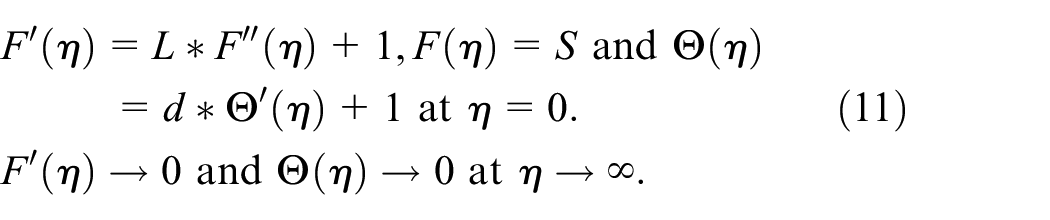
Here, M is the magnetic parameter,

Terms for the local Nusselt number

where the wall heat flux and the shear stress are represented by

HAM Solution
The HAM has been used to determine the solution for the proposed model. 57 For this purpose, the linear operators are given as follows:

The extended forms of

By using Taylor’s expansion, we obtain:


Next, we obtain

The equations above can also be written as:

where the local Reynolds number is given by
Results and Discussion
Analysis of Results
Fluid flow phenomena over a stretching surface under the influence of various physical effects, including heat sources, a porous surface, and application of an inclined magnetic field, have been studied. The flow scenario has been modeled in the form of nonlinear partial differential equations, which have been handled analytically using the HAM. The results are presented graphically in the figures, while the relevant numerical values are tabulated in the tables.
Discussion of Results
This section evaluates the physical mechanism behind each figure in the velocity and temperature profiles. The following observations have been made.
Velocity and Energy Profiles
Figure 2(a) and (b) shows the relationships of the nondimensional magnetic parameter
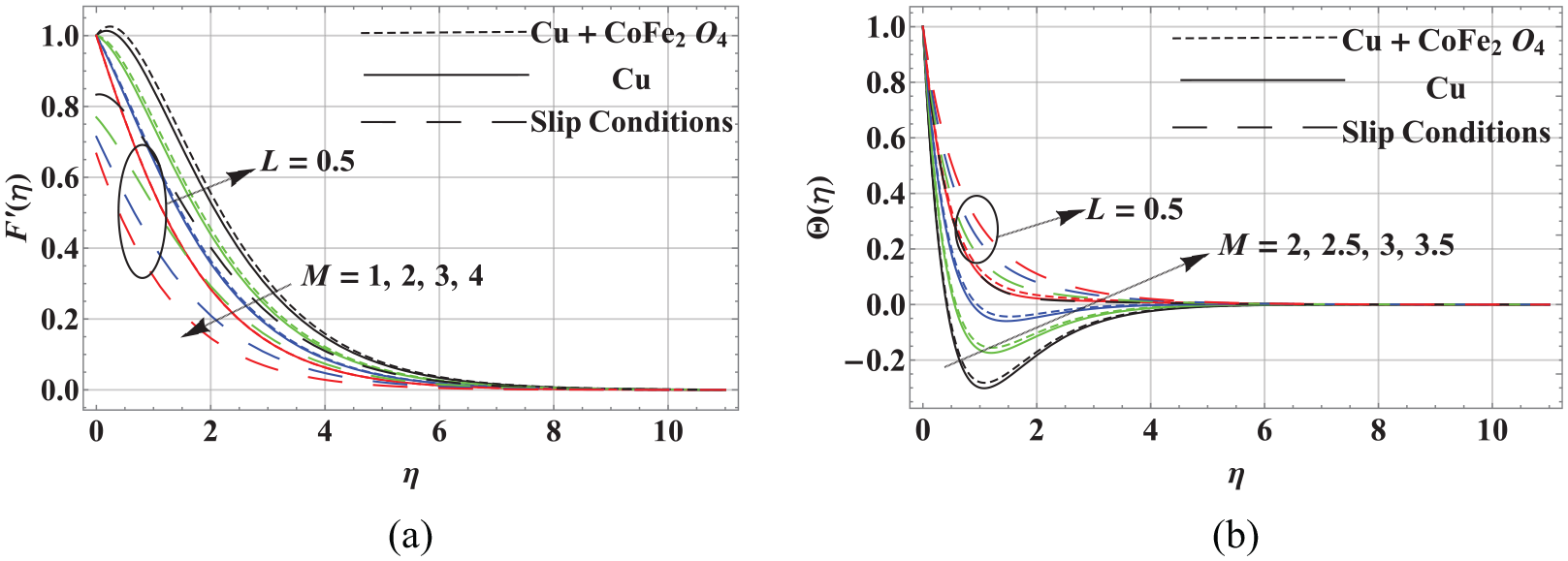
(a) Velocity field
Figure 3(a) and (b) are drawn to represent the effect of the suction parameter

(a), (c) Velocity field
Figure 4(a) and (b) illustrate the impact of the thermal radiation
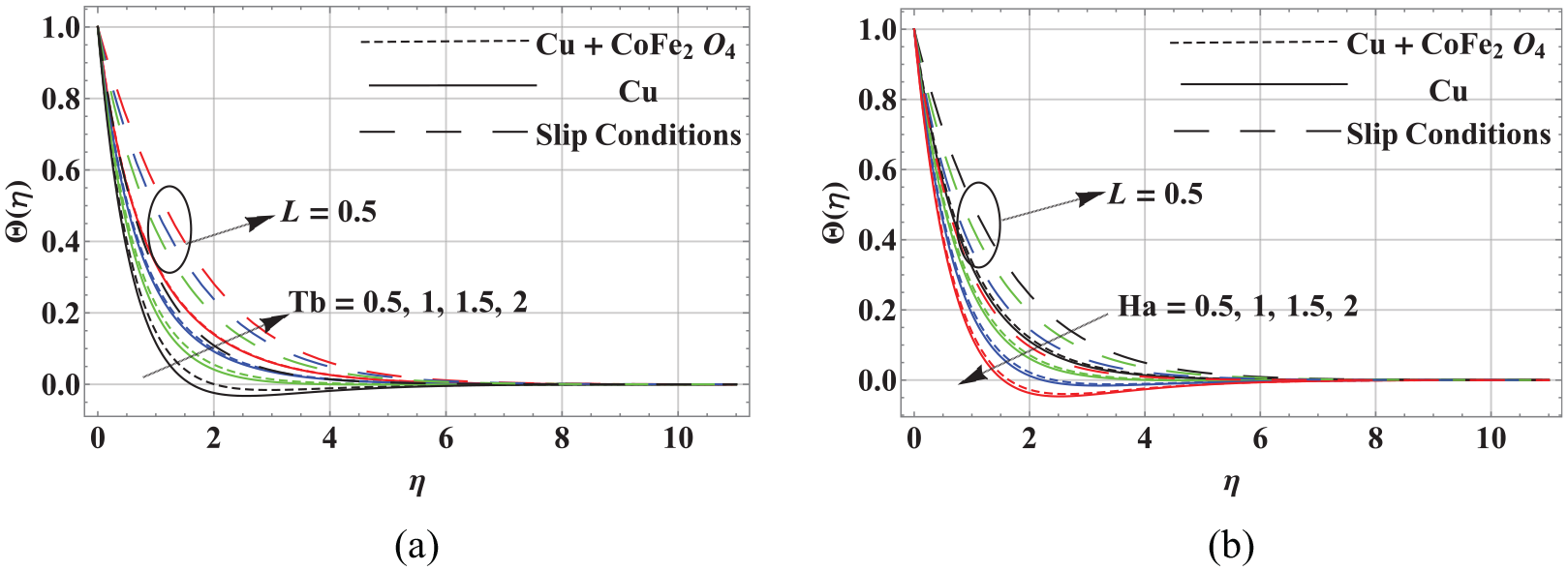
Temperature profile
Figure 5(a) and (b) illustrate the relationships of the angle

(a) Velocity and (b) temperature profile
Figure 6(a) and (b) capture the relationships of the temperature profile

Temperature profile
Figure 7(a) shows the relationship between the velocity profile

(a) Velocity and (b) temperature profile
Figure 8(a) shows the relationship between the velocity profile

(a) Velocity and (b) temperature profile
Figure 9(a) illustrates the effect of the Grashof number

(a) Velocity and (b) temperature profile
Figures 1 to 9 show that the temperature profile
Skin Friction and Nusselt Number
Bar Chart 1(a) to (d) show the effect of increasing the value of the skin friction
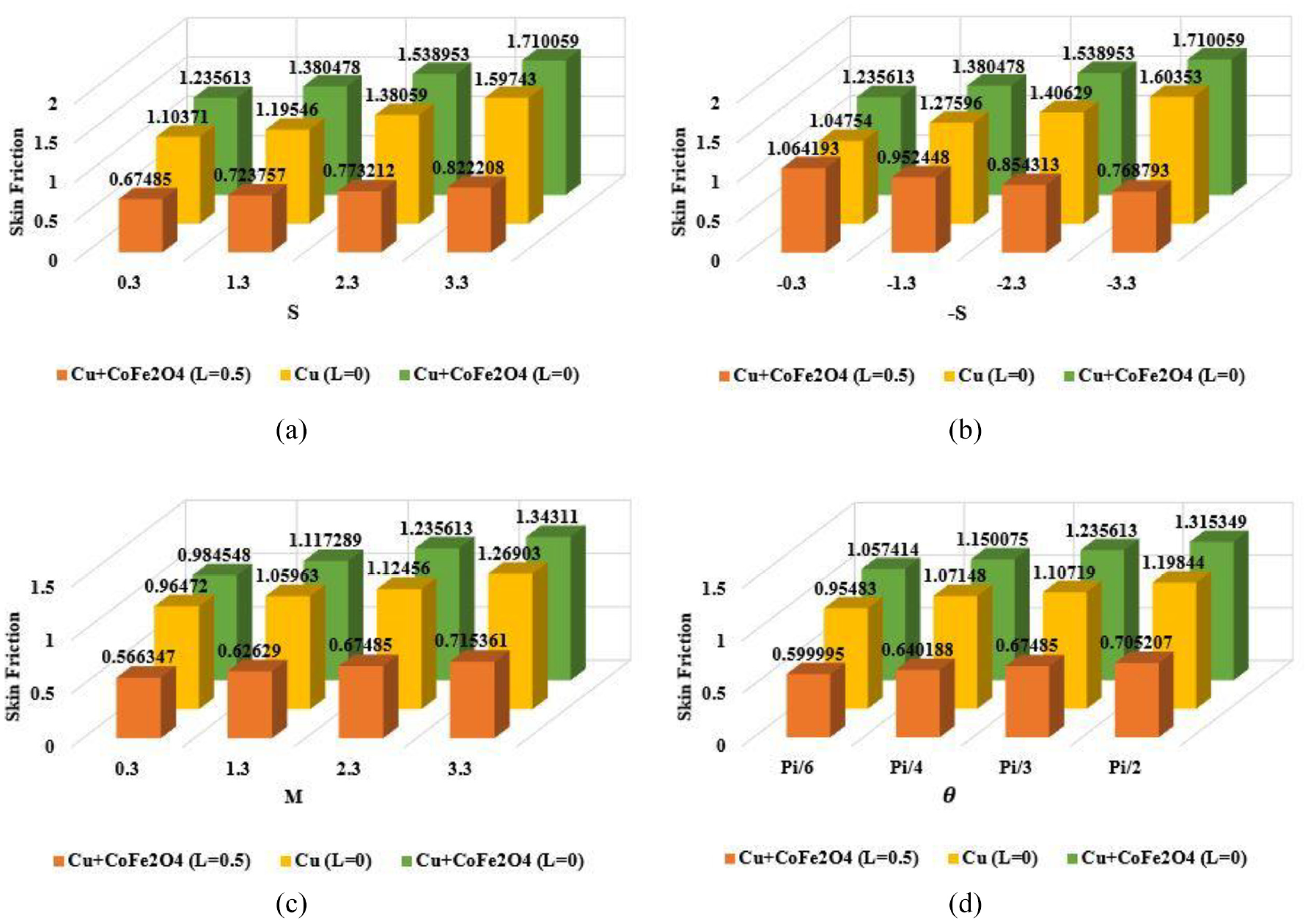
Skin friction
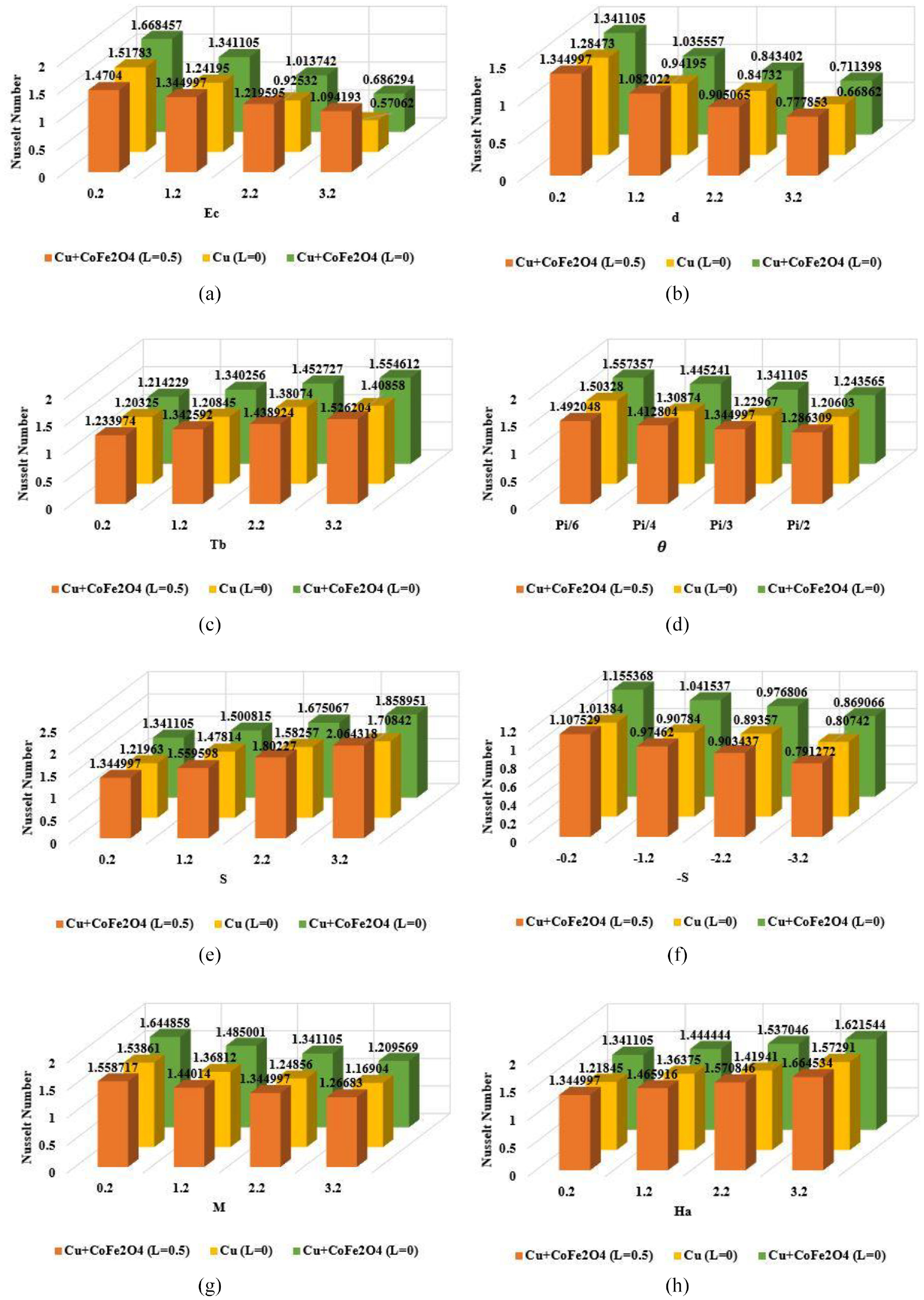
Nusselt number
Conclusion
The analysis presented here reports the dynamic characteristics of a water-based hybridized fluid composed of copper (Cu) and cobalt ferrite (CoFe2O4) NPs when passing over an exponentially stretchable sheet. The previously published work is extended by using the concepts of thermal and velocity slip factors, the heat absorption coefficient, the magnetic field effect, Darcy–Forchheimer parameters, and a hybridized nanomaterial. The core findings from these observations are presented as follows:
The fluid motion
Raising the injection factor causes the fluid dynamics profile
The thermal profile
The contributions of the heat absorption
The dispersion of the copper and cobalt ferrite NPs in the base fluid magnifies the velocity and the energy transmission rate remarkably because of the fluid’s remarkable thermophysical properties.
The transformation of mechanical energy into the thermal energy of the nanoparticles occurs when the Eckert number
In the case of the slip condition
Footnotes
Appendix
Handling Editor: Chenhui Liang
Declaration of conflicting interests
The author(s) declared no potential conflicts of interest with respect to the research, authorship, and/or publication of this article.
Funding
The author(s) received no financial support for the research, authorship, and/or publication of this article.
