



Abstract
Nowadays graphene is emerging as one of the most exciting nanomaterial due to its continuous 29 electrically conducting behavior even at zero carrier concentration. With this initiation, we investigate the flow of magnetohydrodynamic (MHD) water, water−30%EG, water−50%EG, graphene nanofluid over a stretched surface with thermal convection, and zero mass flux conditions and velocity slips comprising motile microorganisms and nanoparticles. Thermal radiation and Arrhenius activation energy are also be under consideration. The governing fluid equations are solved by Homotopy analysis method (HAM) and computed numerically with shooting technique after employing appropriate transformations. The consequence of numerous physical parameters on velocity, concentration, temperature, and density of motile microorganisms graphs as well as table are used for ethylene glycol based and water-based graphene nanoparticles. Additionally, numerically analyze the designed skin friction, Nusselt number, Sherwood number, and density of motile microorganisms. It is observed that due to heat generation and temperature the improvement of the nonlinear convection variable improves the wall friction. It is also originate that increasing the volume fraction of nanoparticles effectively boosting the thermal conductivity of water−50%EG when compared with water−30%EG and water nanofluids. Ethylene glycol based graphene nanofluids take less time for process as compared to water based nanofluids.
Keywords
Introduction
Bioconvection occurs when a collection of microorganisms (less dense than water) floats upward to the surface of the liquid, accumulating and concentrating in the upper region until it become dense and unbalanced. Living micro-organisms are usually responsive to the atmosphere, including chemicals, light, and heat. Bioconvection phenomena are substantially applied in biomicrosystems such as enzyme biosensors.
1
“Khashi et al.”
2
examined the flow of
Nanofluids are used as a coolant agent and lubricants, many applications such as mobile computer processors, air conditioning, refrigeration, and microelectronics. The model proposed by “Buongiorno”
9
and Tiwari and Das
10
considered two forms of nanofluid models in fluid dynamic. “Upadhya et al.”
11
review that water based nanofluid take more time for process than ethylene glycol based graphene nanofluid. Sreedevi et al.
12
analyze the Unsteady MHD mass and heat transfer analysis of hybrid nanofluid flow over extending surface with slip effects, chemical reaction, thermal radiation, and suction. Nadeem et al.
13
the steady flow of a Jeffrey fluid model in the presence of nano particles. “Gul and Firdous”
14
investigate the experimental work to scrutinize the stable scattering of the nanoparticles graphene and to look at nanofluid GO–H2O flow between two rotating disks. The combination of water–ethylene glycol (50:50) as a base fluid and Aluminum Oxide
Further researchers, are still searching better fluids to replace nanofluid. Some types of nanofluid known as water, water−30%EG, water−50%EG based graphene nanofluid are introduced with better thermal conductivity. Transformer cooling, Nuclear system cooling, coolant in machining, refrigeration, electronic cooling, biomedical drug reduction, and other disciplines of heat transfer have found water, water−30%EG, water−50%EG based graphene nanofluid to be more efficient than nanofluid. Researchers have worked on water, water−30%EG, water−50%EG based graphene nanofluid in real world applications. “Labib et al.” 19 quantitatively studied the influence of base fluids such as water, water−30%EG, water−50%EG based graphene nanofluid in forced convective heat transfer.
“Khan et al.” 20 discussed that according to the mechanism that causes their impellent motile bacteria can be divided into different groups, with chemotactic, gyrotactic, gravitaxis, and oxytactic. In response to stimuli like self-propelled, light, gravity, and chemical attraction, motile biological organism may dynamically swim in the fluid. To make a extensive range of industrial and commercial things microbes are employed, with fertilizers, waste-derived biofuel and medicine delivery. 21 The effect over nanofluid bio-convection of homogeneous magnetic field over a porous vertical sheet was proposed by “Mutuku and Makinde.” 22 Motile microorganisms are denser than water. Under some conditions, these features cause instability of hydrodynamic, which result bio-convection flow. 23
The key problem of bio-convection solutions having gyrotactic microbes and small solid particles were stated by Kuznetsov and Avramenko. 24 Kuznetsov and Bubnovich, 25 studied the combined effect of gyrotactic microorganism on nanofluid. Biothermal convection in perforated medium was calculated by “Chakraborty et al.” 26 They verified that fluid velocity decreases with increase in magnetic field. Xu and Pop, 27 studied the combined convective nanofluid flow in the existence of gyrotactic microorganism and nanoparticle on a stretching surface. Zabihi et al. 28 used HAM procedure on the application of variation of parameter’s method for hydrothermal analysis on MHD squeezing nanofluid flow in parallel plates.
The aim of current analysis, is to examine the MHD Arrhenius energy of water, water−30%EG, water−50%EG based graphene nanofluids flowing over stretched surface in the existence of thermal radiation and motile microorganism. The influence of zero mass flux condition, thermal convection, and velocity slip are taken into Consideration. The transformed equations are solved by HAM and are compared with shooting method. The impacts of distinct physical parameters on velocity, temperature, nanoparticle concentration, and density of motile microorganisms is designed using Mathematica by which a thorough study have been made to analyze the effects different parameter on it. Furthermore, the intentional values for skin friction, Sherwood number, density of motile microbes, and Nusselt number are scrutinized numerically. From this study it is observed that as compared to water based nanofluids, ethylene glycol-based graphene nanofluids takes less time for execution. This is because of the thermal conductivity of ethylene glycol-based graphene nanofluid is greater than water based nanofluid.
Formulation
Let us consider two-dimensional incompressible magnetohydrodynamics Casson nanofluid flow over a stretched surface. A strength of magnetic field
Continuity equation

Momentum equation

Energy equation

Nanoparticle’s concentration equation

Density of gyrotactic microorganism

(BCs),

As shown above, the quantity

In the above equations,

Where
The following represents the thermophysical properties:

Where
Thermophysical characteristic of the graphene base and fluids.


Where

Chemotaxis constant are represented by

Where prime denote differentiation with respect to
When the similarities variable
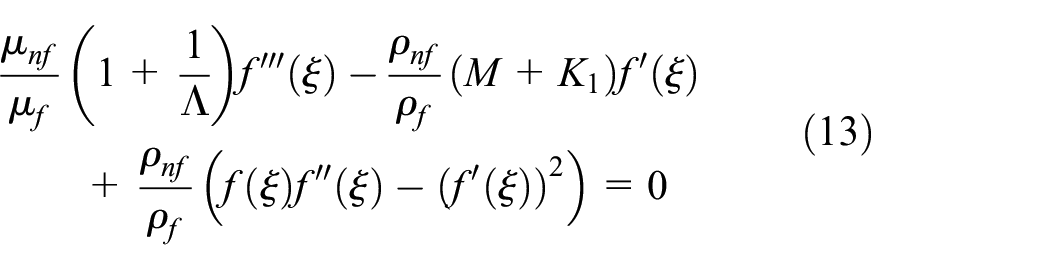
Therefore, the simplest form of the model is given


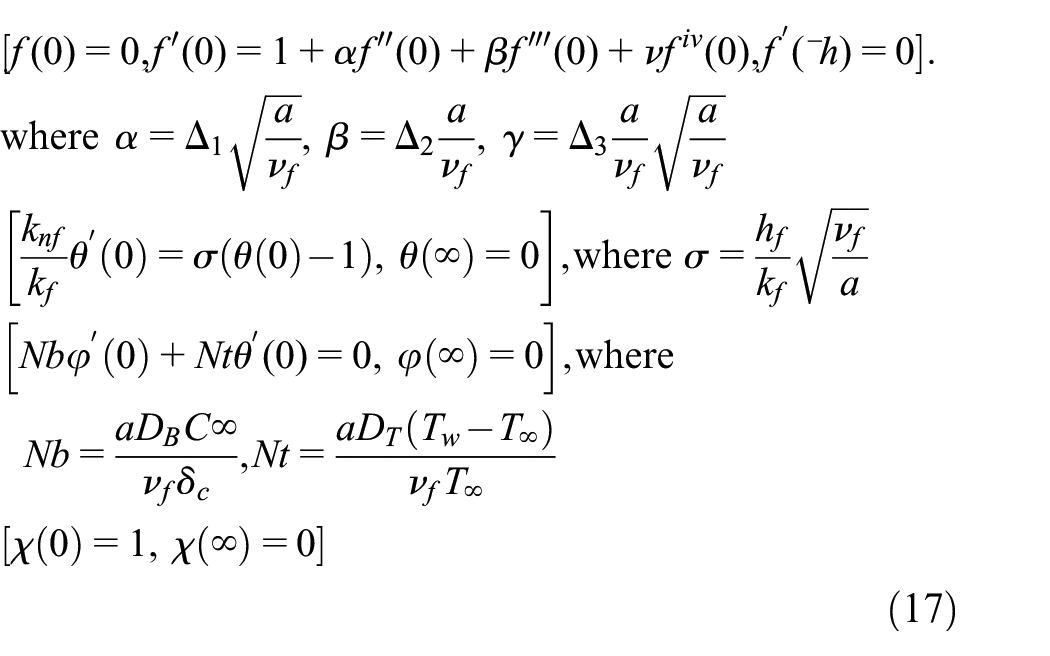
With (BCs),
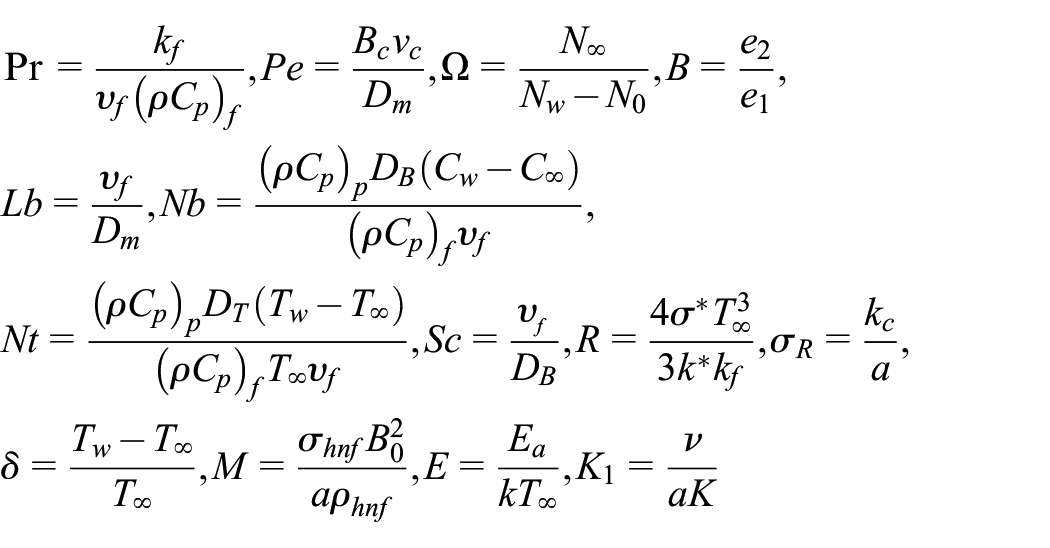
In the given equations,
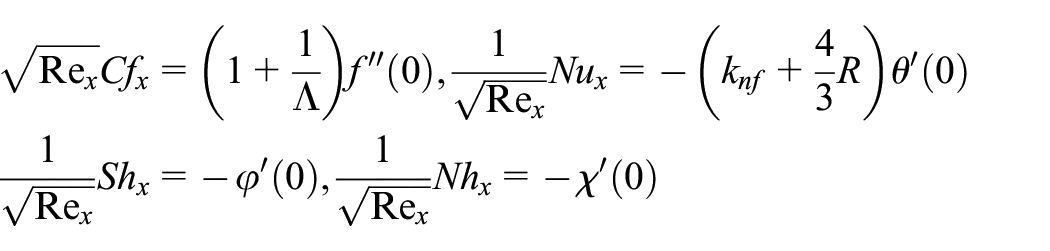
Quantities of interest
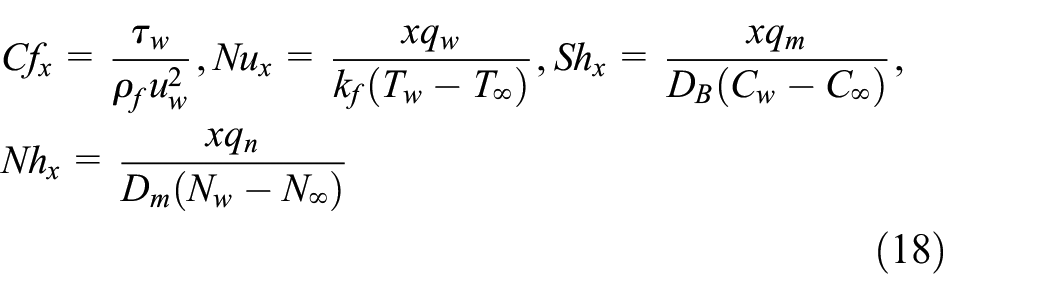
Where

Solution by HAM
The HAM are used to resolve equations (12)–(15), for given (BCs)
The initial suppositions are nominated as follow:

Take the linear operators as

Which have these characteristics:

Where the constants in general solution are
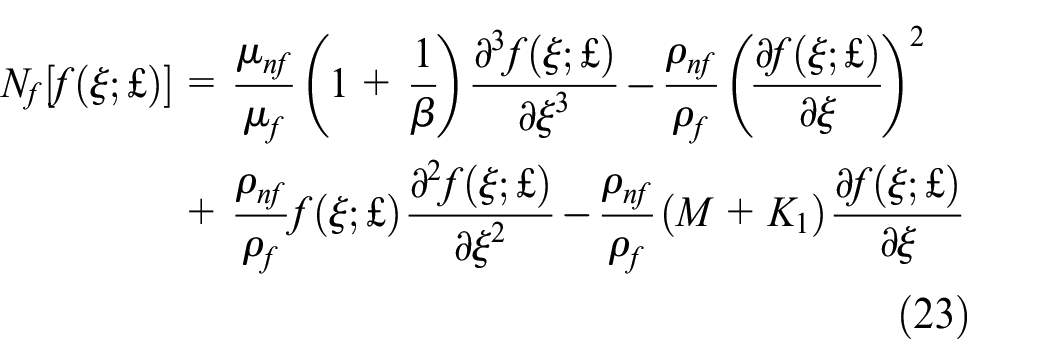
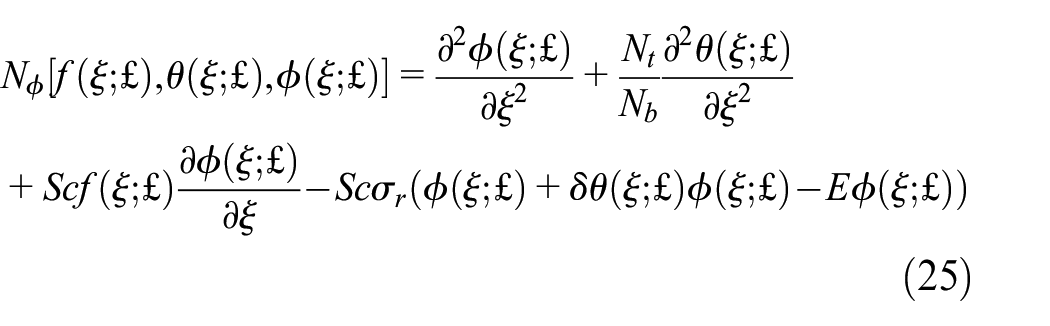
The nonlinear operations that resulted


The basic application of HAM is defined in references.30–35 From equations (12) to (15), The zero-order problems are:


The equivalent boundary conditions are:

Wherever

Expanding

Where


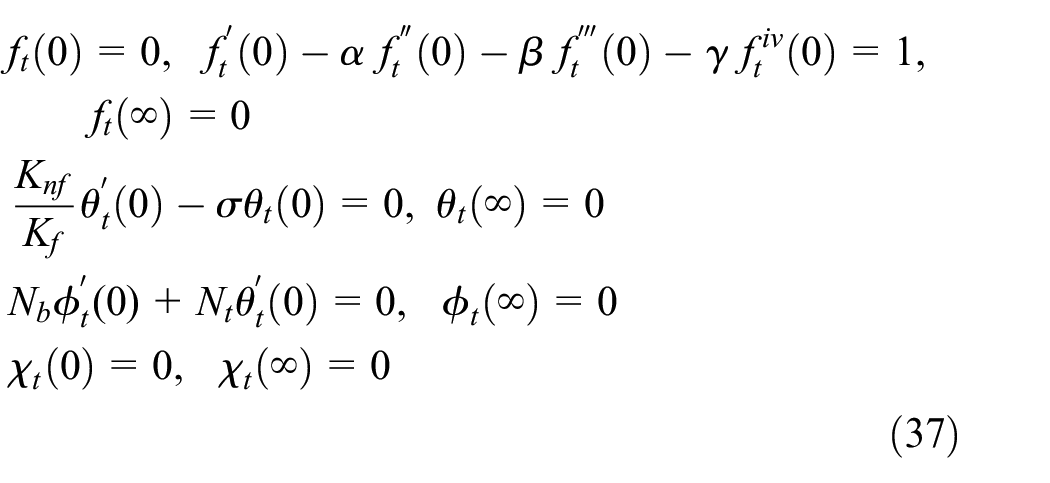
The nth-order problem has the following characteristics:

The related boundary conditions are:
Here


Where

Results and discussions
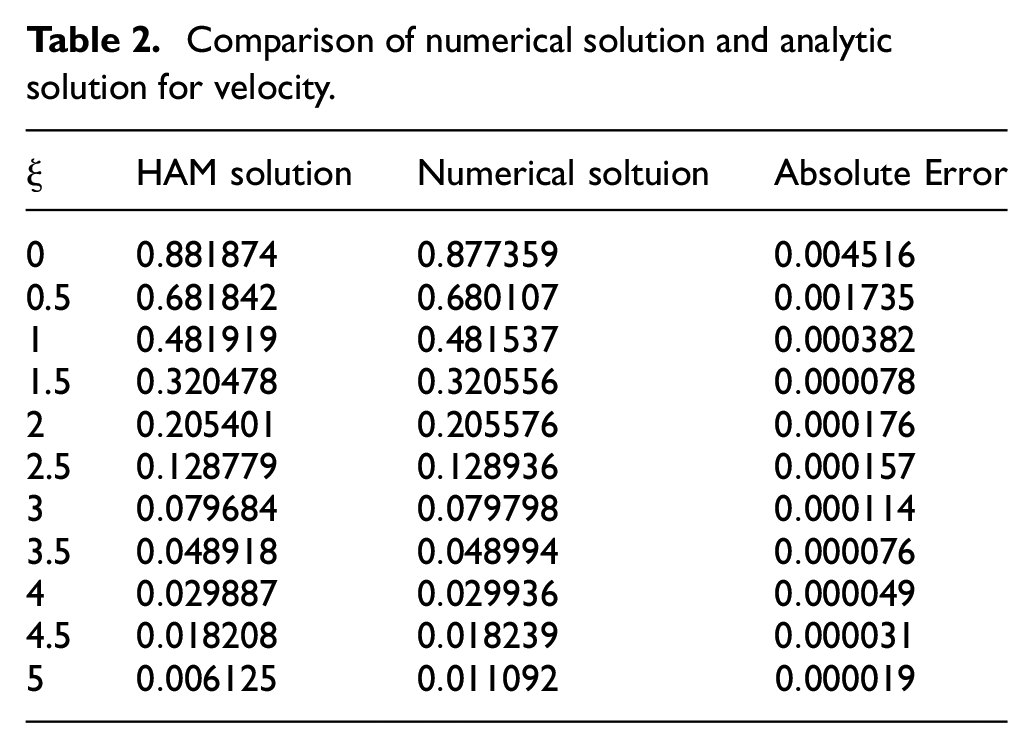
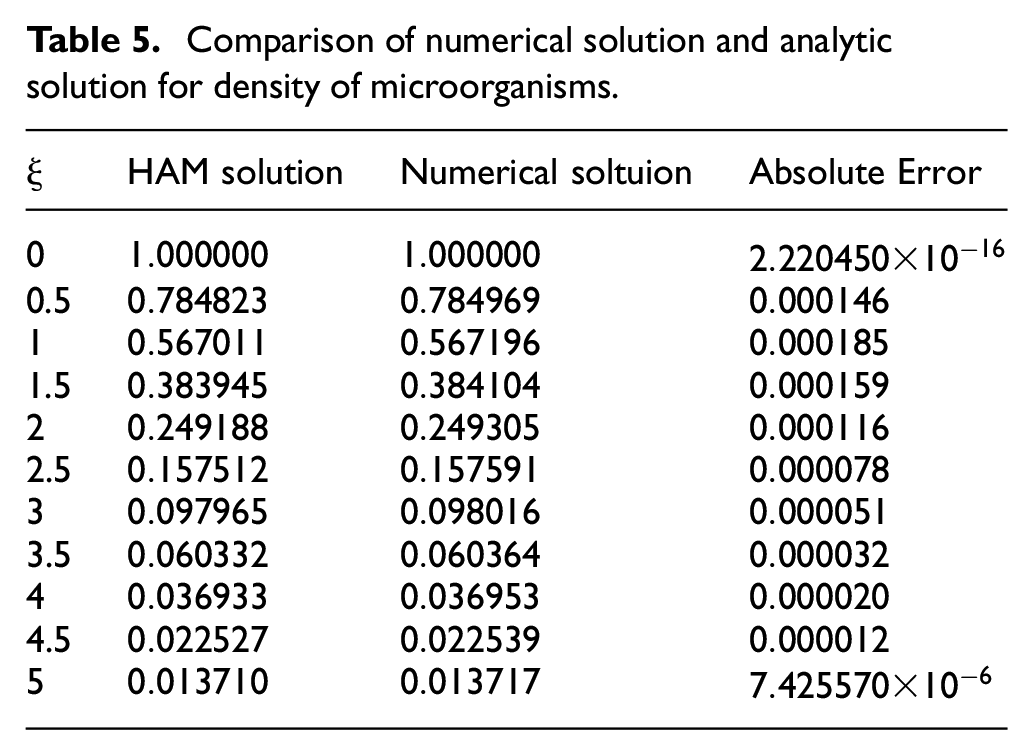
The geometry of the problem displays in Figure 1. For the purpose of authentication, the HAM and numerical results are compared as the limiting case. We find that numerical imitation and analytical solution is in outstanding agreement, showed graphically in Figure 2(a–d) and presented in Tables 2 to 5. Lastly, Figure 3 shown the entire residual error. A decreasing performance of residual error is detected for higher-order errors. Figure 4 displays that an increase in the value of

Flow geometry.

(a) Comparison of HAM and Numerical solutions for
Comparison of numerical solution and analytic solution for velocity.
Comparison of numerical solution and analytic solution for temperature profile.

Comparison of numerical solution and analytic solution for concentration profile.

Comparison of numerical solution and analytic solution for density of microorganisms.

Total residue versus order of approximations.

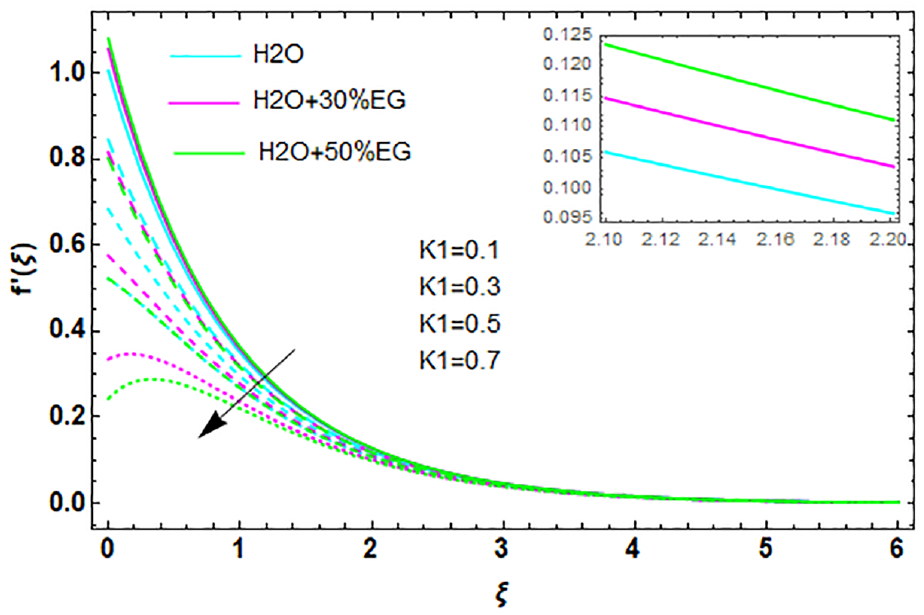
Effect of
Effect of

Effect of

Effect of

Effect of

Effect of

Effect of

Effect of
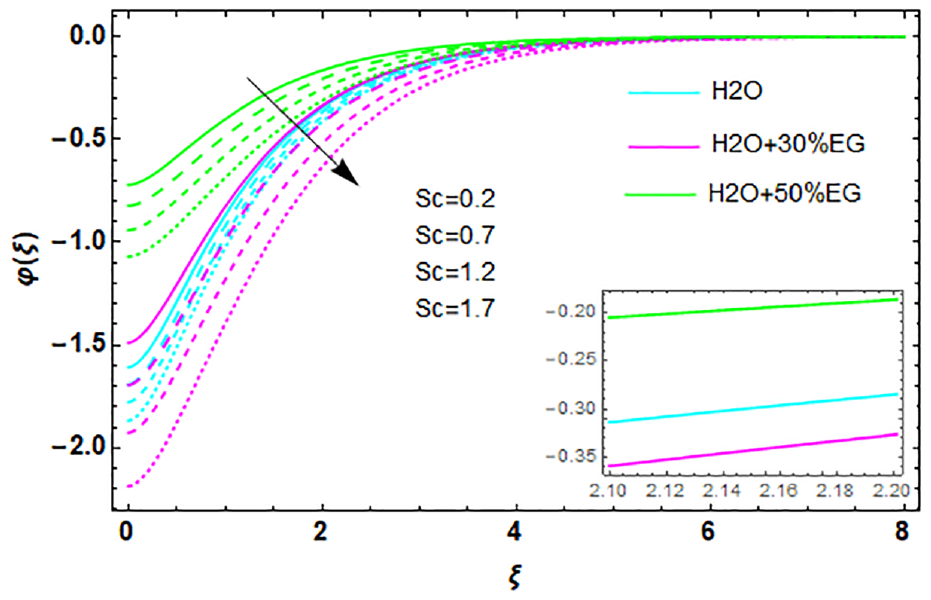
Effect of
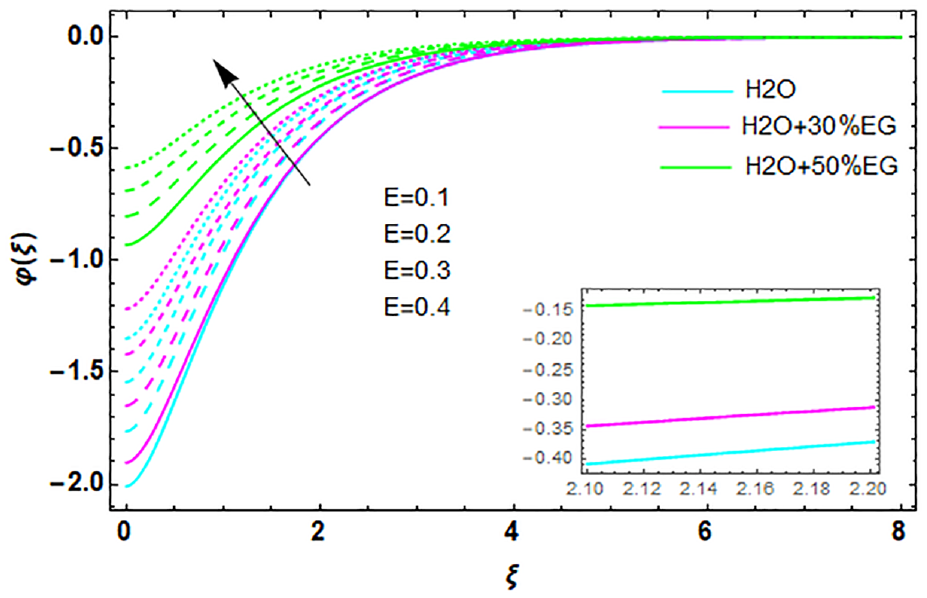
Effect of

Effect of

Effect of Pe on

Effect of Lb on

M versus local skin friction.
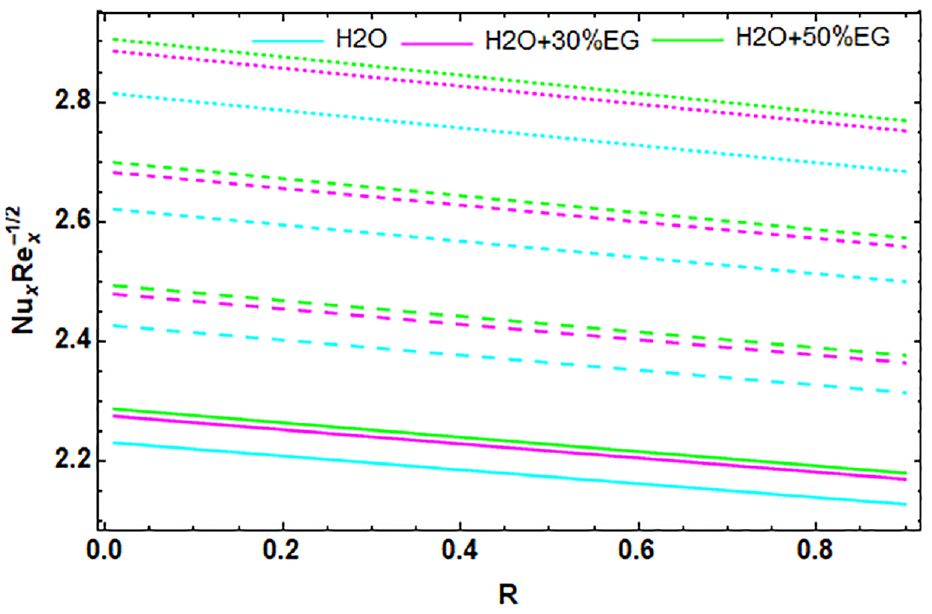
R versus local Nusselt number.

Nb versus local Sherwood number.

Lb versus density of microorganism.
The changes of

Local Nusselt number for distinct parameters

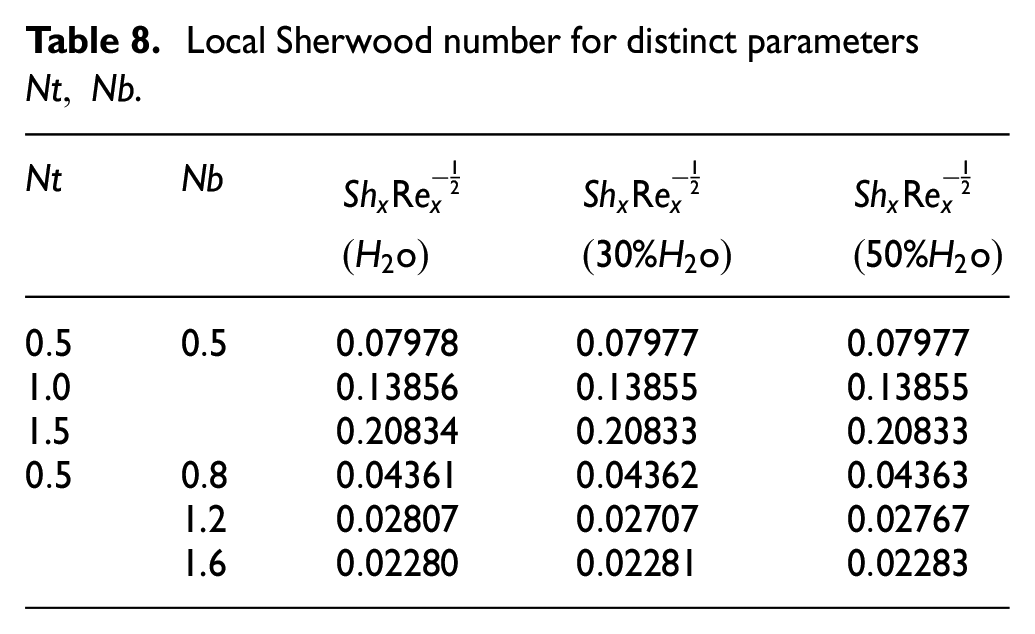
Local Sherwood number for distinct parameters
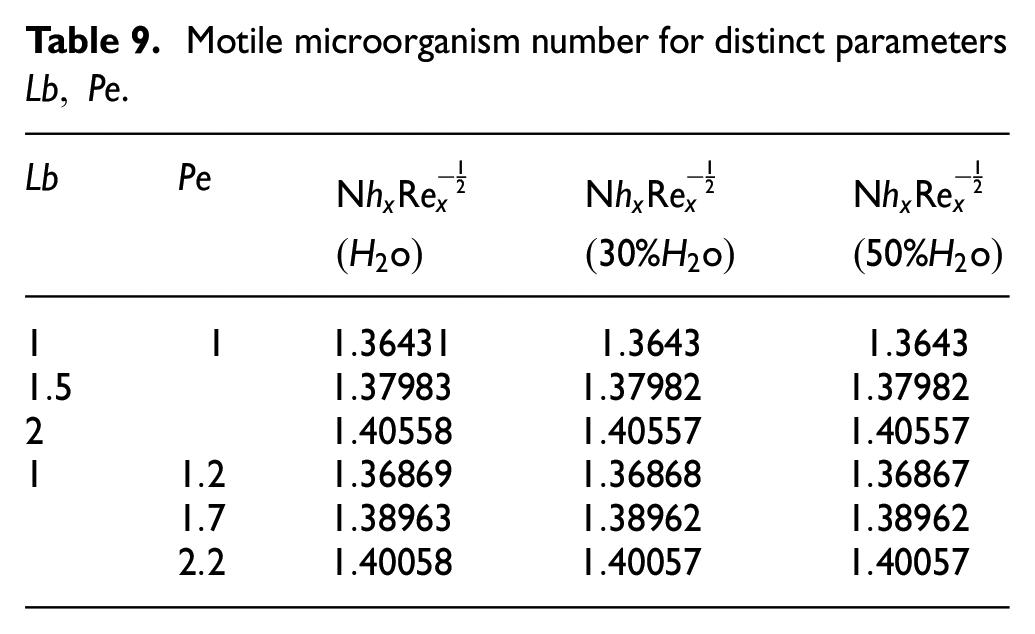
Motile microorganism number for distinct parameters
Conclusion
In this study the consequence of MHD Arrhenius activation energy of water, water−30%EG, water−50%EG based graphene nanofluid flowing over a stretched surface in the occurrence of motile micro-organism and thermal-radiation is examined. Some key findings of the study are:
The ethylene glycol-based graphene nanofluids takes less time for process as compared to water-based nanofluids. This is because of the thermal conductivity of ethylene glycol-based graphene nanofluid is higher than that of water-based nanofluids.
As the magnetic field increases the velocity of fluid decreases, as opposed to this, the temperature and concentration of the fluid increases.
The fluid velocity declines with growing value of both Darcy number and Casson fluid parameter
As the activation energy parameter
Growing the thermophoresis parameter
Increasing the value of Brownian motion parameter
Increasing the value of Schmidt number
Microorganism density profiles are minimized to optimized the material parameters. The bioconvection Lewis parameter
Future work
We will extend our work for unsteady flow nanofluid and Hybrid nanofluid, as well as for polar and cylindrical coordinates.
Footnotes
Handling Editor: Chenhui Liang
Declaration of conflicting interests
The author(s) declared no potential conflicts of interest with respect to the research, authorship, and/or publication of this article.
Funding
The author(s) received no financial support for the research, authorship, and/or publication of this article.

Data availability statement
The data used to support the findings are included in the manuscript.