



Abstract
In the world of fast-growing technology, the electronic gadgets become obsolete with the invention of advanced technology. Reuse of electronic components is a philosophy now being applied to all manufacturing industries to achieve the goal of reuse technology. The accurate assessment of residual life is of great significance for reuse as well as the successful operation of the application. The prediction of failure before it occurs will, in turn, reduce the repairing cost and strengthen the reputation of the manufacturer in real-time market. This article reports a novel technique to explore the residual life of electrolytic capacitor and validates it, using accelerated life testing. The optimization and evaluation of proposed technology are accomplished using design of experiments methodology, that is, Taguchi’s approach to designing the experiments. Prediction of residual life of capacitor is done using regression and artificial neural networks technique. A decision support system is prepared using fuzzy logic, which monitors the current health status of the capacitor and directs the user accordingly. Using six environmental stress and electrical parameters, the actual lifetime of the electrolytic capacitor is accessed, which has been proven as a valid and accurate technique, exhibiting error rate of 2.99%.
Keywords
Introduction
In an era of advanced technology, the integration of electronic components is the primary concern of almost all designing as well as manufacturing industries. While designing compact size and high-speed devices, their reliability becomes a major challenge. A series of tests have been conducted by the manufacturer, on components and devices, before launching the product to real market. A datasheet witnesses the range of rated parameters along with a maximum lifetime of that particular component or device. But in some critical applications, this claimed lifetime and other parameters do not fulfil the expectations of the user. Failure of a component can trigger the chain failure of all other deployed components, which may shut down the complete system. On the other hand, residual life prediction can initiate reuse of the components. In 2014, a total amount of 41.8 metric kilo tonnes of waste electronics and electrical equipment was generated globally. Once the electronics and electrical products become outdated, their components become unaltered. These components can be reused if their remaining useful life can be predicted. So, assessment of the residual life of a component is important for successful operation of the device as well as for providing the capability of reuse. In turn, it will decrease the replacement or repairing cost of the manufacturer and strengthen its market reputation.
From a toy industry to critical military application, a capacitor is widely used. Accident failure of a capacitor can lead to massive degradation of complete electronic gadget or device, in which it is installed. It has been investigated that loss of electrolyte is the main cause of degradation of electrolytic capacitor. 1 As the temperature or thermal stress increases, the change in electrochemical reaction takes place which consequently evaporates the electrolyte. 2 A loss of electrolyte is well estimated by analysing the change in weight of capacitor. A Dehbi et al. 3 have further explored that besides thermal stress, there are various other influential factors, such as ripple current, voltage and vibration, which affect the rating and life of the capacitor. B Saha et al. 4 have analysed capacitor life using different algorithms. For predicting the remaining useful life of machinery, Y Lei et al. 5 have used the model-based technique in which weighted minimum quantization error is constructed and particle filtering-based algorithm is used to predict useful life. In case of time-dependent stochastic models, N Li et al. have explored sequential Monte Carlo method to predict residual life and present a general expression that estimates residual life probability density function. They validate their proposed method using fatigue-crack-growth data. 6 Physics of failure technique is used by B Wan et al. 7 for life prediction of stored electromagnetic relays where they use Accelerated Storage Degradation Test (ASDT) of the electromagnetic relay to forecast the component failure. T Benkedjouh et al. 8 have utilized support vector regression and nonlinear feature reduction for predicting life and condition of machinery tools.
This article emphasizes residual life calculation of electrolytic capacitor starting from the selection of capacitor to building a decision support system. A novel technique is proposed for calculation of residual life of capacitor, which analyses the effect of six various environmental stresses as well as electrical parameters. This proposed method is optimized and evaluated using the design of experiments (DOE). The L25 orthogonal array is created using Taguchi’s method which takes care of six factors at five different levels. On the same set of combinational variables, Arrhenius-based accelerated life testing is conducted, which validates the proposed analytical approach of residual life calculation. The residual lifetime is predicted using linear regression as well as artificial neural networks (ANNs). To access the accuracy of prediction methodologies, error analysis is explored. Graphical user interface (GUI)-based decision support system is created for health prognosis of the electrolytic capacitor.
A complete route map has been shown in Figure 1, which analyses the proposed technique along with its validation and prediction techniques.

The design methodology of the proposed technique.
Residual life calculation of electrolytic capacitor
From ‘design phase’ to ‘development phase’, from ‘offline’ to ‘real market’, assessment of remaining useful lifetime is a major issue. Higher reliability is a key to success in today’s competitive market. V Sankaran et al. 9 have investigated various failure prediction techniques for capacitor. Based on application era, various prediction models have been explored. 10
Analytical models for life prediction
The empirical models such as military handbook MILHDBK-217F and RIAC are based on historical data that are used to explore the residual life of electronic components. But these models are not updated. In contrast to empirical methods, there are several other influential parameters on which life of a system depends (Figure 2). This proposed model will analyse the acceleration factor, a constant multiplier for different stress levels. Then, the effect of this stress level acceleration factor will be studied in the life, as claimed by the datasheet. JL Stevens and RF Dapo 11 have reviewed service life of aluminium electrolytic capacitor and its lifetime calculation. For analysing the response and rating of the electrolytic capacitor, various input parameters have been studied and their effects have been explored.
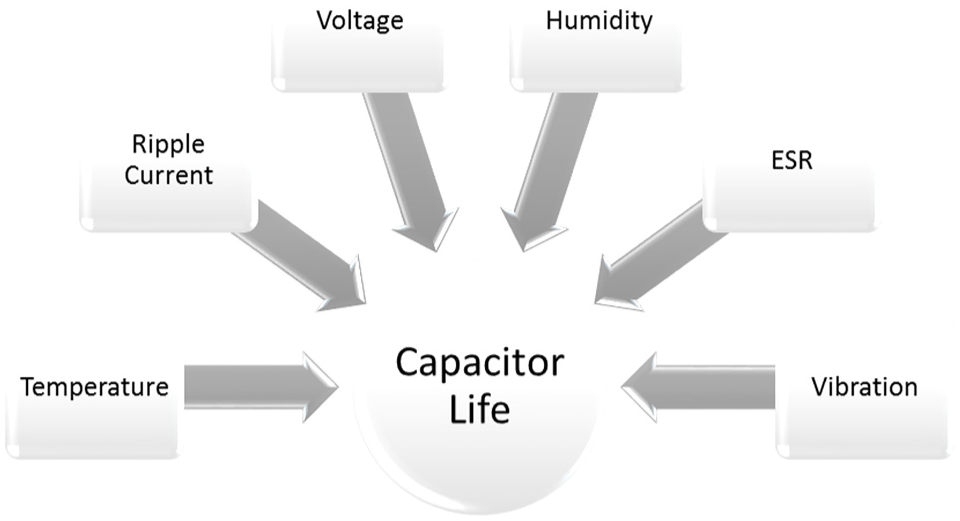
Influential parameters for electrolytic capacitor.
The acceleration factors of all influential parameters have significant impact on the lifetime of the capacitor. Therefore, the major aim is to explore the effect of input parameters and observe the reaction on capacitor’s output. The expected lifetime can be calculated by equation (1), considering lifetime claimed by datasheet and acceleration factors12–15

Equation (1) shows the relation between expected lifetime, lifetime claimed by datasheet and accelerated factors of influential input parameters.
Proposed model for residual life calculation
As literature suggests, the lifetime of electrolytic capacitor depends on the temperature, ripple current and voltage. But in real-time application, there are other factors which also influence the lifetime of electrolytic capacitor. 16 In this article, proposed model for residual life calculation of electrolytic capacitor counts the effect of not only temperature, current and voltage but also explores three more parameters which play an important role in calculating remaining useful lifetime of electrolytic capacitors, that is, humidity, frequency and vibration.
Identification of critical parameters for calculation of residual life
The various factors that affect the life and performance of electrolytic capacitors are explored and the analytical relationship between predictors and estimators are developed.
Effect of temperature on lifetime
With the increase in thermal stress, the derating and degradation of electrolytic capacitor accelerates, as proposed by CS Whitman. 17 As an electrolytic capacitor is an electrochemical device, the chemical reactions trigger with the increase in temperature. R Kötz et al. 18 have explored that temperature is a critical parameter for evaluating performance of capacitors. It has been assumed that with every 10° rise in temperature, the capacitor life degrades by a factor of 2. So, increase in temperature reduces the capacitance. The expected life using this method can be calculated using equation (2). H Ma and L Wang 19 have suggested various fault diagnosis techniques for electrolytic capacitors


where Lifetime (D) = lifetime claimed by manufacturer in datasheet; AT = temperature acceleration factor; Tm and Ta are maximum and applied temperature, respectively.
Effect of voltage on lifetime
As explored by V Naikan and A Rathore, 12 the degradation of capacitor life depends not only on temperature acceleration factor but also on the rated and operated voltage. If the capacitor operates within rated range of operating voltage, its life will be enhanced. C Kulkarni et al. 20 have analysed the effect of electrical parameters on capacitor performance. By considering voltage as influencing factor, the expected residual lifetime is calculated as equation (5), which is modified version of equation (2)


where AV = voltage acceleration factor; Va and Vm are applied and maximum voltage, respectively; n = constant = 1 for radial capacitors.
Effect of ripple current on lifetime
As per Joule’s law, heat generated is directly proportional to applied ripple current. The electrolyte evaporates with the same rate, as heat is generated. Consequently, weight of capacitor reduces and capacitance also decreases. SG Parler et al. 21 have explored the impact of ripple current on rating and life of capacitor


where AI = current acceleration factor; Ki = Ripple current multiplier = 2; ΔT = increase in core temperature.
Impact of frequency on lifetime
As the frequency increases, consequently, the equivalent series resistance (ESR) value will also change. As per ohms law, ESR of only 0.5 ohms generates heat 12.5 W inside the capacitor. High frequencies and high current create disturbance in dissipation factor and ESR. Consequently, heat accelerates at an accelerated pace. As the heat generates, the electrolyte evaporates and ESR tends to increase with frequency. It can deteriorate the component and reduce its rated lifetime. The expected lifetime is calculated by equation (8) when the frequency is also taken as a considerable parameter


where ESR acceleration factor
Impact of humidity on lifetime
While estimating the reliability of electrolytic capacitor, humidity plays a significant role. Due to the presence of moisture, it can damage electrolytic capacitor because of electrolytic corrosion. Consequently, the value of capacitance reduces and subsequently affects the life of the capacitor. As suggested by F Sinnadurai, 22 the humidity acceleration factor can be calculated using equation (8). It is modified form of Peck’s law. It has been analysed that if the capacitor has been operated more than rated humidity, the life has been degraded at an exponential rate. After taking consideration of temperature, voltage and humidity, the equation has been formed as equation (11)

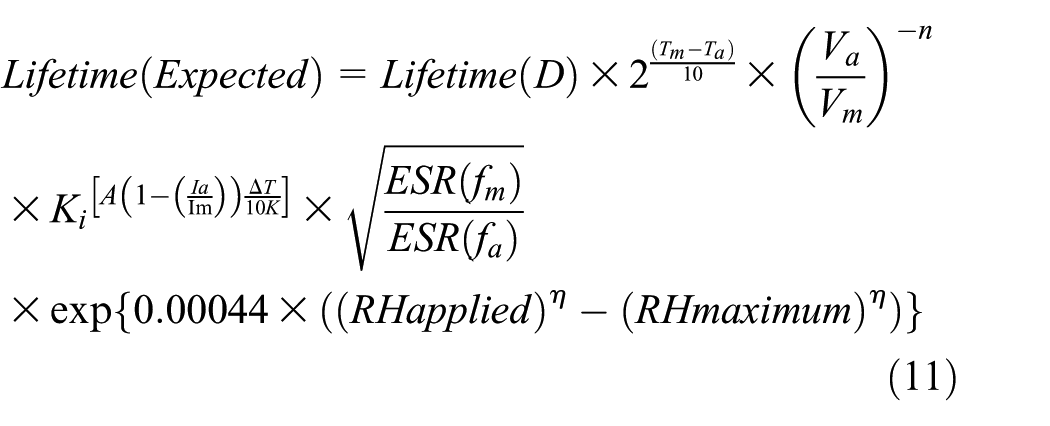
where AH = humidity acceleration factor; η = humidity activation exponent = 2.
Impact of vibration on lifetime
Vibration is another acceleration factor that affects the lifetime of the capacitor. If a capacitor goes throw more vibration rate, then the capacitor goes through the complete breakdown; otherwise, the vibration has a little impact on the life of the capacitor. The vibration accelerator is given by

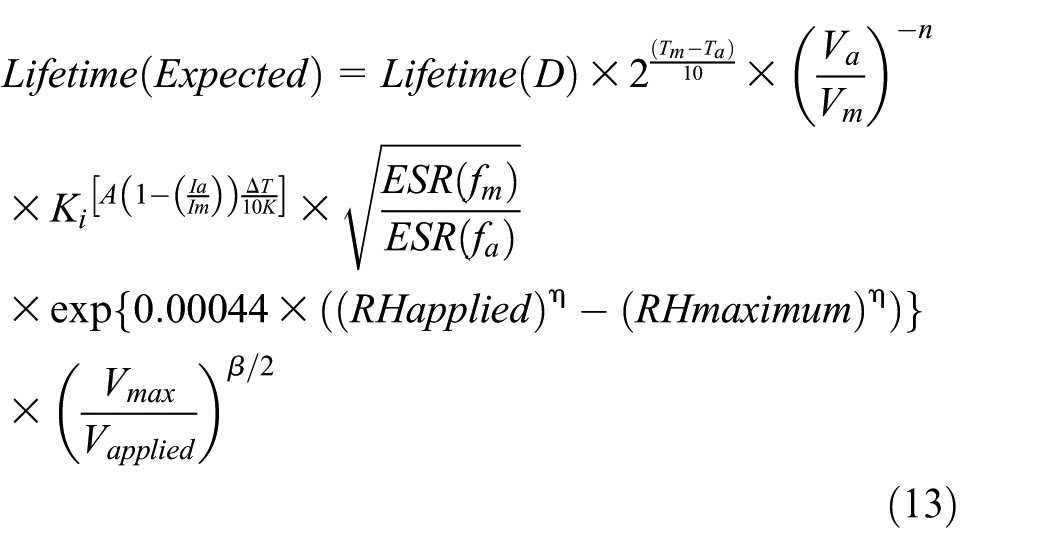
where AVB = (Vmax/Vapplied)β/2 = vibration acceleration factor; β = fatigue parameter = 1.
Optimization and evaluation of mathematical modelling: a DOE approach
DOE is a systematic methodology to explore the cause and effect relationship. Taguchi approach is a systematic means of designing, conducting and analysing experiments which are of great significance in quality planning (Figure 3). The orthogonal array is created based on a number of factors and their levels. The steps in designing, conducting and analysing experiments are as follows:
Selection of factors. For analysing residual lifetime of the electrolytic capacitor, six factors are considered which are temperature, ripple current, voltage, humidity, frequency and vibration.
Selection of the number of levels. The selected six factors are further classified into five different levels: very low, low, moderate, high and very high (Table 1).
Creation of orthogonal array. The L25 orthogonal array has been created for six factors; five level input parameters using Taguchi’s approach, for conducting experiments (Table 2).
Assignment of factors to columns. The values of process variables have been assigned to respective columns of Taguchi’s orthogonal array.
Conduct of the test. After assigning the values to an orthogonal array, the experiments are carried out and calculations have been done as per equation (13), for design matrix. The various acceleration factors are calculated as per equations (3)–(13). The residual lifetime is calculated as per Taguchi’s approach using proposed model and experimental technique.

Flow chart of Taguchi’s approach.
Process variables and their levels.
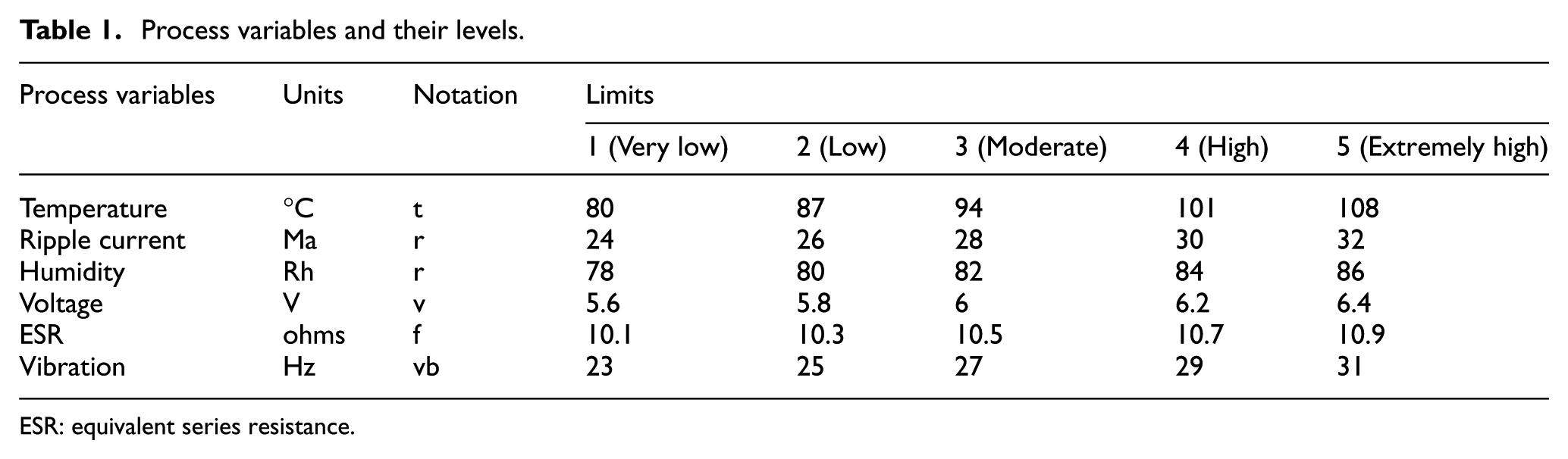
ESR: equivalent series resistance.
L25 Orthogonal Taguchi approach.

ESR: equivalent series resistance.
Prediction of residual life using statistical model
To estimate the relationship between a set of predictor variables and response, statistical methodology, that is, regression technique is employed. The connection between the independent process parameter variables and capacitor residual life can be interpreted by the following mathematical model 23

Here, C is regression constant, CL is the response (capacitor residual life) and T, R, V, H, E, Vb are the values of process parameters, that is, temperature, ripple current, voltage, humidity, frequency and vibration, respectively, whereas l, m, n, o, p and q are model parameters. The values of all the parameters are calculated using Minitab 18.1 software.
The above equation (14) can be represented in a linear form as

Equation (15) can be further modified as given below

where L is the capacitor residual life on logarithmic scale; A1, A2, A3, A4, A5 and A6 are logarithmic representation of process parameters; µ1, µ2, µ3, µ4, µ5 and µ6 are regression coefficients to be determined.
So, the residual life of electrolytic capacitor is developed using regression technique. Minitab 18.1 software is used to explore the regression coefficients.
Prediction of residual life using ANNs
After evaluating the proposed method for residual life calculation of electrolytic capacitor using DOE approach, the statistical method approves its optimization. An expert model is created using artificial intelligence method, that is, ANNs. The ANN is an analogous system of the human neural network which tries to mimic the functioning of the actual brain. The activation function is provided to start the process where system learns by itself how output is coming. The system gets the train with the number of the specified epoch. The system trains itself and reduces the error after every epoch and hence after a number of epochs, we get the best result. The number of neurons in the input layer consists of voltage, ripple current, temperature, frequency, humidity and vibration which are used to obtain the residual life of the electronic component. The 70% of the data is used for training the model, whereas 30% data is used for testing the data.
The ANN model has 6 input layers, 10 hidden layers and 1 output layer (Figure 4). After training and testing the data, the predicted response is analysed. This response is analysed and compared with response obtained using proposed model.

ANN model (6-10-1).
Validation using experimental method
The calculation of residual life is performed using the proposed analytical method. This method is developed by taking care of real-time applications of the capacitor. To validate this proposed method, accelerated life testing is conducted. Gulbrandsen et al. 24 have analysed lifetime of an electrolytic capacitor using practical methods.
In experimental setup, an electrolytic capacitor is chosen (Figure 5). A total of 30 capacitors are taken for experiment. The initial parameters are noted using LCR meter as well as manufacturer datasheet. Puncture each capacitor with 9-mm hole and wrap all the capacitors with sand. Then place all the 30 capacitors on digital hot plate.

Experimental setup.
Conduct the experiments as per design matrix created by Taguchi’s approach. If capacitance decreases by 20% or ESR increases by 100% and weight decreases, the capacitor is said to be failed. The lifetime is calculated using Arrhenius law as per equation. The experiments are conducted by accelerating temperature, voltage, current, ESR, vibration as well as humidity. The overall failure is calculated using equation (17)

where

Ea = activation energy (eV) = 0.7 eV; K = Boltzmann constant.
The analytically calculated life is compared with experimental value and 2.99% error is calculated. R Jánó and D Pitică 14 and Ashburn and Skamser 25 have used accelerated life testing for exploring derating factor of an electrolytic capacitor.
While considering uncertainty in experimental and proposed analytical method, the uncertainty is ±988 and ±940, respectively, where uncertainty represents standard error.
Comparison between experimental and analytical models
The residual lifetime of the electrolytic capacitor is calculated using the proposed method. To validate this proposed technique, an experimental approach is considered. Accelerated life testing is conducted as per L25 design matrix. A comparison is carried out between response to experimental approach and proposed technique. To assess the accuracy of the proposed model, error analysis is analysed based on following formula

The response calculated using the experimental approach as well as the average accuracy of the proposed method is summarized in Table 3.
Error analysis of analytically calculated lifetime.

The comparison suggests that proposed methodology has an average error of 2.99% in comparison with experimental methodology, which validates the proposed technique with an average accuracy of 97.01%.
Figure 6 represents the graphical analysis of lifetime calculation. It has been seen that response to proposed methodology is almost close to the response obtained using experimental approach.

Graphical analysis of lifetime calculation.
Results and discussion
The effect of various environmental stress, as well as electrical parameters, has been analysed. Taguchi’s method is used as DOE technique to evaluate the proposed technique. The residual life of capacitor is determined using acceleration model. 26 The proposed model is validated using experimental approach. The statistical technique and artificial intelligence technique are used to predict the response. Error analysis and the comparison are carried out for all prediction techniques.
Residual life calculation using the proposed method
Using analytical life calculation models, first the values of factor assigned in design matrix then values of acceleration factors are calculated and put in equation (8) to find the lifetime.
Residual life calculation using a statistical method
Using Minitab 18.1 software, regression analysis has been done (Figure 7 and Table 4). The Student’s t-test is used to test the accuracy of the model. Accuracy can be predicted by the fact that variance value should be minimal and R2 value should be higher 27


Regression outputs using Minitab software.
Analysis of regression model.

Using equation (17), lifetime is calculated using a regression equation.
Residual life calculation using ANNs
Using artificial intelligence model, the prediction of residual life is explored and summarized. The neural network technique makes use of a computer and simulates the behaviour of human brain neurons. It is a parallel processing structure which can be divided into several processing procedures that are trained simultaneously. The neural network model is constructed using a set of data consisting of input and output variables. In the training process, the structure of the model is self-adjusted to the data, and the final model can be used for estimation. Here, 6-10-1 model is used for training and testing the data using prediction and estimation model. 28
The graphical comparison of an actual life with respect to regression methodology and ANNs is shown as in Figure 8. Here, actual lifetime represents the lifetime calculated using the proposed analytical method (Table 5).
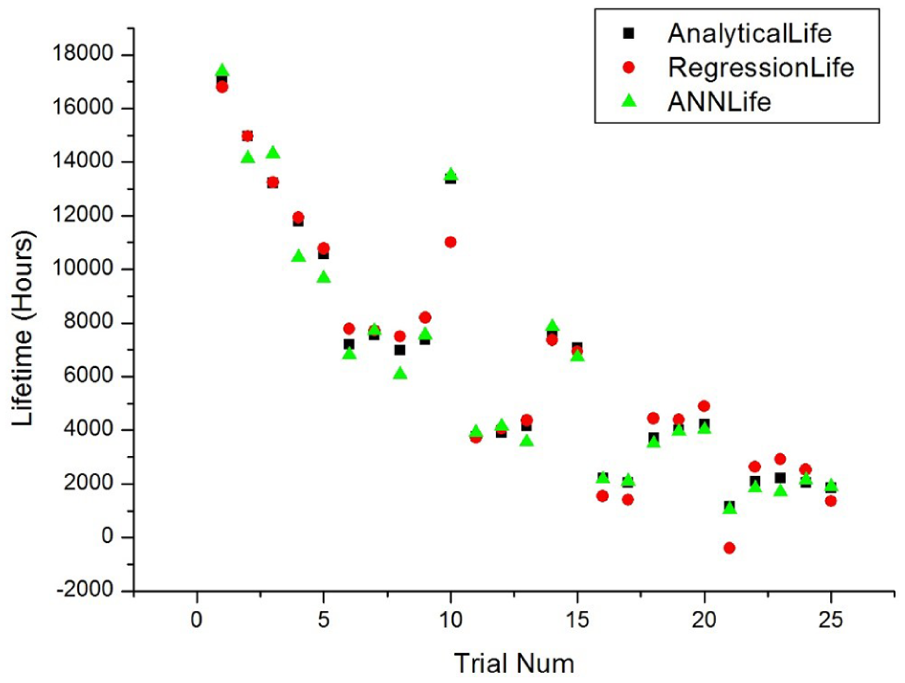
Lifetime comparison of statistical and ANN prediction method.
Calculated residual lifetime (h).

ANN: artificial neural network.
Fuzzy-based decision support system
After validating the proposed analytical method, by comparing its response with experimental response lifetime, a health monitoring system is prepared (Figure 9). A fuzzy-based decision support system is created, which warns the customer by accessing the capacitor’s health prior to complete shutdown.
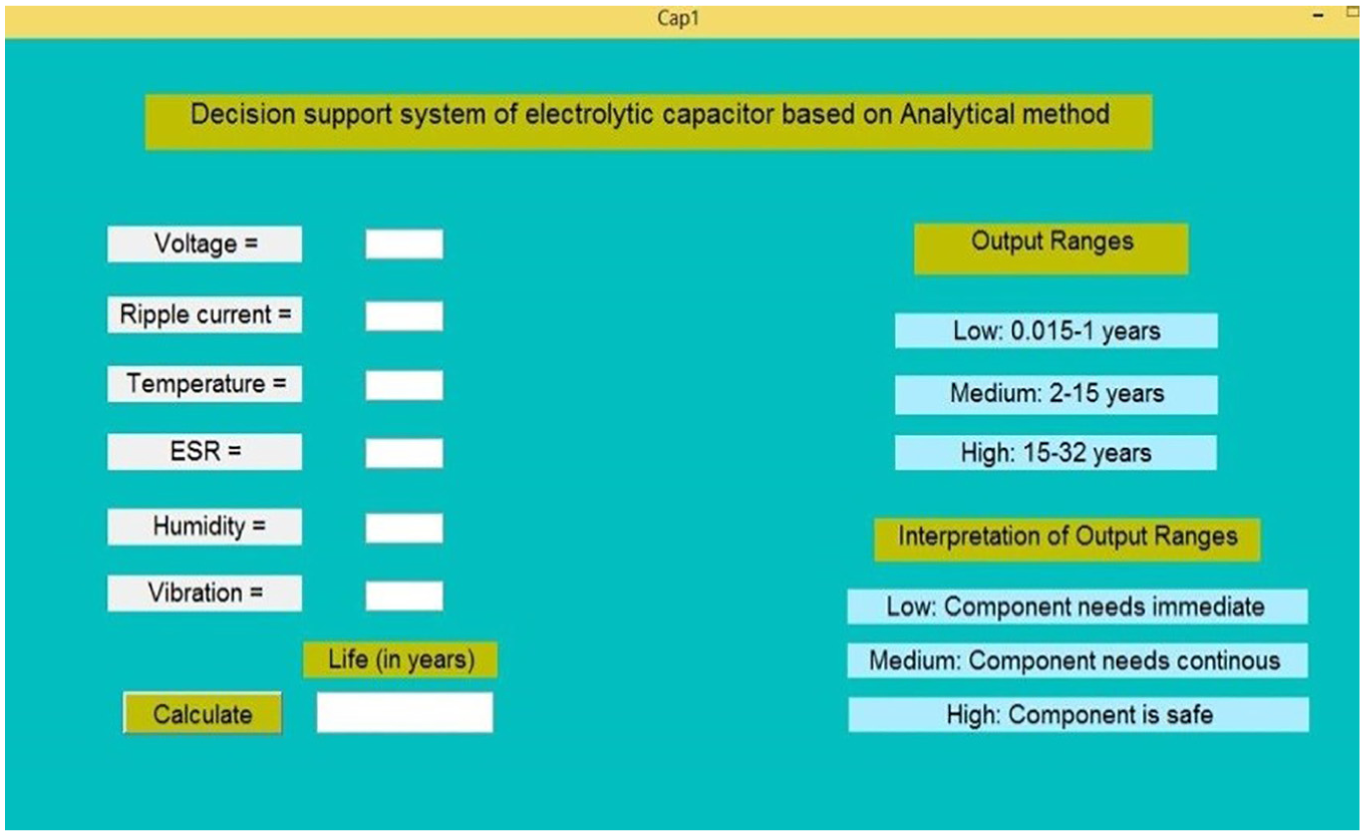
Decision support system for proposed analytical model.
All the six parameters are considered and output response has been categorized and health conditions are monitored. The user can replace the faulty component before it causes the chain reaction to shut down the complete system.
Conclusion
The remaining useful life of an electrolytic capacitor is explored using a proposed analytical method which accounts six various environmental stress and electrical parameters. The proposed technique is evaluated using orthogonal array L25, as designed by Taguchi’s approach. For validation of the proposed technique, Arrhenius-based accelerated life testing has been conducted and residual life is calculated. After comparing the proposed technique with an experimental approach, 97.01% accuracy is accessed. Furthermore, lifetime is calculated using statistical approach, that is, regression technique and ANNs. Health prognostics of the capacitor is done using fuzzy-based decision support system which directs the consumer according to the response of the condition monitoring system.
Footnotes
Handling Editor: Yaguo Lei
Declaration of conflicting interests
The author(s) declared no potential conflicts of interest with respect to the research, authorship and/or publication of this article.
Funding
The author(s) received no financial support for the research, authorship and/or publication of this article.
