




Abstract
Increasingly, customers choose products in terms of the experience and enjoyment that the product can bring to them, in addition to functional performance and usability. These experiences involve a range of customer emotional feelings. Correct understanding of customer feelings and subsequently relating them to new product elements or features, are the important issues for a successful design. While this has been addressed by technologies, like kansei engineering, the difficulty remains in handling the differences of an individual kansei. This article proposes the use of artificial neural networks to solve this problem and to explore the relationship between customer attributes and product evaluation. Initial results have established the feasibility and success of this method. It will find application in product design and in particular personalized customization.
Introduction
Nowadays, the competition between the companies is very intense. Many product technologies have matured, or can be adopted by other competitors quickly. Simple functional design and ergonomic design can rarely help a company to maintain a commercial edge. 1 On the other hand, in relation to the hierarchy of the human needs pyramid, customers increasingly appear to pursue needs at a higher level – self value (or brand). As a result, products offering mere functionality and good usability will not meet all the needs of customers. They expect more satisfaction at an emotional level. Personalized design has thus become an important approach to create added value for a product. The characteristic of this form of design is to care about users’ feelings.
In recent years, many researchers have linked psychological elements to design engineering technologies, in particular kansei engineering (KE). When a consumer wants to choose a product, there is an image arising in his or her mind. This image determines the criteria for judging the product. KE technology is defined as ‘the translating technology of a consumer’s feeling and image for a product into design elements’. 2
The factors that affect people to generate an image in his or her mind are very complex, but most of them originate from the past experience information that people stored in their brains. The main challenge for personalized experience design is how to look inside each customer, clearly and objectively, 3 and to identify their inner feelings. This article explores the sources of the influencing factors and the relationship between human attributes and product choices or preferences. A powerful technique or model for predicting a users’ response when they see a new product is presented by means of an artificial neural network (ANN). KE theory is also used as a foundation to build this model. The novel model can be used to help industrial designers objectively predict customer needs and to transform them between customer attributes and product preferences. It can also be used as an evaluation tool to test a new product concept at the design stage.
Methodologies
KE
KE is a consumer-oriented technology. Kansei means the psychological feeling and image associated with a product. 4 It is an abstract, conscious activity, and the image information is difficult to be used in product development directly. KE aims to aid the transformation between these images and product elements, such as shapes, colours, functions, and structures. It includes three types: category classification, computer assisted KE system, and KE mathematical modelling. Category classification is a method to break down a product into a tree structure of sub-concepts, from zero to nth level, to guide the detail design. Figure 1 is an example of category classification.
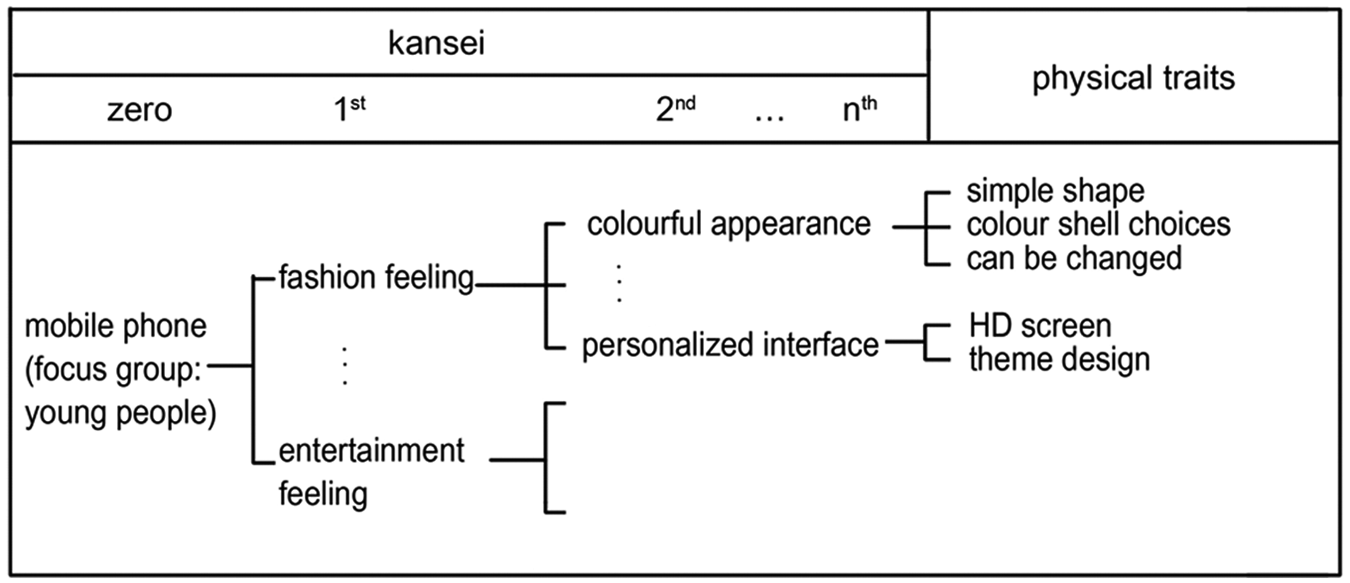
The translation of kansei into car physical traits.
KE has provided a practical approach to process affective information for product design, but there are also some problems that need to be solved. One problem is ‘how to deal with individual difference of people’s kansei’. 5 As we know, the thinking, feeling, and image among different people varies generally. Therefore, the kansei among different people is also different.
ANN
Common computer technologies used in KE (mainly type II) are expert system, ANN, and genetic algorithm. ANN is invented based upon the understanding of biological nervous systems, and it typically consists of many nonlinear computational elements with certain architecture. 6 It is an information processing system and is widely used to model complex mathematical and logical relationships.
The authors propose the use of ANNs to address the above problem of individual differences in KE. The kansei of an individual customer depends, obviously, upon the product features, but importantly it is also conditional upon the customer’s personality and experiences, which may be termed as customer attributes. Customers evaluate a product in relation to their own attributes. These attributes should generally exhibit complex, nonlinear relations in the customer’s evaluation of a product, for which the ANNs will be necessary. The authors believe the ANNs can also provide sufficient capability to address the difference of individual kansei by exploiting the relationship between customer attributes and product design elements, which is presented in this study. This is essentially an extension or generalization of KE.
Neural network model
Many studies have provided methods to combine psychology and computer science for user needs research. However, in industrial design and evaluation areas, these systems tend to pay more attention to product descriptions, much less on the individual differences of customer psychology. This study attempts to integrate the cognitive behaviours into the neural network system. It requires a model to learn and match the relationship between customer attributes and product evaluation (or design elements), and once trained it will be able to predict which product elements and/or features the customer will prefer, thus greatly assisting product design.
A three-layered feed-forward neural network has been selected, which has the customer attributes as the input layer, the product evaluation as the output layer, plus one hidden layer (see Figure 2). The input layer includes the codes for customer attributes, including personalities, and the output layer is the code for product evaluations.
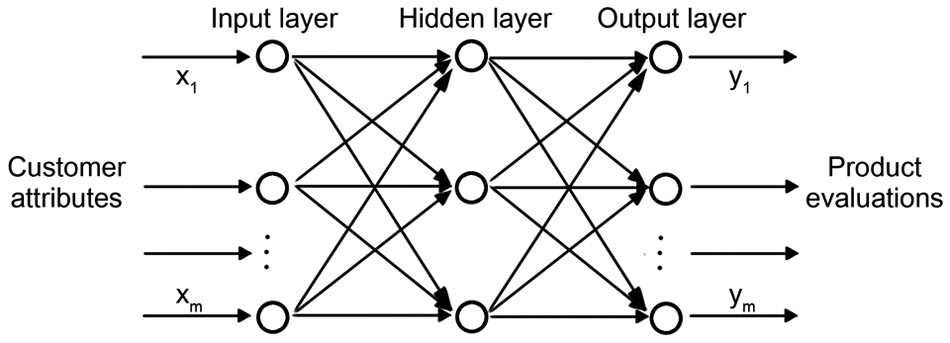
ANN model of relationship between customer attributes and product evaluation.
Neural network inputs
The code selection of the input layer focuses on the customer attributes that likely influence the customer cognitive behaviours, which may be related to many disciplines, such as perceptual psychology, cognitive psychology, and information science. Many factors or attributes can affect a customer’s preference, and the following attributes have been chosen in the preliminary investigation: gender, occupation, age, lifestyle, society role, preference habit, and consumption level at level 1. Attributes including culture, lifestyle, society role, and preference habit have sub-attributes at level 2, as shown in Table 1.
The impact factors of human preference collection.
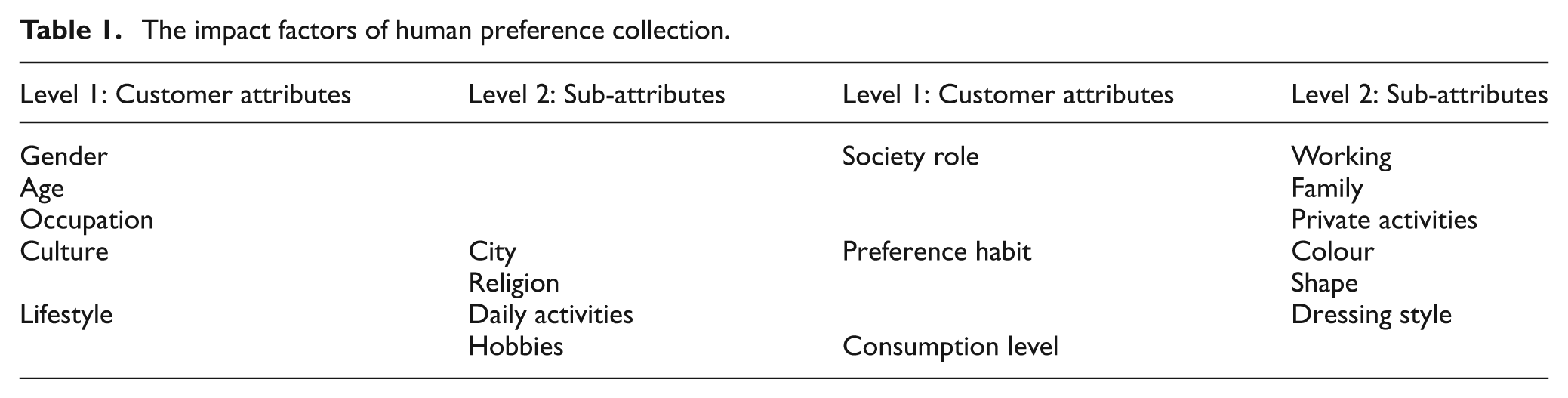
This study examined all these attributes listed in Table 1. Various combinations of these attributes have been studied and tested. The results indicated that gender, age, occupation, lifestyle, and society role are the main influencing factors when people choose and evaluate a product.
Limitation of the simple ANN model
The individual differences are largely attributed to the different experiences of people in their life. Although various kinds of customer attributes can be coded, it has been found difficult to simulate all personalized behaviours of the whole population using one simple ANN. As a consequence, different neural networks are used for each group of customers, with the customer classification determined by self-organizing feature maps (SOFM). Each back propagation (BP) ANN therefore only models one group of customers, and this has significantly improved the performance as shown in Figure 3. This approach may be generally used in the modelling of complex processes.7,8
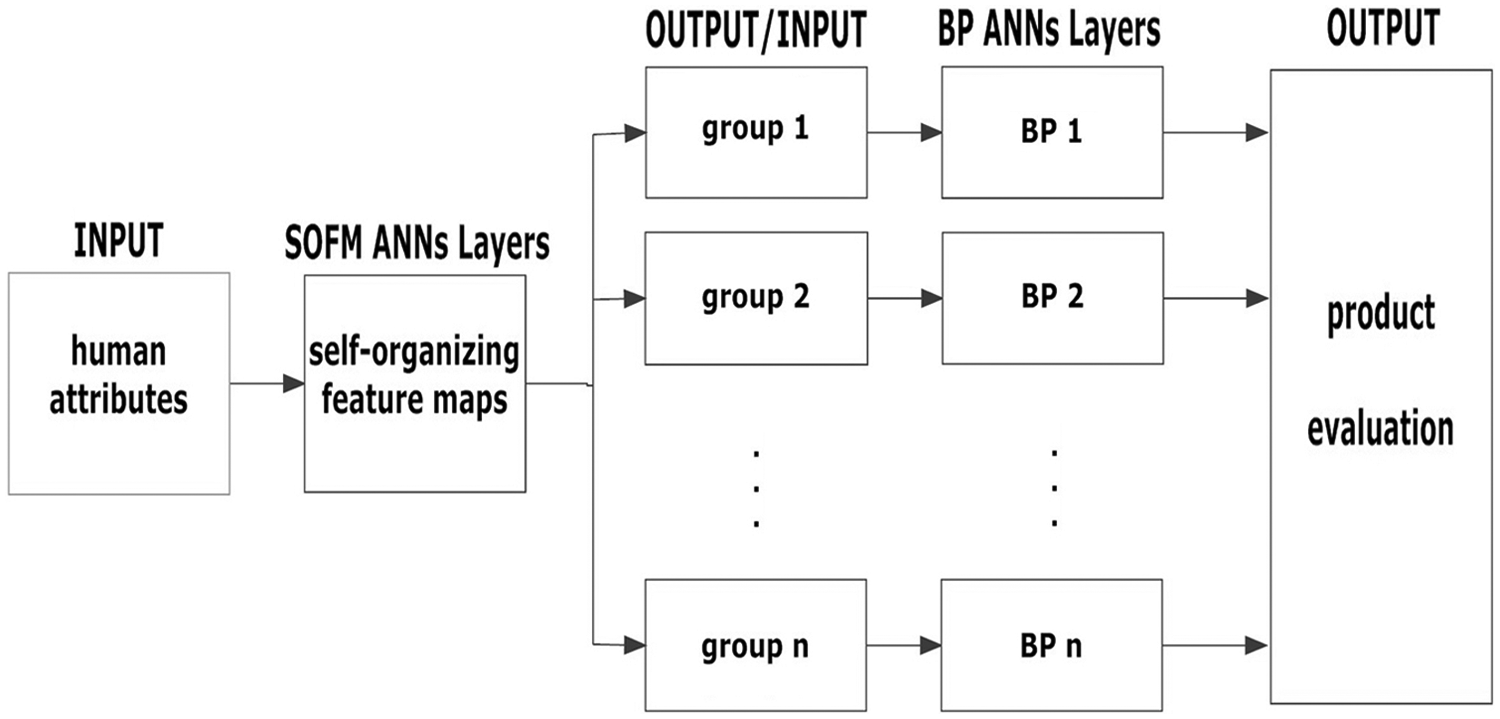
Overall ANN system.
Design and training of the BP neural networks
If people want to cognize a thing in a limited time, the most direct and quick way is to observe it. The information that people can obtain through vision is more than any other sense. In a typical purchase process, most product information is transferred into brain through vision.
The product chosen for this case study is a concept mobile phone. There are three reasons to use concept mobile phones as the study. First, a mobile phone is very popular among any group of people. It is a digital hi-tech product and can perform so many functions. The cognition of a mobile phone has wide individual differences, for example, as a communication device, a business tool, an entertainment product, and even a clock. Second, all concept mobile phone samples do not have brand information. It is for simulating an unbiased survey environment without impact from company abilities. And third, the samples are design concepts that did not appear in the market. All the people who accepted the survey are not informed what the products are, and have never seen them before. This study aims to model the human cognitive behaviour in product evaluation.
The next step is to determine the input and output of the BP neural network.
ANN inputs
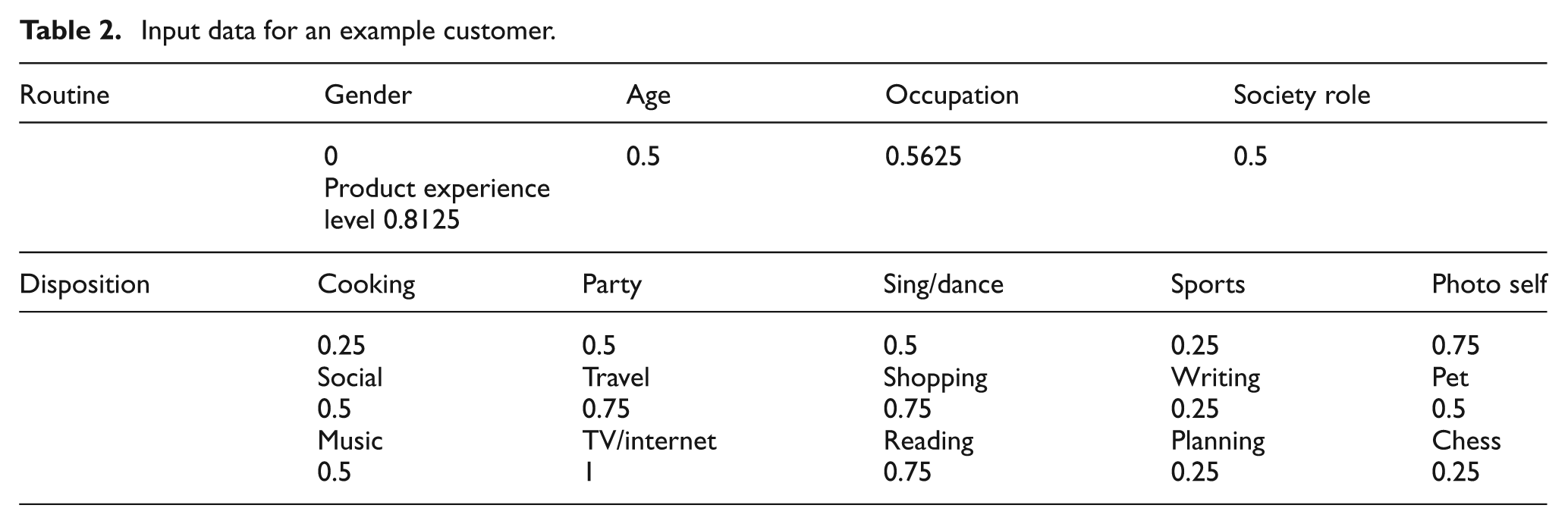
A survey has been carried out with 180 valid responses. A total of 60 different kinds of personalized customer attributes are obtained from the survey, including all those listed in Table 1. According to factor analysis and cluster analysis, 20 of the most important attributes are selected in the input layer. They are gender, age, occupation, society role, product parameter, and 15 hobby attributes.
The society role can reflect the customer’s lifestyle. It is coded by the distribution of the number of hours spent on work, family, private activity, and sleep on a typical day. The code is actually generated by a SOFM neural network. The hobby attributes can reflect the different personalities of people, for example introverted and extroverted. The hobby selection includes sedentary activities and dynamic activities. The product experience reflects the degree to which the customer is familiar with similar digital products.
All the attributes are coded and normalized within [0 1], and then another SOFM neural network is used to classify different groups of customers. A total of 180 customers have been classified as six groups, each group of customers are modelled with a different BP neural network. For example, one group has 60 customers. Given 20 customer attributes are used in the BP neural network, Table 2 shows the input codes of an example customer.
Input data for an example customer.
ANN outputs
As the study first focused on the preference cognition of consumers, each person in the survey was asked which product(s) they like most.
There are 21 products used in the survey. Each participant was presented with 21 product pictures. Since all of these products belong to the same category (with the same function), the target customers only chose the product that they liked. A 21-bit binary code is used to represent the customer preference(s), 1 if the corresponding design is liked, and 0 otherwise.
Neural network parameter
The output layer of the neural network has 21 neurons and there are 20 neurons in the hidden layer. Pairs of customer attribute and product evaluation codes will be trained using the Levenberg–Marquardt algorithm. The learning rate is set as 0.1 and the neural network is trained up to 5000 epochs.
In the example results shown in Figure 4, 30 out of 40 customers have been randomly used for training. After the learning has finished, the remaining 10 out of 40 customers that were not used in the training were used to test the generalization and prediction ability of the ANN. One typical prediction result is given in Figure 4, which indicates a success rate of approximately 87%.
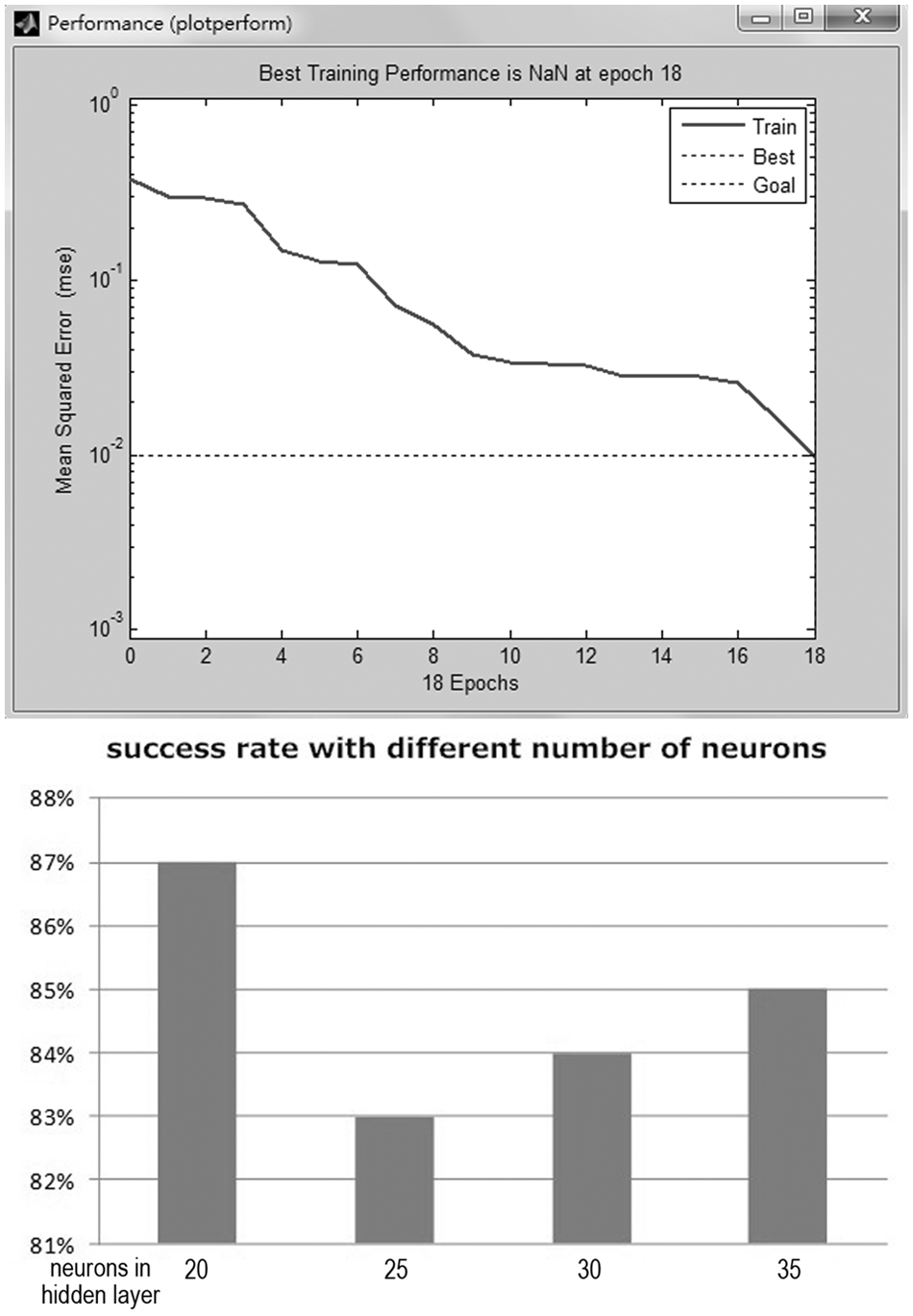
ANN test results example.
Conclusions
The study aims to discover a regularity that exists between customer attributes and product evaluations, and use this regularity in design activities. The neural network system can well simulate the cognitive process of people. This article discusses the relationship between impact factors (customer attributes) of individual differences and product evaluations, and presents a novel information processing method by using an ANN.
The new neural network model developed is essentially an extension of KE technology. It can be used to predict and/or evaluate new product concepts based upon customer attributes. It has great potential to model the relationship between customer personality and product preference, and to assist personalized customization in product design. More detailed results will be presented in the future.
Footnotes
Funding
This research received no specific grant from any funding agency in the public, commercial, or not-for-profit sectors.