




Abstract
A simple method of passive localization is proposed in this article. The proposed approach is located a on the ground or in the air stationary target using the satellites in different signal Doppler frequencies. After the localization principle and algorithm are introduced, the relationship between the positioning precision and the measurement precision of Doppler changing rate, carrier wave frequency, height assumption error, orbit measurement of satellite are analyzed, and then some simulation results are given. Our proposed positioning method can achieve the positioning precision of 5 km within the scope of the radius of 200 km, which is much better than the traditional method based on direction finding on the positioning precision of a few tens of kilometers.
Introduction
Passive location technologies for non-cooperative radiation sources and interference sources are of great value in the field of electronic warfare.1,2 As compared with the ground and airborne observation platforms, satellite platform has its own advantages in information acquisition. The existing single reconnaissance satellite systems, such as the “horn” and “ejection seat,” were successfully used in direction-finding positioning method. 3 Although these systems can locate targets quickly, the satellite clock synchronization and data processing have higher requirements.
A single satellite passive location method based on instantaneous frequency measurement was proposed,4,5 which obtains the optimal location using the grid search technique solution. A passive localization method based on a single satellite Doppler frequency measurement was presented in the study of Li and Zhou. 6 The location of the Doppler frequency change rate can depict the location relation well, and an accurate location estimate can be achieved in a short time if the accuracy of measurement meets some requirements.7,8
Based on the study of Sun, 8 we realize a single star passive location method using the Doppler rate of change. The simulation results show that the accuracy of the absolute position of satellite, the error of satellite altitude, and the accuracy of frequency measurement have little influence on the distribution of positioning error. Comparatively, the change rate of Doppler has large influence on the distribution of positioning error, and it is a key factor to achieve high accuracy of positioning. Finally, as compared with the existing positioning methods using a single satellite, the positioning accuracy of our proposed method in a single satellite point as the center radius 200 km range is 5 km, which is far superior to the traditional positioning based on the direction-finding precision of several tens of kilometers.
Principle and location model
For the radiation source of a stationary on the ground or in the air, the satellite in N different time measure signals reaches the satellite frequency, and the frequency of the corresponding frequency is N in a cone top satellite, cone surface of a cone radiation source, and due to the movement of the satellite, the N angle is not equal.
Therefore, in theory, if the signal source frequency
We are aware, when
The ground radiation source in the work process must have the signal radiation to space, low orbit electronic reconnaissance satellite high-speed motion from the region through the above, the satellite antenna receiver can receive the signal source. In the consideration of the relative motion between the satellite and the radiation source, the received signal on the satellite will be affected by Doppler changing, through digital signal processing and data processing to obtain the signal Doppler rate of change information. Because the Doppler change rate has a corresponding relationship with the target position at different times, the location of the radiation source can be calculated by repeated measurements combined with the prior information of the radiation source located on the earth surface.
As shown in Figure 1, under Cartesian coordinate system, it is assumed that the position of the satellite is
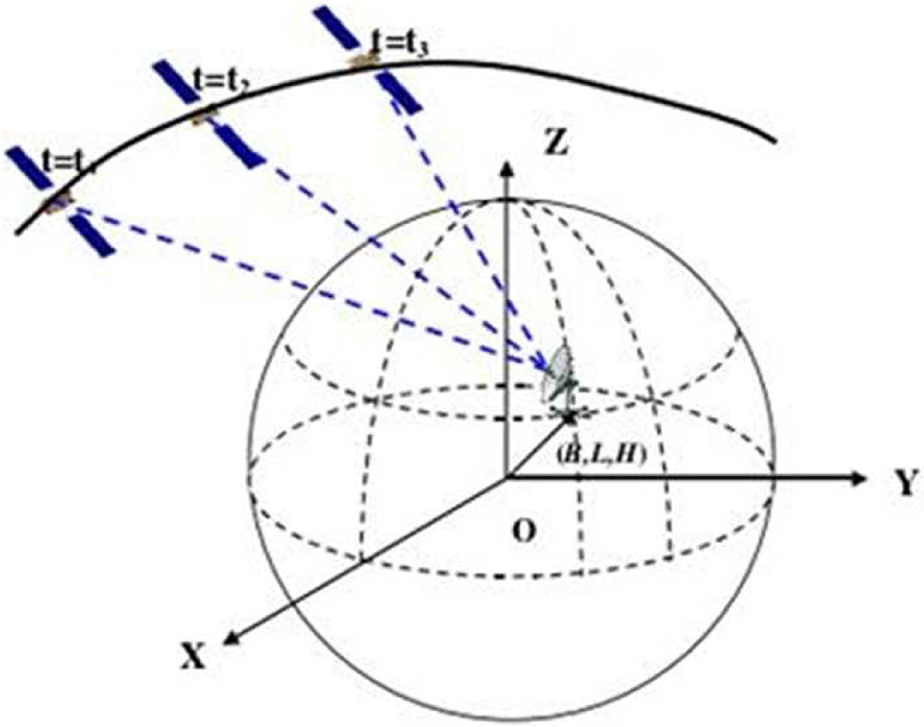
Single star passive location model.
In WGS-84 coordinate system, the transformation from coordinates of longitude and latitude to geocentric coordinate is 9

where
Without consideration of relativistic effects, the frequency of the incoming signal contains a Doppler frequency component relative to the radial velocity modulation, then

where

where
By substituting equation (3) into equation (2), we can obtain the Doppler frequency of the incoming wave signal as

In equation (2), we obtained Doppler change rate by Doppler’s derivative with respect to time;

where
In order to obtain the expression of

where
Based on equation (6),

In WGS-84 coordinate system, we can obtain

At

where
Equation (9) contains the position parameters of the target radiation source, and the coordinates of the target can be obtained by measuring the Doppler change rate at several different time slots. This is the basic principle of single star passive location based on Doppler rate of change.
Theoretical analysis of location error
Analysis of equation (8)—the factors that affect the accuracy of target location of ground radiation sources can be obtained, mainly including the following: Doppler change rate measurement error, carrier frequency measurement error, namely, number of frequency measurement times, satellite orbit determination error (including relative position accuracy and absolute position accuracy), altitude hypothesis error, and radiation source location. Following we will analyze the positioning errors.1,10
From equation (1), we have

On differentiation of equation (10), we obtain the following equation

The matrix form of equation (11) is

where

It is assumed that the measurement errors are uncorrelated:
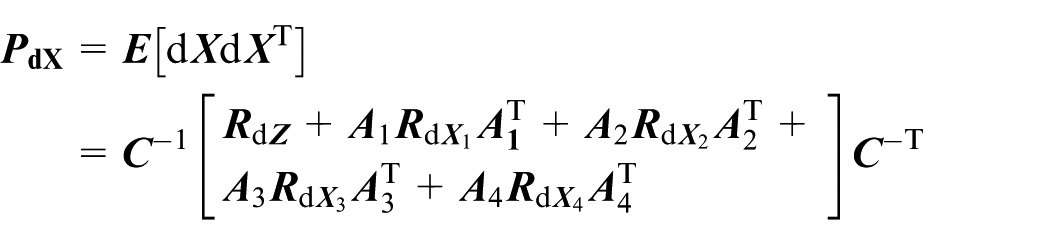
where
When the positioning accuracy is measured by the horizontal component, the above equation is transformed as follows

where
According to equation (13), the positioning horizontal error of each point

Simulation results
The simulation parameters are as shown in Table 1.
The simulation parameters in our experiment.

The influence of Doppler change rate measurement accuracy on positioning performance
Assume that the sampling interval is 10 s, and we show the simulation results when the measurement accuracy of Doppler change rate are 10, 80, and 150 Hz/s, respectively, in Figure 2.
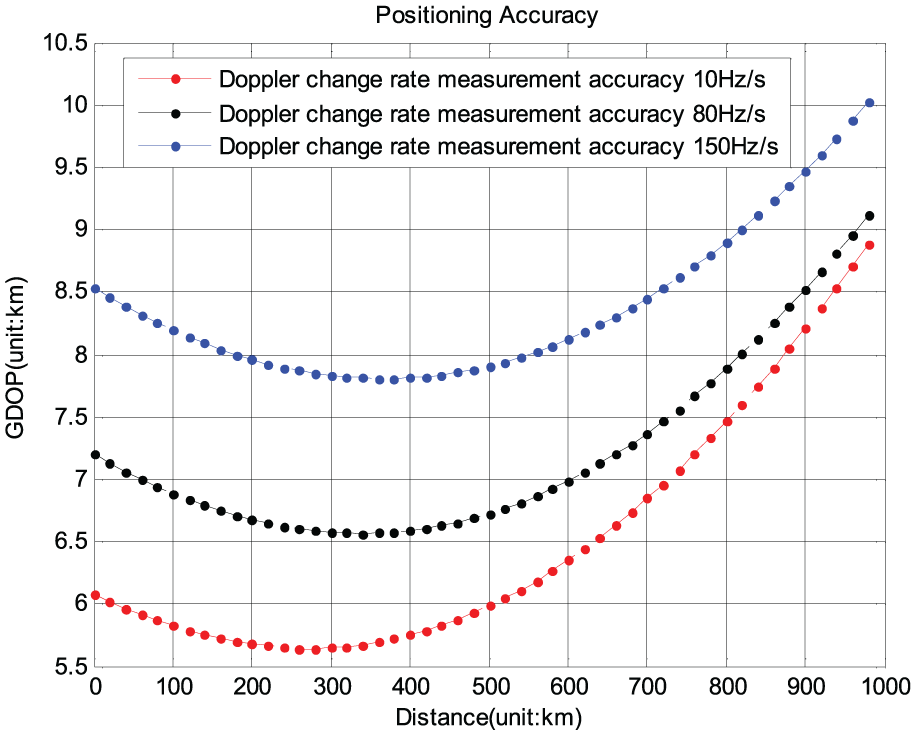
Relationship between GDOP and Doppler change rate measurement accuracy.
As can be seen from Figure 2, an optimal positioning performance can be achieved when the target distance is 200–400 km for single satellite. For analysis convenience, we unify the target distance from a single satellite to the point 300 km, that is, the vertical projection of the earth under a single satellite at the center of the radius 300 km range. The positioning accuracy is about 5.6 km when the measurement accuracy of Doppler change rate of the measurement accuracy is 10 Hz/s; the positioning accuracy is about 6.6 km when the Doppler change rate of the measurement accuracy is 80 Hz; the positioning accuracy is about 7.8 km when the Doppler change rate of the measurement accuracy is 150 Hz/s; and the positioning accuracy is improved about 2.2 km when Doppler rate measurement accuracy increases from 150 to 10 Hz/s.
Hence, the Doppler change rate measurement accuracy has a great effect on the positioning accuracy of the system, and the higher the accuracy of the Doppler change rate is, the better the positioning accuracy will be.
The influence of satellite relative position measurement accuracy on positioning performance
Assume that the satellite orbit height is 1000 km, the carrier frequency is 5 GHz, the elevation assumption error is 0, and the satellite absolute position accuracy is 50 m. The accuracy of the instantaneous frequency measurement is 1 MHz, the sampling interval is 10 s, and the Doppler change rate is 10 Hz/s. When the accuracies of relative position measurements are 20, 50, and 80 m, the simulation results are as shown in Figure 3.

Relationship between GDOP and satellite relative position measurement accuracy.
From Figure 3, it is seen that the positioning accuracy is optimal when the target point is about 400 km from the single satellite. For the convenience of analysis, we unify the target distance from single star to point 400 km. When the relative position accuracy of satellite is 20 m, the positioning accuracy is about 3.3 km; when the relative position accuracy of satellite is 50 m, the positioning accuracy is about 6.2 km; when the relative position accuracy of satellite is 80 m, the positioning accuracy is about 10 km. It can be concluded that when the relative position accuracy of the satellite is increased from 80 to 20 m, its positioning accuracy is improved by about 7 km. Therefore, the higher the satellite relative position measurement accuracy is, the better the positioning accuracy.
The influence of satellite absolute position measurement accuracy on positioning performance
It is assumed that the satellite orbit height is 1000 km, the carrier frequency is 5 GHz, the elevation assumed error is 0, and the satellite relative position accuracy is 150 m. The instantaneous frequency measurement accuracy is 1 MHz, the sampling interval is 10 s, and the Doppler change rate is 10 Hz/s. When the satellite absolute position measurement accuracy is 50, 100, and 150 m, the simulation results are shown in Figure 4.

Relationship between GDOP and satellite absolute position measurement accuracy.
From Figure 4, it can be seen that the absolute positioning accuracy of satellites is 50, 100, and 150 m, respectively, and their positioning accuracy is about 6.2 km when the target is 400 km from the single satellite. That is to say, the absolute position accuracy of satellites can hardly affect the positioning accuracy.
The influence of sampling interval on positioning performance
It is assumed that the satellite orbit height is 1000 km, the carrier frequency is 5 GHz, the elevation assumption error is 0, the satellite relative position accuracy is 150 m, the satellite absolute position accuracy is 50 m, the instantaneous frequency measurement accuracy is 1 MHz, and the Doppler change rate is 10 Hz/s. When the sampling interval is 1, 5, and 10 s, the simulation results are shown in Figure 5.
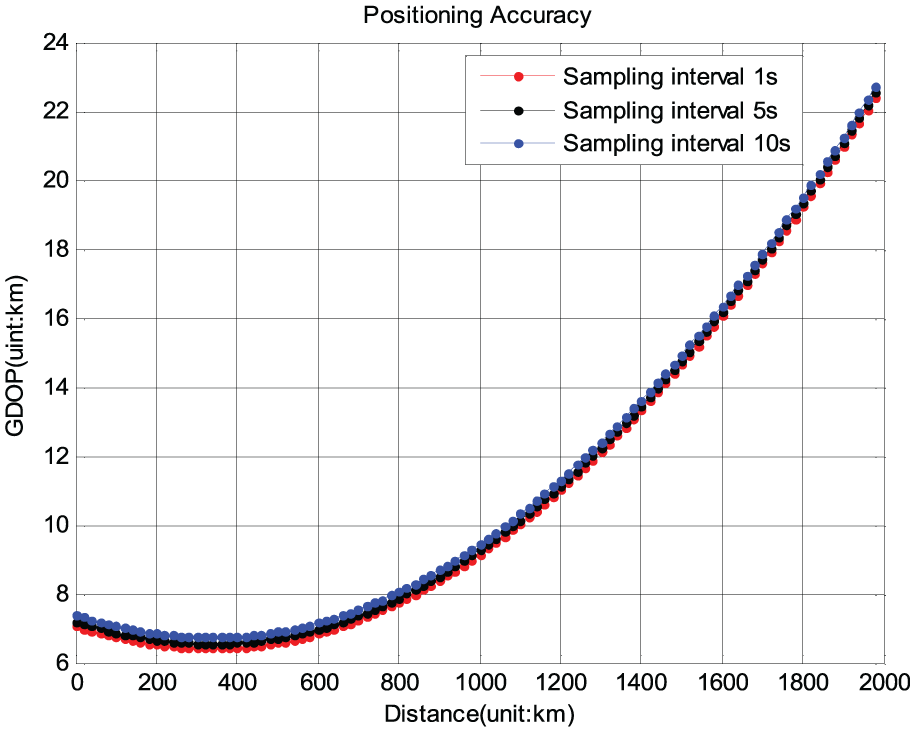
Relationship between GDOP and measurement interval.
From Figure 5, the relation curve between the GDOP and the measurement interval can be seen, when the target is 200 km from the single satellite, the positioning accuracy is about 6.3 km when the frequency measurement intervals are 1, 5, and 10 s. It can be seen that the measurement interval of the frequency measurement has little influence on the positioning accuracy.
In order to compare and analyze the traditional passive lateral positioning, the basic parameters of single satellite passive frequency positioning simulation are as follows: the satellite orbit height is 1000 km, the earth radius is 6370 km, the carrier frequency of the radiation source is 5 GHz, the flying speed of the satellite is 7.350 km/s, the change rate of Doppler is 10 Hz/s, the elevation assumed error is 0, the relative position accuracy of satellite is 150 m, the absolute position accuracy of satellite is 50 m, and the instantaneous frequency measurement accuracy is 1 MHz. Assume that the carrier frequency of the emitter does not occur and is measured every 10 s. That is, take a value for each of the above factors and synthesize them to draw a three-dimensional GDOP of single satellite passive frequency positioning, as shown in Figure 6, and the traditional passive lateral positioning of the GDOP diagram is shown in Figure 7.

Single satellite passive frequency positioning three-dimensional of GDOP.
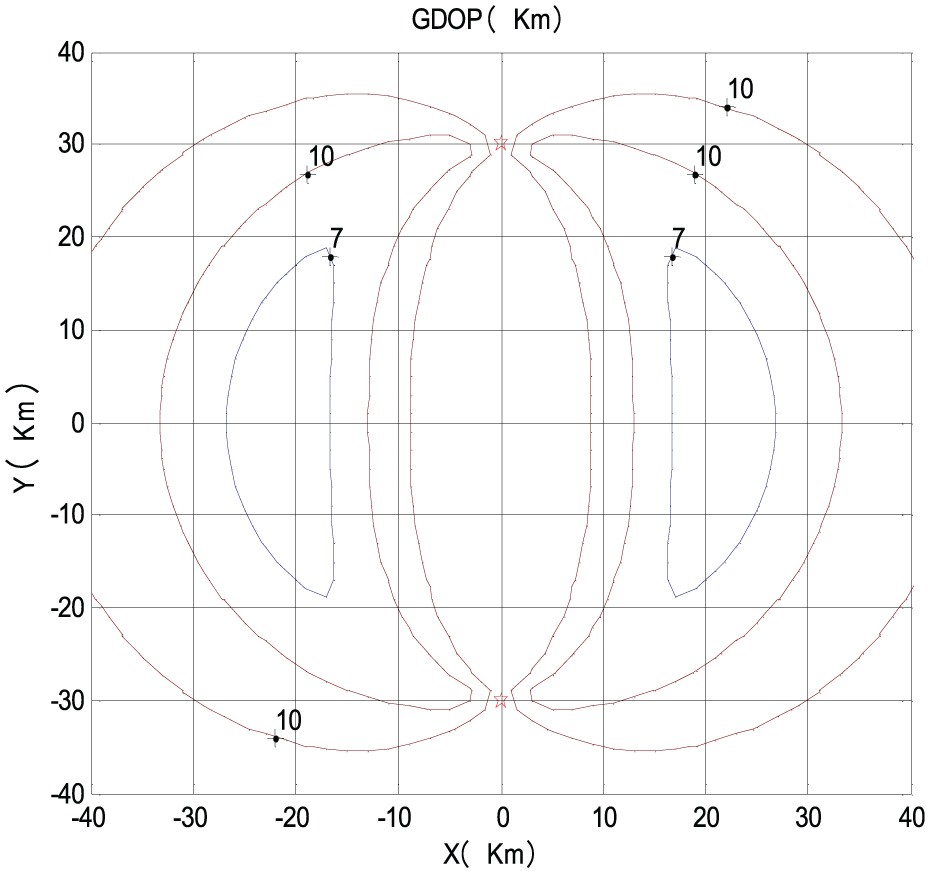
GDOP of traditional passive lateral positioning.
From Figure 6, note that the positioning accuracy can reach about 5 km using passive frequency positioning algorithm, in the range of 200 km under the single satellite. However, based on the traditional passive lateral positioning, the positioning accuracy is reduced to about 10 km in the range of 30 km radius; moreover, there is a locating ambiguity region based on the traditional passive lateral positioning, in a larger radius; its positioning accuracy has dropped to scores of kilometers.
Conclusion
In this article, we have presented a passive location method of ground stationary radiation source using the Doppler rate of change of the signals measured at different positions of a single satellite; the adopted model has the advantages of simple payload, no special requirement for satellite attitude, rapid positioning convergence, and high accuracy. It can reach the positioning accuracy of 5 km, which is far superior to the traditional positioning accuracy of scores of kilometers based on direction-finding localization method. The effect of various measuring accuracies on positioning accuracy is analyzed in this article. By MATLAB simulations, we find that the absolute satellite position accuracy, the height error, and the frequency measurement accuracy have little influence on the positioning error distribution under the same measurement conditions and measurement accuracy; the measurement accuracy of Doppler change rate has the largest influence on the location error distribution, and it is the key factor to realize the fast and high-precision single satellite passive location. This work has certain reference value for the design and engineering application of single satellite positioning system.
Footnotes
Handling Editor: Fei Chen
Declaration of conflicting interests
The author(s) declared no potential conflicts of interest with respect to the research, authorship, and/or publication of this article.
Funding
The author(s) disclosed receipt of the following financial support for the research, authorship, and/or publication of this article: This work has been supported in part by the National Natural Science Foundation of China under grant numbers 61371184, 61671137, 61771114, and 61771316 and the Fundamental Research Funds for the Central Universities (grant no. ZYGX2016J028).