




Abstract
Aiming at the issue of parameter matching in conventional two-step location, a reduced dimension multiple signal classification direct position determination algorithm based on multi-array is proposed. Based on the idea of dimension reduction, the algorithm avoids multi-dimensional search in spatial domain and attenuation coefficient domain and reduces the search complexity. Simulation results show that the performance of the algorithm is better than the traditional angle of arrival two-step localization algorithm and subspace data fusion direct localization algorithm.
Introduction
Nowadays, with the rapid development of intelligent nodes and Internet-of-Things (IOT) technology, the electromagnetic space is becoming more and more complex, and the signal source location technology is becoming more and more important. 1 At present, it has become an indispensable part in many fields, such as intelligent driving, radio supervision, and so on.2,3
With the increasingly complex radio environment, the existing single-emitter location methods cannot meet the needs of location. Therefore, a new location technology for multi-source location is urgently needed.4,5 At present, most multi-source location methods still belong to two-step location methods. 6 First, intermediate parameters related to the source position are extracted from the received signals,7,8 including angle of arrival (AOA), time of arrival (TOA), time difference of arrival (TDOA), and so on. Then, a position equation is established according to the source position and the observation base station position, and the equation is optimized to obtain the target position. It should be noted that due to the existence of intermediate parameters, one-to-one correspondence of parameters is also required for multiple sources. 9 In some cases, when the parameter matching process cannot be used effectively, such as the source is too far from the observation station, the clustering algorithm 10 begins to be used to eliminate false location points in multi-source location. However, due to the use of two-step positioning system, it is necessary to estimate the parameters first, and then locate the emitter. There will be information loss in each step, and the final positioning accuracy will be affected by the accumulated loss of information. Although the positioning accuracy can be improved to a certain extent by improving the method of parameter estimation. For example, Wen et al. 11 studied the multi-parameter estimation of coherent targets in bistatic electromagnetic vector sensor (EMVS) multi-input multi-output (MIMO) radar. In Zheng et al.’s study, 12 the altitude measurement of meter wave polarization MIMO radar is mainly studied. In Shi et al.’s study, 13 for the problem of parameter identifiability, the element spacing is further introduced to establish a complete parameter identifiability scheme. In addition, the conditions of bistatic MIMO radar are derived from a two-dimensional point of view. In Xu et al.’s study, 14 a new and improved signal subspace model is introduced, and the signal subspace is refined using the model, so as to improve the performance of direction of arrival (DOA) estimation. Jirhandeh et al. 15 proposed an effective DOA estimation method for broadband sources based on the concept of super-resolution. However, these improvements cannot avoid the accumulation of two-step positioning error. It is necessary to study a new positioning system to improve the positioning accuracy.
Aiming at the deficiency of two-step positioning, a direct positioning technology is developed. Direct positioning technology directly processes the original data and estimates the target position. The positioning accuracy is better than two-step positioning. 16 In addition, the direct location algorithm does not need intermediate parameter estimation, so the issue of parameter matching in multi-source location scenario is avoided. 17 It has become a research hotspot in wireless location. Although this technology also has its shortcomings, that is, it directly processes the original data and has high information processing capacity for the system, with the development of the information processing system, the equipment has developed rapidly, 18 which can meet the requirements of this technology.
In Amar and Weiss’s study, 19 direct position determination (DPD) is extended to multi-source scenes using the idea of decoherent subspace decomposition when constructing the cost function. In Wang et al.’s study, 20 a direct location method based on cross-correlation matrix (CCM) under multi-antenna array (DPD) is proposed. In Yin et al.’s study, 21 a direct location algorithm is proposed, which uses the angle and Doppler shift information to construct the cost function. Subspace data fusion (SDF) method 22 is a more computationally efficient method for multi-transmitter scenarios, in which all data are collected by mobile antenna arrays, and the cost function is an improvement of the traditional multi-signal classification spectrum. In Ma et al., 23 multiple moving arrays are used to intercept static emitter signals, ignoring TDOA, and a moving multi-station direct positioning method based only on AOA and frequency difference of arrival (FDOA) is proposed. In Wu et al.’s study, 24 a direct positioning method is proposed, which fully combines the noise subspace and signal subspace; therefore, the positioning accuracy of the algorithm is better than that of minimum variance distortion-less response (MVDR) or multiple signal classification (MUSIC) spectrum. In Li et al.’s study, 25 the SDF direct positioning method is improved, and two weighted DPD methods are proposed to improve the positioning accuracy.
Aiming at the advantages of high resolution of music algorithm, some articles have improved it. In Zheng et al.’s study, 12 the problem of split beam in SVS-MUSIC is found, and the solution is given. The proposed algorithm is also extended to long dipole and large-loop MIMO radar. In Zheng and Song’s study, 26 a generalized MUSIC algorithm is proposed. Zuo et al. 27 proposed a new model-based two-dimensional MUSIC damage identification algorithm for plate structures. In Bao et al.’s study, 28 a new synthetic aperture MUSIC algorithm is proposed for damage diagnosis of array error compensation. In Xu et al.’s study, 29 a focused MUSIC algorithm is proposed for baseline free Lamb wave damage location on isotropic materials. In Zhong et al.’s study, 30 a new near-field two-dimensional music method based on piezoelectric sensor array is proposed.
In this article, a direct location algorithm based on reduced dimension MUSIC (RD-MUSIC) is proposed based on the multi-signal source localization problem in multi-array. First, based on the multi-array positioning scene, the received signal model under multi-array is constructed. Then, the signals received by multiple arrays are fused, and the signal covariance matrix is obtained. Then, the signal subspace and noise subspace are obtained according to the covariance matrix. Finally, the objective function is used to search the grid in the spatial region, which avoids the multi-dimensional search in the spatial domain and attenuation coefficient domain and reduces the complexity of the search. In summary, the main contributions of this article are as follows:
In this article, a reduced dimension MUSIC-based direct localization algorithm with dense arrays is proposed, which avoids multi-dimensional search, reduces the search complexity of cost function, and realizes the direct location of signal sources under multiple arrays.
The proposed algorithm is simulated and compared with the traditional AOA two-step location method and SDF-DPD algorithm, the results show that the performance of the RD-MUSIC direct location algorithm is improved to a certain extent.
Signal model
Considering the system model shown in Figure 1, assuming that there are K signal sources in the space, and the number of emitters K has been estimated by the source number estimation algorithm, the position of the emission source is

System model.
It is assumed that the emitter signals are far-field narrow-band signals, and the signal of the

where

Therefore, the received signal of

where

After the array collects the received signals of J snapshots, the output expression of the array can be obtained as

where
By fusing the received signals of all observation positions, the total received signal vector of each position can be obtained as

where matrix
Proposed DPD algorithm
The covariance matrix of the signal obtained from equation (5) is

where
Due to the limited sampling length of the actual received signal, in practice, the sampling covariance matrix composed of the sampling data of

where

where

Let the joint noise subspace be as follows

According to equation (8)

When the matrix

It shows that each column vector in the matrix

where

It should be noted that in the cost function of the above objectives, there is also the attenuation coefficient of the position, and the search complexity is very high. Expand

where
According to Zhang et al.,
31
consider the constraint of

Let

We construct the following cost function

where

According to equation (19),
The key steps of the proposed algorithm are as follows:
The observation array receives the signal at position
Fuse the received signals of multiple observation arrays to obtain the total received signal vector of
According to equation (8), the sampling covariance matrix
According to equation (15), the cost function is constructed and simplified to obtain equation (18). Based on the objective function, the grid search is carried out on the spatial region to obtain the maximum value of the
Complexity analysis
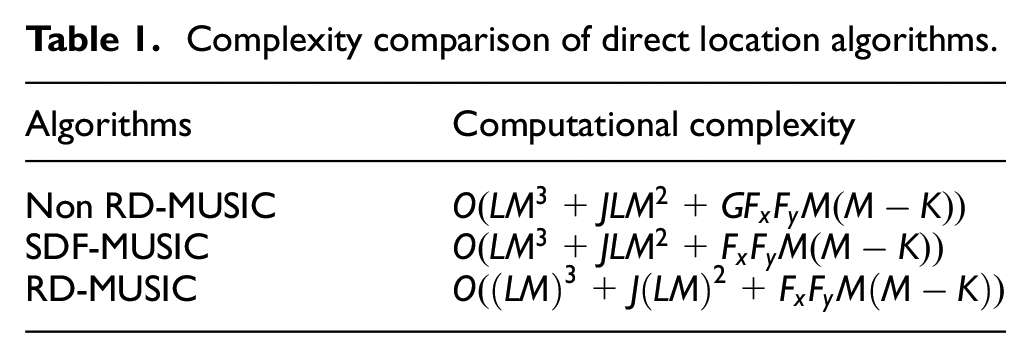
This section studies the complexity comparison between the proposed reduced dimension music direct location algorithm and the traditional direct location algorithm (SDF-MUSIC), only considering the comparison of multiple times in the algorithm. The algorithm complexity analysis in this section is not only related to the number of signals
Complexity comparison of direct location algorithms.
Running time comparison.

As can be seen from Table 2, the running time of the proposed algorithm is the shortest, followed by the SDF direct positioning algorithm, and the running time of the non-dimensionality reduction algorithm is the longest, which shows that the time complexity of the dimensionality reduction algorithm is effectively reduced.
Figure 2 shows the complexity comparison of the two algorithms under specific parameters. The abscissa is the number of points searched along the

Complexity comparison.
Simulation results
In this article, Monte Carlo simulation experiments will be used to evaluate the signal estimation performance of the algorithm, and root mean square error (RMSE) will be used to measure the positioning performance of the algorithm, which is defined as follows

where
Simulation 1
Figures 3 and 4, respectively, show the positioning peak diagram and corresponding contour diagram of the proposed RD-MUSIC algorithm under the condition of signal-to-noise ratio

Location spectrum peak obtained by RD-MUSIC algorithm.

Contour map of RD-MUSIC algorithm location results.
Simulation 2
Figures 5 and 6 show the comparison of the positioning performance of the proposed algorithm with that of other algorithms and the SNR varies from

Performance comparison versus SNR (three signal sources).

Performance comparison versus SNR (four signal sources).
From the simulation results, it can be seen that the positioning performance of these algorithms continues to improve with the increase of
Conclusion
In this article, the simultaneous location of multiple unknown signal sources in multi-array is discussed, and a reduced dimension music direct location method is proposed. The proposed method takes advantage of the inherent advantages of direct location, including avoiding additional data association in multi-source scenes. Because the direct positioning method directly processes the data domain and the performance of the traditional two-step method is limited by the intermediate parameter estimation error, the proposed method obtains better positioning accuracy than the traditional AOA two-step method. At the same time, compared with the original DPD method, the proposed location method has higher location estimation accuracy for multi-source target locations.
Footnotes
Handling Editor: Yanjiao Chen
Declaration of conflicting interests
The author(s) declared no potential conflicts of interest with respect to the research, authorship, and/or publication of this article.
Funding
The author(s) disclosed receipt of the following financial support for the research, authorship, and/or publication of this article: State Key Laboratory of Marine Resource Utilization in South China Sea (Hainan University) (MRUKF2021033), the fund of Sonar technology key laboratory (range estimation and location technology of passive target via multiple array combination), Jiangsu Planned Projects for Postdoctoral Research Funds (grant no. 2020Z013), China Postdoctoral Science Foundation (grant no. 2020M681585).
