




Abstract
The heat storage and release capacities of phase change fabric loaded with phase change microcapsules were measured by differential scanning calorimetry (TADSCQ-2000). The melting peak splits into two sub-peaks at 20.83°C and 28.65°C, in which the heat enthalpy was 25.20 J/g, and the melting range was 16.5°C–36.8°C. The heat-conducting performance of the phase change fabric was tested using a YG (B) 606D face-plate thermometer, and the heat preservation coefficient improved to some extent from 1.05% to 32.2% than that of ordinary fabric. Contrast test was carried out for the shirt made of this fabric by the live test method. The results showed that the heat storage capacity of the phase change shirt was not enough to keep the human body maintaining a comfortable temperature for a long time on the occasions with a bigger temperature difference, thus requiring the need of other warm-keeping clothes. This phase change fabric exhibited good effects on maintaining the uniformity of body temperature and improving human comfort and could avoid low-temperature damages to four limbs in cold regions.
Keywords
Introduction
Phase change material (PCM) can store and release energy through the phase change latent heat, which is accompanied by endothermic and exothermic phenomena. For a long time, many scholars have done a lot of research on the preparation and properties of PCMs.1–5 In recent years, phase change clothing with temperature self-adjusting function, fabricated by adding PCMs into clothing materials, has attracted increasing attention all over the world. The so-called “phase change clothing” is a new type of smart clothing. It can absorb heat from the environment or release heat to the environment through the reversible phase change of the internal PCMs according to the variation in the external environment temperature, thus maintaining a basically constant ambient temperature. Studies on the phase change clothing have a positive practical significance for improving the wearing comfort of clothing and protecting the health of the human body and mind.
The comfort of clothing is related to the following conditions: warmness, coldness, humidity (thermal-wet comfort), and pressure (pressure comfort).6–8 Hence, the tiny space environment between the clothes and skin is very important. Once a human wears clothes, a local climate environment (temperature, humidity, and airflow) is formed between the clothes and the skin, called as internal climate of clothes (also called inner clothing microclimate). The inner clothing microclimate that makes human body feel comfortable refers to a temperature of 32°C, a humidity of 50% ± 10%, and an airflow speed of 25 ± 15 cm/s. 9 This ideal inner clothing microclimate can create a good microclimate zone around the human body and buffer the attack of outside cold weather on the human body, thus maintaining the human body at a constant temperature. Harada et al. 10 once tested the corresponding relationships between the external environment and inner clothing microclimate and the coldness feeling, and the worn clothes of the subjects from inside to outside were undershirt (cotton round collar half sleeve shirt), shirts (50% cotton/50% polyester), suit waistcoat (woolen), and suit (woolen). They obtained the relationship between the temperature and humidity inside clothes and the wear comfortable (as shown in Figure 1), 10 as well as the inner clothing microclimate different from the external climate between the interlayers of clothes (as shown in Figure 2). 10

Relationship between the temperature and humidity inside clothes and the wear comfort. 11

Clothes inner microclimate figure. 11
Suzuki et al. 11 carried out experiments on human comfort according to different seasons dressing. The results indicated that at normal temperature and low temperature, with medium relative humidity (RH), the temperature of inner clothing microclimate within body trunk was ∼32°C and the humidity stabilized within ∼40%–60% RH, making the subjects feel more comfortable; if the outside temperature rose to ∼30°C, the temperature of the inner clothing microclimate also increased to 33°C, and sensible sweat could be observed on the skin of the subjects, leading to a sharp increase in the humidity of the inner clothing microclimate to 80% RH, making the subjects feel not comfortable obviously.
As shown in Figure 3, in the environment-clothing-human body system, the human body would emit heat and discharge sweat and other wastes due to metabolism. These heat and sweat would release to the outside world through the clothing, whereas the temperature, humidity, airflow, and radiation of the external environment would act on the human body after blocking or absorption of clothing. 12 Thus, the clothing worn by the human beings suffers from complex heat and mass transfer process all the time. The heat transfer performance, moisture transfer performance, and breathable performance of clothing and textiles are the basic factors affecting the inner clothing microclimate. Therefore, investigating the heat and humidity properties of clothing materials and strengthening the microclimate regulation function of clothing for the material selection of costume designing under different environments are of great importance.

Schematic diagram of heat and mass transfer process in the environment-clothing-human body system. 13
The body’s heat loss mainly occurs in two forms: (1) sensible heat, namely, the human body releases heat to the environment by conduction, convection, and radiation, when there is a temperature difference between the human body and environment and (2) the latent heat, namely, the latent heat of vaporization, which is released from the body when the sweat on the body skin surface evaporates. Heat insulation performance of clothing determines the heat loss of the human body, and the major factors affecting the heat insulation performance of clothing include the properties of clothing material itself, the number of clothing layers, and the air parameters.
The heat insulation and preservation performance of clothing is commonly represented by the Crowe (clo) value, which can reflect not only the heat transfer characteristics of clothing material and production process but also the physiological state of heat balance adjustment of the human body. A higher clo value means a better heat insulation performance. Here, one clo is defined as the thermal insulation value of the clothing worn by a stay-in person or a person engaging in mild mental labor when he or she feels comfortable under environmental conditions with an air temperature, RH, and wind speed of 21°C, 50% RH, and <0.1 m/s, respectively. At this time, the average skin temperature of human body is 33°C, and the body’s heat yield per unit area is ∼58.2 W/m2 (50 kcal/(h m2)). According to the definition of the clo value, the thermal resistance of 1 clo for clothing is 0.155°C m2/W.
Phase change fabric can realize thermal insulation and humidity adjustment according to the environmental temperature and is a novel material that can provide comfortable “microclimate” environment for the human body. Its functions are not confined to heat insulation only but involve heat adjustment. Textiles containing PCMs can play a role of “regulator” between the human body and the clothing and between the clothing and the external environment regardless of the increase or decrease in the environment temperature, thus buffering the variation in the external environment temperature and humidity.
At present, the research on the phase change fabric mainly focuses on two aspects: (1) ways to load PCM on the fabric or the fiber and (2) effect of the phase change clothes on human thermal sensation.
The methods of loading PCM on the fabric or the fiber mainly include the hollow fiber filling method, composite spinning method, and microcapsule method; fabric finishing can also yield fabric containing PCMs. In the 1970s and 1980s, Vigo et al. filled the solvent with dissolved CO2, the inorganic salts with crystal water, and polyethylene glycol (PEG) into the hollow part of the hollow fiber, affording temperature-adaptable fibers with heat absorption/release function. However, due to the large diameter of hollow fiber, its industrialization is greatly limited.13–15 In the early 1990s, Japan Ester Company used the spinning method to spin the PCMs inside the fibers and obtained temperature-adaptable fibers with significantly different thermal effects than those of ordinary fibers. 16 In the 1980s, the National Aeronautics and Space Administration funded a research project, in which the phase change microcapsules were added to textiles to improve their thermal performance. These textiles were used to make astronauts’ space suit to improve the thermal protection ability of the suit, which can handle the sharp temperature fluctuation in the outer space. 17 In 1993, TRDC Company in the United States sealed paraffin hydrocarbons in microcapsules with the diameters in the range 1.0–10.0 µm and then spun them with a polymer solution to fabricate fibers with reversible heat storage characteristic. 18 In 1997, Outlast Company and Frisby Company produced poly acrylic fabrics using this technology for fabricating thermal underwear, blankets, ski boots, jacket, sports socks, and so on, and these products have nowadays been widely sold in European and American countries.19,20 Kim and Cho 21 carried out blend spinning on the phase change microcapsules and cellulose spinning solution and successfully prepared temperature-controlling viscose. Zhang 22 added low-temperature PCMs and a variety of tackifiers into the spinning solution and successfully prepared temperature-adaptable fibers with a PCM mass fraction of 32% and a phase change latent heat of 45 J/g. Jiang and Ma et al. successively grafted PEG or made PEG to be adsorbed onto the cellulosic fiber and obtained fibers with temperature-regulating function. The thermal stability and durability performance of these fibers have been significantly improved, achieving excellent comprehensive performance of these fibers.23,24 Zhan et al. used liquid paraffin as the core material and toluenediisocyanate (TDI) and ethylenediamine (EDA) as the wall monomers, affording seaweed fibers with the content of phase change microcapsules varying in the range 12%–16%. These seaweed fibers have good physical and mechanical properties and desirable thermal properties, and their air permeability can vary with temperature change in the external environment, thus they can be used as temperature-adaptable medical dressings. 25 Li et al. 26 filled trimethylolethane/neopentyl glycol binary solid–solid PCMs into the hollow polyester fibers by the aqueous vacuum packing method and obtained temperature-adaptable fibers with a PCM filling ratio of 24%. A Nejman et al. prepared microcapsules by a single PCM and a mixture of multiple PCMs and then added the microcapsules to the textiles. They tested the heat transfer performance of these two types of textiles and found that the addition of microcapsules prepared from the mixture of PCMs into textiles can endow the textiles with a wider temperature regulation range. 27
Shim et al. carried out thermal manikin test on the foamed clothes containing one or two layers. They designed the clothes through different combinations and proposed that the heat insulation effects depended on the number of PCM layers in the clothes, the relative position of PCM and the body, as well as the coverage area of PCM clothes on the human body. 28 C Gao et al. 29 tested phase change undershirts with PCMs of different melting point temperatures, and the results showed that the higher melting/solidification temperature can bring better heating effect and thus the longer heat insulation time. Sun et al. prepared paraffin phase change microcapsules and investigated the surface morphology and thermal storage performance of the microcapsules. Furthermore, they fabricated polyester temperature regulation textiles by the coating technology and tested the performance of these textiles. The research results showed that the heat enthalpy of the finished fabric was ∼8.49 J/g and that the heating or cooling rate decreased significantly; the finished fabric exhibited intelligent regulation of temperature, but the air permeability rate decreased by 26%. 30 Chen et al. analyzed the temperature variation of five monitoring points on the outer layer of the phase change clothes and ordinary clothes by the human wearing test method under the same environmental conditions and studied the temperature-adjusting performance of the phase change clothes. The results showed that upon a sudden change in the environment temperature, the phase change clothes affect alleviating low-temperature effect to the human body and can inhibit the rapid change in temperature. 31 Yuan et al. 32 proposed a new coupled cooling method of latent heat thermal energy storage (LHTES) combined with pre-cooling of envelope (PE) and developed the numerical model of the coupled cooling method.
The application of PCMs to clothes requires reasonable selection and design of the phase change temperature, material dosage, and allocation of PCMs in the clothing system according to the application environment and demand. Hence, the knowledge of the performance of the phase change fabric and the wearing comfort of the clothes made of this fabric is necessary to know, thus providing a certain basis for improving the protective effect of clothing system. Therefore, in this study, we first tested the heat storage/release capacities and heat-conducting property of a temperature-adaptable fabric and then monitored the surface temperature of the phase change clothes made of this fabric under varying environmental temperatures by the human wearing test method. Furthermore, we also carried out a questionnaire survey on the wearing comfort to investigate the temperature-regulating performance of this type of phase change clothes, thus providing a basis for the design of phase change clothes.
Methods
The experimental study includes two parts: performance test of phase change fabric and heat insulation capacity comparative test of the shirt which is made of phase change fabric.
Preparation and performance test of phase change fabric
The test raw materials include organic composite PCM, polymethylmethacrylate (PMMA), azodiisobutyronitrile (AIBN), ethyl alcohol and PEG octylphenol ether (emulsifier, OP-10), and polyester cotton–blended fabric.
The experimental instruments contain the following:
Constant-temperature water bath (HH-4; Changzhou Zhibo Rui Instrument Manufacturing Co., Ltd) with a temperature range of room temperature up to 100°C and a temperature control accuracy of ±0.5°C. The instrument has accurate temperature control, digital display, and automatic temperature control.
Electronic balance (RS232; Shanghai Shunyu Hengping Scientific Instrument Co., Ltd) with a measuring range 0.5–2100 g and a scale interval of 0.01 g.
Differential scanning calorimeter (DSC) (DSC-200L; Nanjing Institute of Electrical and Mechanical Technology Institute) with a measuring range and temperature range ∼0 ± 500 mW and −100°C to 600°C, respectively. The heating rate is in the range 1–80°C/min with a temperature resolution of 0.1°C and temperature fluctuation of ±0.1°C.
Vacuum drying oven (DWZ-6050; Kunshan Dongwang Precision Instrument Co., Ltd) with a temperature range 10°C–200°C.
YG (B) 606D face-plate thermometer with the heating powder was 240 W.
A certain amount of PMMA and AIBN at a ratio of 3:1 was dissolved in cyclohexane and mixed evenly. Under constant stirring, the solution was slowly added into the water phase with a certain amount of emulsifier (OP-10). After 300 r/min stirring for 30 min, the mixture was fully emulsified into a uniform oil/water (O/W) emulsion. After the stirring speed decreased to 150 r/min, the PMMA solution was added dropwise to the emulsion for initiating polymerization. After dropwise addition, the temperature was raised to 70°C and incubated for 2 h, and the microcapsule suspension was obtained. The prepared microcapsule suspension was added to the water according to a certain proportion and was matched with a fabric finishing liquid. The polyester cotton–blended fabric was dipped into the finishing liquid and was rolling twice with the rolling mill, and the phase change fabric was obtained by vacuum drying process.
A TADSCQ-2000 differential scanning calorimeter was used to test the heat storage/release capacities of the fabric. The fabric was first heated to 100°C rapidly at a heating rate of 10°C/min to remove the moisture absorbed by the textiles, and then the temperature was decreased to −10°C at a cooling rate of 2°C/min to test the crystallization behaviors of the sample and again heated to 80°C at a heating rate of 2°C/min to test the melting behaviors of the PCMs in the sample.
Heat-conducting performance test of the fabric
After the coverage by fabric, the temperature gradient between the heating baseplate and the environment changed accordingly. By determining the variation in the gradient values and in combination with the heating power of baseplate, heat-conducting performance of the fabric was evaluated. The fabric was placed at 25°C and 60% RH for 48 h to adjust the moisture balance. The heating baseplate temperature was set as 36°C, and the instrument was preheated for 30 min. Under alternating powers, the authors first carried out the empty plate test and recorded the data such as temperature difference and heating power using a computer. Then, the instrument was recovered to the status before the test, successively placing the fabrics without and with the addition of the phase change microcapsules to the instrument, and repeated the test thrice under alternating power. The data were recorded for calculating the fabric heat transfer coefficient, heat preservation rate, clo value, and R value.
Experimental studies on the temperature-adjusting performance of the phase change clothing
The test raw materials include phase change shirt, ordinary cotton shirt, two healthy males (aged 35–40 years).
The experimental instrument contains FLIR ONE infrared thermal imager, which is produced by U.S. FLIR Company. It was employed to test the temperature of eight positions on the surface of subject clothes (the left chest, right chest, left abdomen, right abdomen, left upper arm, right upper arm, left forearm, and right forearm). The temperature test precision of the thermal imager was ±0.1°C, and the sampling frequency was once per 10 min. For the convenience of drawing, each measuring point position was numbered, as listed in Table 1.
Test part number.

The wearing sequence is as follows: in the first test group, one subject wears ordinary shirt, and the other wears phase change shirt; in the second test group, the two subjects exchange their shirts.
Two healthy males were selected as the subjects for the two groups of the contrast test. The subjects wore the specified clothes under environmental conditions of no wind and no radiation heat source. The experimental conditions were set as follows:
First, both the shirts were heated to 31°C, at which the PCMs reached the melting temperature.
Then, the subjects wore the tested clothes and went in the climate warehouse at a temperature of 17°C for a stay-in duration of 20 min.
Results and discussion
Performance of the phase change fabric
The DSC curves of the fabric without and with the addition of phase change microcapsules are shown in Figures 4 and 5, respectively. As shown in these figures, the DSC curve of the fabric without the addition of phase change microcapsules did not show any obvious endothermic or exothermic peaks in the range −10°C to 80°C. In contrast, obvious melting peaks appeared during the testing process for the fabric with the addition of phase change microcapsules. The melting peak split into two sub-peaks at 20.83°C and 28.65°C, with the heat enthalpy 25.20 J/g, and the melting ranges were 16.5°C–36.8°C.
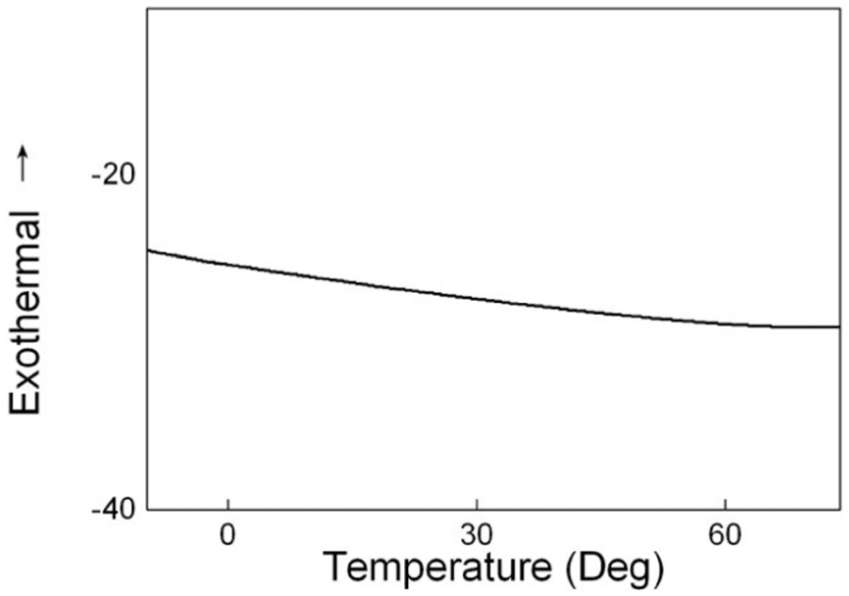
DSC curve of the fabric without phase change microcapsules.
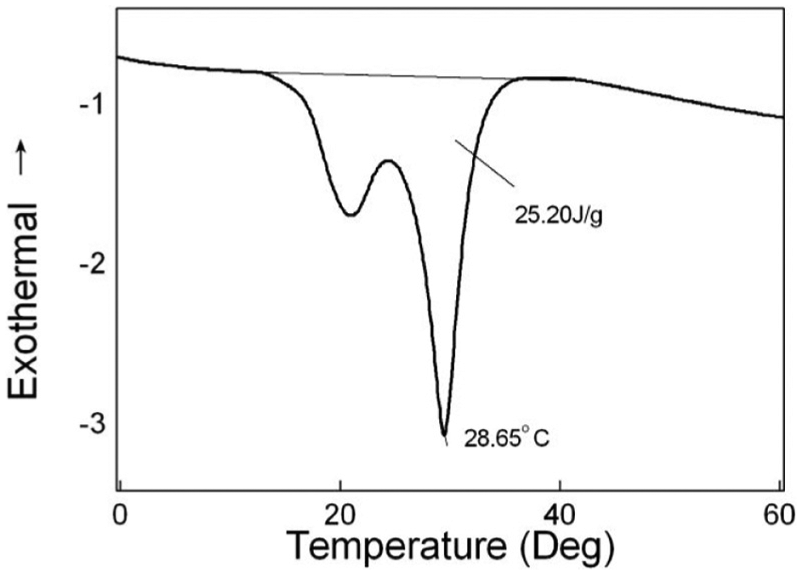
DSC curve of the fabric with phase change microcapsules.
The data were recorded for calculating the fabric heat transfer coefficient, heat preservation rate, clo value, and R value, as listed in Table 2. The test results show that the heat transfer coefficient of the fabric without the addition of phase change microcapsules was 16.85 W/m2 °C, whereas that of the fabric after adding microcapsules was 35.48 W/m2 °C; the thermal resistance R of the fabric without the addition of the phase change microcapsules was 0.06417°C/W, whereas that of the fabric after adding microcapsules was 0.06875°C/W. In the absence of phase change microcapsules, the temperature difference between the baseplate and the environment was 15.4°C; after adding the phase change microcapsules, the temperature difference increased to 16.5°C, indicating an improvement in the heat preservation ability of the fabric on the baseplate. As shown, the coefficient of heat preservation increased from 1.05% to 32.2%.
Heat-conducting performance of the tested fabric.

The temperature-adjusting performance of the phase change clothing
The temperature distribution curves of each measuring point at the initial time, after 10 min, and after 20 min are shown in Figures 6–8, respectively.

Temperature distribution curve of each measuring point at the initial time.

Temperature distribution curve of each measuring point after 10 min.

Temperature distribution curve of each measuring point after 20 min.
As shown in Figure 6, the initial temperature of all the measuring points of the ordinary shirt is lower than those of all the measuring points of the phase change shirt. This is because the PCMs loaded by the phase change shirt store a certain amount of heat and the stored heat is not completely released out quickly. Although the shirt releases heat to the external environment during the time period of the shirt leaving the heater and being worn by the subjects, the temperature can be kept stable. In contrast, there are no PCMs in ordinary shirt, and the heat only involves that stored by the ordinary fibers; during the time period of the shirt leaving the heater and being worn by the subjects, the heat is released to the external environment quickly, exhibiting a large temperature drop.
As shown in Figures 6–8, after the subjects put on the shirts, the temperature of all the measuring points on the shirts gradually decreases with time, and the decrease in amplitude did not show any big differences. This is because, the environmental temperature is lower than the surface temperature of clothes, and the clothes transfer heat to the environment, thus decreasing the surface temperature of clothes. Meanwhile, in the case of a temperature difference of 15°C, the subjects feel cold and uncomfortable. This phenomenon also indicates that the heat storage of the phase change shirt is not enough to make the human body maintaining a comfortable temperature for a longer time than 10 min.
These figures also show that the temperature difference between the measuring points of the phase change shirt at the same time is relatively small and that the temperature distribution of all the parts of the body is relatively uniform. In contrast, the temperature difference between the measuring points of the ordinary shirt at the same time is relatively large and that the temperature distribution of all parts of the body is not uniform. Hence, it can be concluded that phase change shirt can maintain a uniform body temperature and improve the minimum temperature of the human body surface, thus avoiding low-temperature damage to the limbs in cold regions.
Figure 8 shows that after 20 min, the temperature at different measuring points was significantly different for both the two tested samples. Overall, the temperature of the chest is higher, whereas those of the abdomen and forearm are lower. When the subjects wear an ordinary shirt, the temperature of abdomen and forearm is 2.4°C lower than that of the chest, with a large temperature difference. When the subjects wear a phase change shirt, although the temperature ununiformity is alleviated, the temperatures at the abdomen and forearm still increase rapidly. This phenomenon is related to the heat yield from different parts of the human body. The heat yield of human limbs is less than those of the head and chest; therefore, temperature easily decreases, indicating that the thickness of the phase change fabric should be increased or that the fabric with a large loading amount of phase change microcapsules should be adopted at the parts with a low heat yield to avoid the low-temperature damage to the parts such as limbs, with a low heat yield, in cold regions.
Conclusion
The performance data of the phase change fabric from the experiments and investigating the temperature variation rules of the phase change clothing indicated that the phase change fabric and clothing had very significant functional effects. The conclusions of the experimental results are as follows:
The melting temperatures of the phase change fabric sample used in this study were in the range ∼16.5°C–36.8°C, within in the thermal comfort temperature range of the human body.
The heat preservation coefficient of the phase change fabric sample used in this study increased from 1.05% to 32.2%, enhancing the heat preservation performance.
On the occasions of a larger temperature difference, the heat storage capacity of the phase change shirt is not enough to make the human body maintain a comfortable temperature for a longer time than 10 min, necessitating the need of other warm-keeping clothes.
Phase change fabric exerted positive effects on maintaining a uniform body temperature (drawn from the clothing surface temperature) and improving the human body comfort and thus can avoid low-temperature damage to the limbs in cold regions.
Different heat yields of each part of the human body suggested that the fabric with a large loading amount of phase change microcapsules should be utilized at the parts with a low heat yield to avoid the low-temperature damage to the parts such as limbs, with a low heat yield, in cold regions.
Footnotes
Academic Editor: Shuli Liu
Declaration of conflicting interests
The author(s) declared no potential conflicts of interest with respect to the research, authorship, and/or publication of this article.
Funding
The author(s) received no financial support for the research, authorship, and/or publication of this article.