




Abstract
In this work, viscose fiber with antibacterial and phase change energy storage was made by microcapsule technology and wet spinning. Graphene oxide was used to enhance the thermal conductivity and antimicrobial properties. The heat preservation performance of graphene antibacterial phase change energy storage viscose fiber was determined by flat type fabric temperature protector and differential scanning calorimetry. The result of heat preservation test shows that the fiber has a good heat preservation property The antibacterial property, far-infrared property, mechanical properties, and the structures were also characterized. The enthalpy of exothermic & endothermic phase transition reached about 10 mJ/mg. According to the result of antibacterial test, the fiber had good antibacterial properties. The distribution of phase change microcapsules and graphene in fibers was analyzed by scanning electron microscopy (SEM) and transmission electron microscopy (TEM). The strength and elongation of antibacterial phase change viscose fiber were found suitable for underwear garments fabrics and filling storage sheet. Combined with the electron microscope photograph and strength test results, the addition of graphene and phase change microcapsules has little effect on the mechanical properties of fibers, and can be used for industrial production.
Introduction
In recent years, the use of phase change materials (PCMs) with remarkable properties for energy storage and outdoor clothing is an extremely important topic, due to enhanced demand for energy consumption and the rise of outdoor sports.1–4 PCMs refers to a material that absorbs or releases large latent heat by phase transition between different phases of the material itself (solid-solid phase or solid-liquid phase) at certain temperature, 3 it has a high heat storage density and melting enthalpy which can store relatively dense energy under the condition of almost constant temperature.5,6 PCMs has already widely used in sustainable thermal energy storage and management, thermal energy waste heat recovery, building energy conservation, solar energy utilization, thermal control of electronic devices, and outdoor fabric.7,8
With the development of science and technology and the improvement of people's living standard, outdoor and extreme sports are favored by more and more people, and the demand for intelligent temperature-regulating textiles is also increasing. Thermal regulation functional textile can regulate the ambient temperature around the human body, isolate the human body from the surrounding atmospheric environment, and maintain a suitable environment for the skin on the human body even under the extremely harsh surrounding environment. Phase change fibres (PCFs) with excellent thermal energy storage abilities and suitable tuneable temperature properties are of high interest for not only providing human comfort but also reducing energy waste. However, the complex fabrication process and the fragility and low durability of PCFs are issues that must be addressed to widen the scope of their application. 9
The suitable temperature range for human body is 18°C to 35°C, so the phase change temperature of PCMs should also be within this range. 10 Known organic PCMs mainly store and release energy through solid-liquid phase transition, n-tetradecane, n-hexadecane, n-eicosane and their mixtures have been successfully applied in the field of thermal regulation functional textile. However, the before and after state changes of PCMs are often accompanied by liquid leakage, thus severely limiting their application in textile. Microencapsulation of PCMs, as an effective technique, can barricades their leak during the melting operation, and their possible interactions with the surrounding matrix. Since Bryant and Colvin 11 developed phase-change energy storage fibers using microencapsulated PCM, they have investigated a variety of methods to continuously increase the content of microencapsulated PCM in the fibers in order to improve the thermal properties without affecting the mechanical properties. After that, researchers began to apply microcapsule PCM to wet spinning of viscose fiber, acrylic fiber and other fibers, and then extended it to melt spinning to prepare phase change energy storage polyethylene fiber and polypropylene fiber. 12 The structure of the microcapsule determines that the addition amount of the microcapsule should not be too large (<10%), and the processing technology needs to be precisely controlled, otherwise the microcapsule will rupture and affect its other performance,13,14 such as single fiber strength, antibacterial, wet permeability and so on.
Peng Xi 15 prepared dual-functional ultrafine fibers with phase-change energy storage and luminescence properties using parallel electrospinning. With the same solid contents, the fluorescence intensity and phase-change enthalpy values of ultrafine fibers prepared by parallel electrospinning were 1.6 and 2.1 times that of ultrafine fibers prepared by mixed electrospinning, respectively. Mengmeng Zhao 16 used two types of n-alkane based phase change material (PCM) microcapsules to treat 100% cotton fabrics, by a knife over roll method, the treated fabrics had the ability to regulate thermal effect. Shubham Srivastava 17 used Phase change materials (PCMs) such as wax, sand and mixture of sand and wax were used with cotton curtain to compare the results of PCM curtains with the performance of normal cotton curtain against constant heat exposure. They analyze the variations of thermal comfort inside a building space by using different curtains. Further simulation was performed on ANSYS and experimental results were compared with the simulation results, that PCM used curtains that have better performance than normal curtain. Siddiqui Muhammad Owais Raza 18 established an advanced modelling technique to develop a finite element model of woven fabrics coated by Micro PCMs, the developed model was used to simulate and predict the effective thermal conductivity and thermal resistance.
Nandy Putra 19 measure and analyze the thermal properties of beeswax/graphene as a phase change material. The latent heat of 0.3 wt% beeswax/graphene increased by 22.5%. The thermal conductivity of 0.3 wt% beeswax/graphene was 2.8 W/m.K. The existence of graphene nanoplatelets enhanced both the latent heat and thermal conductivity of the beeswax. Xiaofeng Sui & Bijia Wang 20 used Graphene oxide (GO) as the photon captor and paraffin wax as the phase change material (PCM). High energy storage polyurea microPCMs for photothermal storage were fabricated from a Pickering emulsion consisting of bio-derived and sustainable regenerated chitin from shrimp shells as the emulsifier. The microPCM at a core/shell ratio of 9:1 stored up to 234.7 J/g heat energy, was leak proof, and thermally reliable over 100 heating and cooling cycles with efficient photothermal conversion up to 76.03% conversion efficiency. These studies21,22 show that GO, as a modifier of PCMs, can not only effectively improve the thermal conductivity and enthalpy of phase change materials, but also improve the efficiency of light conversion as a photon trapping agent. But there is no relevant research on phase-change energy storage fiber and its application as antibacterial underwear, the addition of GO has the potential to increase the antibacterial properties of the fiber while improving its phase-change energy storage function.
This work is mainly focused on the preparation of an antibacterial phase change energy storage viscose fiber (APVF). The microencapsulated PCMs was high shear blended with GO to make a modifier slurry, the modifier slurry was blended with a viscose spinning solution. The mixture was filtered, defoamed, maturated, and then spun into a solidifying solution. The fibers were stretched, cut, desulfurized, washed, and oiled. GO was used to improve the thermal conductivity, enthalpy, photon trapping agent, antibacterial agent and far infrared additive, to increase the comfort of APVF as the underwear fabric. The heat preservation performance of graphene antibacterial phase change energy storage viscose fiber was determined by flat type fabric temperature protector and differential scanning calorimetry. The morphology, mechanical properties, antibacterial and far infrared emissivity of APVF were also characterized.
Experimental
Materials and reagents
Microencapsulated PCMs were purchased from China University of Petroleum (N-octadecane was used as the phase transition unit and the melamine-formaldehyde resin as the shell). Viscose pulp and viscose fiber production experimental line were provided by Shandong Silver Hawk Chemical Fiber Co., Ltd. P.R. China. Single layer graphene oxide (GO) was purchased from Hangzhou Gaoxi Technology Co., Ltd. P.R. China.
Preparation of APVF
GO was dispersed in water in a TJH-SY-A nano ball-milling machine (Qinhuangdao Taijihuan, P.R. China) at 35°C, with alkyl polysaccharide glycoside (APG) as dispersant. Then, the microcapsule PCM was added in the nano-dispersion liquid, and blend at reduced frequency for 1 h. The obtained mixture was composed of 30% Microencapsulated PCM, 1% GO and 69% water, which is the functional slurry used to experimental research.
Viscose fiber spinning process diagram was shown in Figure 1. The functional slurry (5% mass fraction) was blended with a viscose spinning solution (95% mass fraction). The mixture was filtered, defoamed, maturated, and then spun into a solidifying solution (ZnSO4 55 g/L, Na2SO4 250 g/L, H2SO4 80 g/L, and 50°C). The fibers were stretched, cut, desulfurized, washed, and oiled. 23 The process parameters of wet spinning are as follows: Length of bath: 1.6 m; Temperature of the coagulation bath: 70°C; Nozzle diameter: R=74 mm, Number of nozzle holes =15,000; Spinning speed: 15–17 m/min; Draft ratio: Nozzle draft 40.15%; Spinning disc drafting 41.16%; Two-bath drafting 9.91%; Total draft 117.45%. Winding speed: 22 m/min; Vacuum drying temperature: 104°C.

Viscose fiber spinning process diagram.
Characterization techniques
Fourier transform infrared (FTIR) spectra were obtained using an E55 FTIR spectrometer (Bruker, Germany). Scanning electron microscopy (SEM) images were taken using a S4800 II cold-cathode field-emission scanning electron microscope (Hitachi, Japan). The SEM samples were coated with gold. Transmission electron microscope (TEM) images were taken using a FEI-TECNAI G2 F20 (FEI, US). The TEM samples were sliced to ∼100 nm by ion. Mechanical properties of the samples were measured using a YG001D fiber electronic tension meter (Changzhou Huafang, P. R. China). Differential scanning calorimetry (DSC) of the samples were carried out using a STA449C thermal analyzer (NETZSCH, Germany) synchronously at a heating rate of 10°C/min from 0°C to 80°C in the nitrogen. The thermal insulation properties of the fibers refer to the ISO Physiological effects - Measurement of thermal and water-vapour resistance under steady-state conditions (sweating guarded-hotplate test) (ISO 11,092:2014). 24 The antibacterial performance test was measured according to ISO 20,645 & GB/T 20,944.3 (Evaluation for antibacterial activity: shake flask method).
Results and discussion
Fourier transform infrared spectra analysis
The FTIR spectra of viscose fiber (VF) and APVF were shown in Figure 2. Figure 2 was analyzed according to the Sadtler handbook of infrared spectra.
25
A new stretching vibration peak for C=O appeared at 1745 cm−1 in APVF. The stretching vibration peak of primary ammonia appeared at 816 cm−1, caused by melamine in phase change microcapsules. FTIR spectra of viscose fiber and antibacterial phase change energy storage viscose fiber.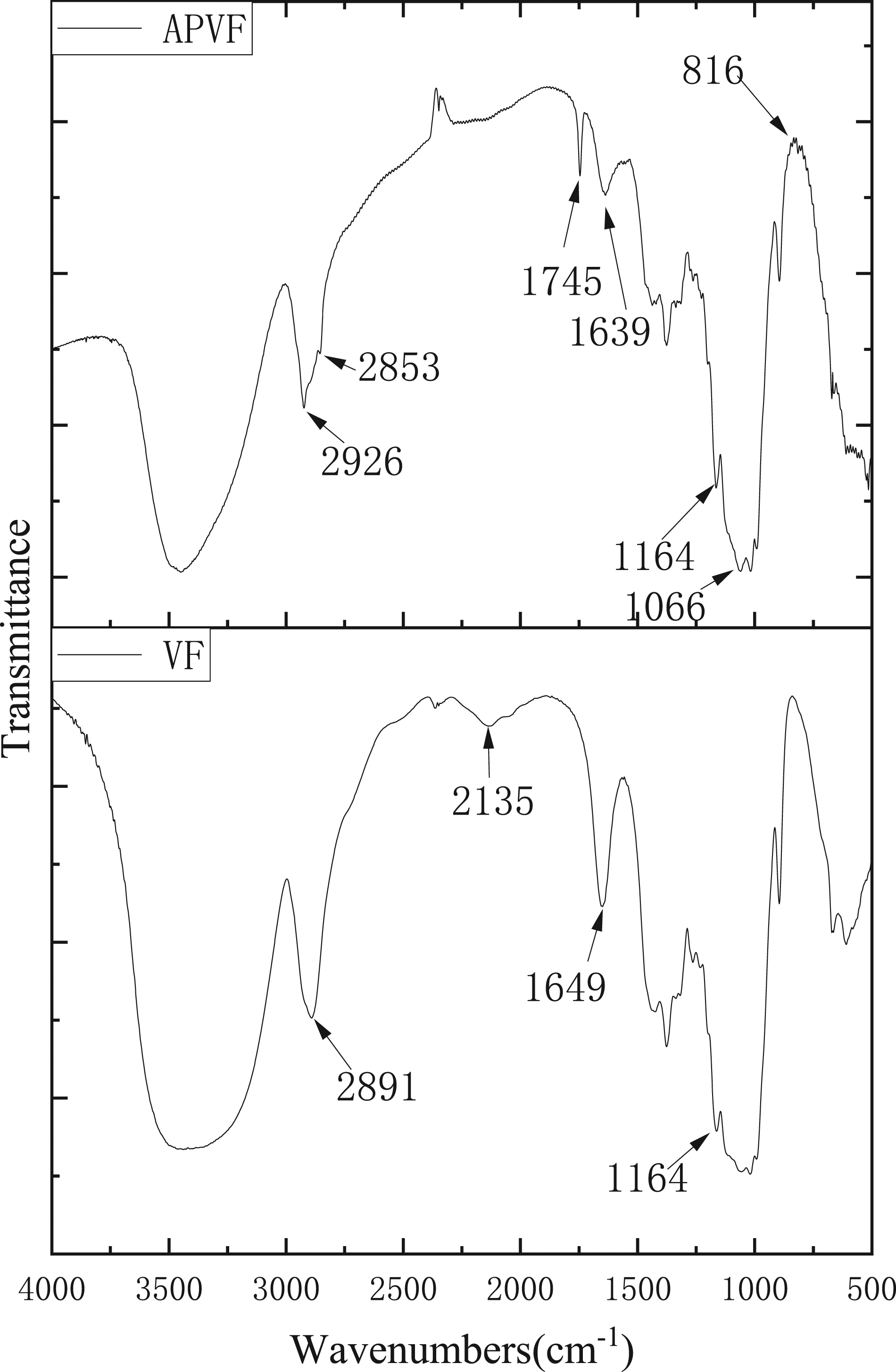
The bending vibration absorption peak for C-OH at 1649 cm−1 was affected by the stretching vibration peak for C=O at 1620 cm−1, and they merge into one peak at 1639 cm−1. The vibration absorption peak for C-O-C at 1066 cm−1, and the telescopic vibration peak for CH2 at 2926 cm−1 & 2853 cm−1 became more obvious, with the telescopic vibration peak at 2891 cm−1 for CH became less obvious.
Warmth retention analysis
Differential scanning calorimeter
It is necessary to analyze the phase transition property which is basic to set the application environment of APVF. The DSC curve of APVF is shown in Figure 3, endothermic direction downward. DSC curves of APVF.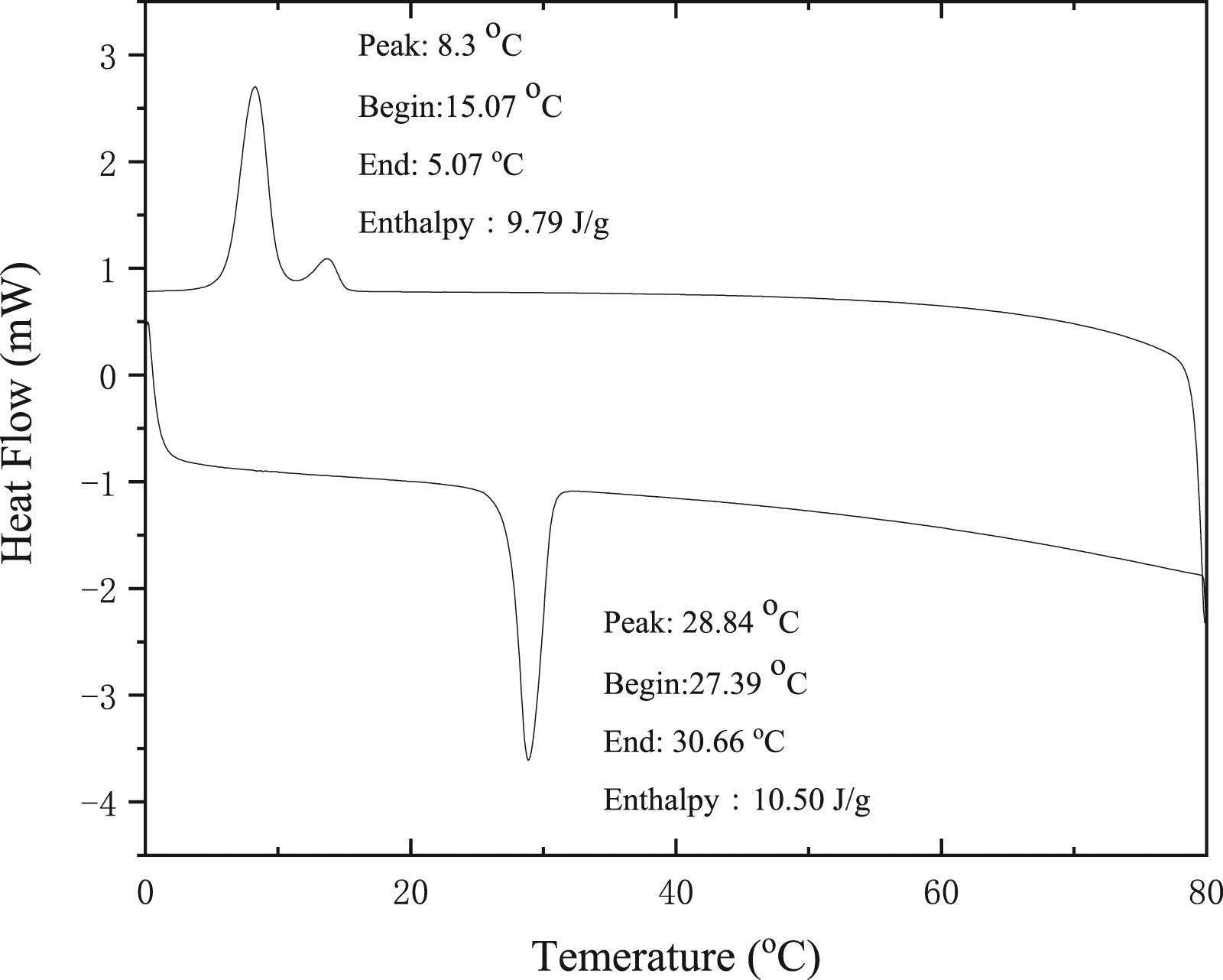
The enthalpy of APVF exothermic phase transition reached 9.79 mJ/mg (peaked at 8.3°C). The enthalpy of APVF endothermic phase transition reached 10.05 mJ/mg (peaked at 28.84°C). The phase transition property of APVF is reversible, APVF has a solid-liquid phase change in the process of heating (absorbs heat) and cooling (releases heat). Because the content of phase change microcapsules can reach 10% at most, so the method to increase the phase change enthalpy is to choose a phase change material with higher phase change enthalpy to replace N-octadecane. The addition of GO has no negative effect on the phase transition function.
Flat type fabric temperature protector
Results of warmth retention.

No.4 (0.78dtex*20 mm 2D crimp solid polyester) had the highest weight converted clo value (about 1.3 times of APVF). That may due to the lowest fiber fineness of No.4, resulting in more fluffy flakes to more resting air layers for effective insulation. Although No. 2 (3dtex *64 mm 3D crimp hollow polyester) has the highest thickness, the clo value of No. 2 was the lowest. This may be due to the coarser fiber fineness resulting in fewer resting air layers for effective insulation. APVF had the highest thickness converted clo value. That because the fiber elasticity of APVF is poor, the storage sheet prepared by APVF has the lowest thickness among all samples. From the data of thermal insulation of storage sheet, No.4 had the best thermal insulation, followed by APVF, this is mainly due to the gap in fineness. The thermal insulation coefficient of 1.5dtex APVF is higher than 1.33dtex polyester fiber, indicates that the thermal insulation coefficient of APVF may be higher with the same fineness of polyester fiber. The preparation of APVF with lower fineness may further improve its thermal insulation performance.
Microstructure of fibers
As shown in Figure 4, clearly VF has a smooth surface section structure, while APVF has a rough surface section structure. During the solidification, the fibers regenerated from the spinning solution. Simultaneously, Phase change microcapsules and GO also uniform embedded in the fibers. SEM images of VF (a) and APVF (b,c,d).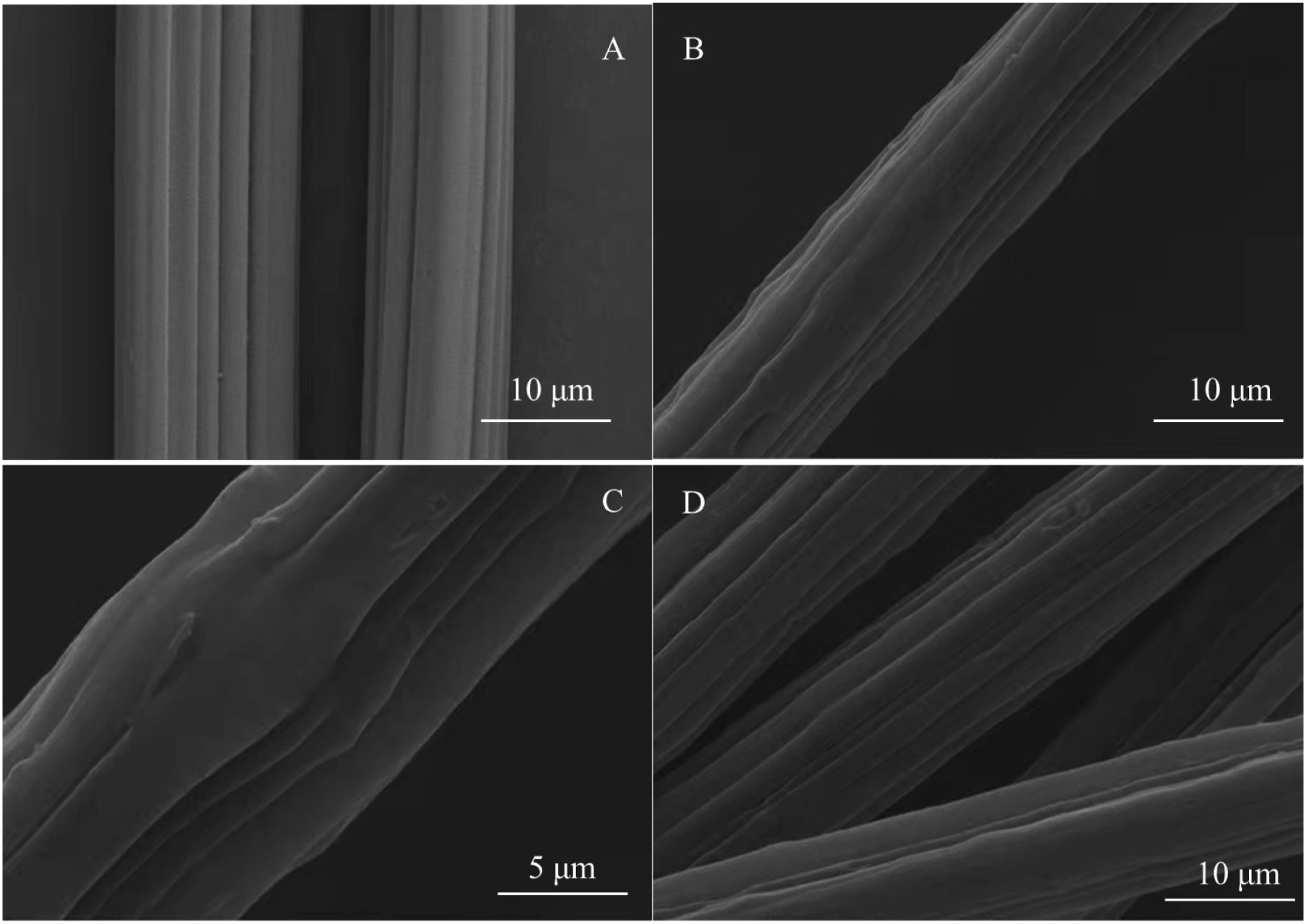
The main reaction of the regeneration can be shown as follows: 2Cellulose-OCS2Na + H2SO4 → 2Cellulose-OH + Na2SO4 + 2CS2. In this reaction, the reaction rate is much higher than the permeation rate. Thus, the spinning solution formed an outer-layer structure when it reached the solidification solution, while the inner part remained liquid. Thus, a skin-core (or shell-core) structure was formed. Then, because of Na2SO4 (dehydration) and ZnSO4 (slows down the reaction rate), the fiber maintained some degree of xanthation before stretching. During the same process, the functional slurry became dehydrated and relatively concentrated. When the fibers were stretched, the reaction finally completed, and the cellulose molecules were oriented. When the orientation was performed, the addition of GO may change the orientation of cellulose in APVF, which caused the sharp bulge shown in Figure 4(b) and (d). Phase change microcapsules may be partially agglomerated, which caused larger spherical bulge in the fibers shown in Figure 4(c). Phase change microcapsules and GO together cause uneven distribution in fibers.
The TEM photograph is shown in the Figure 5 to further illustrate the internal structure of the APVF fiber. It can be clearly seen that there is a flake GO inside the fiber, which has a sharp edge structure and translucent under TEM. The microcapsules inside the fiber have clear structure and uniform size. The thickness of the shell is about 0.1 μm, and the diameter of the microcapsules is 1-3 μm. The microcapsules inside the fibers are present irregularly circle, which is caused by the uneven stress of the fibers during stretching. The shell of the microcapsule well protects the phase-change energy storage material inside without emission leakage. TEM images of APVF.
Antibacterial performance test
Antibacterial tests were conducted against Staphylococcus aureus (ATCC 6538), Escherichia coli (ATCC 25,922) and Candida albicans (ATCC 10,231). The antibacterial rate of fiber to three strains exceeded 99%. This may be mainly caused by the free amino contained in the microcapsule shell material and the antibacterial properties of GO (the principle is still controversial).
Due to the single layer GO mainly exists inside the fiber, its sharp edges are difficult to cut the bacterial cell membrane. After we tested the far-infrared of the fiber (GB/T30127-2013), the far infrared emissivity of the APVF reached 0.83, and the far infrared radiation temperature rise reached 3.2°C. We believe that the antibacterial effect of GO is mainly achieved by emitting far-infrared radiation.
Mechanical properties
Figure 6 shows that the breaking strength of the viscose fiber decreased by 9.27% with the introduction of 10% phase change microcapsule & 0.3% single layer GO, while the wet strength decreased by17.39%. The impact of the phase change microcapsule & single layer GO on the mechanical strength is acceptable. According to the addition of GO, the number of crystal nucleus of cellulose increases during crystallization, thus reducing the negative impact of viscose fiber on the mechanical properties. When the fiber was stretched, cellulose was oriented and crystallized with the crystal nucleus of single layer GO; therefore, the crystallization area and degree of orientation increased. Moreover, the slight decrease in the elongation-at-break indicates that further improvements are expected. Mechanical properties of fibers.
Conclusions
In this paper, a viscose fiber with antibacterial and phase change energy storage functions was successfully prepared by microcapsule technology and wet spinning. According to DSC, the phase transition property of APVF is reversible, APVF has a solid-liquid phase change in the process of heating (absorbs heat) and cooling (releases heat). The thermal insulation coefficient of 1.5dtex APVF is higher than 1.33dtex polyester fiber, indicates that the thermal insulation coefficient of APVF may be higher with the same fineness of polyester fiber. The preparation of APVF with lower fineness may further improve its thermal insulation performance. APVF has a rough surface section structure as it shown in SEM photos, which may also be helpful for its warm keeping performance. The antibacterial rate of fiber to three strains (S. aureus, E. coli and C. albicans) exceeded 99%. This may be mainly caused by the free amino contained in the microcapsule shell material and the emitting far-infrared radiation of GO. The effect of functional slurry on the mechanical properties of APVF is acceptable for fabric or filler.
Footnotes
Declaration of conflicting interests
The author(s) declared no potential conflicts of interest with respect to the research, authorship, and/or publication of this article.
Funding
The author(s) disclosed receipt of the following financial support for the research, authorship, and/or publication of this article: This work was supported by Natural Science Basic Research Program of Shaanxi Province in 2022 grant number 2022JQ-317, Key R&D Projects of Shaanxi Province in 2022 grant number 2022GY-362 and Xi’an Polytechnic University Start-up Research Fund (20200809).
