



Abstract
Chromatics provides a theoretical basis for the production of visual effects that is crucial to design education. As one of the pillars supporting chromatics, knowledge about color mixing is thus necessary for students who plan to design products. However, students tend to be bored by traditional learning methods in this regard. To remedy this deficiency, this study designed a mobile color mixing game to assist students in learning color mixing. On a more specific basis, this game not only enables students to learn color mixing anytime and anywhere but also provides them with an effective mechanism for exploring the potentials of this technology. Using the technology acceptance model, this study developed a questionnaire concerning the subjects’ perceptions of the mobile game, according to which the effectiveness of the game was evaluated. The research findings of this study showed that most of the subjects found the game not only easy to use but also of significant help for them to learn color mixing.
Introduction
As design industries (e.g. product design or industrial design) are constantly springing up, design education has been offered by many educational institutions where professionals in this field are incubated. Design education mainly consists of theoretical and practical training. The practical training enables students to use established design software. The theoretical training introduces basic principles of design that help students create products with visual effects, among which chromatics is the most fundamental knowledge. Chromatics provides students with basic knowledge of chromatic principles, facilitating their understanding of the way to properly match or mix colors. Specifically speaking, a large gamut of colors are the mixtures of primary colors. Learning color mixing is in turn helpful for students to grasp the color system, and students can learn design principles as well as the way to create products with existing software after receiving design education.
Teaching design theories is by no means an easy task for teachers because they tend to find that students are generally uninterested in theoretical concepts. The consequence has become apparent in the unattractiveness of students’ designs because they have very little idea about design principles. After all, a good design entails not only practical skills but also theoretical knowledge.
To remedy this deficiency, that is, to facilitate students’ learning of the theoretical knowledge of design, this study developed a mobile color mixing game. With the assistance from advanced information technology, digital games have been construed as a promising method to enhance students’ learning motivation.1,2 For example, Cagiltay’s 3 study suggested that digital games are more adequate than traditional pedagogical tools for creating a congenial learning environment that encourages students in learning activities. In addition, it has been a proven fact that digital games may provide players with an immersive environment. In other words, they set students’ challenging goals that immerse them in the games. Furthermore, students can master the subjects through the drill-and-practice process in such a favorable learning environment. As a result, educational computer games have attracted many researchers’ attention,4,5 which is why this study seeks to assist students in learning color mixing by offering them the mobile game.
Besides, this study employed the technology acceptance model (TAM) to investigate the subjects’ perception and intention of using the mobile color mixing game.6,7 This investigation is significant due to its usefulness for refining the game. Generally speaking, a successful educational technology should be based on students’ intention of using; otherwise, it will become ineffective no matter how useful it is to learning. Pressing TAM into service, this study identified the influential factors behind the subjects’ intention of using the game, thereby promoting a wider range of its practical applications.
Literature review
TAM has been applied extensively to studying information technology due to its effectiveness in assessing the degree of users’ acceptance. Proposed by Davis and colleagues,6,7 TAM consists of four constructs, including perceived ease of use, perceived usefulness, attitude toward using, and behavioral intention.6,7 Perceived ease of use is defined as “the degree to which a person believes that using a particular system would be free from effort,” 6 while perceived usefulness is defined as “the degree to which a person believes that using a particular system would enhance his or her job performance.” 6 Attitude toward using refers to a person’s positive or negative feelings about using a technology. 8 Behavioral intention refers to a person’s intention to use a technology. 9 Based on these definitions, Davis and colleagues6,7 further formulated the following hypotheses to examine the relationships among these constructs. First, perceived ease of use has a positive and significant influence on perceived usefulness and attitude toward using. Second, perceived usefulness has a positive and significant influence on attitude toward using and behavioral intention. Third, attitude toward using has a positive and significant influence on behavioral intention. In this sense, TAM has served as a theoretical basis to reveal the deciding factors behind users’ attitude and intention toward a technology. It means that this model is an effective tool for explaining or predicting the degree to which users accept or reject a proposed mobile game, through which the value of the new technology can be measured.
In view of the success of TAM, many researchers have adopted it to measure the degree to which users accept digital games. For example, Ha et al. applied this model to examining the acceptability of mobile broadband wireless access (MBWA) technology-based games to their subjects. Their research findings indicated that perceived ease of use significantly influenced the subjects’ attitude toward using MBWA games, while perceived usefulness did not. 10 It implied that their subjects were primary concerned with the question as to whether the games are easy to play. Shin and Shin also used TAM to study their subjects’ attitude toward social network games and found that perceived usefulness significantly and directly influenced the subjects’ intention of using rather than their attitudes toward this type of games. 11 A recent research by Chen and Lin further employed TAM to assess the acceptability of a Chinese learning game to their subjects. Their research findings suggested that both perceived ease of use and perceived usefulness had a significant influence on the subjects’ intention of using the game. 12 In other words, both the ease of use and usefulness of this type of games were the subjects’ major concerns as users.
Research design
Mobile color mixing game
Figure 1 illustrates the mobile color mixing game developed by this study. Since the game was written in HTML 5, it can be played on mobile devices or personal computers. It is a shooting game in which players have to annihilate enemy aircrafts with bullets of different colors. To tackle the challenge, namely, to create bullets with required colors, first, the players must gain knowledge of color mixing. For instance, when encountering yellow enemy aircrafts, the player must click the red button and the green one to produce yellow bullets to destroy the enemy aircrafts that cannot be annihilated otherwise. Figure 1(a) is the main menu of the game where the players can check both the instruction and the leaderboard, or directly enter the game. Figure 1(b) is the tutorial page of the game according to which the players learn how to play it. Figure 1(c) and (d) are the scenes of the game. Figure 1(e) is the page offering the players’ tips on mixing bullets’ colors. The players can click the pause button during the game whenever they need advice in this regard. Figure 1(f) is the leaderboard indicating the ranking of different players’ performance on this game.
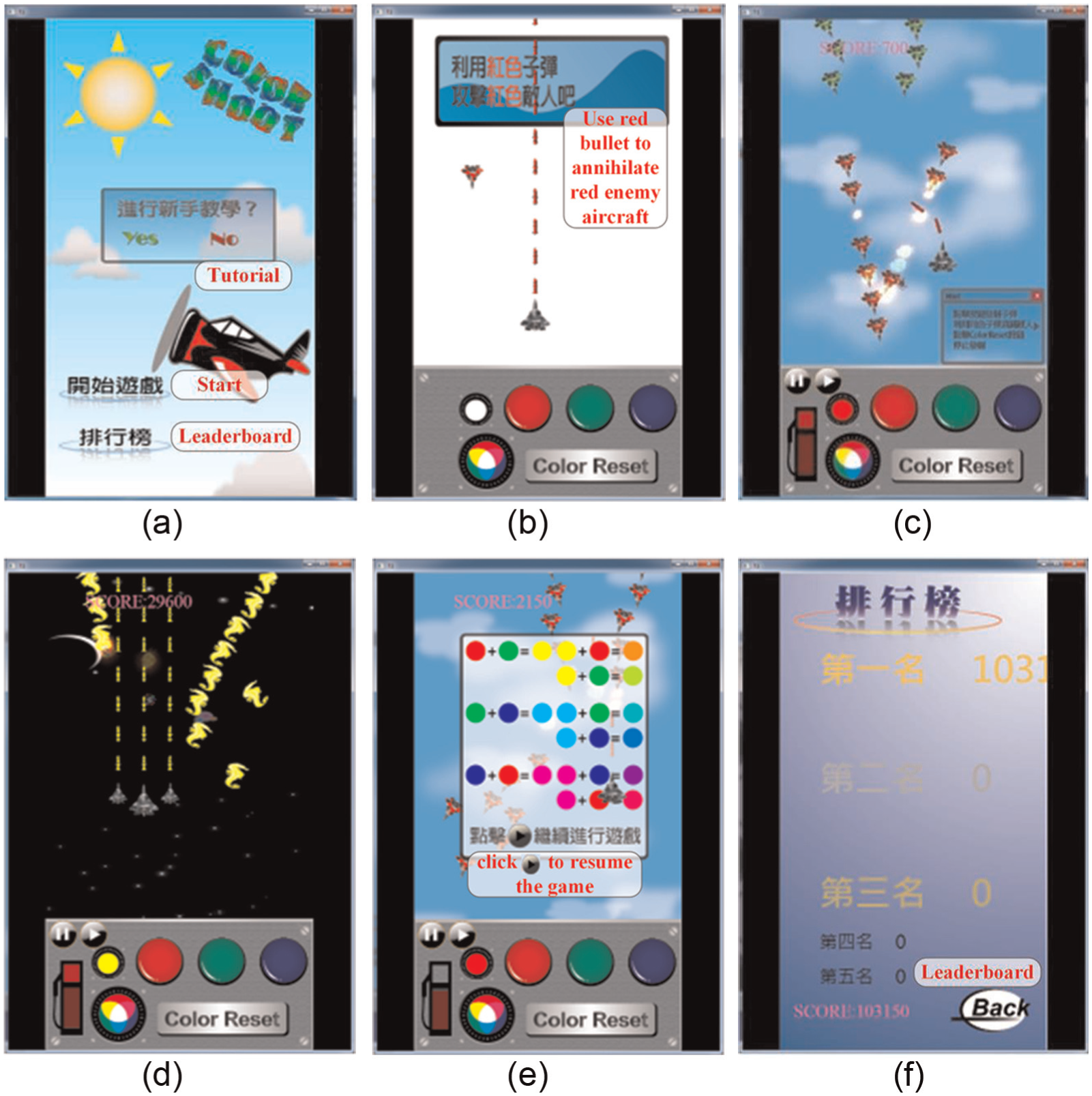
Mobile color mixing game: (a) main menu, (b) tutorial, (c) scene 1 of the mobile game, (d) scene 2 of the mobile game, (e) tips, and (f) leaderboard.
Research model and hypotheses
Figure 2 illustrates the research model of this study. It is based heavily on TAM,6,7 a model which has been widely used in exploring users’ perspectives of educational technologies.9,13 Five hypotheses are formulated accordingly and explained below.

Research model.
A majority of studies on TAM6,7,9,13,14 have proved that a technology would positively influence users’ attitude toward using if they regard it as easy to use as well as useful in enhancing their job performance. Besides, the users would believe the technology as quite useful if they find it easy to use. Moreover, the users would be willing to use the technology if they have a positive attitude to it and construe it as useful. Accordingly, this study formulated the following five hypotheses:
H1. Perceived ease of use is positively related to perceived usefulness.
H2. Perceived ease of use is positively related to attitude toward using.
H3. Perceived usefulness is positively related to attitude toward using.
H4. Perceived usefulness is positively related to behavioral intention.
H5. Attitude toward using is positively related to behavioral intention.
Measurement
In order to collect the data on the subjects’ perspectives of the proposed mobile game, a structured questionnaire was developed on the basis of an extensive review of previous studies.6,7,11 The questionnaire includes four constructs, namely, perceived ease of use, perceived usefulness, attitude toward using, and behavioral intention. Table 1 shows the final questionnaire which was distributed to the subjects who were asked to give their level of agreement or disagreement with the items using a five-point Likert scale.
Final questionnaire.

Data collection
To know how students appreciate the mobile color mixing game, this study called for volunteers through the online bulletin board of the department of applied informatics and multimedia of a university in Taiwan. The subjects who volunteered to participate in this study were 20 college students with the average age of 20 years. They first learned to play the mobile game under our instruction. Then, they played the game on their own for 30 min after knowing how to play it. Finally, they were required to fill in the questionnaire, from which the validity of the research model and hypotheses can be examined.
Results
The partial least-squares approach was used to analyze the questionnaire data, because this approach is more than adequate for dealing with a small sample size (minimum N = 20) 15 such as the case of this study. In addition, the SmartPLS 2.0 software was applied to perform the approach, which includes the measurement model and the structural one.
Measurement model
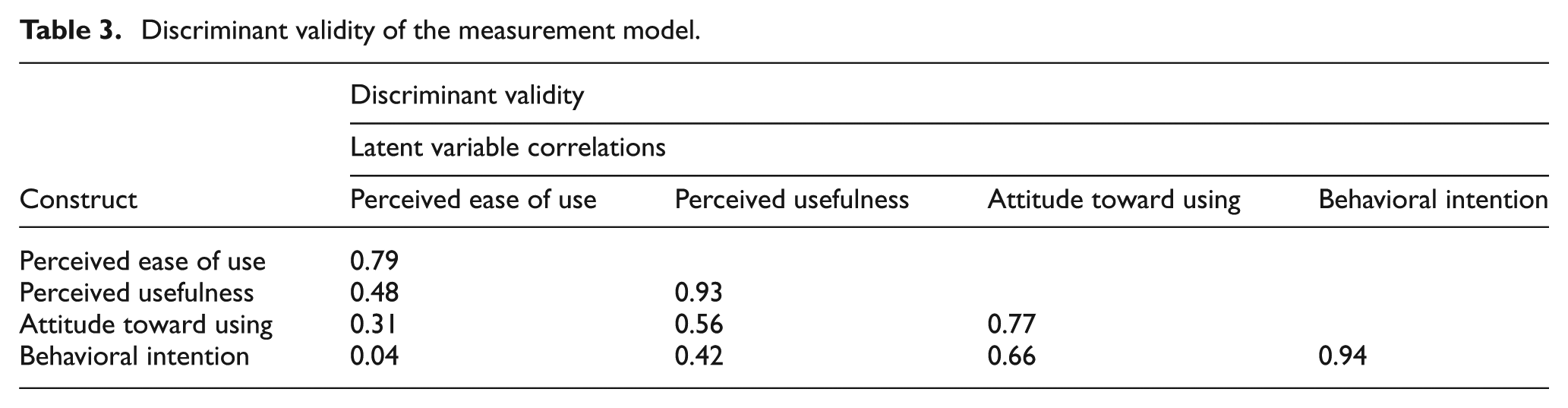
The measurement model was assessed using the reliability of the measures as well as the convergent and discriminant validities. The reliability of the measures was evaluated by composite reliability and Cronbach’s alpha. In general, the minimum acceptable value of composite reliability is 0.7 and that of Cronbach’s alpha is 0.6. 16 The convergent validity was assessed by the average variance extracted which was required to exceed the standard minimum threshold of 0.5. 16 The discriminant validity was assessed by the square root of the average variance extracted and the latent variable correlations. Each construct’s square root of the average variance extracted must exceed its correlation coefficient with other constructs in the model. 17 Tables 2 and 3 indicate that the results delivered by the measurement model are significant and acceptable, since all the values meet the required standards.
Reliability and convergent validity of the measurement model.

Discriminant validity of the measurement model.
Structural model
Based on the path coefficients and the R2 values, the structural model was employed to test the hypotheses formulated in this study. 12 The path coefficients served as the indicator for the statistical significance of the hypotheses, and the R2 values indicated the model’s ability in explaining the variation in the dependent variables. Figure 3 shows the results of the structural model that highlighted the rejection of H2 and H4 and confirmed the other three hypotheses.

Results of the structural model.
Discussion and implication
Figure 3 indicates that perceived usefulness was influenced by perceived ease of use in a significant way that attitude toward using was not, and perceived usefulness in turn exerted a significant influence on attitude toward using. It means that the perceived ease of using the game did not directly affect the subjects’ attitude toward it, but the game might indirectly influence the subjects’ attitude by manifesting its perceived usefulness. Hence, when promoting and applying this game to teaching, teachers should give prominence to the correlation between its ease of use and usefulness, so as to foster students’ positive attitude to using this type of games.
Figure 3 also suggests that attitude toward using was affected by perceived usefulness in a significant way that behavioral intention was not, and attitude toward using in turn wielded a substantial influence on behavioral intention. It means that the perceived usefulness of the game did not directly affect the subjects’ intention of using it, but the game might indirectly influence the subjects’ intention through their positive attitude toward it. Therefore, when promoting and applying this game to teaching, teachers should highlight the game’s usefulness by hinting that students will learn color mixing in a more effective way through the game rather than directly asking them to play the game by reason of its usefulness for learning color mixing.
Finally, Figure 3 illustrates that attitude toward using directly and substantially influenced the intention of using, while attitude toward using was affected directly by perceived usefulness and indirectly by perceived ease of use. It signifies that the perceived usefulness, rather than the perceived ease of use, significantly affected the subjects’ attitude toward playing the game. On that ground, teachers should strongly emphasize the game’s usefulness and implicitly endorse its ease of use when promoting the game, so as to instill students’ positive attitude to using it.
Conclusion
This study not only designed an HTML 5-based mobile color mixing game to improve students’ learning effectiveness regarding the knowledge of color mixing but also developed a TAM-based questionnaire to investigate the subjects’ perceptions of the game. The experimental results demonstrated that (1) the subjects’ perceived ease of use had a more significant influence on their perceived usefulness than on their attitude toward using; (2) the subjects’ perceived usefulness had a significant influence on their attitude toward using but did not directly affect their intention of using; (3) the subjects’ attitude toward using had a significant influence on their intention of using. To sum up, the subjects displayed positive attitudes toward the game and intended to learn color mixing by using it. Nevertheless, the game’s ease of use and usefulness still need to be improved.
Although the findings of this study contribute to design education and game-based learning, they do have some limitations. First, all the subjects who voluntarily participated in this study were students from the same university, making the generalizability of the findings questionable. We plan to include students from other universities in our future research, and thereby increase the generalizability of the findings. Second, the mobile game developed in this study is a shooting game. We may wonder whether different types of games will yield different results. It is one of the key questions to be addressed in our future research. Finally, the generalizability of the findings of this study may also be limited by the relatively small sample size. We plan to increase the sample size in our future research, and thereby uncover more cogent evidence to strengthen our arguments.
Footnotes
Acknowledgements
The authors would like to express their special thanks to Mr Zhi-Yao Zhuang, Mr Guo-Ping Zhang, Mr Wei-Hong Zhang Jian, and Mr Shun-Kai Zhuang who provided effective technical support to implement the proposed game.
Academic Editor: Stephen D Prior
Declaration of conflicting interests
The author(s) declared no potential conflicts of interest with respect to the research, authorship, and/or publication of this article.
Funding
The author(s) disclosed receipt of the following financial support for the research, authorship, and/or publication of this article: This study was financially supported by the Ministry of Science and Technology of the Republic of China, Taiwan, under contract no. MOST 103-2511-S-041-002-MY3.