




Abstract
Blades act as key components for twin-blade planetary mixer; their geometric parameters (blade–blade clearance and helical angle) and two different rotating modes (counter-rotating mode and co-rotating mode) were investigated numerically via commercial software ANSYS Fluent 14.5 to reveal the effects on the power or torque consumption. The results indicate that decreasing the blade–blade clearance or increasing the helical angle increases the power consumption of the twin-blade planetary mixer. The proportionality constant of power curves depends on the geometry of the blades.
Keywords
Introduction
The mixing of highly viscous fluids is a common operation in the chemical, pharmaceutical, biochemical, and food industries. Twin-blade planetary mixer, which provides a suitable bulk circulation and good homogenization for highly viscous materials and pastes, is an important production device for the solid propellant batch mixing process. Blades are key components for twin-blade planetary mixer, and the variation in their geometric parameters (clearance and helical angle) has a significant effect on the power consumption and mixing efficiency.
At low Reynolds number, the mixing is usually inefficient due to the flow structures generated at the onset of operation. For the twin-blade planetary mixer, due to blades’ close-clearance nature, their scraping action leads to an efficient transfer of the paste inside the mixing vessel. In recent years, different mixing systems have been developed for agitation of non-Newtonian or Newtonian fluids, but the efficient mixing remains a difficult task, as does the design and scale-up of reactors for processing of highly viscous fluids.1,2 Inducing chaotic mixing can enlarge the active mixing regions (AMRs) and minish the isolated mixing regions (IMRs), which in turn improves the mixing efficiency. 3 Yao et al. 4 indicated that increasing the amplitude of fluctuation of stirring speeds and enhancing the frequency of periodic co-reverse rotation can make better mixing. Takahashi et al.5,6 experimentally found that inserting an object into a vessel to destroy the IMRs can achieve a short mixing time compared to an off-center impeller and inclined impeller methods. Yu and Gunasekaran 7 indicated that a larger blade induces a better mixing effectiveness due to the increment of strain rate in the mixing system. In stirred vessels, the design and geometry of blades can determine the quality of flow and the power consumption. Youcefi et al. 8 and Devals et al., 9 respectively, indicated that the slot length and the bottom clearance play a significant role in the power consumption. Kumaresan and Joshi 10 and Patwardhan and Joshi, 11 respectively, investigated the effect of impeller design on the flow pattern and mixing time for axial flow impellers. Rivera et al. 12 compared the mixing efficiency of the coaxial mixer under counter-rotating and co-rotating modes. The above analysis indicates that improving the motion mode, installation manner, and geometry of blades can vary the fluid flow pattern and enhance the intensity of chaotic mixing, which in turn make the mixing more efficient.
Unlike classical mixers, the literature on the mixing process using twin-blade planetary mixer is scarce, and the blade’s geometric design is based on empirical consideration and industrial experience. Compared with single-shaft centric or eccentric mixers, Zhang et al. 13 pointed out the planetary motion that the twin-blade planetary mixer undergoing can effectively minish IMRs in the laminar mixing system. Tanguy et al. 14 first numerically investigated the mixing process in a twin-blade planetary mixer utilizing a three-dimensional (3D) model. Yi et al. 15 investigated the relationship of geometric parameters of blades and mixing efficiency based on equivalent motion conditions. Coesnon et al. 16 found that the power consumption of twin-blade planetary mixer is time dependent. Similarly, Tanguy et al. 17 concluded that the double-arm planetary mixer provides good radial dispersion capabilities but poor axial (top-to-bottom) pumping. According to the concept of Metzner and Otto, scholars attempted to plot the master curves of power number versus Reynolds number with the aim to scale-up of power consumption.18–20 For the planetary mixer, Auger et al.21,22 proposed a modified Reynolds number and a modified power number to predict the power consumption. Delaplace et al. 23 verified that the modified Froude number appears to be a robust indicator for the whip planetary machines. André et al. 24 modified the mixing and power numbers of a conventional mixer to investigate the effects of process parameters on mixing efficiency of planetary mixer. However, to the authors’ best knowledge, the research on the geometric parameters of blades on power consumption for twin-blade planetary mixer is scarce.
Nowadays, computational fluid dynamics (CFD) method has been widely utilized in analyzing fluid flow field.25–28 In chemical mixing process, CFD method is used to optimize the mixer geometry and get a better insight on the complex flow patterns generated by the interaction between the impeller and the vessel wall.29,30 For the twin-blade planetary mixer, due to the low mechanical efficiency of the gear box and the planetary motion of blades, it is hard to measure the torque blades power consumption experimentally. However, CFD method provides a novel way to investigate the power consumption of the mixer on the basis that the numerical model has been validated. Inspired by Metzner and Otto’s concept, for the twin-blade planetary mixer, the power curve is applied to the scale-up of power consumption.31,32 The object of this work is to reveal the relationship between the geometric parameters (clearance and helical angle) of blades and the power curve of twin-blade planetary mixer utilizing CFD method. The results will characterize the effectiveness of new blade designs and the development of scaling rules for the twin-blade planetary mixer.
Stirred vessel configuration
The twin-blade planetary mixer has a slow plain blade and a fast hollow blade (the rotational speed ratio is 2), and the two blades are mounted on a carousel, as shown in Figure 1. The ratio of the rotational speed and the gyrational speed of the hollow blade is 9.34 in this article. For the blade–blade clearance c being 2 mm, the diameter of plain blade and hollow blade is 64 mm, and the effective height of blades is 96 mm. The inner diameter of the vessel is 128 mm. At the initial moment, the height of the liquid surface is 85 mm. For the plain blade and the hollow blade, the eccentric distance to the vessel’s center is 14.75 and 29.5 mm, respectively. The volume of mixing materials inside the vessel is about 1 L. There are three kneading regions inside the mixing vessel, blade–blade kneading region (I), blade-vessel-inner-wall kneading region (II), and blade-vessel-bottom-wall kneading region (III), as shown in Figure 1(a).

Physical sketch of the twin-blade planetary mixer: (a) three-dimensional view and (b) sectional view.
The mixing materials, typical of a propellant at the end of the kneading cycle in the planetary mixer, are consider as Newtonian fluid in this study, with a density ρ of 1800 kg/m3 and a viscosity µ of 400 Pa s. 16
Numerical simulation and setup
Laminar modeling
In Cartesian (x, y, z) coordinates, the continuity equation and the momentum equation can be expressed as follows 33
Continuity equation

For incompressible fluids

where
Momentum equation

where
Inside the mixing vessel, the flow is in the laminar regime and laminar model is adopted. Due to the high viscosity of materials and small Reynolds number, the free-surface deformation is neglected. For the twin-blade planetary mixer, the hollow blade tip speed is selected as the characteristic velocity, and the modified Reynolds number

where

where
In this study, the rotational speed of hollow blade varies from 10 r/m to 100 r/m, and the scope of Reynolds number is from 0.01954 to 0.195447.
Initial and boundary conditions
In this study, the mixer vessel was assumed to be filled with mixing materials and there was no wall slip. Thus, the motion of the blades determined the boundary conditions. More specifically, the velocity at vessel walls was zero, and at the blades, velocity was determined by the rigid body motion of the blades themselves. The boundary conditions are defined by the following:
No-slip conditions at the vessel wall and bottom, v = 0.
No normal velocity at the fluid surface, vn = 0, where n denotes the normal to the surface, and the surface of the fluid is considered as flat.
The gravity is taken into consideration.
Computational domain and grid arrangement
Due to the complex geometry of twin-blade planetary mixer blades, a non-uniform unstructured 3D mesh with tetrahedron volumes was generated utilizing ICEM software, as shown in Figure 2. The clearance between the blades and the vessel wall is very small so that the high shear rates are expected to occur in these gaps. Consequently, the blades surface mesh size was properly refined. The CFD software ANSYS Fluent 14.5 was utilized to solve the governing equations. The Semi Implicit Method for Pressure-Linked Equations (SIMPLE) Consistent algorithm was performed to couple velocity and pressure terms. The pressure and momentum equations were discretized by the second-order upwind scheme. The gradient was calculated with the Green–Gauss node-based method. A scaled residual value of 10−6 was set as a convergence criterion for solution of flow equations. The inner wall of the mixing vessel was treated as stationary wall, and the liquid surface was defined as deforming mesh zone. The numerical simulation was treated as transient process, the time step size was set 0.001 s, and the maximum iteration per time step was 20. The simulations were performed in a HP Workstation with an Intel(R) Xeon(R) CPU and 32 GB RAM.
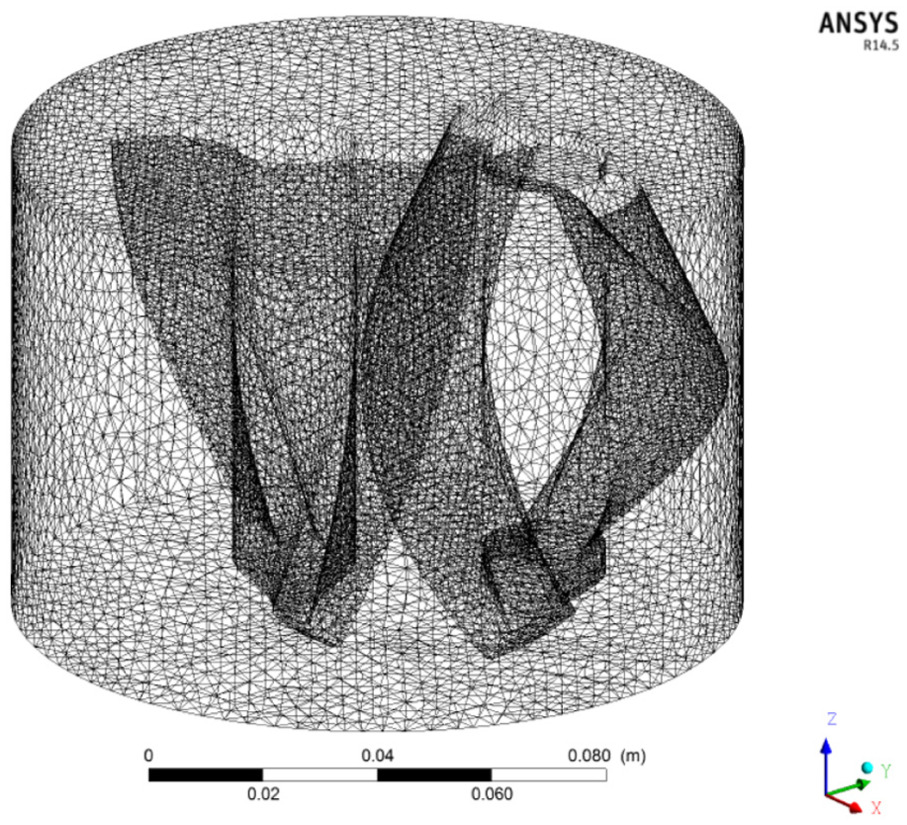
Mesh model of twin-blade planetary mixer.
Grid independence analysis
During the transient numerical simulation process, the grid is being continually reconstructed. In order to determine that the numerical results are independent of the grid quantity, three different dynamic mesh settings are analyzed in this subsection.
With respect to dynamic mesh, the integral form of the conservation equation for a general scalar,

where
When the rotational speed of hollow blade is 60 r/m, cell count irregularly varying along with the mixing time is shown in Figure 3. It can be seen that the cell count varies notably during the mixing process, and different dynamic mesh parameter settings induce different cell count curves.

Variation of cell count along with mixing time.
The maximum extrusion and shear stresses within kneading region (I) are selected as the criteria to identify the convergence of results having been reached, as listed in Table 1. For the three different dynamic mesh parameter settings, the maximum difference of the maximum extrusion stress is less than 3%, and the maximum shear stress is less than 2%. It indicates that the numerical results are independent of the dynamic mesh settings, and the dynamic mesh setting 2 is selected in this study.
Numerical results under different dynamic mesh parameter settings.

Validation of numerical model and setup
Before numerical simulations, it is necessary to validate the setup and numerical model by comparing the numerical results with the experimental results from Auger et al.
21
In Auger’s experiment, four Newtonian fluids were mixed in the planetary mixer bowl P600 equipped with a helicoidal dough hook. In this article, the data sets of the mixing Newtonian fluid Polybutene oil N15000 (density: 888.9 kg/m3, dynamic viscosity: 40.69 Pa s) in Auger’s experiments were utilized to validate the parametric setup and numerical model. The detailed information of Auger’s experiment refers to the Auger et al.
21
The definition of the modified power number



where dG is the diameter of the gyrational motion, m; P is the power, W; N is the rotational speed of blade, r/m;
The comparison between the numerical and experimental results is shown in Figure 4. The mechanical efficiency of gearbox of the planetary mixer was set 0.45, the value of the proportionality constant Kp of experimental results is 48.6, while the

Comparison between experimental and numerical results.
Results and discussion
Power consumption is an important parameter to describe the performance of a mixing system, and the clearance has significant influence on power consumption. The master curve obtained can be applied to the scale-up of power consumption of twin-blade planetary mixers in the mixing of Newtonian fluids. In this work, the detailed values of rotational speed of the hollow blade are listed in Table 2.
Processing parameter of twin-blade planetary mixer.

Periodic evolution of blades’ torque
Under the counter-rotating mode condition, when the rotational speed of hollow blade is 60 r/m, the periodic evolution of torque of hollow blade and plain blade along with mixing time is shown in Figure 5. For the twin-blade planetary mixer, the torque of blades periodically varies with the respective position of the plain blade versus the hollow blade during mixing process. And the torque of the hollow blade is four times more than that of the plain blade. The value of the hollow blade’s torque is positive value, while that of the plain blade has positive and negative values. It means that during mixing process, the hollow blade consumes the power to convect materials; however, due to the counterturn and the kneading action of plain blade and hollow blade, the hollow blade’s torque has the positive value which means it produces torque.

Variation of torque of the two blades along with mixing time.
In order to elucidate the transient characteristic of torque variation curves, the maximum oscillation amplitude η is defined as follows


where
For the torque variation curves, the maximum oscillation amplitude of the hollow blade is about 23.20%, while that of the plain blade is about 178.46%. This means that the design scale-up from time-average power consumption may lead to mechanical failure if appropriate care is not given to the blade mounting and mechanical design, in particular for the control of vibrations of baffles.
During mixing process, the relative location between plain blade and hollow blade is shown in Figure 6. The plain blade is labeled as green color, while the hollow blade is labeled as gray color. At the moment t = 1.0 s, due to the intensively kneading action between the hollow blade and the plain blade, the hollow blade consumes much torque; at the moment t = 0.4 s or 1.4 s, due to the weakly kneading action between the two blades, the hollow blade consumes little torque. This is in agreement with the conclusion in Chesterton et al. 35 At the moment from 0.7 to 1.0 s, the kneading area between the two blades is increasing along with the increment of t, which in turn increases the pressure of blades acting on the mixing materials, so the torque of the hollow blade is increasing, and that of the plain blade is decreasing, as shown in Figure 5.

Relative position between plain blade and hollow blade at different moments: (a) t = 0.4 s, (b) t = 0.7 s, (c) t = 1.0 s, and (d) t = 1.4 s.
Effect of clearance on the power and torque
From the analysis in section “Periodic evolution of blades’ torque,” the variation of the torque shows a periodic characteristic. So in this section, the variation curve within one period is selected to analyze the effects of clearance on the torque of hollow blade, as shown in Figure 7. Increasing rotational speed of blades allows to enhance the effective deformation rate inside the vessel, yielding a larger power consumption. 36 So increasing the rotational speed of blades enhances the fluctuant characteristic of torque curves and increases the value of the torque of blades.
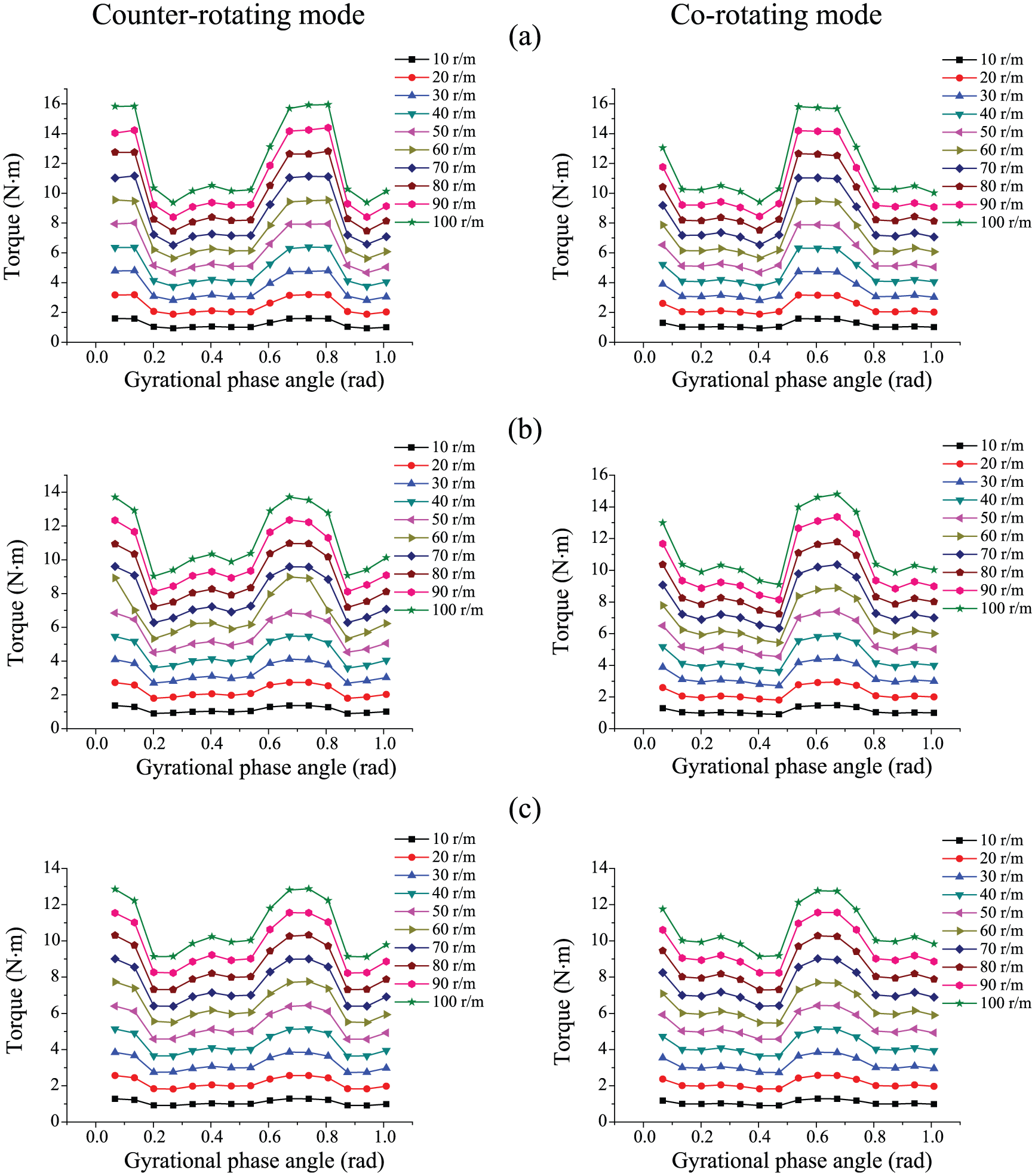
Torque curves of the hollow blade under different blade–blade clearance c: (a) c = 1.5 mm, (b) c = 2.0 mm, and (c) c = 2.5 mm.
Decreasing the blade–blade clearance c will weaken the intensity of materials convection inside kneading region (I), which in turn increases the pressure of blades acting on the materials. So the little the clearance is, the more the torque is consumed. This is in good agreement with the conclusion in Tanguy et al. 14
From the above analysis, it is necessary to elucidate the effects of blade–blade clearance on the torque more clearly. With the rotating speed of hollow blade being 60 r/m, the torque curves of the hollow blade under different blade–blade clearance c are shown in Figure 8. For the same rotating mode, with the decrement of c, the blade torque is increasing, and the curves show a similar variation trend along with the increment of phase angle revolution under the same rotating mode, as shown in Figure 8(a) and (b).

Torque curves of the hollow blade under different blade–blade clearance c with the rotational speed of hollow blade being 60 r/m: (a) counter-rotating mode and (b) co-rotating mode.
For the same blade–blade clearance c, when the mixer is mixing Newtonian fluids under different rotating modes, the maximum value and the minimum value of the torque curves are the same, as shown in Figure 9. Under the counter-rotating and co-rotating modes, different rotating modes lead to the difference in relative location between plain and hollow blades at the same phase angle revolution, so the value of the torque curves is different at the same phase angle revolution.
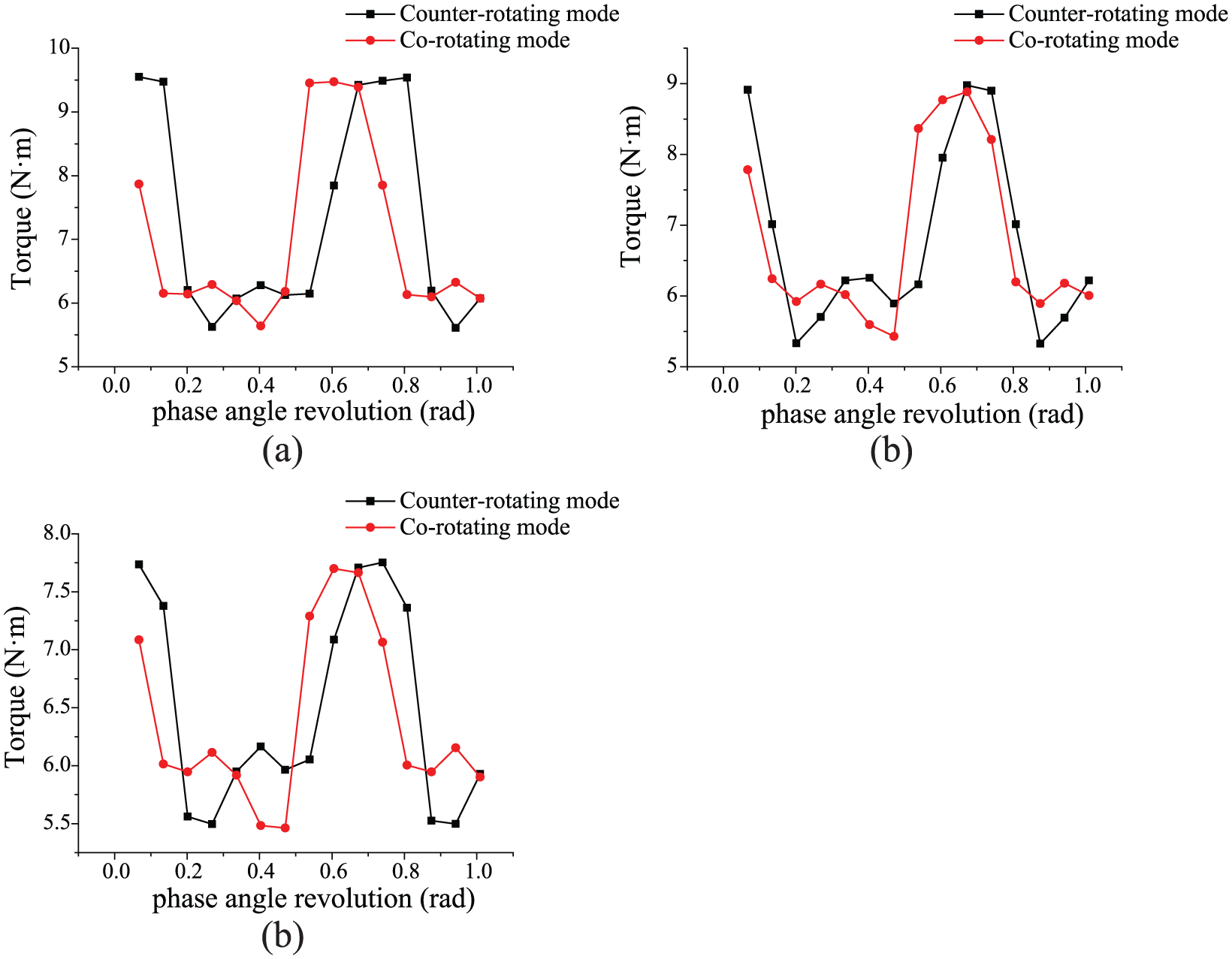
Torque curves of the hollow blade under different rotating modes: (a) c = 1.5 mm, (b) c = 2.0 mm, and (c) c = 2.5 mm.
For the twin-blade planetary mixer, the modified Reynolds number and the modified power number can be calculated according to equations (4)–(8). As shown in Figure 10(a) and (b), the torque curves increase notably along with the decrement of clearance c. The twin-blade planetary power curves keep a familiar shape. For counter-rotating and co-rotating modes, the decrease in NpM follows a nearly equivalent slope K under different blade–blade clearance c, and the detailed values are listed in Table 3.

Newtonian power curves obtained for the twin-blade planetary under different blade–blade clearance c, log–log plot: (a) counter-rotating mode and (b) co-rotating mode.
Slope of power curves under different blade–blade clearance c.

As reported for classical mixing systems when mixing highly viscous fluids, Auger et al. 21 investigated the proportionality constant Kp of a planetary mixer. In this article, it is necessary to study the proportionality constant Kp for the twin-blade planetary mixer, as shown in Figure 11. The value of Kp increases along with the decrement of clearance. It can be concluded that the proportionality constant Kp depends on the blade–blade clearance c. Decreasing the blade–blade clearance c makes the effect of c on Kp more notable. But different rotating modes of blades seem to have no effect on the value of Kp.

Kp of different clearances under counter-rotating and co-rotating modes.
Effect of helical angle on the power and torque
The helical angle is another significant geometric parameter for the blade of twin-blade planetary mixer. With the aim to investigate the effect of helical angle on power and torque of blades in this subsection, keeping the blade–blade clearance c constant 2 mm, the helical angle β varies from 35° to 55°, uniform space 5° under the counter-rotating mode condition.
As shown in Figure 12, at the same rotational speed, increasing the helical angle makes the hollow blade to consume more torque. The fluctuant characteristic of torque curves of low helical angle (e.g. β = 35°) is weaker compared to that of high helical angle (e.g. β = 55°). The detailed values of fluctuant amplitude Amax are listed in Table 4. Increasing the helical angle β decreases the interactive time between the plain blade and the hollow blade in kneading region (I), so the torque curve shows more fluctuant characteristic under high helical angle condition. At the same time, increasing helical angle β may decrease the axial flow of fluids inside the kneading region (I), which in turn increases the extrusion stress and the shear stress of blades acting on the mixing materials, so the value of torque curves increases along with the increment of helical angle from 35° to 55°.
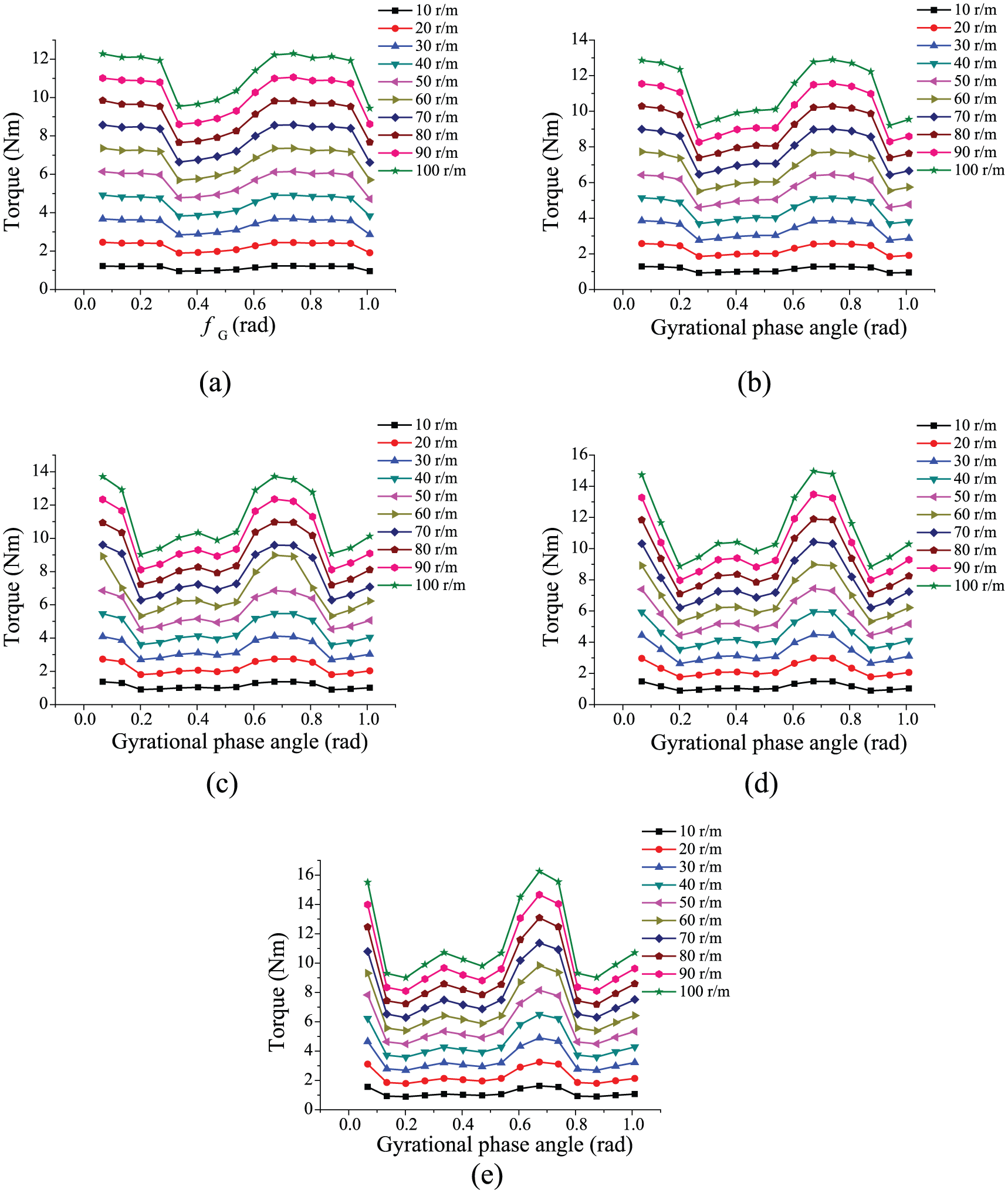
Torque curves of the hollow blade under different helical angles: (a) β = 35°, (b) β = 40°, (c) β = 45°, (d) β = 50°, and (e) β = 55°.
Maximum amplitude of the torque curve at rotational speed of hollow blade 100 r/m under different helical angle β.

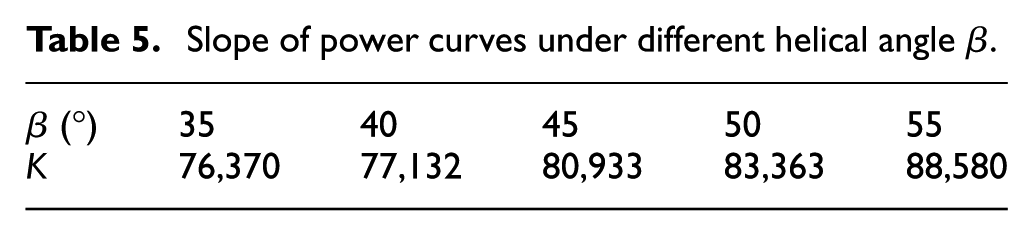
The power curves obtained for the twin-blade planetary of different helical angle β under counter-rotating mode are shown in Figure 13. The values of power curves increase along with the increment of helical angle β. For the slope of power curves, increasing the helical angle β increases the slope value. The detailed values of the slope are listed in Table 5.
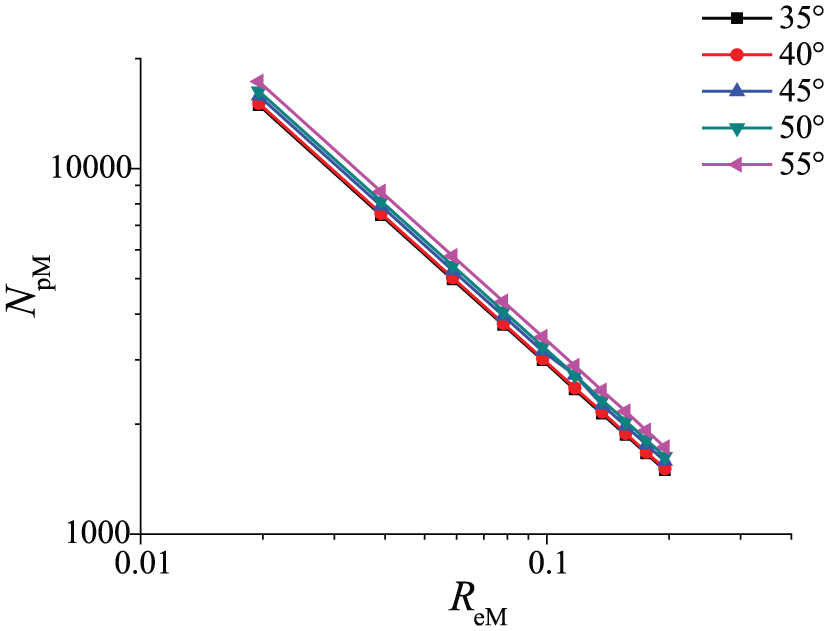
Newtonian power curves obtained for the twin-blade planetary under different helical angle β, log–log plot.
Slope of power curves under different helical angle β.
With the aim to investigate the effect of helical angle β on the proportionality constant Kp for the twin-blade planetary mixer, the Kp curves of different helical angles are shown in Figure 14. Increasing the helical angle β increases the value of Kp. It can be concluded that the proportionality parameter Kp depends on helical angle β of the blades of twin-blade planetary mixer.

Kp curve of different helical angle β under counter-rotating mode.
Conclusion
In this article, the study provides a more comprehensive knowledge of the fluid mechanics inside a twin-blade planetary mixer. The geometric parameters (blade–blade clearance and helical angle) of the blades were investigated numerically to reveal the effect on the power consumption of twin-blade planetary mixer, and two different rotational modes were also investigated for mixed Newtonian fluids. The main conclusions are listed in the following:
The torque curves of blades show periodic and fluctuant characteristics. The torque or power consumption of the twin-blade planetary relies on the respective position between the hollow blade and the plain blade. Decreasing the blade–blade clearance increases the pressure of blades acting on the mixing materials inside the kneading regions, which in turn increases the torque or power consumption.
For the twin-blade planetary mixer, the proportionality constant Kp of power curve depends on the blade’s geometry. Decreasing the blade–blade clearance or increasing the helical angle increases the value of proportionality constant Kp.
When the Newtonian fluids are mixed inside the mixer, the power consumption or the proportionality constant Kp seems to have no difference under the counter-rotating and co-rotating modes.
Footnotes
Academic Editor: Hongwei Wu
Declaration of conflicting interests
The author(s) declared no potential conflicts of interest with respect to the research, authorship, and/or publication of this article.
Funding
The author(s) disclosed receipt of the following financial support for the research, authorship, and/or publication of this article: This study is funded by the financial support from the Open Research Fund Program of Hubei Provincial Key Laboratory of Chemical Equipment Intensification and Intrinsic Safety (No. 2015KA03) and the Fundamental Research Funds for the Central Universities (No. 2016YXMS266).