




Abstract
In this study, the volumetric entropy generation rate is analyzed in sharp edge wavy channels. A two-dimensional steadily developing fluid flow is considered. Air is considered as the working fluid in the numerical analysis. Two parameters, Reynolds number (Re) and the horizontal-pitch-to-module-length ratio, are considered as variables. The effect of these variables on the volumetric entropy generation is analyzed numerically using a finite volume technique. Domain discretization was made using a body-fitted coordinate system. The volumetric entropy generation profiles for varying Re number and the horizontal pitch are discussed. It is found that the total entropy generation increases considerably with the increase in the Re number. For the Re number range of 25–400, the total entropy generation in the second module near the inlet varied from 0.38 to 18922.67 W/K, respectively. However, the entropy generation rate was found to decrease along the channel through the modules, as the periodic steady conditions were approached in the subsequent modules.
Keywords
Introduction
Heat transfer enhancement techniques are generally used to increase the heat transfer in heat exchangers. As a result of which the heat transfer enhances and the entropy generation increases. This phenomenon causes decrease in the energy efficiency (i.e. the second law efficiency) of the system/device. Therefore, a compromise may need to be made in designing the flow passages. Symmetrical corrugated or wavy walled channels are simple geometries of the flow passages. 1 These types of channels are widely used in heat exchangers in food processing, pharmaceutical, and chemical industries.2–4
Most of the studies found in the literature on the corrugated or wavy channels deal with the fluid flow and heat transfer only. Very few studies are found on the second law aspects and the entropy generation in such channels. From the heat transfer and fluid flow point of view, Nishimura et al. 5 investigated the characteristics of the flow and heat transfer in a channel with such configuration for turbulent flow. They considered Reynolds numbers in the range of 20–300 in their experimental investigation. They used two different wall geometries, namely, sinusoidal wall and arc-shaped wall. Similarly, Wang and Vanka 6 analyzed the heat transfer and fluid flow phenomena in sinusoidal channels using numerical techniques. They found that the flow was steady up to Re of 180. The flow was found to be self-sustained oscillatory beyond 180 Re value. Niceno and Nobile 7 studied numerically the flow behavior in channels that were arc-shaped and wavy sinusoidal. The developing flow and heat transfer in a wavy passage was studied numerically by Stone and Vanka. 8 They considered a sinusoidal channel and presented their results for 14 modules with a fixed set of geometrical parameters. Bahaidarah et al. 9 investigated the two-dimensional developing fluid flow and heat transfer characteristics over a bank of flat tubes for a range of geometric parameters. They considered six modules and attained a periodically fully developed flow (PDF) downstream of the first module. They found that sinusoidal and arc-shaped configurations resulted in little or insignificant heat transfer enhancement at low Reynolds numbers when compared with that in parallel plate channel. They also found that the heat transfer augmentation was as high as 80% at higher Reynolds numbers. Islamoglu and Parmaksizoglu 10 carried out numerical and experimental investigation for air-forced convective heat transfer and pressure drop in corrugated channels. They showed that there was a large variation in the local heat transfer coefficients on the wavy walls. Gut and Pinto 11 studied the forced convection in plate heat exchangers with generalized configurations. They used the assembling algorithm to study the influence of the configuration on the heat exchanger performance. Naphon 12 carried out numerical and experimental studies of forced convection heat transfer and flow field in a channel with V-corrugated upper and lower plates. They showed that the effects of wavy angle and channel height had significant effect on the temperature distribution and flow development. In an experimental study, Elshafei et al. 13 discussed forced convection heat transfer and pressure drop characteristics of flow in corrugated channels. They concluded that the average heat transfer coefficient and pressure drop enhancement depended on the spacing and phase shift. Durmus et al. 14 studied forced convection heat transfer and pressure drop in plate heat exchangers with different surface profiles experimentally. They showed that the efficiency of the heat exchanger increases by increasing the fluids’ contact surface, pressure drop, and mass flow rates. Recently, Mohammed et al. 15 carried out a numerical investigation for the forced turbulent convective flow and heat transfer in corrugated channels with varying corrugated tilt angles and channel heights. They found that the wavy angle of 60° and wavy height of 2.5 mm with channel height of 17.5 mm are the optimum parameters, and they have a significant effect on the heat transfer enhancement.
Most of the papers published in the literature consider symmetric triangular, sinusoidal, and arc-shaped wavy walls. Little attention was given to the sharp edge shape converging–diverging channels with varying sizes of horizontal pitch. Hossain and Islam 16 investigated numerically the unsteady laminar flow in periodic wavy (sinusoidal and triangular) channels as shown in Figure 1. The study found that the flow in the channels was steady up to a critical Reynolds number beyond which the flow became self-sustained quasi-periodic oscillatory.

Geometrical configurations of the wavy sharp edge shape channels of various horizontal pitch (l/L) considered in this study: (a) l/L = 0, (b) l/L = 0.1, (c) l/L = 1/4, and (d) l/L = 1/2.
Entropy generation analysis in corrugated channels has not been studied in detail in the literature. From the entropy generation and second law perspective, Ko 17 studied numerically the effects of corrugation angle of a wavy channel on the entropy generation during the development of laminar-forced convective flow. In the analysis, he considered the recirculation of the flow and the resulting vortices. Additionally, he considered the temperature and the friction effects on the entropy generation. He also focused on the corrugation angle on the volumetric entropy generation, and in particular the components of entropy generation due to the heat transfer irreversibility and fluid-friction-related irreversibility. He also discussed the optimum corrugation angle providing a minimum entropy generation. In another work, Ko and Cheng 18 discussed the effects of the aspect ratio and the Reynolds number on the entropy generation in a wavy channel. In their study, they discussed the volumetric local entropy generation rate due to pressure drop and heat transfer irreversibility by considering the flow circulations and temperature distribution in the channel. They concluded that minimum rate of entropy generation corresponded to the square cross-sectional channel with aspect ratio of one. They also pointed out that high Re number would yield a lower total entropy generation rate in the channel.
To assess the performance of heat exchangers with corrugated channels from the perfective of not only first law (heat transfer) but also second law of thermodynamics (entropy generation), there is a need for analyzing further the entropy generation in corrugated channels. The objective of this work is to analyze the entropy generation in the sharp edge wavy channels with varying pitch-to-module-length ratios as shown in Figure 1.
Mathematical formulation
Consider two-dimensional flow in the wavy channel as shown in Figure 1. In this case, the governing equations, that is, the conservation laws for the mass, momentum, and energy, respectively, can be written as


The Semi-Implicit Method for Pressure-Linked Equations (SIMPLE) algorithm was used to solve the conservation equations. An iterative procedure was used in which a combination of the Tri-Diagonal Matrix Algorithm (TDMA) and Gauss–Seidel scheme was employed. To discretize the governing conservation equations, the finite volume technique proposed by Karki
19
was used for body-fitted coordinates,
Figure 1(a) shows the triangular wavy channel with no horizontal pitch (l/L = 0). In this study, the height ratio (Hmax/Hmin = 3) and module length ratio (L/a = 8) were considered as the fixed geometric parameters for the flow characteristics of wavy channels. The Reynolds number (Re) and the horizontal pitch ratio were used as independent parameters to analyze the fluid flow and heat transfer characteristics. The Reynolds numbers of 25, 50, 100, 200, and 400 were considered along with the horizontal pitch ratios of 1/10, 1/4, and 1/2, as shown in Figure 1(b)–(d).
The inlet boundary condition was assumed to be uniform with inlet velocity of (u = Uin). No-slip boundary condition was assigned at the walls of the channel, that is, both velocity components were set to be equal to zero at that walls of the wavy channel (u = v = 0). On the wall of the channel, a constant and uniform wall temperature of (T = Tw) was assumed. At the inlet of the channel, a constant temperature of (T = Tin) different than the wall temperature was considered. At the exit of the channel, the stream-wise gradients of all variables were set to zero to attain fully developed flow for which no changes took place in the flow direction.
Numerical convergence
The convergence was assumed to be reached when the maximum absolute value of the mass residues become less than ε = 10−5. The sum of the residues at each node was considered for the convergence in this study. Monitoring the relative residuals is more meaningful, and hence, the following relative convergence criteria were used for


The pressure convergence criterion is given as

Similarly, for the temperature, the convergence criterion is

Validation of the numerical model
The numerical code was validated by reproducing solutions for some benchmark problems. In this regard, the model was used to predict the fluid flow and heat transfer in a parallel plate channel subjected to constant and uniform wall temperature. As expected from the classical results of this problem, the flow will be developing in the entrance region until it reaches a fully developed flow condition where no further changes occur in velocity profile in the stream-wise direction. 21
Figure 2 shows a comparison of the variation of the local Nusselt number by Bahaidarah et al. 22 and that of Wang and Vanka 6 for the first six consecutive modules. Disregarding the first module, the next five modules show that the flow has reached the fully developed condition as they have the same behavior and the results of a PDF can fit to any one of them. The local Nusselt number was given by


Local Nusselt number along the walls of a sine-shaped channel. 22
Niceno and Nobile 7 studied the same flow problem numerically for the same set of geometrical parameters by means of unstructured co-volume method, but for two different geometric configurations (sinusoidal shaped and arc-shaped channels). They analyzed only one module; however, 10 consecutive modules are considered in this work. Figure 3 shows a comparison of the friction factors (f) with Reynolds number (Re) for sine-shaped geometry for the fourth module.

Variation of the friction factor with Re number for the fourth module of the sine-shaped channel. 22
The friction factor was calculated using the following equation

where MI and MO stand for module inlet and module outlet, respectively; Pm is the mean pressure; Hav is the average channel height (Hav = Hmax/2 + Hmin/2); and uav is the average velocity of one module in the channel. The Reynolds number (Re) was given by the following equation

Grid independence
In order to ensure the accuracy of the results, a grid refinement study was performed. Structured symmetric grids were used for computations in this study to ensure symmetric solutions. Table 1 shows a summary of grid independence test results for both sine-shaped and arc-shaped channels at different Reynolds numbers.
Grid independence study. 22

Results and discussion
Numerical results for the volumetric entropy generation in the wavy channel with various horizontal pitch and different Re numbers are presented in this section. The flow shows a periodic behavior. 1 Thus, the discussion of one of the modules, namely, the fourth, is presented to show most of the details needed for examining the entropy generation. Entropy generation is due to the temperature gradients developed in the channel as well as the pressure drop variation. Consequently, variations of the Nu number as well as the pressure drop are shown in Figure 4.

(a) Average Nusselt number (Nu) and (b) normalized pressure drop (PD) as function of the Re number for the fourth module of the wavy channels.
The effect of Reynolds number on the entropy generation for one of the modules of triangular wavy channel with no horizontal pitch l/L = 0 and with horizontal pitch l/L = 0.1, 1/4, 1/2, and 3/4 is shown in Figures 5–9, respectively. The range of Re numbers considered in this study vary from 25 to 400. Air is considered as the working fluid with Prandtl number (Pr) number of 0.7. For low Re number, the entropy generation rate was high only at the inlet due to the sudden expansion of the fluid in both upper and lower directions of the channel. A large section around the centerline exhibited low entropy generation rate. At the converging section, near the exit of the channel module, the entropy generation rate started increasing again as a result of fluid acceleration and increase in heat transfer rate. At the sharp corner around the middle of the channel, a local stagnation region developed, and this leads to low entropy generation rate. As the Re number was increased, a considerable increase in the entropy generation rate was observed, and this was due to the increase in temperature and velocity gradients that developed in the channel. Consequently, the region of low entropy generation around the centerline gets smaller and the high entropy generation regions grew and eventually covered the whole region in the channel, as shown in Figure 5(a)–(e). It was also noted that the stagnation region at the sharp corner decreased and disappeared as the Re number increased.

Entropy generation as function of Reynolds number for one of the modules of triangular channel configuration without horizontal pitch (l/L = 0): (a) Re = 25, (b) Re = 50, (c) Re = 100, (d) Re = 200, and (e) Re = 400.

Entropy generation as function of Reynolds number for one of the modules of triangular channel configuration with horizontal pitch (l/L = 0.1): (a) Re = 25, (b) Re = 50, (c) Re = 100, (d) Re = 200, and (e) Re = 400.

Entropy generation as function of Reynolds number for one of the modules of triangular channel configuration with horizontal pitch (l/L = 1/4): (a) Re = 25, (b) Re = 50, (c) Re = 100, (d) Re = 200, and (e) Re = 400.
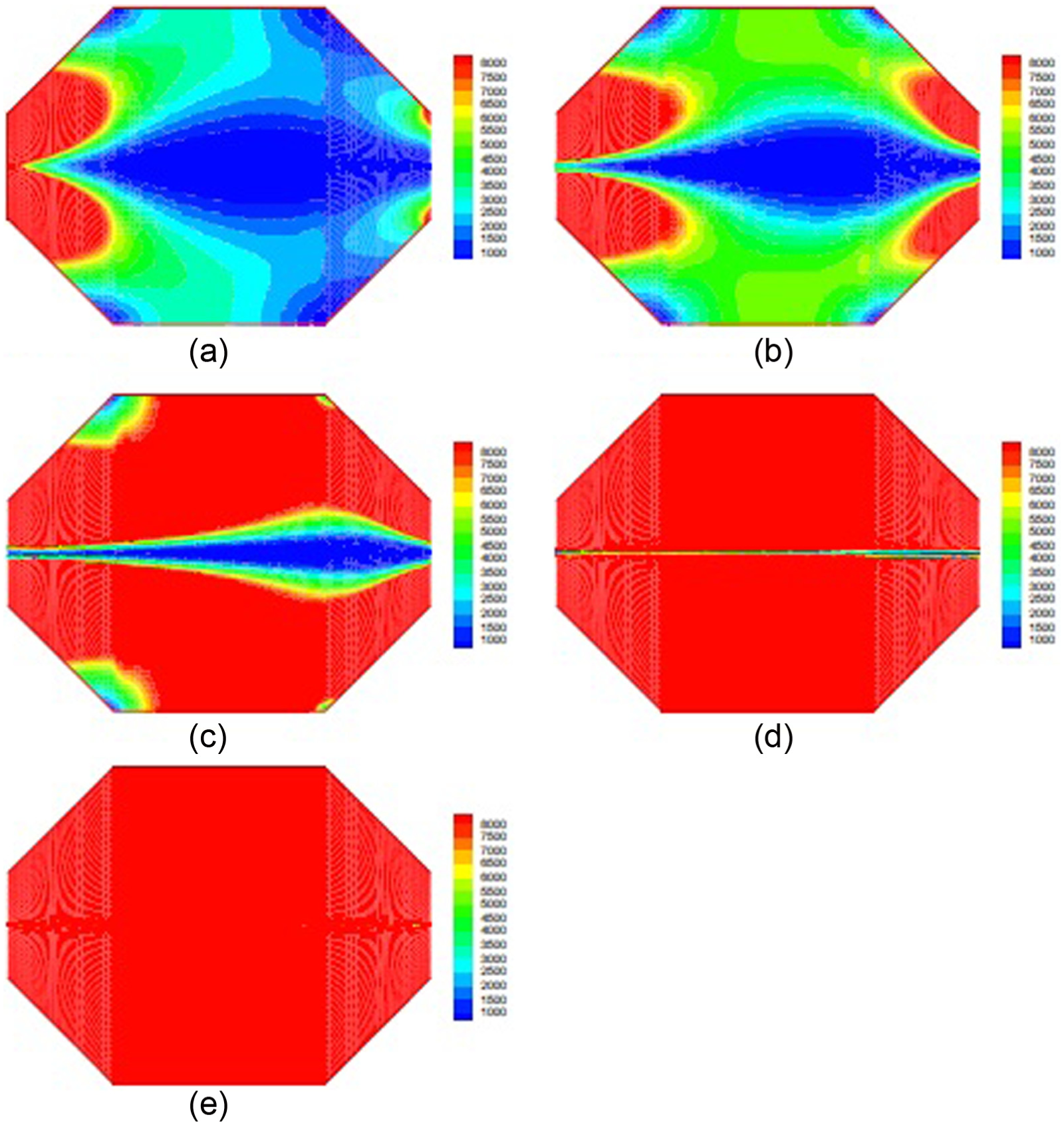
Entropy generation as function of Reynolds number for one of the modules of triangular channel configuration with horizontal pitch (l/L = 1/2): (a) Re = 25, (b) Re = 50, (c) Re = 100, (d) Re = 200, and (e) Re = 400.
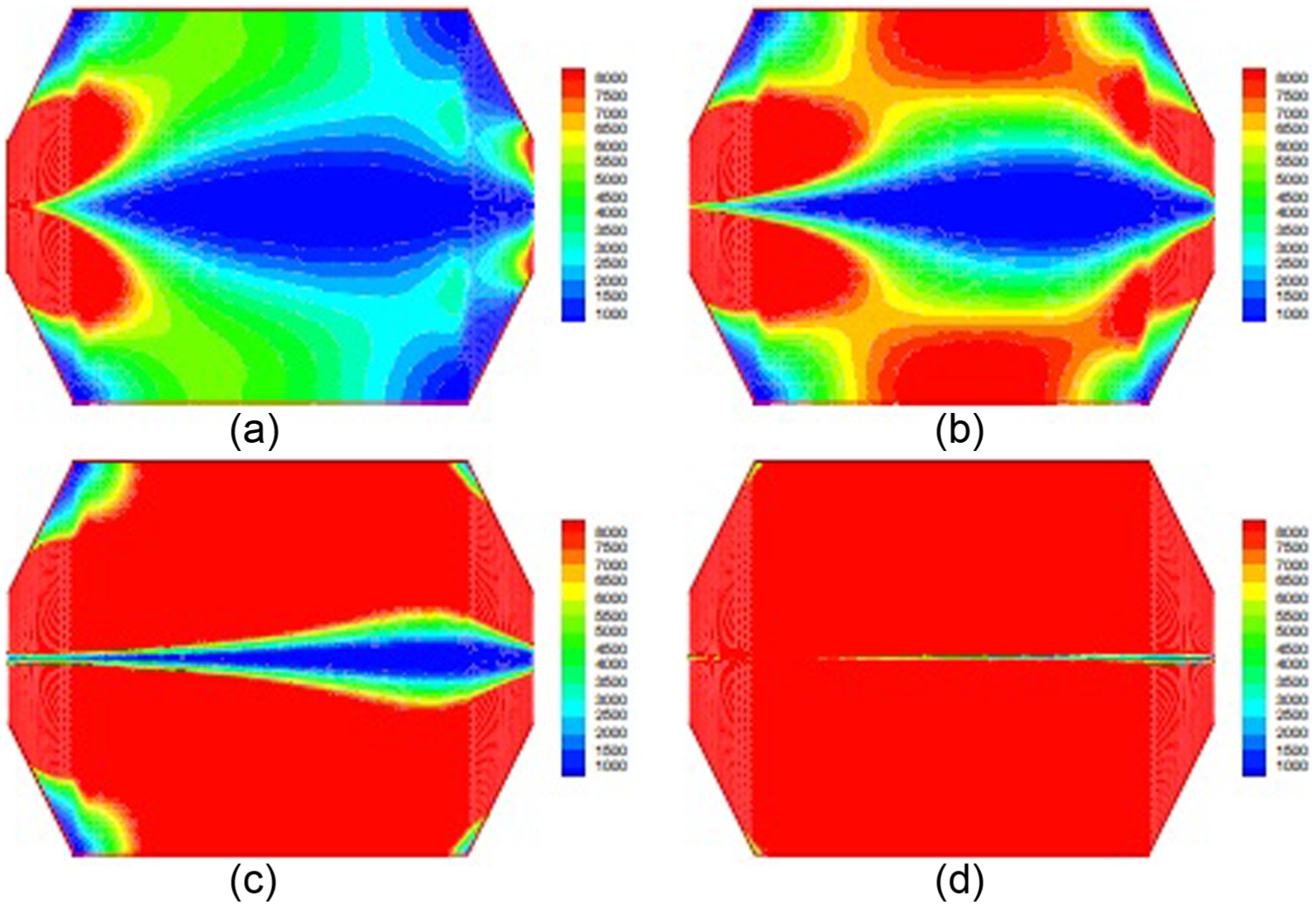
Entropy generation as function of Reynolds number for one of the modules of triangular channel configuration with horizontal pitch (l/L = 3/4): (a) Re = 25, (b) Re = 50, (c) Re = 100, (d) Re = 200, and (e) Re = 400.
The effect of the horizontal pitch on the rate of the entropy generation profiles is shown in Figures 5–9. As the horizontal pitch increases, two stagnation regions developed around the two sharp corners at each side of the channel. The stagnation regions get separated as the horizontal pitch increased and grew in size as the channel volume also increased. Consequently, the average volumetric entropy generation rate was smaller for the large horizontal pitch sizes. This can be observed from the low entropy generation rate around the sharp corners for the case of Re of 200 and horizontal pitch of l/L = 3/4 (Figure 9(d)).
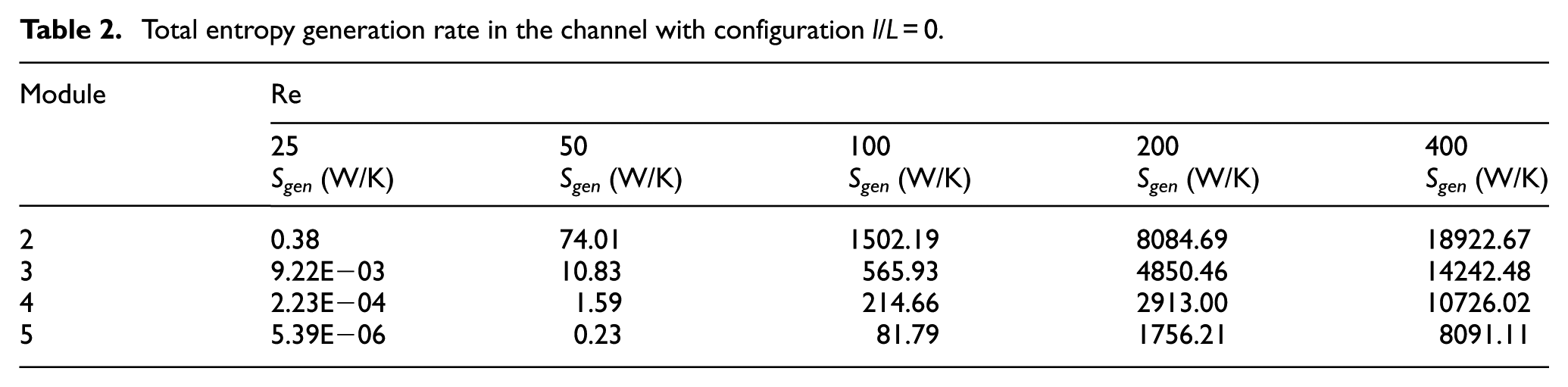
The overall entropy generation in various modules in the channel with no horizontal pitch (l/L = 0) is given in Table 2 as a function of the Re number. The effect of the Re number was observed to be considerable. The overall entropy generation was higher in the second module. This is due to sudden expansion that occurs in the modules close to the inlet. The total entropy generation in the second module varies from 0.38 W/K for Re number of 25 to 18922.67 W/K for Re number 400. The range of the total entropy generation in the fifth module for the same Re number range varies from 5.39 × 10⁻⁶ to 8091.11 W/K. As the periodically fully developed condition was reached, the entropy generation rate decreased and approached to a steady state value. Therefore, the decrease in the total entropy generation is much faster for the case of Re number 25 in which case the steady state flow is reached in a shorter distance from the inlet. The total entropy generation for the case of Re number 400 across the modules from the second module to the fifth module is only 57% which indicates that the steady state flow is not yet reached. The effect of the boundary condition at the exit was also observed in the overall entropy generation.
Total entropy generation rate in the channel with configuration l/L = 0.
Conclusion
A numerical analysis is carried out for the volumetric entropy generation in the periodic, corrugated triangular channels with and without horizontal pitch for steady flow conditions. Air was considered as the fluid with Prandtl number 0.7. Four different types of wavy geometries were considered, namely, triangular without horizontal pitch l/L = 0 and triangular with horizontal pitch l/L = 0.1, 1/4, 1/2, and 3/4, respectively. The effect of the Re number on the volumetric entropy generation was found to be significant. The size of the horizontal pitch affects the distribution of the volumetric entropy generation. As the horizontal pitch increased, the sharp corners in the channel exhibited low entropy generation rate regions. The overall entropy generation rate was found to be higher in the modules close to the entry. For the case of no horizontal pitch, the total entropy generation in the second module near the inlet varied from 0.38 to 18922.67 W/K, for Re number 25 to 400, respectively. As the periodic steady conditions were reached in the subsequent modules, the entropy generation rate was found to decrease. The total entropy generation decreases sharply across the modules for low Re number (Re = 25). The decrease in the total entropy generation from the second through the fifth module is only 57% for the case of Re = 400.
Footnotes
Academic Editor: Oronzio Manca
Declaration of conflicting interests
The author(s) declared no potential conflicts of interest with respect to the research, authorship, and/or publication of this article.
Funding
The author(s) disclosed receipt of the following financial support for the research, authorship, and/or publication of this article: This study was supported by King Abdulaziz City for Science and Technology (KACST) through the Science & Technology Unit at King Fahd University of Petroleum & Minerals (KFUPM) through project no. 14-ENE2337-04 as part of the National Science, Technology and Innovation Plan.