Flow and heat transfer through the boundary layers of a falling liquid film on a vertical permeable plate subject to nonuniform suction flow are analyzed in this work. The continuity, momentum, and energy equations are transformed to nonsimilar equations and solved using a validated implicit and iterative finite difference method. Increases in the Froude number, Galilei number, and the dimensionless average suction velocity are found to increase the skin friction coefficient, the Nusselt number, and the heat transfer enhancement ratios. These enhancement ratios are noticed to increase at the plate exit as the suction velocity power-law index increases. The Froude number for uniform suction case required to attain the same enhancement ratios due to nonuniform distribution of this suction flow is found to increase as the Galilei number, average suction velocity, and power-law index increase. It is found that the upper most values of the enhancement factors in heat transfer and Froude number are folds when the suction power-law index is equal to . This work demonstrated that significant heat transfer enhancement inside developing gravity-driven liquid films is attainable when properly distributing the suction velocity along the plate.
The transport phenomena associated with liquid falling films (gravity-driven liquid films) along solid surfaces are vital to many engineering applications. For example, liquid falling films are used in air conditioning applications where that liquid is a salt solution known as liquid desiccant. This salt solution has the capability to absorb moisture from air,1–3 resulting in reducing the environment humidity ratio and improving the coefficient of performance of the refrigerating cycle.2 Thus, human comfort is enhanced and electrical energy consumption is reduced. Also, gravity-driven liquid films are widely used in reactors that encounter processes such as sulfonation, chlorination, ethoxylation, and hydrogenation.4,5 These liquid film reactors have two main advantages: large mass transfer rates and small pressure drops.6 Accordingly, hydrodynamics and heat transfer in developing gravity-driven liquid films have been analyzed extensively in the literature.7–15 In most of these researches, similar and nonsimilar solutions were developed7–14 based on the fact that the liquid falls on the plate with zero velocity. However, the most occurring situations are the cases when the free stream velocity at the wall entrance is nonzero. These situations are expected when the wall entrance is below the outlet nozzle of the gravity-driven liquid stream.
One can notice that the works in the available literature concerned with gravity-driven liquid films in the absence of phase change7,8,13–15 do not include the effect of the pressure gradient outside the liquid film. This gradient adds additional buoyancy force against the driving gravitational force that reduces the stream velocity. Also, it can be noticed from those works that the controlling parameters for flow and heat transfer inside the gravity-driven liquid films are limited to the Reynolds and Prandtl numbers. However, having both nonzero falling velocity and external pressure gradient necessitates that those controlling parameters must be the Froude, Galilei, and Prandtl numbers as well as the external fluid-to-falling liquid density ratio. As such, advanced modeling of flow and heat transfer inside the boundary layers of the gravity-driven liquid films will be made in this work to account for the role of the Froude and Galilei numbers as well as the fluid’s relative density ratio. Meanwhile, relatively modest attention has been made in the available literature7,8,13–15 to explore the heat transfer enhancement inside the developing region of the gravity-driven liquid film. Consequently, advanced heat transfer analysis will be performed in this work to account for heat transfer enhancement inside gravity-driven liquid films due to uniform and nonuniform surface suctions. These choices proved in the literature to have significant influence in increasing the heat transfer inside various thermal systems.16,17
In the next sections, flow and heat transfer inside the boundary layers of a gravity-driven liquid film along a vertical preamble plate subject to nonuniform suction flow are modeled and analyzed. The surface suction velocity is considered to have power-law profile distribution. Both momentum and energy equations of the developing liquid film are transformed into nonsimilar equations and solved numerically. The skin friction coefficient, Nusselt number, and different heat transfer enhancement indicators are computed. The numerical solutions are validated with the asymptotic analytical ones. An extensive parametric study has been conducted in order to explore the influence of average surface suction velocity, suction velocity profile, Froude number, and Galilei number on the skin friction coefficient, Nusselt number, and different heat transfer enhancement indicators.
Problem formulation
Modeling of flow and heat transfer inside a falling film boundary layer
Consider a vertical permeable plate of length . A fluid stream with free velocity and thickness starts to fall over the plate from its highest edge (entrance) as shown in Figure 1. Based on the Bernoulli equation,18 the fluid free stream velocity will change outside the velocity boundary layer of the plate according to the following relationship
where and are given by
Schematic diagram of the problem and the coordinate system.
, , and are the coordinates along the plate length, gravitational acceleration, and effective Froude number, respectively. and are the falling and external fluid densities, respectively. The following assumptions are considered in this work: laminar flow, constant fluid properties, negligible axial diffusive terms, and negligible transverse variation in the pressure. The last two assumptions reveal the boundary layer assumptions. The falling liquid stream forms a developing region that has the following dimensionless continuity, momentum, and energy equations18,19
where , , , , and are given by
is the normal position coordinate. and are the velocity components along the - and -coordinates, respectively. and are the liquid and the free stream temperature fields, respectively. and are the dimensionless temperature and the applied heat flux which is constant, respectively. and are the liquid Prandtl number and dynamic viscosity, respectively. is a reference Reynolds number. Ga is the Galilei number. This number is defined as follows
The permeable plate is considered to be subjected to nonuniform surface suction with surface suction velocity equal to
where is the average surface suction velocity and is the power-law index. The boundary conditions of the present problem are the following
Equations (12) and (13) were derived based on fact that the liquid film is thicker than both the velocity and temperature boundary layers.
It should be mentioned here that when , the velocity boundary layer will be thicker than the temperature boundary layer. Thus, the temperature profile will not be directly affected by the advection in inviscid region. However, when , the velocity boundary layer will be thinner than the temperature boundary layer. For this case, the temperature profile will be more influenced by the advection in the inviscid region, as the free edge of the temperature boundary layer is located in the inviscid fluid region.
Nonsimilar transformation of the transport equations
Define the following independent and dependent variables
These variables transform equations (2)–(4) to the following nonsimilar equations
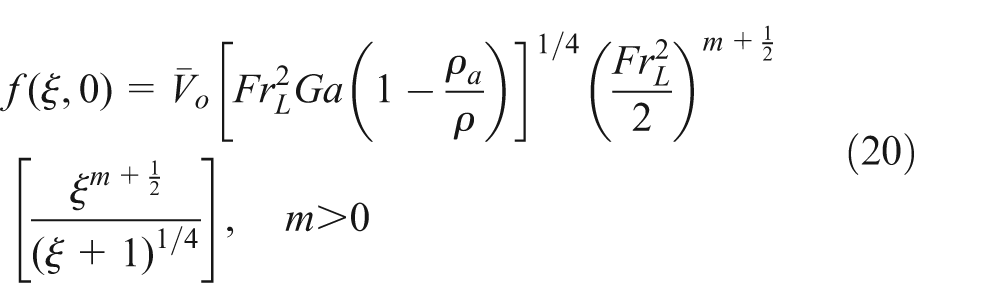
When applying the boundary condition given by equations 11(b) on equation (17) the resulting equation is an ordinary differential equation which when solved results in the following equation
Equation (18) along with its boundary conditions reduces to the following when
Equation (25) is the Blasius equation.19,20 Furthermore, equation (19) can be solved analytically when . Its solution is given by
The flow and heat transfer performance numbers
The local skin friction coefficient and local Nusselt number are given by
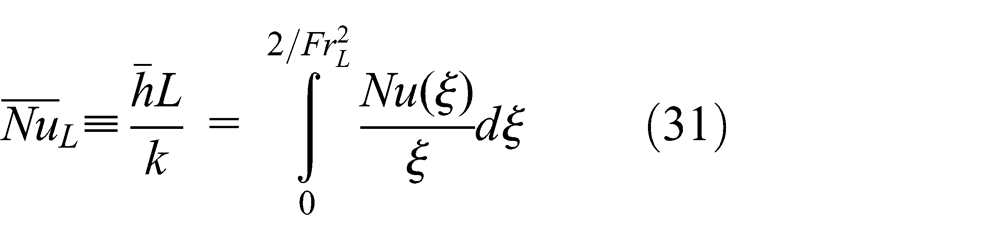
The average values of and are given by
The heat transfer enhancement indicators
Let the first heat transfer enhancement indicator be defined as ratio of the boundary excess temperature for reference case to that quantity when . It is written as
Since the applied heat flux is constant, heat transfer is already known in advance. The enhancement in heat transfer that is indicated by will occur if it is larger than 1. This means that the plate temperature is colder than that of the typical case where there is no suction. Accordingly, the applied heat flux can be increased to raise the plate temperature in order to reach that of the latter typical case.
The second performance indicator is defined as the ratio of the boundary excess temperature for the perfect fluid-slip case to that quantity under no-slip condition. Mathematically, it is given by
The energy equation for the perfect fluid-slip at the solid boundary (ideal case)
When perfect slip is present between the plate and the liquid, equation (6) reduces to
where is the dimensionless temperature field for this case, . Applying the following independent variable
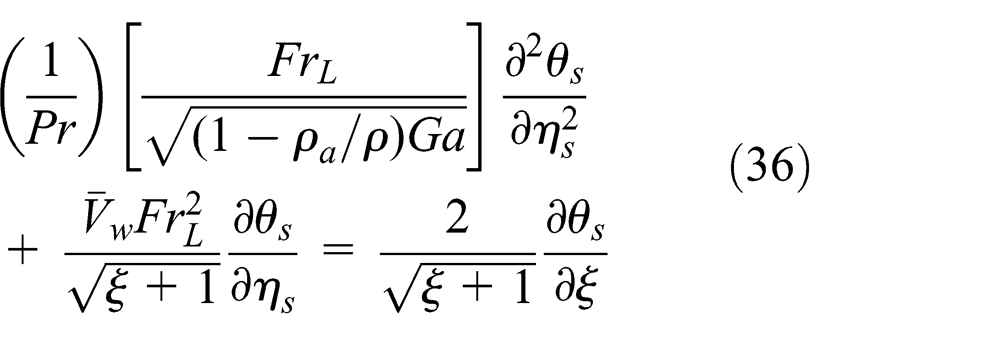
to equation (34) results in the next partial differential equation
The reduced boundary conditions are given by
Numerical methodology validations and results
Numerical methodology
The implicit finite difference method explained by Blottner21 is used to solve equations (18), (19), and (36) that are subjected to boundary conditions given by equations (20)–(24) and equations (37) and (38). Equation (18) is a third-order partial differential equation which is reduced to second-order partial differential equation by letting . Also, equations (18) and (19) are linearized and consequently discretized using three-point central different quotients for all derivatives in the -direction. The following linearization models are used to linearize and 22
where and are the values of and at the previous iteration, respectively. The resulting discretized equations at given value form tridiagonal systems of algebraic equations that can be easily solved using Thomas algorithm.21 Next, the differential equation is solved using the trapezoidal rule.23 Since equation (18) is nonlinear, an iterative procedure is required to obtain its exact solution at given . A maximum relative error in computing of was considered as a convergence criterion. The following iterative scheme is used
where is taken to be . Solutions of equations (18), (19), and (36) march from to using two-point backward different quotient for the first derivatives in the -direction. The step sizes in the - and -directions are taken to be and , respectively.
Validations and numerical results
For large and uniform suction velocity, equations (5) and (6) reduce to
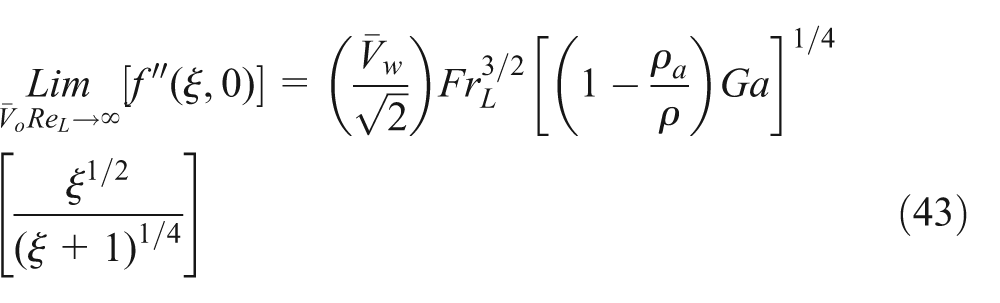
The solutions to these equations result in and equal to
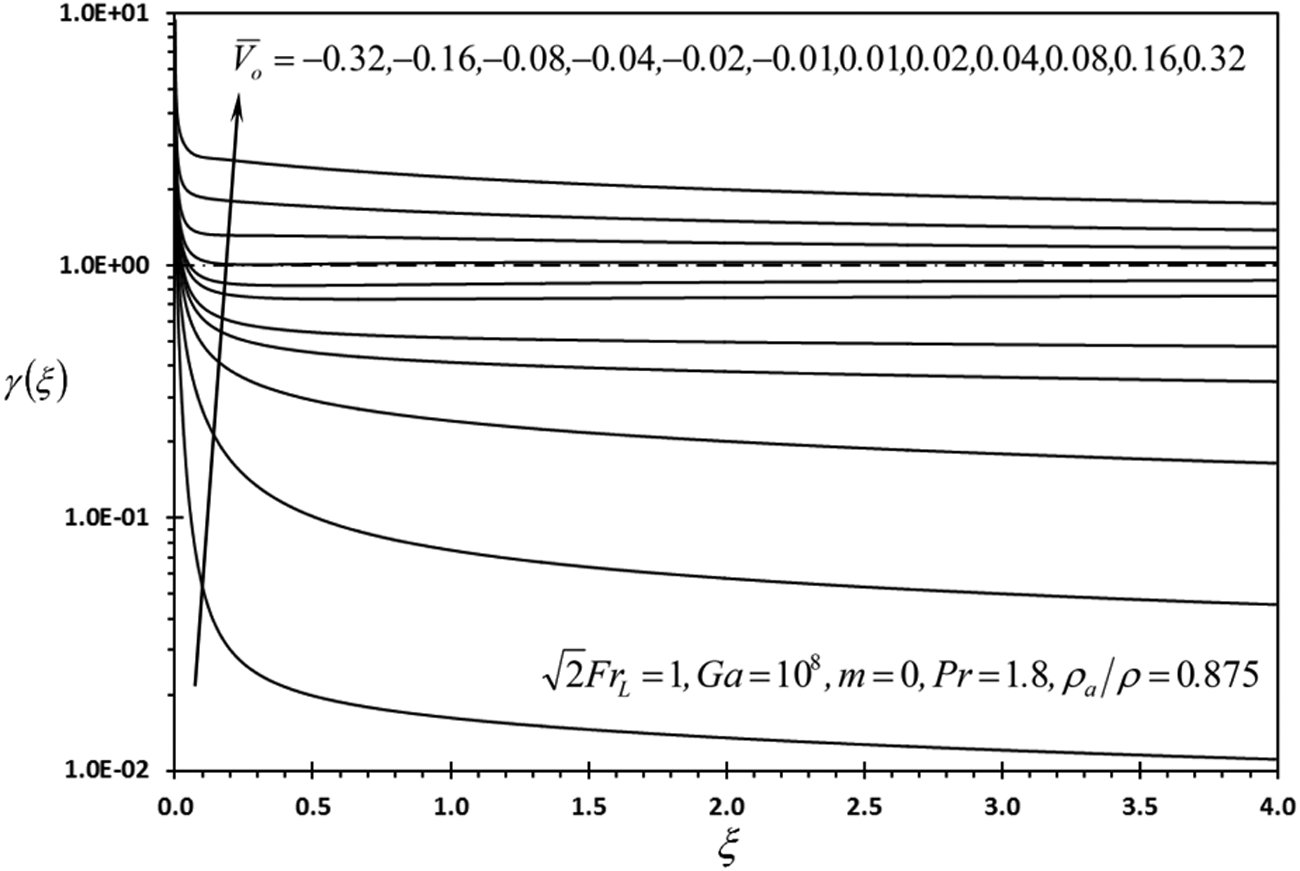
The plots of Figures 2 and 3 that are indented by show the comparison between and computed using the proposed numerical method and those computed by equations (43) and (44), respectively. The maximum relative difference between the compared results is equal to when . This led to large confidence in the obtained numerical solutions of this work which are shown in Figures 2–14.
Effects of and on .
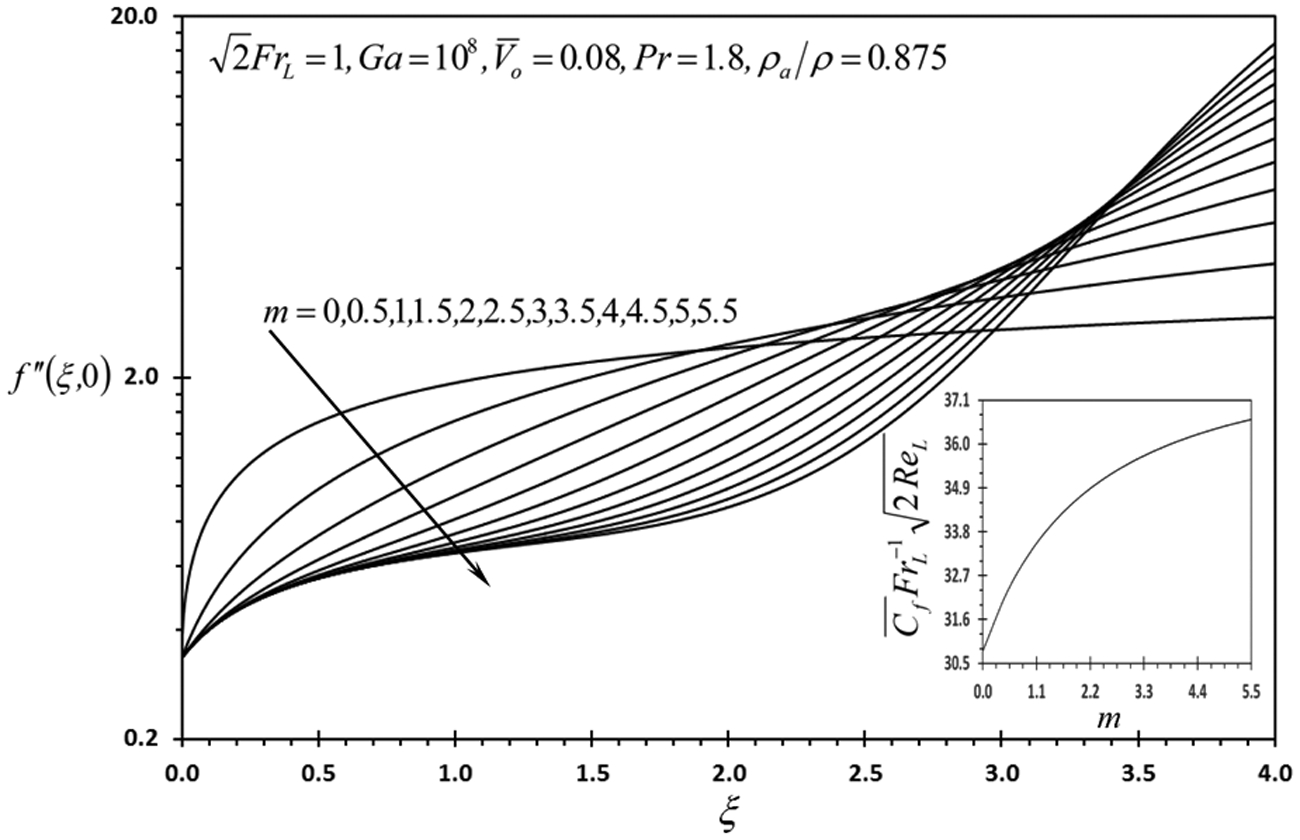
Effects of and on .
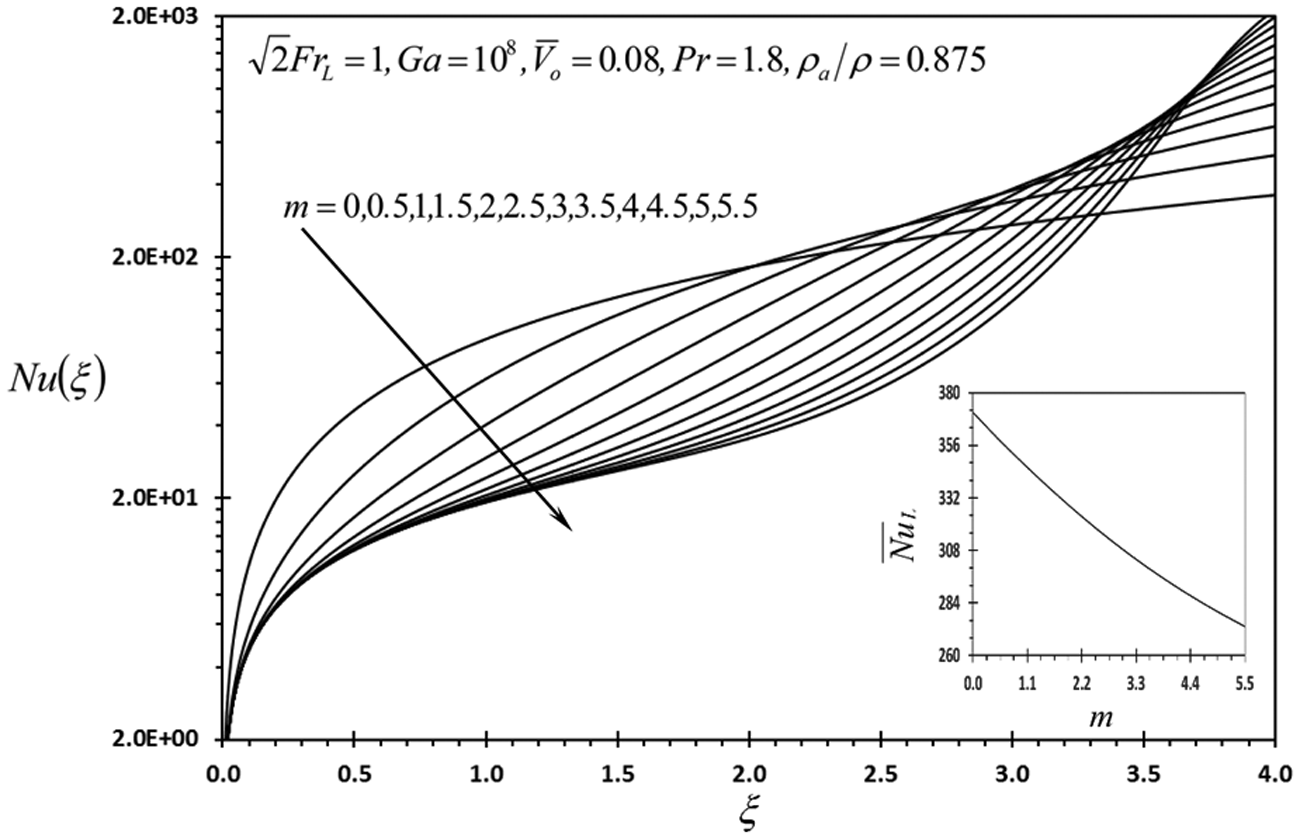
Effects of and on .
Effects of and on .
Effects of and on .
Effects of and on .
Effects of and on .
Effects of and on .
Effects of and on .
Effects of and on .
Effects of and on .
Effects of and on .
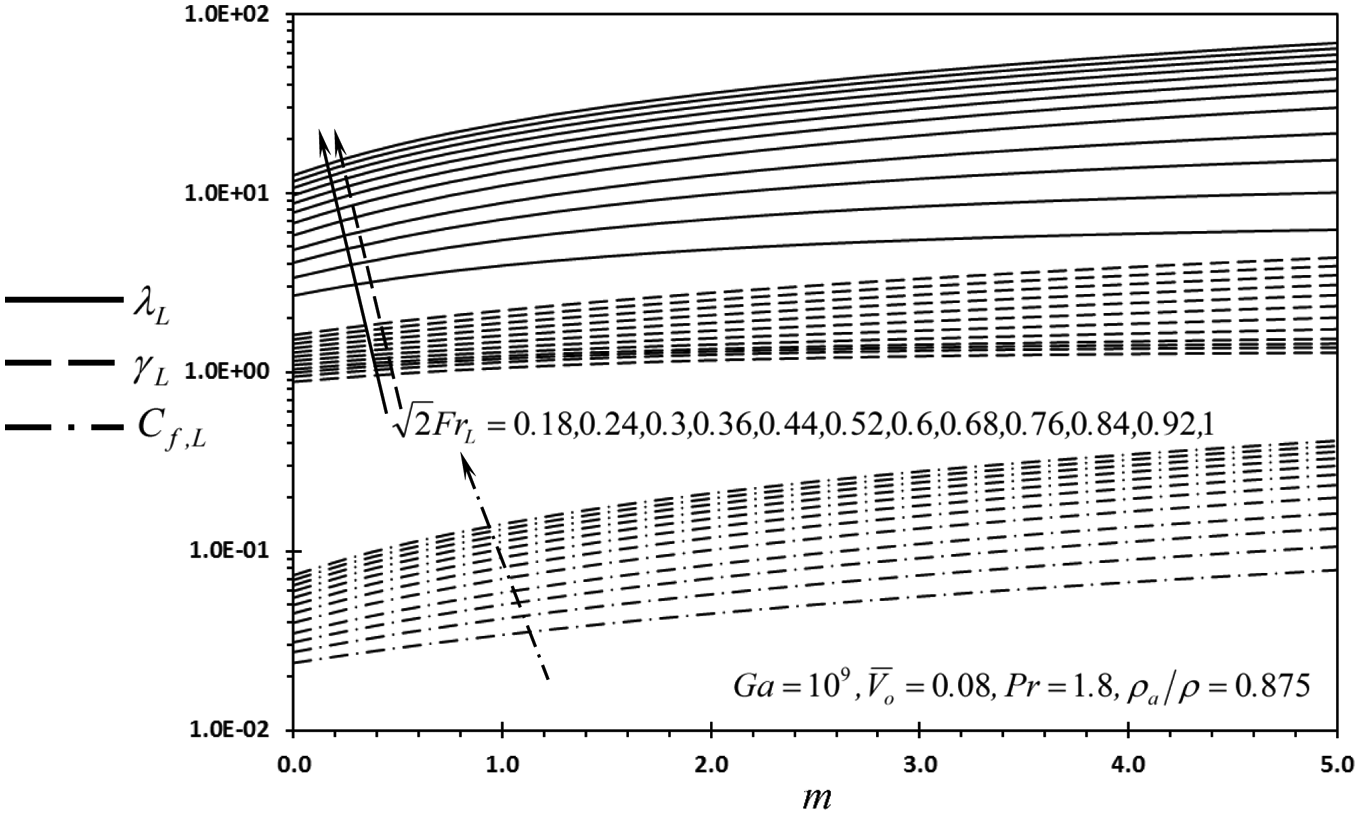
Effects of and on , , and .
Discussion of the results
Influence of average suction velocity on flow and heat transfer characteristics
Figure 2 shows the effects of the average suction velocity on that is linearly proportional to the skin friction coefficient at given -value. It is seen from this figure that increases as increases since the velocity boundary layer thickness decreases as increases.7 When and is near the plate entrance, wall blowing affects wall shear stress more than the shear force at boundary layer interface since is small in this region. This effect causes to decrease as increases. However, far downstream, the shear force at the boundary layer interface affects the wall shear stress more than the wall blowing since is large there and this causes to increase as increases. Accordingly, has a local minimum value near the plate upper edge when . It should be mentioned here that the wall blowing tends to decrease wall shear stress when free stream velocity is constant.
Figure 3 shows that the Nusselt number increases as increases. When , increases as increases due to the increase in the free stream velocity. For large values of when , the blowing effect significantly widens the boundary layer thicknesses causing insignificant influence of free stream velocity on heat transfer. Thus, decreases as increases. For moderate values of when , the counter-effects of blowing and free stream accelerating velocity on heat transfer result in having local maximum value of close to the upper end. This is clearly shown in Figure 3 for the plot with . Also, Figure 3 shows that increases as increases when and when . This indicates that the role of the accelerating free stream velocity on heat transfer is dominating over the role of the blowing effect along the whole length of the plate. Figure 4 illustrates that heat transfer enhancement is ensured when since along the whole plate length when . Figure 5 demonstrates that the present system has better enhancement ratio than the case with perfect fluid-slip at the surface when . It is because that perfect fluid-slip condition at the surface tends to increase the convection heat transfer coefficient leading to reduction in excess surface temperature. This causes reduction in the transverse convection due to surface suction. Note that this transverse convection is proportional to .
Influence of suction power-law index on flow and heat transfer characteristics
Figures 6–9 show that , , , and decrease as increases near the upper end (entrance) while they increase as increases close to the lower end (exit). The average value of the skin friction coefficient is shown from Figure 6 to increase as increases, while Figure 7 shows that the average value of the Nusselt number decreases as increases. All values of when result in as shown in Figure 8. Figure 9 demonstrates that as increases, the extension of the plate from the lower end that results in decreases. This is because the surface suction velocity increases significantly at the lower end as increases. This results in increasing the transverse convection. However, the perfect fluid-slip condition at the surface tends to additionally increase the convection coefficient leading to further reduction in excess surface temperature. This causes reduction in the transverse convection due to surface suction as this convection is proportional to . Table 1 shows the variation in the required effective Froude number with uniform surface suction velocity case necessary to obtain the same Nusselt at the lower end for the case having nonzero power-law index . This value is denoted by . It is shown that increases as both and increase. The variation in with is noticed to be insignificant for large values of . This table shows that properly distributing the surface suction velocity can save large flow work energy necessary to obtain the same temperature of the lower end as reached values above 6 when and . The values of are obtained as follows: (1) the present problem is solved for wide range of for a given with , (2) is correlated to for the given , (3) the present problem is solved for a given and with various values, and (4) for a given is set to be equal to and is substituted in the aforementioned correlation in order to obtain . The generated correlation is of the following form
Values of Froude number at required to have the same Nusselt number at the bottom end when , , and .
The correlation coefficients for four different cases that produce correlation coefficient equal to are shown in Table 1. For large values, equation (44) can be used to show that
Influence of Galilei and Froude numbers on flow and heat transfer characteristics
Figures 10–13 show that , , , and increase as increases. Also, Figure 14 shows that , , and increase as increases. The increase in is achieved by the increase in both and under same ratio, while the increase in is achieved by the increase in . Figure 12 shows that all numbers resulted in . Furthermore, it is shown from Figure 13 that becomes when . It is because the boundary layer thickness increases as increases. Thus, the excess temperature becomes more apparent as increases compared to that for the perfect fluid-slip condition at the surface. This effect tends to increase the transverse convection as that convection is proportional to . Figure 14 shows that , , and become less sensitive to for large numbers.
Conclusion
The problem of laminar flow and heat transfer by forced convection inside the boundary layers of a gravity-driven liquid film on a vertical permeable plate subject to nonuniform surface suction was analyzed. A constant wall heat flux was assumed at the plate. A power-law functional form was considered to model the surface suction velocity. Nonsimilar continuity, momentum, and energy equations were obtained using properly selected transformation variables. These equations were solved numerically using an implicit, iterative, and finite difference method. Excellent agreement was obtained between the present results and those for asymptotic analytical solutions. It was found that increases in the Froude number, Galilei number, and dimensionless average suction velocity cause increases in the skin friction coefficient, Nusselt number, and heat transfer enhancement ratios. The heat transfer enhancement ratios computed at the lower end of the plate were noticed to increase as the suction power-law index increases. The Froude number for the uniform surface suction case that is necessary to attain the same heat transfer enhancement ratios due to nonuniform surface suction distribution was found to increase as the Galilei number, average suction velocity, and power-law index increase. The upper most values of the enhancement factors in heat transfer and Froude number were found to be fold when the suction power-law index is equal to . The results of this work demonstrate that significant heat transfer enhancement inside the boundary layers is attainable when properly distributing the suction velocity along the plate.
Footnotes
Appendix 1
Academic Editor: Gongnan Xie
Declaration of conflicting interests
The author declares that there is no conflict of interests regarding the publication of this article.
Funding
This article was funded by the Deanship of Scientific research (DSR), King Abdulaziz University, Jeddah. The author, therefore, acknowledges with thanks DSR’s technical and financial support.
References
1.
SickFBushulteTKKleinSA. Analysis of the seasonal performance of hybrid desiccant cooling systems. Sol Energy1988; 40: 211–217.
2.
AliAVafaiKKhaledARA. Analysis of heat and mass transfer between air and falling film in a cross flow configuration. Int J Heat Mass Tran2004; 47: 743–755.
3.
MeiLDaiYJ. A technical review on use of liquid-desiccant dehumidification for air-conditioning application. Renew Sust Energ Rev2008; 12: 662–689.
4.
DabirBRiaziMRDavoudiradHR. Modelling of falling film reactors. Chem Eng Sci1996; 51: 2553–2558.
5.
Talens-AlessonFI. The modelling of falling film chemical reactors. Chem Eng Sci1999; 54: 1871–1881.
6.
ZhangHChenGYueJ. Hydrodynamics and mass transfer of gas–liquid flow in a falling film microreactor. AIChE J2009; 55: 110–1120.
7.
PopIWatanabeTKonishiH. Gravity-driven laminar film flow along a vertical wall with surface mass transfer. Int Commun Heat Mass1996; 23: 685–695.
8.
AndersonHIIrgensF. Gravity-driven laminar film flow of power-law fluids along vertical walls. J Non-Newtonian Fluid1988; 27: 153–172.
9.
YihSMLeeMW. Heating or evaporation in the thermal entrance region of a non-Newtonian, laminar, falling liquid film. Int J Heat Mass Tran1989; 29: 1999–2002.
10.
ShangD. Free convection film flows and heat transfer—models of laminar free convection with phase change for heat and mass transfer analysis. 2nd ed.New York: Springer, 2012.
11.
ShangD. Theory of heat transfer with force convection film flows. New York: Springer, 2011.
12.
SparrowEMGreggJL. A boundary layer treatment of laminar film condensation. J Heat Trans: T ASME1959; 81: 13–18.
13.
AnderssonHIYtrehusT. Falkner-Skan solution for gravity-driven film flow. J Appl Mech: T ASME1985; 52: 783–786.
14.
JalilAHossainARezaM. Study of gravity-driven film flow with variable physical properties along an inclined wall. Int J Sci Eng Res2013; 4: 1346–1354.
15.
AhmadKNazarRPopI. Falkner-skan solution for gravity-driven film flow of a micropolar fluid. Sains Malays2011; 40: 1291–1296.
16.
KhaledARA. Mathematical and numerical analysis of heat transfer enhancement by distribution of suction flows inside permeable tubes. Math Probl Eng2015; 2015: 953604-1–953604-11.
17.
BerglesAE. Chapter 11: techniques to enhance heat transfer. In: RohsenowWMHartnettJPChoYI (eds) Handbook of heat transfer. New York: McGraw-Hill, 1998, p. 11.55.
18.
DurstF. Fluid mechanics: an introduction to the theory of fluid flows. Berlin, Heidelberg: Springer-Verlag, 2008.