



Abstract
Glazing energy resulting from solar radiation can be the main source to vary the thermal field inside of a building. As the glass material is loaded by intensive solar radiation, the glazing energy, greatly induced, will result in the drastic increase in interior temperatures and yield the energy demand for air conditioning loads. Reducing energy consumption is imperative; therefore, this article presents the patterned glass technology which incorporates linearly and uniaxially symmetric patterns throughout the exterior surface of glass to attenuate the solar energy entering indoors. By imposing the patterns over the glass surface, the glazing energy can be reduced due to the increase in the incident angle and the decrease in the solar energy loading on the glass. The thermal performance of the linearly patterned glass is evaluated by computational fluid dynamics technique. Based on computational fluid dynamics–evaluated results, as the patterned glass is applied on the window opening, the interior solar heat is able to be decreased. Moreover, the glazing energy can be strongly associated with the pattern design. Increasing the patterned angle and decreasing the patterned space help reduce solar effect on the interior temperatures.
Keywords
Introduction
Building energy consumption due to solar radiation can be significantly increased in warm climates. In summer season, for instance, since the excessive solar load transmits glass material and enters indoors, the interior temperature drastically rises and yields the air conditioning need and energy demands. Whereas reducing energy consumption is consistently an important course to the world, this article attenuates the effect of solar energy on the glass material, using linear patterns. For a solar-loaded glass material, the transmitted solar energy, which is strongly associated with the thermal field inside of a building, depends on the incident angle. As the glass material is subjected to patterns over the exterior surface, the pattern member is able to locally vary the incident angle and yield the change in glazing energy due to solar radiation.
Lin et al. 1 employed the theoretical approach to investigate the incident angle of linearly patterned glass and demonstrated that the linearly patterned glass is able to give the reduction in the interior solar heat based on thermal measurements. Due to difficulties of fabricating patterned glass specimens, Lin et al.’s work concentrated on analyzing the linearly patterned glass having trapezoidal-shaped patterns under solar energy loaded, and the relation between the thermal performance of linearly patterned glass and the patterned design was investigated based on varying the dimension of top edge of the trapezoidal pattern only. The linearly patterned glass with various patterned shape, patterned spacing, and patterned angle is not involved in Lin et al.’s study. Numerical analysis related to linearly patterned glass was provided by Lin et al. 2 Lin et al. utilized computational fluid dynamics (CFD) technique to evaluate the thermal performance of the roof linearly patterned glass under solar radiation at noon. Based on Lin et al.’s analytical results, as the linearly patterned glass is applied on the roof and vertically solar loaded, the interior thermal energy due to solar radiation can be reduced. Based on the theoretical incident angle of the patterned glass given by Lin et al.’s work, 1 the solar orientation at noon yields the incident angle of the roof linearly patterned glass equal to the patterned angle. For the traditional flat glass applied on the roof, since the flat glass is vertically loaded by solar radiation, the incident angle of the flat glass equals zero which is always smaller than the incident angle of the roof linearly patterned glass under solar radiation at noon. Since the glazing energy is related to cosine function of the incident angle, 3 the patterned glass applied on the roof window and loaded by solar radiation at noon will always result in the less glazing energy compared with that of the traditional flat glass. Moreover, Lin et al 1 found that the incident angle of the patterned or traditional flat glass can be dependent on the direction of the incident solar beam and the orientation of the glass (i.e. the tilted angle of glass). Therefore, if the patterned glass is not placed horizontally and/or vertically loaded by solar energy, the incident angle of the linearly patterned glass is not equal to the patterned angle. For the traditional flat glass, except the solar orientation is coincident with the normal direction of the flat glass, for instance, the flat glass applied on the roof and vertically subjected to the solar radiation, the incident angle of the traditional flat glass is not zero. Consequently, it is possible that the roof solar-loaded traditional flat glass can sometimes appear to have greater incident angle than that of the patterned glass in a certain time of a day. In order to fully understand the effect of surface pattern on the glazing energy, this article employs CFD approach to analyze the thermal response of linearly patterned glass based on solar radiation loaded in a whole day. Moreover, since the incident angle can be locally changed by the surface pattern, this article varies the design parameters of the surface pattern including the patterned angle and patterned spacing to analyzing the linearly patterned glass and determines the adequate design rule based on the analytical results.
Theoretical glazing energy indicates that as the glass material is loaded by incident solar radiation, the glazing energy induced in the glass material can be affected by the incident angle. When the incident angle increases, the glazing energy decreases. According to Lin et al.’s study, 1 the incident angle can be dependent on the orientation of incident solar beam, pattern design, and the tilted angle of glass. Therefore, applying the theoretical glazing energy and Lin et al.’s analytical results, 1 one is aware that as the flat glass is horizontally applied on the roof window and loaded by solar radiation at noon, the maximum glazing energy is induced due to the incident angle equal to zero and the maximum outdoor solar energy attained in the middle day. In order to investigate the maximum solar heat dissipation given by the glass pattern, the parametric analysis of the linear pattern is completed based on the roof patterned glass subjected to solar radiation at noon. The analytical results given by the parametric analysis will be utilized to determine the design rule for the linearly patterned glass. Moreover, due to the linearly patterned glass possibly appearing to have the smaller incident angle than that of the traditional flat glass at some time of a day, it is crucial and informative to analyze the patterned glass under solar loaded in a whole day. Therefore, as long as the adequate design rule for the linearly patterned glass is acquired, the thermal response of the patterned glass with the adequate/optimal surface patterns under solar radiation throughout a whole day will be analyzed in this article, using CFD technique. The assessment of the interior solar heat dissipation given by the optimized linearly patterned glass is provided based on comparing with the traditional flat glass.
In previous years, there were several works related to attenuate solar effect on the interiors. Hassan et al. 4 utilized ventilations to reduce the interior solar heat intensity and gave that as the two windows are place apart, interior ventilation due to window openings will be improved. Persson et al. 5 analyzed the effect of window size on energy consumptions of houses and found that making the smaller dimension for the window opening facing to south enables the reduction in energy demands in warm climates. Etzion and Erell 6 developed a rotatable glazing mechanism which gave the flexibility to place the adequate glazing material on the outer pane of glass unit as climate changes and so as to yield the decrease in transmitted solar energy entering indoors. Glass surface having blue and green coatings helps filter some infrared radiation and thereby can be applied in warm climates to reduce the interior thermal energy due to solar radiation. 7 Urbikain and Sala 8 evaluated energy savings associated with windows based on analyzing the U-factor of window, solar heat gain of glazing and infiltration, as well as U-factor and absorptivity of the frame. Fang et al. 9 employed a three-dimensional finite volume model to investigate the thermal performances of vacuum glazing with coatings and found that the excellent performance of glazing is able to be acquired as a single low emittance of 0.02 coating is applied on the vacuum glazing. Al-Shukri 10 developed a multilayer thin film–coated energy-efficient glass window for the applications in warm season and concluded that the glass system with any of the three dielectrics performs well on reducing energy needs, and the efficiencies of the glazing systems with different dielectrics are approximately same. Karlsson and Roos 11 studied the impact of thermal emittance values on the cooling energy. Their study indicated that as the thermal emittance of glazing is decreased between 2% and 3%, the solar transmittance is also reduced approximately between 2% and 3%. Glass double facades (GDF) are getting popular to be applied in commercial buildings. Manz 12 and Manz et al. 13 utilized a spectral optical and a CFD model to investigate the thermal behavior of GDF and proposed that based on a well-designed GDF with free convection, a 10% reduction in total solar energy transmittance can be attained. Since the effect of solar radiation on the glazing system is important to the thermal comfort and energy consumptions, Pal et al. 14 measured the optical properties of glazing to determine the percentage of incident solar radiation.
While previous works provided in the literatures help solar heat dissipations in the interiors, they could be difficult and elaborative. Therefore, this article provides the linearly patterned glass approach, which incorporates linear patterns throughout the exterior surface of glass, to attenuate the transmitted solar energy. Advantages of less elaboration and complexity enhance the applicability of the described linearly patterned glass on the reality.
Theoretical incident angles for roof linearly patterned and traditional flat glass
Reducing glazing energy of the solar-loaded glass material helps attenuate the interior thermal energy resulting from solar radiation. The governing equation of glazing energy written in equation (1) indicates that the glazing energy q due to solar radiation is associated with the direct normal solar irradiation EDN, the cosine function of incident angle θ, and the glazing solar heat gain coefficient (SHGC) of the glass material

For traditionally flat-uncoated single glazing, the SHGC can be slightly affected by the incident angle. When the incident angles of the solar-loaded clear-single glazing are equal to 0°, 40°, and 50°, the SHGC of the glass material will be 0.81, 0.80, and 0.78, respectively. 3 As obtained in equation (1), since the glazing energy is the cosine function of the incident angle, varying the incident angle will be able to yield the significant change in the glazing energy. Due to the glazing energy strongly associated with the incident angle of the glass material, this article periodically imposes surface patterns throughout the exterior surface of glass to vary the incident angle of the glass. As the incident angle is increased by the surface pattern, the glazing energy, which is related to transmitted radiation as well as the interior solar heat, is decreased. Based on Lin et al.’s work, 1 the incident angle varies with the direction of incident solar beam, patterned configuration, and the titled angle of glass. Therefore, while the glass orientation is fixed, for instance, the glass placed on the roof, the solar-loaded glass can appear at different incident angles due to the variation of the solar orientation and/or the pattern design.
Figure 1 shows the schematic diagram of the incident angle of the roof patterned glass with linear patterns over the external surface, where θ1 is the direction of the incoming solar ray clockwisely measured from the horizon, θpb is the patterned angle, and θ and θp are the incident angles of traditional flat and linearly patterned glass. The surface pattern shown in Figure 1 is in trapezoidal shape since it has the horizontally flat area on the top edge of the pattern body where it yields the identical incident angle for the traditional flat glass. By analyzing the trapezoidal pattern, this article is able to obtain the incident angles of the linearly patterned and traditional flat glass in one glass figure. Table 1 indicates the incident angle of roof linearly patterned glass over the left and right edges. The incident angle of roof traditional flat glass is expressed in Table 2. As shown in Tables 1 and 2, the incident angle of the roof patterned glass under solar loaded at noon will be equal to the patterned angle θpb; moreover, for the traditional flat glass, as the flat glass is placed on the roof window and vertically loaded by solar energy, the incident angle of the traditional flat glass equals zero. As indicated in equation (1), since the glazing energy is the cosine function of incident angle and the incident angle of the roof patterned glass θpb is greater than the zero incident angle for the traditional flat glass, the roof patterned glass can firmly reduce the solar heat existing in the interiors. It supports the modeling results provided by Lin et al.’s work.
2
According to the incident angles expressed in Tables 1 and 2, one can find that the roof linearly patterned glass over the left- and right-edged areas of the surface pattern are loaded by solar radiation as long as θ1 is in the ranges of 0 and π − θpb and θpb and π, respectively, instead of 0 and π for the traditional flat glass. Moreover, while the incident angle of the patterned glass on the left edge of surface pattern can be smaller than that of the traditional flat glass during solar orientation θ1 coincident with the direction between 0 and π/2 − θpb, the incident angle of the linearly patterned glass on the left edge of surface pattern is greater than that of the traditional flat glass as the solar radiation varying from θ1 > π/2 − θpb to θ1 < π − θpb. Therefore, based on comparing with the traditional flat glass, the less glazing energy induced over the left edge of the roof linearly patterned glass can be acquired. The incident angle on the right edge of the surface pattern obtained in Table 1 gives that the roof linearly patterned glass is solar loaded on the right edge of the surface pattern until the solar energy orients between θpb and π. When the direction of incident solar beam θ1 is smaller than π/2 + θpb, the glazing energy induced over the right edge of surface pattern will be lesser than that of the traditional flat glass. However, as the solar orientation θ1 is greater than or equal to π/2 + θpb, the incident angle of patterned glass over the right-edged area is smaller than that of traditional flat glass and yields the increase in the solar energy getting into the glass material. While Tables 1 and 2 illustrate that the incident angle of linearly patterned glass is not always greater than that of the traditional flat glass during a day, one can notice that the patterned glass on the left and right edges of surface pattern are only loaded by incident solar radiation between

Incident angles on the (a) left- and (b) right-edged areas of the horizontally placed linearly patterned glass.
Incident angle of roof linearly patterned glass.
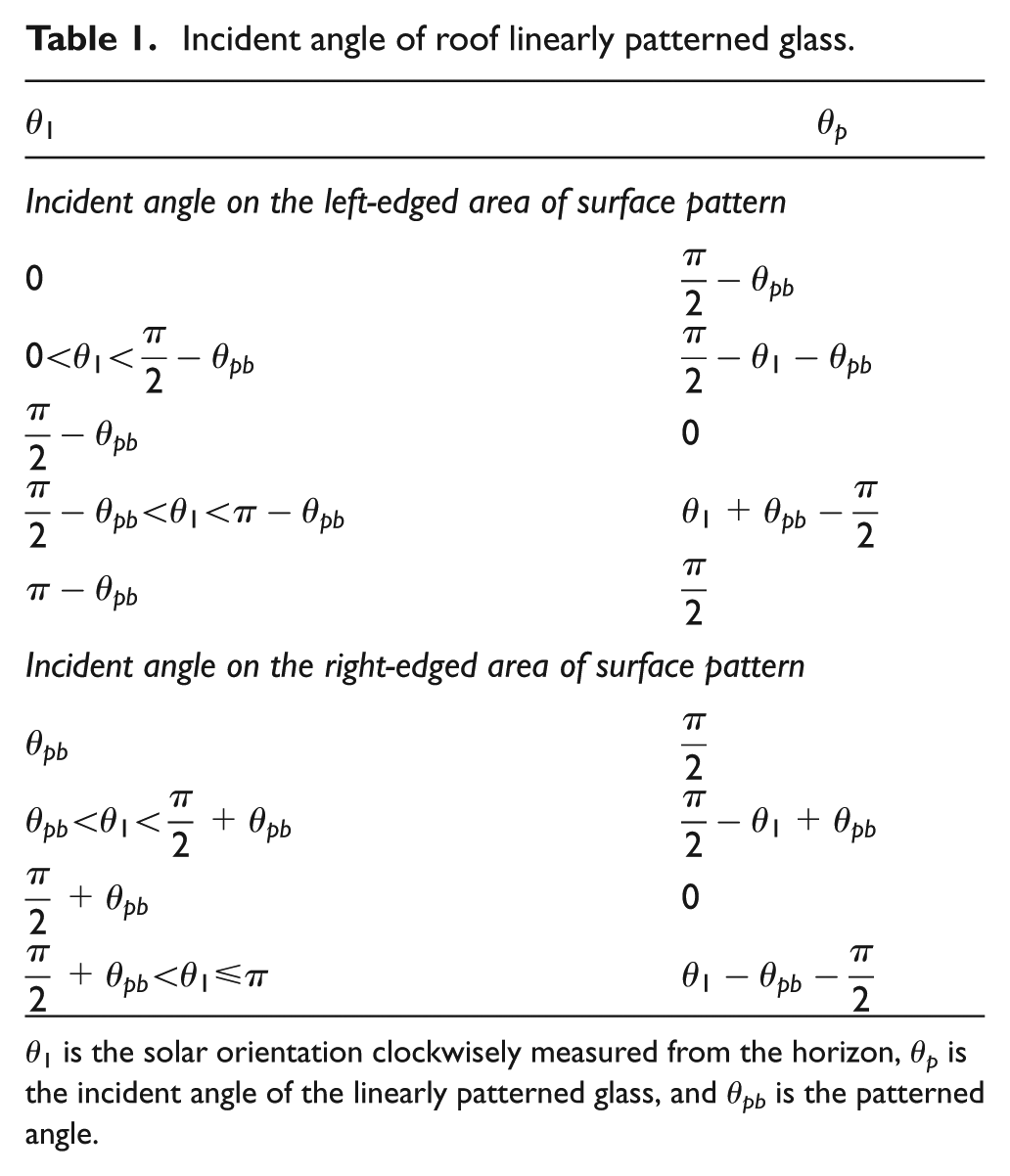
θ 1 is the solar orientation clockwisely measured from the horizon, θp is the incident angle of the linearly patterned glass, and θpb is the patterned angle.
Incident angle for the traditional flat glass applied on the roof.

θ 1 is the solar orientation clockwisely measured from the horizon and θ is the incident angle of the traditional flat glass.
Investigating the thermal performance of linearly patterned glass under solar radiation in a whole day is helpful to fully understand the effect of patterned glass on the interior solar heat dissipation. This article evaluates the thermal response of the roof patterned glass loaded by solar energy in a day, using CFD ANSYS Fluent. Since solar loading conditions including solar radiations and orientations are quite difficult to be determined, this article analyzes the linearly patterned glass in a whole day based on the solar loading information provided by CFD Fluent. Moreover, the analytical results determined by CFD evaluations are utilized to assess the interior solar heat dissipation due to linear patterns.
Numerical analysis
The analytic model, utilized for predicting the thermal performance of linearly patterned glass, refers to a glass house located in 3M Taiwan site and whose schematic diagram is shown in Figure 2. The glass house, having dimensions of 3.65 m in length, 2.40 m in width, and 3.10 m in height, contains a roof window nearby the front door and large glazing walls facing to East, West, and South. The furnished glass house consists of two couches and one table as well as two air conditioners placed on the back wall as shown in Figure 2. Since this article emphasizes on analyzing the patterned glass under intensive solar radiation and has strong intension to reduce computational efforts, the patterned glass, whose dimensions are 700-mm long, 1600-mm wide, and 8-mm thick, is applied on the roof opening, and all of the large floor windows are assumed to be the concrete walls instead of glazing materials. The surface emission and thermal as well as radiant responses of furniture are neglected; in addition, the effect of air conditioning on the interior thermal field is not involved in this analysis.

The schematic graph of the glass house.
Figure 3 plots the CFD meshed model and two-dimensional (2D) configurative diagram of the linearly patterned glass analyzed in this article. The linearly patterned glass periodically incorporates trapezoidal patterns throughout the exterior surface of roof glass and remains flat over the interior face. To satisfy the mechanics of strength and fabrication feasibility, the trapezoidal pattern having 11-mm bottom edge is not formed throughout the glass thickness; instead, it is established from the outer surface to the mid thickness of glass. Besides, as this article would like to provide the parametric analysis for the linearly patterned glass, the patterned parameters including the patterned angle θpb and spacing dimension s are assumed to be variables in CFD analysis. The analytical results based on varying the patterned parameters will be utilized to determine the design rule for the linearly patterned glass applied on attenuating interior solar heat.

(a) CFD model and (b) 2D configurative diagrams of the linearly patterned glass.
This article employs CFD ANSYS Fluent to analyze the thermal performance of linearly patterned glass under solar radiation. The loading information employed in the CFD analysis is provided by the solar ray tracing model which determines solar loadings by the position vector of the incoming solar radiation. Therefore, the solar loading information will be dependent on the location of the analyzed model as well as the analytical day and time. As mentioned previously, since this article concentrates on investigating the effect of glass patterns on the interior thermal field due to excessive solar energy, the CFD Fluent–provided solar loadings are determined based on satisfying the fair weather condition in Taiwan on 8 July at 12:00 in the afternoon. Therefore, this article gives 120°16′ longitude and 22°16′ latitude and assigns 8 July at 12:00 p.m. as the day and time in solar energy calculator to obtain the excessive solar loadings for simulating the solar loading conditions appearing in summer season in Taiwan. Based on 8 July at 12:00 p.m. in Taiwan, the solar energy calculator gives the instantaneous solar loadings including the direct normal solar radiation, vertically diffuse solar radiation, horizontally diffuse solar radiation, and ground reflected solar radiation equal to 883.9, 66.7, 119.4, and 100.3 W/m2, respectively, and these solar loading magnitudes are applied in this article to analyze the linearly patterned glass under excessive solar radiation. Moreover, the air flow in the furnished glass house would be turbulent. This article applies re-normalization group (RNG) k − ε turbulence model 15 to simulate the air flow in the glass house to enhance the accuracy of analytical results. Besides, due to the natural convection driven by the temperature gradient in the fluid boundary layer, the buoyancy effect is involved in the momentum equation using Boussinesq model.
The main objectives of this article are to evaluate the reduction in glazing energy induced in the solar-loaded linearly patterned glass based on comparing with the traditional/conventional flat glass as well as to analyze the thermal performance of linearly pattern glass related to the pattern design. Therefore, the present CFD analysis focuses on the instantaneous status of the glass material under solar radiation and that will yield the several boundary conditions and thermal as well as radiation properties/parameters fixed in CFD evaluations. For instance, temperatures over the concrete-made floor in the glass house and outdoor ambience are fixed in this analysis. As reports of Taiwanese Central Weather Bureau 16 obtained that the average temperature in July of Taiwan is approximately 32.4°C, this article fixes the outdoor and floor temperatures at 33°C and 30°C, respectively, as boundary conditions to analyze the thermal response of patterned glass under solar radiation at noon. Furthermore, identical thermal and radiant as well as optical properties/parameters are applied on the analyzed patterned and traditional flat glass in order to assess the interior solar heat dissipation given by the glass patterns. In this analysis, the heat transfer coefficient of glazing material is 4 W/m2 K, and the radiant properties of the glass material are determined by ASHRAE fundamentals handbook 3 which gives the absorptivity of glass for direct visible, direct infrared (IR), and diffuse hemispherical of 0.49 and transmissivity for direct visible, direct IR, and diffuse hemispherical of 0.3, 0.3, and 0.32, respectively.
Parametric analysis for the linearly patterned glass
Figures 4–6 show the thermal performance of roof trapezoidal patterned glass loaded by solar radiation at noon. As mentioned previously, the solar loading conditions applied in Figures 4–6 are determined by CFD-provided solar ray tracing model on 8 July at noon in Taiwan and the weather satisfying the fair weather condition. Figure 4 plots the radiation heat flux on the inner face of traditional flat glass and trapezoidal patterned glass of Figure 3 having 45°-patterned angle and 11-, 26-, and 41-mm patterned space. As can be seen in Figure 4, under identical solar loadings, the radiation heat flux on the inner face of the traditional flat glass is greater than that induced in the trapezoidal patterned glass. It agrees with the decrease in glazing energy due to the roof linearly patterned glass given by the theory. According to Tables 1 and 2 provided in this article, as the roof linearly patterned glass is solar loaded at noon, the incident angle of the glass material will increase compared with that of traditional flat glass. As indicated in Tables 1 and 2, under solar radiation at noon, the incident angle of roof trapezoidal patterned glass equals the patterned angle θpb which is greater than the zero incident angle of the roof traditional flat glass. The theoretical glazing energy indicates that the glazing energy due to solar radiation is strongly associated with cosine function of incident angle. Thereby, as the incident angle increases, the glazing energy of the solar-loaded glass material decreases. Since the roof trapezoidal patterned glass having 45°-patterned angle yields the increase in the incident angle, the roof linearly patterned glass gives the less radiation heat flux on the inner face of glass than that of the traditional flat glass, as plotted in Figure 4. The numerical result obtained in Figure 4 agrees with the theoretical aspect. Furthermore, Figure 4 indicates that the radiation heat flux of the solar-loaded patterned glass can be varied with the dimension of patterned space. When the patterned space is sized by 11 mm, the radiation heat flux on the inner face of glass is 156 W/m2. However, as the dimensions of patterned space increases from 11 mm to 26 and 41 mm, the radiation heat flux over the glass interior surface will raise to 160 and 163 W/m2, respectively. Therefore, based on results provided in Figure 4, enlarging the patterned space will yield the increase in the radiation heat flux on the glass surface, and this analytical result is supported by experimental measurements given by Lin et al. 1 Furthermore, the variation of CFD-determined results based on different mesh/grid dimensions is analyzed. For the roof trapezoidal patterned glass of Figure 3 having 45°-patterned angle and 11-mm-patterned spacing, the CFD model meshed by sizes of 3.5, 3, and 2.5 mm gives the radiation heat fluxes on the inner face of glass equal to 154, 156, and 155.84 W/m2, respectively. The small discrepancies among the computational predictions for the different mesh-sized CFD models demonstrate the reliability and accuracy of the numerical results.

Radiation heat flux on the inner face of the roof traditional flat glass as well as the trapezoidal patterned glass based on varying the patterned space s.
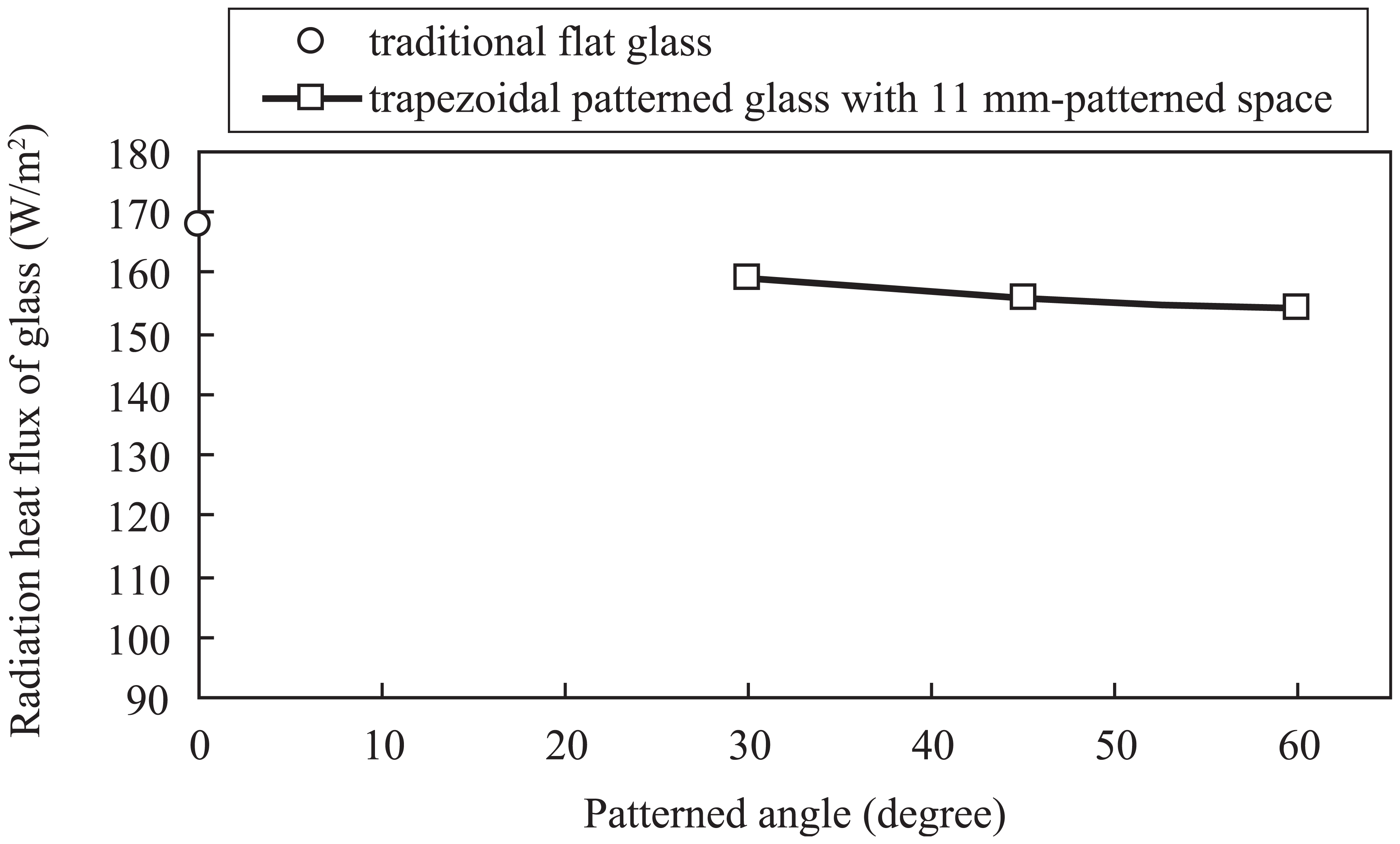
Radiation heat flux on the inner face of the roof traditional flat glass as well as the trapezoidal patterned glass against the patterned angle.

Interior thermal field over the plane of (a) based on applying (b) the roof traditional flat glass and (c)–(e) the trapezoidal patterned glass having the patterned angle
The patterned angle θpb associated with the interior thermal energy due to solar radiation is obtained in Figures 5 and 6. Based on the trapezoidal patterned glass of Figure 3 with fixed 11-mm-patterned spacing, the radiation heat flux over the interior surface of glass against the patterned angle θpb is plotted in Figure 5. As can be seen in Figure 5, increasing the patterned angle yields the decrease in the solar heat flux induced in the glass material. As the 30°-patterned angle is applied on the pattern member, the radiation heat flux of the solar-loaded roof glass is 159 W/m2. However, when the patterned angle is designed to be 45° or 60°, the radiation heat flux induced over the glass inner face becomes 156 or 154 W/m2, respectively. An approximate 5 W/m2 reduction in solar heat flux is acquired if the patterned angle increases from 30° to 60°. Moreover, based on comparing with the traditional flat glass, Figure 5 illustrates that if the roof glass imposes trapezoidal patterns with the patterned angle of 60°over the external surface, the radiation heat flux on the interior face of glass can be reduced about 8.3% (from 167.9 W/m2 for the traditional flat glass to 154 W/m2 for the 60°-trapezoidal patterned glass). On the other hand, the theoretical incident angle expressed in Table 1 gives that the incident angle of the roof patterned glass under solar loaded at noon equals the patterned angle θpb. As the patterned angle is increased, the solar effect on the glass material is decreased due to the glazing energy theoretically associated with the cosine function of the incident angle. The theoretical prediction supports the CFD-determined relation between the patterned angle and radiation heat flux obtained in Figure 5.
Figure 6 obtains the temperature distribution on the interior plane of the glass house where it is located 200 mm below the ceiling. In Figure 6, it indicates that the interior thermal energy due to solar radiation is attenuated if the linear patterns are imposed on the external surface of glass. However, as can be seen in Figure 6, the interior temperature of the glass house is not significantly decreased even the roof trapezoidal patterned glass applying 60°-patterned angle on the surface patterns. Based on the results provided in the parametric analysis, one can recognize that if the roof linearly patterned glass is design to have the greater patterned angle and smaller-sized patterned space, the interior solar heat dissipation resulting from the linearly patterned glass can be enhanced. Therefore, as the surface pattern of Figure 6 is modified based on satisfying the design rule, the reduction in interior solar heat is desirably to be enhanced. Moreover, as can be seen in Figure 6, since the solar-loaded roof glass only takes 13% of the entirely roof space, the solar energy passing through the roof window and entering into the glass house is relatively small. Therefore, while the present trapezoidal patterned glass is able to reduce the solar energy getting into the interior, relatively small solar energy acting on the glass house yields the slight interior solar heat dissipation given by the patterned glass. If the roof window takes the full roof space of the glass house and is assembled with the present patterned glass, the decrease in the interior temperature is firmly to be enhanced. The present CFD model for analyzing the trapezoidal patterned glass with 60°-patterned angle contains 3,290,827 elements. If the roof patterned glass of Figure 2 is enlarged to the entirely roof space of the glass house, the enormous computational effort is not able to be managed by the presently utilized computer device which consists of the dual 2.4 GHz processors and 32-GB memory space. Therefore, the modeling result for the patterned glass applied throughout the roof area of glass house is not provided in this article.
Thermal performance of linearly patterned glass based on applying optimized surface patterns
Under solar radiation at noon
The CFD-evaluated results based on analyzing the trapezoidal patterned glass loaded by solar radiation given in the previous section obtain that reducing the patterned spacing is advantageous to decrease the glazing energy for the solar-loaded glass material. Under vertically solar loaded, since the incident angles of the roof trapezoidal patterned glass over the patterned space and top-edged area are equal to zero which allows the maximum solar energy transmitting the glass material, decreasing the dimension of the patterned space and the top edge of trapezoidal pattern can help attenuate the solar energy getting into the interior. Therefore, the linearly surface pattern having the absence of patterned space and top-edged area can be an optimal design to enhance the interior solar heat dissipation. In order to understand the effect of optimized patterns on the interior solar heat, this article analyzes the triangular patterned glass which imposes the triangular patterns immediately adjacent to each other and periodically distributed over the exterior surface of glass, using CFD technique. Figure 7 obtains the solar radiation heat flux on the inner surface of the roof triangular patterned glass against the patterned angle. As plotted in Figure 7, the radiation heat flux over the glass interior surface can be significantly reduced from 167.9 to 103.6 W/m2 (approximately 38% reduction) if one applies the patterned glass, which incorporates 60° triangular patterns on the external surface of glass, instead of the traditional flat glass on the roof window. Moreover, based on comparing the radiation heat flux of the linearly patterned glass having the trapezoidal-shaped patterns with that containing the triangular patterns, Figure 7 gives that the triangular patterned glass yields the less radiation heat flux induced in the glass material. It illustrates that eliminating the flat feature appearing on the linearly patterned glass, for instance, the top-edged area of the trapezoidal pattern and patterned space, does assist to effectively reduce the glazing energy resulting from solar radiation.

Radiation heat flux on the inner face of the roof traditional flat glass and linearly patterned glass having the patterned angles of 30°, 45°, and 60°, respectively.
Under solar radiation in a whole day
The incident angle appearing on the solar-loaded glass material can significantly affect the glazing energy as well as the transmitted radiant energy existing in the interiors. As the incident angle increases, the glazing energy, which is associated with the cosine function of the incident angle, decreases. According to Table 1 provided in this article, the incident angle of the roof linearly patterned glass can be varied with the solar orientation θ1 and the patterned angle θpb. Moreover, as indicated in Tables 1 and 2, one can notice that the incident angle of the roof linearly patterned glass is not always greater than that of the traditional flat glass during
Due to the solar loadings determined by the solar orientation vector which depends on time, the roof linearly patterned glass is analyzed under solar radiation on 8 July in Taiwan from 6:00 to 18:00 and satisfying the fair weather condition. Moreover, the CFD model assigns boundary conditions on the outdoor ambient temperatures by 29°C, 30.5°C, 31.5°C, 33°C, 32.5°C, 31.5°C, and 30°C at 6:00, 8:00, 10:00, 12:00, 14:00, 16:00, and 18:00, respectively, and the floor temperature inside of the glass house remains 3°C below the outdoor temperature in each of analyzed time. For instance, as the linearly patterned glass is investigated under solar radiation at 6:00, the outdoor temperature is assumed to be 29°C and the floor temperature is 26°C in CFD evaluations. Based on the solar loaded between 6:00 and 18:00 and boundary conditions assigned in the analyzed model, the radiant heat fluxes on the inner faces of the roof traditional flat and patterned glass are shown in Figure 8. As plotted in Figure 8, it indicates that under solar-loaded between 6:00 and 18:00, reductions in the radiation heat flux over the interior glass surface attain 35.7%, 36.8%, 37.6%, 38.3%, 38.1%, 36.9%, and 36.1% at 6:00, 8:00, 10:00, 12:00, 14:00, and 18:00, respectively, as the triangular patterned but traditional flat glass is applied on the roof window. It illustrates that the radiation heat flux on the interior surface of the roof triangular patterned glass is always smaller than that of roof traditional flat glass in a day. Based on the incident angle obtained in Tables 1 and 2, one can find that the incident angle of the linearly patterned glass is greater than that of traditional flat glass as the solar orientation satisfies with the specific directions. Moreover, the linearly patterned glass is not consistently solar loaded throughout a day. Instead, except the solar orientation is coincident with the particular directions expressed in the Table 1, the roof linearly patterned glass on the left- and right-edged areas will not be loaded by the incident solar radiation. It results in the roof linearly patterned glass subjected to the less solar loading than the traditional flat glass and helps reduce the glazing energy induced in the glass material. The CFD-determined results shown in Figure 8 are supported by the theoretical prediction given in Tables 1 and 2.

Radiation heat flux on the inner face of the roof traditional flat glass and triangular patterned glass under solar loaded between 6:00 and 18:00.
Discussions
Transmitted solar energy is the main source to vary the interior temperature of a building. As the solar energy rapidly increases during summer season, the excessive solar load results in the drastic increase in the interior temperature and thereby raises the energy need for air conditioning. To reduce energy demands in a building, this work introduces a linearly patterned glass technology which incorporates linear patterns over the exterior surface of glass to attenuate the solar energy passing through the glass material. Imposing the described patterns on the glass surface makes the incident angle greater than that of the traditional flat glass and less solar energy acting on the glass. According to the theoretical glazing energy, the glazing energy is associated with the cosine function of the incident angle. It gives that as the incident angle increases, the solar load entering into the glass decreases. Due to the described patterned glass causing an increase in the incident angle and the reduction in the solar load applying on the glass material, attenuating the solar effect on the interiors is then achieved as the described linearly patterned glass is applied.
The CFD-evaluated results provided in this article indicate that applying trapezoidal patterns periodically throughout the outer surface of glass results in the decrease in the interior solar heat. Moreover, the thermal performance of linearly patterned glass can be affected by the patterned design. Based on results obtained in Figures 4–6, decreasing the dimension of the patterned space and increasing the patterned angle help reduce the solar energy penetrating the glass material. Under solar loaded at noon, the incident angles of the roof traditional and linearly patterned glass are equal to zero and patterned angle, respectively. Since the glazing energy of the solar-loaded glass material is theoretically related to cosine function of the incident angle, the roof linearly patterned glass, which has the greater incident angle on the patterned member, results in the decrease in the solar radiation heat flux induced in the glass, compared with that of the traditional flat glass. When the dimension of patterned space is decreased, the increase in the number of the surface patterns will help decrease in the solar energy transmitting the glass material. On the other hand, the incident angle over the patterned spacing of the roof linearly patterned glass under solar laded at noon equals zero, where the patterned spacing area will allow the maximum incident solar energy transmitting interiors. Therefore, making the size of patterned space as small as possible advantageously assists the reduction in glazing energy existing in the glass material and interior solar heat as well. Moreover, as mentioned previously, due to the glazing energy theoretically associated with cosine function of the incident angle, applying the greater patterned angle on the roof linearly patterned glass does help reduce the solar heat existing in the interior, as shown in Figures 5 and 6.
The thermal performance of the linearly patterned glass based on applying the optimal surface patterns is analyzed in this article. Based on CFD results plotted in Figure 7, as the optimally triangular patterned glass is employed on the roof opening of Figure 2 instead of the trapezoidal patterned glass as shown in Figure 3 with the pattern spacing of 11 mm, the radiation heat flux on the inner face of the linearly patterned glass having 60° patterned angle can be reduced from 154 to 103.6 W/m2. It gives that an approximate 32.7% reduction in solar heat flux on the roof glass can be acquired as the triangular patterned glass is applied. Therefore, if the linearly patterned glass incorporating the surface patterns which satisfies the design rule provided by this article, enhancing the interior solar heat dissipation can firmly be attained.
The roof linearly patterned glass loaded by solar radiation in a whole day is also analyzed, using CFD technique. Figure 8 shows the CFD-determined radiation heat fluxes on the interior surfaces of roof triangular patterned and traditional flat glass under solar loaded between 6:00 and 18:00. As obtained in Figure 8, one can observe that the radiation heat flux induced on the roof triangular patterned glass is consistently less than that of the traditional flat glass under solar loaded from 6:00 to 18:00. According to the incident angles expressed in Tables 1 and 2, one can see that while the incident angles of the roof linearly patterned glass on the left- and right-edged areas are not always greater than that of the traditional flat glass under the solar orientation θ1 between 0 and π (or throughout a day), the incident solar energy loading on the left- and right-edged areas of linearly patterned glass only occur until the solar radiation θ1 aligned between 0 and π − θpb and θpb and π, respectively, instead of 0 and π for the traditional flat glass. The less solar energy acting on the linearly patterned glass does result in the less solar energy penetrating the glass material. Therefore, although the incident angle of the linearly patterned glass can possibly be less than that of the traditional flat glass, the less solar energy loading on the glass material due to patterned members does help yield the reduction in solar energy transmitting the glass material in a whole day.
Conclusion
Reducing the energy demands is a crucial course to the world. As the excessive solar energy usually results in the enormous energy demands for air conditioning loads, this article provides linearly patterned glass technology which incorporates the linear patterns throughout the exterior surface of glass to attenuate the solar effect on the interior thermal field. By applying the linear patterns on the surface of glass, the decrease in the solar energy acting on the glass material and the increase in the incident angle yield the reductions in the glazing energy as well as the interior solar heat to be attained. The thermal performance of linearly patterned glass is strongly associated with the patterned design. Making the greater patterned angle and smaller dimension of patterned space will help reduce the solar energy transmitting the glass material.
Footnotes
Academic Editor: Bo Yu
Declaration of conflicting interests
The author(s) declared no potential conflicts of interest with respect to the research, authorship, and/or publication of this article.
Funding
The author(s) disclosed receipt of the following financial support for the research, authorship, and/or publication of this article: This work is supported by the 3M Taiwan Ltd and Ministry of Science and Technology in Taiwan.