



Abstract
This article presents heat transfer characteristics of circular and elliptic cylinders in cross flow for various Reynolds numbers. Numerical investigations as well as wind tunnel experiments are carried out to study the convective heat transfer of in-line cylinder banks. In particular, the heat transfer characteristics of upstream and downstream cylinders are compared in terms of local and average Nusselt numbers. The effects of turbulence induced by upstream cylinders on the heat transfer of downstream cylinders are discussed with the help of detailed numerical results.
Keywords
Introduction
With increasing demands for energy saving in recent years, it is of great importance to design efficient heat exchangers which have high heat transfer rate and low pressure loss. As mentioned by Winding, 1 the heat transfer rate of the heat exchanger is proportional to some power of the pressure loss, which suggests that it should be possible to design optimized heat exchangers operating at the minimum power consumption. A bank of cylinders is most widely employed type of heat transfer apparatus in heat exchangers. Therefore, heat transfer characteristics of cylinders in cross flow have been the subject of particular interest for the development of efficient heat exchangers.
Heat transfer of circular cylinder has been investigated extensively in the literature. For instance, Achenbach 2 measured local and total heat transfer of single circular cylinder in cross flow for high Reynolds number ranging from 30,000 to 4,000,000. Particularly, he also measured the local static pressure and skin friction to investigate the boundary-layer effect on the heat transfer. Scholten and Murray 3 had measured time-resolved local velocity and local heat flux on the surface of single circular cylinder, and the details of the flow and heat transfer characteristics were discussed. Heat transfer characteristics of a bank of circular cylinders have been also investigated by many researchers.4–7 For example, Aiba et al. 4 studied the heat transfer around in-line circular cylinders. It was noted that the heat transfer of downstream cylinders is significantly affected by upstream cylinders especially at high Reynolds number. Buyruk 5 studied the heat transfer around staggered bank of circular cylinders. Analytical approach for heat transfer of circular cylinder bank has been investigated by Khan et al. 6
There have been several studies on the thermal and hydraulic performances of cylinders having cross-sectional shape other than circle. There can be many possible candidates for noncircular cylinders, but the most widely studied one is an elliptic cylinder.8–11 Recent articles by Hasan 8 and Ibrahim and Gomaa 9 have presented the effects of angle of attack and axis ratio on the thermal and hydraulic performances of elliptic cylinders. The results from these studies indicated that the elliptic cylinder has significantly lower pressure loss, while the thermal performance of the elliptic cylinder is comparable to that of circular cylinder. There are a few studies for odd-shaped cylinders such as cam cylinder and streamline cylinder.12,13
Although the advantages for using noncircular cylinders are well understood from those studies mentioned above, there are still several issues which need to be addressed. For instance, the local heat transfer characteristics of the elliptic cylinder are not fully described, but only the overall heat transfer characteristics were presented in the above mentioned works. Thus, the details of the heat transfer on the cylinder surface could not be discussed. The local heat transfer characteristics are particularly important in understanding the performance of cylinder bank.
In this regard, this study compares the heat transfer characteristics of circular and elliptic cylinders in detail by numerical simulation along with wind tunnel experiments. Local and average heat transfer characteristics of single cylinder and two-row cylinder bank are studied. Especially, local heat transfer characteristics on the cylinder surface are presented in detail for various Reynolds numbers. In addition, the effects of upstream cylinder on the heat transfer of downstream cylinder are investigated.
Experiments
Figure 1 shows cross-sectional shapes of circular and elliptic cylinders considered in this study. The geometrical parameters are
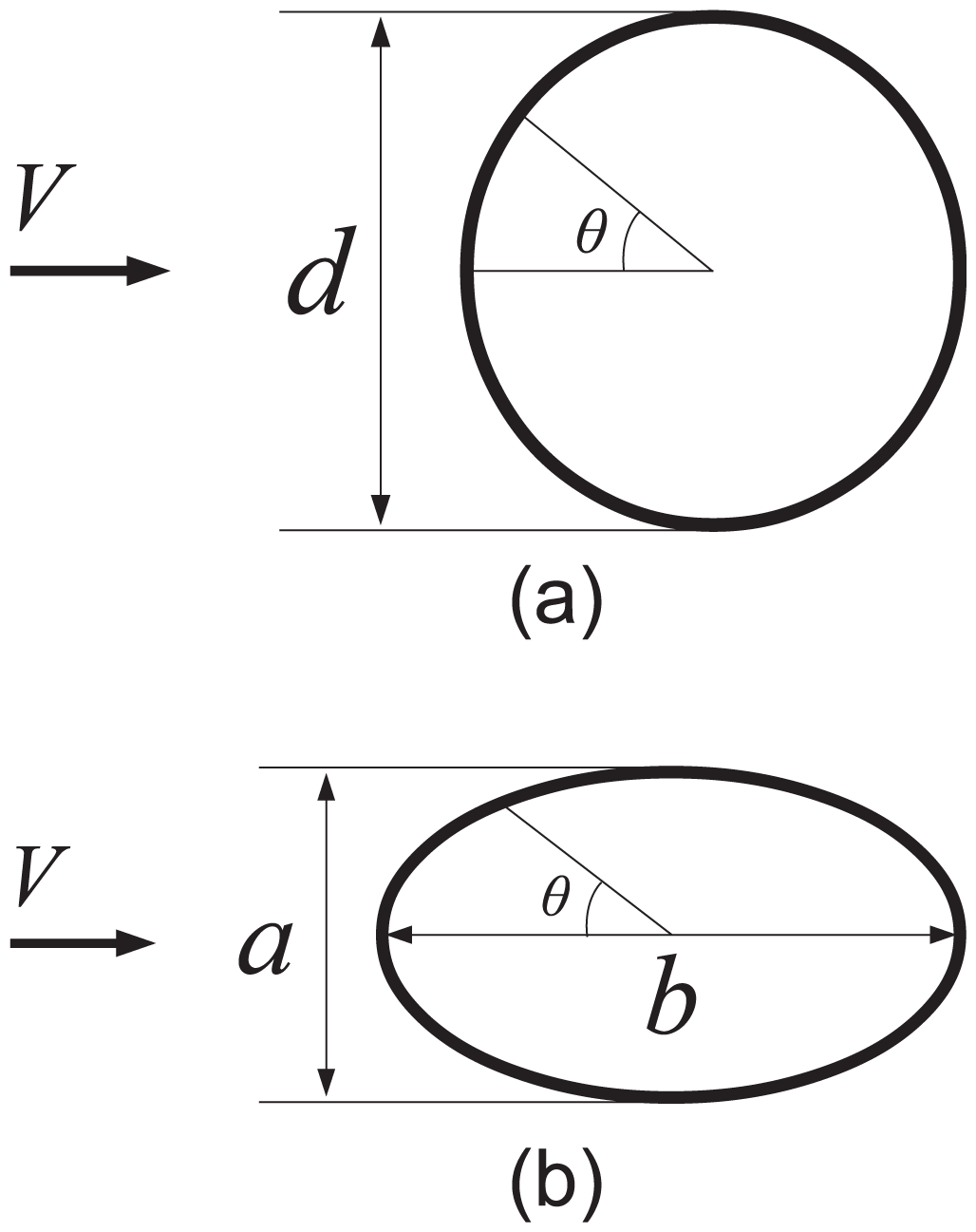
Cross-sectional shapes of (a) circular cylinder and (b) elliptic cylinder.
The experiments are carried out for in-line two-row cylinder banks using wind tunnel which is schematically shown in Figure 2. The test section has dimensions of 20 cm of width, 13 cm of height, and 15 cm of length. Six thermocouples are located at each side of the test section to measure the average temperature. A centrifugal blower is used to drive the airflow. The airflow rate is varied from 1.15 to 4.12 m3/min in the experiments.

Schematic diagram of wind tunnel setup.
The cylinders which will be located in the test section are made of stainless steel of 1 mm thickness, and water is used as a working fluid to maintain the temperature of the cylinders constant. Although not shown in this schematics, the water temperatures at the inlet and outlet of the cylinders and the cylinder wall temperature are measured using resistance temperature detectors (RTDs). The total flow rate of water is fixed at 21.8 kg/min. The water and air temperatures are set at 10°C and 30°C, respectively. In this experimental setup, the temperature differences between the inlet and outlet of the cylinders and between the water and the cylinder wall in steady state are less than 0.1°C, while the temperature difference between each side of test section is larger than 2°C. Thus, it would be reasonable to assume that the cylinders have a constant temperature.
Two-row cylinder banks are located in the test section as shown in Figure 3. The distances,

where


where

Two-row cylinder banks of (a) circular cylinders and (b) elliptic cylinders.
Numerical analysis
In the present numerical simulation, the heat transfer characteristics of single cylinder and two-row cylinder banks are investigated. The airflow is assumed to be incompressible. Reynolds-averaged equations for mass, momentum, and energy conservations in steady state can be written as follows



where
The computational domains for single and two-row cylinders are shown in Figure 4. Only upper half of the whole geometry is considered as a computational domain due to symmetry. There are five kinds of boundaries, the inlet




where

Computational domains for (a) single cylinder and (b) two-row cylinder bank.
The governing equations along with the boundary conditions are solved by commercial software ANSYS Fluent where the governing equations are discretized by a finite volume method. The streamline-upwind scheme is used to stabilize the convective terms, and SIMPLE algorithm is used to obtain the solution. The computational domain for single circular cylinder (Figure 4(a)) is discretized by 64,146 nodes and 63,500 quadrilateral elements, while the domain of for two-row circular cylinder bank (Figure 4(b)) is discretized by 163,715 nodes and 162,112 quadrilateral elements. The mesh has more refined elements around the cylinder wall than the surroundings, and the minimum element size is 0.1 mm. The mesh system for elliptical cylinder cases has similar number of nodes and elements as that for circular cylinder cases.
The numerical results will be presented in terms of local Nusselt number and average Nusselt number which are, respectively, defined as follows


where
Results and discussion
First, the heat transfer characteristics of single circular and single elliptic cylinders are compared for Reynolds number ranging from 7150 to 50,350. Figure 5 shows local Nusselt number profiles of circular and elliptic cylinders. For the circular cylinder, existing experimental results by Scholten and Murray
3
are plotted as well for a verification purpose. It is noted that the flow separation takes place at

Local Nusselt number profiles of (a) single circular cylinder and (b) single elliptic cylinder for various Reynolds numbers.

Average Nusselt number of circular and elliptic cylinders.
The results for two-row cylinder banks are shown in Figures 7–10. Total Nusselt number (equation (2) and experimental and numerical results) and friction factor (numerical result only) of cylinder banks are shown in Figure 7. The friction factor

where

(a) Total Nusselt number and (b) friction factor of two-row cylinder banks.

Numerical results of average Nusselt number of upstream and downstream cylinders for (a) two-row circular cylinder bank and (b) two-row elliptic cylinder bank.

Local Nusselt number profiles of upstream and downstream cylinders of circular cylinder bank at Reynolds number of (a) 2382 and (b) 23,825.

Local Nusselt number profiles of upstream and downstream cylinders of elliptic cylinder bank at Reynolds number of (a) 2382 and (b) 23,825.
Figure 8 compares average Nusselt number of upstream cylinder and downstream cylinder (cylinders 1 and 3, respectively, in Figure 3). It is observed that the average Nusselt number of the upstream cylinder is larger than that of downstream cylinder when the Reynolds number is low (Re < 17,000 for circular cylinder and Re < 12,000 for elliptic cylinder). As the Reynolds number increases, however, the downstream cylinder has higher level of the average Nusselt number than the upstream cylinder does. This reflects that the turbulent flow developed by the upstream cylinder enhances the heat transfer of the downstream cylinder as Reynolds number increases. As noted by Buyruk, 5 such effect of upstream cylinder is most significant at the first two or three rows, and it will become constant beyond third to fifth row.
For the circular cylinder bank, Figure 9 compares local Nusselt number profiles of the first-row and second-row cylinders (cylinders 1 and 3, respectively, in Figure 3) at two different Reynolds number flows. The upstream cylinder affects the heat transfer on the frontal (
Figure 11 shows streamlines when Reynolds number is 2382. As discussed above in terms of the local Nusselt number, the second-row cylinder is affected by the recirculating flow developed by the first-row cylinder; thus, the local Nusselt number at the frontal region is reduced significantly. The elliptic cylinder has narrower recirculating flows, and the frontal region is less than that of the circular cylinder. Although not shown here, the streamlines for Reynolds number of 23,825 are similar to those shown in Figure 11 but with higher turbulence intensity.

Streamlines of (a) circular and (b) elliptic cylinder banks at Reynolds number of 2382.
Conclusion
This study compares heat transfer characteristics of circular and elliptic cylinders in cross flow. Numerical investigation is carried out to study the convective heat transfer over single cylinder and two-row cylinder banks along with experiments to verify the numerical results. Presented are the local and average Nusselt numbers for single and two-row banks of circular and elliptic cylinders for various Reynolds numbers. In particular, the effect of upstream cylinder on the heat transfer characteristics of the downstream cylinder is discussed.
For single cylinder cases, Reynolds number is varied from 7190 to 50,350. The average Nusselt number of the elliptic cylinder is lower than that of the circular cylinder by 9.3% in average for the range of Reynolds number considered in the study. It is noted that the local Nusselt number profile of the elliptic cylinder is significantly different from that of the circular cylinder in that it decreases significantly for
For two-row cylinder banks, Reynolds number is varied from 1192 to 23,845. As noted in many previous studies, the friction factor of the elliptic cylinder bank is observed to be significantly lower than that of the circular cylinder bank. The total Nusselt number shows similar trends as observed for the single cylinder. It is noted that the average Nusselt number of the first-row cylinder is larger than that of the second-row cylinder for Reynolds number lower than a certain value, which is reversed for higher Reynolds number case. This indicates that as the Reynolds number increases, the turbulence developed by the cylinders in the upstream enhances the heat transfer over the cylinders in the downstream.
Details of the upstream cylinder effect have been observed by comparing the local Nusselt number profiles of upstream and downstream cylinders. A significant reduction of the local Nusselt number around the frontal area (
The results indicate that elliptic cylinder has significantly lower friction factor compared to circular cylinder, while elliptic cylinder has only 9.3% lower Nusselt number than circular cylinder does. The elliptic cylinder has smaller facial area compared to the circular cylinder, enabling more compact design of heat exchangers. It would be, therefore, mentioned that the elliptic cylinder has useful features for future development of efficient heat exchangers.
Footnotes
Acknowledgements
Prof. J. M. Park would like to thank Yeungnam University for financial support via the Yeungnam University Research Grant Program 2014.
Academic Editor: Bo Yu
Declaration of conflicting interests
The author(s) declared no potential conflicts of interest with respect to the research, authorship, and/or publication of this article.
Funding
The author(s) disclosed receipt of the following financial support for the research, authorship, and/or publication of this article: This work was supported by the Energy Efficiency & Resources of the Korea Institute of Energy Technology Evaluation and Planning (no. 20102020100210) grant funded by the Korea Government Ministry of Knowledge Economy and by Yeungnam University via the Yeungnam University Research Grant Program 2014.