




Abstract
Excessive solar energy can significantly increase interior temperatures and yield great energy demands for air conditioning. Whereas reducing energy consumptions is very crucial today, this article employs patterned glass technology which incorporates linear patterns throughout the exterior surface of glass to attenuate the solar effect on the interior thermal field based on theoretical and experimental studies. By periodically imposing linearly three-dimensional patterns over the outer surface of window glass, the analytical results indicate that the interior solar heat is able to be reduced, as the surface patterns increase the incident angle and/or decrease the solar energy loading on the patterned glass material. Moreover, the interior solar heat can be strongly affected by the pattern design. According to thermally measured results, the trapezoidal patterned glass having 3-mm-top-edged patterned members yields lower temperature on the interior surface of glass comparing with that for the trapezoidal patterns having 6-mm-top edges. Therefore, making the least non-sloped feature or flat plane appearing on the patterned glass helps decrease the interior temperature resulting from solar energy.
Introduction
The thermal field inside a building can be varied as the solar radiant energy penetrates windows or any type of fenestration system. In summer season, especially, since the incident radiation intensity usually attains maximum, the excessive solar load entering indoors yields the intensive heat existing in the interiors and drastically raises the indoor temperature. However, the drastic increase in temperature is often high enough against thermal comfort and thereby results in energy need for air conditioning loads. Field experimental measurements indicate that the total energy consumption for a conventional house can be raised at least 10% or above in the warm season.
In order to reduce energy demands for buildings and subsequently achieve energy savings, many works provided solutions to attenuate the effect of solar load on the interiors. Hassan et al. 1 applied natural ventilation to reduce the heat intensity inside of a building. Their study indicated that in single-sided ventilation, the adjacent-opening design will give similar ventilation wherever the openings are placed. However, the non-adjacent openings can perform different ventilation. The two openings located on each of far left and far right sides will induce the better ventilation than the two adjacent openings. Hassan et al.’s work is not only advantageous to improve the indoor ventilation but is informative for architects to design a good energy-efficient building. Window size can influence the thermal field inside of a building. Persson et al. 2 found that as the window opening facing the south is designed to have small dimension, the risk of excessive temperatures or energy needed for cooling can be reduced. Glass double facades (GDFs) are well known to help attenuate the solar energy transmittance into the interior; therefore, Manz and colleagues3,4 provided the optimization of the GDFs based on experimental and computational fluid dynamics (CFD) results. Triple glazings characterized by low solar transmittance give the most effective thermal insulation not only in summer but also in winter. 5 Etzion and Erell 6 developed a flexible glazing mechanism that applies a rotatable frame to support the transparent and absorptive glazing components. Based on their novel mechanism design, the absorptive glazing with a low shading coefficient can be flexibly placed facing the exterior or interior of a building as the solar load changes. This glazing system is promising to reduce the energy consumption and provides comfortable living environment. Chow et al. 7 first evaluated the thermal performance of the photovoltaic (PV)-ventilated window system. By analyzing a small office room in Hong Kong, Chow et al. reported that the transmittance of a solar cell obtained in the range of 0.45–0.55 can achieve the best energy savings. Low-emissivity glass with coatings can also alter the solar heat load transferred into the building. Blue and green glasses tend to filter some infrared (IR) radiation and thereby can be used as an outer pane of a double-glazed unit in the warm climate. 8 The coating or film applied on the glazing material can reduce the heat transfer level; however, it could result in the increase in absorption level at the same time. Gijón-Rivera et al. 9 developed glazing with an internal coating to block the excessive heating of the glass. The solar transmitting properties can be associated with the thermal emittance of the glazing. Reducing the thermal emittance of the glass material yields a decrease in the total solar transmitting energy. 10 Reppel and Edmonds 11 provided energy-saving glazing by placing horizontal laser-cut panels inside of glazing that gives the selection of solar rays getting into the building, depending on their incident angles. Glass rotation can effectively vary the amount of heat entering the building through the window. Saleh et al. 12 found that horizontal glass rotation yields an increase in the solar heat gain approximately 63% comparing with no glass rotation.
The thermal solutions for reducing the interior solar energy provided in the literatures emphasized on ventilations, window opening designs, and glazing mechanism as well as glazing coatings. Although these technologies are able to reduce solar effect on the interiors, they could be difficult and elaborative. Therefore, different from the past works, this article provides the linear, three-dimensional (3D) patterned glass technology which employs mechanical 3D patterns throughout the exterior surface of glass to attenuate the excessive solar load passing through window glass. By imposing mechanical 3D patterns over the outer surface of glass, the incident angle is able to be changed. As the incident angle is increased due to surface patterns, the solar energy penetrating the glass material can be reduced; thereby, the solar heat existing in the interiors can be reduced. However, it has to be noticed that simply applying patterns on the glass surface is not able to effectively reduce interior solar heat since the transmitted solar energy is significantly dependent on the pattern design. This article provides theoretical incident angles and experimental results to obtain the effect of pattern design on the interior solar heat and also summarizes the design rule for glass surface patterns. Numerical analyses related to the patterned glass have been introduced by Lin et al. 13
Theoretical incident angle for the linearly patterned glass
Traditional flat glass loaded by solar irradiation could attain heat balance as shown in Figure 1, if the diffuse radiation consisting of radiation reflected from ground and the sky diffusive radiation was neglected.

Instantaneous solar energy mechanism for a traditional flat glass.
Based on Figure 1, the glazing energy q resulting from incident beam radiation can be determined by the following equation 14

where EDN is the direct normal solar irradiation, θ is incident angle, and SHGC is the glazing solar heat gain coefficient of the glass material. The SHGC (θ) in equation (1) is written as follows 14

where
In order to understand the interior solar heat dissipation provided by the described linearly patterned glass comparing with the conventional/traditional flat glass, this article concentrates on analyzing the patterned glass which incorporates the linear patterns on the external surface of the traditionally rectangular-flat but differently shaped glass.
Figures 2 and 3 show the incident angle induced on a patterned glass which incorporates a symmetrical and linear pattern throughout the exterior surface. The linear pattern analyzed in this article is concentrated on the trapezoidal prism since it gives the sufficient geometric features to determine the theoretical incident angles of the described patterned glass and traditional flat glass based on one glass configuration as shown in Figures 2 and 3. In these figures, θ1 is the direction of the incident beam radiation measured clockwise from horizon, θ2 is the inclined angle of glass and θpb is the patterned angle determined from the flat face of glass. Since there is a linear pattern imposed on the surface of glass, the incident angle along the pattern body is not the same as that of the traditional flat glass. Figure 2 indicates the incident angle located on the left edge of the pattern. As shown in Figure 2, when the sum of θ2 and θpb is less than π/2, the incident angle of patterned glass θp is dependent on θ1, θ2, and θpb. As the direction of incoming solar ray θ1 is aligned with the direction of π/2 − θ2 − θpb, the incident angle θp of Figure 2 equals 0; however, once the incoming solar ray is aligned with the direction of π − θ2 − θpb, the incident angle on the left edge of pattern will attain π/2. According to theoretical glazing energy expressed in equation (1), if the incident angle equals π/2, the solar effect on the glass material is eliminated. The solar ray of θ1, which gives the solar energy loading on the glass material, is in the range between 0 and π − θ2 − θpb less than that between 0 and π − θ2 for the traditional flat glass. Moreover, if the linearly patterned glass designed to yield the sum of θ2 and θpb greater or equal to π/2, the incident angle θp on the left-edged area of the linear pattern will never be 0 and that is significantly advantageous to attenuate the glazing energy for the solar-loaded glass due to zero incident angle allowing the maximum solar energy entering into the glass material, as indicated in equation (1). Table 1 summarizes the incident angle on the left edge of the linear surface pattern. Figure 3(a) and (b) shows the incident angle on the right edge of the linear pattern when θpb > θ2 and θpb < θ2, respectively. For the patterned angle θpb greater than the glass inclined angle of θ2, the glass material can be loaded by solar radiation as θ1 is in the range between θpb − θ2 and π + θpb − θ2. As the direction of incoming solar ray is parallel to the oblique face of the pattern body of Figure 3(a) (i.e. θ1 equals either θpb − θ2 or π+θpb − θ2), the incident angle over the right-edged area of the solar-loaded surface pattern will be equal to π/2. However, if the incoming solar radiation is aligned with the normal direction of the right-edged oblique face of the pattern body of Figure 3(a) (i.e. θ1 = π/2+θpb − θ2), the glazing energy due to solar radiation attains maximum since the incident angle equals 0. Table 2 indicates the incident angle on the right edge of pattern based on θpb > θ2. Figure 3(b) shows the incident angle on the right-edged face of the surface pattern when θpb < θ2. Figure 3(b) indicates that θp equals π/2, if θ1 = π − θ2 + θpb. However, once the direction of incident beam radiation θ1 is aligned with the direction of π/2 − θ2 + θpb, the glazing energy on the right-edged face of the pattern body of Figure 3(b) can attain maximum. Based on θpb < θ2, the incident angle on the right edge of the pattern body obtained in Figure 3(b) is summarized in Table 3.
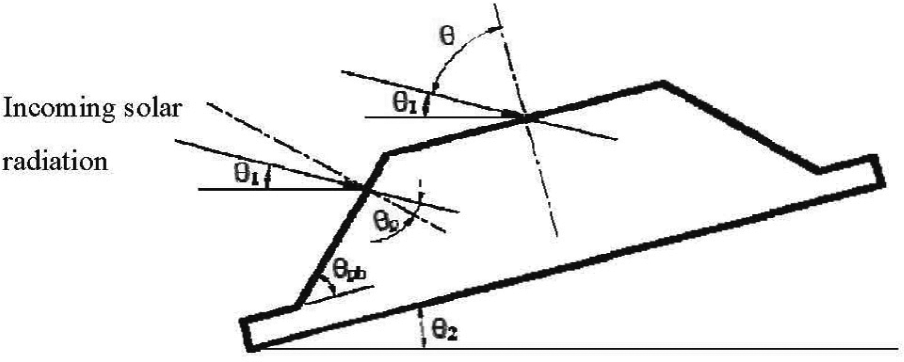
The schematic graph of the incident angle θp on the left edge of the linearly patterned glass.

The schematic graph of the incident angle θp on the right edge of the linearly patterned glass when (a) θpb > θ2 and (b) θpb < θ2 where θpb is the patterned angle and θ2 is the glass tilted angle.
Incident angle on the left edge of the patterned glass.
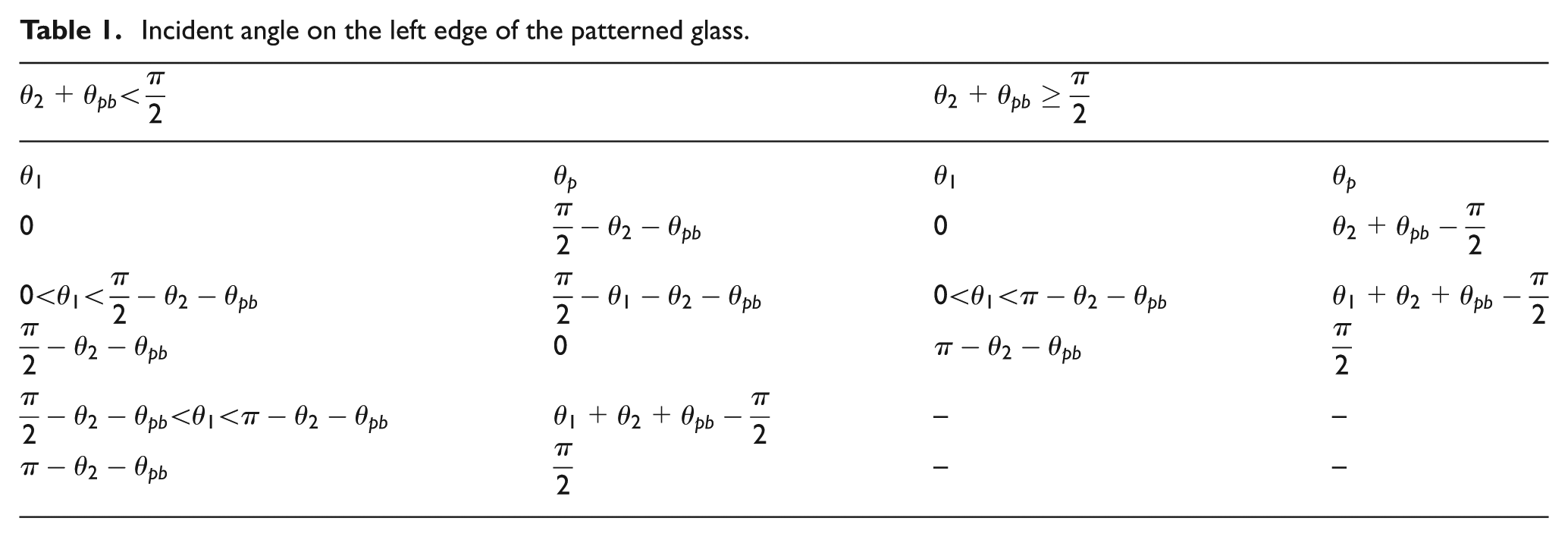
Incident angle on the right edge of the patterned glass, when

Incident angle on the right edge of the patterned glass, when
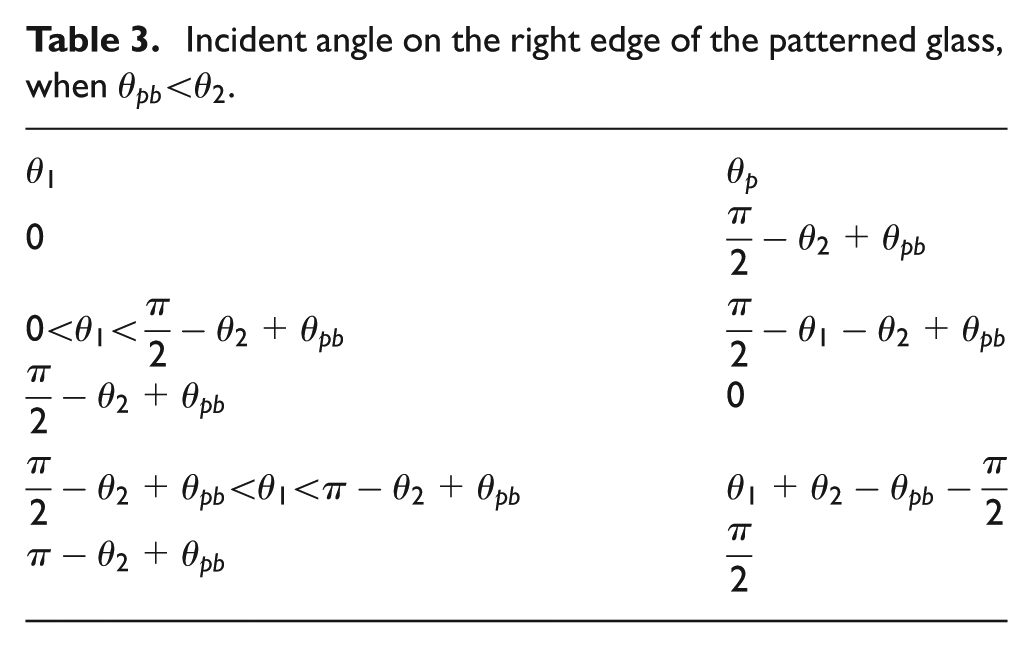
Table 4 provides the incident angle θ for a solar-loaded traditional flat glass. As indicated in Table 4, the traditional flat glass can be solar loaded as the incident beam radiation varies between 0 and π − θ2. By imposing a linear pattern on the external surface of a window glass as obtained in Figures 2 and 3, the glazing energy on the left edge of the pattern is induced when the incident beam radiation directs between 0 and π − θ2 − θpb. On the right edge of the pattern satisfying θpb > θ2, the glass material is solar loaded as the direction of the incident beam radiation θ1 is aligned with the direction between θpb − θ2 and π + θpb − θ2. Moreover, if the linear surface pattern is designed to yield θpb < θ2, the glazing energy is generated on the right-edged area of patterned glass as solar radiation is aligned with the direction between 0 and π − θ2 + θpb. Therefore, comparing the glazing energy of the traditional flat glass with that for the described linearly patterned glass, the described linearly patterned glass is able to produce the less glazing energy since the incident solar energy loading on the glass material can be reduced by the existence of either one or both inclined edges of the pattern member. Moreover, based on Tables 1–4, the patterned angle is able to increase the incident angle and yields a decrease in the solar effect on the interior. While it is possible that the described patterned glass can induce greater glazing energy on one linearly inclined-edged area of the pattern under particular solar orientations, the increase in glazing energy can be fully compensated by the dissipations of the glazing energy occurred on the other linearly inclined face of the pattern. Therefore, the described linearly patterned glass can firmly result in the decrease in glazing energy and reduce the interior temperature due to solar radiation.
Incident angle for a traditional flat glass.

Experimental measurements and results
The experimental model utilized for conducting thermal measurements of the solar-loaded patterned glass would be good to apply on a glass house since it eliminates undesirable parameters affecting the measured results. However, establishing a glass house is truly very expensive; therefore, instead of using the glass house, this article selected the laboratory office containing large windows to implement the thermal experiments for analyzing the described patterned glass under solar radiation.
Figure 4 shows the schematic diagram of the experimental model employed in this study. As can be seen from Figure 4, the experimental model has dimensions of 10.2 m in length, 4 m in width, and 3.8 m in height and contains four windows with large glazing. The window glass is 772 mm wide, 885 mm high, and 6 mm thick. Restricted by supplier’s diamond glass cutter, patterned glass specimens were fabricated to consist of trapezoidal-shaped patterns which have the bottom angle equal to 12° and are periodically distributed over the outer surface of glass. While this article mainly analyzes the effect of patterned glass on interior temperatures due to solar load, it could be informative to investigate the relation between pattern design and interior thermal field. Therefore, this article thermally analyzes three types of trapezoidal patterned glass specimens which consist of different dimensions on the top edges of the surface patterns. The top edges of patterned glass specimens are 3, 6, and 12 mm. Figure 5 shows two-dimensional (2D) configurations of the glass specimens utilized in this article.

The schematic graph of the analyzed model.

Two-dimensional configurations of the tested glass specimens: (a) traditional flat glass and (b) to (d) the patterned glass having 3-, 6-, and 12-mm-top-edged trapezoidal patterns on the exterior surface, respectively.
In this study, thermal experiments including IR and thermocoupled measurements were simultaneously conducted to record temperatures over the interior surfaces of the solar-loaded glass specimens. In the thermal experiments, the two glass specimens are placed on the right windows of the laboratory office shown in Figure 4 and loaded by solar radiation in Spring of Kaohsiung city in Taiwan. Instead of testing the four windows contained in the laboratory office, IR and thermocoupled detectors concentrate on capturing temperature data over the inner surface (facing the interior of the laboratory office) of the glass specimens placed on the two right-sided windows. Since this article assumes that the thermal field induced on the glass surface results from the sources of solar radiation, interior natural convection, and glass configuration as well as the thermal and radiant properties of the glass material (even the glass configuration is the main interest here), any exceptional factors that can affect the temperature distributions on the window glass will not be allowed. However, the thermal behaviors of the two left-sided window glass are not merely associated with the source factors mentioned previously. The heat transfer between the exterior air and a metallic outer unit of a split air-conditioner located nearby the two left-sided windows is able to influence the thermal response of the tested solar-loaded glass specimens, as shown in Figure 4. Therefore, the present thermal experiments were conducted to measure the interior surface temperatures of the two glass on the right-sided windows instead of the four glass existing in the laboratory office. Moreover, since this article emphasizes on studying the effect of patterned glass on attenuating interior solar heat, all of windows are exactly closed and air conditioning is not operated at least 10 h prior to conducting thermal measurements. The model of IR camera utilized here is Thermo Gear G100EXD camera with a resolution of 0.04 °C and available for the temperature range between −40 °C and 1500 °C. In this study, the measured data provided by the Thermo Gear G100EXD camera were calibrated by glass emissivity of 0.94 which is recommended by the manual of G100EXD camera. 15
Figure 6 indicates the locations of thermal data measured by IR and thermocouples. As can be seen in Figure 6, the thermocouples having the resolution of 0.1 °C 16 are symmetrically mounted on glass surfaces and located in the IR-detected region where it obtains the gray background. Due to IR-recorded thermal data influenced by reflected images, the IR camera captures temperature data approximately within the region of 470 by 650 mm over each of the glass specimen instead of 772 by 885 mm for the fully glazing space to discard as many reflections as possible of lab furniture appearing on the IR-tested surface area. Moreover, since the theoretical solution is unavailable for the present analysis, surface temperatures measured by thermocouples and IR arrayed detector will be compared with each other to verify the accuracy of the experimental results.

Thermal measurements provided by IR within the gray background and thermocouples at T1 through T4 mounted on the tested glass surfaces.
A series of thermal experiments were implemented to analyze the thermal performance of patterned glass due to solar energy. In the first thermal measurements, the patterned and traditional flat glass specimens were consistently solar loaded in the pleasant weather from 12:00 to 16:00 on 21st April 2014 and their thermal responses measured by IR and/or thermocouples were shown in Figures 7–9. The patterned glass specimen utilized in the first thermal test is the trapezoidal patterned glass having 6-mm-top-edged pattern members and placed on the left side of the tested windows. Figure 7 shows the averaged thermal image consisting of temperature distributions over the inner faces of the traditional flat and patterned glass specimens which were simultaneously loaded by solar radiation between 13:00 and 13:30 in the presence of mild wind, and the averaged inner and outer air temperatures were 28.9 °C and 33 °C, respectively. Due to the sensor array of the IR camera giving horizontally 320 pixels by vertically 240 pixels, the thermal image of Figure 7 contains 33,620 and 25,830 thermal data over the measured patterned and flat glass surfaces, respectively. The pixel space in Figure 7 is 3.04 mm. As shown in Figure 7, the surface temperature of the patterned glass is lower than that for the traditional flat glass. The discrepancy between the interior surface temperatures of the trapezoidal patterned glass and traditional flat glass results from the transmitted radiant energy of glass. As the transmitted solar energy increases, the interior surface temperature of glass increases. Since the interior surface of the trapezoidal patterned glass is cooler than that of the traditional flat glass, it substantiates that the described patterned glass technology is valid to attenuate the solar energy entering indoors. Figure 8 plots the average temperature of IR measurements between 12:00 and 16:00 based on 30-min increment. Recognizing that the glass surface temperatures can be affected by metallic window frame, the source thermal data utilized to determine the mean temperatures in Figure 8 were selected 3 pixels away from the top edge of the tested glass specimens (i.e. approximately 6.08 mm). Moreover, since there is a large-scaled metallic handle existing on the right-sided window frame, this study symmetrically takes IR thermal measurements about 19 pixels (approximately 54.72 mm) away from the middle aluminum frames as plotted by dashed lines in Figure 7 to discard the effect of the window handle on IR-captured data. Based on averaging thermocoupled and IR-recorded thermal data between 13:00 and 13:30, respectively, Figure 9 plots glass surface temperatures on the discrete locations as indicated in Figure 6. The thermal measurements provided by IR and thermocouples given in Figure 9 indicate that the solar effect on the interior thermal field is able to be reduced due to surface patterns resulting in the attenuation of transmitted solar energy. Moreover, according to Figure 9, the maximum temperature discrepancy between thermocoupled and IR measurements is 0.85 °C for the traditional flat glass and 0.86 °C for the 6-mm-top-edged patterned glass. While the slight discrepancy between IR- and thermocouple-measured temperatures can result from the transmittance of the solar radiation, good agreements between the thermocoupled and IR-recorded data demonstrate the accuracy of experimental results.

Averaged IR temperature contour on the inner face of the traditional and trapezoidal patterned glass loaded by solar energy between 13:00 and 13:30 on 21 April 2014.

Averaged IR-measured data on the tested glass surfaces under the solar radiation on 21 April 2014 between 12:00 and 16:00.

In Figures 7–9, surface temperatures on the inner face of patterned glass are lower than those on the traditional flat glass. These experimental results substantiate the validity of patterned glass on the reduction of solar effect on the interior and further support the theory provided in this article. Pattern design associated with the interior thermal field is also analyzed in this article. As mentioned previously, due to the fabrication of patterned glass specimens restricted by the glass cutter, the investigation of the patterned design parameter concentrates on analyzing the top edge of trapezoidal pattern. Moreover, the frame structures of the left and right windows of Figure 6 (or the first and second windows from the right-sided wall in Figure 4) are different. Since the window frame having a metallic handle has to be assembled on the right-sided window opening, the patterned glass which is integrated in the handle-included window frame must be placed on the right-sided window. The trapezoidal patterned glass specimens having 3-mm- and 12-mm-top-edged surface patterns were assembled with the window frames consisting of a handle, thereby these two glass specimens have to be placed on the right-sided window of Figure 6 in the thermal experiment. Consequently, having three patterned glass specimens with 3-mm-, 6-mm-, and 12-mm-top-edged trapezoidal patterns, respectively, this article implemented two sets of thermal experiments to study the effect of patterned design on the interior temperature. The trapezoidal patterned glass specimens having 6-mm- and 12-mm-top edged surface patterns were consistently subjected to solar energy between 12:00 and 16:00 on 23rd April 2014 and thermal fields on their inner faces were simultaneously recorded by IR detectors and thermocouples during the test. Averaging the IR and thermocoupled measurements between 13:00 and 13:30 in the presence of mild wind and the averaged inner and outer air temperatures equal to 28.7 °C and 32.5 °C, respectively, the surface temperatures on the interior face of the trapezoidal patterned glass with top edges of 6 and 12 mm are shown in Figure 10. In the thermal experiment, since the IR camera captured thermal data in every 15 s and the thermal sensors read data based on every 5-s increment, the surface temperatures indicated in Figure 10 are based on averaging 120 IR images and 360 thermocoupled data. In Figure 10, the glass temperatures labeled by IR and thermocouples are determined by IR and thermocoupled measurements, respectively. As can be seen in Figure 10, the trapezoidal patterned glass with 12-mm-top edge of pattern yields the higher interior temperature on the interior surface of glass, comparing with that for the trapezoidal patterned glass having 6-mm-top edge. Based on the expressions of incident angles indicated in Tables 1 and 2, the solar energy loading on the glass material is reduced due to the linearly inclined edges appearing on the surface patterns giving the variation of incident angle. Therefore, as the top edge of the trapezoidal pattern enlarges, the decrease in the inclined area enables more solar energy entering into the glass material. As the solar energy transmitting through the glass material increases, the interior surface temperature of glass will increase as well. Similar to Figure 10, Figure 11 plots the temperatures on the inner surface of solar-loaded trapezoidal patterned glass specimens which contain 3- and 6-mm-top-edged patterns over the exterior surfaces. In IR and thermocoupled measurements, the 3 and 6-mm-top-edged trapezoidal patterned glass specimens were consistently loaded by solar radiation between 12:00 and 16:00 on 24th April 2014. Based on averaging the IR and thermocoupled measured data between 13:00 and 13:30 in the presence of mild wind and the averaged interior and exterior air temperatures were 29 °C and 32.5 °C, respectively, the thermal responses of the tested 3- and 6-mm-top-edged patterned glass specimens are shown in Figure 11. As plotted in Figure 11, the trapezoidal patterned glass having 3-mm-top-edged patterns results in the cooler inner surface than that for the trapezoidal patterned glass with 6-mm-top edge. The results plotted in Figures 10 and 11 illustrate that making the flat (or non-sloped) features appearing on the surface patterned body as small as possible helps reduce the solar effect on the interior temperature due to solar energy.

Averaged thermocouple- and IR-measured temperatures at T1 through T4 obtained in Figure 6 for the patterned glass having trapezoidal patterns with the top-edged sizes of 6 and 12 mm, respectively.

Averaged thermocouple- and IR-measured temperatures at T1 through T4 obtained in Figure 6 for the patterned glass having trapezoidal patterns with the top-edged sizes of 3 and 6 mm, respectively.
Discussions
This article utilizes hybrid theoretical and experimental techniques to analyze the thermal response of patterned glass under solar radiation. Due to the glazing energy related to the cosine function of incident angle, incorporating surface patterns throughout the exterior surface of glass gives the potential to increase the incident angle of solar-loaded glass and yields a decrease in the solar heat existing in the interior. The expressions of incident angles indicated in Tables 1–3 give that as the linearly patterned glass is placed vertically, the bottom-inclined-edged area of glass material can be solar loaded until the solar radiation aligned with the directions between 0 and π/2 − θpb; on the other hand, except the incident solar beam which is coincident with the directions between 0 and π/2 + θpb, the obliquely top-inclined-edged area of linearly patterned glass will not be loaded by solar energy. For a traditional flat glass vertically placed, Table 4 indicates that the solar energy enters the glass material as solar radiation aligns with the direction from 0 to π/2. Therefore, for the vertically placed trapezoidal patterned glass consistently loaded by solar radiation from the early morning, while theoretical incident angles indicated in Tables 1–4 give that the transmitted solar energy getting into the obliquely top-edged area of the linearly patterned glass is sometimes greater than that for the traditional flat glass due to the incident angle of patterned glass less than that of traditional flat glass, the trapezoidal patterned glass is still able to reduce interior temperature. It is since where the obliquely bottom-edged area of the trapezoidal pattern yields the increase in incident angle (based on comparing with that for the traditional flat glass) and the decrease in solar energy loading on the glass material as obtained in Tables 1–4, the significant reduction of transmitted solar energy resulting from the obliquely bottom-edged area of patterned glass is greater than the increase in the transmitted solar energy generated on the obliquely top-edged area. Therefore, as the linearly patterned glass is vertically applied on the window opening, the interior solar heat can be reduced. Moreover, an attention is paid on that, although the solar-loaded patterned glass orients in a different direction from Figures 2 and 3, for instance, the present tested trapezoidal patterned glass, reducing the solar effect on the interior by applying the described linearly patterned glass can still be acquired and supported by the theory provided in this article. As mentioned previously, even though the solar-loaded patterned glass allows the greater solar energy getting into one oblique area of the pattern, the increase in the transmitted solar energy will be less than the significant attenuation of solar energy getting into the other oblique edge of the surface pattern. Therefore, the interior temperature due to solar energy can be reduced based on applying linearly patterned glass. The thermally measured results obtained in Figures 7–9 indicate that the trapezoidal patterned glass under solar radiation remains cooler over the inner surface than the traditional flat glass. It agrees with the theoretical prediction given in this article.
The thermal behavior of the described patterned glass is found to be affected by the pattern design. This article gives that the linearly patterned glass which contains flat features (or non-sloped features) on the patterned body can perform the same thermal response as the traditional flat glass. As the traditional flat glass allows greater solar energy entering into glass material, it is advantageous to design the patterned angle θpb > 0 to reduce the solar effect on the interior. Figures 10 and 11 illustrate that the linearly patterned glass having the greater top-edged size of the pattern results in the increase in the interior solar heat. Therefore, making the dimension of the top edge of the surface trapezoidal pattern as small as possible is good to reduce the interior heat due to solar radiation.
While the patterned glass with trapezoidal prisms is demonstrated to give the reduction of solar effect on the interiors, the linearly patterned glass approach provided in this article is not restricted to incorporate trapezoidal-shaped patterns. Periodically incorporating linear and symmetric patterns, which have non-zero θpb of Figures 2 and 3 over the external surface of glass, can help reduce the interior temperatures due to solar radiation. The advantages of the present patterned glass technology including readily to be fabricated, same window space needed as the traditional flat glass, less elaboration for surface preparation, and brightness preserved as well as applicable for any of the linear patterns, for instance, triangular patterns, firmly enable the described patterned glass approach to be broadly applied in reality.
Conclusion
Reducing the intensity of the solar heat load existing in the interior helps decrease energy demands in warm climates. Based on theoretical glazing energy, the transmitted solar energy of the traditional flat glass is strongly affected by the incident angle; therefore, this article provides theoretical incident angles of the linearly patterned glass which incorporates patterns throughout the exterior surface of the traditionally flat clear (uncoated) single glazing to investigate the interior solar heat dissipation given by the described linearly patterned glass.
Based on the expressions of incident angles provided in this article, it is clear that the patterned glass appearing as sloped areas is able to increase the incident angle and/or reduce the solar energy loading on the glass material. Therefore, as the described linearly patterned glass is applied on the window opening, the interior temperature due to solar radiation can be decreased. Moreover, the thermal performance of linearly patterned glass can be influenced by the patterned design. Based on the experimental results given in this article, making non-sloped features (for instance, the top edge of the trapezoidal pattern) appearing on the surface pattern as small as possible assists to attenuate the solar energy entering indoors. Consequently, based on applying the described patterned glass technology, reducing the solar effect on the interior thermal field can be enhanced, as the least non-sloped features appearing on the patterned glass.
Footnotes
Appendix 1
Academic Editor: Jiin-Yuh Jang
Declaration of conflicting interests
The authors declare that there is no conflict of interest.
Funding
This study was financially supported by 3M Taiwan Ltd and Ministry of Science and Technology of Taiwan.